INTRODUCTION
Predation is an important environmental fac- tor that affects the community structure of fresh- water zooplankton (Kerfoot and Sih, 1987). Zoo- plankton communities are influenced by the pre- dation of various invertebrate and vertebrate predators having different foraging behaviors.
The presence of predators can alter the species composition or size structure of zooplankton com- munities (Lynch, 1979; Gliwicz et al., 2000; Rettig, 2003). Zooplanktivorous fishes in lakes are known to have strong prey selectivity and tend to con- sume large zooplankton. They often have a great impact on the composition of zooplankton species by reducing the number of dominant large-bodi- ed zooplankton as compared to the corresponding
─
─ 130 ──
Prey Preference of Juvenile Fish Based on the Laboratory Experiments and its Impact on Zooplankton Community
of the Nakdong River
Chang, Kwang- -Hyeon, Hyun- -Woo Kim
1, Geung- -Hwan La
2, Kwang- -Seuk Jeong
2and Gea- -Jae Joo
2*
Research and Education Center for Inlandwater Environment, Shinshu University 5-2-4 Kogandori, Suwa 392-0027, Japan
1Department of Environmental Education, Sunchon National University, Suncheon, Jeonnam 540-742, S. Korea
2Department of Biology, Pusan National University, Pusan 609-735, S. Korea
치어의 먹이선호도 및 포식이 낙동강 동물플랑크톤군집에 미치는 영향. 장광현∙김현우1∙라긍 환2∙정광석2∙주기재2*(일본 슈대학교 내륙환경연구 및 교육센터, 1순천대학교 환경교육학과,
2부산대학교 생물학과)
저수지화성향을 띤 낙동강은 수체가 정체되는 시기에 높은 동물플랑크톤 밀도를 보인다. 이 시기 의 높은 치어개체군 밀도는 지각류 개체군 밀도의 감소와 윤충류 개체군 밀도의 증가를 유도하는 주요요인으로 제시되었다. 본 연구에서는 실험실실험을 통해 치어의 먹이선호도와 포식이 낙동강 동물플랑크톤 군집에 미치는 영향을 평가하였다. 여러 종류의 치어의 먹이선호도 및 크기가 다른 치어의 먹이선호도를 실험실 수조내에서 평가하는 한편, 대형 수조에서 이들 치어의 포식이 동물 플랑크톤군집에 미치는 영향을 모니터링하였다. 실험에 사용된 세종류의 치어(Hyporhamphus sajori, Rhinogobius brunneus, Opsariichtys uncirostris) 및 크기가 다른 치어(O. uncirostris) 모두 지각류 Moina micrura에 가장 높은 먹이선호도를 나타냈다. 야외수조에서 실시된 실험에서 치어 의 포식은 지각류 M. micrura를 억제하는 한편 윤충류인 Polyarthra spp.의 우점을 유도하였다. 본 실험결과, 치어의 섭식은 낙동강에서 동물플랑크톤 군집구조를 결정하는 중요한 요인으로 사료 된다.
Key words : fish predation, prey selectivity, zooplankton, Nakdong River, Moina micrura, rotifer
* Corresponding Author: Tel: +82-51-510-2258, Fax: +82-51-583-0172, E-mail: [email protected]
number of small individuals or species (Brooks and Dodson, 1965). Such predator interaction may also be an important factor for zooplankton community in rivers (Bøhn and Amundsen, 1998).
However, the zooplankton community of rivers and their response to fish predation remains still fragmentary (Jack and Thorp, 2002).
The Nakdong River in Korea is a large regulat- ed river controlled by multi-purpose dams and an estuary barrage (Ha et al., 1998; Kim et al., 1998). The succession of zooplankton in the river shows a reservoir-like pattern from winter to early summer, owing to the stagnant characteri- stics of the water body (Lim et al., 1997; Kim et al., 2000). In particular, zooplankton including cladocerans and rotifers is abundant during the spring and summer, and demonstrates a succes- sion pattern of cladoceran dominance followed by rotifer dominance. Chang et al. (2001) suggested that the abundance of juvenile fish from late spring to early summer is an important factor regulating the zooplankton community of the river, based on an analysis of the stomach con- tents of fish in the river. However, there is little information on the impact of juvenile fish preda- tion on zooplankton community of the river, bas- ed on experimental approaches.
In the present study, we examined prey selec- tivity of juvenile fishes and their impacts on the zooplankton community in the laboratory to show how predation by the juvenile fish can affect the species composition of zooplankton at the com- munity level in the Nakdong River.
MATERIALS AND METHODS
1. Experiments in individual level
We observed the prey selectivity of three ju- venile fishes (Hyporhamphus sajori, Rhinogobius brunneus and Opsariichtys uncirostris) in the experimental aquarium. We also compared their prey selectivity according to the body size of the juveniles of O. uncirostris; i.e. between the ju- veniles (average body size, 1.5 cm) and young fishes (average body size, 2.3 cm).
For the experiments, juvenile fish and zoo- plankton were collected at the Nakdong River (Mulgum) during May and June 1999. Juvenile fish were collected by shoreline seining in shal- low areas of the river. They were held in the ex-
perimental aquarium (semi-transparent plastic container, 30×20×18 cm) in the laboratory for 3 days of acclimation before the experiments. Fish were starved for at least 24 h in order to ensure gut clearance before the experiments. At the beginning of the experiment, eight liters of river water, which included zooplankton, was intro- duced into the experimental aquarium, and two individuals of juvenile fish were added to the aquarium. The river water used in the experi- ment was sampled from two-meter-depth of the water column using a Van-Dorn sampler at Mul- gum of the Nakdong River. To investigate prey availability, two aliquots of river water (8 L) were filtered through a 40 µm-mesh-net and preserv- ed with 10% formalin before the experiments.
Zooplankton abundance and species composition were analyzed using the preserved samples.
Juvenile fishes were fed for 3 h in the aquarium, and then the stomach contents were analyzed.
Prey selectivity of juvenile fish was determined by the selectivity index ( α ) of Chesson (Chesson, 1978) which is widely used to estimate the selec- tive feeding of fish (Parrish and Margraf, 1991;
Boersma et al., 1996, Equation 1).
r
i––– p
iα = ––––––––––– Equation 1.
r
ir
j––– ±––– p
ip
jHere, r is the proportion of the prey item in the investigated gut, and p is the proportion in the environment. For each proportion parameter, both i (the prey class) and j (all other classes) were considered. α ranges from 0 (negative selec- tion) to 1 (positive selection), while 0.5 indicates nonselectivity.
For each experiment, four individual juvenile fish was examined as replicates. The difference of prey selectivity was analyzed by two-way ANOVA ( α = 0.05). In the statistical analysis, both species prey items and fish species were considered.
2. Experiments at the community level
To estimate the effect of juvenile fish predation on the zooplankton community, six plastic ex- perimental tanks (150×80×60 cm) were used.
Those tanks were divided into three groups
(control, low fish density, and high fish density
tanks) with two replicates. River sediment in-
cluding the resting eggs of zooplankton was collected at the shore line from the Nakdong River (1 m depth) and spread over the bottom of each tank (1 cm thickness). River water contain- ing plankton was collected from a depth of 1 m and the tanks were filled with 100 L of river wa- ter. All tanks were located outdoor and covered with net (1 mm-mesh) to prevent insects spawn- ing. Juvenile fishes (body size 1~1.5 cm) were introduced 24 h after the impoundment of river water. Two species of juvenile fish (R. brunneus and O. uncirostris) were added to the tanks. Six juvenile fishes (three individuals of R. brunneus and three individuals of O. uncirostris) were added to the low fish density tanks and 24 in- dividuals (12 individuals of R. brunneus and 12 individuals of O. uncirostris) into the high fish density tanks as well. No fish were added into the control tanks.
Zooplankton was sampled every 2~3 days from each tank. Two liters of tank water were collected and filtered through a 32 (m-mesh-net and preserved with 10% formalin (final concen- tration, 4%). Water temperature and dissolved oxygen (DO) concentration in the tanks was mea- sured using YSI model 58 (YSI Inc., Ohio, USA).
pH was measured using Orion model 250A (Thermo Electron Co., MA, USA). Phytoplankton biomass (Chl. a) was analyzed at 4~5 day inter- vals using a monochromatic method (Wetzel and Likens, 1991). The experiment was set up on June 1 and ended on June 28, 1999.
RESULTS
1. Experiments at the individual level
All three juvenile fishes (Hyporhamphus sajori, Rhinogobius brunneus and Opsariichtys unciro- stris) prefered Moina micrura, which showed the highest individual preference values (Table 1).
The degree of preference on the M. micrura was similar among the fish species (two-way ANOVA, 0.25¤p¤0.10). On the other hand, they showed different prey selection on other prey species.
Rhinogobius brunneus selected copepods as well as M. micrura, while O. uncirostris selected Bos- mina longirostris. All three juvenile fishes show- ed negative selection on Diaphanosoma brachy- urum or did not consume this prey during the experiment. Rhinogobius brunneus and O. un- cirostris did not consume small rotifer species
except Brachionus calyciflorus, the largest rotifer species in the aquarium. However, H. sajori consumed small rotifer species such as Keratella cochlearis, but preference values showed nega- tive selection.
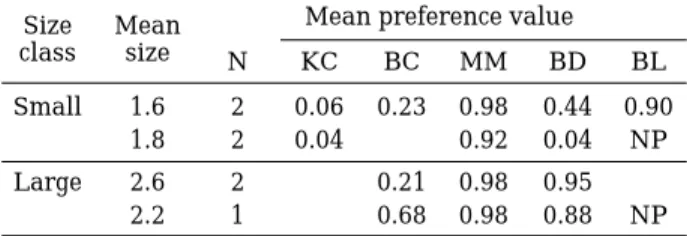
Both small and large juvenile O. uncirostris selected M. micrura at the highest individual preference values. However, they showed differ- ent prey selection patterns on other cladocerans.
Though small sized fish fed on small rotifers, the preference values were very low (Table 2). The small-bodied juvenile fish selected a wide range of prey, from small rotifer, K. cochlearis to large M. micrura (Fig. 1).On the other hand, larger fish consumed only cladocerans and large rotifer, B. calyciflorus. The amount of consumption of cladoceran prey increased in tandem with an increase in body size. The large fish in particular consumed more of M. micrura, B. longirostris and Bosminopsis deitersi than the small fish.
In the experiments, juvenile fish selected large cladoceran, M. micrura, which accounted for less
Table 1. Means of individual preference value (Manly/
Chesson index), based on the selectivity experi- ments in the laboratory for three juvenile fish species. BC, Brachionus calyciflorus; KC, Kera- tella cochlearis; MM, Moina micrura; BL, Bos- mina longirostris; DB, Diaphanosoma brachy- urum; CO, copepodid; N, the number of fish.
Juvenile fish Mean preference value
species N BC KC MM BL DB CO
H. sajori 4 0.60 0.08 0.89 0.27 0.29 0.41 R. brunneus 4 0.59 - 0.88 0.35 - 0.80 O. uncirostris 4 0.55 - 0.89 0.68 - -
Table 2. Means of individual preference values (Manly /Chesson index) for different size class of O.
uncirostris from the selectivity experiments (KC, Keratella cochlearis; BC, Brachionus calyci- florus; MM, Moina micrura; BD, Bosminopsis deitersi; BL, Bosmina longirostris; N, number of fish; NP, does not exist in the plankton prey community in the aquarium).
Size Mean Mean preference value
class size N KC BC MM BD BL
Small 1.6 2 0.06 0.23 0.98 0.44 0.90
1.8 2 0.04 - 0.92 0.04 NP
Large 2.6 2 - 0.21 0.98 0.95 -
2.2 1 - 0.68 0.98 0.88 NP
than 1% of the total prey abundance in the ex- perimental aquarium. In contrast, the fish sel- ected only B. calyciflorus and did not select small rotifer species, such as Polyarthra spp. and K.
cochlearis, though these prey were abundant, i.e.
more than 100 ind. L
-1in the experimental aqua- rium.
2. Experiment at the community level
The basic limnological parameters of the ex- periment are summarized in Table 3. Values in the parameters were similar in all tanks except for Chlorophyll a values which was higher at the
“Low fish density-2” and “High fish density-2”
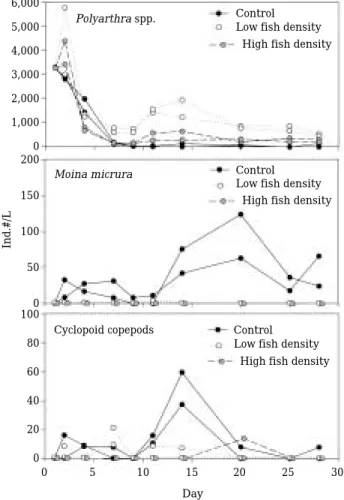
tanks than the control tanks. However, the chl. a became similar among treatments after about 17 days (Table 3). The changes in the zooplankton community were different among treatments. In the control tanks, M. micrura was dominant throughout the experimental period and the den- sity increased after 10 days and reached more than 50 ind. L
-1around day 20. On the other hand, few M. micrura were observed both in the low fish density and the high fish density tanks.
They were not found in the samples after day 15 (Fig. 2). Dominant rotifer species in the tanks, Polyarthra spp. also showed different succession patterns among tanks. Their density was very low in the control tanks, but much higher in the low and high fish density tanks. Their density
Fig. 1. Comparison of the stomach contents of O. uncirostris with different body size (K, K. cochlearis; B, Brachionus spp.;
M, M. micrura; BD, B. deitersi; BO, Bosmina spp.; C, Chydorus sp.)
Fig. 2. Changes of zooplankton in the experimental tanks during the experiment.
K B M BD BO C K B M BD BO C
Zooplankton species
Size⁄2 cm Size¤2 cm
(Average size : 1.65 cm) (Average size : 2.38 cm) 25
20
15
10
5
0
Ind. #/stomach Ind./stomach
25
20
15
10
5
0
0 5 10 15 20 25 30
Day 6,000
5,000 4,000 3,000 2,000 1,000 0
Polyarthra spp.
Moina micrura
Cyclopoid copepods
Control Low fish density
High fish density
Control Low fish density
High fish density
Control Low fish density
High fish density 200
150
100
50
0 100
80
60
40 20
0
Ind.#/L
was highest in the low fish density tanks and often reached more than 1,000 ind. L
-1. Cyclopoid copepods showed higher densities in the control tanks than the low and high fish density tanks.
DISCUSSION
The large cladoceran M. micrura was the pre- ferred prey by three fish species and did not show body size preference among the fishes in the laboratory experiments. The presence of juvenile fish completely consumed M. micrura in the experimental tanks. Previous studies (Chang et al., 2001) found that in the Nakdong River, a decrease in the density of M. micrura coincided with the high abundance of juvenile fish, and the stomach contents of fish also showed that M.
micrura is the preferred prey item for fish. The present results support the suggestion that pre- dation by juvenile fish is a major factor in the rapid decrease in cladoceran density in the river.
Our results also showed that the presence of the juvenile fish greatly impacts cladoceran popula- tions and possibly suppresses their development in the field. However, contrary to our experimen- tal results, the population of M. micrura was not consumed and recovered soon after the short- term decline of their density in the Nakdong River (Chang et al., 2001). It seems that the envi- ronment of the river, i.e. the changes in juvenile fish density related to the occurrence of piscivore fish and the high trophic state of the river, pro- vided more favorable conditions for cladocerans to recover their populations as suggested by Chang et al. (2001).
Although all juvenile fishes positively selected M. micrura, their prey preference values on other prey items were different among species. It is known that fish usually select the largest prey (Brooks and Dodson, 1965; Werner and Hall,
1974). On the other hand, the swimming beha- vior of zooplankton is also known as an impor- tant factor affecting the foraging behavior of fish.
Zooplankton species have different evasion effi- ciencies against fish foraging attempts (i.e. suc- tion attack). Copepods and Diaphanosoma have better evasion capacity than other crustacean zooplankton species (Drenner and McComas, 1980). The negligible selection of Diaphanosoma by fish in the present experiment also shows that this species is less vulnerable to juvenile fish predation. By contrast, Diaphanosoma is very vulnerable to predation by cyclopoid copepods (Chang and Hanazato, 2003). Thus, it seems that Diaphanosoma in the Nakdong River are mainly affected by invertebrate predation rather than by fish predation. Different selection behaviors by the juvenile fish on copepods and B. longirostris suggest that their foraging abilities and prey preferences may differ among species (e.g. R.
brunneus as bottom dweller and predating small invertebrates).
In the outdoor experiment, juvenile fish con- sumed large cladocerans, and the numbers of rotifer Polyarthra increased in the low and high fish density tanks. Similar zooplankton succes- sion patterns induced by fish predation and con- sequent changes in the competitive relationships between cladocerans and rotifers have been well reported (Dodson, 1974; Qin and Culver, 1995;
Attayde and Hansson, 2001). However, our re- sult clearly shows the different densities of ro- tifer between the low and high fish density tanks with higher densities in the low fish density tanks. It is known that the presence of fish in- duces a high density of rotifers due to the exclu- sion of cladocerans, a rotifer competitor and en- hancing the availability of food with increased nutrient excretion by fish (Qin and Culver, 1995;
Vanni et al., 1997; Attayde and Hansson, 2001).
The exclusion of invertebrate predators by fish
Table 3. Mean (±SD) values of basic limnological parameters during the experiments in outdoor tanks.
Tanks Water temperature (�C) DO (mg L-1)
pH (n = 10) Turbidity (NTU) Chl. a (µg L-1)
(n = 10) (n = 10) (n = 10) (n = 6)
Control - 1 27.1±3.4 11.5±0.9 8.6±0.3 3.3±2.8 5.4±3.9
Control - 2 27.3±3.5 11.1±0.9 8.6±0.2 2.9±2.8 5.3±4.8
Low fish density - 1 27.1±3.5 11.3±1.4 8.7±0.3 3.0±3.0 5.4±3.9
Low fish density - 2 27.0±3.5 11.5±1.4 8.7±0.2 3.0±2.9 6.2±3.6
High fish density - 1 26.9±3.5 11.7±1.4 8.7±0.2 2.8±3.0 5.1±3.4
High fish density - 2 26.7±3.3 11.5±1.2 8.7±0.2 3.0±2.9 6.7±2.5
predation also results in an abundance of rotifers in the presence of fish (Hanazato et al., 1990;
Zagarese, 1990). However, the difference in ro- tifer density in our experiment suggests that high predation pressure by fish reduces the rotifer density when there is a high fish density. Alth- ough prey preference values and consumption amounts were low, juvenile O. uncirostris con- sumed small rotifers in the individual level ex- periments. Thus, a high density of fish may su- ppress the rotifer population as well as clado- cerans and copepods.
The ‘top-down’ effects of fish on zooplankton in rivers have been considered less significant than in lakes since the zooplankton communities of many rivers are dominated by rotifers and small -bodied crustacean zooplankton, and their den- sities are often very low (Jack and Thorp, 2002).
However, in regulated rivers such as the Nak- dong River, large-bodied cladoceran and rotifer populations are often large due to the stagnancy of the water body and phytoplankton develop- ment. Our experiments do not replicate realistic field conditions of the river. However, our results have shown that the presence of fish is a signifi- cant factor in controlling the zooplankton com- munity. This suggests that a ‘top-down’ effect, such as interactions between fish and zooplank- ton, is one of the important factors affecting the succession of zooplankton in the river. Especi- ally, S. Korean region has lower rainfall during spring when zooplankton and juvenile fishes may abundant. The increased stagnancy in this period can increase the fish predation effects on the zooplankton communities.
ABSTRACT
In the present study, prey preference of ju- venile fishes was examined using an experimen- tal approach. Zooplankton composition, as a prey of the fish, was evaluated by taking into account the species as well as body size of juveniles in the aquarium. The predation of juvenile fishes is known to be an important factor in changes of zooplankton communities. In some previous studies at the regulated Nakdong River, the collapse of large cladcoerans and an increase in the rotifer population by selective predation during spring and summer were observed. This study focused on the predation of juvenile fishes
such as Hyporhamphus sajori, Rhinogobius bru- nneus, and Opsariichtys uncirostris amurensis on zooplankton community structure in meso- cosm scale experiments. These fishes selected the cladoceran Moina micrura with highest indi- vidual preference value (Manly/Chesson index) among zooplankton prey in the experimental aquarium. When the size-selective prey prefer- ences of the juvenile fish were compared, both small (body size ⁄2 cm) and large (body size ¤2 cm) juveniles of O. uncirostris positively selected M. micrura. In the outdoor experimental tanks, juvenile fishes consumed the cladoceran M. mi- crura, resulting in an high abundance of the rotifer, Polyarthra spp. The results suggest that juvenile fish predation may play an important role in regulating the zooplankton community structure by reducing the cladoceran density and increase of rotifers in the Nakdong River during spring and summer.
ACKNOWLEDGEMENTS
This study was in part supported by the Mini- stry of Environment (Long Term Ecological Rese- arch 2003). It is a series of the Ecosystem Study on the Nakdong River of the Limnology Lab, Pu- san National Univ.(Contribution No. 36).
REFERENCES
Attayde J.L. and L.-A. Hansson. 2001. The relative importance of fish predation and excretion effects on planktonic communities. Limnol. Oceanogr.
46: 1001-1012.
Boersma, M., O.F.R. van Tongeren and W.M. Mooij.
1996. Seasonal patterns in the mortality of Da- phnia species in a shallow lake. Can. J. Fish.
Aquat. Sci. 53: 18-28.
Bøhn, T. and P.-A. Amundsen. 1998. Effects of inva- ding vendace (Coregonus albula L.) on species composition and body size in two zooplankton communities of the Pasvik River System, nor- thern Norway. J. Plankton Res. 20: 243-256.
Brooks, J.L. and S.I. Dodson, 1965. Predation, body size, and the composition of the plankton. Science 150: 28-35.
Chang, K.H. and T. Hanazato. 2003. Vulnerability of cladoceran species to predation by the copepod Mesocyclops leuckarti; laboratory observations on the behavioural interactions between predator and prey. Freshwater Biol. 48: 476-484.
Chang, K.H., S.J. Hwang, M.H. Jang, H.W. Kim, K.S.
Jeong, and G.J. Joo. 2001. Effect of juvenile fish predation on the zooplankton community in the large regulated Nakdong River, South Korea. Kor.
J. Lim. 34: 310-318.
Chesson, J. 1978. Measuring preference in selective predation. Ecology 9: 923-947.
Dodson, S.I. 1974. Zooplankton competition and pre- dation: an experimental test of the size-efficiency hypothesis. Ecology 55: 605-613.
Drenner, R.W. and S.R. McComas. 1980. The role of zooplankter escape ability and fish size selectivity in the selective feeding and impact of planktivor- ous fish. In: Evolution and Ecology of Zooplankton Communities (W.C. Kerfoot, ed.), University Press of New England, Hanover, N.H., pp.587-592.
Gliwicz, Z.M., A.E. Rutkowska and J. Wojciechowska.
2000. Daphnia populations in three interconnect- ed lakes with roach as the principal planktivore.
J. Plankton Res. 22: 1539-1557.
Ha, K., H.W. Kim and G.J. Joo. 1998. The phyto- plankton succession in the lower part of hypertro- phic Nakdong River (Mulgum), South Korea.
Hydrobiologia 369/370: 217-227.
Hanazato, T., T. Iwakuma and H. Hayashi. 1990.
Impact of whitefish on an enclosure ecosystem in a shallow eutrophic lake: selective feeding of fish and predation effects on the zooplankton commu- nities. Hydrobiologia 200/201: 129-140.
Jack, J.D. and J.H. Thorp. 2002. Impacts of fish predation on an Ohio River zooplankton commu- nity. J. Plankton Res. 24: 119-127.
Kerfoot, W.C. and A. Sih. 1987. Predation: direct and indirect impacts on aquatic communities. Univer- sity Press of New England, Hanover and London.
pp.386.
Kim, H.W., K. Ha and G.J. Joo. 1998. Eutrophication of the lower Nakdong River after the construction of an estuary dam in 1987. Internat. Rev. Hydro-
biol. 83: 65-72.
Kim, H.W., S.J. Hwang and G.J. Joo. 2000. Zooplank- ton grazing on bacteria and phytoplankton in the regulated Nakdong River (Korea). J. Plankton Res. 22: 1559-1577.
Lim, B.J., B.C. Kim, K.I. Yoo and J.K. Ryu. 1997.
Changes in zooplankton community during the blue-green algal bloom in the Nakdong River.
Kor. J. Limnol. 30: 337-346.
Lynch, M. 1979. Predation, competition, and zooplank- ton community structure: an experimental study.
Limnol. Oceanogr. 24: 253-272.
Parrish, D.L. and F.J. Margraf. 1991. Selectivity by age 0 white perch (Morone americana) and yellow perch (Perca flavescens) in laboratory experi- ments. Can. J. Fish. Aquat. Sci. 48: 607-610.
Qin, J. and D.A. Culver. 1995. Effect of young-of- the-year walleye (Percidae: Stizostedion vitreum) on plankton dynamics and water quality in ponds.
Hydrobiologia 297: 217-227.
Rettig, J.E. 2003. Zooplankton responses to predation by larval bluegill: an enclosure experiment. Fresh- water Biol. 48: 636-648.
Vanni, M.J., C.D. Layne, and S.E. Arnott. 1997. “Top -down” trophic interactions in lakes: effect of fish on nutrient dynamics. Ecology 78: 1-20.
Werner, E.E. and D.J. Hall. 1974. Optimal foraging and the size selection of prey by the bluegill sun- fish (Lepomis macrochirus). Ecology 55: 1042- 1052.
Wetzel, R.G. and G.E. Likens. 1991. Limnological Analyses, 2nded. Sppringer-Verlag, New York.
Zagarese, H.E. 1990. Effect of selective planktivory by fry of Rhamdia sapo (Pimelodidae: Pisces) on zooplankton community structure. Freshwater Biol. 24: 557-562.
(Manuscript received 8 December 2003, Revision accepted 28 February 2004)