—
ISSN 1229-3350(Print) ISSN 2288-1867(Online)
—
J. fash. bus. Vol. 21, No. 6:66-76, December. 2017 https://doi.org/
10.12940/jfb.2017.21.6.66
Using Virtual Dressing System - Based on Female Bodice Pattern -
Seong Yeon Jeon
†Hye Jung Wee ‧
*Dept. of Clothing and Textiles, Sookmyung Women's University, Korea
*Dept. of Fashion Design, Chungkang College of Cultural Industries, Korea
Corresponding author
—
Seong Yeon Jeon Tel : +82-62-234-5300 Fax : +82-62-234-5320 E-mail: [email protected]
Keywords Abstract
modified, hanbok, jeogori, git, virtual dressing system
This study used a virtual wearing system equipped with body shape data with a 3D scanner, based on a female basic bodice, to develop a modified Hanbok Jeogori with high fitness capabilities to provide basic data for the development of the modified Hanbok Jeogori pattern for the academic and industrial fields.
In this study, the representative modified Hanbok design which most frequently appeared in broadcasting ads and on line was selected. The wearing test was conducted by six professionals, and three times wearing tests were implemented based on 17 evaluation items. The data for this study was processed statistically using SAS 9.0. We conducted , the F-test for significance verification, the Duncan-test for a post test, and a correlation analysis of Cronbach's alpha coefficient for a reliability test of dressing test results were implemented for each of the three tests. The pattern of the developed modified Hanbok Jeogori overcame the defects of the short length of the conventional modified hanbok, and could fix the length issue. The developed Hanbok pattern solved the overlapping problem of the shoulder, back neck point-sleeve length(Whajang), and armhole, displayed in a straight line from the Godae point of the previous modified Hanbok; it suggested the position of the Seop and neck line in the basic bodice. Based on this, the Seop width, Git form, Goreum and the width, length, and position of the string whose dimensions can differ in accordance with the trend can be applied in various forms.
. Introduction
Ⅰ
The recently changed trend in style and silhouette of Hanbok among the young people is leading a new cultural formation of casual Hanbok. Taking a picture in Hanbok at a royal palace that mass-produces the fashion trend through SNS underlies this trend playing a role of reilluminating the beauty of our costume and expanding the culture of wearing Hanbok.
The look to Hanbok is changing. After passing the time of considering it as ‘old costume’, it is now rapidly emerging as the most noteworthy ‘look.’ To be recognized from everyone’s daily wear in the past to a formal wear for a special day, and again to one of the fashion genres, Hanbok continued to change. It is becoming more popular after the event held under the title of ‘Hanbok, Let’s Play’ in Gangnam and Itaewon in Seoul, and the popularization of hanbok is developing towards a street fashion beyond a seasonal trend. The modified Hanbok brands such as LEESLE and TCHAIKIM rising as popular ready-made clothes now are showing the clothes with the active silhouette based on the traditional hanbok and the length of Jeogori is longer, the line and width of Seop is wider, and the Git is round or a mokpan Git with narrow sleeves in form mainly.
This type of Jeogori is called the modified Hanbok and is different in its background of birth from the modernized Hanbok from the 1990’s, the term that refers to the Korean style clothes which simply changed the traditional Hanbok to fit the modern life. The features include additional practicability and functionality in a modern sense while maintaining the traditional beauty of Hanbok. It is called as the modified Hanbok in that it is suitable to the daily life of modern people.
Despite that it is improper to apply the traditional Hanbok Jeogori pattern when making the modified Hanbok pattern and there is a problem in fitness when it is drawn in the Western bodice pattern, Ha and Kim(2017), Kim and Jang(2015a), Kim, Jang(2015b), and Gang and Choi(2009) previously set it to the
improvement or the trend of the traditional Hanbok Jeogori pattern. Thus, the modified Hanbok Jeogori pattern for the trend is required.
Accordingly, this study used a virtual dressing system equipped with the body shape data with a 3D scanner based on a female basic bodice to develop a modified Hanbok Jeogori with the high fitness to provide the basic data for the development of the modified Hanbok Jeogori pattern to the academic and industrial fields.
. Theoretical Background
Ⅱ
The theories related to the status of the modified Hanbok market, the status of the modified Hanbok pattern development, and the virtual dressing system, the 3D simulation program, prior to developing the female Jeogori pattern with the high fitness and examined focusing on the literature and precedent studies are as below:
1. Status of Modified Hanbok Market
Since l997, the modified Hanbok stores are increasing rapidly around Insa-dong in Jongno, traditional markets, and department stores, and products vary remarkably in design, color, quality, and convenience(Ahn, 2000)
The online open market auction in the first half of 2016 in Hanbok shoes and modified and traditional Hanbok rose by 26% and 33% respectively compared to the same period in 2015. The exclusive Hanbok brands are newly showing the brands targeting the young people. (“Hanbok tendency of young people,”
(2016)
Hanbok got out of the outdated clothes of the elderly when the Busan headquarter of Lotte Department Store showed the young street store on the 7th floor as the nation’s first experiential street market following the extension and renewal of the building.
The modified Hanbok store ‘Chima Jeogori’ opened as a ‘unique store’ and is actively selling in online malls such as Auction as well.(“Street Style Market ‘village7’
open”, 2017)
Hanbok Advancement Center said, "The size of the Hanbok market showed no signs of improvement in the beginning of 1 trillion Won but it is expected to grow owing to the recent popularity of the modified Hanbok." Our hanbok which once had a fever of the 'modernized hanbok' but was dejected with the image of the 'clothes for the elderly' overcame the image of the 'outdated clothes' and is emerging as a blue-chip in the depressed fashion industry. It is because of the
‘New Hanbok“ of the generations in their 20s and 30 who broke the stereotypes of a formal wear, uncomfortable clothes, and outdated costume. The popularity of the modified Hanbok also creates the virtuous circulation that mass-produces the female founders. To catch the heart of the women in their 20s and 30s as the modified Hanbok becomes a fashion item, the women between 20s and 30s themselves contributed to design and make the products to open the market. One of the cases is Daraewon Hanbok who used to run a mall called 'Sonjjang' before opening the professional mall ‘LEESLE’ in 2014.
The number of the modified Hanbok stores that grew suddenly in 2014 since its slight appearance in 2009 in the industry is estimated to be over 70 online to sort out only the sizeable ones. As Hanbok becomes the wearable clothes, not ‘compelled to wear’ on a holiday or a wedding day, the size of the Hanbok market which couldn’t get any forwarder from 1.3 Trillion Won for years, is expecting a growth this year.
Hanbok Advancement Center said, "The size of the Hanbok market showed no signs of improvements from early 1 Trillion Won but its growth is anticipated with the recently increased popularity of the modified Hanbok."(“Consumer journal: 2030 Fashionable new Hanbok”, 2016).
2. Status of Modified Hanbok Pattern Development
Our Hanbok overcame the image of the 'outdated clothes' and is emerging as a blue-chip in the depressed fashion industry. It owes to the ‘New Hanbok“ of the
generations in their 20s and 30 who broke the stereotypes of a formal wear, uncomfortable clothes, and outdated costume. What made it become sudden hip? The reason is that it improved the excessive formality, uncomfortableness to wear, and outdated design that have been pointed out as the chronic problems.(“Consumer journal: 2030 Fashionable new Hanbok”, 2016). The recent trend ’modified Hanbok’
developed the female Jeogori pattern that has the high fitness
The development of patterns of Jeogori to enhance the fit with a Focus on Women in their 20s and 30s of Gang, Choi(in their theses in 2009), a study of Jeogori design pattern using the pattern analysis in the books entitled Hanbok construction focusing on the women in 20's of Kim and Jang(2015a), a study of pattern analysis in the books entitled Hanbok construction focusing on the women’s Jeogori of Kim and Jang(2015b). Hanbok pattern research trend analysis focused on korean Journals and theses of Ha and Kim(2017), were produced in accordance with the traditional Hanbok formation, the fitness problems in the shoulder, armhole, and the length of Jeogori haven’t been solved.
3. Virtual Dressing System
The 3D virtual dressing system software based on the apparel CAD system is the program that introduced the computer graphics and 3D technology to the previous functions of the apparel CAD system, simulating the clothes over a 3D human body model to visualize the clothes in 3D and predict the condition when it is worn by the human body.(Lee, 2007) It is the 3D virtual dressing software developed by 3D Runway Designer, Israeli Optitex. It basically expresses the accurate pattern and actual characteristics of fabric by pattern CAD. It can design the costume in 3D with fast and easy use of various colors and texture mapping. It can create a virtual human body model using 3D human body scan data or create a virtual human body model by transforming the partial
dimensions of the body model in the data base.
i-Designer is the 3D CAD system developed by the Japanese Technoa Co., Ltd. which calculates the silhouette of the clothes from each data including the 3D body and characteristics of the raw material, confirms the spare balance on the 3D screen, and reduces the sample production time through a simulation such as the fabric texture. DC Suite is the nation’s first one-step 3D virtual dressing simulation program developed by the Digital Clothing Center of Seoul National University established in 2009. DC Suite proceeds from Body Preparation of a virtual model to Pattern Making of clothes pattern, Garment Simulation, and Simulation after Textile Mapping. CLO 3D Fashion design software is a 3D CAD software made by CLO Virtual Fashion Inc. which designs clothes and produces patterns in a program simulating in 3D avatars. As the designer produces and changes the patterns in real-time to apply them to a 3D window, it is effective for draping and simulation(Yoon, 2013).
. Methods and Procedures
Ⅲ
1. Jeogori Pattern Design
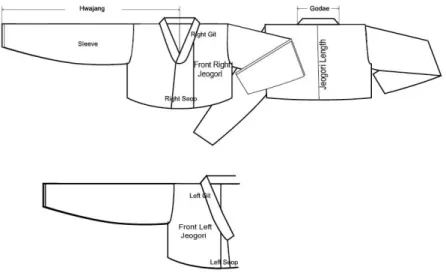
Figure 1. Diagram and Name of Selected Modified Hanbok
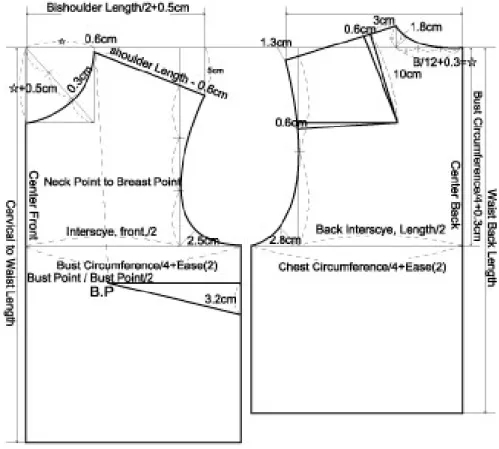
The study model Jeogori selected experimentally in this study is the representative modified Hanbok design with the high level of appearance in broadcasting and online from August, 2016 to April, 2017.(Figure 1) It is designed based on the A brand pattern(Lee, 2012) Figure 2 and showed the 3 types of educational JeogJori pattern(Park, 2003; Baek, 2004; Ahn, 2007) which were modified and supplemented through the virtual dressing test for three times. The dimensions applied to the research model of the virtual dressing test followed the average dimensions of the standard body type extracted from the 2010 body measurement data of Size Korea.
2. Making Modified Hanbok Jeogori Research model
1) The extracted dimensions were applied and the virtual dressing program was used based on the basic bodice and Jeogori patterns to produce the first experimental Jeogori.
2) Making the second test
Center back line, back neck line, front neck line, front width, and Right Seop line which showed low conformity
Figure 2. Drafting of Basic Bodice Pattern (1/5 scale)
in the first dressing test result were changed and supplemented. After designing the patter, the second test Jeogori was made in the same way as the first test using the virtual dressing program.
3) Making the third test
After designing the Jeogori pattern using the changed Jeogori pattern design modified according to the second dressing test result. the third test Jeogori was made and completed using muslin.
3. Dressing Test
For the test subject, the avatars were made in the virtual dressing program based on the average dimensions. For the evaluation of conformity of the research model, 5-point Likert scale from highly unfit(1
point) to unfit(2 points), average(3 points), fit(4 points), and highly fits(5 points) was applied to examine the external appearance of the front, sides, and back of the avatars. The Jeogori test items to evaluate conformity were 17. There were six clothing composition and Hanbok professionals for the examination.
4. Data Process and Analysis Method
The data of this study was statistically processed using SAS 9.0. To verify conformity of the research model, average score and standard deviation of each item for 17 questions of sensory test were obtained for three times, F-test was implemented for significance test, and Duncan-test was applied for post hoc test. For the reliability test of the result, the Cronbach's alpha coefficient which analyzes the level of consensus
between variables was obtained.
. Results and Discussion
Ⅳ
The results of this study after developing the set in sleeve modified Hanbok Jeogori pattern with the high fitness based on the basic bodice and three types of educational Jeogori pattern are as follows:
1. Body Dimensions of 3D Virtual Model
It is difficult to show the accurate average dimensions because it is adjusted not by the size but by the ratio of width and circumference. This study adjusted the circumference and height items of the chest and targeted the women between 19 and 24 from the 3D body measurement data among the 6th body measurement survey of Size Korea and created the model dimensions within the deviation range of the average model dimensions. The measurement items of the 3D virtual model supported in the program is limited to the circumference, height, and length and the dimensions used are Bust Circumference 847.1㎝ Chest Circumference 823.5㎝, Waist Circumference 684.5㎝,, Underbust Circumference 717.9㎝, Waist Circumference (Omphalion)831.7㎝, Armscye Circumference 370.9㎝, Hip Circumference 912.3㎝, Neck Circumference 321.0㎝, Neck Base Circumference 385.2㎝, Shoulder Height1438.8
㎝, Axilla Height 1326.7㎝, Cervical Height 137.5㎝, Waist Height 109.9㎝, Stature 163.2㎝, Waist Height (Omphalion)106.5㎝, Hip Height 935.3㎝, Bishoulder Length 367.9, Shoulder Length 112.8㎝, Back Interscye, Length 309.5㎝, Front Interscye, Length 279.1㎝,Waist Front Length 351.7㎝, Neck Point to Breast Point to Waistline 422.3㎝, Waist Back Length 383.6 .㎝
2. Applied Dimensions of Basic Bodice and Jeogori Pattern
The dimensions applied for pattern making of this study is the actual measurement dimensions based on the 3D body measurement data of the 6th body
dimensions survey of Size Korea and the basic pattern dimensions of CAD.
The dimensions applied to the pattern are Bust Circumference(B) 85 ,Chest Circumference(C) 83 , ㎝ ㎝ Waist Circumference 69.6 , Stature 160.2 , Bishoulder ㎝ ㎝ Length 37.9 , Neck Point to Breast Point to Waistline ㎝ 24.5 , Waist Back Length 38 , Pattern size is B/4+2㎝ ㎝
, C/4+2 , Waist Back Length, Waist Back
㎝ ㎝
Length-actual measurement, Cervical to Waist Length-Waist Back Length is Waist Back Length+3.2 , ㎝ Armhol Height B/4+0.3 , Back Interscye, Length is ㎝ Back Interscye, Length(actual measurement)/2, Front, Interscye, Length is Front, Interscye, Length(actual measurement)/2, Bishoulder Length/2 is fixed dimensions19 , Back Cervical Breadth/2 is Chest ㎝ Circumference/12+0.3 , Back Cervical Height(Back ㎝ Cervical Breadth/2)×1/3, Front Cervical Breadth/2 is Back Cervical Breadth, Front Cervical Height is Back Cervical Breadth+0.5 , Neck Point to Breast Point to ㎝ Waistline is actual measurement dimensions.
The dimensions applied to the modified Hanbok Jeogori pattern followed the aforementioned dimensions applied to the pattern. The front length is calculated based on the side length and front sagging based on the Jeogori back. The back length is calculated based on the total full length from the back neck to the bottom but this study followed 32cm, the general length of the modified Hanbok, and the size of the back may vary depending on the design.
3. Developed Research Pattern Design
The basic lines were designed by applying the partial dimensions of A brand pattern, the basic bodice pattern with the side chest dart was completed, and the Jeogori pattern was designed based on the basic bodice.
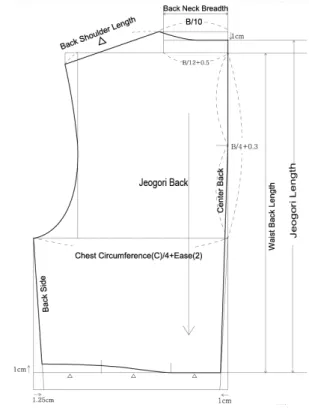
The designing of the back of the Jeogori pattern is as below:
By applying the back basic bodice pattern, extend to the center back line along the side neck point, come down 1cm from the point that meets at the right angle, and extend the back Godae of Jeogori smoothly. Mark
the back length desired and along the center back line of Jeogori, naturally roll the seam at the point that entered 1.5cm along the side line of the Jeogori length.
Draw the Jeogori length horizontally, and draw the Jeogori edge naturally along the point that entered 2cm from the side line(Figure 3).
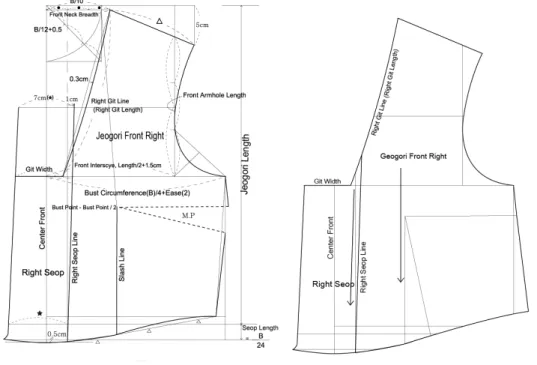
The designing of the front right pattern of Jeogori is as below:
Move the front underarm dart of Jeogori to the waist dart based on the front basic bodice and form the front sagging set in the traditional Hanbok naturally at the edge. Set the point met after extending to the center front line along the side neck line at the right angle and set the front Godae. Using the 1/2 point between the shoulder end point and the armpit point, set the position of Git width and along the center front line set the Right Seop line by entering 1cm inside along the 1/3 point of the Godae point. Connect the side neck line to 1/3 point between the center front
Figure 3. Drafting of Hanbok Jeogori Pattern (Back, 1/5 scale)
line and the Godae width and draw the Git line of the front external clothes. The width of the external Right Seop varies depending on the design and the difference of up and down should be within 0.5cm based on the top, handling naturally in the diagonal direction. Follow the pattern(back) drawing of the side line and edge line design methods.
The designing of the front left of Jeogori is as below:
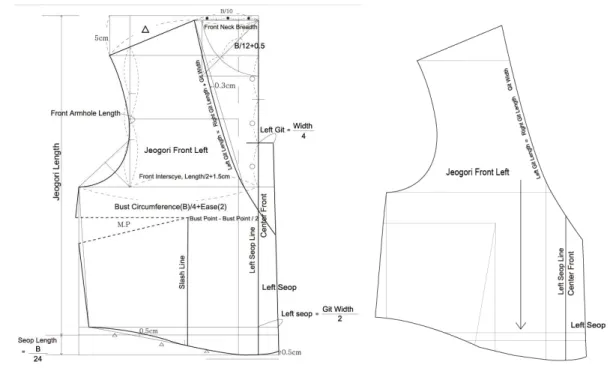
The formation of front sagging and setting of the front Godae as same as the front side drawing of Jeogori. The design of the front right Left Git of Left Seop follows the symmetrical line of the front left side up to the circumference line of the chest. For the length of the internal Git, use the length which added the Git width to the Right Git length and draw it to the tangent line that meets with the Left Seop. The width of the Left Seop should be 1/2 of the Right Seop width, and within 0.5cm of up and down based on the bottom. It should be proceeded naturally in the
Figure 4. Drafting of Hanbok Jeogori Pattern (Front Right, 1/5 scale)
diagonal direction. Follow the pattern(back) drawing of the side line and edge line design methods.
The sleeves are in the form of set in sleeve and have no additional production methods. The width and length of the strings are also applied separately depending on the design. For the selvage direction, the length of front and back follows the length of Jeogori, while the Right Seop follows the Right Seop line and the Left Seop follows the Right direction(Figure 4, 5).
2. Virtual Dressing Test and Analysis Results
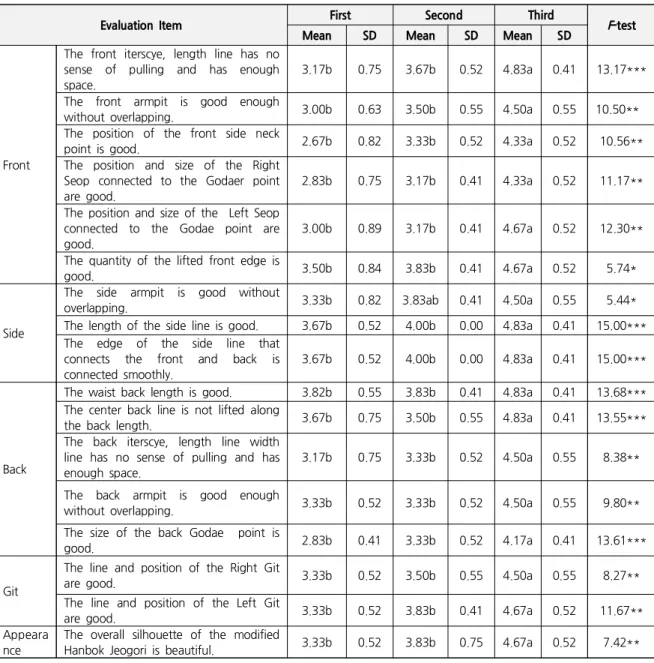
The test results of the virtual dressing of the front, sides, and back of the modified Hanbok Jeogori are as follows: The results of the first, second, and third dressing tests of the modified Hanbok Jeogori developed in the research pattern showed that there was the significant difference at the level of 0.05 and 0.01 in the position of the Godae width, Git line, and Right Seop line based on the front Godae, front width, back
width, shoulder points, and armpit points, after applying the back Godae and front neck line which followed the center back line and back neck line. It was changed and supplemented based on the level of conformity shown in the significant difference.
The results of the first dressing test showed that the total average of the research pattern was 0.05, while those of the second and third dressing tests showed that the total average of the research pattern was 0.01 and 0.001 respectively. The overall external appearance was 3.33 for the first test, 3.83 for the second test, and 4.67 for the third test with improvement in evaluation.
The quantity of the lifted front and side armpit showed the difference at the significance level of 0.05. The front armpit, position of the front side neck point, position and size of the Right Seop, position and size of the Left Seop, back iterscye, back armpit, line and position of the Right Git and line and position of the Left Git showed the difference at the significance level of 0.01.
The front iterscye, length of the side line,
Figure 5. Drafting of Hanbok Jeogori Pattern (Front Left, 1/5 scale)
Figure 6. Virtual Dressing Test of Modified Hanbok Jeogori
(front, 1/5 scale)
Figure 7. Virtual Dressing Test of Modified Hanbok Jeogori
(side, 1/5 scale )
Figure 8. Virtual Dressing Test of Modified Hanbok Jeogori
(back, 1/5 scale)
waist back length, center back line and size of the back Godae showed the difference at the significance level of 0.001. To improve the front collar and back Godae, the Godae point was modified to B/10+1 in the first
test, B/10 in the second test, and B/10-0.5㎝ in the third test from the center line. For the front width, 0.5cm was added to Front Interscye, Length/2+1㎝ for 1cm more space in the Front Interscye, Length, and
Table 3. Jeogori Dressing Evaluation Item
Evaluation Item First Second Third
F-test
Mean SD Mean SD Mean SD
Front
The front iterscye, length line has no sense of pulling and has enough space.
3.17b 0.75 3.67b 0.52 4.83a 0.41 13.17***
The front armpit is good enough
without overlapping. 3.00b 0.63 3.50b 0.55 4.50a 0.55 10.50**
The position of the front side neck
point is good. 2.67b 0.82 3.33b 0.52 4.33a 0.52 10.56**
The position and size of the Right Seop connected to the Godaer point are good.
2.83b 0.75 3.17b 0.41 4.33a 0.52 11.17**
The position and size of the Left Seop connected to the Godae point are good.
3.00b 0.89 3.17b 0.41 4.67a 0.52 12.30**
The quantity of the lifted front edge is
good. 3.50b 0.84 3.83b 0.41 4.67a 0.52 5.74*
Side
The side armpit is good without
overlapping. 3.33b 0.82 3.83ab 0.41 4.50a 0.55 5.44*
The length of the side line is good. 3.67b 0.52 4.00b 0.00 4.83a 0.41 15.00***
The edge of the side line that connects the front and back is connected smoothly.
3.67b 0.52 4.00b 0.00 4.83a 0.41 15.00***
Back
The waist back length is good. 3.82b 0.55 3.83b 0.41 4.83a 0.41 13.68***
The center back line is not lifted along
the back length. 3.67b 0.75 3.50b 0.55 4.83a 0.41 13.55***
The back iterscye, length line width line has no sense of pulling and has enough space.
3.17b 0.75 3.33b 0.52 4.50a 0.55 8.38**
The back armpit is good enough
without overlapping. 3.33b 0.52 3.33b 0.52 4.50a 0.55 9.80**
The size of the back Godae point is
good. 2.83b 0.41 3.33b 0.52 4.17a 0.41 13.61***
Git
The line and position of the Right Git
are good. 3.33b 0.52 3.50b 0.55 4.50a 0.55 8.27**
The line and position of the Left Git
are good. 3.33b 0.52 3.83b 0.41 4.67a 0.52 11.67**
Appeara nce
The overall silhouette of the modified
Hanbok Jeogori is beautiful. 3.33b 0.52 3.83b 0.75 4.67a 0.52 7.42**
*p<.05, **p<.01, ***p<.001
※ Groups with different subscripts are significantly different from each other using Duncan’s test (a>b>c).
0.5cm was added to Back Interscye, Length/2+1㎝ for 1cm more space in the Back Interscye, Length. Thus, total 2cm was extended for the width (Figure 6, 7, 8).
. Conclusion
Ⅴ
This study applied the traditional Hanbok pattern based
on the basic bodice in order to improve the fitness of Hanbok emerging as a trend and developed the modified Hanbok Jeogori with the set in sleeve.
The research model Jeogori used for testing in this study is selected as the representative modified Hanbok design most frequently appeared in broadcasting and online between August, 2016 and April, 2017. The tests
of the modified Hanbok Jeogori as a research model were conducted using the virtual dressing system. For the subjects, avatars were created in the virtual dressing program based on the average dimensions, and conformity of the research model was evaluated using 17 sensory test items. The examiners were composed of six professionals in clothes formation and Hanbok.
After the first, second, and third virtual dressing tests, the front iterscye, length, back iterscye, length , and Godae that showed the difference at the significance level of 0.001 were modified and supplemented finally, and the positive evaluation was deducted by using the excellent sensory test.
The pattern of the developed modified Hanbok Jeogori overcame the defect of the short length of the conventional modified Hanbok and could fix the length.
Based on this, it can calculate the front length caused by the quantity of front sagging. The developed Hanbok pattern solved the overlapping problem of the shoulder, back point-sleeve length(Whajang), and armhole displayed in a straight line from the Git point of the previous modified Hanbok and suggested the position of the Seop and neck line in the basic bodice.
Based on this, the Seop width, Git form, and the width, length, and position of the string of which dimensions can differ in accordance with the trend can be applied in various forms.
This study had several limitations. Firstly, the development of the pattern of the modified Hanbok Jeogori was designed based on the standard body shape. Therefore, there could be some restrictions when applied to a special body shape such as a large body shape. Secondly, the virtual dressing system can have a difference in evaluation from the actual dressing.
This study developed the modified Hanbok Jeogori pattern using a virtual dressing system based on the basic bodice to improve the fitness of the traditional Hanbok. It is expected to be used as the basic data in a variety of fields in the academic and industrial areas when making the modified Hanbok Jeogori pattern.
References
Ahn, B. (2000).
21C Golden market culture industry: Is globalization of Hanbok possible?
Seoul, Korea:Maeil Business Newspaper Ltd.
Ahn, M. (2007).
Our traditional clothes story.
Seoul:Yehac.
Baek, Y. (2004).
Making our traditional clothes (interesting).
Seoul: Gyohac.Consumer journal: 2030 Fashionable new Hanbok.
(2016),
Maeil Business Newspaper.
Retrieved from http://news.mk.co.kr/newsRead.php?no=412248&year=2016
Gang, K., & Choi, J. (2009). The development of patterns of Jeogori to enhance the fit –With a focus on women in their 20's and 30's-.
International Journal of Costume and Fashion, 59
(1), 94-105.Ha, J., & Kim, H. (2017). Hanbok pattern research trend analysis : Focused on korean journals and theses.
Journal of The Society Fashion & Textile Industry, 19
(1), 11-18 .Hanbok tendency of young people. (2016, Oct. 27).
Kyunghyang Shinmun.
p. 12.Kim, H., & Jang, M. (2015a). A study of Jeogori design pattern using the pattern analysis in the books entitled Hanbok construction focusing on the women in 20's.
Journal of Korea Fashion & Costume Design Association, 17
(4), 1-14.Kim, H., & Jang, M. (2015b). A study of pattern analysis in the books entitled “Hanbok Construction”
-Focusing on the women’s Jeogori -.
Journal of Korean Traditional Costume, 18
(2), 95-109.Lee, H. (2012).
Rules of pattern.
Pajul: Gyomoonsa.Street Style Market ‘village7’ open. (2017, Octor 12).
Kookje daily news.
p. 21.Yoon, J. (2012).
Quilting Effect and Exterior Change according to Fabrics Properties and Usage of 3D Digital Clothing System
(Unpublished master's theses).Ewha Womans University Seoul, Korea.
Received (November 6, 2017) Revised (December 2, 2017) Accepted (December 18, 2017)