Proteinase 활성수용체-2로 유발된 백서족척 부종에 미치는 위릉채의 항염효과
임종필*․이홍규․전 훈․임보라1
우석대학교 약학대학, 1 : 펜실베니아 의과대학
Anti-inflammatory Effect of Potentillae Chinensis Herba Water Extract on the Proteinase-activated Receptor2-mediated Paw Edema
Jong Pil Lim*, Hong Kyu Lee, Hoon Jeon, Bora Lim1
College of Pharmacy, Woosuk University, 1 : Department of Experimental Therapeutics, School of Medicine, University of Pennsylvania
Potentilla chinensis Ser. (Rosaceae) has long been used for a remedy of diarrhea and inflammation in Korea. In this study, the anti-inflammatory effects of the Potentillae chinensis Herba water extract (PCX) was investigated in proteinase-activated receptor-2 (PAR2)-mediated rat paw edema. Paw edema was induced by injection of trypsin or trans-cinnamoyl-LIGRLO-NH2 (tc-NH2) into the hind paw of rats. PCX (10, 50, 100 and 200 mg/kg) was orally administered 1 h before the induction of inflammation. At doses of 50, 100 and 200 mg/kg, PCX showed significant inhibition on both change in paw volume and vascular permeability. PCX (100 mg/kg) significantly inhibited PAR2 agonists-induced myeloperoxidase (MPO) activity in paw tissue. These results indicate that PCX has an anti-inflammatory action in PAR2-mediated paw edema.
Key words : potentilla chinensis, anti-inflammatory, trypsin, tc-NH2, paw edema
* 교신저자 : 임종필, 전북 완주군 삼례읍 후정리 490, 우석대학교 약학대학
․E-mail : [email protected], ․Tel : 063-290-1571
․접수 : 2009/11/02 ․수정 : 2009/12/01 ․채택 : 2009/12/12
서 론
최근 어떤 蛋白分解酵素들은 炎症細胞에 나타나는 프로테이 나제 活性受容體 (proteinase-activated receptor : PAR)에서 N-말 단의 특이적 인식부위를 절단하여 활성형으로 변화시킨다고 보 고되었으며, 현재까지 PAR1, PAR2, PAR3 및 PAR4 등 4가지가 cloning되었다1-6). 이 중에서 proteinase 활성수용체인 PAR1, PAR3 및 PAR4가 thrombin에 의하여 활성화될 수 있다는 보고 가 있었다7). 그리고 PAR2 및 PAR4는 trypsin에 의하여 활성화 될 수 있으며 mast cell tryptase 도 PAR2를 활성화시킨다고 하 였다8,9). 또한 trypsin, mast cell tryptase 또는 합성 peptide인 SLGRL-NH2는 PAR2를 활성화시켜서 광범위한 염증을 일으킨다 고 하였다10). PAR2가 염증과정에 중요한 역할을 하는데 氣道 上 皮細胞, 纖維芽細胞, 單核細胞, 血管平滑筋 및 內皮細胞 등 대부 분의 염증세포들에서 나타나며, 이는 血管 透過性의 증가,
neutrophil의 침투 및 proinflammatory cytokines의 분비에 의한 것이라고 하였다11,12). 또한 neutrophil의 축적은 다양한 염증질환 의 특징이며 neutrophil은 myeloperoxidase (MPO)라는 효소를 과립에 가지고 있다12). 그러므로 이 경우 PAR2 활성의 억제는 PAR2에 의한 염증치료에 중요한 의미가 있는 것이다.
萎陵菜 (Potentilla chinensis Ser)는 장미과 (Rosaceae)에 속한 다년생 초본인 딱지꽃으로 이 식물의 뿌리는 圓柱形 또는 類圓 錐形으로 조금 비틀려 구부러져 分枝되었고 길이 5∼17 cm, 지 름 0.5∼1 cm로 우리나라 각지에 자생하고 있으며, 이의 전초를 봄에 줄기가 아직 나오지 않을 때 채취 晒乾하여 사용한다. 전초 에 vitamin C, 단백질, 지방, 무기성분, P2O5, CaO 가 함유되어 있고, 뿌리에는 tannin이 많다. 性은 寒 無毒하고 味는 甘하여 肝 및 大腸經에 들어가 淸熱解毒, 凉血止痢의 效能으로 治赤痢腹 痛, 久痢不止, 痔瘡出血, 癰腫瘡毒한다. 일반적으로 白頭翁, 馬齒 莧 등을 配合하여 痢疾腹痛을 治療하고, 槐花, 地楡 등을 배합하 여 濕熱로 因한 痔出血을 치료하며, 金銀花, 蒲公英 등을 배합하 여 癰腫을 치료하는데 사용하고 있다13).
그 동안의 萎陵菜에 관한 보고는 많지 않으나, Wang 등14)이
萎陵菜로부터 3-hydroxy-11-ursen-28, 13-olide, 11, 12-dehydroursolic acid lactone, 3-O-acetyl pomolic acid, betulinic acid, 3-oxo-12-ursen-28-oic acid, ursolic acid, oleanic acid 등의 화합물을 분리했으며, Armstrong 등15)은 萎陵菜가 濕 疹에 유효하다고 보고한 바 있다.
본 연구에서는 본초서에 기재된 '治癰腫瘡毒'의 효능을 알아 보기 위하여 trypsin이나 trans-cinnamoyl-LIGRLO-NH2 (tc-NH2) 에 의하여 生成된 흰쥐의 발 浮腫에 대하여, 萎陵菜 물엑스 (PCX)의 투여로 인한 浮腫, 血管透過性, 및 MPO 활성도의 억제 효과를 측정하여, 抗炎症效果를 확인하였기에 보고하는 바이다.
재료 및 방법
1. 시약 및 동물
Trypsin은 Sigma (St. Louis, MO), trans-cinnamoyl-LIGRLO-NH2(tc-NH2) (M.W. 812.59)는 Santa Cruz Biotech. Inc.(CA. USA)에서 구입하여 사용하였으며 기타 시약은 특급이상을 사용하였다.
동물은 Sprague-Dawley 숫컷 흰쥐를 대한바이오링크 (충북 음성)에서 구입하여 체중 200±20 g인 것을 실험실 환경에서 충 분한 사료와 물을 공급하면서 적응시킨 뒤 실험하였으며, 대조군 (saline) 및 활성을 확인하기 위한 검액투여군 (PCX로 각기 10, 50, 100 및 200 mg/kg)으로 나누어 각 군마다 6마리씩 실험에 이 용하였다.
2. 검액의 조제
본 실험에 사용한 약재는 전주 보화당 약업사에서 구입하여 정선한 것을 사용하였으며, 500 g을 세절하여 물로 3시간씩 3회 가열 추출한 여액을 감압 농축한 후 냉동 건조하여, 萎陵菜 물엑 스 (PCX) 92.8 g (收得率 18.6%)을 얻어 본 실험에 필요한 농도로 희석하여 사용하였다.
3. 부종 억제율 측정
쥐에게 물은 자유롭게 마시도록 하고 18시간 절식시킨 후 ketamine HCl (30 mg/kg)과 xylazine (6 mg/kg)을 근육주사 하 였다. PCX (10, 50, 100 and 200 mg/kg) 및 생리식염수를 경구투 여하고 1시간 후 trypsin (500 pmol) 또는 tc-NH2 (500 ㎍)을 쥐 의 뒷다리 발바닥에 주사하였다. Trypsin 및 tc-NH2는 생리식염 수에 녹여 100 ㎕씩으로 만들어 주사하였다. 부종의 크기는 쥐의 발바닥 주사직전과 1시간 후에 plethysmometer (Ugo Basile, Italy)를 이용하여 측정하였으며 전후 차이로 계산하였다. 이때 A는 trypsin 및 tc-NH2 투여 직전의 수치이며 B는 trypsin 및 tc-NH2 투여 1시간 후의 수치이다.
Inhibition (%) = (A-B)/A × 100
4. 혈관투과성 억제율 측정
Trypsin 및 tc-NH2주사에 의한 혈관투과성은 Katayama 등
16)의 방법에 따라 측정하였다. PCX (10, 50, 100 and 200 mg/kg) 및 생리식염수를 경구투여하고 trypsin 이나 tc-NH2을 상기와 같 이 100 ㎕씩 쥐 발바닥에 주사한 직후 2.5 mg/kg의 Evans blue 를 생리식염수에 녹여 정맥주사 1시간 후 쥐를 죽인 다음 발바닥 을 제거하여 무게를 측정하고 잘게 썰어 마개 있는 시험관에 넣 어 1 N KOH용액 1 ml를 붓고 37℃에서 하루 밤을 침출시킨 후 0.6 N H3PO4 와 acetone (5:13) 혼액 9 ml를 가하고 수초동안 시 험관을 세게 흔들어 3,000 rpm 에서 15분 동안 원심분리하여 上 澄液을 spectrophotometer로 620 nm에서 흡광도를 측정하여 Evans blue표준곡선에 의하여 농도를 구하여 ㎍/g으로 표시하 였다. 血管透過性 抑制率은 다음 식으로 계산하였다. 이때 A는 trypsin 및 tc-NH2 투여 직전의 수치이며 B는 trypsin 및 tc-NH2
투여 1시간 후의 수치이다.
Inhibition (%) = (A-B)/A × 100
5. MPO 활성도 억제율 측정
생리식염수나 PCX를 경구투여한 1시간 후 trypsin이나 tc-NH2를 쥐 발바닥에 상기와 같이 주사하고, 6시간 후 쥐 발바 닥 무게를 측정한 뒤 MPO 활성도는 Bradley 등17)의 방법에 따 라 시행하였다. 조직을 잘게 썰어서 0.5% hexadecyltrimethyl- ammonium bromide (HTAB) (Sigma, St. Louis, MO, USA)를 포 함하는 KH2PO4/K2HPO4 buffer (pH 6.0)중에 0℃에서 45초 동안 전동 homogenizer로 혼화한 후 4℃에서 3,000 rpm으로 20분간 원심분리한다. Myeloperoxidase 활성도를 측정하기 위하여 96-well microtiter plate에 상징액 50 ㎕, 50 ㎕의 phosphate buffer 함유 0.5% HTAB (pH 6.0), 50 ㎕의 o-dianisidine (Sigma) (0.68 mg/ml in distilled water)을 첨가하고 반응을 촉진하기 위하여 새로 조제한 0.003 % hydrogen peroxide를 가하였다. 그 리고 450 nm에서 흡광도차를 이용하여 계산하였다. MPO 활성 도 억제율은 다음 식으로 계산하였다. 이때 A는 trypsin 및 tc-NH2 투여 직전의 수치이며 B는 trypsin 및 tc-NH2 투여 1시간 후의 수치이다.
Inhibition(%) = (A-B)/ A ×100
5. 통계처리
실험 성적의 통계처리는 student's t-test로 하였으며 유의수 준은 0.01이하로 하였다
결 과
1. 부종 억제율
PAR2 작용약물인 trypsin이나 tc-NH2로 유발된 쥐의 뒷발 바닥 부종은 PAR2 작용약물을 주사한 경우 생리식염수 단독 처 리시보다 유의성 있게 증가하였다(Table 1). Trypsin으로 유발된 부종에서 PCX 50 mg/kg 투여 시 36.7%, 100 mg/kg에서 67.3%, 200 mg/kg에서 61.2%의 유의성 있는 억제율을 보였다. tc-NH2
로 유발된 부종에서는 PCX 50 mg/kg 투여군에서 33.3%, 100 mg/kg에서 57.1%, 200 mg/kg에서 54.8%의 억제율을 나타냈다.
Trypsin이나 tc-NH2으로 유발된 부종에서 PCX 100 mg/kg과 200 mg/kg 투여군에서 거의 비슷한 억제율을 나타냈으나 10 mg/kg에서는 유의성이 보이지 않았다.
Table 1. Effects of PCX on trypsin or tc-NH2-induced paw edema in rats.
Agonist Treatment Dose
(mg/kg p.o.) Change of paw % inhibition
Trypsin (500 pmol)
Saline - 0.49±0.02 -
PCX
10 0.46±0.09 8.7
50 0.31±0.02* 36.7*
100 0.16±0.05* 67.3*
200 0.19±0.11* 61.2*
tc-NH2 (500 ㎍)
Saline - 0.42±0.10 -
PCX
10 0.39±0.12 7.1
50 0.28±0.08 33.3*
100 0.18±0.01* 57.1*
200 0.19±0.02* 54.8*
Data show the mean±SE from 6 rats. The PCX was orally administered 1 hr before the subplantar injection of trypsin (500 pmol) or tc-NH2 (500 ㎍).
*p<0.01 compared to the saline group.
2. 혈관투과성 억제율
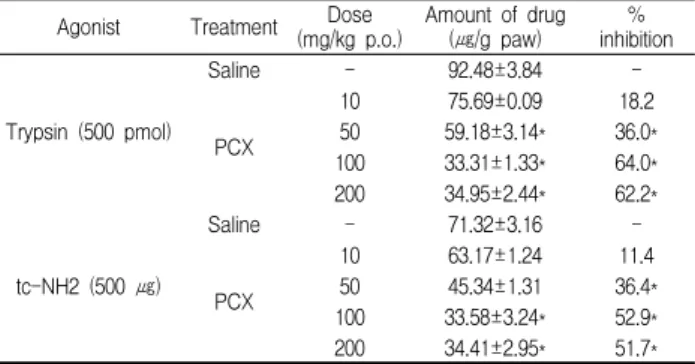
500 pmol trypsin이나 500 ㎍ tc-NH2주사 1시간 후 뚜렷이 Evans blue의 투과성이 높아졌다. 그러나 PCX 투여군 (50, 100 and 200 mg/kg)은 유의성 있게 발바닥 조직의 Evans blue 투과 성을 억제하였다(Table 2). PCX 100 mg/kg에서 혈관투과율은 trypsin의 경우 64.0%, tc-NH2의 경우 52.9%의 억제율을 보였다.
100 mg/kg과 200 mg/kg에서 trypsin 및 tc-NH2의 경우 혈관투 과 억제율은 비슷했다.
Table 2. Effects of PCX on trypsin or tc-NH2-induced vascular permeability in the paw of rats.
Agonist Treatment Dose
(mg/kg p.o.)
Amount of drug (㎍/g paw)
% inhibition
Trypsin (500 pmol)
Saline - 92.48±3.84 -
PCX
10 75.69±0.09 18.2
50 59.18±3.14* 36.0*
100 33.31±1.33* 64.0*
200 34.95±2.44* 62.2*
tc-NH2 (500 ㎍)
Saline - 71.32±3.16 -
PCX
10 63.17±1.24 11.4
50 45.34±1.31 36.4*
100 33.58±3.24* 52.9*
200 34.41±2.95* 51.7*
Data show the mean±SE from 6 rats. The PCX was orally administered 1 hr before the subplantar injection of trypsin (500 pmol) or tc-NH2 (500 ㎍).
*p<0.01 compared to the saline group.
Table 3. Effects of PCX on trypsin or tc-NH2-induced MPO activity in the paw of rats.
Agonist Treatment Dose (mg/kg p.o.) % inhibition
Trypsin (500 pmol) Saline - -
PCX 100 60.6*
tc-NH2 (500 ㎍) Saline - -
PCX 100 59.6*
Data show the mean±SE from 6 rats. The PCX was orally administered 1 hr before the subplantar injection of trypsin (500 pmol) or tc-NH2 (500 ㎍).
*p<0.01 compared to the saline group.
3. Myeloperoxidase 활성도 억제율
PCX투여군 (100 mg/kg)은 유의성 있는 MPO활성 억제효과 를 나타냈는데, trypsin의 경우에는 MPO activity가 2.59±0.61일 때 그 억제율은 60.6%, tc-NH2의 경우에는 MPO activity가 2.39±0.41일 때 59.6%의 억제효과를 보였다(Fig. 1, Table 3).
Fig. 1. Effects of PCX on PAR-2 agonist-induced MPO activity in the paw of rats. The PCX was orally administered 1 hr before the subplantar injection of trypsin (500 pmol) or tc-NH2 (500 ㎍). Saline was used as control. Data show the mean±SE from 6 rats. *p<0.01 compared to the saline group.
고 찰
본 연구에서 trpysin이나 tc-NH2로 유발된 쥐발바닥 浮腫, 血管透過性, myeloperoxidase 활성도에서 PCX 50, 100 및 200 mg/kg 투여시 유의성있는 감소율을 보였다. PCX 1,000 mg/kg 이상의 고용량에서는 trypsin 이나 tc-NH2로 유발된 부종에서는 100 mg/kg의 경우보다 오히려 더 낮은 효과를 보여 (data 게재 하지 않음) 고농도의 PCX는 큰 도움이 되지 않는 것으로 보인다.
Trypsin 이나 tc-NH2와 같은 PAR2 誘發劑의 주사는 쥐 발 바닥에서 血管透過性이 증가하여 부종으로 나타난다고 한다18,19). 따라서 이러한 염증반응 모델은 抗炎症反應을 평가하는데 적당하다고 생각된다. PAR2는 neutrophil과 eosinophil에서 뿐 아니라 mast cell에서도 나타난다고 한다20-22). Kawabata 등18)은 조직침투 (Evans blue extravasation)에서 신속 (15 min)한 mast cell 의존도의 증가는 PAR2 은 조직침ating peptide인 SLIGRL-NH2의 投與에 기인한 것이라고 하였다. 반대로 Vergnolle등19)은 tc-NH2에 의한 염증반응은 주로 mast cell degranulation에 독립적이라고 말하였다. 이러한 반응들은 PAR2 가 endothelial cell 뿐 아니라 neutrophil 과 eosinophil과 같은 mast cell 이외의 조직 함유물에서 나타나는데 이는 쥐의 발에서 trypsin이나 tc-NH2에 대한 하나의 중요한 표적이 되며 이것이 조직의 투과성과 부종 증가의 원인이 된다고 하였다22). 또한 tc-NH2로 유발된 발바닥 부종은 prostaglandin나 nitric oxide와 는 관계가 없다고 하였다23-25).
대부분의 淸熱解毒藥이 性이 寒하며 이들이 抗菌과 抗炎作 用을 함께 가지고 있는 경우가 많으므로, 萎陵菜의 抗炎作用도 豫見된 것이지만 proteinase 活性受容體-2로 誘發된 炎症反應 모 델을 이용하여 萎陵菜의 抗炎症效果를 약리학적으로 확인할 수 있었으며, 그 효과도 비교적 좋았으므로 기존 한의서에서 金銀
花, 蒲公英 등을 배합하여 癰腫을 치료하는데 사용했음이 의의가 있다고 할 수 있다.
결 론
Proteinase 活性受容體-2로 誘發된 흰쥐 뒷발바닥 浮腫모델 에서, trypsin이나 tc-NH2로 誘發된 발바닥 浮腫, 血管透過性, myeloperoxidase 活性度가, 萎陵菜 물엑스를 50, 100 및 200 mg/kg 경구투여한 경우 유의성있는 억제율을 보였으며, 100 mg/kg 경구투여한 경우가 가장 抗炎症效果가 뚜렷함을 나타 냈다.
감사의 글
이 논문은 2009년 교육과학기술부의 지원 (지역거점연구단 육성사업/헬스케어기술개발사업단)과 2009학년도 우석대학교 교내학술연구비 지원에 의하여 연구되었음.
참고문헌
1. Macfarlane, S.R., Seatter, M.J., Kanke, T., Hunter, G.D., Plevin, R. Preteinase-activated receptors. Pharmacol Rev 53:
245-249, 2001.
2. Vu, T.K., Hung, D.T., Wheaton, V.I., Coughlin, S.R.
Molecular cloning of a functional thrombin receptor reveals a novel proteolytic mechanism of receptor activation. Cell 64: 1057-1062, 1991.
3. Nystedt, S., Emilsson, K., Wahlestedt, C., Sundelin, J.
Molecular cloning of a potential proteinase activated receptor. Proc Natl Acad Sci USA 91: 9208-9213, 1994.
4. Bohn, S.K., Kong, W., Bromme, D., Smeekens, S.P., Anderson, D.C., Connolly, A., Kahn, M., Nelken, N.A., Coughlin, S.R., Payan, D.G., Bunnett, N.W. Molecular cloning expression and potential functions of the human proteinase-activated receptor-2. Biochem J 314: 1009-1013, 1996.
5. Hollenberg, M.D., Saifeddine, M., Al-Ani, B.
Proteinase-activated receptor-activating peptides. Mol Pharmcol 49: 229-232, 1996.
6. Ishihara, H., Connolly, A.J., Zeng, D., Kahn, M.L., Zheng, Y.W., Timmons, C., Tram, T., Coughlin, S.R.
Protease-activated receptor-3 is a second thrombin receptor in humans. Nature 386: 502-506, 1997.
7. Kahn, M.L., Zheng, Y.W., Huang, W., Bigornia, V., Zeng, D., Moff, S., Farese, R.V.Jr., Tam, C., Coughlin, S.R. A dual thromgin receptor system for platelet activation. Nature 394(6694):690-694, 1998.
8. Coughlin, S.R. How the protease thromgin talks to cells.
Proc Natl Acad Sci USA 96(20):11023-11027, 1999.
9. Corvera, C.U., Dery, O., McConalogue, K., Bohm, S.K., Khitin, L.M., Caughey, G.H., Payan, D.G., Bunnett, N.W.
Mast cell tryptase regulates rat colonic myocytes through proteinase-activated receptor 2. J Clin Invest 100(6):1383- 1393, 1997.
10. Kong, W., Mcconalogue, K., Khitin, L.M., Hollenberg, M.D., Payan, D.G., Bohm, S.K., Bunnett, N.W. Luminal trypsin may regulate enterocytes through proteinase-activated receptor-2. Proc. Natl Acad Sci USA 94: 8884-8889, 1997.
11. Molino, M., Barnathan, E.S., Numerof, R., Clark, J., Dreyer, M., Cumashi, A,, Hoxie, J.A., Schechter, N., Woolkalis, M., Brass, L.F. Interactions of mast cell tryptase with thrombin receptors and PAR-2. J Biol Chem 272: 4043-4039, 1997.
12. Steinhoff, M., Vergnolle, N., Toung, S.H., Tognetto, M., Amadesi, S., Ennes, H.S., Trevisani M., Hollenberg, M.D., Wallace, J.L., Caughey, G.H., Mitchell, S.E., Williams, L.M., Geppetti, P., Mayer, E.A., Bunnett, N.W. Agonists of protease-activated receptor 2 induce inflammation by a neurogenic mechanism. Nat Med 6: 151-158, 2000.
13. Kim, C.M., Shin, M.K., Ahn, D.K., Lee, K.S. Great Chinese Medicine Dictionary, Jungdam Co. p 4294, 1998.
14. Wang, Q.H., Li, Z.Y., Shen, Y., Lin, H.W., Shu, W.Z.
Studies on triterpenoids from Potentilla chinensis, J B Zhongguo Zhong Yao Za Zhi 31(17):1434-1436, 2006.
15. Armstrong, N.C., Ernst, E. The treatment of eczema with Chinese herbs: a systematic review of randomized clinical trials. Br J Clin Pharmacol 48(2):262-264, 1999.
16. Katayama, S., Shionoya, H., Ohtake, S. A new method for extraction of extravasated dye in the skin and the influence of fasting stress on passif cutaneous anaphylaxis in guinea pigs and rats. Microbiol Immunol 22(2):89-101, 1978.
17. Bradley, P.P., Priebat, D.A., Christensen, R.D., Rothstein, G.
Measurement of cutaneous inflammation: Estimation of neutrophil content with an enzyme marker. J Invest Dermatol 78(3):206-209, 1982.
18. Kawabata, A., Kureda, R., Imnami, T., Kataka, K., Taneda, M. Increased vascular permeability by a specific agonist of protease-activated receptor-2 in rat hidpaw. Br J Pharmacol 125: 419-422, 1998.
19. Vergnolle, N., Hollenberg, M.D., Sharkey, K.A., Wallace, J.L. Characterization of the inflammatory response to proteinase-activated receptor-2 (PAR-2) -activating peptides in the rat paw. Br J Pharmacol 127: 1083-1090, 1999.
20. Nystedt, S., Ramakrishnan, B., Sundelin, J. The proteinase-activated receptor 2 is induced by inflammatory mediators in human endothelial cells. J Bil Chem 271:
14910-14915, 1996.
21. Howells, G.L., Macey, M., Chinni, C., Hou, L., Fox, M.T., Harriott, P., Stone, S. Proteinase-activated redeptor-2:
expression by human neutrophils. J. Cell Sci 110: 881-887, 1997.
22. Miike, S., McWiliam, A.S., Kita, H. Trypsin induces activation and inflammatory mediator release from human eosinophils through protease-activated receptor-2. J Immunol 167(11):6615-6622, 2001.
23. Vergnolle, N., Macnaughton, W.K., Al-Ani, B., Saifeddine, M., Wallace, J.L., Hollenberg, M.D. Proteinase-activated
receptor-2-activating peptides: identification of a receptor that regulates intestinal transport. Proc Natl Acad Sci USA 95: 7766-7771, 1998.
24. Lohman, R.J., Jones, N.C., O'Brien, T.J., Cocks, T.M. A regulatory role for protease-activated receptor-2 in motivational learning in rats. Neurobiol Learn Mem 92(3):301-309, 2009.
25. Morla, L., Crambert, G., Mordasini, D., Favre, G., Doucet, A., Imbert-Teboul, M. Proteinase-activated receptor 2 stimulates Na,K-ATPase and sodium reabsorption in native kidney epithelium. J Biol Chem 283(42):28020-28024, 2008.