Effect of Silkworm (Bombyx mori) Excrement Powder on the Alcoholic Hepatotoxicity in Rats
Yong-Soon Kim1, Kee-Young Kim1, Pil-Don Kang1, Jae-Young Cha2, Jin-Sun Heo, Bo-Kyung Park and Young-Su Cho*
Department of Biotechnology, Dong-A University
1Department of Agricultural Biology, National Institute of Agricultural Science And Technology, RDA and
2Technical Research Institute, Daesun Distilling Co., Ltd.
Received September 4, 2008 /Accepted October 16, 2008
The purpose of present study was to investigate the protective effect of silkworm excrement powder (SEP) on alcohol-induced hepatotoxicity in rats. Semisynthetic diet supplemented with SEP (3%, w/w) given to alcohol-feeding rats for 30 days, then blood and tissues were collected, processed and used for alcohol concentration mensuration, various biochemical estimations and histopathological examination. Chronic alcohol administration resulted in significantly increase in the activities of the clinically important liver marker enzymes, alanine aminotransferase (ALT), aspartate aminotransferase (AST), γ-glutamyl transpeptidase (γ-GTP) and lactate dehydrogenase (LDH). Also, a highly significant increase in the blood alcohol level by alcohol treatment was observed. But alcohol-induced elevation of ALT and LDH levels markedly prevented and the level of blood alcohol decreased in SEP treated rats as compared to alcohol-administered control rats. SEP supplementation showed highly decreased the concentrations of total lipid, triglyceride and cholesterol in serum, as compared with alcohol treat- ed control rats. Alcohol treatment induced the marked accumulation of large lipid droplets, hep- atocytes necrosis and inflammation in the liver, but SEP administration attenuated to alcohol-induced accumulation of lipid droplets and hepatocyte necrosis. The results indicated that SEP may exert a protective effect against alcoholic hepatotoxicity through decreasing the activity of hepatic marker enzymes.
Key words : Silkworm excrement powder (SEP), alcohol, hepatotoxicity, rat
*Corresponding author
*Tel:+82-51-200-7586, Fax:+82-51-200-7505
*E-mail : [email protected]
Introduction
The liver is considered to be the main organ capable of oxidizing alcohol. Hepatocytes are the only cells in the body that can produce sufficient amounts of the enzyme alcohol dehydrogenase to oxidize alcohol at an appreciable rate [18]. The chronic consumption of alcoholic beverage is the major cause of liver injury and the development of se- rious liver disease. Worldwide, one of the most prevalent forms of chronic disease is alcoholic fatty liver, which may progress to more severe forms of liver injury including steatosis, fibrosis, and cirrhosis. The earliest manifestation of alcoholic abuse is fatty liver, which is characterized by the lipids accumulation within the hepatocytes [17].
Normal liver contains approximately 5 g of lipids per 100 g of wet weight and fatty liver is the term used when lip- ids, predominantly triglycerides, in liver are more than 5%
of liver weight [1,3].
Ameliorating effects against chronic alcohol con- sumption have long been a focus for many researchers and clinicians. There have been numerous attempts to develop clinically useful compounds to ameliorate or treat alco- hol-related pathology, however, these chemically derived compounds can have harmful and unforeseen side effects [4,26,29]. Therefore, various studies have increasingly fo- cused on the development of therapeutic agents for alco- hol-induced disease based on natural products.
Silkworm is a good sources of protein, fibroin, amino acids, peptides, 1-deoxynojirimycin, and pigments have been found to protect hyperlipidemia and hyperglycemia [13,14, 30]. Silk protein fibroin has been widely explored for many biomedical applications including cell support matrixes for hepatocytes, fibroblasts and scaffolds[7,10,12]. Silkworm pu- pae protein is a good source of high quality protein and its hydrolyzates is a new potential source of angiotensin-1 con- verting enzyme (ACE) inhibiting drugs [28].
It is well known that the nondigestible dietary fiber and
chlorophyll pigments in a unicellular green algae Chlorella are important components and these have many physio- logic functions including potential hypocholesterolemic and hepatoprotective effects [25,27]. Silkworm excrement also contained the fiber and chlorophyll pigments [9,14]. We have hypothesized that the main efficacious ingredients of silkworm excrement, specifically the fiber and chlorophyll pigment compounds may exert hepatoprotectic and hypo- lipidemic effects when tested in experimental alcohol-in- duced liver damage in rats. Thus, this study seeks to inves- tigate the possible protective effects of orally administrated SEP on acute alcohol-induced hepatotoxicity in rats.
Materials and Methods Silkworm excrement powder
Fresh silkworm excrement powder was obtained from the Department of Agricultural Biology, National Institute of Agricultural Science and Technology, RDA, Suwon, Republic of Korea.
Animal and experimental design
Sprague-Dawley strain rats were obtained from the Hyochang Science Animals Co. (Daegu, Korea). Animal was housed individually in the suspended wire-mesh stainless steel cage under room temperature between 21 to 24oC and lighting between 08:00 and 20:00. Animals were allowed to freely to semipurified basal diet for 1 week be- fore the experiment. Animals were then randomly divided into three experimental groups based on dietary categories:
the normal rats fed with water, the alcohol feeding control rats fed with alcoholic beverage containing ethanol 30%
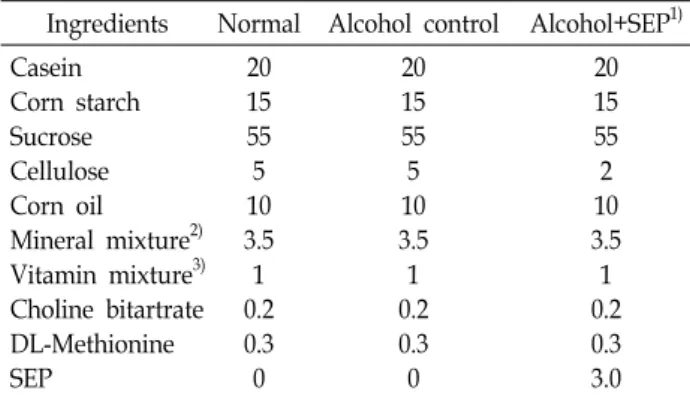
(v/v), the SEP supplemented rats fed with alcohol and SEP (3%, w/w). The equal amount of SEP supplementation was replaced with cellulose into the alcohol feeding control rats (Table 1). Overall, each group consisted of six rats that were fed appropriate diet for a 4-week period. The food consumption and water intake were measured with every day and body weight gain was measured with once a week.
Analytical procedure
The rats were sacrificed by withdrawing blood from the abdominal aorta under light dietary ether anesthesia at the end of the experimental period. Serum was obtained by centrifuging the blood at 1,026× g for 15 min at 4oC. The
Table 1. Compositions of experimental diets (%)
Ingredients Normal Alcohol control Alcohol+SEP1) Casein
Corn starch Sucrose Cellulose Corn oil Mineral mixture2) Vitamin mixture3) Choline bitartrate DL-Methionine SEP
20 15 55 5 10 3.5 1 0.2 0.3 0
20 15 55 5 10 3.5 1 0.2 0.3 0
20 15 55 2 10 3.5 1 0.2 0.3 3.0
1)SEP: Silkworm excrement powder.
2)AIN 93 M-MX mineral mix, MP Biomedicals, Illkirch, France.
3)AIN 93 VX vitamin mix, MP Biomedicals, Illkirch, France.
concentrations of total lipid, triglyceride, total-cholesterol, HDL-cholesterol, and the activities of ALT, AST, LDH, and γ-GTP in serum were measured by Chemiclinical Chemistry Analyzer in Neodin Medicinal Institute (Seoul, Korea).
Determination of blood alcohol concentrations
Blood alcohol concentration was determined using a commercial UV-test kit (R-Biopharm Co., Ltd. Darmstadt, Germany). This enzymatic test for alcohol utilizes the coen- zyme NAD and alcohol dehydrogenase. Formation of NADH can then be measured quantitatively by the in- crease in the absorbance at 378 nm.
Liver histopathological examination
Liver was carefully removed and small fragments fix- ations for histomorphology were prepared with 4% paraf- ormaldehyde in 0.1 M phosphate buffered saline (PBS, pH 7.4). The chemically fixed sample was embedded in paraf- fin then sliced at an approximate 6 m thick for standard Hematoxylin & Eosin staining. The morphology of any le- sions observed was classified and registered at the Anatomy Laboratory in the College of Medicine, Dong-A University, Busan, Republic of Korea.
Statistical analysis
The data from animal experiments are presented as the mean±SE, and were analyzed using one way analysis of variance (ANOVA), with the differences analyzed using the Duncan's new multiple-range test [6]. A p value <0.05 was accepted as being a statistical significance of difference.
Table 2. Effect of silkworm excrement powder (SEP) on the body weight, food intake, water consumption and the relative tissues weight in alcohol feeding rats
Group Body weight gain (g)
Food intake (g/day)
Water consumption (ml/day)
Relative liver weight1) (%)
Blood alcohol level (g/l) Normal
Alcohol Control Alcohol+SEP
242.0±9.1a 135.4±9.2b 130.5±17.5b
24.0±0.3a 14.1±0.3b 15.5±1.2b
35.6±1.3a 15.2±0.3b 20.6±2.7c
4.0±0.1a 3.4±0.1b 3.5±0.1b
0.000±0.000a 0.009±0.001b 0.005±0.000c
1)Relative each tissue weight means the percent of the each tissue weight in the body weight.
Values with different letters are significantly different at p<0.05. (mean±SE, n=6).
Results and Discussion
Effect of SEP on body weight, food intake, water consumption and relative tissues weight
This study was undertaken to examine the protective ef- fect of SEP on hepatotoxicity of alcohol administered rats.
Body and liver weights were measured as an indicator of alcoholic toxicity for this purpose. Alcohol feeding was sig- nificantly decreased in body weight gain and food intake compared to the normal rats (Table 2). However, SEP sup- plementation in alcohol feeding rats was also decreased the body weight gain and food intake, but was increased the water consumption. Alcohol treatment rats resulted in a significant decrease of the ratio weight between liver and whole body weight (Table 2).
Effect of SEP on blood alcohol concentrations
Blood alcohol was not detected in normal rats (Table 2).
As expected, alcohol treatment caused a significant in- crease in blood alcohol concentration. However, the alco- hol concentration in serum was significantly lowered by SEP supplementation in alcohol feeding rats when com- pared the alcohol alone treatment.
Effect of SEP on serum activities of ALT, AST, γ- GTP and LDH
The activities of AST and ALT are the most sensitive tests employed in the diagnosis of hepatic diseases [22].
These enzyme activities were increase in the result of prob- lem with liver metabolism and loss of liver cell by alcohol intake [22]. The previous our study observed that pretreat- ment of rats with glutathione-enriched yeast powder had a markedly protective effect against carbon tetra- chloride-induced hepatotoxicity, as evidenced by decreased serum ALT [26]. Alcohol administration resulted in sig- nificant increase in the activities of the clinically important liver marker enzymes, ALT, AST, γ-GTP and LDH (Fig. 1),
confirming previous research [16,24]. These enzymes are well-documented indicators of hepatic dysfunction, with AST and ALT levels reflecting impaired liver function [26].
The activities of ALT and LDH were significantly in- creased by alcohol treatment. However, γ-GTP activity tends to decrease in SEP feeding rats and AST activity was not statistically significant difference (Fig. 1).
Recently, a supplementation of Chlorella vulgaris was shown to alleviate the cadmium toxicity in rats since it contains phytochemicals, fiber, chlorophyll and minerals [8,27]. Chlorella contains 55~67% protein with all the essen- tial amino acids, 1~4% chlorophyll, 9~18% dietary fiber and a large amount of minerals and vitamins [19]. It is also postulated that Chlorella, because of its high chlorophyll
γ-GTP
Fig. 1. Effect of silkworm excrement powder (SEP) on the se- rum activities of aspartate aminotransferase (AST), ala- nine aminotransferase (ALT), γ-glutamyltranspeptidase (γ-GTP) and lactate dehydrogenase (LDH) in alcohol feeding rats. Values with different letters are the sig- nificantly different statistically at p<0.05. (mean±SE, n=6). N: Normal, C: Alcohol control, SEP: Alcohol+
Silkworm excrement powder.
concentrations, is able to assist in the detoxification of heavy metals and pesticides [2]. It was reported that a uni- cellular green algae Chlorella contained important compo- nents, such as dietary fiber and chlorophyll have many physiological functions including potential hypocholester- olemic, hypoglycemic and hepatoprotective effects [5,25,27]. Silkworm excrement also contained the fiber and chlorophyll pigments derived from mulberry leaves [9,14].
Thus, these ingredients of silkworm excrement can poten- tially confer attenuate the liver damage induced by long-term alcohol consumption. These results suggest the possibility of enriched fiber and chlorophyll containing SEP treatment being an excellent candidate to ameliorate the hepatocytes damage induced by alcohol treatment.
Alcohol-induced hepatic injury was also characterized by the increases of the activities of LDH and ALP in serum [24]. Several studies have also indicated the elevation of LDH and ALP levels in the serum by alcohol treatment would accurately be reflected as hepatic injury [15,20]. The current study observed that LDH activity was significantly increased in response to the alcohol treatment, but this was significantly decreased by SEP administered rats (Fig. 1).
Present study indicate that SEP may have a powerful hep- atoprotective activity, at least, especially on the elevated ALT and LDH levels.
Effect of SEP on serum lipid concentrations
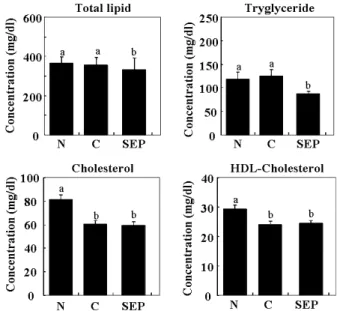
The serum concentrations of lipids were not sig- nificantly differences between normal rats and alcohol treatment control rats (Fig. 2). The concentrations of serum total lipid, triglyceride, total-cholesterol and HDL-choles- terol showed a significant decrease by SEP supplementa- tion in alcohol feeding rats. Many reports indicate that al- cohol intake significantly increases the levels of serum tri- glyceride and cholesterol [11,23], but this is not in agree- ment with the results in the present study. The current study demonstrated a possibility that SEP would be able to decrease the serum lipid concentrations by the simulta- neous addition of alcohol.
Effect of SEP on liver histopathological investigation
The current observations demonstrated that SEP effec- tively protected liver from the alcohol-induced hepatotox- icity by decreasing those serum ALT, LDH and γ-GTP activities. The evidential histological observations are also represented in Fig. 3. Alcohol treatment induced the
Fig. 2. Effect of silkworm excrement powder (SEP) on the se- rum lipid concentrations in alcohol feeding rats. Values with different letters are the significantly different stat- istically at p<0.05. (mean±SE, n=6). N: Normal, C:
Alcohol control, SEP: Alcohol+Silkworm excrement powder.
Fig. 3. Effect of silkworm excrement powder (SEP) on hepatic histopathologic changes in alcohol feeding rats. Hepatic histopathologic changes in alcohol treated rats (magnification ×200). Hepatocyte staining was carried out with the hematoxylin and eosin staining method.
marked accumulation of lipid droplets. The lipid droplets in the hepatocytes of alcohol control rats were increased in numbers and volumes as the fatty liver progressions [21]
and this was in agreement with the previous reports [12,24]. However, the SEP supplementation was attenuated to the accumulation of small lipid droplets. However, the hepatic pattern of normal rats revealed the uniform pattern towards the periphery from the central vein. Hepatic tis-
sues of yeast FF-10 strain supplementation in alcohol feed- ing rats, which has morphology similar to that of the nor- mal rats except for the lipid droplets.
These results indicated that SEP may exert a protective effect against alcoholic hepatotoxicity through decreasing the activity of clinically important liver marker enzymes.
Acknowledgments
This study was supported by the Dong-A University re- search fund. We are very grateful to Department of Agricultural Biology, National Institute of Agricultural Science and Technology, RDA for providing silkworm ex- crement powder.
References
1. Andersen, T. and C. Gluud. 1984. Liver morphology in morbid obesity: a literature study. Int. J. Obes. 8, 97-106.
2. Arimoto-Kobayashi, S., N. Inada, H. Nakano, H. Rai and H. Hayatsu. 1998. Iron-chlorophyllin-mediated conversion of 3-hydroxyamino-1-methyl-5H-pyrido[4,3-b]indole (Trp-P -2(NHOH) into its nitroso derivative. Mutat. Res. 400, 259-269.
3. Cha, J. Y., Y. Mameda, K. Oogami, K. Yamamoto and T.
Yanagita. 1998. Association between hepatic triacylglycerol accumulation induced by administering orotic acid and enhanced phosphatidate phosphohydrolase activity in rats.
Biosci. Biotechnol. Biochem. 62, 508-513.
4. Cha, J. Y., B. S. Jun and Y. S. Cho. 2004. Prevention of or- otic acid-induced fatty liver in rats by capsaicin. Food Sci.
Biotechnol. 13, 597-602.
5. Cherng, J. Y. and M. S. Shim. 2006. Improving glyco- genesis in streptozotocin (STZ) diabetic mice after admin- istration of green algae Chlorella. Life Sci. 78, 1181-1186.
6. Duncan, D. B. 1957. Multiple range test for correlated and heteroscedastic means. Biometrics 13, 164-176.
7. Gotoh, Y., S. Niimi, T. Hayakawa and T. Miyashita. 2004.
Preparation of lactose-silk fibroin conjugates and their ap- plication as a scaffold for hepatocyte attachment.
Biomaterials 25, 1131-1140.
8. Hwang, Y. K., H. J. Choi, M. Nam, J. D. Yoo and Y. H.
Kim. 2006. Effects of Chlorella on metallothionein synthesis and binding capacity of cadmium poisoned rat liver and kidney. J. Exp. Biomed. Sci. 12, 23-27.
9. Hu, L. Q. and D. Y. Xu. 1989. HPLC separation and char- acterization of chlorin derivatives with intact ring V from acid degradation products of silkworm excrement crude chlorophyll mixture. Biomed. Chromatogr. 3, 72-74.
10. Inouye, K., M. Kurokawa, S. Nishikawa and M. Tsukada.
1998. Use of Bombyx mori fibroin as a substratum for cul- tivation of animal cells. J. Biochem. Biophys. Methods 37,
159-164.
11. Izu, H,, M. Shobayashi, Y. Manabe, K. Goto and H. Iefuji.
2006. Sake yeast suppresses acute alcohol-induced liver in- jury in mice. Biosci. Biotechnol. Biochem. 70, 2488-2493.
12. Kang, G. D., K. H. Lee, S. G. Do, C. S. Kim, J. G. Suh, Y.
S. Oh and J. H. Nham. 2001. Effect of silk fibroin on the protection of alcoholic hepatotoxicity in the liver of alco- hol preference mouse. Int. J. Indust. Entomol. 2, 15-18.
13. Kang, P. D., J. W. Kim, B. H. Sohn, K. Y. Kim, I. Y. Jung, M. J. Kim and K. S. Ryu. Accumulating pattern of α- glycosidase inhibitor in various silkworm varities. Korean J. Seric. Sci. 48, 25-27.
14. Kim, Y. H. 1998. Characteristics of greenish pigments from silkworm excrement by ethanol extraction. Korean J. Food Nutr. 44, 375-380.
15. Koivula, T. and M. Koivusalo. 1975. Different form of rat liver aldehyde dehydrogenase and their subcellular distribution. Biochim. Biophys. Acta. 397, 9-23.
16. Liever, C. S. 2001. Alcoholic liver injury: Pathogenesis and therapy in 2001. Pathologie et Biologie 49, 738-752.
17. Lieber, C. S. 2004. Alcoholic fatty liver: its pathogenesis and mechanism of progression to inflammation and fibrosis. Alcohol 34, 9-19.
18. Maher, J. J. 1997. Exploring alcohol's effects on liver function. Alcohol Health Res. World 21, 5-12.
19. Morita, K. T. Matsueda, T. Lida and T. Hasegawa. 1999.
Chlorella accelerates dioxin excretion in rats. J. Nutr. 129, 1731-1736.
20. Nagy, L. E. 2004. Molecular aspects of alcohol metabolism:
transcription factors involved in early ethanol-induced liv- er injury. Annu. Rev. Nutr. 24, 55-78.
21. Ohtake, Y. and Y. Okumura. 1992. Establishing a high glutathione producing yeast species. Biosci. Ind. 50, 29-34.
22. Park, K. J., H. Y. Kim, B. J. Chang and H. H. Lee. 2004.
Ameliorative effects of soy 11S protein on liver damage and hyperlipidemia in alcohol-fed rats. Biol. Pharm. Bull.
27, 1636-1641.
23. Park, K. J., M. J. Lee, H. Kang, K. S. Kim, S. H. Lee and I. Cho. 2002. Saeng-Maek-San, a medicinal herb complex, protects liver cell damage induced by alcohol. Biol. Pharm.
Bull. 25, 1451-1455.
24. Seo, H. J., K. S. Jeong, M. K. Lee, Y. B. Park, U. J. Jung, H. J. Kim and M. S. Choi. 2003. Role of naringin supple- ment in regulation of lipid and ethanol metabolism in rats. Life Sci. 73, 933-946.
25. Shibata, S., K. Oda, N. Onodera-Masuoka, S. Matsubara, H. Kikuchi-Hayakawa, F. Ishikawa, A. Iwabuchi and H.
Sansawa. 2001. Hypocholesterolemic effect of indigestible fraction of Chlorella vulgaris in cholesterol-fed rats. J. Nutr.
Sci. Vitaminol. 47, 373-377.
26. Shon, M. Y., J. Y. Cha, C. H. Lee, S. H. Park and Y. S.
Cho. 2007. Protective effect of administrated glutathione- enriched Saccharomyces cerevisiae FF-8 against carbon tetra- chloride (CCl4)-induced hepatotoxicity and oxidative stress in rats. Food Sci. Biotechnol. 16, 967-974.
27. Shim, J. Y., H. S. Shin, J. G. Han, H. S. Park, B. L. Lim,
K. W. Chung and A. S. Om. 2008. Protective effects of Chlorella vulgaris on liver toxicity in cadmium-ad- ministered rats. J. Med. Food 11, 479-485.
28. Wang, W., S. Shen, Q. Chen, B. Tang, G. He, H. Ruan and U. N. Das. 2008. Hydrolyzates of silkworm pupae (Bombyx mori) protein is a new source of angiotensin-1 converting enzyme (ACE) inhibitory peptides (ACEIP). Current Pharm. Biotechnol. 9, 307-314.
29. Yin, M., K. Ikejima, G. E. Arteel, V. Seabra, B. U.
Bradford, H. Kono, I. Rusyn and R. G. Thurman. 1998.
Glycine accelerates recovery from alcohol-induced liver injury. J. Pharmacol. Exp. Ther. 286, 1014-1019.
30. Yoon, J. W., S. G. Lee and K. B. Lee. 2005. Effects of silk- worm extract powder on plasma lipids and glucose in rat.
Korean J. Food Nutr. 18, 140-145.
초록:알코올성 간독성에 미치는 누에배설물의 영향
김용순1․김기영1․강필돈1․차재영2․허진선․박보경․조영수*
(동아대학교 생명공학과, 1농촌진흥청 농업과학기술원 농업생물부, 2대선주조(주) 기술연구소)
알코올 급여 흰쥐에서 알코올성 간독성에 대한 누에배설물(silkworm excrement powder)의 영향을 검토하기 위하여 반합성 식이에 누에배설물을 3% (w/w) 수준으로 첨가하여 30일간 급여한 후 혈중 알코올 및 지질 농도, 간 기능 지표 효소 활성 및 간 조직 검사를 실시하였다. 임상생화학적으로 중요한 간 기능 지표 효소인 alanine aminotransferase (ALT), aspartate aminotransferase (AST), γ-glutamyl transpeptidase (γ-GTP) 및 lactate de- hydrogenase (LDH) 활성이 알코올 대조군에서 증가하였다. 또한 혈중 알코올 농도도 알코올 섭취에 의해 증가하 였다. 그러나 누에배설물 투여에 의해 혈중 ALT 및 LDH 활성은 현저하게 감소하였다. 혈중 중성지질, 콜레스테 롤 농도는 알코올 대조군에 비해 누에배설물 투여에 의해 현저히 감소하였다. 또한 간 조직 검사에서 알코올 대 조군에서 많은 지방적이 나타나 지방간이 확인되었으나 누에배설물 투여에 의해서는 지방적의 크기와 수가 많이 줄어드는 결과를 얻었다. 이상의 결과에서 누에배설물에 의한 알코올-유발 간독성의 개선효과는 간 조직의 임상 생화학적 지표 효소의 활성 감소에 기인하는 것으로 나타났다.