Effect of Intermediate Metal on the Methanol Gas Sensitivity of ITO Thin Films
H. M. Lee, S. B. Heo, Y. M. Kong, and Daeil Kim*
School of Materials Science and Engineering, Ulsan University, Ulsan 680-749 (Received February 15, 2011, Revised April 13, 2011, Accepted April 13, 2011)
ITO thin films and gold (Au), copper (Cu) and nickel (Ni) intermediate ITO multilayer (ITO/Au/ITO, ITO/Cu/ITO, ITO/Ni/ITO) films were deposited on glass substrates with a reactive radio frequency and direct current magnetron sputtering system and then the effect of intermediate metal layer and annealing temperature on the methanol gas sensitivity of ITO films were investigated. Although both ITO and ITO/metal/ITO (IMI) film sensors have the same total thickness of 100 nm, IMI sensors have a sandwich structure of ITO 50 nm/metal 10 nm/ITO 40 nm. The change in the gas sensitivity of the film sensors caused by methanol gas ranging from 100 to 1000 ppm was measured at room temperature. The IAI film sensors showed the higher sensitivity than the other sensors. Finally, it is concluded that the ITO 50/Au 10/ITO 40 nm film sensors hasthe potential to be used as improved methanol gas sensor.
Keywords : ITO, Multilayer, Magnetron sputtering, Gas sensor
I. Introduction
Currently, thin film gas sensors for hazardousgases have attracted much attention due to growing envi- ronmental safety concerns. A number of semi-con- ductive oxides such as SnO
2have been used for dif- ferent gas sensors [1].
Most of these gas sensors are based on a variation in resistance when the film sensors are exposed to target gases. Since most methanol gas sensors oper- ate at relatively high temperatures, a heater is re- quired [2]. However, integration of a heater in gas sensors not only increases the power consumption but also the complexity of the device. Thus, it is very de- sirable to decrease the operating temperature for viable gas sensors in industrial applications.
In this study, Sn doped In
2O
3(ITO) thin films and 10 nm thick Au, Cu and Ni intermediate ITO films (IAI, ICI, INI) were prepared, respectively and then the effects of the intermediate metal layer on the electrical and structural properties of the films and post-deposition annealing on the methanol gas sensitivity of the films were investigated with Cu-K X-ray diffraction (XRD), atomic force microscopy (AFM), four-point probes and gas sensing measurements, respectively.
II. Experiments
Deposition of ITO and Au, Cu, and Ni thin films
was performed in a magnetron sputtering system that
was equipped with two cathodes. radio frequency (RF)
H. M. Lee, S. B. Heo, Y. M. Kong, and Daeil Kim
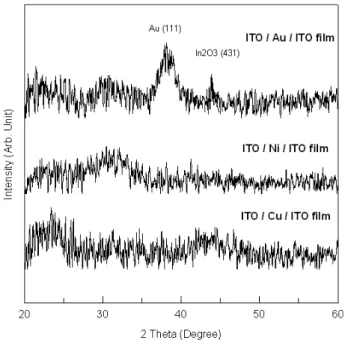
Figure 1. XRD pattern of IAI, ICI and INI films.
Figure 2. SEM images of ITO and IAI films.
(3.2 W/cm
2, 13.56 MHz) and direct current (DC) (3.0 W/cm
2) powers were applied to ITO (In
2O
390%∼SnO
210%, purity; 99.99%) and metal (Au, Cu, and Ni) tar- gets (purity; 99.99%), respectively. ITO and inter- mediate metal (Au, Cu, Ni) films were deposited onto glass (Corning 1747) substrates with constant deposi- tion rate of 14 and 10 nm/minute, respectively at an optimized gas flow condition. Substrate temperature was detected by a K-type thermocouple.
Although the substrate was not heated intention- ally, substrate temperature increased up to 70
oC dur- ing deposition. The distance between the target and substrate was constant at 10 cm. Substrate rotation speed was set to 10 rpm for all depositions. By con- trolling deposition time, the thickness of ITO and IMI films were kept constant at 100 nm and 50/10/40 nm, respectively.
The film’s thickness was confirmed with a surface profilometer, and Cu-K XRD (X’pert Pro MRD, Philips) analysis at the Korea Basic Science Institute (Daegu center) was used to observe the crystalline. The elec- trical properties of the films were measured via a Hall Effect measurement system (HMS-3000, Ecopia), while surface morphology and root mean square (RMS) rough- ness of the films were obtained via an AFM (XE-100, Park system).
In this study, all gas sensing measurements were carried out at room temperature and the gas concen- tration was varied from 100 to 1,000 ppm. Ag elec- trodes (0.5 cm
2) for measuring sensitivity to methanol vapor were deposited onto the prepared sensors by thermal evaporation. A thin gold wire was attached to the Ag electrode with Ag paste to analyze the conductivity. The film sensors which have the higher gas sensitivity (S) was annealed at 200
oC and 400
oC for 30 min to consider the effect of annealing in a vacuum of 1×10
-3Torr on the methanol sensitivity.
The schematic diagram of the static measurement set-up used to measure the gas sensitivity was re- ported in a previous report [3].
III. Results and Discussion
It is well known that ITO films deposited by mag- netron sputtering at low temperature are usually amorphous [4, 5]. Fig. 1 shows the XRD pattern of the as-deposited IMI multilayer films. Although INI and ICI films revealed an amorphous phase, IAI films show the Au (111) and In
2O
3(431) diffraction peaks on the XRD pattern by an inherent nucleation seed effect of Au. The crystallization of ITO by an Au under layer was described in a previous report [6].
Fig. 2 shows the SEM imagesof the ITO and IAI films. ITO films do not have any grains on the sur- face, while IAI films show some grains on the surface.
Fig. 3 shows the surface morphology (scan area
Figure 3. AFM images of ITO and IAI films. (a) ITO (RMS roughness 0.6), (b) ITO/Au/ITO (RMS roughness 1.1).
Table 1. Comparison of the carrier density (1019/cm3), mobility (cm2/Vs) and electrical resistivity (10-4 Ωcm), of ITO and IMI films.
Carrier density Mobility Resistivity
ITO 2.1 133 22.2
INI 3.0 65 3.3
ICI 5.4 39 1.5
IAI 22.1 47 0.5
Concentration (PPM)
0 100 200 300 400 500 600 700 800 900 10001100
Sensitivity
0.8 1.0 1.2 1.4 1.6 1.8
ITO ICI INI IAI
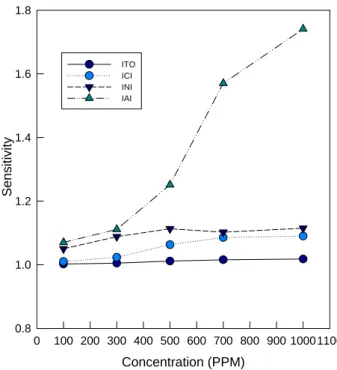
Figure 4. Variation of gas sensitivity with methanol vapor concentration for ITO and IMI film gas sensor.
2×2 μm
2) of ITO (a) and IAI (b) films. INI and ICI films show a RMS roughness of 0.6, and 0.8 nm, respectively. As shown in Fig. 3, IAI films show a higher RMS roughness (1.1 nm) than that of the other films.
Table 1 shows the carrier density, mobility, and electrical resistivity of the ITO and IMI films eval- uated with Hall Effect measurements. In general, oxygen gas flow rate during transparent and conduct- ing oxide (TCO) deposition is very effective in im- proving carrier concentration because each oxygen vacancy on the In
2O
3matrix donates two electrons.
Although a severe oxygen deficiency also causes high resistivity due to structural disorder and reduced mobility in oxygen vacancies, moderate deficiency of oxygen in In
2O
3film is favorable to the electrical conductivity due to optimized carrier density [7].
However, in this study all of the ITO films were deposited under a constant oxygen flow rate of 0.5 sccm. Thus, the observed change in carrier density does not originate from oxygen vacancies, rather the
increased carrier density stems from the intermediate
Au, Cu, and Ni films. In Table 1, although ITO single
layer films show the highest mobility, the IAI films
show the lowest resistivity of 510
-5cm due to ex-
tremely high carrier density of 22.1×10
19/cm
3. Fig. 4
shows the variation in the sensitivity(S) at room
temperature as a function of methanol gas concent-
ration. The sensitivity (S) of the sensors is evaluated
as the change in electrical resistance (R
gas) in the
specified gas atmosphere with respect to its resist-
ance (R
air) in air and is determined using the follow-
H. M. Lee, S. B. Heo, Y. M. Kong, and Daeil Kim
Table 2. Comparison of the methanol sensitivity of IAI films after post deposition vacuum annealing at different temperatures. The gas concen- tration is kept constant at 1,000 ppm.
As deposition 200oC 400oC
IAI 1.74 2.36 2.81
ing equation:
S = R
air/ R
gasWhere R
gasis the resistance of the film sensor in presence of methanol vapors and R
airthe resistance in air, which should be constant for a given test tem- perature [8].
Recently, V. S. Vaishnav studied the influence of a stimulating layer of MgO below the ITO film on the ethanol sensitivity [3]. The stimulating layer of MgO shows enhancement in the sensitivity related to a change in resistance with an improvement of 23 times that of the single ITO layer films. In Fig. 4, the gas sensitivity of all sensors increased with gas concen- tration and the 10 nm thick Au intermediate ITO film sensors show a higher sensitivity than that of the other sensors within the observed methanol vapor concentration. From AFM images, it is supposed that the increased surface area by rough surface of the IAI film may enhances the sensitivity.
Table 2 shows the variation in the sensitivity of the IAI films as a function of annealing temperature. In a previous study, the increased ITO and Au dif- fraction peak in a XRD pattern by annealing process were reported [9] already. Thus the increased sensi- tivity of IAI films in Table 2 is attributed to the large grain size by annealing that results in the lower electrical resistivity than that of as deposited IAI films. The result is similar with ZnO film sensor for hydrogen detection under various operation temper- atures [10].
IV. Conclusions
The changes in sensitivity for methanol gas of ITO/metal (Au, Cu, and Ni)/ITO (IMI) film were in- vestigated at roomtemperature and then compared to those of conventional ITO film sensors. It was dem- onstrated that the IMI film sensor shows increased sensitivity to methanol gases compared to ITO film sensors. Further, 10 nm thick Au intermediate IAI films show higher sensitivity than other films.
Finally, it can be concluded that the ITO 50nm/Au 10 nm/ITO 40 nm film sensors have the potential to be used as improved methanol gas sensors.
References
[1] A. Salehi, Sens. Actuators B 96, 88 (2003).
[2] M. Fleischer and H. Meixner, Sens. Actuators B
43, 1 (1997).[3] V. Vaishnav, P. Patel, and N. Patel, Thin Solid Films 490, 94 (2005).
[4] J. Park, J. Chae, and D. Kim, J. Alloy Comp. 478, 330 (2009).
[5] Y. Kim, Y. -S. No, D. -H. Park, J. Choi, K. -H.
Chae, T. Kim, and W. -K. Choi, J. Korean Vacuum Soc. 19, 475 (2010).
[6] Y. Kim, J. Park, and D. Kim, Vacuum 82, 574 (2008).
[7] L. Meng, J. Gao, R. Silva, and S. Song, Thin Solid Films 516, 5454 (2008).
[8] H. Mbarek, M. Seadoun, and B. Bessais. Mater.
Sci. Eng C 26, 500 (2006).
[9] D. Kim, J. Alloy Comp. 493, 208 (2010).
[10] Y. Kong, S. Heo, H. Lee, and D. Kim, Kor. J.
Mater. Res. 20, 42 (2010).
층간금속층에 따른 ITO 박막의 메탄올 검출민감도 개선 효과
이학민ㆍ허성보ㆍ공영민ㆍ김대일*
울산대학교 첨단소재공학부, 울산 680-749
(2011년 2월 15일 받음, 2011년 4월 13일 수정, 2011년 4월 13일 확정)
RF 마그네트론 스퍼터와 DC 마그네트론 스퍼터를 병행하여 ITO/Au/ITO, ITO/Cu/ITO, 그리고 ITO/Ni/ITO 박막을 유리기 판 위에 증착하였다. 증착 후 진공열처리를 통하여 층간 금속 층이 ITO박막의 메탄올 검출 민감도에 미치는 영향을 분석하였 다. 모든 박막센서의 두께는 100 nm로 동일하게 ITO 50 nm/metal 10 nm/ITO 40 nm로 제작되었고 메탄올 농도는 100에서 1,000 ppm까지 달리하였다. ITO/Au/ITO 박막센서가 가장 높은 민감도를 보임으로써 ITO/Au/ITO 다층박막이 기존의 ITO메 탄올 센서를 대체할 수 있는 센서임을 확인하였다.
주제어 : ITO, 다층, 마그네트론 스퍼터, 가스센서