• 검색 결과가 없습니다.

A Study on Correlation between Compressive Strength and Rebound Hardness of Urban Underground Structures

N/A
N/A
Protected

Academic year: 2021

Share "A Study on Correlation between Compressive Strength and Rebound Hardness of Urban Underground Structures"

Copied!
7
0
0

로드 중.... (전체 텍스트 보기)

전체 글

(1)

http://dx.doi.org/10.17703/JCCT.2020.6.4.655

JCCT 2020-11-81

Ⅰ. 서 론

최근까지 도시철도 지하구조물의 유지관리는 많은

이용객의 안전과 도심지 교통수단으로서의 중요성이 높 아 “시설물의 안전 및 유지관리에 관한 특별법”에 따라 정기점검, 정밀안전점검 및 정밀안전진단을 정기적으로

*정회원, 동양대학교 건설공학과 교수

**정회원, 서울교통공사 토목2사업소 부장 (교신저자) 접수일 : 2020년 03월 02일, 수정완료일: 2020년 11월 10일 게재확정일: 2020년 11월 15일

Received: March 02, 2020 / Revised: November 10, 2020 Accepted: November 15, 2020

**Corresponding Author: [email protected] Dept. of Civil Engineering Office, Seoul Metro, Korea

도시철도 지하구조물 압축강도와 반발경도의 상관관계에 관한 연구

A Study on Correlation between Compressive Strength and Rebound Hardness of Urban Underground Structures

최정열*, 이수재**, 정지승*

Jung-Youl Choi*, Soo-Jae Lee**, Jee-Seung Chung*

요 약

본 연구에서는 도시철도 지하구조물을 대상으로 동일위치에서의 콘크리트 코어채취 압축강도와 비파괴시험 반발경도를 측정하여 반발경도 범위별 추정식을 도출하고 반발경도 구간별 실측 콘크리트 코어강도와의 비교를 통해 범위에 따른 추정 압축강도의 적정성을 확인하였다. 연구결과, 가우시안 확률밀도 함수를 이용하여 산출한 반발경도 범위별 평균 압축강도의 선형회귀분석 결과(대표 압축강도 추정식)와 반발경도 범위별 추정식은 실측 콘크리트 코어 압축강도 실험결과와 약 3% 이내로 잘 일치하는 것으로 나타났다. 본 연구의 반발경도 범위별 압축강도 추정결과는 추정 압축강도의 오차를 줄이고 높은 신뢰수준을 확보할 수 있을 것으로 분석되었다. 따라서 본 연구에서 제안한 반 발경도 측정결과를 이용한 확률적 통계분석결과는 추정식에 따라 상대적으로 편차가 크게 나타나는 반발경도와 콘크 리트 압축강도간의 상관관계의 신뢰수준을 확보하는 데에 도움이 될 수 있을 것으로 판단된다.

주요어 :
콘크리트, 압축강도, 반발경도, 콘크리트 코어, 선형회귀분석

Abstract In this study, the correlation between concrete core compressive strength and rebound hardness of urban railway underground structures was analyzed. The equations for the range of rebound hardness were derived and compared with the measured concrete core strengths for each range of rebound hardness to confirm the adequacy of the estimated compressive strength. As the result, the linear regression analysis results of the average compressive strength by the Gaussian probability density function (representative compressive strength estimation formula) and the estimation formula by the rebound hardness range were founded to match well within 3% of the experimental concrete core compressive strength test results. Therefore, the stochastic statistical analysis using the rebound hardness measurement results suggested in this study could be help to secure the confidence level of the correlation between the rebound hardness and the concrete compressive strength which are relatively large deviation according to the estimation equations.

Key words : Concrete, Compressive Strength, Rebound Hardness, Concrete Core, Linear Regression Analysis

(2)

시행하고 있다 [1]. 도시철도 지하구조물에서 가장 중요 한 성능 중 하나인 콘크리트 압축강도는 구조물에서 직 접 콘크리트 시료(콘크리트 코어)를 채취하여 압축강도 시험을 통해 강도와 내구성을 평가하는 것이 가장 정확 한 방법이다. 그러나 슬래브나 벽체 등에서만 콘크리트 코어 채취가 가능하고, 빈번하게 콘크리트 코어를 채취 하는 경우에는 장기적으로 구조물 손상과 내하력 저하 등을 초래할 소지가 있어 충분한 콘크리트 코어 채취 수량을 확보하는 것은 한계가 있다. 이에 따라 대부분 구조물 손상방지를 위해 비파괴시험법인 슈미트해머에 의한 반발경도법이 가장 많이 사용되고 있다 [2-6]. 그 러나 대부분의 반발경도법에 의한 강도추정식은 해외 연구자들에 의한 실험식으로서 국내 여건과 맞지 않아 최근까지 다수의 연구자들에 의해 다양한 실험식이 제 안되고 있는 실정이다 [2-6]. 반발경도법에 의한 강도추 정식은 기본적으로 시험기법 상 콘크리트 내부의 강도 가 아닌 표면상태에 지배적인 영향을 받을 수 있어 콘 크리트 코어 압축강도와 비교적 큰 차이를 발생시킨다 [2-6]. 따라서 본 연구에서는 도시철도 지하구조물을 대 상으로 동일위치에서의 콘크리트 코어 압축강도와 반발 경도를 측정하고 이를 바탕으로 반발경도 범위별 콘크 리트 코어 압축강도를 가우시안 확률 밀도함수를 이용 해 대표 압축강도 및 표준편차를 산출하고 기존 제안식 과 비교, 분석하였다. 또한 대표 압축강도와 표준편차 최대값 기울기를 이용하여 구간별 추정식을 산출하여 기존 제안식과 본 연구의 제안식을 비교 분석하였다.

표 1. 비파괴강도 추정 제안식 [7]

Table 1. Non-destructive compressive strength of concrete

Proposer Proposed equation

Japanese society for materials f

c

= -18.0 + 1.27ㆍ R

o

Japanese institute of architecture f

c

= (7.3 R

o

+100)×0.098 Tokyo material inspection office f

c

= (10 R

o

-110)×0.098

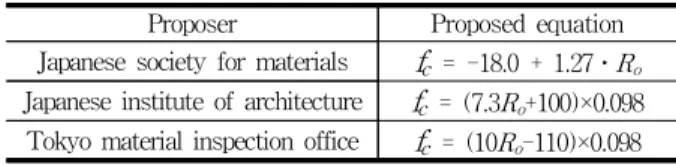
기존 구조물의 콘크리트 압축강도 추정방법은 표 1 과 같이 측정 반발경도(R

o

)로 부터 압축강도(f

c

)와의 상 관관계를 수식화한 제안식들을 사용하여 공용중인 콘 크리트의 압축강도를 추정한다 [7, 8].

Ⅱ. 현장시험

본 연구에서는 콘크리트 코어 압축강도와 슈미트해

머를 이용한 반발경도의 상관관계를 비교, 분석하고자 공용중인 지하철 터널 및 박스구조물 180개소에서 시험 을 수행하였다 [9]. 현장 콘크리트 코어채취는 천공지름 Φ 100㎜로 하였으며, KS F 2422 및 KS F 2405의 콘크 리트 압축강도 시험방법에 따라 시행하였다. 또한 현장 별 반발경도 시험은 KS F 2730의 반발경도시험 방법을 준용하였으며 측정구간의 콘크리트 코어 채취 및 시험 전경은 그림 1과 같다 [10].

(a) Concrete core sampling and compressive strength test

(b) Schmidt hammer rebound hardness test 그림 1. 현장시험 전경

Figure 1. Photographs of field test

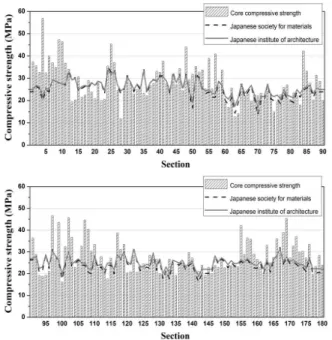
압축강도 시험결과는 그림 2와 같이 측정 평균 압축 강도는 27.8MPa로 분석되어 터널(21MPa) 및 박스구조 물(24MPa)의 설계기준강도를 모두 만족하는 것으로 분 석되었다 [10].

그림 2. 콘크리트 코어 압축강도 측정결과

Figure 2. Measured result of concrete core compressive strength

(3)

압축강도 시험결과, 표 2와 같이 20∼30MPa 범위가 54.4%이며, 30∼40MPa 범위는 23.9%, 10∼20MPa 범위 는 13.3%, 40∼50MPa 범위가 7.8%, 50MPa 이상이 0.6% 순으로 분석되었다 [10].

표 2. 반발경도 범위별 콘크리트 코어 압축강도 측정결과 Table 2. Measured result of compressive strength of concrete core by

rebound hardness Compressive

strength(MPa) Section(EA) Average strength (MPa) Ratio (%)

Total 180 100

< 10 0 0 -

10 < R ≤ 20 24 18.1 13.3

20 < R ≤ 30 98 24.7 54.4

30 < R ≤ 40 43 34.3 23.9

40 < R ≤ 50 14 43.9 7.8

50 < 1 56.8 0.6

지하구조물 180개소의 반발경도(R

o

)는 31∼58로 측 정되었으며 반발경도와 콘크리트 코어 압축강도의 분 포도를 그림 3과 같이 나타내었다.

그림 3. 반발경도와 콘크리트 코어 압축강도 분포 양상

Figure 3. Distribution of rebound hardness and compressive strength of concrete core

측정 반발경도를 활용하여 일본재료학회 제안식에 의한 압축강도 추정결과는 13.5∼35.1MPa이며 일본건 축학회 제안식에 의한 압축강도는 16.8∼33.7MPa로 산 출되었다 [10].

일본의 제안식에 의한 압축강도를 실제 콘크리트 코 어 압축강도와 비교한 결과, 그림 4 및 표 3과 같이 일 본재료학회와 일본건축학회 제안식을 이용한 콘크리트 압축강도 추정결과는 콘크리트 코어 압축강도 보다 약 8.3∼11.6%정도 낮게 산출되어 실제 콘크리트의 강도를 과소평가할 소지가 있을 것으로 분석되었다 [10].

그림 4. 제안식별 추정 압축강도와 콘크리트 코어강도의 비교 Figure 4. Comparison of compressive strength between proposed

equation and concrete core test

표 3. 반발경도 측정값에 의한 압축강도 비교

Table 3. Comparison of compressive strength by measured rebound hardness

Method Measured result (MPa) Compressive strength ratio by concrete core (%)

a) 11.9∼56.8 -

b) 13.5∼35.1 88.4

c) 16.8∼33.7 91.7

a) Concrete core compressive strength b) Japanese society for materials c) Japanese institute of architecture

Ⅲ. 반발경도 범위별 대표 압축강도산출

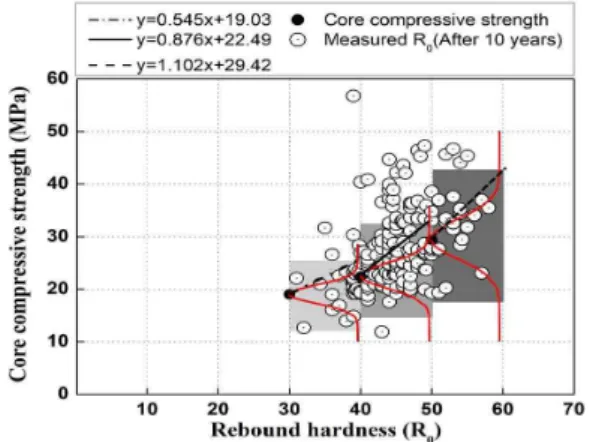
본 연구에서는 측정 반발경도 범위별 콘크리트 압축 강도의 범위를 파악하고자 반발경도 측정위치와 동일 한 개소에서 채취한 콘크리트 코어 시료를 이용한 강도 를 그림 5와 같이 도식화하였다.

그림 5와 같이 반발경도는 크게 3가지 영역으로 구 분되어 30∼60범위에 분포하는 것으로 나타났으며, 가 장 많은 빈도를 갖는 반발경도의 범위는 40~50범위로 분석되었다.

본 연구에서는 반발경도 범위별 대표 압축강도를 산

출하고자 가우시안 확률분포 모델을 이용하여 반발경

도 범위별 콘크리트 코어강도와 발생빈도를 고려한 확

률통계분석을 수행하였다 [10].

(4)

그림 5. 반발경도 범위별 확률 해석 구간

Figure 5. Regions of probability analysis by rebound hardness

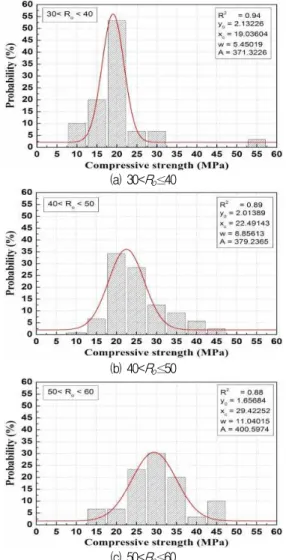
반발경도 30<R

o

≤40 범위의 콘크리트 코어 압축강 도에 대한 가우시안 확률밀도함수 분석결과, 그림 6(a) 와 같이 확률평균 압축강도는 19.03MPa(R

2

=0.94, S.D 5.45)로 분석되었다 [10].

(a) 30< R

o

≤40

(b) 40< R

o

≤50

(c) 50< R

o

≤60 그림 6. 가우시안 확률분석 결과

Figure 6. Results of gaussian probability density analysis

또한 반발경도 40<R

o

≤50 범위의 콘크리트 코어 압 축강도에 대한 가우시안 확률밀도함수 분석결과, 그림 6(b)와 같이 확률평균 압축강도는 22.49MPa(R

2

=0.89, S.D 8.85)로 검토되었다 [10]. 반발경도 50<R

o

≤60 범위 의 콘크리트 코어 압축강도에 대한 가우시안 확률밀도 함수 분석결과, 그림 6(c)와 같이 확률평균 압축강도는 29.42MPa(R

2

=0.88, S.D 11.04)로 검토되었다 [10]. 반발 경도 범위별 가우시안 확률 밀도 분석결과를 바탕으로 확률평균 압축강도와 표준편차를 고려한 반발경도 범 위별 대표 압축강도를 산출하여 표 4에 나타내었다 [10].

표 4. 반발경도 범위별 대표 압축강도

Table 4. Representative compressive strength by range of rebound hardness

Range of R

o

Representative compressive strength 30< R

o

≤40 19.03MPa ±5.45 MPa 40< R

o

≤50 22.49MPa ±8.85 MPa 50< R

o

≤60 29.42MPa ±11.04 MPa

Ⅳ. 분석 및 고찰

1. 대표 압축강도 회귀분석

가우시안 확률밀도 분석을 통해 산출한 반발경도 범 위별 대표 압축강도를 선형회귀분석을 통해 반발경도 에 따른 압축강도 추정식을 산출하여 그림 7에 나타내 었다 [10].

그림 7. 대표 압축강도 회귀분석결과

Figure 7. Regression analysis of representative compressive strength

표 5와 같이 반발경도 범위별 대표 압축강도의 선형회

귀분석을 통한 압축강도는 18.9∼32.9MPa(평균 26.1MPa)

(5)

로 나타나 실제 콘크리트 코어 압축강도의 약 93.8% 수 준인 것으로 분석되었다.

표 5. 압축강도 추정식을 이용한 압축강도 비교

Table 5. Comparison of regression analysis compressive strength Method Measured result Standard

deviation Compressive strength ratio

a) 11.9∼56.8 MPa 7.72 -

b) 18.9∼32.9 MPa 2.59 93.8%

c) 13.5∼35.1 MPa 4.00 88.4%

d) 16.8∼33.7 MPa 3.12 91.7%

a) Concrete core compressive strength

b) This study(using representative compressive strength) c) Japanese society for materials

d) Japanese institute of architecture

콘크리트 코어 압축강도와 추정 압축강도가 유사한 순서는 표 5 및 그림 8과 같이 본 연구의 대표 압축강 도회귀식이 가장 일치하는 것으로 분석되었으며 일본 건축학회 제안식, 일본재료학회 제안식 순으로 나타났 다 [10].

그림 8. 압축강도 추정식을 이용한 압축강도 비교

Figure 8. Comparison of regression analysis compressive strength

2. 반발경도 범위별 추정식 분석

그림 7의 반발경도 범위별 대표 압축강도와 표준편 차 최대값의 기울기를 이용한 범위별 추정식은 그림 9 와 같다 [10]. 반발경도 30<R

o

≤40 범위의 추정식을 이 용한 추정 압축강도는 19.6∼24.5MPa이며 표준편차는 1.2로 분석되었다 [10]. 반발경도 30<R

o

≤40구간의 경 우, 기존의 제안식과 본 연구에서 수행한 제안식의 비 교결과 표 6 및 그림 10(a)와 같이 반발경도 범위별 대 표 압축강도 추정식(y=0.5185R

o

+2.87)이 콘크리트 코어 압축강도와 가장 유사한 값으로 분석되었다 [10]. 반발 경도 40<R

o

≤50구간의 경우, 표 6 및 그림 10(b)와 같

이 반발경도 범위별 추정식(y=0.876x+22.49)이 콘크리 트 코어 압축강도와 가장 유사한 값으로 분석되었다 [10].

그림 9. 반발경도 범위별 추정식

Figure 9. Estimated compressive strength by range of rebound hardness

또한 반발경도 50<R

o

≤60구간의 경우, 표 6 및 그림 10(c)와 같이 본 연구의 대표 압축강도 추정식이 콘크 리트 코어 압축강도 평균값과 가장 유사한 것으로 분석 되었다 [10].

표 6. 압축강도 추정식 및 반발경도 범위별 압축강도 비교 Table 6. Comparison of compressive strength by various methods

Method Range of R

o

Estimated result S.D Ratio 1)

a) 12.7∼56.8MPa 7.72 -

b) 11.9∼47.3MPa 6.93 -

c) 19.4∼46.7MPa 7.50 -

2)

a) 18.9∼23.6MPa 1.16 98.5%

b) 23.6∼28.8MPa 1.37 93.6%

c) 29.3∼32.9MPa 1.10 91.5%

3)

a) 13.5∼20.7MPa 1.78 83.5%

b) 20.7∼28.7MPa 2.12 88.3%

c) 29.5∼35.1MPa 1.60 94.1%

4)

a) 16.8∼22.4MPa 1.39 92.5%

b) 22.5∼28.7MPa 1.66 91.4%

c) 29.3∼33.7MPa 1.30 92.3%

5)

a) 19.6∼24.5MPa 1.20 102%

b) 22.5∼31.3MPa 2.30 96.2%

c) 30.5∼38.2MPa 2.30 99.6%

a) 30< R

o

≤40 b) 40< R

o

≤50 c) 50< R

o

≤60

1) Concrete core compressive strength 2) This study

(using compressive strength by range of rebound hardness) 3) Japanese society for materials

4) Japanese institute of architecture

5) This study(using representative compressive strength)

(6)

(a) 30< R

o

≤40

(b) 40< R

o

≤50

(c) 50< R

o

≤60

그림 10. 압축강도 추정식 및 반발경도 범위별 압축강도 비교 Figure 10. Comparison of compressive strength by various methods

표 7은 본 연구에서 제안하는 대표 압축강도 추정 식과 반발경도 범위별 추정식을 나타낸다 [10]. 또한 표 8과 같이 반발경도 30<R

o

≤60 구간에 대해 대표 압축강도 및 반발경도 범위별 추정식을 비교한 결과 반발경도 범위별 추정식이 콘크리트 코어 압축강도와 가장 잘 일치하는 것으로 분석되었다.

표 7. 콘크리트 코어 압축강도 비교 추정식

Table 7. Concrete core compressive strength comparison estimation equation

Rebound hardeness Estimated equation Representative compressive strength f

c

=0.5185 R

o

+2.87

30< R

o

≤40 f

c

=0.545( R

o

-30)+19.03 40< R

o

≤50 f

c

=0.876( R

o

-40)+22.49 50< R

o

≤60 f

c

=1.102( R

o

-50)+29.42

표 8. 추정기법별 콘크리트 코어 압축강도 분석결과

Table 8. Concrete core compressive strength by estimation methods Method Average strength (MPa) Ratio (%)

a) 27.8 100

b) 26.1 106

c) 27.1 102.4

a) Concrete core compressive strength b) Representative compressive strength

c) Estimated equation by range of rebound hardness

그림 11. 추정기법별 콘크리트 코어 압축강도 분석결과

Figure 11. Concrete core compressive strength by estimation methods

그림 11과 같이 콘크리트 코어 압축강도의 반발경도 30<R

o

≤40 구간과 40<R

o

≤50 구간은 대표 압축강도 추정식이 가장 근접한 것으로 분석되었다. 반면 반발경 도 50<R

o

≤60 구간은 반발경도 범위별 추정식이 가장 근접한 것으로 분석 되었으며 분석결과는 표 9와 같다.

표 9. 반발경도 범위별 콘크리트 코어 압축강도 분석결과 Table 9. Concrete core compressive strength by range of rebound

hardness

Range Method Average strength (MPa) Ratio (%) 30< R

o

≤40

a) 23.0 100

b) 22.7 101.6

c) 23.5 98

40< R

o

≤50

a) 28.1 100

b) 26.3 101.5

c) 27.0 98

50< R

o

≤60

a) 33.5 100

b) 30.6 109.3

c) 33.4 100.4

a) Concrete core compressive strength b) Representative compressive strength

c) Estimated equation by range of rebound hardness

(7)

Ⅴ. 결론

본 연구에서는 준공 후 10년이 경과된 도시철도 지 하구조물의 콘크리트 코어 압축강도와 반발경도 간의 상관관계를 180개소의 실험데이터를 바탕으로 확률통 계분석기법을 이용하여 분석하였으며, 그 결과는 다음 과 같다.

1) 가우시안 확률밀도 분석을 통한 반발경도 범위별 대표 추정 압축강도식(f

c

=0.5185R

o

+2.87)을 제안하였으 며 가장 범용적으로 사용하고 있는 기존 해외제안식과 의 비교를 통해 본 연구에서 제안한 대표 추정 압축강 도식의 적정성을 입증하였다.

2) 본 연구에서는 반발경도 범위별 추정식을 도출하 고 반발경도 구간별 실측 콘크리트 코어강도와의 비교 를 통해 범위에 따른 추정 압축강도의 적정성을 확인하 였다.

3) 연구결과, 가우시안 확률밀도 함수를 이용하여 산 출한 반발경도 범위별 평균 압축강도는 정규분포로 가 정할 수 있는 것으로 분석되었다. 또한 반발경도 범위 별 평균 압축강도를 모두 이용한 선형회귀분석 결과(대 표 압축강도 추정식)와 반발경도 범위별 추정식은 실측 콘크리트 코어압축강도 실험결과와 약 3% 이내로 잘 일치하는 것으로 나타났다.

4) 본 연구의 반발경도 범위별 압축강도 추정결과는 추정 압축강도의 오차를 줄이고 높은 신뢰수준을 확보 할 수 있을 것으로 분석되었다. 따라서 본 연구에서 제 안한 반발경도 측정결과를 이용한 확률통계분석결과는 추정식에 따라 상대적으로 편차가 크게 나타나는 반발 경도와 콘크리트 압축강도간의 상관관계의 신뢰수준을 확보하는 데에 도움이 될 수 있을 것으로 판단된다.

References

[1] J.S. Chung, D.R. Park, and J.Y. Choi, “Evaluation of Track Irregularity Effect due to Adjacent Excavation on Serviced Railway Line”, The Journal of the Convergence on Culture Technology (JCCT), Vol. 5, No. 4, pp.401-406, 2019

https://doi.org/10.17703/JCCT.2019.5.4.401

[2] Y.H. Oh, Y.C. Kim, and E.G. Kim, S.J. Lee,

“Proposal Formula for Compressive Strength by Rebound Hardness Value of High Strength Concrete”, 2007 Proceedings of Korea Concrete

Institute Autumn Conference, pp.1021-1024, 2007 [3] Hur, K., “A Study on Estimated Compressive

Strength of Domestic Bridge Structures by Using Impact-Echo Method”, Master’s thesis, Seoul National University of Science and Technology, 2010

[4] Lee, D., “Estimation equation of concrete strength in tunnel by non-destructive test method of rebound hardness,” Master’s thesis, Kyungpook National University, 2019

[5] Lee, S., “Study Wsing Schmit Hammer-Impact-Echo Test Method for the Comparison of the Compressive Strength of Concrete,” Master’s thesis, Hanyang University, [6] J.K. Park, K.H. Kwak, and T.Y. Chung, “A 2008 Study on Estimation of Rebound Hammer Test Compressive Strength of Schumit Hammer, 2011 Proceedings of Korea Institute for structural Maintenance and inspection Autumn Conference, pp.11-16, 2011

[7] An, J., “A Study on Estimation Methods for Measuring the Concrete Compressive Strength of Underground Structures of Urban Railways based on their Rebound Hardness and Core Strength,” Master’s thesis, Korea National University of Transportation, 2019

[8] Suk, W., “A Comparative Study on Estimated Compressive Strength of high-speed Railway by Non-Destructive Tests,” Master’s thesis, Seoul National University of Science and Technology, 2012

[9] K.H. Yun, K.C. Oh, and C. K, “A Correlation Analysis of Compressive Strength of High Strength Concrete Applied Rebound Hardness Method”, 2014 Proceedings of Korea Concrete Institute Spring Conference, pp.991-992, 2014 [10] Lee, S., “A Study on Correlation between

Compressive Strength and Rebound Hardness of

Urban Underground Structures”, Master’s thesis,

Dongyang University, 2020

수치

그림 2. 콘크리트 코어 압축강도 측정결과
표 2. 반발경도 범위별 콘크리트 코어 압축강도 측정결과 Table 2. Measured result of compressive strength of concrete core by
Figure 6. Results of gaussian probability density analysis
표 5. 압축강도 추정식을 이용한 압축강도 비교

참조

관련 문서

That is, the expansion of material by high temperature and distortion by cooling during welding process is caused by tensile and compressive residual stresses in welding

XRD analysis, surface roughness test, FE-SEM imaging, and biaxial flexural strength test were performed... Results: In the result of XRD analysis, an phase change occurred

As a result, exhibition booth development was carried out the basis of the study results. On that account, the result of the exhibition booth

The average tensile strength value before heat treatment of PLA output was 9.67 N/㎟, and the average tensile strength value after heat treatment was 24.17 N/㎟, which

As a result of the systematic strength training for six sports climbing speed athletes, there were positive changes due to the improvement of

 Euler buckling strength of long column cannot be improved by higher- strength material since it is due to the instability of the column as a whole.  For a column

 Hull girder failure is controlled by buckling, ultimate strength and yielding of longitudinal structural elementsl.  The maximum value on the static

출처 : IAEA 발표 자료(Comprehensive inspection exercise at bulk handling facilities, “U-235 Enrichment measurements by gamma-ray spectroscopy”) 13.  Uranium