• 검색 결과가 없습니다.

Trends in Oral AnticOAgulation Therapy Among Korean Patients With Atrial Fibrillation: The KORean Atrial Fibrillation Investigation

N/A
N/A
Protected

Academic year: 2021

Share "Trends in Oral AnticOAgulation Therapy Among Korean Patients With Atrial Fibrillation: The KORean Atrial Fibrillation Investigation"

Copied!
5
0
0

로드 중.... (전체 텍스트 보기)

전체 글

(1)

Korean Circulation Journal

Introduction

Since its first electrocardiographic description in 1909, atrial fi- brillation (AF) has been recognized as a common arrhythmia, and more recently it has been associated with increased cardiovascular morbidity and mortality. With a prevalence of 1% among the adult population, AF is the most common arrhythmia that requires treat- ment. Current treatment guidelines recommend long-term oral an-

Print ISSN 1738-5520 • On-line ISSN 1738-5555

Trends in Oral Anticoagulation Therapy Among Korean Patients With Atrial Fibrillation: The KORean Atrial Fibrillation Investigation

Hong-Won Shin, MD 1 , Yoon-Nyun Kim, MD 1 , Han-Jun Bae, MD 1 , Ho-Myung Lee, MD 1 , Hyun-Ok Cho, MD 1 ,

Yun-Kyeong Cho, MD 1 , Hyoung-Seob Park, MD 1 , Hyuck-Jun Yoon, MD 1 , Hyungseop Kim, MD 1 , Chang-Wook Nam, MD 1 , Seung-Ho Hur, MD 1 , Kwon-Bae Kim, MD 1 , and Young-Soo Lee, MD 2 ; KORAF Investigator

1
Department of Cardiology, Keimyung University Dongsan Medical Center, Daegu,

2

Department of Cardiology, Daegu Catholic University Medical Center, Daegu, Korea

Background and Objectives: Anticoagulation with vitamin K antagonists (VKAs) such as warfarin provides effective stroke prophylaxis in patients with atrial fibrillation (AF). We conducted a large multicenter survey of Korean patients with AF to determine trends in VKA use.

Subjects and Methods: Eligible patients were adults with AF that had been prescribed VKAs. Medical records from a total of 5616 patients {mean age 63.6±12.2 years, male 3150 (56.1%)} in 27 hospitals from Jan. 2001 to Oct. 2007 were reviewed.

Results: The mean international normalized ratio (INR) was 2.04±0.64, and mean dosage of VKA was 3.66±1.50 mg. Individuals in their sixties (1852 patients) accounted for about one third of patients studied. As patients grew older, INR increased and VKA dosage decreased.

The dosage of VKA in male patients was larger than that in females for all ages. A total of 2146 (42.4%) patients had an INR of 2-3, and less than 40% patients in their sixties had an INR within optimal range. The dosage of oral anticoagulant for optimal INR level was 3.71 mg.

Conclusion: In this study, less than half of the Korean patients with AF on VKA reached the therapeutic range of INR. Mean dosage of VKA was 3.66±1.50 mg, and the dosage of oral anticoagulant for optimal INR level was 3.71 mg, which decreased with age. (Korean Circ J 2012;42:113-117)

KEY WORDS: Atrial fibrillation; International Normalized Ratio; Anticoagulants.

Received: July 30, 2011

Revision Received: September 20, 2011 Accepted: October 3, 2011

Correspondence: Yoon-Nyun Kim, MD, Department of Cardiology, Keimyung University Dongsan Medical Center, 56 Dalseong-ro, Jung-gu, Daegu 700- 712, Korea

Tel: 82-53-250-8040, Fax: 82-53-250-7034 E-mail: [email protected]

• The authors have no financial conflicts of interest.

This is an Open Access article distributed under the terms of the Creative Commons Attribution Non-Commercial License (http://creativecommons.

org/licenses/by-nc/3.0) which permits unrestricted non-commercial use, distribution, and reproduction in any medium, provided the original work is properly cited.

ticoagulation with a vitamin K antagonist (VKA), such as warfarin,

that is targeted at an international normalized ratio (INR) of 2.5

(range, 2.0 to 3.0) in patients with AF who are at a moderate to high

risk of stroke based on the presence of two or more of the following

risk factors: 1) age >75 years; 2) history of hypertension; 3) diabetes

mellitus; and 4) moderately or severely impaired left ventricular sys-

tolic function and/or heart failure.

1)2)

However anticoagulants can

cause severe adverse events, and physicians should therefore moni-

tor the INR of patients taking these drugs to ensure that their ra-

tios fall within a target range.

3)

Furthermore, anticoagulation with

VKAs has many limitations. VKAs offer a narrow therapeutic range

of INR of 2.0-3.0; consequently, when INR levels fall below this tar-

get range, patients are at an increased risk of ischemic stroke, and

when they exceed 3.0, the risk of bleeding is increased. Therefore, fre-

quent INR monitoring and dose adjustments are required. Further-

more, anticoagulation intensity can be influenced by multiple drug

and food interactions, as well as by alcohol consumption. Therefore,

patients taking VKAs have to be cautious about concomitant drug

use and adhere to dietary and lifestyle restrictions.

4)

As Western co-

untries as well as Korea are confronted with aging populations and

(2)

an increasing prevalence of obesity, the number of patients with AF is expected to rise sharply over the next 50 years.

5)

There are racial/

ethnic differences in the prevalence of certain polymorphisms in genes that influence warfarin pharmacokinetics and pharmacody- namics (e.g. cytochrome P450 2C9 and vitamin K epoxide reductase).

The Asian population generally appears to require the lowest daily dose of warfarin to maintain a given INR target, whereas the White population requires an intermediate daily dose and the Black pop- ulation requires the highest daily dose.

6)

Thus, estimating INR in the context of AF in Korea is important, however only a few studies of this kind have been conducted. We conducted a large multicenter survey of Korean patients with AF to determine trends in oral anti- coagulation use. The aim of this study was to investigate the pro- portion of patients with optimal range INR and the dosage of oral anti-coagulation to achieve the optimal range according to age and gender in the Korean population.

Subjects and Methods

This retrospective KORean Atrial Fibrillation investigation (KORAF) was conducted with patient medical record information collected between January, 2000 and October, 2007 in 27 Korean hospitals.

Patients eligible for inclusion were adults with documented AF who had been taking VKAs for at least 1 year and with INR monitoring for more than two occasions. We excluded data from patients who received antiplatelet medications with their anticoagulants. We studied average INR levels according to age and average dosage of oral anticoagulant. All statistical analyses were performed using Statistical Package for the Social Sciences (SPSS) version 15.0 for Windows (SPSS Inc., Chicago, IL, USA)

Results

In total, 5616 patients were included in this study. The mean age of the surveyed population was 63.5±12.3 years and 56.1% were male. Patients were divided into age groups: below 50, 50-59, 60-

69, 70-74, and over 75 years old. The average INR level was 2.04.

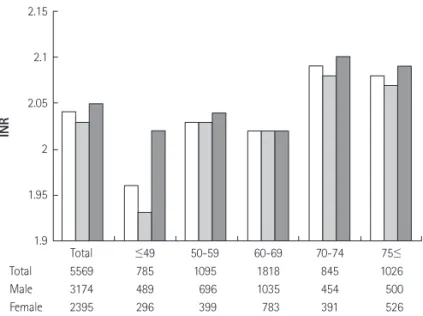
There was a significant difference in INR level according to age gr- oup (Table1). Fig. 1 shows that the mean INR level of older patients

Table 1. Average international normalized ratio level according to age group

Total ≤49 50-59 60-69 70-74 75≤

Total (mg) 2.04±0.64 1.96±0.56 2.03±0.66 2.02±0.60 2.09±0.67 2.08±0.69

Male (mg) 2.03±0.62 1.93±0.58 2.03±0.68 2.02±0.60 2.08±0.59 2.07±0.65

Female (mg) 2.05±0.65 2.02±0.52 2.04±0.61 2.02±0.59 2.10±0.76 2.09±0.74

Table 2. Average dosage of oral anticoagulant according to age group

Total ≤49 50-59 60-69 70-74 75≤

Total (mg) 3.66±1.50 4.33±1.72 4.00±1.48 3.62±1.40 3.31±1.40 3.14±1.31

Male (mg) 3.73±1.48 4.33±1.58 4.05±1.51 3.67±1.40 3.39±1.36 3.13±1.27

Female (mg) 3.57±1.52 4.33±1.93 3.92±1.42 3.57±1.40 3.22±1.44 3.15±1.34

Fig. 1. Average INR level according to age group. The mean INR level of older patients was slightly higher than that of younger patients. INR: interna- tional normalized ratio.

2.15

2.1

2.05

2

1.95

1.9

IN R

Total ≤49 50-59 60-69 70-74 75≤

Total 5569 785 1095 1818 845 1026

Male 3174 489 696 1035 454 0500

Female 2395 296 399 783 391 0526

Fig. 2. Average dosage of oral anticoagulant according to age group. There was significant difference in dosage of oral anticoagulant according to age group. OAC: oral anticoagulant.

4.5

4.2

3.9

3.6

3.3

3.0

Do sa ge o f O AC (m g)

Total ≤49 50-59 60-69 70-74 75≤

Total 5569 785 1095 1818 845 1026

Male 3174 489 696 1035 454 0500

Female 2395 296 399 783 391 0526

(3)

was slightly higher than that of younger patients. Generally, old age is a high risk for stroke, so physicians want to maintain a higher INR in older patients. The mean dosage of oral anticoagulant was 3.66±

1.59 mg. There was significant difference in dosage of oral antico- agulant according to age group (Table 2, Fig. 2). The dosage of oral anticoagulant decreased with increasing age. Table 3 and Fig. 3 show the average dosage of oral anticoagulant according to the INR gr- oup. The dosage of oral anticoagulant in the lower INR group was higher than in the higher INR group. An average 3.89 mg of oral anticoagulant was prescribed to individuals with INR over 3.5 in the male group, denoting possible drug over-prescription. In contrast, an

average of 3.48 mg of oral anticoagulant was prescribed to individ- uals with INR 1-1.4, possibly indicating drug under-prescription. The proportion of individuals achieving an optimal INR level (2-3) was only 42.4% (Fig. 4). An INR of 1.5-2 was maintained in one-third of patients, while patients with INR below 2 accounted for more than half (51.3%) the cases studied. The proportion of individuals achiev- ing optimal INR level was higher among younger women and older men (Table 4, Fig. 5). The dosage of oral anticoagulant to achieve an optimal INR level was 3.71 mg (Table 5, Fig. 6). With increasing age, the higher INR level was preserved with a lower dosage of oral an- ticoagulant. The dosage of oral anticoagulant in men was slightly hi- gher than in women, and as shown in Fig. 6, the difference gradu- ally decreased with increasing age.

Discussion

This study provides insight into the proportion of individuals ach- ieving optimal-range INR and oral anticoagulant dosage in Korean Table 3. Average dosage of oral anticoagulant according to international normalized ratio group

Total 1-1.4 1.5-1.9 2-2.4 2.5-2.9 3-3.4 3.5≤

Total (mg) 3.66±1.50 3.48±1.37 3.75±1.57 3.72±1.50 3.66±1.44 3.46±1.43 3.51±1.63

Male (mg) 3.72±1.48 3.48±1.31 3.85±1.57 3.77±1.47 3.71±1.47 3.55±1.46 3.89±1.63

Female (mg) 3.57±1.52 3.48±1.44 3.60±1.60 3.66±1.55 3.59±1.39 3.36±1.40 3.09±1.54

Table 4. Proportion of optimal international normalized ratio level (2-3) according to age group

Total ≤49 50-59 60-69 70-74 75≤

Total (%) 42.4 42.5 42.6 41.5 46.4 40.9

Male (%) 43.2 39.2 41.4 43.2 40.7 42.8

Female (%) 41.7 47.9 45.1 39.6 41.7 38.8

Fig. 3. Average dosage of oral anticoagulant according to INR group. The dos- age of oral anticoagulant in the lower INR group was higher than that in higher INR group. INR: international normalized ratio.

4.0

3.8

3.6

3.4

3.2

3.0

Do sa ge o f O AC (m g)

Total 1-1.4 1.5-1.9 2.0-2.4 2.5-2.9 3.0-3.4 3.5≤

Total 5616 1068 1812 1638 744 231 123

Male 3186 628 997 949 424 124 064

Female 2399 433 803 682 318 106 057

Fig. 4. Proportion of INR level in patient with AF who taken oral anticoag- ulants. The proportion of individuals achieving an optimal INR level (2-3) was only 42.4%. INR: international normalized ratio, AF: atrial fibrillation.

5.0<

4.5-4.9 4.0-4.4 3.5-3.9 3.0-3.4 2.5-2.9 2.0-2.4 1.5-1.9 1-1.4

IN R

0 5 10 15 20 25 30 35 (%)

0.3 0.2 0.4 1.2

4.1

13.2

29.2 32.3 19

Fig. 5. Proportion of optimal INR level (2-3) according to age group. The proportion of individuals achieving optimal INR level was higher among younger women and older men. INR: international normalized ratio.

50

45

40

35

30

Pr op or tio n of o pt im al IN R le ve l ( % )

Total ≤49 50-59 60-69 70-74 75≤ (years)

Total 2370 334 468 757 393 418

Male 1371 192 288 447 230 214

Female 0999 142 180 310 163 204

Total Male Female

(4)

patients with AF. Among Korean patients with AF on VKAs, less than half reached therapeutic range levels of INR and the mean dosage of oral anticoagulant was 3.66 mg, which decreased with increasing age. The dosage of oral anticoagulant to achieve optimal INR levels was 3.71 mg.

Almost all studies have shown that AF is a potent risk factor for stroke, increasing its risk by nearly 5- fold; adjusted dose warfarin reduced the annual rate of any stroke by 68%.

7)8)

Besides antico- agulant use, it is necessary to use medications for rate and rhythm control.

9)

Compared with aspirin, oral anticoagulant use significantly decreases the risk of all strokes and cardiovascular events for pa- tients with nonvalvular chronic or paroxysmal AF.

10)

While the preval- ence of AF was 0.4% in Korean individuals that were 40-69 years of age,

5)

it may increase with the aging population rendering AF a pu- blic health problem of major concern.

This study was conducted as a large multicenter survey of Kore- an patients with AF to gain insight into trends of oral anti-coagu- lation use. The average INR level was 2.04 for AF patients. This level is within the therapeutic range for prevention of stroke. However, an optimal INR level (2-3) was achieved in only 42.4% of cases stud- ied. In over half of the patients with AF, the INR value was out of range, especially in the sub-therapeutic range, which is of particu- lar concern because of the increased risk of ischemic stroke. Sub- therapeutic INR levels of less than 2.0 have been associated with more thromboembolic events and severe strokes.

11)

In this study, the mean dosage of oral anticoagulant was 3.66 mg, which decreased with age. Age of greater than 80 years and perceived bleeding risk

were the most often cited reasons for not prescribing warfarin.

12)

For this reason, the proportion of optimal INR was higher in younger wo- men and older men. With increasing age, dosage of oral anticoag- ulant needed to achieve optimal INR level (2-3) decreased. Therefore, when physicians prescribe oral anticoagulants to older patients with AF, dosage of oral anticoagulant needs to be decreased relative to that given to younger patients with AF. However patients with sub- therapeutic INR have an increased risk of ischemic stroke, hence frequent INR monitoring and dose adjustments are required in older patients with AF. Physicians should adjust their clinical practices ac- cordingly by aggressively correcting sub-therapeutic INR and av- oiding overreaction to INR that narrowly exceeds 3.

Non-whites are at greater risk for several subtypes of ischemic stroke; cardioembolic stroke attributable to AF is more frequently im- plicated in Whites.

13)

In a recent systematic review of 67 anticoagul- ation studies (69% of which were for AF) by van Walraven et al.

14)

patients were in the therapeutic range 63.6% of the time overall in the USA. The percent-time on warfarin did not differ by race and eth- nicity. The same study reported that Whites, Hispanic, and Asians had similar achieved anticoagulation intensity, however Blacks spent more time in the sub-therapeutic range (INR <2), which likely contributed to the observed absence of stroke reduction. The me- dian percent-time on warfarin when INR was 2 to 3 was 54.5%

overall, but it was lower in Blacks at 47.8% while the other groups had a rate of about 54%.

6)

In Japan, in order to prevent stroke in AF, lower INR (1.6-2.6) was recommended for elderly patients

15)

and with a mean daily dose of warfarin of 2.68±0.95 mg, INR was 1.99±0.24. The INR did not cor- relate with increasing age.

16)

Moreover, warfarin was used extensive- ly in patients with AF whose stroke risk was relatively low with half of them having CHADS2 scores of 0 to 1.

17)

In Japan, lower INR val- ues were recommended and the dose of warfarin was lower than in Korean patients.

This study showed that the dosage of oral anticoagulants that was needed to achieve an optimal INR level was 3.71 mg in Korean patients. The proportion of patients with optimal INR was lower than in other countries. An effort to maintain optimal INR there- fore will be required.

There were several limitations in our study. This study had the inherent limitation of its retrospective nature. Various methods of patient recruitment were used in different hospitals; hence gener- Table 5. Dosage of oral anticoagulant for optimal international normalized ratio level (2-3) according to age group

Total ≤49 50-59 60-69 70-74 75≤

Total (mg) 3.71±1.48 4.43±1.61 4.10±1.54 3.66±1.36 3.37±1.41 3.09±1.20

Male (mg) 3.75±1.47 4.44±1.56 4.11±1.57 3.70±1.33 3.43±1.39 3.12±1.21

Female (mg) 3.64±1.50 4.43±1.69 4.09±1.50 3.59±1.40 3.29±1.43 3.06±1.20

Fig. 6. Dosage of oral anticoagulant (OAC) for optimal international nor- malized ratio level (2-3) according to age group. The dosage of oral antico- agulant in men and women gradually decreased with increasing age.

4.5

4.2

3.9

3.6

3.3

3.0

Do sa ge o f O AC (m g)

≤49 50-59 60-69 70-74 75≤ (years) Total

Male

Female

(5)

alizing among hospitals may be problematic. The relationship be- tween INR level and rates of major adverse cardiac events was not studied. It is clear that much additional work will be required and it is hoped that this study will stimulate further investigation. Howev- er, findings of this study should help reduce future cardiovascular disease events and better understand AF in Korea.

In conclusion, in Korean patients with AF, less than half of the cases on oral anticoagulant reached the therapeutic range of INR.

Mean dosage of VKA was 3.66±1.59 mg, and the dosage of oral an- ticoagulant to achieve optimal INR level was 3.71 mg, which de- creased with increasing age.

Acknowledgments

This study was performed with the support of the Korean Society of Circulation in celebration of the 50th Anniversary of the Korean So- ciety of Circulation.

References

1. Singer DE, Albers GW, Dalen JE, et al. Antithrombotic therapy in atrial fibrillation: American College of Chest Physicians Evidence-Based Clinical Practice Guidelines (8th Edition). Chest 2008;133(6 Suppl):

546S-92S.

2. Fuster V, Rydén LE, Cannom DS, et al. 2011 ACCF/AHA/HRS focused updates incorporated into the ACC/AHA/ESC 2006 Guidelines for the management of patients with atrial fibrillation: a report of the Amer- ican College of Cardiology Foundation/American Heart Association Task Force on Practice Guidelines developed in partnership with the European Society of Cardiology and in collaboration with the Euro- pean Heart Rhythm Association and the Heart Rhythm Society. J Am Coll Cardiol 2011;57:e101-98.

3. Lip GY, Agnelli G, Thach AA, Knight E, Rost D, Tangelder MJ. Oral anti- coagulation in atrial fibrillation: a pan-European patient survey. Eur J Intern Med 2007;18:202-8.

4. Ansell J, Hirsh J, Poller L, Bussey H, Jacobson A, Hylek E. The pharma- cology and management of the vitamin K antagonists: the Seventh ACCP Conference on Antithrombotic and Thrombolytic Therapy. Chest 2004;126(3 Suppl):204S-33S.

5. Lee KS, Choi SJ, Park SH, Kim HL, Min H, Park HY. Prevalence of atrial fi- brillation in middle-aged people in Korea: the Korean Genome and Epi- demiology Study. Korean Circ J 2008;38:601-5.

6. Shen AY, Chen W, Yao JF, Brar SS, Wang X, Go AS. Effect of race/ethnici- ty on the efficacy of warfarin: potential implications for prevention of stroke in patients with atrial fibrillation. CNS Drugs 2008;22:815-25.

7. Wolf PA, Abbott RD, Kannel WB. Atrial fibrillation: a major contributor to stroke in the elderly: the Framingham Study. Arch Intern Med 1987;

147:1561-4.

8. Laupacis A, Boysen G, Connolly S, et al. Risk factors for stroke and ef- ficacy of antithrombotic therapy in atrial fibrillation: analysis of po- oled data from five randomized controlled trials. Arch Intern Med 1994;154:1449-57.

9. Kim YH. Rhythm control versus rate control of atrial fibrillation: ph- armacologic and non-pharmacologic therapy. Korean Circ J 2003;33:

553-8.

10. van Walraven C, Hart RG, Singer DE, et al. Oral anticoagulants vs aspi- rin in nonvalvular atrial fibrillation: an individual patient meta-anal- ysis. JAMA 2002;288:2441-8.

11. Hylek EM, Go AS, Chang Y, et al. Effect of intensity of oral anticoagul- ation on stroke severity and mortality in atrial fibrillation. N Engl J Med 2003;349:1019-26.

12. Waldo AL, Becker RC, Tapson VF, Colgan KJ; NABOR Steering Com- mittee. Hospitalized patients with atrial fibrillation and a high risk of st- roke are not being provided with adequate anticoagulation. J Am Coll Cardiol 2005;46:1729-36.

13. Stansbury JP, Jia H, Williams LS, Vogel WB, Duncan PW. Ethnic dis- parities in stroke: epidemiology, acute care, and postacute outcomes.

Stroke 2005;36:374-86.

14. van Walraven C, Jennings A, Oake N, Fergusson D, Forster AJ. Effect of study setting on anticoagulation control: a systematic review and me- taregression. Chest 2006;129:1155-66.

15. Yasaka M, Minematsu K, Yamaquchi T. Optimal intensity of interna- tional normalized ratio in warfarin therapy for secondary prevention of stroke in patients with non-valvular atrial fibrillation. Intern Med 2001;40:1183-8.

16. Miura T, Nishinaka T, Terada T, Yonezawa K. Relationship between aging and dosage of warfarin: the current status of warfarin anticoagulant therapy for Japanese outpatients in a department of cardiovascular medicine. J Cardiol 2009;53:355-60.

17. Atarashi H, Inoue H, Okumura K, Yamashita T, Kumagai N, Origasa H; J-

RHYTHM Registry Investigators. Present status of anticoagulation tr-

eatment in Japanese patients with atrial fibrillation: a report from the

J-RHYTHM Resistry. Circ J 2011;75:1328-33.

수치

Table 1. Average international normalized ratio level according to age group
Table 4. Proportion of optimal international normalized ratio level (2-3)  according to age group
Fig. 6. Dosage of oral anticoagulant (OAC) for optimal international nor- nor-malized ratio level (2-3) according to age group

참조

관련 문서

