Open Access
Prospective Validation of the Korean Cancer Study Group Geriatric Score (KG)-7, a Novel Geriatric Screening Tool, in Older Patients with Advanced Cancer Undergoing First-line Palliative Chemotherapy
Original Article
Purpose
The purpose of this study was to prospectively validate the Korean Cancer Study Group Geriatric Score (KG)-7, a novel geriatric screening tool, in older patients with advanced can- cer planned to undergo first-line palliative chemotherapy.
Materials and Methods
Participants answered the KG-7 questionnaire before undergoing geriatric assessment (GA) and first-line palliative chemotherapy. The performance of KG-7 was evaluated by calculating the sensitivity (SE), specificity (SP), positive and negative predictive value (PPV and NPV), balanced accuracy (BA), and area under the curve (AUC).
Results
The baseline GA and KG-7 results were collected from 301 patients. The median age was 75 years (range, 70 to 93 years). Abnormal GA was documented in 222 patients (73.8%).
Based on the ! 5 cut-off value of KG-7 for abnormal GA, abnormal KG-7 score was shown in 200 patients (66.4%). KG-7 showed SE, SP, PPV, NPV, and BA of 75.7%, 59.7%, 84.4%, 46.0%, and 67.7%, respectively; AUC was 0.745 (95% confidence interval, 0.687 to 0.803).
Furthermore, patients with higher KG-7 scores showed significantly longer survival (p=
0.006).
Conclusion
KG-7 appears to be adequate in identifying patients with abnormal GA prospectively. Hence, KG-7 can be a useful screening tool for Asian countries with limited resources and high pati- ent volume.
Key words
Geriatric assessment, KG-7, Screening tools, Prospective, Validation
Jin Won Kim, MD
1Se Hyun Kim, MD
1Yun-Gyoo Lee, MD
2In Gyu Hwang, MD
3Jin Young Kim, MD
4Su-Jin Koh, MD
5Yoon Ho Ko, MD
6Seong Hoon Shin, MD
7In Sook Woo, MD
8Soojung Hong, MD
9Tae-Yong Kim, MD
10Ji Yeon Baek, MD
11Hyun Jung Kim, MD
12Hyo Jung Kim, MD
13Myung Ah Lee, MD
14Jung Hye Kwon, MD
15Yong Sang Hong, MD
16Hun-Mo Ryoo, MD
17Kyung Hee Lee, MD
18Jee Hyun Kim, MD
1+ + + + + + + + + + + + + + + + + + + + + + + + + + + + + + + + + + + + + + + + + + + + + + + + + + + + + + + + + + + + + + + + + + + + + + + + + + + + + + + + + + + + + + + + + + + + + + + + + + + + + + + + + + + + + + + + + + + + + + + + + + + + + + + + + + + + + + + + + + + + + + + + + + + + + + + + + + + + + + + + + + + + + + + + + + + + + + + + + + + + + + + + + + + + + + + + + + + + + + + + + + + + + + + + + + + + + + + + + + + + + + + + + + + + + + + + + + + + + + + + + + + + + + + + + + + + + + + + + + + + + + + + + + + + + + + + + + + + + + + + + + + + + + + + + + + + + + + + + + + + + + + + + + + + + + + + + + + + + + + +
Correspondence: Jee Hyun Kim, MD
Division of Hematology and Medical Oncology, Department of Internal Medicine,
Seoul National University Bundang Hospital, Seoul National University College of Medicine, 82 Gumi-ro 173beon-gil, Bundang-gu, Seongnam 13620, Korea
Tel: 82-31-787-7022 Fax: 82-31-787-4052 E-mail: [email protected]
Received August 8, 2018 Accepted December 30, 2018 Published Online January 2, 2019
*A list author’s a!liations appears at the end
of the paper.
Introduction
Geriatric assessment (GA) can identify various problems necessary to determine the appropriate geriatric intervention and follow-up strategies for older patients, otherwise not possible by conventional physical examination and/or his- tory taking [1,2]. It is considered useful due to its ability to differentiate between older patients with good and dimin- ished physiological reserves. In older patients with cancer, GA has been used to predict tolerability of cancer treatment [3,4], toxicity of chemotherapy [5,6], and survival [7,8]. How- ever, the full GA consists of many domains with items, inclu- ding medical, functional, neuropsychiatric, nutritional, and social assessments [9], which can be highly time consuming and labor intensive. Therefore, it can be ineffective in routine practice, especially in institutions with limited resources and high patient volume, especially in high-burden oncology clinics. To remedy this, a screening method that differentiates older patients who need the full GA from those who do not need such extensive approach may be highly beneficial [10].
To date, there are several geriatric screening tools avail- able, including Geriatric 8 (G-8), Abbreviated Comprehen- sive Geriatric Assessment (aCGA), Groningen Frailty Index (GFI), Vulnerable Elders Survey-13 (VES-13), and Triage Risk Screening Tool (TRST) [11-13]. However, these methods pro- vide insufficient information to precisely identify patients that need the full GA [9]. Moreover, they do not represent all domains evenly [9,14]. VES-13 was developed to identify vulnerable older individuals in a community, and TRST was developed to predict repeat emergency department visits [15,16]. Hence, the applicability of these methods in cancer patients may be limiting. In addition, domain of GA could be various based on cultural backgrounds and clinical prac- tice patterns. Given these considerations, we have developed a novel screening tool: the Korean Cancer Study Group Geri- atric Score (KG)-7 with objective, easy-to-answer questions that have been selected from a large dataset to represent each
domain of GA with high sensitivity (SE) and specificity (SP) in the previous study [17].
In this study, we aimed to prospectively validate the clin- ical utility of KG-7 from an independent cohort of older pati- ents with advanced cancer planned to undergo first-line palliative chemotherapy. We also assessed the prognostic value of KG-7 in terms of overall survival (OS).
Materials and Methods
This prospective study to validate KG-7 was conducted as a substudy of another prospective, longitudinal, and multi- center cohort study to develop a prediction tool for adverse events ! grade 3 due to chemotherapy [18]. Inclusion criteria of this study were as follows: patient age ! 70 years; candi- date for first-line palliative chemotherapy; and patients with histologically confirmed solid tumor. The exclusion criteria were hematologic malignancy, such as lymphoma, leukemia, and multiple myeloma; patient with a treatment plan of monotherapy with biologic agent or targeted agent, concur- rent chemoradiotherapy, combination chemotherapy with investigational agents, or monotherapy with oral agents; and recurrent cases during adjuvant chemotherapy.
1. KG-7 and GA
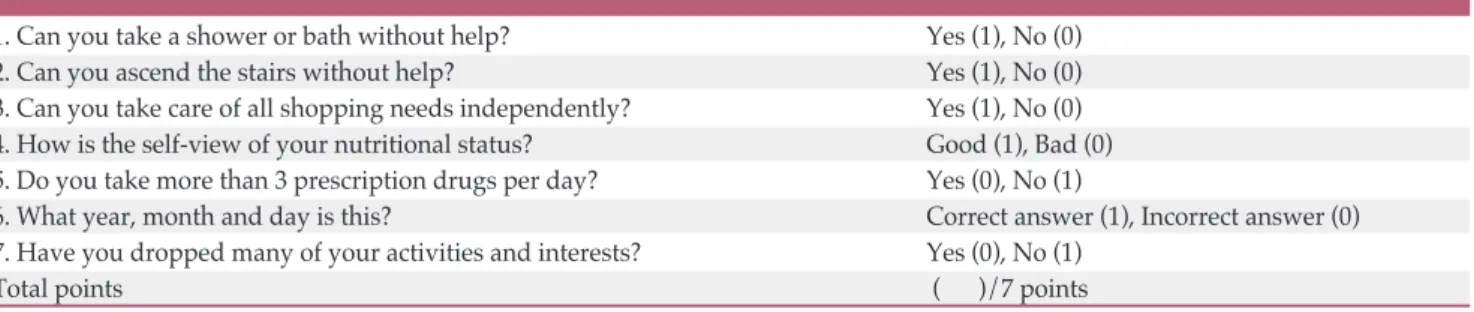
KG-7 questionnaire was answered before full GA. KG-7 consisted of seven questions evenly distributed to represent each domain of GA (Table 1). KG-7 scores ranged from 0 to 7, and higher scores indicated better conditions. In a previous study, the cut-off value of KG-7 was defined as 5.5 [17]. As in our previous studies, GA consisted of an evaluation of medical problems, social support, functional status, cognitive status, emotional status, nutritional status, and mobility [3,17,19]. To measure comorbidity, Charlson comorbidity
Table 1. The Korean Cancer Study Group Geriatric Score (KG)-7
1. Can you take a shower or bath without help? Yes (1), No (0)
2. Can you ascend the stairs without help? Yes (1), No (0)
3. Can you take care of all shopping needs independently? Yes (1), No (0) 4. How is the self-view of your nutritional status? Good (1), Bad (0) 5. Do you take more than 3 prescription drugs per day? Yes (0), No (1)
6. What year, month and day is this? Correct answer (1), Incorrect answer (0)
7. Have you dropped many of your activities and interests? Yes (0), No (1)
Total points ( )/7 points
index was used, which was divided into low (0 points), medium (1-2 points), high (3-4 points), and very high (! 5 points) groups in accordance with the original weighting sys- tem [20]. The functional status was tested using the activities of daily living (ADL) and Korean instrument activities of daily living (K-IADL) scores [21,22]. At least one item with dependency in ADL or K-IADL was categorized as ADL- dependent or IADL-dependent, respectively. Timed get-up- and-go test (TGUG) of greater than 20 seconds was defined as impaired mobility [23]. Cognitive function was tested using Mini-Mental Status Examination in the Korean version of the Consortium to Establish a Registry for Alzheimer's dis- ease Assessment Packet (MMSE-KC), which was categorized into severe cognitive impairment (scores " 16) and mild cog- nitive impairment (scores 17-24) [24]. For depression, short- form geriatric depression scale (SGDS) scores of 5 to 9 and of 10 or more showed mild depression and severe depression, respectively [25]. In terms of nutritional status, the mini nutritional assessment (MNA) score of less than 17.0 and between 17.0 and 23.5 indicated malnutrition and risk of mal- nutrition, respectively [26]. GA was evaluated by clinical research coordinators who underwent appropriate educa- tion – and were certified by the Korean Cancer Study Group (KCSG) for the standardization of GA. Abnormal GA was defined as deficits in at least two out of six domains (ADL, K-IADL, MMSE-KC, SGDS, MNA, and TGUG).
2. Statistical analysis
SE, SP, positive and negative predictive value (PPV and NPV), balanced accuracy [BA=(SE+SP)/2], as well as the area under the curve (AUC) were calculated. The performance of KG-7 was numerically compared with that of G-8. The G-8 Table 2. Baseline characteristics including geriatric assess-
ment
(Continued)
Variable No. (%) (n=301)
Age, median (range, yr) 75 (70-93)
70-79 259 (86.0)
! 80 42 (14.0)
Sex
Male 208 (69.1)
Female 93 (30.9)
ECOG PS
0 39 (13.0)
1 206 (68.4)
2 52 (17.3)
3/4 4 (1.3)
Cancer type
Colorectal cancer 87 (28.9)
Lung 74 (24.6)
Hepato-biliary-pancreatic 67 (22.3)
Stomach 32 (10.6)
Urinary tract cancer (including prostate) 15 (5.0)
Head and neck 10 (3.3)
Others
a)16 (5.3)
Comorbidity (Charlson risk index)
Low (0) 157 (52.2)
Medium (1-2) 114 (37.9)
High (3-4) 28 (9.3)
Very high (! 5) 2 (0.7)
Activity of daily living
Independent 215 (71.4)
Dependent 86 (28.6)
Instrumental activity daily of living
Independent 177 (58.8)
Dependent 124 (41.2)
Cognitive function (MMSE-KC)
Intact (25-30) 134 (44.5)
Mild impairment (17-24) 137 (45.5)
Severe impairment (" 16) 30 (10.0) Depression (SGDS)
Intact (< 5) 167 (55.5)
Mild depression (! 5 and < 10) 92 (30.6)
Severe depression) (! 10) 40 (13.3)
Unknown 2 (0.7)
Nutritional status (MNA)
Normal (! 24) 70 (23.3)
Risk of malnutrition (! 17 and < 24) 171 (56.8)
Malnutrition (< 17) 59 (19.6)
Unknown 1 (0.3)
Mobility (TGUG)
Intact 235 (78.1)
Impaired or incapable 47 (15.6)
Unknown 19 (6.3)
Table 2. Continued
ECOG PS, Eastern Cooperative Oncology Group Scale of Performance Status; MMSE-KC, Mini-Mental Status Examination in the Korean version of the Consortium to Establish a Registry for Alzheimer's disease Assessment Packet; SGDS, Short-Form Geriatric Depression Scale;
MNA, Mini Nutritional Assessment; TGUG, Timed Get Up and Go test.
a)Others: breast (4), gynecological (4), esophageal cancer (3), sarcoma (2), melanoma (2), thymo- ma (1).
Variable No. (%) (n=301)
Geriatric assessment
Abnormal 222 (73.8)
Normal 77 (25.6)
Undetermined 2 (0.7)
was obtained from MNA and age. OS was calculated from the date of GA to the last follow-up or any cause of death.
The event for OS was defined as any cause of death. The probability of OS was calculated using Kaplan-Meier sur- vival analysis with log-rank significance tests. All analyses were performed using PASW Statistics ver. 18 (SPSS Inc., Chicago, IL).
3. Ethical statement
This study was approved by the institutional review boards and independent ethics committee of each hospital and KCSG (KCSG PC13-09). This study was registered with the Clinical Research Information Service (CRiS, WHO ICTRP number: KCT0001071). All participating patients pro- vided written informed consent.
Results
1. Baseline characteristics and GA
Between February 2014 and December 2015, 301 patients undergoing palliative chemotherapy were enrolled in 17 hos- pitals affiliated with KCSG. The baseline patient characteris- tics and results of GA are shown in Table 2. The median age was 75 years (range, 70 to 93 years). Forty-two patients (14.0%) were 80 years of age or older. Males were more than females (69.1% and 30.9%, respectively). The most common
cancer types were colorectal cancer (28.9%), lung cancer (24.6%), and hepato-biliary-pancreatic cancer (22.3%). In terms of GA, Charlson comorbidity index showed low or medium risk of comorbidity (52.2% and 37.9%, respectively) in most patients. Dependency in ADL and IADL was identi- fied in 28.6% and 41.2% of patients, respectively. MMSE indicated mild and severe impairment of cognitive function in 45.5% and 10.0% of patients, respectively. Mild and severe depression were detected in 30.6% and 13.3% of patients, respectively. The risk of malnutrition and having malnutri- tion by MNA were seen in 56.8% and 19.6% of patients, respectively. There were 47 patients (15.6%) who had impai- red mobility by TGUG > 20 seconds or were unable to com- plete the test. In two patients, abnormality of GA could not be determined in accordance with the definition of abnor- mality defined above due to missing values of GA. Abnor- mal GA was identified in 222 patients (73.8%).
2. KG-7
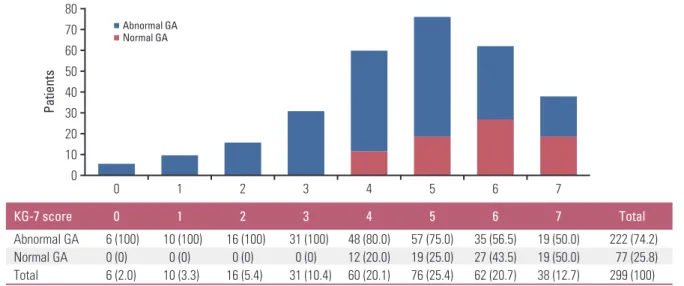
The KG-7 score was collected in all patients. The distribu- tion of KG-7 score is shown in Fig. 1. SE and SP using differ- ent cutoffs were presented as a S1 Table. Based on the ! 5 cut-off value of KG-7 for abnormal GA, as suggested by a previous study [17], abnormal KG-7 score was shown in 200 patients (66.4%). The SE, SP, PPV, NPV, and BA were 75.7%, 59.7%, 84.4%, 46.0%, and 67.7%, respectively. According to the receiver operating characteristic (ROC) curve analysis, AUC was 0.745 (95% confidence interval [CI], 0.687 to 0.803;
p < 0.001) (Fig. 2A).
Fig. 1. Distribution of Korean Cancer Study Group Geriatric Score (KG)-7 score according to status of geriatric assessment (GA). Values shown in Table are presented as number (%).
Pa tie nt s
80 70 60
0 20 10 30 40
0 1 2 3 4 5 6 7
50
Abnormal GA Normal GA
6 (100) 0 (0) 6 (2.0)
10 (100) 0 (0) 10 (3.3)
16 (100) 0 (0) 16 (5.4)
31 (100) 0 (0) 31 (10.4)
48 (80.0) 12 (20.0) 60 (20.1)
57 (75.0) 19 (25.0) 76 (25.4)
35 (56.5) 27 (43.5) 62 (20.7)
19 (50.0) 19 (50.0) 38 (12.7)
222 (74.2) 77 (25.8) 299 (100)
KG-7 score 0 1 2 3 4 5 6 7 Total
Abnormal GA
Normal GA
Total
3. The performance of KG-7 compared with that of G-8
The G-8 score was calculated using MNA and age. In one patient, G-8 score could not be calculated due to missing val- ues. There was the positive correlation between KG-7 and G-8 scores (Pearson correlation, 0.517; p < 0.001). With the G-8 cut-off value of ! 14 for abnormal GA, as suggested by a reference study [27], abnormal G-8 score was shown in 263 patients (87.4%). SE, SP, PPV, NPV, and BA were 94.1%, 28.6%, 79.0%, 61.1%, and 61.4%, respectively. According to ROC, AUC was 0.772 (95% CI, 0.710 to 0.834; p < 0.001) (Fig. 2B). The SE and NPV of G-8 were higher than those of KG-7. However, SP and PPV of G-8 were lower than those of KG-7. Furthermore, BA was higher in KG-7 than in G-8 (67.7% and 61.4%, respectively). Normal G-8 score (> 14 points) was shown in only 12.3% of all patients. Hence, G-8 showed a lower number of patients without the need of full
GA than KG-7 (33.6%).
4. OS according to KG-7 score
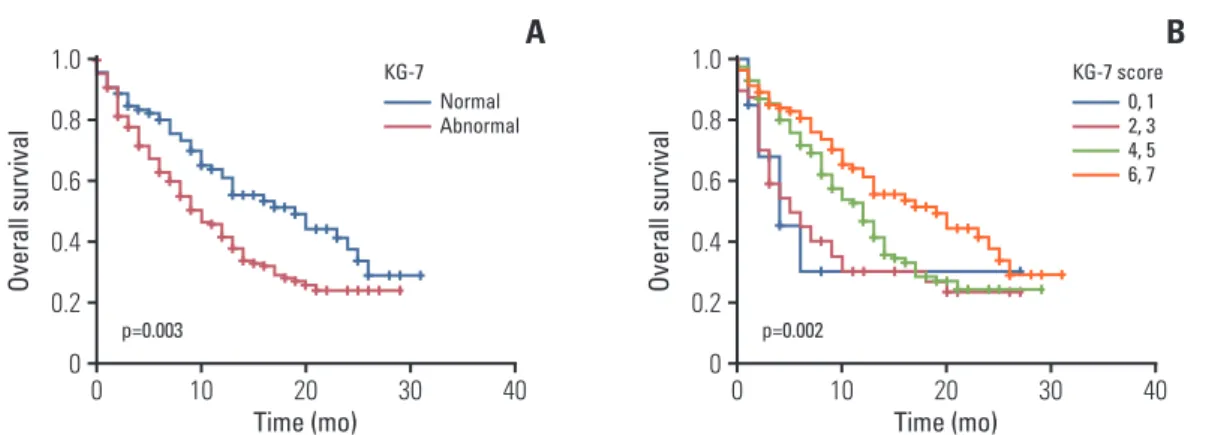
The KG-7 scores showed a prognostic value for OS. Pati- ents with a higher KG-7 score showed longer OS (p=0.006).
The median OS was longer in patients with normal KG-7 scores than those with abnormal KG-7 scores (19 months vs.
10 months, p=0.003) (Fig. 3A). When patients were catego- rized into four groups according to KG-7 score (0, 1 vs. 2, 3 vs. 4, 5 vs. 6, 7), groups with higher scores also showed longer OS (median OS, 4 vs. 5 vs. 12 vs. 19 months, respec- tively; p=0.002) (Fig. 3B).
Fig. 2. Receiver operating characteristic (ROC) curve comparing Korean Cancer Study Group Geriatric Score (KG)-7 (A) with Geriatric 8 (G-8) (B). CI, confidence interval.
A
KG-7, cutoff ≤ 5
ROC=0.745 (95% CI, 0.687-0.803) p < 0.001
Se ns iti vi ty
1.0
0 0.2 0.4 0.6
0 0.2 1-Specificity 0.4 0.6 0.8 1.0 0.8
B
G-8, cutoff ≤ 14
ROC=0.772 (95% CI, 0.710-0.834) p < 0.001
Se ns iti vi ty
1.0
0 0.2 0.4 0.6
0 0.2 1-Specificity 0.4 0.6 0.8 1.0 0.8
Fig. 3. Overall survival according to normal Korean Cancer Study Group Geriatric Score (KG)-7 vs. abnormal KG-7 score (A), overall survival based on subgroups of KG-7 scores (B).
0, 1 2, 3 4, 5 6, 7 KG-7 score
B
p=0.002
Ov er al l s ur vi va l
1.0
0 0.2 0.4 0.6
0 10 Time (mo) 20 30 40
Normal 0.8
Abnormal KG-7
A
p=0.003
Ov er al l s ur vi va l
1.0
0 0.2 0.4 0.6
0 10 Time (mo) 20 30 40
0.8
Discussion
In this study, we prospectively validated the performance of KG-7, which is a novel screening tool suitable for an out- patient oncology clinic setting with low resources and high patient burden to identify patients in need of full GA [17].
KG-7 could identify patients with abnormal GA with com- parable performance with G-8. Furthermore, KG-7 showed a prognostic value for OS.
KG-7 consists of seven easy-to-answer questions. In the previous development study, several characteristics of KG-7 have been reported to be noteworthy when compared with the characteristics of other screening tools [17]. First, KG-7 was based on a large GA dataset, which included the stan- dard method in evaluating older patients. Second, the items in each domain of KG-7 were rearranged to encompass the entire GA and distributed evenly across each essential domain. Third, KG-7 was developed with the consideration of its applicability to cancer patients. Finally, KG-7 showed the prognostic value.
In a previous systematic review, SE and SP of each screen- ing tool for predicting frailty on GA was various, ranging from 25% to 92% and 39% to 100%, respectively, depending on the definition of abnormal GA, prevalence of abnormal GA, enrolled population, and applied tools [9]. They did not show enough of a discriminative value to be applicable in routine practice. Recently, it has been reported that modify- ing or adding relevant items enhanced the SE and SP of the current tools [28,29]. Based on these findings, KG-7 showed affordable accuracy in this validation study (SE, SP, PPV, NPV, BA, and AUC were 75.7%, 59.7%, 84.4%, 46.0%, 67.7%, and 0.745, respectively). This value was somewhat attenu- ated compared to those reported in development cohort and retrospective cohort receiving first-line palliative chemother- apy [17]. This could be explained by lower incidence of abnormal GA (66.4% vs. 79.5%). However, in comparison with G-8, our study showed similar AUC value, although SE and NPV of KG-7 were slightly lower than those of G-8. SP and PPV were higher than those of G-8. Furthermore, BA was higher in KG-7 than in G-8.
GA should reflect various social and cultural aspects. Body mass index selected in G-8 is not acceptable for older Asian patients with cancer due to relatively smaller body mass indexes compared with older Western patients with cancer.
Therefore, a modified or novel tool was necessary to meet the characteristics of Asian clinical setting and population.
KG-7 is the first validated screening tool in older Asian patients with cancer.
The percentage of patients with a normal score of KG-7 was higher in this validation study than that in the previous development cohort study (33.6% vs. 20.5%) [17]. The per-
centage of patients with a normal score of G-8 was also higher in this study population than in the previous study (12.3% vs. 9.2%). This can be attributed to the characteristics of patients enrolled. In this validation study, candidates for first-line palliative chemotherapy were included prospec- tively, and all patients were fit to receive chemotherapy on physician’s decisions and were able to provide informed con- sent. This result suggests that KG-7 may be a good, func- tional screening tool, of which results could be different according to characteristics of patients.
In this validation study, prognostic factors of enrolled patients were homogeneous. Most patients had good per- formance status of Eastern Cooperative Oncology Group performance status 0-1 and less comorbidity of low/medium Charlson risk index. All patients were candidates for first- line palliative chemotherapy. Nevertheless, according to the KG-7 score, OS was significantly discriminated, similar to a previous study [17]. The findings of this study indicate that KG-7 is a good tool for routine practice as it provides not only screening but also prognosis.
There are some limitations in this study. First, KG-7 was obtained by face-to-face interview before full GA; however, the scores of G-8 were retrieved using MNA and age. Hence, our study is not a head-to-head comparison between KG-7 and G-8. However, because items of G-8 are identical to cor- responding items of MNA and it was collected prospectively, the results of G-8 should be reliable. Although indirect, the comparison performed in this study between KG-7 and G-8 should provide the reader with the relative performance of KG-7. Second, this study was conducted as a substudy of another prospective, longitudinal, and multicenter cohort study. The validation of KG-7 was the secondary outcome of another study. However, GA was the essential data in the primary study and KG-7 was collected in all patients. Timing of obtaining KG-7 before GA was followed with great atten- tion. Further studies are necessary to determine whether a two-step approach using KG-7 screening followed by full GA impacts patient outcome, including toxicity, chemotherapy completion rate, and ultimate survival of older cancer pati- ents. Finally, abnormal GA was defined as two or more defi- cits of GA domains in our study, which have been used in many studies related with geriatric screening tools. Older patients with cancer who have only one deficit of GA domain should be identified to provide a proper geriatric interven- tion to correct the deficit.
In this study, we have validated the usefulness of KG-7 as
a screening tool in older patients with cancer planned to
receive first-line palliative chemotherapy. We showed that
KG-7 was comparable to G-8. Moreover, OS was discrimi-
nated according to KG-7 scores. KG-7 could be used effec-
tively in countries with high patient burden and low resour-
ces to select patients in need of full GA.
Electronic Supplementary Material
Supplementary materials are available at Cancer Research and Treatment website (https://www.e-crt.org).
Conflicts of Interest
Conflict of interest relevant to this article was not reported.
Acknowledgments
All authors would like to express our deepest respect and grati- tude to late Prof. Hong Suk Song, a valued member of Korean Can- cer Study Group, who participated as principal investigator and contributed greatly from initial stage of the study.
This study was supported by grants from the National R&D Pro- gram for Cancer Control, Ministry for Health and Welfare, Republic of Korea (study no: 1320370). The funding source did not play any role in the study except for funding.
Author Details
1
Department of Internal Medicine, Seoul National University Bun- dang Hospital, Seoul National University College of Medicine, Seongnam,
2Department of Internal Medicine, Kangbuk Samsung Hospital, Sungkyunkwan University School of Medicine, Seoul,
3