• 검색 결과가 없습니다.

The Study on Estimation of Assembly Efficiency via Diversifying Joinery Techniques for Wooden Furniture - Focused on the Studio Classes of Furniture Design Department of Two Universities in Korea -

N/A
N/A
Protected

Academic year: 2021

Share "The Study on Estimation of Assembly Efficiency via Diversifying Joinery Techniques for Wooden Furniture - Focused on the Studio Classes of Furniture Design Department of Two Universities in Korea -"

Copied!
8
0
0

로드 중.... (전체 텍스트 보기)

전체 글

(1)

The Study on Estimation of Assembly Efficiency via Diversifying Joinery Techniques for Wooden Furniture

- Focused on the Studio Classes of Furniture Design Department of Two Universities in Korea -

Ki Choi

1

ABSTRACT

The joinery technique, as one of manufacturing techniques for the wooden furniture, influences the production process, the economic efficiency, and the diversification of design. Especially, the usage of machine tools can determine how much the students can enhance their design expression capabilities during the practice class in furniture design courses of domestic universities, in accordance with whether to utilize the machine tools or not, and how much and frequent to use the machine tools.

The study proved that the joinery techniques, based on the high-tech machine, has more efficiencies in the various aspects, including the easiness to manufacture the products, and the diversity of design than the joinery technique, based on the handcraft-only. As the ground of this, this study estimated the time to produce the wooden furniture by machine tools and by handcraft-only, each.

Also, this study show the comparison of the features of three different joinery techniques. On the basis of this comparison, this study made the conclusion that the machine-based joinery technique, which is used in the practice class, is the best method to bring the best results in manufacturing the wooden furniture.

Key words: wooden furniture, diversification of design, finger joint technique, dovetails, miters.

1. INTRODUCTION

Study Purpose

Material lumbers as the materials for formative arts have developed a variety of manufacturing techniques for a long time from the ancient time to these days. With this steady development of the fabrication techniques, these are utilized for diverse purposes including the manufacture of common life goods. Since material lumbers have the merits to satisfy the customers' demands for functionality and aesthetic features as well as ECO-friendliness, these can be considered as highly competitive materials.

The wooden furniture is manufactured by the various Joinery-techniques based on its structural features. Since joinery techniques depended wholly on handcraft, it took a long time. There were demands for elaborate skills. Besides, the handcraft products improved the product price so as to decrease the economic feasibility.

Received for publication: Feb 22, 2009 ; Reviewed: Apr 28, 2009 ; Accepted: May 15, 2009.

1)Department of Interior & Furniture Design, College of Design, Kangwon National University, Samcheok

245-711, Republic of Korea. E-mail: [email protected].

(2)

It is admitted that the scarcity of handicraft products possess the advantage to raise the value of products. Meanwhile, this has the difficulties in mass-production, so that most customers are reluctant to purchase the handcraft products due to high price.

However, the development of wooden manufacturing tools and the segmented function diversify the manufacturing methods, so that, even, the joinery technique in the basis of handcraft process can be applied to mass-production and expand its area from the furniture production to the design. Currently, the art-related organizations or departments, including the art department of universities, place the high value on woodworking joinery techniques. And the development, distribution, and effective operation of new manufacturing tools positively influence on ensuring the diversity of the furniture design.

Therefore, this study intends to contemplate the types of Joinery techniques and the diversity of manufacturing method, which are lessoned in the studio classes as a major course of the universities in Korea, which are the nurturing place for the Korean furniture designers. At the same time, the manufacturing facilities and equipments for joinery techniques are estimated in comparison with the economic efficiency of hand-craft products.

This study also has the purpose to identify the positive influence which the diversities of manufacturing methods based on the joinery technique endow the students majoring in the furniture design. Especially, this study has the intension to suggest the hypothetical theory that the time-shortening and the improvement of easiness by using the high-tech machine with joinery technique can draw the interests in wooden furniture design from students.

Therefore, students should have the priority to experience the thorough education for the joinery technique by both handcraft and manufacturing machine. Through this process, the future furniture designers can ultimately improve the design capability, resulting from the training of various furniture manufacturing methods.

Study Method and Range

To ensure the objectivity of this study, this study selected 2 universities which have the furniture design department; Craft art and design department of Sangji-University, and the interior furniture design department of Gangwon University, and checked the current status of joinery technique and other manufacturing methods as the practice courses.

Especially, the major issues related to the research are the efficiency evaluation by comparative analysis of the pros & cons and changes of practice course as the result of introducing and operating the assembly production facilities.

Above all, the major joinery techniques, highly used in the practice course, are classified into 3 parts and investigated: finger joints, dovetailing, and miters. Each type of joinery technique was analyzed in terms of the economic feasibility and aesthetics according to its detailed methods- by handcraft, by fabrication equipment or by mixed one.

Lastly, the experiments are executed to find out and suggest the best education and practice by utilizing the machines. Also, the alternatives are introduced to find out new design by using the features of formative art. Also, in the class, the demonstrative products are exhibited by using the various manufacturing methods; by the machine and by using the mixed methods with handcraft and machine. These will help to open up the new opportunities for further research.

2. THE ORETICAL BACKGROUND Types and features of wood- joinery technique

Joinery techniques have the merits to strengthen the durability of external structure without

(3)

using nails during producing the wooden furniture. Simultaneously, the original pattern of each type of the joinery technique can underline the aesthetic feature of the furniture such as plane division by overlapping the cross-plane and longitudinal-plane. There are various kinds of joinery techniques.

But, this study mainly describes three types of joinery techniques which are mostly educated and used in the practical class of furniture design department of universities in Korea.

Three types of joinery techniques which were mentioned above are classified into finger joints, the dovetailing, and miler technique. And the characteristics and outlines of them are as follows;

First, Box Joint is called as the nickname "finger joint", which is name after the resemblance like locking fingers between fingers. The wood is cut curved at the rectangle with wood texture.

This is the dado joint by meeting the side planes between other materials, sometimes with extending over 2 tenons for its purpose. Figure1. explains the structure of finer joins ( box joints) and the finished furniture product.

Fig. 1. The structure of finger joint technique and the finished Tea-table Design which applies the finger joints.

The feature of finger joints is the excellent durability with the wide face-plane. Since the tenons are arranged in a row, it exhibits the unique beauty. But, this finger joint technique always requires the clamps.

Second, Dovetails are observed mostly in the Korean traditional furniture, especially from Chosen Dynasty. Also, on gluing, it can strengthen the durability. Although it is similar to the Finger Joints in the one hand, the dovetail joint has the fixed angle which helps to pull the joint out one end and prevents it from pulling out in one end and prevents the joints from pulling out in the other end. Especially, it can minimize the deformation like shrinking and expansion. Figure 2 describes the structure of dovetails and the finished furniture product.

Fig. 2. The structure of dovetails and the finished drawer design by using dovetails.

Third, the Miter is one of joinery techniques that the ear of plank is cut at the angle of 45° and

glued. Sometimes, the miter is used by mixing finger joints with dovetails. But, the miters

(4)

are mostly used to strengthen the durability by joining and putting the joint. The external feature of miters is to display the neat completion plane without showing cross plane of wood. But, as mentioned above, due to the weakness in the durability at the joint, it is recommended to use this with other joinery techniques. Figure 3 explains the structure of miters and the finished furniture products.

Fig. 3. The structure of miters and the finished drawer by using miters.

The current status and features of the machine tool for production of wooden furniture by using the joinery technique

Craft art and design department of Sangji-university, and interior furniture design department of Gangwon University operate the practice courses related to various furniture design during academic years.

Table 1. The current status and features of the machine tool by using the joinery technique in the practice course of furniture design.

Machine

Name Manufacture Specification Features Usage Remark

combined Joint system

Festool company (Germany)

Model:

VS600+OF2200 consumption electricity :2200W depth: 80 ㎜

․ easier and faster setting with easily exchanging blades

․ 99% dust collection

․ Maximum depth 25 ㎜

․ Possible to produce the small items and furniture by finger joints and dovetails

Consumption good: Various types of blades

Domino Joint System

Festool company (Germany)

Model: DF500EQ consumption electricity:420W depth: 5~30 ㎜

․ Without kickback, possible to execute the elaborate operation from small products

․ quick and easy modification

․ possible to fabricate the Panel, frame, furniture

․ proper for the strengthen durability for miters method furniture

Consumption good: Domino (Domino slot size

: 5, 6, 8, 10 mm)

Sliding Top

Festool company (Germany)

model:KS120 consumption electricity:1600W saw diameter: 260

․ easy to equip the apparatus to adjust the angle

․ preview by two

․ To

manufacture the box type furniture and table by miters

Consumption

good: saw

blade( separate

unit)

(5)

parallel laser

․ easy to adjust the angle for miters

․ To strengthen the durability by combining Domino Joint system

Corner locking machine

Daeruk Machine

Model

name:DCL-355 consumption electricity:2200W saw width: 9 ㎜

․ possible for finger joints to be applied to marxism depth

․ combined operation of electricity and air-pressure

․ possible to manufacture the furniture and small good by finger joints

․ Fixed type

․ size :

1230×880×134 0 ㎜

During the practical courses as mentioned above. The students adopt the production fabrication methods but they usually select the joinery technique. The formative method uses the mixed fabrication method by combining handcraft and machine tool. And table1 shows the major machine tool which is mostly used.

The most popular machines are the products from Festool company of Germany including the electro motor tools for wood / interior materials as well as from Korean companies. The complex Jointing system (VS600GE) is marked as the most efficient one, which can produce the products at a time with Finger joints and dovetails. While a few years ago, the machine tools for finger joint manufacturing is large size, nowadays, the operation method is so simplified that even students can use it better and more easily. Also, Domino Joining system of Festool company can strengthen the durability as well as simplify the manufacturing process by improving the weakness of miter joint technique.

3. OPTIMUM STUDY

Efficiency analysis of education and suggestion of the usage are in accordance with the diversification of joinery techniques.

The noticeable thing in the practice courses of selected universities for educating and introducing the joinery techniques is that new machinery tends to be introduced in universities later than in the domestic furniture industries. This problem should be improved to activate the development of the domestic furniture design. The practice courses for furniture design should be accurately programmed. Since this process takes a long time by using only joinery techniques, the students easily lose their interests in joinery techniques. This can lead students not to use the wood for furniture fabrication, but to use the artificial materials like MDF or plywood. Ultimately, this prevents students from understanding the materials for furniture, but negatively leads them to execute the narrow-minded design. In case of Sangji-University, while 40% of pieces for graduation work in 2005 were the furniture designs using the joinery technique with lumber, the rate decreased in to 10% in 2008. The students via interview proved that this decrease would result mainly from the difficulties in manufacturing process of furniture by using lumbers.

Therefore, the introduction of joinery techniques into the academic courses is the prerequisite

to cultivate the students' design capability and to expand their design area. This study compares the

difference in manufacturing time among joinery techniques by handcraft, by machine and by the

(6)

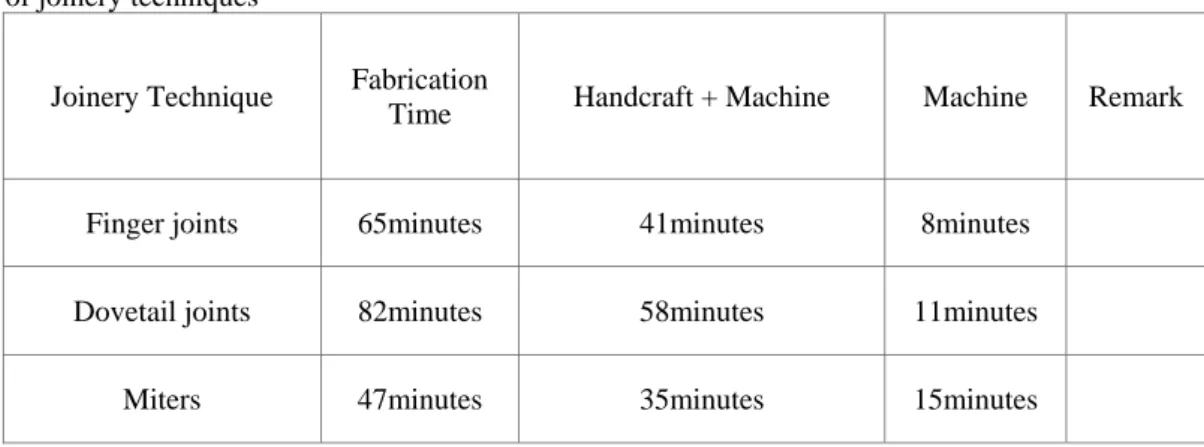
mixed one with handcraft and machine. The subject for experiment is the researcher. And this experiment is designed to compare the time in assembling two planks with the depth 20mm, and the width 300mm by using joinery techniques. The consumption time is estimated by minutes with rounding up second unit. Table 2 exhibits this result.

Table 2. Comparison of consumption time to assemble the wood furniture by using different types of joinery techniques

Joinery Technique Fabrication

Time Handcraft + Machine Machine Remark

Finger joints 65minutes 41minutes 8minutes

Dovetail joints 82minutes 58minutes 11minutes

Miters 47minutes 35minutes 15minutes

The results indicate that, in case of finger joints, using the machine can shorten the fabrication time into 1/8 of consumption time by handcraft. That is, to use machine can positively influence on the development of design for wooden furniture via using the joinery technique. Therefore, it is urgently executed to introduce the machine tools, operational plan and motivation of various design ideas for wooden furniture. Figure 4 is the tentative furniture design by joinery technique machine.

It is expected to extremely slash the production time which is consumed by handcraft and lead the further development for the future model.

Fig.4. Examples of design for wooden furniture, using by the joinery technique machine.

Suggestion of the diversifying and usage of design

It can motivate the involvement of students into experimenting the diverse design in the extensive areas into the design for interior goods to apply joinery techniques for wooden furniture in many ways. The detailed alternatives are classified into three categories.

First, wooden furniture can be used from storage to novel& diversified purposes. For instances,

mass-production goods including tableware or table apparatus can be produced in large quantities

by using the Joinery technique by the machine tools. Fig5. Is the design example of the interior

good by the machine tools with joinery technique.

(7)

Fig.5. Design example of the interior good by the machine tools with the joinery technique.

Second, the practice courses should be planned for the aesthetic features of wooden planes (cross section and longitudinal section) around the Dovetail junction. Especially, finger joints or dovetailings can lead the aesthetic design due to the segmentation plane itself without the additional apparatus. So, the design to use the born aesthetics by joints should be developed.

Finally, the design for the eco-friendly image of wood furniture as well as for reduction of the manufacturing time should be developed and be intensified. Upon purchasing the wooden furniture, the customers tend to consider several things such as price, functionality, and beauty, simultaneously.

Accordingly, furniture should be developed by prices in a variety of ways in compliance with the demands and wants from customers. These efforts should be continuously repeated from school education.

As this study indicates, the development of the Joinery technique for new wooden furniture can be considered as the encouragers to enable the design to permeate into new areas and new expression methods to be realized. Therefore, when producing the wooden furniture in the machine based Joinery technique, it, with positive influence, can reduce the time and cost of design for students and increase the time investment for creative idea or concept design.

Especially, the various experiences of the development of furniture design by using material lumber as the school curriculum can positively influence on the basic training courses, which have owned the obstacles in modernization of Korean traditional Wooden Furniture design due to the difficulties of handcraft manufacturing.

Future study

Joinery techniques which have brought the diversification of fabrication methods for wooden furniture, such as introduction and operation of high-tech machine, are positively appraised. Also, it is expected that these will be steadily developed in the academic courses. As mentioned above, it should not be ignored that students spent much time to manufacture their products and that they can't invest their efforts including time into the creative idea and idea extraction due to the time shortage. Since the economic efficiency, functionality and beauty as the design elements are the required things to produce the products, the effort to reduce the manufacturing time and to simplify the processes.

Also, various machines should be introduced for the efficient class. The machinery of Festool

company consists of the diverse types of machines. Since these are systematically connected, if the

institute holds around 30 kinds of machines, it can motivate to develop more creative design. To

insist on the introduction of machines for academic purpose, the methological research should be

executed to provide the sufficient grounds, with concentration on the features of practice courses.

(8)

4. CONCLUSION

Joinery techniques play an important role to improve the durability of wooden furniture and the design capability of students, which use the aesthetic of joint plane, with the diversification of manufacturing methods through the introduction and operation of high-tech machine. Finger joints, dovetailing, and miters are the main joinery techniques to be used in the practice class for furniture design department in universities. But, the handcraft oriented Joinery technique endows some burdens to students. This causes the significant problem of the insufficiency of diversity in developing the design capability.

Therefore, the various and simple fabrication method should be developed regarding joinery techniques of wooden furniture. This study intends to prove this necessity in the basis of the research about machines from domestic machinery manufactures & Festool company( Germany).

The suggestions are summarized as follows;

First, the machine tools of joinery techniques should be applied to manufacturing various products. Second, the cross and longitudinal plane of wood joints should be used to maximize the utilization of its own beauty. Third, the design development should be concentrated on the eco-friendly image which the wood furniture can appeals.

Especially, there should be more opportunities for students to use Festool company's machinery based on joinery techniques, so that the students can develop their capabilities and potentials for the bright future design industry. So, the thorough analysis about this should be executed.

The efforts to maximization of high tech joinery technique and the modernization of the efficient fabrication method are the required things for the constant experiments and trials. Also, the combination of handcraft-oriented and machine-oriented joinery techniques can develop the design for the differentiated wooden furniture and life goods as well as mass production.

5. REFERENCES

2 Besides Kim Han-Hee. 2006. Furniture production and Wood craft. 71-72pp.

Jung Bok-Sang and Kim Sang Kwon. 2001. Modern Furniture Design. 239-241pp.

Human Resources Development Service of Korea, 2003, Wood Materials and production.

224-227pp.

Dept. of Living & Formative Design Sangji University, 2007, Graduation Exhibition.18pp.

Dept. of Interior & Furniture Design, Kangwon National University, 2006, Graduation Exhibition.

32pp

http://www.festool.com

http://www.uro.co.kr

수치

Fig. 1. The structure of finger joint technique and the finished Tea-table Design  which applies the finger joints
Table 1. The  current status  and features of the  machine tool by using  the joinery technique in the  practice course of furniture design
Table 2. Comparison of consumption time to assemble the wood furniture by using different types  of joinery techniques

참조

관련 문서

MP Yousef Al-Fadalah, Supervisor of Parliament Business Environment Committee declared that the Public Institution for Housing Care intends to dedicate nearly 150

"Naming the State of Kuwait to be Speaker of the Asian Group reflects the trust and confidence of member states in the important and active role played by Kuwait

Al-Hajeri Discussed with Prime Minister of Romania Means of Enhancing Relations Ambassador of Romania to Kuwait, Talal Al-Hajeri and Romanian Prime Minister Fiorica

Due to the heavy downpours during the coming few hours, and anticipations of Meteorological Department that weather fluctuation shall continue, it has been decided

Kuwait Direct Investment Promotion Authority (KDIPA) said the 2019 Doing Business Report of the World Bank Group, came in recognition of the reforms made between June 2, 2017, and

HH the Amir and Abbas Discussed Mutual Relations and Support of Mutual Arab Work His Highness the Amir of Kuwait, Sheikh Sabah Al-Ahmad discussed in Bayan Palace with President

q March 28, 1906: County Magistrate Shim Heung-taek of Uldo-gun[Uldo County] heard this news from the Japanese survey team, he reported to the Korean central government

In a statement to Kuwait News Agency (KUNA) on the sidelines of a meeting of the Arab Parliament's Foreign Affairs Political and National Security