중금속 오염 농경지 토양의 토양질 평가에 관한 연구
김주희ㆍ정덕영ㆍ오세진1ㆍ김록영1ㆍ양재의1ㆍ박관인2ㆍ이진수2ㆍ김성철*
충남대학교 생물환경화학과, 1강원대학교 바이오자원환경학과, 2한국광해관리공단 기술연구소
Determining Soil Quality of Heavy Metal Contaminated Agricultural Field in Korea
Ju Hee Kim, Doug Young Chung, Se Jin Oh
1, Rog Young Kim
1, Jae E. Yang
1, Gwan In Park
2, Jin Soo Lee
2, and Sung Chul Kim*
Department of Bio Environmental Chemistry, Chungnam National University, Daejeon, 305-764, Korea
1
Department of Biological Environment, Kangwon National University, Chuncheon, 200-701, Korea
2
Korea Mine Reclamation Corporation (MIRECO), Seoul, 110-727, Korea
Heavy metal pollution in agricultural field has been a critical issue in worldwide. For this reason, remediation technologies for heavy metal polluted soil are applied especially near at the abandoned metal mine. Soil quality analysis is also an important factor for proper management in heavy metal polluted agricultural field.
In this study, scoring function was utilized to evaluate soil quality in heavy metal polluted agricultural field.
Among other soil properties, bulk density, soil pH, EC, NH
4-N, NO
3-N, and cation exchange capacity (CEC) were determined for minimum data set (MDS) with principal component analysis. Result showed that both upland and paddy soil contaminated with heavy metal were not suitable for crop growth except scoring of soil pH for paddy soil and CEC for upland soil. This result might indicate that chemical stabilization technology with chemical amendment could be adapted for remediation method for heavy metal polluted agiclutural field not only for heavy metal immobilization but also enhancement of soil condition for crop growth.
Key words: Heavy metal, Agricultural field, Soil quality, Scoring function, Remediation
접수 : 2012. 11. 23 수리 : 2012. 12. 5
*연락저자 : Phone: +82428216737 E-mail: [email protected]
서 언
과거 농경지에 대한 토양 질(soil quality) 평가란 농산물 의 증산을 위한 요인 분석 및 자재에 대한 평가에 국한되어 왔으나 최근 토양의 질 평가는 농업의 지속성을 고려한 생 산성과 안전성 및 체계적인 토양 관리 체계를 위한 평가로 확대되고 있다 (Monokrousos et al., 2006; Yoon 2004). 토 양질 평가에 대한 구체적인 내용은 Warkentin and Fletcher (1977)에 의해 체계화된 후 여러 연구자에 의해 개 념이 정립되어 왔으며 1994년 OECD에서는 토양의 질을 농 업환경지표의 하나로 설정하였다 (Wander and Bollero, 1999; Yoon 2004). 토양질 평가의 특징은 토양의 질을 여러 가지 측면에서 고려하여 토양의 기능을 평가하기 때문에 단 하나의 요인으로는 평가를 할 수 없으며 토양의 물리 ‧ 화학
‧ 생물학적 특성 등을 종합적으로 평가하여 토양의 복합적 인 기능을 평가하는 것이다 (Poggio et al., 2008). 특히 중
금속으로 오염된 농경지에 대한 토양질 평가 및 관리체계는 농산물의 안전성 측면에서 매우 중요하지만 현재 이에 대한 연구는 매우 미비한 실정이다 (Brooks et al., 1985; Karen and Scott 1994).
최근 국내 조사에 의하면 100여개의 폐금속 광산 중 약 89개 광산이 주요 중금속에 대해 토양오염 우려 기준을 초 과 하였으며 32개 광산은 수질 기준을 초과하는 등 오염도 가 심각한 것으로 보고되었다. 특히 2005년의 경우 44개 폐 광산 지역 농경지 874 필지에 대해 농산물 안전성 평가를 실시한 결과 조사 면적 85.6ha의 7.7%인 6.6ha 면적의 농경 지에서 재배한 농산물이 오염기준을 초과하여 약 19.4톤의 농작물이 수매 또는 폐가된 것으로 조사되었다.
중금속 오염 농경지 복원을 위한 공법에는 식물정화법 (phytoremediation), 고형화/안정화법 (solidification/stabilization), 동전기법 (electrokinetics), 및 토양 세척법 (soil washing) 등이 있으나 작물을 재배하는 농경지의 특수성 때문에 경제 성, 현실성, 및 기술적용의 용이성 등을 고려하여 적절한 방 법을 선택해야 한다 (Mora et al., 2005; Li et al., 2008).
다양한 복원 공법 중 국내에서는 단순 객(복)토와 석회물질
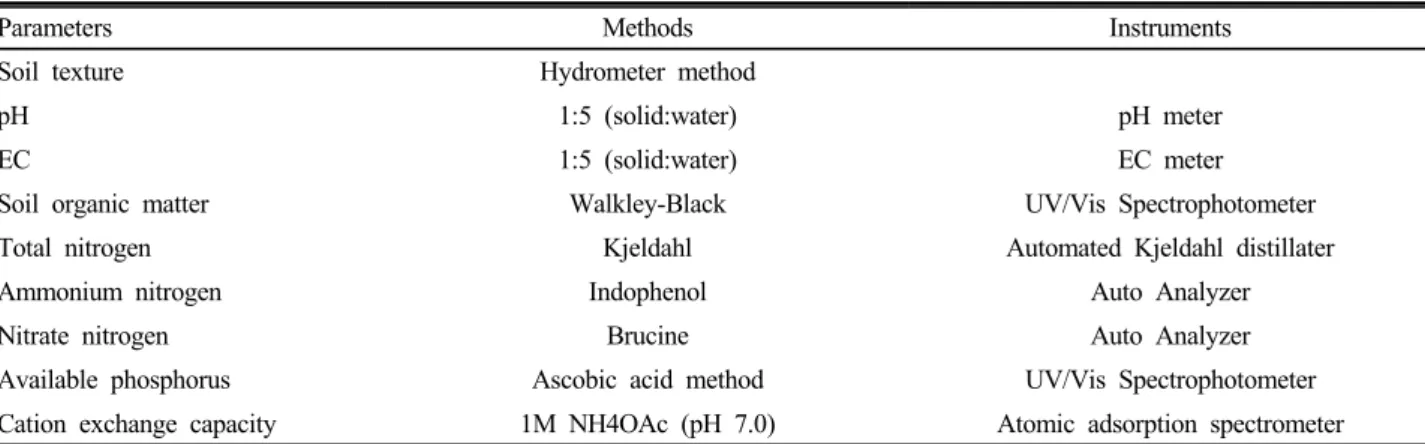
Table 1. Analysis methods and instrument for physicochemical properties of soil.
Parameters Methods Instruments
Soil texture Hydrometer method
pH 1:5 (solid:water) pH meter
EC 1:5 (solid:water) EC meter
Soil organic matter Walkley-Black UV/Vis Spectrophotometer
Total nitrogen Kjeldahl Automated Kjeldahl distillater
Ammonium nitrogen Indophenol Auto Analyzer
Nitrate nitrogen Brucine Auto Analyzer
Available phosphorus Ascobic acid method UV/Vis Spectrophotometer
Cation exchange capacity 1M NH4OAc (pH 7.0) Atomic adsorption spectrometer 등과 같은 토양 개량제를 이용한 공법을 사용하고 있으나
이는 심부 오염물질의 상승, 반입 객(복)토의 특성, 및 토양 개량제의 효율 지속성 등과 같은 문제점이 있다. 또한 중금 속 오염 농경지의 복원 후 사후관리 방법 중 토양질에 대한 평가 기준은 미비하여 이에 대한 연구 개발이 시급한 실정 이다.
따라서 본 연구의 목적은 중금속으로 오염된 광산 인근 농경지의 토양 특성 분석을 통해 중금속 복원에 따른 농경 지의 토양질 평가를 위한 프로토콜을 제시하고 이를 이용한 토양질 평가의 예시를 제공하는 것이다.
재료 및 방법
시료 채취 장소 및 방법 연구 대상 지역은 충청북도 단양군 적성면 상원곡리 및 하원곡리에 위치한 농경지이며 공시 토양 시료는 표토(0-30cm)를 대상으로 채취하였다.
논과 밭을 대상으로 총 5개의 시료를 채취한 후 합하여 하 나의 샘플로 만들었으며 시료 채취 후 토양은 풍건한 후 2mm 체로 체거름하여 토양의 물리 ‧ 화학적 특성 및 중금속 분석을 위한 시료로 사용하였다. 토양의 생물학적 특성 평 가를 위해서는 풍건을 하지 않은 시료를 사용하였다.
토양의 특성분석 토양의 물리 ‧ 화학 특성을 평가하기 위한 시험 방법 및 기기는 Table 1에 정리하였다. 토양의 특 성 중 토성(soil texture)은 hydrometer법에 의해 분석하였 으며 화학적 질 평가 항목에 대한 분석은 국립농업과학기술 원의 토양 및 식물체 분석법 (2000)에 준하여 실험하였다.
토양의 pH(1:1)와 EC(1:1)는 풍건토양 50 g에 증류수 50 ml 을 가하여 30분간 진탕하고 Whatman No. 2로 여과시킨 후 pH meter (Orion mode 921A)와 EC meter (Orion model 50 conductivity meter)를 이용하여 각각 측정하였다. 유기물 함량은 walkely-black 방법에 따라 1N K2Cr2O7을 가하여 반응시킨 후 UV/Vis Spectrophotometer (UV 240 Schimadzu,
Japan)로 파장 610 nm에서 비색 정량하였다. 유효인산 함 량은 bray No.1 방법으로 추출하여 ammonium paramolybdate 로 발색시킨 후 파장 660 nm에서 UV/Visible spectro- photometer를 이용하여 비색 정량하였다. 총 질소는 토양 1g을 H2SO4-H2O2 습식 분해 후 분해액을 Kjeltec system (2300 Kjeltec analyzer, FOSS)을 이용하여 측정하였다. 치 환성 양이온은 1M NH4OAc (pH 7.0) 용액으로 침출 후 AAS (Atomic Absorption Spectrophotometer, Shmadzu, Japan) 를 이용하여 Ca, Mg, K, Na의 함량을 측정하였다. 토양의 중금속 분석을 위한 전처리는 토양오염공정시험법의 전함 량 분석법(aqua regia)에 준하였으며 기기분석은 ICP-OES (Thermo, iCAP 6000 series, USA)를 이용하여 실시하였다.
토양질 평가방법 중금속 오염 토양을 대상으로 토양질 (soil quality)평가를 위해 최소단위군 (minimum data set) 선정 및 토양의 각 세부지표에 대한 등급화와 점수화 (scoring)를 실시하였다. 최소단위군 선정을 위해서는 통계 프로그램인 SAS 10.0을 이용하여 주요인분석 (principle component analysis)을 실시하였으며 선정된 최소단위군에 대한 토양 특성을 이용하여 표준 등급 시스템 구축을 위한 모델식을 산정하였다 (Glover, et al., 2000).
연구결과
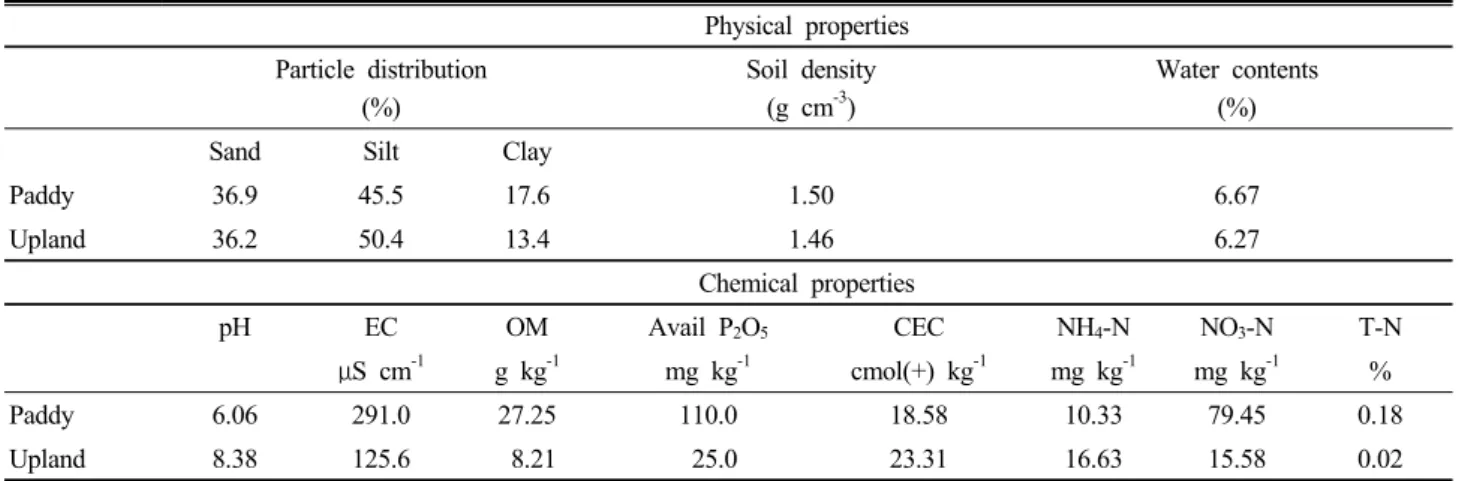
대상 지역의 토양 특성 연구 대상 지역의 농경지를 대상으로 복원 전의 토양질 평가를 위해 토양의 특성 분석 을 실시하였다 (Table 2). 농경지(논과 밭)의 토양 모두 사 질양토 (silt loamy)적 토성을 가지고 있었으며 논과 밭에 대해 수분함량은 각각 6.67, 6.27 %, 용적밀도는 1.46, 1.50 g cm-3로 비슷한 값을 나타내었다. 토양의 화학적 특성 평 가 결과 논의 경우 토양 pH, 유기물함량, 유효인산 등의 값 이 적정범위 안에 분포하는 반면 밭의 경우 토양 pH의 적정 범위(6.0-6.5)에 비해 높은 것으로 조사되었으며 유기물함
Table 2. Summary of physicochemical properties of soil.
Physical properties Particle distribution
(%)
Soil density (g cm-3)
Water contents (%)
Sand Silt Clay
Paddy 36.9 45.5 17.6 1.50 6.67
Upland 36.2 50.4 13.4 1.46 6.27
Chemical properties
pH EC OM Avail P2O5 CEC NH4-N NO3-N T-N
μS cm-1 g kg-1 mg kg-1 cmol(+) kg-1 mg kg-1 mg kg-1 %
Paddy 6.06 291.0 27.25 110.0 18.58 10.33 79.45 0.18
Upland 8.38 125.6 8.21 25.0 23.31 16.63 15.58 0.02
Table 3. Heavy metal concentration in upland and paddy soil.
As Cd Cu Pb Zn
--- mg kg-1 ---
Concerned level 25 4 150 200 300
Response level 75 12 450 600 900
A Upland 296.39 9.93 29.33 668.63 713.99
Paddy 45.23 3.55 26.62 64.45 107.43
B Upland 198.68 7.63 26.76 555.18 451.91
Paddy 90.96 4.19 28.06 80.63 158.23
C Upland 165.28 9.99 32.23 279.69 778.12
Paddy 249.50 6.11 33.39 141.56 346.28
량과 유효인산 모두 적정범위에 비해 낮은 것으로 조사되었 다. 암모니아태 질소의 경우 논 (10.33 mg kg-1)에 비해 밭 (16.33 mg kg-1)에서 높은 반면 질산태 질소의 농도는 밭 (15.58 mg kg-1)에 비해 논(79.45 mg kg-1)에서 높게 측정되 었다. 하지만 밭의 경우 무기태 질소 함량 뿐만 아니라 총질 소의 함량 모두 적정범위 (0.08-0.4%)에 비해 낮았다.
연구 대상 지역의 중금속 함량 논과 밭을 대상으로 5가지 중금속(As, Cd, Cu, Pb, Zn)에 대한 농도를 분석한 결과 논과 밭 모두 비소(Arsenic, As)에 대해 토양오염 대책 기준(75 mg kg-1)을 상회하는 것으로 조사되었다(Table 3).
밭의 경우 비소의 오염 농도는 165.28 - 296.39 mg kg-1의 범위였으며 논의 경우 45.23 - 249.50 mg kg-1로 밭에 비해 오염도의 공간적 편차가 큰 것으로 조사되었다. 카드뮴 (Cadmium, Cd)의 경우 밭토양에서는 모든 지점에 대해 토 양오염 우려기준 (4 mg kg-1)을 초과한 것으로 조사되었으 며 논토양의 경우 2개의 지점에서 토양오염 우려기준 또는 대책기준 (12 mg kg-1)을 초과하는 것으로 조사되었다. 납 (Lead, Pb) 역시 밭토양에서는 조사 지점 모두 우려기준 (200 mg kg-1) 또는 대책기준 (600 mg kg-1)을 초과하는 것 으로 조사되었다. 따라서 대상 지역 토양의 중금속 오염도는
비소, 카드뮴, 납에 대해 오염이 심한 것으로 조사되었다.
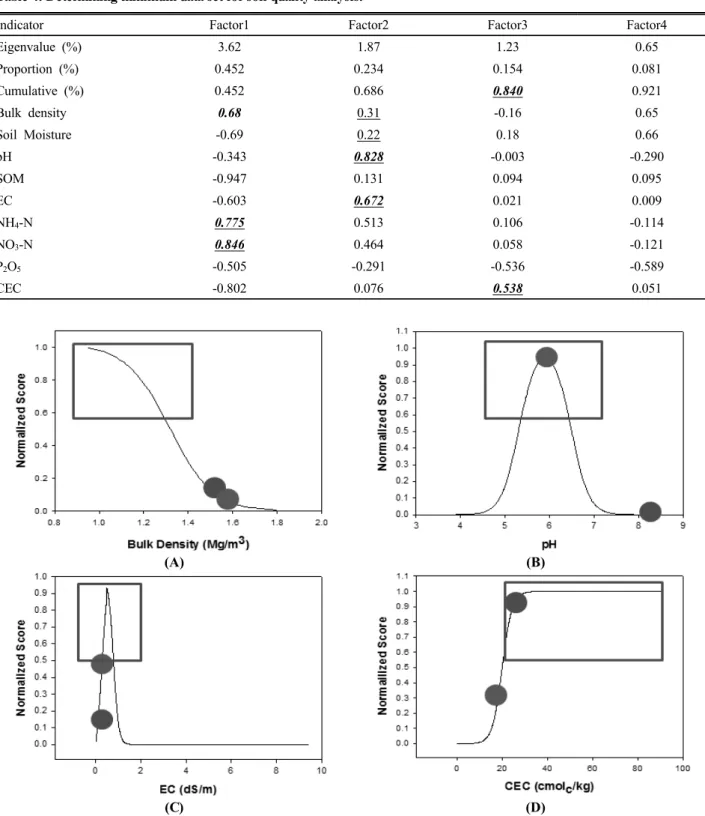
최소단위군 선정 토양질 평가를 위한 최소단위군 선 정을 위해 통계기법인 주요인분석 (principle component analysis)을 사용하였다. Principal component analysis (PCA)를 이용한 토양의 물리화학적 특성에 대한 factor analysis 분석결과, factor 3까지의 축적지수(cumulative)가 약 84%인 것으로 나타났으며 토양의 물리적 특성 중 상관관 계가 큰 변수는 용적밀도인 것으로 조사되었다 (Table 4).
토양의 화학적 특성중 상관관계가 큰 변수로는 NH4-N, NO3-N, pH, EC, 그리고 CEC인 것으로 조사되어 토양의 화 학적 질에 대한 평가 시 반드시 고려되어야 할 변수인 것으 로 사료된다.
중금속 오염 농경지의 토양질 평가 연구 대상 지역 의 토양 특성 결과와 각 항목별 모델식을 이용하여 각 토양 항목에 대한 토양질 평가를 실시하였다 (Fig. 1). 논과 밭의 토양 특성에 따른 토양질 평가 결과 논토양의 경우 토양 pH 와 전기전도도(EC)를 제외한 모든 항목이 적정범위에서 벋 어나는 것으로 조사되었으며 밭토양의 경우 양이온 치환용 량(CEC)을 제외한 모든 항목에서 토양의 적정범위에 포함
Table 4. Determining minimum data set for soil quality analysis.
Indicator Factor1 Factor2 Factor3 Factor4
Eigenvalue (%) 3.62 1.87 1.23 0.65
Proportion (%) 0.452 0.234 0.154 0.081
Cumulative (%) 0.452 0.686
0.840
0.921Bulk density
0.68
0.31 -0.16 0.65Soil Moisture -0.69 0.22 0.18 0.66
pH -0.343
0.828
-0.003 -0.290SOM -0.947 0.131 0.094 0.095
EC -0.603
0.672
0.021 0.009NH4-N
0.775
0.513 0.106 -0.114NO3-N
0.846
0.464 0.058 -0.121P2O5 -0.505 -0.291 -0.536 -0.589
CEC -0.802 0.076
0.538
0.051(A) (B)
(C) (D)
Fig. 1. Result of soil quality analysis in upland and paddy soil. (A) Bulk density, (B) Soil pH, (C) EC, (D) Cation exchange capacity (CEC).
되지 않은 것으로 조사되었다. 중금속 오염 농경지에 대한 토양질 평가의 경우 중금속 농도에 따른 유해성 평가에 초 점을 맞춘 오염도 평가지수 방법이 주로 사용되어 왔다 (Li et al., 2008). 하지만 본 연구에서는 토양의 물리화학적 특 성 분석을 통한 토양질을 평가함으로서 중금속 오염 농경지 의 토양질 평가를 위한 프로토콜을 제시하였으며 토양 등급
화를 통한 토양질 평가를 통해 복원에 따른 작물재배 효율 성 증대 방안을 제시하였다.
사 사
본 논문은 2012년 한국광해관리공단의 광해방지기술개발
사업의 일환으로 “최적토양 개량 및 안정화기술 개발”의 지 원을 받아 수행한 연구 과제입니다.
인 용 문 헌
Brooks, P.C., A. Landman, G. Pruden, D.S. Jenkinson. 1985.
Chloroform fumigation and the release of soil nitrogen: a rapid direct extracting method to measure microbial biomass nitrogen in soil. Soil Bio. Biochem. 17:837-842.
Glover, J.D., J.P. Reganold, and P.K. Andrews. 2000.
Systematic method for rating soil quality of conventional, organic, and integrated apple orchards in Washington State.
Agric. Ecosyst. Environ. 80:29-45.
Karlen, D.L and D.E. Scott. 1994. A framework for evaluating physical and chemical indicators of soil quality. In ‘Defining soil quality for a sustainable environment’ pp.53-72. SSSA Special Publishing, Madison.
Li,W.X., X.X. Zhang, B. Wu, S.L. Sun, Y. S. Chen, W.Y. Pan, D.Y. Zhao, and S.P. Cheng. 2008. A comparative analysis of environmental quality assessment methods for heavy metal-contaminated soils. Pedosphere. 18:344-352.
Monokrousos, N., E.M. Papatheodorou, J.D. Diamantopoulos and G.P. Stamou. 2006. Soil quality variables in organically
and conventionally cultivated field sites. Soil Bio. Biochem.
38, 1282-1289.
Mora, A.P., J. Ortega-Calvo, F. Cabrera, E. Madejon. 2005.
Changes in enzyme activities and microbial biomass after "in situ" remediation of a heavy metal-contaminated soil. Appl.
Soil Ecolo. 28:125-137.
NIAST. 2000. Methods of soil chemical analysis. National Institute of Agricultural Science and Technology, RDA.
Suwon. Korea.
Poggio L., B. Vrscaj, E. Hepperle, R. Schulin, F.A. Marsan.
2008. Introducing a method of human health risk evaluation for planning and soil quality management of heavy metal-polluted soils-An example from Grugliasco(Italy).
Landsc. Urban Plan. 88:64-72
Wander M.R and G.A. Bollero 1999. Soil quality assessment of tillage impacts of Illinois. J of Soil Sci. Soc. Ameri.
63:961-971.
Warkentin, B.P., and H.F. Fletcher. 1997. Soil quality for intensive agriculture. p. 594-598. In Proc. Int. Sem. on Soil Environ. and Fert. Manage. in Intensive Agric. Soc. Sci. Soil and Manure, Natl. Inst. of Agric. Sci., Tokyo, Japan.
Yoon, J.H. 2004. Review and discussion on development of soil quality indicators. Korean J. Soil. Sci. Fert. 37:192-198.