281
and Safety
Available online at http://www.foodhygiene.or.kr
https://doi.org/10.13103/JFHS.2021.36.4.281
Determination of Heavy Metal Concentration in Herbal Medicines by GF-AAS and Automated Mercury Analyzer
Sang-A Kim, Young-Jun Kim*
Department of Food Science and Technology, Seoul National University of Science and Technology, Seoul, 01811, Korea
(Received August 5, 2021/Revised August 18, 2021/Accepted August 22, 2021)
ABSTRACT - This study was conducted to analyze and compare the concentrations of heavy metals in 430 dif- ferent products of 20 types of herbal medicines available in the domestic market in Korea by Graphite Furnace–
Atomic Absorption Spectrometry (GF-AAS) and automated mercury analyzer. The accuracy for lead (Pb), arsenic (As), cadmium (Cd), and mercury (Hg) was in the range 92.67-102.56%, and the precision was 0.21-6.00 relative standard deviation (RSD%), which was in compliance with the Codex acceptable range. Furthermore, the Food Anal- ysis Performance Assessment Scheme (FAPAS) quality control (QC) material showed a recovery range of 96.7- 102.0% and 0.33-4.93 RSD%. The average contents (µg/kg) of Pb, As, Cd, and Hg in herbal medicines were 254.9 (not detected (N.D.)-2,515.2), 171.0 (N.D.-2,465.2), 99.2 (N.D.-797.1), and 6.0 (N.D.-83.6), respectively. Based on the quantitative analysis results, the heavy metal contents of 20 types of herbal medicines distributed in Korea are within the acceptable range according to the standards issued by the Ministry of Food and Drug Safety (MFDS). By using the manufacturer of herbal products as the standard for QC, the Pb, As, Cd, and Hg contents were investigated in the packaging process just before distribution to determine the actual conditions of residual heavy metals in herbal medicines. Thus, these result may contribute to monitoring the QC of herbal medicines distributed in Korea and could provide basic data for supplying safe herbal medicines to the public.
Key words : Herbal medicine, Heavy metal, Validation, Monitoring
With the steady increase in life expectancy and the desire for an improved quality of life, consumers are increasingly turning to herbal medicines1). Despite its widespread use over the past decade, traditional medicine has not been officially recognized in most countries because the legal basis for establishing quality and safety standards for raw materials and finished products of herbal medicines is insufficient or not properly implemented2,3).
However, as the use of herbal medicines increases worldwide, the health risk of heavy metals in herbal medicines due to contamination is a serious safety issue4). Medicinal plants can accumulate heavy metals by absorption, mainly via the root system, or by foliar transfer after deposition of atmospheric particles directly on the leaf
surfaces5). Heavy metals are widely distributed and persistent environmental pollutants, notably due to rapid industrialization occurring in China and other parts of the world. In a situation where more than 80% of the herbal medicines used in Korea are imported from abroad6).
Herbal medicines may thus contain persistent pollutants that affect the human body. Some heavy metal elements that are particularly harmful to humans include lead (Pb), arsenic (As), cadmium (Cd), and mercury (Hg)7). Increased exposure to Pb is associated with a spectrum of neurodevelopmental deficits, such as behavioral disorders and antisocial behavior in children8). Long-term exposure to As causes lung cancer, skin cancer, and liver cancer and non-carcinogenic toxic effects, such as cardiovascular disease and skin disease9). Human exposure to Cd can cause osteoporosis, high blood pressure, liver deterioration, emphysema, and obstructive pulmonary disease, among several other diseases. Organic mercury compounds cross the blood-brain barrier, causing kidney damage and adversely affecting neurodevelopment10,11). Management standards for heavy metals in herbal medicine in Korea started with the review of heavy metals in herbal medicines and their related products in 1985. Then,
*Correspondence to: Young-Jun Kim, Department of Food Science and Technology, Seoul National University of Science and Technology, Seoul, 01811, Korea
Phone: 82-2-970-6734, Fax: 82-2-970-9736 E-mail: [email protected]
Copyright © The Korean Society of Food Hygiene and Safety. All rights reserved. The Journal of Food Hygiene and Safety is an Open-Access journal distributed under the terms of the Creative Commons Attribution Non-Commercial License(http://creativecommons.org/licenses/by-nc/3.0) which permits unrestricted non-commercial use, distribution,and reproduction in any medium, provided the original work is properly cited.
in 2005, the individual hazardous heavy metal acceptance standards for herbal medicines were introduced12). The FAO/
WHO lists Pb, As, Cd, and Hg as chemical contaminants and manages them safely through monitoring13). In addition, those same heavy metals are included in the top 10 Toxic Hazardous Substances Priority List published by the United States Agency for Toxic Substances and Disease Registry (ATSDR)14).
Quality control (QC) of herbal medicines is the basis for quality management of the entire production process:
collection, drying, processing, packaging, and storage.
Optimal management aims to secure the efficacy, stability, and safety of medicines by preserving and enhancing their medicinal properties15). Therefore, to secure the safety of medicinal crops, various pollutants that may be introduced during the cultivation stage should be thwarted in advance, and appropriate management measures should be devised for medicinal crops with high absorption of heavy metals.
In addition, it is necessary to minimize the induction of human toxicity to consumers by promptly barring the distribution of crops exceeding the pollution standard through continuous monitoring of medicinal crops16).
Therefore, in this study, by using an oriental medicine manufacturing company as the center of QC for herbal medicines, the contents of Pb, As, Cd, and Hg in herbal medicines in the processing and packaging process before distribution to oriental clinics are identified by Graphite Furnace-Atomic Absorption Spectrophotometry (GF-AAS) and automated mercury analyzer. The results are intended to be used as data for monitoring the QC of domestically distributed herbal medicines to ensure safe levels of heavy metals in commercialized herbal medicines.
Material and Methods Samples
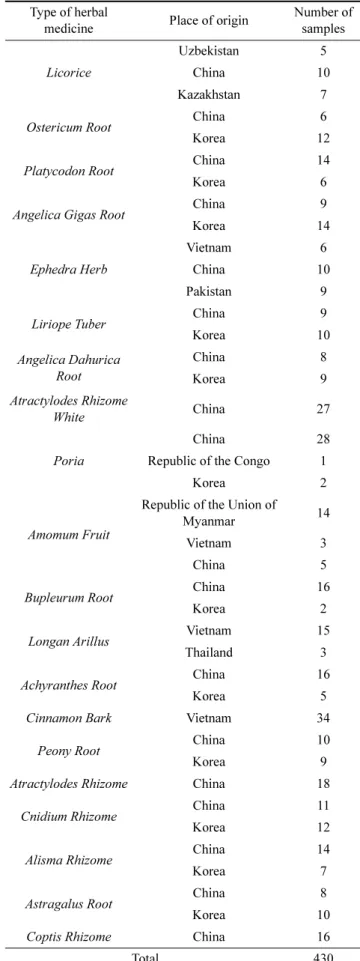
A total of 430 samples of 20 types of herbal medicines, including Licorice, Ostericum Root, Platycodon Root, Angelica Gigas Root, Ephedra Herb, Liriope Tuber, Angelica Dahurica Root, Atractylodes Rhizome White, Poria, Amomum Fruit, Bupleurum Root, Longan Arillus, Achyranthes Root, Cinnamon Bark, Peony Root, Atractylodes Rhizome, Cnidium Rhizome, Alisma Rhizome, Astragalus Root, and Coptis Rhizome were collected and analyzed from January 2017 to March 2021 (Table 1).
Standards and reagents
The standard stock solutions used for the analysis were Pb, As, Cd, and Hg (Kanto Chemical Co., Tokyo, Japan), and 60% nitric acid (HNO3, Samchun Pure Chemical Co., Pyeongtaek, Korea) was used as a reagent for acid decomposition. Distilled water was purified to 18.2 MΩ.
Table 1. Type of herbal medicine samples used in this study Type of herbal
medicine Place of origin Number of samples
Licorice
Uzbekistan 5
China 10
Kazakhstan 7
Ostericum Root China 6
Korea 12
Platycodon Root China 14
Korea 6
Angelica Gigas Root China 9
Korea 14
Ephedra Herb
Vietnam 6
China 10
Pakistan 9
Liriope Tuber China 9
Korea 10
Angelica Dahurica Root
China 8
Korea 9
Atractylodes Rhizome
White China 27
Poria
China 28
Republic of the Congo 1
Korea 2
Amomum Fruit
Republic of the Union of
Myanmar 14
Vietnam 3
China 5
Bupleurum Root China 16
Korea 2
Longan Arillus Vietnam 15
Thailand 3
Achyranthes Root China 16
Korea 5
Cinnamon Bark Vietnam 34
Peony Root China 10
Korea 9
Atractylodes Rhizome China 18
Cnidium Rhizome China 11
Korea 12
Alisma Rhizome China 14
Korea 7
Astragalus Root China 8
Korea 10
Coptis Rhizome China 16
Total 430
Instrumental analysis (Pb, As, and Cd)
For the analysis of Pb, As, and Cd, the samples were pretreated according to the microwave decomposition method detailed in the Korean Pharmacopoeia (KP; General Test Method No. 30: Herbal Medicine Test Method)17). Briefly, about 0.2 g of the homogenized sample was weighed, HNO3 was added, and after the first decomposition and cooling, the sample was decomposed using a microwave (Ethos Touch Control, Milestone Co., Bergamo, Italy). The heavy metals were subsequently analyzed using a GF-AAS apparatus (AA-6800, GFA-EX7, Shimadzu Co., Tokyo, Japan).
GF-AAS is based on the same principle as conventional flame atomic absorption spectrometry, but the atomization takes place in an electrically heated graphite tube. The absorption wavelengths for Pb, As, and Cd, were 283.3, 193.7, and 228.8 nm, respectively. The standard stock solution was diluted with 0.5 M HNO3 to prepare a concentration of 10- 50 µg/kg for Pb and As, and 1.0-3.5 µg/kg for Cd. The average coefficient of determination (R²) value was ≥0.999.
Instrumental analysis (Hg)
To analyze Hg, about 0.05 g of the homogenized sample was placed in a fully automatic Hg analyzer (Model Hydra II, Teledyne Leeman Labs, Hudson, NH, USA), which measures Hg based on heat-vaporization, gold-amalgamation, and cold vapor atomic absorption. After drying the sample at 300oC for 70 s, it was analyzed under conditions of decomposition and amalgamation at 800oC for 150 s. Hg was prepared in a concentration range of 20-100 µg/kg and showed an average R2≥0.999.
Method validation
The parameters used to verify the effectiveness of the detected heavy metals were limit of detection (LOD), limit of quantitation (LOQ), accuracy, and precision. LOD denotes the minimum detectable value during analysis, and LOQ is the minimum value that can be expressed as a quantitative value.
LOD and LOQ were assessed according to the calculation method suggested by the International Conference on Harmonization (ICH) of Technical Requirements for Registration of Pharmaceuticals for Human Use, based on the standard deviation of the response and the slope of the calibration curve as follows18).
LOD = 3.3 × σ / S LOQ = 10 × σ / S
σ = the standard deviation of the response S = the slope of the calibration curve
For accuracy and comparison of the measured values
between pretreatment methods, the concentration of the recovered standard material was evaluated after the standard material was pretreated to obtain the concentrations detailed in the steps above in the same manner as the sample. All experiments were repeated three times. Precision (intra-day and inter-day) was measured to confirm the change in the same analyte according to the experimental environment.
Intra-day precision (expressed as the relative standard deviation, RSD%) was calculated for three replicates analyzed on the same day. Inter-day precision (RSD%) was calculated for three replicates analyzed for 3 days.
To certify the accuracy and reliability of the analysis results, the recovery rate was measured using QC material T07350QC (soya flour) for heavy metal analysis purchased from the Food Analysis Performance Assessment Scheme (FAPAS, Sand Hutton, York, UK) operated by the Central Science Laboratory (CSL) of the UK Department for Environment Food and Rural Affairs. The recovery analysis of the QC material was repeated three times.
Results and Discussion Method validation
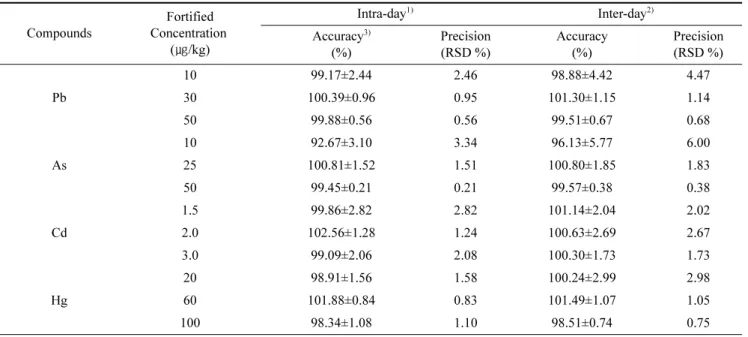
Table 2 shows the accuracy and precision for validation of the heavy metal analysis. The LOD for Pb, As, Cd and Hg were 7.3, 6.3, 0.5, and 1.6 µg/kg, respectively. The LOQ for Pb, As, Cd and Hg were 22.2, 19.0, 1.6, and 4.7 µg/kg, respectively. The results below the LOD were indicated as not detected (N.D.).
To evaluate the accuracy and precision of the analytical method, a standard solution was added to Atractylodes Rhizome White, in which heavy metals were not detected, and it was analyzed three times subsequent to pretreatment.
After obtaining the concentration for each step, the recovery was measured by calculating the recovered concentration relative to the added concentration. As a result of comparing the accuracy and recovery of the added concentration for comparison of measured values by pretreatment methods, the recovery of four heavy metals (Pb, As, Cd and Hg) showed reproducibility of 0.21-6.00 RSD% in all measured values. Thus, it was within the acceptable range stated by the Codex guideline19) (Table 2). The recovery of Pb, As, Cd, and Hg for three replicates of the QC material were 96.7±3.1%, 100.1±2.4%, 100.6±0.3%, and 102.0±5.0%, respectively (Table 3).
Results of heavy metals in herbal medicines
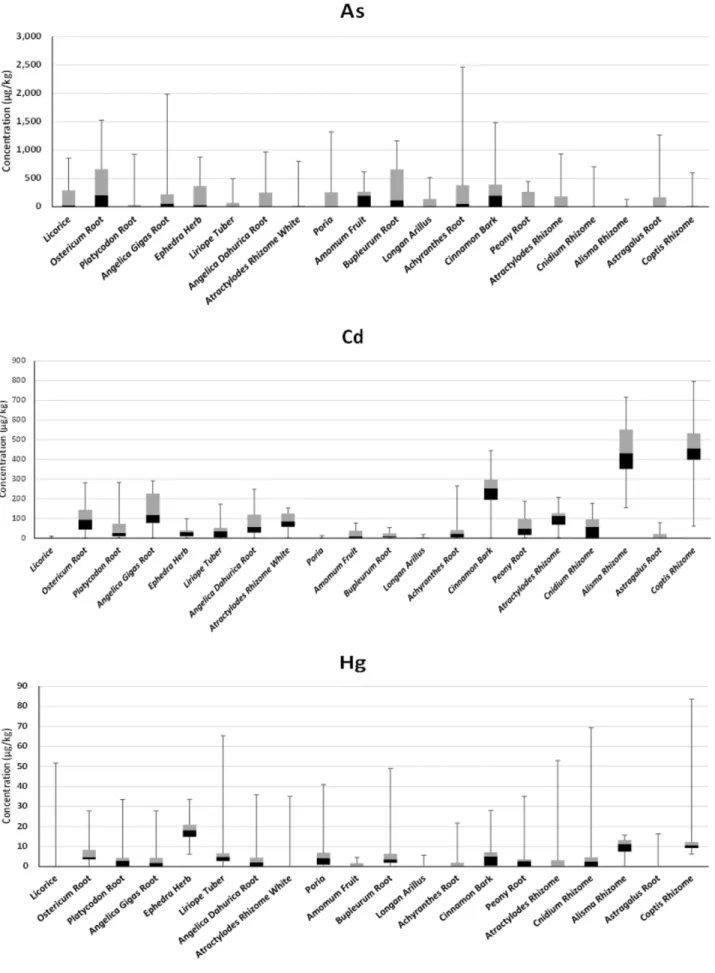
The minimum, maximum, median, and distribution obtained for each heavy metal in the herbal medicines are shown in a box plot (Fig. 1). The average concentration of Pb was 254.9 µg/kg (N.D.-2,515.2), and was highest in Coptis
Rhizome, followed by Ephedra Herb and Ostericum Root.
The herbal medicine with the highest Pb concentration was Coptis Rhizome (2,515.2 µg/kg), followed by Licorice
(2,313.9 µg/kg) and Bupleurum Root (2,113.3 µg/kg).
Previously, Bupleurum Root7,20) and Atractylodes Rhizome20) were reported as exceeding the allowable limit of Pb
Table 2. Accuracy and precision of heavy metals in Atractylodes Rhizome White
Compounds
Fortified Concentration
(㎍/kg)
Intra-day1) Inter-day2)
Accuracy3) (%)
Precision (RSD %)
Accuracy (%)
Precision (RSD %)
Pb
10 99.17±2.44 2.46 98.88±4.42 4.47
30 100.39±0.96 0.95 101.30±1.15 1.14
50 99.88±0.56 0.56 99.51±0.67 0.68
As
10 92.67±3.10 3.34 96.13±5.77 6.00
25 100.81±1.52 1.51 100.80±1.85 1.83
50 99.45±0.21 0.21 99.57±0.38 0.38
Cd
1.5 99.86±2.82 2.82 101.14±2.04 2.02
2.0 102.56±1.28 1.24 100.63±2.69 2.67
3.0 99.09±2.06 2.08 100.30±1.73 1.73
Hg
20 98.91±1.56 1.58 100.24±2.99 2.98
60 101.88±0.84 0.83 101.49±1.07 1.05
100 98.34±1.08 1.10 98.51±0.74 0.75
1)Analysis was conducted three times/day.
2)Analysis was conducted three times on three days.
3)Average±SD.
Table 3. Heavy metals in QC material (T07350QC, soya flour) Compounds Certified value
(µg/kg)
Measured value (µg/kg)
Recovery (%)
Relative standard deviation (%)
Pb 782 756±24 96.7±3.1 3.18
As 994 995±24 100.1±2.4 2.43
Cd 526 529±2 100.6±0.3 0.33
Hg 498 508±25 102.0±5.0 4.93
Fig. 1. Average concentrations of Pb, As, Cd and Hg in herbal medicines.
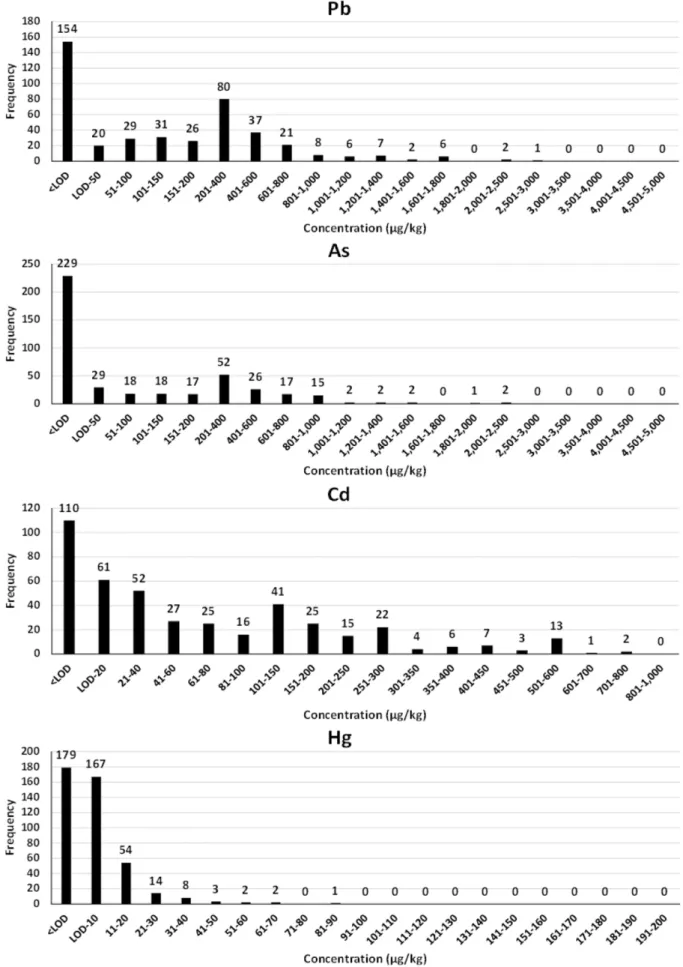
Fig. 2. Frequency distribution histogram of Pb, As, Cd and Hg in herbal medicines.
established by the KP but were acceptable in the current study.
The average As concentration was 171.0 µg/kg (N.D.- 2,456.2), and the top three highest values were detected in order of Ostericum Root > Achyranthes Root > Bupleurum Root. The herbal medicine with the highest As concentration was Achyranthes Root (2,465.2 µg/kg), followed by Angelica Gigas Root (1,988.2 µg/kg) and Ostericum Root (1,527.9 µg/
kg). Lee et al.21) found that the As concentration in Cinnamon Bark was higher than that in other herbal medicines. The result obtained for Cinnamon Bark in the current study is similar to that previous study21), but below the standard set by the KP. In addition, the average As concentration of imported Licorice was 169.2 µg/kg, which was similar to the average value (170 µg/kg) obtained by Jang et al.22)
The average Cd concentration was 99.2 µg/kg (N.D.- 797.1). The highest Cd concentration was detected in Coptis Rhizome (797.1 µg/kg), followed by Alisma Rhizome (716.0 µg/kg) and Cinnamon Bark (444.5 µg/kg), which was the same order as the average results. Heo et al.23) reported that the Cd concentration in Angelica Gigas Root was higher than the residual tolerance level. Although a high concentration of Cd (244.62 µg/kg) was found in Angelica Gigas Root in the current study, it was below the standard suggested by the KP. Moreover, it was similar to that observed by Kim et al.24) of 260 µg/kg.
The average Hg concentration was 6.0 µg/kg (N.D.-83.6) and was highest in Ephedra Herb, followed by Coptis Rhizome and Alisma Rhizome. The highest Hg concentration was detected in Coptis Rhizome (83.6 µg/kg). Cnidium Rhizome (69.3 µg/kg) and Liriope Tuber (65.4 µg/kg) had the second and third highest Hg concentrations, respectively.
In the study by Park et al.25), the average concentration of Hg in herbal medicines in North Gyeongbuk was 37.0 µg/
kg. In the current study, all data were below the standards given in the KP.
Results of distribution of heavy metal concentrations in herbal medicines
The frequency histogram of the heavy metals (Pb, As, Cd and Hg) in herbal medicines is shown in Fig. 2. Of the 430 herbal medicines analyzed, 154 (35.8%), 229 (53.3%), 110 (25.6%), 179 (41.6%), and of the samples were <LOD (N.D.) and had the highest distribution of heavy metals.
Therefore, the concentrations of all tested heavy metals in 20 types of herbal medicines sold in Korea were below the permissible limits stipulated by the Ministry of Food and Drug Safety (MFDS). As a result, the heavy metals in herbal medicines distributed in Korea were within the recommended safe standard.
국문요약
GF-AAS와 수은분석기를 이용하여 납, 비소, 카드뮴 및 수은의 회수율로 정확도를 측정한 결과 92.67-102.56% 범 위에서 측정되었고, 정밀도를 측정한 결과 0.21-6.00 RSD%
의 재현성을 보였으며, CODEX guideline에서 규정하는 범 위에 적합하였다. 또한, FAPAS QC material을 검증결과, 회 수율은 96.7-102.0%, 재현성은 0.33-4.93 RSD%로 우수한 결 과를 나타냈다. 한약재 430건의 평균 Pb 함량은 254.9 µg/kg (N.D.-2,515.2)이었고, 평균 As 함량은 171.0 µg/kg (N.D.- 2,465.2)이었으며, 평균 Cd 함량은 99.2 µg/kg (N.D.-797.1), 평균 Hg 함량은 6.0 µg/kg (N.D.-83.6)이었다. 분석 결과 우리나라에 유통되는 한약재 20종은 식품의약품안전처에 서 규정하는 한약재의 중금속 함량에 대한 허용기준 이내 의 결과로 모두 안전한 수준의 한약재로 나타났다. 이를 토대로 한약 규격품 제조업소를 품질관리의 기준으로 하 여 유통되기 직전의 가공 포장 과정에서의 한약재 중 납, 비소, 카드뮴 및 수은의 함량을 조사하여 한약재 내 중금 속 함량 실태를 파악하고, 국민에게 안전하고 우수한 한 약재를 공급하기 위한 기초자료로 활용할 수 있을 것으로 사료된다.
Conflict of interests
The authors declare no potential conflict of interest.
ORCID
References
1. Oh, C.H., Seo, D.W., Yook, C.S., Lee, Y.J., Chang, S.Y., Ze, K.R., Park, J.Y., Lee, J.P., Seong, R.S., Park, J.Y., Ko, S.K., Lee, P.J., The variation of residual sulfur dioxide and marker components of herbal medicines during drying process. Kor.
J. Pharmacogn., 38, 299-304 (2007).
2. Dobos, G.J., Tan, L., Cohen, M.H., McIntyre, M., Bauer, R., Li, X., Bensoussan, A., Are national quality standards for traditional Chinese herbal medicine sufficient?: Current gov- ernmental regulations for traditional Chinese herbal medi- cine in certain Western countries and China as the Eastern origin country. Complement. Ther. Med., 13, 183-190 (2005).
3. Zeng, Z.D., Liang, Y.Z., Chau, F.T., Chen, S., Daniel, M.K.W., Chan, C.O., Mass spectral profiling: an effective tool for quality control of herbal medicines. Anal. Chim.
Acta, 604, 89-98 (2007).
4. Wang, Z., Wang, H., Wang, H., Li, Q., Li, Y., Heavy metal pollution and potential health risks of commercially avail- Sang-A Kim https://orcid.org/0000-0003-1362-144X Young-Jun Kim https://orcid.org/0000-0001-7232-6008
able Chinese herbal medicines. Sci. Total Environ., 653, 748- 757 (2019).
5. Parvathy, P., Murali, V.S., Devi, V.N.M., Murugan, M., Jmaes, J.J., ICP-MS assisted heavy metal analysis, phyto- chemical, proximate and antioxidant activities of Mimosa pudica L. Mater. Today:Proc., 45, 2265-2269 (2021).
6. Lee, S.D., Lee, Y.K., Kim, M.S., Park, S.K., Kim, Y.S., Chae, Y.Z., The content and risk assessment of heavy metals in herbal pills. J. Food Hyg. Saf., 27, 375-387 (2012).
7. Yim, O., Han, E., Chung, J., Park, K., Kang, I., Kang, S., Kim, Y., The monitoring of some heavy metals in oriental herbal medicines and their intake rates. Anal. Sci. Technol., 22, 128-135 (2009).
8. Bellinger, D.C., Very low lead exposures and children's neu- rodevelopment. Curr. Opin. Pediatr., 20, 172-177 (2008).
9. Mandal, B.K., Suzuki, K.T., Arsenic round the world: a review. Talanta, 58, 201-235 (2002).
10. Vieira, C., Morais, S., Ramos, S., Delerue-Matos, C., Oliveira, M.B.P.P., Mercury, cadmium, lead and arsenic lev- els in three pelagic fish species from the Atlantic Ocean:
intra-and inter-specific variability and human health risks for consumption. Food Chem. Toxicol., 49, 923-932 (2011).
11. Al-Saleh, I., Al-Rouqi, R., Obsum, C.A., Shinwari, N., Mashhour, A., Billedo, G., Al-Sarraj, Y., Rabbah, A., Mer- cury (Hg) and oxidative stress status in healthy mothers and its effect on birth anthropometric measures. Int. J. Hyg. Envi- ron. Health, 217, 567-585 (2014).
12. Lee, S.D., Lee, J.S., Hwang, K.H., Kim, H.S., Yoo, I.S., Han, K.Y., Chae, Y.Z., A survey on heavy metal contents and transfer rate in animal medicines. Yakhak Hoeji, 57, 8-17 (2013).
13. Kim, J.W., Chio, H.Y., Cho, J.H., Kim, D.H., Kang, I.H., Shim, Y.H., Kim, E.K., Myung, S.W., Studies on monitoring hazardous substances of natural medicines (I)-Studies on heavy metals of natural medicines in market. Kor. J. Herbol- ogy, 17, 235-245 (2002).
14. Jang, S., Kim, T.H., Lee, A.R., Lee, A.Y., Choi, G., Kim, H.K., Monitoring of heavy metal contents in commercial herbal medicines. Korean J. Medicinal Crop Sci., 20, 434- 439 (2012).
15. Choi, S.M., Chung, H.J., Yoon, Y.S., Lee, M.Y., Choi, H.S., Sung, H.J., Studies on the administration of the quality of herbal medicine. J. Korean Med., 21, 99-112 (2000).
16. Kim, H.S., Kim, K.R., Hong, C.O., Go, W.R., Jeong, S.H., Yoo, J.H., Cho, N.J., Hong, J.H., Kim, W.I., Monitoring of Cd, Hg, Pb, and As and risk assessment for commercial medicinal plants. Korean J. Environ. Agric., 34, 282-287 (2015).
17. Ministry of Food and Drug Safety, (2021, June 24). The Korean herbal pharmacopoeia. Retrieved from https://
nedrug.mfds.go.kr/ekphome
18. International Conference on Harmonisation, (2021, June 24).
Quality Guidelines: Analytical Validation. Retrieved from https://www.ich.org/page/quality-guidelines
19. Thompson, M., Ellison, S., Fajgelj, A., Willetts, P., Wood, R., Harmonized guidelines for the use of recovery informa- tion in analytical measurement. Pure Appl. Chem., 71, 337- 348 (1999).
20. Jung, S.J., Kang, S.T., Han, C.H., Kim, S.J., Ko, S.K., Kim, Y.H., Kim, Y.K., Kim, B.S., Choi, B.H., Survey of heavy metal contents and intake rates after decoction in herbal medicines classified by parts. J. Food Hyg. Saf., 25, 402-409 (2010).
21. Lee, S.H., Choi, H.Y., Park, C.H., Determination of heavy metal contents in oriental medical aterials and the effect of washing. KSBBJ, 18, 90-93 (2003).
22. Jang, S., Lee, A.R., Lee, A.Y., Choi, G.Y., Kim, H.K., Moni- toring of heavy metal contents in commercial herbal medi- cines in Korea: cultivated herbal medicines in the Seoul and Daegu areas. J. Environ Health Sci., 41, 30-39 (2015).
23. Cha, Y.Y., Heo, S.K., Kim, D.G., Baik, T.H., Seo, H.S., Park, H.S., Kim, B.W., Kwon, K.R., Lee, S.G., Yoo, J.S., Sohn, Y.J., Sun, S.H., Cha, B.C., Seo, S.H., Determination of heavy metals and residual pesticides in oriental medical materials- cultivated oriental medical materials at sangji university ori- ental medical hospital. J. Physiol & Pathol Korean Med., 21, 226-230 (2007).
24. Kim, J.S., Hwang, S.W., Kim, J.M., Ma, J.Y., Monitoring research for heavy metals as endocrine disruptors in sibjeon- daebotang and its ingredients herbal medicines (II). Yakhak Hoeji, 45, 448-454 (2001).
25. Park, M.K., Kim, S.Y., Hwang, H.U., A study on the heavy metal contents in herbal medicines-cultivated herbal medi- cines at North Gyeongbuk Area. J. Environ. Sci. Int., 13, 1117-1122 (2004).