Impact of Continuous Application of Swine Slurry on Changes in Soil Properties and Yields of Tomatoes and Cucumbers in a Greenhouse
Young-Ho Seo*, Byoung-Ouk Cho, Jun-Keun Choi, An-Seok Kang, Byeong-Chan Jeong, and Yeong-Sang Jung1
Gangwondo Agricultural Research & Extension Services, Chuncheon 200-150, Korea
1Kangwon National University, Chuncheon 200-701, Korea
Five year term study from 2002 to 2006 was carried out to examine the effects of continuous long-term application of swine liquid manure on soil chemical properties including heavy metal contents and yield of tomato (Lycopersicon esculentum) and cucumber (Cucumis sativus L.) in a greenhouse. Treatments were conventional chemical fertilizers and three types of swine slurry; Slurry composting and biofiltration (SCB), Thermophilic aerobic oxidation (TAO), and Bio-mineral water (BMW). Total nitrogen level of the SCB, TAO, and BMW was 0.47%, 0.09%, and less than 0.01%, respectively. The heavy metal contents of the three liquid manures were much lower than the Korean regulation level. The soil phosphorus, potassium, and heavy metal contents after five year continuous application of swine slurry were not significantly higher than those of chemical fertilizer use. Contents of heavy metals in leaves of the crops did not show significant difference among treatments. The levels of copper and zinc, plant essential elements, in leaves were in the range of optimum plant growth. Yields of tomato and cucumber for swine liquid manures were not significantly different from that of chemical fertilizer. The results implied that the three types of swine slurry may not deteriorate soil chemical properties including phosphate and trace elements in greenhouse soils when they are applied as a basal fertilization at a recommended nitrogen rate based on soil testing.
Key words: Cucumber, Greenhouse soil, Heavy metal, Swine slurry, Tomato
Received : June 10. 2010 Accepted : June 14. 2010
*Corresponding author : Phone: +82332589732 E-mail: [email protected]
Introduction
Mass production of animal waste has been one of the major environmental problems in Korean agriculture as livestock production has increased (Ministry for Food, Agriculture, Forestry and Fisheries, 2009). The annual production of animal wastes was as much as 42 million Mg. The estimated amount of animal wastes returned to agricultural land was 82% of the animal by-products (Lee, 2006). The amount of nitrogen, phosphorus, and potassium in animal by-products, therefore, were 398, 495, and 310 thousand tons annum, respectively. Many farmers prefer use of livestock manure as organic fertilizer resources to chemical fertilizers for nutrient supply, probably due to low price.
It is reasonable to assume that the application of
animal manure to agricultural fields can have both positive and negative effects on soil and water environments. One of the negative impacts is the buildup of phosphorus (P) in manure-applied soils, resulting in excessive soil P levels relative to crop requirements and reduced plant uptake of other essential nutrients. Furthermore, P can reach aquatic environments via preferential flow pathways through soil macropores and facilitated transport by mobile organic sorbents in addition to soil erosion and surface runoff (Sharpley et al., 1994; James et al., 1996; Jensen et al., 1998; Scott et al., 1998; Seo and Lee, 2005; Seo et al., 2005).
Additionally, various trace elements such as copper (Cu), zinc (Zn), arsenic (As), cobalt (Co), iron (Fe), manganese (Mn), and selenium (Se) are added to animal feed in order to prevent diseases, improve body weight gain, and increase feed use efficiency (Tufft and Nockels, 1991), which leads to elevated concentrations
Table 1. Soil chemical properties of the site before the study.
pH (H2O, 1:5)
Electrical conductivity
Organic matter
Available P2O5
Exchangeable cation Trace element
Ca K Mg Cu Zn
dS m-1 g kg-1 mg kg-1 cmol+ kg-1 mg kg-1
5.8 1.2 21 593 4.8 0.69 1.6 0.9 7.1
of the elements in animal manure by-products (Morrison, 1969; Kunkle et al., 1981). As a result, it has been reported that continuous application of animal manure resulted in elevated levels of Cu and Zn in the surface soils and the plants grown in the soil (Kingery et al., 1994; Lim et al., 2004; Moreno-Caselles et al., 2005). Long-term repeated application of animal manure by-products may adversely affect soil and water environments and food quality. Therefore, the value of land application of animal waste to agricultural soils should be assessed from an environment standpoint in addition to crop production.
Copper and zinc are two of the 16 essential plant nutrients, and a lack of these micronutrients can limit plant growth and crop yields even when all other essential nutrients are present in adequate levels in the soil. Copper and zinc catalyze several plant metabolic reactions and are necessary for chlorophyll production.
Most of the functions of Cu are related to the bound Cu to enzymes regarding redox reactions including plastocyanin, superoxide dismutase, cytochrome oxidase, ascorbate oxidase, diamine oxidase, and phenol oxidases.
Zinc also is an integral component of the enzyme structure including alcohol dehydrogenase, carbonic anhydrase, Cu/Zn superoxide dismutase, alkaline phosphatase, phospholipase, carboxypeptidase, and RNA polymerase, and involved in DNA replication and in the regulation of gene expression (Marschner, 2002).
However, excessive supply of Cu and Zn can result in expression of plant toxicity. Copper toxicity leads to Fe deficiency symptoms in plants by depressing the Fe activity. Additionally, high Cu concentrations may cause chlorosis due to lipid peroxidation and the destruction of membranes, and inhibited root elongation and root plasma membrane damage. High Zn concentration can result in inhibition of root elongation and photosynthesis and chlorosis in young leaves due to induced deficiency of Fe or
magnesium (Marschner, 2002).
The objective of the study was to assess the effects of continuous 5-year application of liquid swine manure on soil environments under greenhouse by comparing with the application of inorganic chemical fertilizers.
Materials and Methods
Tomato (Lycopersicon esculentum) and cucumber (Cucumis sativus L.)were planted at 1.8 by 4.4 m confined plots with Gyuam silty loam (coarse silty, mixed, nonacid, mesic Aquic Fluventic Eutrochrepts) in spring and fall, respectively. Selected chemical properties of the soil in the site are shown in Table 1.
The treatments consisted of conventional chemical fertilizer (C) and three types of liquid swine manure;
thermophilic aerobic oxidation (TAO), slurry composting and bio-filtration (SCB), and bio-mineral water (BMW).
Fertilization rates were determined based on soil testing before the crop cultivation. TAO and SCB were applied as a basal fertilization at a recommended nitrogen rate, 12.5 kg N 10a-1 and 13.1 kg N 10a-1 for tomato and 10.0 kg N 10a-1 and 10.4 kg N 10a-1 for cucumber, respectively. Applied amounts of TAO and SCB were 2,700 L and 14,600 L for tomato and 2,100 L and 11,600 L for cucumber per 10a, respectively.
Application rate of BMW was the same as that of TAO, 2,100~2,700 L 10a-1, and deficient nitrogen was supplemented with chemical fertilizer, urea, due to very low nitrogen level in BMW. Additional fertilization of nitrogen and potassium during the crop cultivation was performed as a form of drip irrigation of fertilizer-dissolved water for all the treatments. The chemical fertilizers and liquid manures were applied to the same plot for 5 consecutive years (2002-2006).
Chemical compositions of three liquid manures are presented in Table 2.
The surface soils collected at the 15-cm depth from
Table 2. Chemical components of the liquid swine manures used in the study.
Swine slurry Plant nutrient Trace element
T-N P2O5 K2O CaO MgO Cd Cr Cu Ni Pb Zn Hg As
g kg-1 mg kg-1
TAO† 4.7 0.3 3.5 0.3 tr 0.02 0.67 3.1 0.81 0.05 0.61 tr 0.02
SCB 0.9 0.2 1.9 0.1 tr 0.02 0.88 1.7 0.58 0.15 11 tr 0.01
BMW 0.1 0.1 0.9 0.4 tr 0.03 0.83 0.7 0.61 0.12 0.62 tr tr
†TAO: Thermophilic aerobic oxidation, SCB: Slurry composting & bio-filtration, BMW: Bio-mineral water.
Table 3. Soil chemical characteristics after the five-year study.
Treatment pH
(H2O, 1:5)
Electrical conductivity
Organic matter
Available P2O5
Exchangeable cation
Ca K Mg
dS m-1 g kg-1 mg kg-1 cmol+ kg-1
TAO† 6.1a‡ 1.6a 21a 571a 5.2a 0.66a 1.7a
SCB 5.9a 1.4a 20a 547a 5.1a 0.55a 1.7a
BMW 5.8a 1.9a 22a 587a 4.6a 0.72a 1.8a
Fertilizer 5.7a 1.8a 21a 593a 4.9a 0.84a 1.9a
†TAO: Thermophilic aerobic oxidation, SCB: Slurry composting & bio-filtration, BMW: Bio-mineral water.
‡Treatments with same letter in each column are not significantly different at the 0.05 probability level by t-test.
each plot were air-dried, passed through a 2 mm sieve, and used to determine soil chemical properties including soil pH, electrical conductivity (EC), soil organic matter, available phosphate, and exchangeable cations by soil analysis method recommended by National Institute of Agricultural Science and Technology (2000). Briefly, soil pH and EC were measured after mixing soil with H2O at a ratio of 1:5. Soil organic matter and available phosphate were determined by Tyurin and Lancaster method, respectively. Exchangeable cations such as potassium, calcium, and magnesium were analyzed by extracting them with 1 N ammonium acetate (pH 7).
Amounts of exchangeable cations were determined by inductively coupled plasma spectrophotometer (ICP, GBC Integra XMP, GBC Scientific Equipment Pty Ltd, Victoria, Australia). Soil exchangeable nitrate level was obtained by Kjeldahl distillation using devarda alloy after removing ammonium and nitrite with sulfamic acid and MgO from 2 M KCl extracts. Extractable trace elements including Cd, Cr, Cu, Ni, Pb, Zn, Hg, and As were extracted from the soil samples using 0.1 N HCl at a ratio of 1:5 soil: extractant. Amounts of trace elements in the extracts were determined by inductively coupled plasma spectrophotometer (ICP, GBC Integra XMP, GBC Scientific Equipment Pty Ltd, Victoria,
Australia).
Results and Discussion
Soil chemical properties for swine slurry treatments were not significantly different from those of conventional chemical fertilizer treatment (Table 3).
Soil pH values for swine slurry were slightly higher than soil pH for fertilizer. Available phosphate levels for three types of liquid swine manure were not significantly different from the level for chemical fertilizer because of low phosphate concentration in the liquid swine manures relative to nitrogen. The result may indicate that soil chemical properties including phosphorus level were not greatly affected by the application of swine liquid manures when they were applied as basal fertilization alone based on recommend nitrogen rate.
Accumulation of trace elements including zinc and copper for swine slurry treatments was not observed as compared with chemical fertilizer because trace elements levels after 5-year experiment showed little difference among treatments (Table 4). Soil zinc concentration for SCB having relatively higher zinc
Table 4. Trace element levels in the soils after the study.
Treatment Cd Cr Cu Ni Pb Zn Hg As
mg kg-1
TAO† 0.05a‡ 0.38a 1.2a 0.23a 1.4a 6.4a 0.03a 0.05a
SCB 0.06a 0.38a 0.9a 0.20a 1.4a 6.1a 0.05a 0.04a
BMW 0.05a 0.37a 1.4a 0.17a 1.4a 7.4a 0.03a 0.04a
Fertilizer 0.04a 0.37a 0.9a 0.19a 1.5a 7.2a 0.02a 0.04a
†TAO: Thermophilic aerobic oxidation, SCB: Slurry composting & bio-filtration, BMW: Bio-mineral water.
‡Treatments with same letter in each column are not significantly different at the 0.05 probability level by t-test.
Table 5. Trace element levels in leaves of tomato and cucumber.
Crop Treatment Cd Cr Cu Ni Pb Zn
mg kg-1
Tomato TAO† 0.11a‡ 1.4a 13a 2.0a 1.4a 26a
SCB 0.15a 1.3a 11a 1.6a 1.6a 27a
BMW 0.34a 2.0a 7a 2.4a 1.1a 29a
Fertilizer 0.21a 1.3a 10a 2.2a 1.3a 31a
Cucumber TAO 0.28a 2.4a 12a 5.9a 5.4a 40a
SCB 0.37a 2.3a 17a 4.3a 4.4a 35a
BMW 0.33a 2.3a 24a 3.6a 4.0a 48a
Fertilizer 0.16a 2.2a 29a 5.1a 3.3a 48a
†TAO: Thermophilic aerobic oxidation, SCB: Slurry composting & bio-filtration, BMW: Bio-mineral water.
‡Treatments with same letter in each column are not significantly different at the 0.05 probability level by t-test.
than other swine slurries was not significantly different from the other treatments.Lim et al. (2009) also reported little difference in copper and zinc concentration between SCB and chemical fertilizer treated soils after four cropping seasons.
Average levels of cadmium, copper, lead, zinc, and arsenic of greenhouse soils in Korea were 0.21 mg kg-1, 3.7 mg kg-1, 2.5 mg kg-1, 23 mg kg-1, and 0.65 mg kg-1, respectively (Jung et al., 1997). Concentrations of soil trace elements after the study were less than the average values for greenhouse soils in Korea; less than 0.1 mg kg-1 for cadmium, less than 2 mg kg-1 for copper, and less than 10 mg kg-1 for zinc. The result imply that applying swine slurry based on basal nitrogen fertilization may not result in damage to crops by contamination of trace elements including cadmium, copper, and zinc. Successive application of excessive amount of swine slurry relative to recommended nitrogen rate may cause potential accumulation of trace elements, which is being tested now.
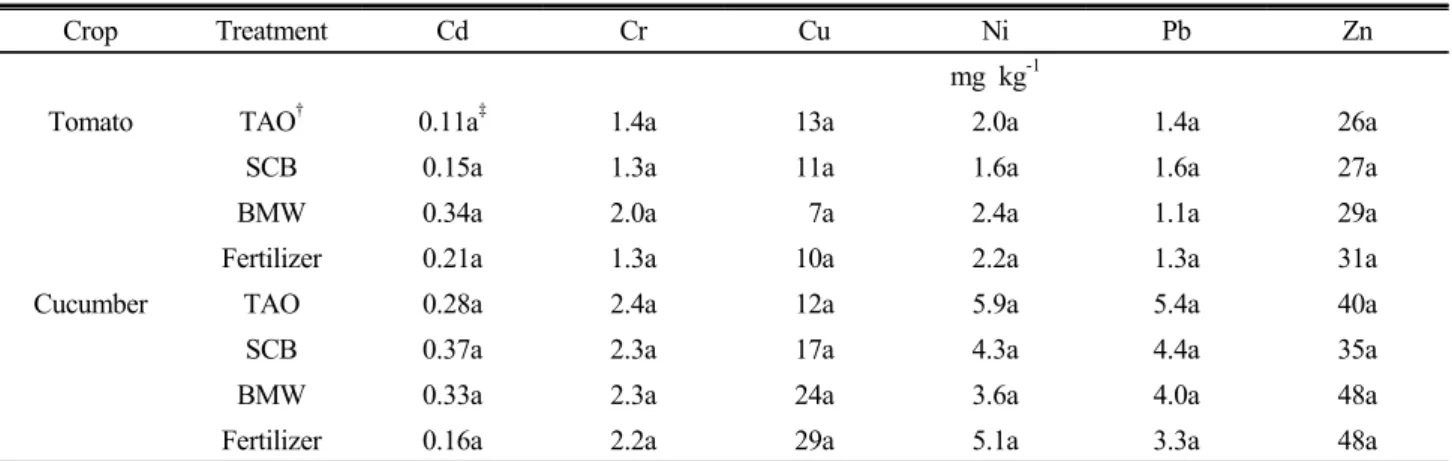
As in soils, trace elements levels in leaves of tomato
and cucumber for swine slurry treatment were not significantly different from those for chemical fertilizer. Average amounts of cadmium, copper, lead, and zinc in leaves of cucumber cultivated in greenhouse were 0.54 mg kg-1, 11.5 mg kg-1, 3.6 mg kg-1, and 73.4 mg kg-1, respectively (Jung et al., 1997).
Ha et al. (1997) reported that mean zinc level in leaves of cucumber cultivated in southern Korea area was 64 mg kg-1. Copper and zinc levels in leaves were 568 mg kg-1 and 38 mg kg-1 for tomato, and 169 mg kg-1 and 101 mg kg-1 for cucumber grown in Yeongnam region (Jung et al., 2006). Mean levels of trace elements in vegetables were reported to be 0.44 mg kg-1 for cadmium, 8.2 mg kg-1 for copper, 4 mg kg-1 for lead, 74 mg kg-1 for zinc, 4.0 mg kg-1 for nickel, and 1.5 mg kg-1 for chromium.Compared with these values in previous studies, trace element levels in this experiment were relatively low. On the other hand, optimum concentrations in crop leaves ranged from 5 to 30 for copper and from 20 to 150 for zinc in terms of essential plant nutrient (Jones, 1991). It can be concluded that
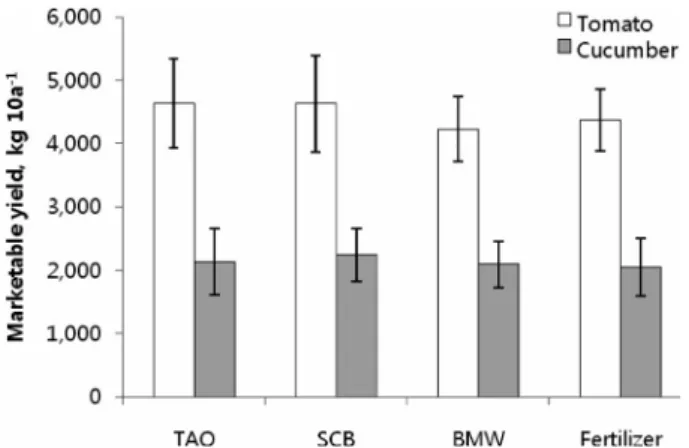
Fig. 1. Mean marketable yield of tomato and cucumber during 5 year study. Error bars indicate ± 1 standard deviation. TAO: Thermophilic aerobic oxidation, SCB:
Slurry composting & bio-filtration, BMW: Bio-mineral water.
levels of copper and zinc in the study were in proper range.
Copper in swine slurry was not seemed to accumulate in tomato and cucumber because of inhibition mechanism of excessive absorption of copper by soil-plant barrier (McBride et al., 2003). Therefore, potential risk of copper intake by human from soil through crop may be relatively low compared with other trace elements (USEPA, 1992). Jung et al. (2006) reported a little relationship between trace element levels in greenhouse soils and those in plants cultivated in the soils. They assumed that plant and soil factors more greatly influenced on trace elements absorption by crop roots than trace element levels in soils.
Absorption and accumulation of trace elements by plants may depend on type of crops. For instance, considerable amounts of cadmium and zinc were taken up by lettuce as compared with radish (Sukkariyah et al., 2005). The possibility of trace element accumulation cannot be excluded for other crops than tomato and cucumber.
Successive application of livestock manure to agricultural land may result in trace element contamination of water environments. Tian et al.
(2006) reported a little impact of trace elements treatment for 31 years on surface water contamination;
30.7 kg copper ha-1, 4.5 kg cadmium ha-1, and 0.11 kg mercury ha-1 every year. However, more extensive researches are needed to examine potential contamination of trace elements in surface water and groundwater by
trace elements in livestock manure through runoff and leaching.
Mean marketable yields of tomato and cucumber for five years are shown in Fig. 1 Statistical significance among treatments was not observed. It can be concluded that swine slurry application did not decrease crop yield compared with conventional chemical fertilizer. Lim et al. (2009) reported no significant effect of SCB and chemical fertilizers on Chinese cabbage yield in two year experiment.
Conclusion
Successive application of three types of liquid swine manures for five years did not result in deterioration of soil chemical properties including phosphate level and contamination and accumulation of trace elements including zinc and copper in soils and crops as compared with conventional chemical fertilizers when they were applied as basal fertilization alone based on recommended nitrogen rate. Productivities of tomato and cucumber showed no significant difference between swine slurry treatments and chemical fertilizer treatment. There was no significant difference among three types of swine slurries in terms of soil chemical properties and crop yields. More extensive studies will be required to determine the effect of long-term application, more than 10 years, and continuous treatment of excessive amount of livestock manure on soil and water environments.
Acknowledgement
This study was carried out with the support of
“Cooperative Research Program for Agricultural Science & Technology Development (Project No.
PJ004652201006)”, Rural Development Administration, Republic of Korea.
References
Chung, J.B., B.J. Kim, K.S. Ryu, S.H. Lee, H.J. Shin, T.K.
Hwang, H.Y. Choi, Y.W. Lee, Y.J. Lee, and J.J. Kim. 2006.
Relationships between micronutrient contents in soils and crops of plastic film house. Korean J. Environ. Agr. 25:217-227.
Ha, H.S., M.S. Yang, H. Lee, Y.B. Lee, B.K. Sohn, and U.G.
Kang. 1997. Soil chemical properties and plant mineral contents in plastic film house in southern part of Korea.
Korean J. Soil Sci. Fert. 30:272-279.
James, D.W., J. Jotuby-Amacher, G.L. Anderson, and D.A.
Huber. 1996. Phosphorus mobility in calcareous soils under heavy manuring. J. Environ. Qual. 25:770-775.
Jensen, M.B., P.R. Jorgensen, H.C.B. Hansen, and N.E. Nielsen.
1998. Biopore mediated subsurface transport of dissolved orthophosphate. J. Environ. Qual. 27:1130-1137.
Jones, J.B. 1991. Plant tissue analysis in micronutrients. p. 477- 521. In Mortvedt, J.J. et al. (ed.) Micronutrient in agriculture (2nd ed.). Soil Science Society of America book series 4, Madison, WI, USA.
Jung, G.B., K.Y. Jung, G.H. Cho, B.G. Jung, and K.S. Kim.
1997. Heavy metal contents in soils and vegetables in the plastic film house. Korean J. Soil Sci. Fert. 30:152-160.
Kingery, W.L., C.W. Wood, D.P. Delaney, J.C. Williams, and G.L. Mullins. 1994. Impact of long-term land application of broiler litter on environmentally related soil properties. J.
Environ. Qual. 23:139-147.
Kunkle, W.E., L.E. Carr, T.A. Carter, and E.H. Bossard. 1981.
Effect of flock and floor type of the levels of nutrient and heavy metals in broiler litter. Poultry Sci. 60:1160-1164.
Lee, Y. 2006. Nitrogen management in Korean agriculture. In Nitrogen Behavior and Effective Management in Agro- Ecosystem. Korea-Japan Joint International Symposium.
Rural Development Administration. Suwon. Rep. of Korea.
Lim, D.K., S.B. Lee, S.I. Kwon, S.H. Lee, K.H. So, K.S. Sung, and M.H. Koh. 2004. Effect of pharmaceutical byproduct and cosmetic industry wastewater sludge as raw materials of compost on damage of red pepper cultivation. Korean J.
Environ. Agr. 23:211-219.
Lim, T.J., I.B. Lee, S.B. Kang, J.M. Park, and S.D. Hong. 2009.
Effects of continual pre-plant application of pig slurry on soil mineral nutrients and yield of Chinese cabbage. Korean J.
Environ. Agr. 28:227-232.
Marschner, H. 2002. Mineral nutrition of higher plants (2nd ed.).
pp 333-364. Academic Press. London. UK.
McBride, M.B., E.A. Nibarger, B.K. Richards, and T. Steenhuis.
2003. Trace metals accumulation by red clover grown on sewage sludge-amended soils and correlation to Mehlich-3 and calcium chloride extractable metals. Soil Sci. 168: 29-38.
Ministry for Food, Agriculture, Forestry and Fisheries. 2009.
Statistics 2009 for food, Agriculture, Forestry, and Fisheries.
Ministry for Food, Agriculture, Forestry and Fisheries.
Gwacheon, Korea.
Moreno-Caselles, J., R. Moral, M.D. Perez-Murcia, A.
Perez-Espinosa, C. Paredes, and E. Agullo. 2005. Fe, Cu, Mn, and Zn input and availability in calcareous soils amended with the solid phase pig slurry. Commun. Soil Sci. Plant Anal. 36:525-534.
Morrison, J.L. 1969. Distribution of arsenic from poultry litter in broiler chickens, soil and crops. J. Agric. Food Chem.
17:1288-1290.
National Institute of Agricultural Science and Technology (NIAST). 2000. Methods of soil and plant analysis. NIAST, Rural Development Administration, Suwon, Korea.
Scott, C., L.D. Geohring, and M.F. Walter. 1998. Water quality impacts of tile drains in shallow, sloping, structured soils as affected by manure applications. Appl. Eng. Agric. 14:593-603.
Seo, Y. and J. Lee. 2005. Characterizing preferential flow of nitrate and phosphate in soil using time domain reflectometry.
Soil Sci. 170:47-54.
Seo, Y., J. Lee, W.E. Hart, H.P. Denton, D.C. Yoder, M.E.
Essington, and E. Perfect. 2005. Sediment loss and nutrient runoff from three fertilizer application methods. Trans. ASABE.
48:2155-2162.
Sharpley, A.N., S.C. Chapra, R. Wedepohl, J.T. Sims, T.C. Daniel, and K.R. Reddy. 1994. Managing agricultural phosphorus for protection of surface waters: Issues and options. J. Environ.
Qual. 23:437-451.
Sukkariyah, B.F., G. Evanylo, L. Zelazny, and R.L. Chaney.
2005. Cadmium, copper, nickel, and zinc availability in a biosolids-amended Piedmont soil years after application. J.
Environ. Qual. 34: 2255-2262.
Tian, G. T.C. Granato, R.I. Pietz, C.R. Carlson, and Z. Abedin.
2006. Effect of long-term application of biosolids for land reclamation on surface water chemistry. J. Environ. Qual. 35:
101-113.
Tufft, L.S. and C.F. Nockels. 1991. The effects of stress, Escherichia coli, dietary EDTA, and their interaction of tissue trace elements in chicks. Poultry Sci. 70:2439-2449.
US. Environmental Protection Agency (EPA). 1992. Technical support document for land application of sewage sludge.
NTIS PB 93-110575. USEPA. Office of Water, Springfield, VA. USA.
돈분 액비의 연용이 시설하우스 토양 및 토마토와 오이 수량에 미치는 영향 평가
서영호*·조병욱·최준근·강안석·정병찬·정영상1 강원도농업기술원, 1강원대학교 바이오자원환경학과
돈분뇨 축산 액비의 연용이 토마토와 오이의 수량 및 식물체내 중금속 함량에 미치는 영향과 시설하우스 토양의 화학성 및 중금속 함량에 미치는 영향을 구명하고자 2002년부터 2006년까지 5년간 같은 처리구에 동일한 돈분 액비를 계속 처리하 였다. 시험에 쓰인 돈분 액비는 SCB, TAO, BMW 등 3종이었으며, 대조구로 화학비료 처리구를 두어 비교하였고, 시설하 우스의 토양은 규암통 미사질양토로, 염류나 중금속 함량이 높지 않았다. TAO에 비해 SCB는 질소 함량이 적었고 BMW는 매우 낮았으며, 인산과 칼리 함량도 비슷한 경향을 나타내었다. 세 가지 돈분 액비를 처리했을 때 토마토와 오이의 수량은 화학비료를 처리한 관행시비와 크게 다르지 않아, 축산 액비의 연용이 작물의 수량성에 악영향을 미치지는 않은 것으로 여 겨진다. 5년간 돈분 액비를 계속 사용하여 처리한 결과, 토양 화학성에 있어 화학비료 처리구에 비해 인산과 칼리의 함량 이 높지 않았으며 중금속 함량도 비슷한 수준이었다. 식물체의 중금속 함량도 관행 화학비료 처리와 크게 다르지 않았으 며, 우리나라 시설재배지 작물의 평균 중금속 함량과 비교해서도 높지 않았다. 따라서 돈분뇨 발효 액비를 기비의 질소 시 용량 기준으로 처리했을 때에는 토마토와 오이의 수량이 화학비료를 처리했을 때와 대등하였으며, 토양 화학성 측면에서도 나쁜 영향을 미치지는 않는 것으로 판단된다. 이는 돈분뇨 축산 액비를 질소 기비 수준으로 처리한 결과로서, 단위 면적당 돈분 액비 처리량을 높였을 때에는 다른 결과를 얻을 수 있으므로, 심도있는 검토와 연구가 필요하다.