• 검색 결과가 없습니다.

Capillary Electrophoresis Detection of Hydrogen Peroxide by Using Titanium Ion and 4-(2-thiazolylazo)resorcinol

N/A
N/A
Protected

Academic year: 2021

Share "Capillary Electrophoresis Detection of Hydrogen Peroxide by Using Titanium Ion and 4-(2-thiazolylazo)resorcinol"

Copied!
5
0
0

로드 중.... (전체 텍스트 보기)

전체 글

(1)

http://dx.doi.org/10.11620/IJOB.2017.42.4.197 pISSN 1226-7155, eISSN 2287-6618

A novel method for the detection of hydrogen peroxide in aqueous solution was developed via reaction between H

2

O

2

, trivalent titanium ion (Ti

3+

) and 4-(2-thiazolylazo) resorcinol (TAR), resulting in a ternary complex with a maximum UV absorbance at 530 nm. The CE detection of H

2

O

2

was fast, sensitive and cost-effective without pretreatment procedures.

H

2

O

2

was detected within 15 min at 1 to 100 μM range with the lowest detection limit at 1.0 μM. Under the optimized CE conditions, the concentration of H

2

O

2

in coffee or tea extract was quantitatively determined. Our results show that CE detection of the ternary complex of H

2

O

2

-Ti

3+

-TAR has potential applications for the detection of H

2

O

2

in aqueous sources.

Key words: Hydrogen peroxide, capillary electrophoresis (CE), titanium ion (Ti

3+

), 4-(2-thiazolylazo)resorcinol (TAR).

Introduction

Hydrogen peroxide is an integral part of chemical and biological systems as temporary reservoirs for HO

x

· and RO

x

· radicals [1]. In biological systems, H

2

O

2

is produced in various reactions catalyzed by numerous enzymes [2,3], functioning as a messenger in cellular signal transduction [3]. H

2

O

2

mediates various cellular injuries and may cause mutagenesis or carcinogenesis [4]. In dental field, H

2

O

2

is used for tooth whitening purpose by degrading colored pigments on the enamel [5].

Detecting hydrogen peroxide in aqueous environment has been difficult due to short half-life time and instability. There has been several methods developed for the detection of H

2

O

2

. Ti-PAPS (titanium 2-((5-bromopyridyl)azo)-5-(N-propyl-N- sulfopropylamino) phenol) reagents were used for the spectrophotometric detection of H

2

O

2

[6]. The Fox assay, developed in 1990’s, uses ferrous ion oxidation in the presence of the ferric ion indicator, xylenol orange, under acidic condition [7]. Tanner and co-workers detected H

2

O

2

through a reaction with pyridine-2,6-dicarboxylic acid and vanadate (V) in acidic solution to form chelate complex, oxo- peroxo-pyridine-2,6-dicarboxylato vanadate (V) [8]. Recently, the ternary complex of Ti-H

2

O

2

and 4-(2-pyridinylazo)resorcinol (PAR) was used for H

2

O

2

detection [9]. Other methods using florescent probes, chemiluminescence or enzyme peroxidase are also known [10,11].

4-(2-Thiazolylazo)resorcinol (TAR) used in this study is a

Capillary Electrophoresis Detection of Hydrogen Peroxide by Using Titanium Ion and 4-(2-thiazolylazo)resorcinol

Dong Vu Phuong and Hoon Yoo

*

Department of Pharmacology and Dental Therapeutics, College of Dentistry, Chosun University, Gwangju 501-759 South Korea (received November 16, 2017; revised December 14, 2017; accepted December 15, 2017)

*Correspondence to: Hoon Yoo, Department of Pharmacology and Dental therapeutics, College of Dentistry, Chosun University, Gwangju 501-759 South Korea

Tel: +82-62-230-6894, Fax: +82-62-230-6894 E-mail: [email protected]

ORCID : 0000-0002-9249-1446

This is an Open-Access article distributed under the terms of the Creative Commons Attribution Non-Commercial License (http://creati- vecommons.org/licenses/by-nc/3.0) which permits unrestricted non- commercial use, distribution, and reproduction in any medium, pro- vided the original work is properly cited.

197

(2)

derivative of PAR which has high affinity to titanium ion.

TAR also functions as an indicator of spectrometric detection of complexes. Here, we present novel CE detection method of hydrogen peroxide in aqueous solution by using the interaction of H

2

O

2

, TAR and trivalent titanium ion. CE detection of Ti(III)–TAR–H

2

O

2

ternary complex was fast, sensitive, cost-effective without requiring pre-treatment steps.

We show that this method could be successfully applied for the accurate measurement of H

2

O

2

in beverages such as tea and coffee.

Material and Methods

Hydrogen peroxide (35 %) was purchased from Junsei Chemical Industries (Tokyo, Japan). Sep-Pak catridges and filters (0.45 µm) were from Waters (Milford, MA, USA).

Commercial tea or coffee product was purchased from a local shop. Catalase from bovine liver was obtained from Sigma Chemical (St. Louis, MO, USA). CE background electrolyte and standard solutions were prepared in Milli-Q water produced by a purification system (Millipore, Molsheim, France). The background electrode (BGE) was 75 mM boric acid and 35 mM NaOH, pH 9.1.

Preparation of Ti(III)-TAR-H

2

O

2

ternary complex Trivalent titanium ion (Ti

3+

) solution was prepared by dissolving a titanium disc into concentrated HCl (10 M) on hot plate and then diluted to 10 mM solution. The mixed solution of Ti(III) ion and 4-(2-thiazolylazo) resorcinol (Ti(III)–

TAR) was prepared by mixing 1:1 volume ratio of stock titanium (10 mM) and 10 mM TAR solutions (Alfa Aesar, Seoul, Korea). The appropriate concentration of aqueous H

2

O

2

was added into the Ti(III)-TAR complex solution to form ternary complex of Ti(III)–TAR–H

2

O

2

. The complex of Ti(III)–

TAR–H

2

O

2

was detected at 530 nm by UV-Vis spectrophotometer (Hitachi, Tokyo, Japan).

Capillary electrophoresis

CE analyses were carried out with a P/ACE 5500 system (Beckman, Kraemer, CA) equipped with photodiode array (PDA) detector and interfaced with the Karat 8.0 software. A fused-silica capillary (60 cm length, 100 µm i.d, 365 µm o.d) was used for all separations (Polymicro Technologies, Phoenix,

USA). Before injection, the capillary was reconditioned by rinsing with 0.1 N HCl for 1 min, 0.1 N NaOH for 1 min and BGE solution for 1 min. Electrophoresis was carried out at a constant current mode in a positive polarity (+20 kV) at 25

0

C. Hydrodynamic injections at the pressure of 0.5 psi for 3s were applied for all analytical operations.

Preparation of coffee or tea extract

100 mg of coffee / tea leaves in 1 ml of water were boiled for 5 minutes and centrifuged at 10,000 rpm for 20 min. The supernatant was filtered through Sep-pak C18 cartridge and microfilter (0.45 µm), and then diluted by BGE. Injection samples for CE were prepared by mixing 2 µl of Ti-TAR (100 µM) reagent and 48 µl of the extract. All CE operations were triplicated.

Results

Ternary complex formation of Ti-TAR-H

2

O

2

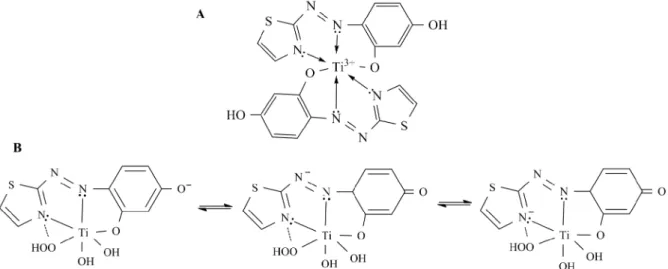
Doubly deprotonated TAR

2-

formed a complex with trivalent titanium ion, predominantly in 2:1 ratio of TAR to titanium ion (Fig. 1A). As aqueous H

2

O

2

was added into the Ti(III)–TAR solution at pH 3, stable ternary complexes of Ti(III)–TAR–H

2

O

2

were rapidly formed with the maximum absorbance at the wavelength of 531 nm (eq. 1 & Fig. 1B) [12].

Ti (III) + TAR + H

2

O

2

→ Ti-TAR-H

2

O

2

(eq. 1)

The aqueous TAR at pH 3.0 displayed the absorbance spectrum with λ

max

= 400 nm (Fig. 2). In the presence of trivalent Ti ion, new absorbance band was appeared at 450 nm which belongs to Ti(III)-TAR complex. Finally, when 25 μM of aqueous H

2

O

2

was titrated into the 50 μM of Ti(III)-TAR solution, significant band shift of maximum absorbance (450 to 530 nm) was observed with the rapid increase of pH to 9.1 within minutes (Ti(III)-TAR-H

2

O

2

, Δ = 80 nm). Newly formed ternary complex was stable for more than 24 hours at room temperature (data not shown).

CE detection of ternary complex Ti-TAR-H

2

O

2

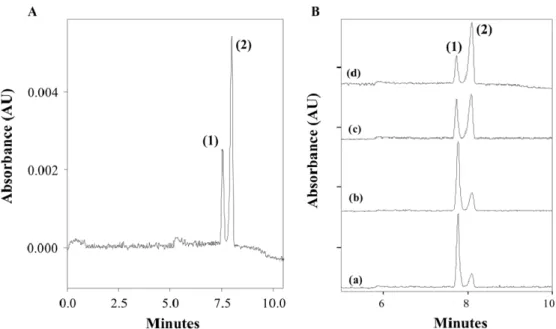
The ternary complex was detected by observing a CE

migration peak of Ti(III)-TAR-H

2

O

2

on electropherogram (Fig

3A). The peak intensity of ternary complex was proportionally

(3)

Fig. 2. UV absorbance spectra of Ti(III)-TAR (50 µM) and Ti(III) –TAR–H

2

O

2

complex. (a) Ti(III)-TAR (50 µM); (b-e) H

2

O

2

(25, 50, 100, 200 µM in pH 3.0) titration into Ti(III)-TAR (50 µM) solution. Band shift of maximum absorbance (450 to 530 nm) was observed.

dependent on the mole ratio of H

2

O

2

to Ti-TAR (Fig. 3B). For the sensitive detection, we tested the background electrode (BGE) in different ion strengths (50 to 125 mM) and pHs (8.0 to 10.0) as well as the voltages supplied (15 to 25 kV) at room temperature. Among the tested BGE conditions (data not shown), 75 mM boric acid and 35 mM NaOH was the most suitable buffer condition showing the highest resolution of ternary complex peak at the migration time of 8.0 minutes (Fig. 3).

Detection of H

2

O

2

in coffee or tea extract

In order to test the detection condition of H

2

O

2

we optimized

is appliable to other sources, the aqueous extracts of coffee or green tea were prepared as described in Materials and methods. As shown in Figure 4A, the complex of Ti-TAR- H

2

O

2

was detected on CE electropherogram with expected migration time, convincing that Ti-TAR formed the ternary complex with H

2

O

2

in coffee extracts. Similarly the same peak of Ti-TAR-H

2

O

2

complex was observed in green tea extract when Ti-TAR was added (Fig. 4B). The intensity of the Ti-TAR-H

2

O

2

peak was decreased as the unit of catalase was added to the extract prior to CE running, indicating that H

2

O

2

in extract was slowly decomposed by the action of catalase. From the analysis of a Ti-TAR-H

2

O

2

peak area by using standard fitting curve generated, H

2

O

2

concentration in the extracts of instant coffee, roasted coffee and green tea was 75.3, 85.1 and 97.5 μM, respectively.

Discussion

In this study, we investigated CE detection of hydrogen

peroxide in aqueous solution by using trivalent titanium ion

(Ti

3+

) and TAR. The detection was based on the ternary

interaction of H

2

O

2

, trivalent titanium ion (Ti

3+

) and TAR,

forming stable ternary complex of Ti(III)–TAR–H

2

O

2

. TAR

provides benefits as a chelating agent and also as an indicator

of spectrometric detection of complexes. Among the known

methods, the most common method for H

2

O

2

detection was

based on the redox reaction. This method requires pre-treating

steps to eliminate the redox substances such as ascorbic acid

or polyphenols in samples since they interfere accurate

Fig. 1. The interaction scheme of Ti(III)-TAR (A) and Ti(III)–TAR–H

2

O

2

complex (B).

(4)

measurement of H

2

O

2

. The CE detection of H

2

O

2

in our work is highly sensitive and specific. The concentration of H

2

O

2

in aqueous solution was accurately determined within the concentration range of 1 to 100 μM. Furthermore, the detection of H

2

O

2

by ternary complex formation is cost effective without pre-treatment steps. By using this method, the concentration of H

2

O

2

in other food sources could be determined. In our trial, H

2

O

2

concentrations in instant coffee, roasted coffee and green tea extracts were found to be 75.3,

85.1 and 97.5 μM, respectively, which are consistent with a previous report [13]. Considering that hydrogen peroxide is utilized as sanitizers or disinfectants in food industries [14], various applications of our method might be possible in future for the detection of H

2

O

2

.

The CE detection and quantitation of H

2

O

2

were achieved by using Ti(III)–TAR–H

2

O

2

ternary complex formation. Our method may provide potential application for the sensitive detection of H

2

O

2

in various aqueous sources.

Fig. 3. CE detection of Ti-TAR-H

2

O

2

and Ti(III)-TAR complexes. A. (a) Ti-TAR complex (100 µM), (b) Ti(III)-TAR-H

2

O

2

complex generated by adding 100 µM of H

2

O

2

. B. Titration of aqueous H

2

O

2

(10, 20, 60, 80 µM) into 100 µM of Ti(III)-TAR solution. The complex was detected at the wavelength of 530 nm. Buffer ground electrode (running buffer) was 75 mM boric acid, 35 mM NaOH, pH 9.1.

Fig. 4. CE detection of H

2

O

2

in coffee / tea extract. A. Ternary complex of Ti-TAR-H

2

O

2

in coffee extract. The extract of 48 µl was

mixed with 2 µl of Ti-TAR (100 µM) reagent prior to CE injection. B. Ternary complex of Ti-TAR-H

2

O

2

in tea extract: catalase (0,

1, 2, 20 unit/ml) was added into the extract solution prior to the complex formation. Arrow indicates Ti-TAR-H

2

O

2

complex.

(5)

Acknowledgments

This study was supported by the research funds from Chosun University, 2016.

Conflict of interest

The authors declare no conflict of interest.

References

1. Tahirović A, Čopra A, Omanović-Mikličanin E, Kalcher K . A chemiluminescence sensor for the determination of hydrogen peroxide. Talanta. 2007;72: 1378-1385. doi:

https://doi.org/10.1016/j.talanta.2007.01.072.

2. Georgiou G, Masip L. An Overoxidation Journey with a Return Ticket. Science. 2003;5619: 592-594. doi: 10.1126/

science.1084976.

3. Rhee SG. H

2

O

2

, a Necessary Evil for Cells Signaling. Science.

2006;312: 1882-1884. doi: 10.1126/science.1130481.

4. Klein-Szanto AJP, Slaga TJ. Effects on peroxides on rodent skin: Epidermal hyperplasia and tumor promotion. J. Invest.

Dermatol. 1982;79: 30-34. doi: https://doi.org/10.1111/

1523-1747.ep12510444.

5. Tredwin CJ, Naik S, Lewis NJ, Scully C. Hydrogen peroxide tooth-whitening (bleaching) products: Review of adverse effects and safety issues. Br. Dent. J. 2006;200: 371-376. doi:

10.1038/sj.bdj.4813423.

6. Matsubara C, Kudo K, Kawashita T, Takamura K.

Spectrophotometric Determination of Hydrogen Peroxide with Titanium 2-((5-Bromopyridyl)azo)-5-(N-Propyl-N- Sulfopropylamino)Phenol Reagent and Its Application to the Determination of Serum Glucose Using Glucose Oxidase.

Anal. Chem. 1985;57: 1107-1109. doi: 10.1021/ac00283a032.

7. Simon PW. Ferrous Ion Oxidation in Presence of Ferric Ion Indicator Xylenol Orange for Measurement of Hydroperoxides.

Methods Enzymol. 1994;233: 182-189. doi: https://doi.org/

10.1016/S0076-6879(94)33021-2.

8. Tanner PA, Wong AYS. Spectrophotometric determination of hydrogen peroxide in rainwater. Anal. Chim. Acta 1998;370:

279-287. doi: https://doi.org/10.1016/S0003-2670(98)00273-6.

9. Komazaki Y, Inoue T, Tanaka S. Automated measurement system for H2O2 in the atmosphere by diffusion scrubber sampling and HPLC analysis of Ti(IV)-PAR-H2O2 complex.

Analyst 2001;126: 587-593.

10. Miller EW, Tulyathan O, Isacoff EY, Chang CJ. Molecular Imaging of Hydrogen Peroxide Produced for Cell Signaling.

Nat. Chem. Biol. 2007;3: 263-267. doi:10.1038/nchembio 871.

11. Navas MJ, Jiménez AM, Galán G. Air analysis:

determination of hydrogen peroxide by chemiluminescence.

Atmos. Environ. 1999;33: 2279-2283. doi: https://doi.org/

10.1016/S1352-2310(98)00117-4.

12. Matsubara C, Iwamoto T, Nishikawa Y, Takamura K, Yano S, Yoshikawa S. Coloured species formed from the titanium (IV)- 4-(2'-pyridylazo) resorcinol reagent in the spectrophotometric determination of trace amounts of hydrogen peroxide. J.

Chem. Soc. Dalton. Trans. 1985;1:81-84. doi: 10.1039/

DT9850000081.

13. Akagawa M, Shigemitsu T, Suyama K. Production of Hydrogen Peroxide by Polyphenols and Polyphenol-rich Beverages under Quasi-physiological Conditions. Biosci.

Biotechnol. Biochem. 2003;67: 2632-2640. doi: 10.1271/

bbb.67.2632.

14. Ping J, Wu J, Fan K, Ying Y. An amperometric sensor based on Prussian blue and poly(o-phenylenediamine) modified glassy carbon electrode for the determination of hydrogen peroxide in beverages. Food Chem. 2011;126: 2005-2009.

doi: 10.1016/j.foodchem.2010.12.073.

수치

Fig. 2. UV absorbance spectra of Ti(III)-TAR (50 µM) and Ti(III) –TAR–H 2 O 2  complex
Fig. 3. CE detection of Ti-TAR-H 2 O 2  and Ti(III)-TAR complexes. A. (a) Ti-TAR complex (100 µM), (b) Ti(III)-TAR-H 2 O 2  complex  generated by adding 100 µM of H 2 O 2

참조

관련 문서