
한국 전통 막걸리의 품질 특성 및 생리활성기능의 연구 동향⁃
12
0
0
전체 글
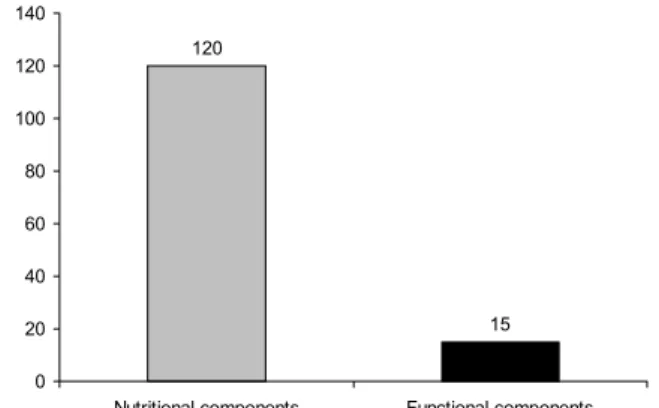
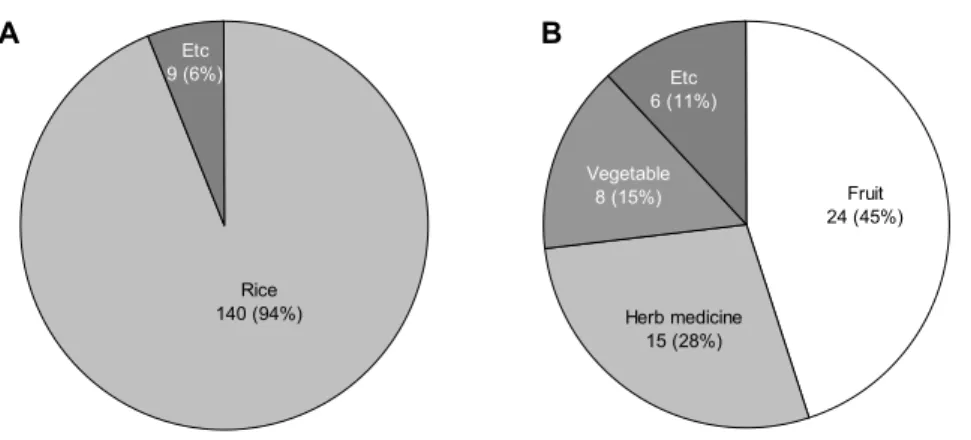
(2) 김미경 ․ 박성수. 150. 그러한 막걸리 특성의 영향으로 도리어 막걸리가 대중들로. 140. 부터의 관심이 점점 낮아지고 있으며, 주류시장의 판도 변화. 120. 에 의한 막걸리의 소비가 주춤하게 되는 등 맥주나 기타 주. 120. 100. 류에 비해 국내에서의 막걸리 시장이 축소되고 선호도가 점 차 줄어들고 있는 경향이 나타나고 있다(32,38-46).. 80. 본 연구에서는 우리나라의 전통주인 막걸리의 연구논문. 60. 을 대상으로 막걸리에 함유된 품질 특성 및 생리활성에 대해. 40. 정리함으로써 막걸리의 다양한 생리적 활성을 포함한 막걸. 15. 20. 리의 기능성에 대해 알리고자 하였다(33,39,41,47,48). 현 재까지의 연구 동향을 살펴보면 막걸리에 대한 다양한 여러 연구가 수행되었으나, 임상실험 및 in vivo 등의 연구가 일 반성분 실험에 비해 적어 이에 따른 연구가 앞으로 지속해서. 0 Nutritional components. Functional components. Fig. 1. The numbers of research articles according to Makgeolli’s components.. 진행되어야 할 것이며 막걸리의 정량 섭취에 의한 건강 기여 여부에 대한 연구가 수행되어야 한다. 또한 다양한 막걸리의. fumaric acid 등이 있는 것으로 보고되었으며, 조성 및 함량. 성장 가능성을 제시하고 한국의 대표 전통주로서 막걸리에. 에 따라 전체적인 맛을 좌우하는 것으로 보고되었다(58-. 대한 관심을 높이는 노력이 필요할 것으로 사료된다.. 62). Choi(63)와 Kim(64)의 연구에서 막걸리의 유기산의. 본 총설을 통해 우리나라 전통주인 막걸리의 관심을 높이. 경우 citric acid, succinic acid, lactic acid가 주로 나타났. 고 더 나아가 해외에 막걸리의 우수성을 알리기 위한 저장성. 다. Im 등(65)의 감 막걸리의 품질 특성에 대한 연구에서는. 및 기능성을 향상시킨 막걸리와 이를 응용한 다양한 막걸리. 다른 유기산에 비해 lactic acid가 가장 많이 검출되었다.. 개발을 위한 기초자료가 되고자 본 연구를 수행하였다.. 그 밖에 Kim(66)의 단호박 막걸리의 연구에서는 citric acid, malic acid, lactic acid 3종이 검출되었다고 보고되어. 막걸리의 영양학적 특성. 있다. 그 밖에 oxalic acid, phosphoric acid, acetic acid 등의 유기산은 미량 검출되거나 발효기간에 따라 감소하여. 소주와 맥주와 같이 알코올도수가 높은 일반주류를 마시. 검출되지 않았다(8,67,68).. 게 될 경우에는 빨리 취하게 돼서 간에 많이 부담이 가지만,. 최근 Wang 등(28)은 막걸리로부터 4-hydroxybenzal-. 막걸리의 알코올 도수는 일반주류에 비해 낮으며 쌀과 찹쌀. dehyde, 2-(4-hydroxylphenyl) ethanol(tyrosol), trans-. 등 전분질 재료를 이용해 만들었기 때문에 위와 간에 부담이. ferulic acid, cis-ferulic acid 및 1-H-indole-3-ethanol. 덜 간다고 알려져 있다(4,37,49-52). 또한 단백질, 당질, 식. (tryptophol) 등의 항산화 물질을 분리하여 발표하였고,. 이섬유 등이 풍부하고 비타민과 필수아미노산, 유기산, 에스. Wang 등(35)과 Ha 등(36)의 논문에서는 막걸리 속 파네졸. 테르류 등이 들어있어 맛과 향을 내고 다양한 생리활성기능. (farnesol)이라는 물질이 항암 효과를 가졌다는 것을 세계. 을 하여 영양학적으로도 가치가 있다고 보고되었다(53). 막. 최초로 발견하였다.. 걸리의 주요 향기 성분은 ethyl alcohol, ethyl acetate,. 이처럼 막걸리의 성분에 따라 관련 연구를 분류하여 Fig.. amylacetate, ethyldecaproate 등의 에스테르류와 간 기능. 1에 제시하였다. 항산화 물질 등을 분리한 기능성분 관련. 을 도와주는 acetylcholine이 함유되어 술의 맛과 품질을. 연구논문과 단백질, 당질, 식이섬유 등의 영양성분을 비교한. 결정하게 된다(54).. 연구논문을 살펴본 결과, 영양(일반)성분의 연구논문 수는. 특히 생막걸리의 경우 유산균과 효모가 다량으로 포함되 어 있어 맛이 신선하고 청량감이 강하며, 배변활동을 원활히. 120편이며 기능성분을 나타낸 연구논문 수는 15편으로 조 사되었다.. 하고 유해균을 억제하는 등 장에 좋다는 장점이 있다(19,32, 55). 젖산균주인 Pediococcus acidilactici K3와 S1을 이용. 막걸리 원료 및 재료에 관한 연구 동향. 하여 막걸리 담금 시 품질을 측정한 결과, Staphylococcus. aureus의 생육 저해를 일으키는 bacteriocin 생성 능력이. 막걸리의 연구논문에서 원료 및 재료별로 연구논문 수를. 있음을 확인하였고 막걸리 품질에 악영향을 주지 않는다는. 살펴본 결과를 Fig. 2에 제시하였다. 막걸리를 제조할 때. 연구가 보고되었다(55-57).. 주재료로 사용된 전분질 재료 중 쌀이 140편으로 가장 많았. 발효과정 중 생성되는 유기산은 막걸리 특유의 신맛과 향. 으며, 기타 전분질 재료에는 찹쌀, 가바쌀, 보리, 조, 현미,. 을 나타내고 막걸리에 약 0.8%가 함유되어 있으며, 유해 미. 흑미 등은 각 1~2편이 있었다. 막걸리 제조 시 첨가하는 부. 생물의 생육을 억제하는 역할을 하는 것으로 보고되었다.. 재료 중 과실이 24편, 생약 15편, 채소 8편 순으로 기타는. 막걸리의 유기산으로는 lactic acid, citric acid, succinic. 6편으로 조사되었으며, 부재료로 과실이 가장 많이 사용되었. acid, tartaric acid, pyruvic acid, malic acid, oxalic acid,. 다. 사용된 과실로는 감, 딸기, 마늘, 배, 석류, 오미자, 파인.
(3) 한국 전통 막걸리의 품질 특성 및 생리활성기능의 연구 동향. A. Etc 9 (6%). B Etc 6 (11%). Vegetable 8 (15%). Rice 140 (94%). 151. Herb medicine 15 (28%). Fruit 24 (45%). Fig. 2. The number of studies characterized by main ingredients (A) and sub materials (B).. 애플 등의 다양한 재료를 이용하여 막걸리가 개발되고 있는. 이를 자연 배양을 시켜 만든 것으로, 미생물의 생장조건이. 추세이다. 생약 성분으로는 구기자, 당귀, 둥굴레, 울금, 인. 다르기 때문에 기후와 환경에 큰 영향을 받는다. 또한 다양. 삼, 한약재, 황칠나무 등을 첨가하여 막걸리가 개발되었고 채. 한 미생물이 관여하기 때문에 따로 효모를 첨가할 필요가. 소 등을 사용한 연구로는 고구마, 마늘, 산채류, 오이, 으름. 없다. 여러 미생물이 다양한 성분을 만들어 맛과 향이 복잡. 열매 등을 사용한 연구가 있었다. 기타 재료에는 청국장, 커. 하며 특유의 누룩 향, 구수한 맛, 쓴맛, 떫은맛이 강하다.. 피박, 키토산, 화분 등을 활용한 연구가 보고되었다(20,40,. 막걸리의 전통누룩은 자연 배양을 시켜 만들기 때문에 기. 50,63,69-88).. 후와 환경에 큰 영향을 받게 된다. 이 점을 보완한 방법으로. 막걸리 연구에서 막걸리에 첨가된 재료를 연도별로 정리. 균주를 따로 접종하여 만든 개량누룩을 사용하게 되는데 현. 하여 2000년부터 2009년까지, 그 이후부터 2년 단위로 묶. 재에는 우수한 곰팡이 몇 종만을 배양시켜 만든 개량누룩을. 어 분석한 결과, 2009년 이전까지의 연구 중 첨가된 재료는. 사용하여 잡균에 의한 주질에 변화를 적게 해준다. 개량누룩. 발아현미, 인삼, 키토산, 배, 울금 각 1편으로 총 5편에 그쳤. 은 밀가루와 밀기울을 원료로 순수 배양균을 접종하여 만든. 다. 2010년부터 2011년까지 연구 중 막걸리에 첨가된 재료. 것으로 전통누룩보다 당화력이 높으며 효모를 별도로 첨가. 를 달리한 연구 논문 수는 총 12편으로 가바쌀, 구기자, 건조. 해야 한다. 입국은 고두밥에 백국균을 접종하여 인위적으로. 유자과피, 마늘, 블루베리, 오이, 유자, 유자즙, 찹쌀, 천일염,. 번식시켜 주로 대량생산 시에 시간, 원가, 비용을 단축하기. 팽화차조, 홍국쌀로 각 1편이 있었다.. 위해 만든 것이다. 입국의 경우에도 효모를 따로 첨가해야. 마찬가지로 2012년부터 2013년까지의 연구 논문 수는 총 23편으로 구기자, 당귀 및 둥굴레와 같은 생약성분과 비. 한다. 주로 백국균을 첨가하기 때문에 다량의 구연산이 생성 되어 신맛이 강하다는 특징이 있다(9,91,92).. 파열매, 오디, 포도 등의 과일류 등을 첨가한 연구가 있었다.. Aspergillus kawachii와 Aspergillus oryzae의 균주로. 2014년부터 2015년까지의 연구 논문 수는 총 9편으로, 곡. 탁주를 담금한 연구에서 A. kawachii에 속하는 균주들의. 류, 생약, 과일 등을 첨가 후 품질 특성을 비교하여 제시하였. 경우 유기산 생성력이 높고, A. oryzae에 속하는 균주는 당. 다. 2016년부터 2017년까지의 연구 논문 수는 총 7편으로. 화력과 액화력이 높았다. A. kawachii CF1과 A. oryzae. 구기자, 단호박 가루, 딸기, 아로니아, 제주 동백나무 겨우살. CF7으로 입국을 각각 제조하여 동량 병용하여 탁주를 담금. 이 각 1건, 화분을 첨가한 논문이 2편이 있었다. 막걸리 재료. 하였을 때가 단독으로 입국을 사용하여 담금하였을 때보다. 를 달리한 논문의 논문 수는 총 56편으로 2012년부터 2013. 맛과 향이 더 좋았고 발효 또한 잘 진행되었다고 보고되었. 년까지의 첨가물을 달리한 막걸리의 연구 수가 가장 많으며. 다. 그러나 입국을 혼합 배양하여 제조하였을 때에는 A. ka-. 그 이후로 점차 줄어드는 추세를 보이고 있다(20,40,50,63,. wachii가 생산한 유기산을 A. oryzae가 대사에 이용하여 좋은 효과가 나타나지 않았다고 보고되었다(93). A. oryzae. 69-90).. 균주를 이용한 Choi(63)의 연구에서 구심적 분생자를 형성. 막걸리와 관련된 균주, 누룩, 발효 미생물, 발효제 등에 관한 연구 동향. 하는 것으로 나타났으며, A. oryzae KACC 93172P로 배양 된 발효제와 전통누룩의 당화력을 비교한 결과 당화력과 단 백질 분해력이 전통누룩과 0.9~1.2 mL로 평균적으로 비슷. 막걸리의 쌀, 찹쌀, 보리, 밀 등의 전분질 재료를 포도당으. 한 결과를 나타냈다고 보고되었다.. 로 당화하여야 하는 데 필수적으로 첨가하는 것이 누룩이다.. 그 밖에 Baek 등(91)은 전분 분해력과 단백질 분해력이. 또한 효모가 이를 이용하여 포도당을 알코올로 되는 병행복. 우수한 A. oryzae를 이용하여 막걸리 제조 시 사용하였고,. 발효로 진행된 것이 전통주인 막걸리이다. 전통누룩은 밀,. Lee 등(94)은 전분당화력과 단백질 분해력이 강한 Aspergillus awamori 입국을 이용하여 아로니아 첨가 막걸리의. 호밀, 좁쌀 등을 빻아 소량의 물로 반죽하여 공기 중의 곰팡.
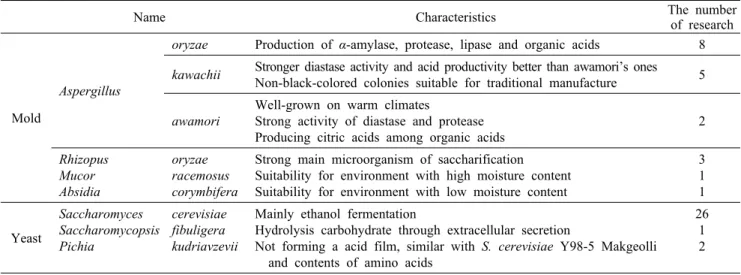
(4) 김미경 ․ 박성수. 152. Table 1. Microorganism from Makgeolli Name. Characteristics oryzae. Production of α-amylase, protease, lipase and organic acids. kawachii. Stronger diastase activity and acid productivity better than awamori’s ones Non-black-colored colonies suitable for traditional manufacture. 5. awamori. Well-grown on warm climates Strong activity of diastase and protease Producing citric acids among organic acids. 2. oryzae racemosus corymbifera. Strong main microorganism of saccharification Suitability for environment with high moisture content Suitability for environment with low moisture content. 3 1 1. Mainly ethanol fermentation Hydrolysis carbohydrate through extracellular secretion Not forming a acid film, similar with S. cerevisiae Y98-5 Makgeolli and contents of amino acids. 26 1 2. Aspergillus Mold Rhizopus Mucor Absidia Yeast. The number of research 8. Saccharomyces cerevisiae Saccharomycopsis fibuligera Pichia kudriavzevii. 2,2-diphenyl-1-picrylhydrazyl(DPPH) 라디칼 소거능이 대조군에 비해 높은 결과를 나타냈다고 보고하였다. Kwon (95)은 Kocuria rhizophila, Pantoea agglomerans, Ped-. iococcus pentosaceus, Kocuria halotolerans 세균을 동 정하였고, Lichtheimia corymbifera, Mucor racemosus, Rhizopus microspores, Trichomonascus farinosus, Cladosporium cladosporioides, Pichia kudriavzevii, A. oryzae 곰팡이를 동정하였다고 보고하였다. 과거 연구에서도 Aspergillus, Mucor, Rhizopus 속 곰팡이와 Saccharomyces, Pichia, Candida, Torlopsis, Hansenula 속의 효모와 Bacillus, Micrococcus, Aerobacter, Pseudomonas 속의 세균이 생육하고 있다고 보고되어 있다(96-99). Lee 등(100)은 막걸리 속 Absidia, Rhizopus가 수분 함 량이 적은 환경에서 잘 자라며, Aspergillus sp.와 Mucor sp.는 수분 함량이 많은 환경에서 잘 자라는 균주라고 보고 하였다. 포도막걸리 제조 시 산 생성능이 크고 술덧의 풍미 가 우수한 Fermivin 양조효모가 가장 적합한 효모인 것으로. Fig. 3. Phylogenetic tree for the strains from Makgeolli based on the 16S rDNA sequence.. 보고되었다(101). 발효 미생물에 관한 동향을 살펴본 결과를 Table 1에 제. 막걸리 저장 또는 보관에 관한 연구 동향. 시하였다. Aspergillus sp.를 사용한 막걸리의 연구논문 수 가 15편으로 가장 많이 사용되었으며, A. kawachii 5편,. 생막걸리는 맛이 신선하고 청량감이 강하며, 영양학적으. Rhizopus sp.를 이용한 연구가 3편이며, 이 외에 Absidia sp., Mucor sp.가 1편으로 조사되었다. 막걸리의 효모는 알 코올 발효를 주도하는 것으로 알려진 Saccharomyces cerevisiae를 사용한 연구가 총 26건으로 가장 많았으며 Saccharomycopsis fibuligera 1편, P. kudriavzevii 2편 그. 로도 장에 좋지만 유통기한이 짧다는 단점이 있다(18). 반면. 리고 Fermivin을 포함한 제품화된 기타 상업 효모를 이용한. (10,105), 냉동저장방법(106), 저장온도(43), 저장기간(107). 연구가 보고되었다. 제시된 미생물에 대한 phylogenetic. 을 달리하여 막걸리의 저장성을 높였다. 특히 높은 저장 온. tree를 NCBI의 BLAST 분석프로그램을 사용하여 상동성. 도에서 유발되는 biogenic amine 물질 중에서 putrescine. 을 비교한 결과는 Fig. 3에 제시하였으며, Mega4(The Bio-. 과 tyramine은 두통을 유발하는 숙취물질이다(108). 낮은. design Institute, Arizona State University, Tempe, AZ,. 온도에서의 막걸리 저장은 저장성 향상과 동시에 숙취 물질. USA) 등의 프로그램을 이용하여 작성하였다.. 을 억제하는 기능성이 있다고 연구되었다(29). 추후 저장성. 에 장기보관 가능 살균막걸리에 탄산을 주입하여 풍미를 보 완한 탄산 막걸리도 출시되고 있다(46,102,103). 여러 연구 에서 키토산(9), 커피박(72)의 첨가재료에 의한 저장기간의 변화, 침전물과 상등액을 분리저장 방법(104), 살균처리방법.
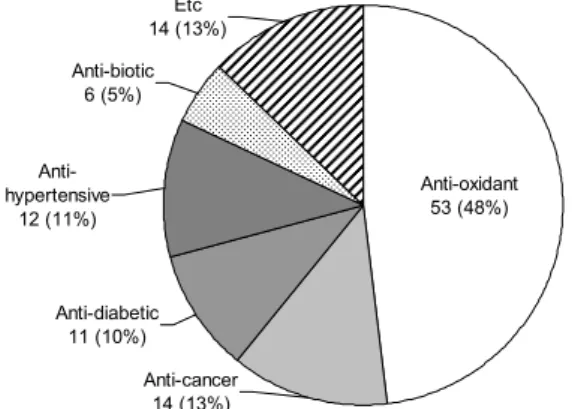
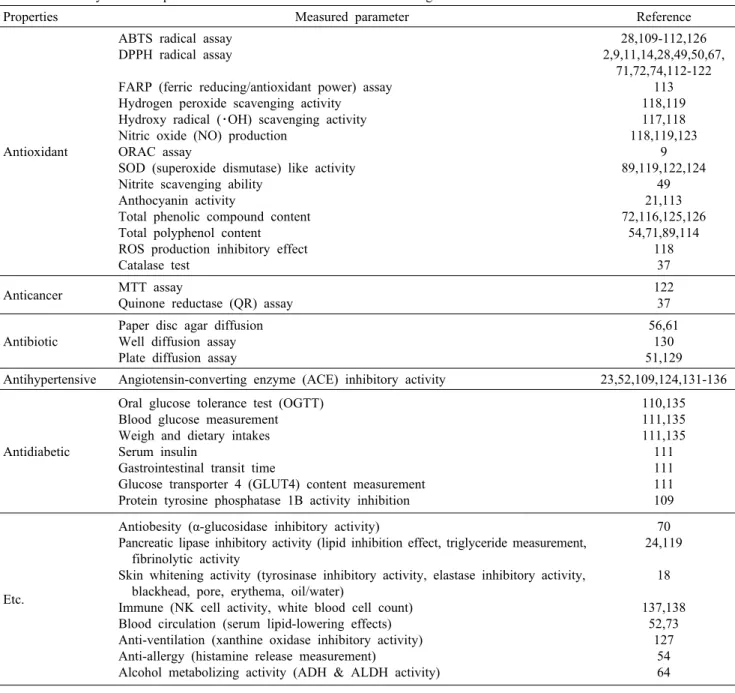
(5) 한국 전통 막걸리의 품질 특성 및 생리활성기능의 연구 동향. 153. 환원이 되어 짙은 자색이 탈색되는 원리이다. 막걸리의 막걸. Etc 14 (13%). 리 열수 추출물(49)과 막걸리 첨가 설기떡(117)에서 막걸리. Anti-biotic 6 (5%). 의 라디칼 소거능을 확인하였다. 그리고 막걸리에 여러 재료 를 첨가함으로써 항산화력을 증가한 여러 연구가 보고되었 다. 감(113), 녹차(115), 고구마(113,116), 당귀(50), 둥굴. Antihypertensive 12 (11%). Anti-oxidant 53 (48%). 레(14), 마늘(54), 복숭아, 석류(9), 으름 열매(118), 제주 동백나무 겨우살이(119), 커피박(72), 크랜베리, 홍국쌀(2), 황칠나무 잎차(74), 화분(71) 등을 첨가하여 대조구 막걸리. Anti-diabetic 11 (10%) Anti-cancer 14 (13%). Fig. 4. The number of studies characterized by physiological activities of Makgeolli.. 보다 높은 라디칼 소거능이 보고되었다. 이러한 증가한 항산 화능은 첨가한 재료에 항산화 물질이 존재함을 나타낸다고 할 수 있고, 막걸리 발효와 함께 상승효과를 보인다고 추정 할 수 있다. 이것은 재료 첨가량이 증가할수록 항산화 활성 이 유의적으로 증가하는 연구 결과에서 뒷받침되고 있다. 예를 들어 자색고구마-쌀누룩으로 제조된 막걸리의 FRAP. 을 향상시키는 연구가 진행되어야 할 것으로 사료된다.. 분석에서 자색고구마의 첨가량이 증가할수록 활성이 유의 적으로 증가하였고, 발효가 진행됨에 따라 역시 증가하였다. 막걸리의 생리활성 실험 방법별 연구 동향. (113). 제주 동백나무 겨우살이를 이용한 막걸리의 hydrogen peroxide 라디칼 소거능 결과 동백나무 겨우살이의 첨. 생리활성 효과별로 연구 동향을 살펴본 결과를 Fig. 4와. 가 비율에 따라 활성이 유의적으로 증가하였다(119). Nitric. Table 2에 제시하였다. 연구 동향을 살펴보면 항산화 효과. oxide와 superoxide radical 소거능의 측정 결과도 hydro-. 53건, 항암 효과 14건, 항고혈압 효과 12건, 항균 효과 6건,. gen peroxide 소거능 결과와 유사하였다(119). 그리고 복. 항당뇨 효과가 11건이다. 기타 시험은 총 14건으로, 항비만. 숭아 첨가량이 증가할수록 IC50값이 낮아져 항산화능이 향. 4건, 혈행개선 1건, 피부미백 5건, 면역 1건, 항통풍성 1건,. 상되었다고 연구가 되었다(125). 석류를 이용한 막걸리의. 항알레르기 1건, 숙취해소능 1건이다.. 담금 직후에는 석류의 껍질과 씨에 함유된 항산화 성분에 의해 항산화 활성이 비례적으로 증가하였다. 그러나 발효가. 항산화 시험. 진행됨에 따라 항산화 활성의 차이는 석류 첨가량에 따라. 항산화 시험은 총 52건으로 ABTS radical scavenging. 다른 경향을 보였는데, 석류 첨가의 10%까지는 막걸리의. assay 6건(28,109-111), DPPH radical scavenging assay. 항산화 활성을 비례적으로 높인다는 결과를 확인할 수 있다. 22건(2,9,11,14,28,49,50,67,71,72,74,112-122), FARP. 고 보고하였다(9).. (ferric reducing/antioxidant power) 분석 1건(113), hy-. 이 외에도 ROS 생성 억제 효과(118), catalase의 과산화. drogen peroxide 소거 활성 2건(118,119), hydroxy radi-. 수소 제거 효과(37), 아질산염 소거능 측정(49), 안토시아닌. cal 소거능 2건(117,118), nitric oxide(NO) 생성량 측정. 측정(21,113), 총 페놀성 화합물 함량 측정(72,116,125,. 3건(118,119,123), ORAC assay 측정 1건(9), SOD 유사활. 126), 총 폴리페놀 함량 측정(54,71,89,114) 등으로 다양한. 성 측정 4건(89,119,122,124), 아질산염 소거능 측정 1건. 실험 방법이 있었다. 다른 시험에 비해 항산화 시험 연구. (49), 안토시아닌 측정 2건(21,113), 총 페놀성 화합물 함량. 수가 가장 많았으며, 항산화 시험 방법 중 DPPH를 이용한. 측정 4건(72,116,125,126), 총 폴리페놀 함량 측정 4건(54,. 실험방법이 23건으로 가장 많이 사용되었다.. 71,89,114), ROS(활성산소종) 생성 억제 효과 1건(118), catalase의 과산화수소 제거 효과 1건(37) 등으로 다양한 실험 방법이 있었다(Table 2).. 항암 시험 문헌 중의 항암 시험 내역을 분석한 결과, 항암시험에 사. ABTS radical scavenging assay로 항산화 물질의 수소. 용된 암세포의 종류 및 시험방법에 따라 분류된 시험건수는. 이온 공여능을 측정하는 항산화능 분석 방법이다. 막걸리 부. 총 14건으로 으름열매를 첨가하여 만든 막걸리는 DU145. 산물을 이용하여 미용 소재로서의 기능을 확인하였고(126),. cell(전립선암), HeLa cell(자궁경부암), MCF-7 cell(유방. in vivo를 통해 쥐 혈장 과산화물 생성 억제 효과(112)와 in vitro로 막걸리로부터 항산화 화합물의 단리 및 정제, 동. 암), U87 cell(뇌종양)에 대한 항암효과가 나타났으며(118),. 정을 한 연구(28)에서 모두 ABTS 라디칼을 소거하여 막걸. -29 cell(대장암), HepG2 cell(간암세포), B16-F10 cell. 리의 항산화 기능을 밝혀내었다. DPPH radical scaveng-. (피부암세포)에 대한 뛰어난 암세포 성장억제를 보였다. 그. ing assay에서 비교적 안정한 free radical로써 ascorbic. 중 간암세포에서 메탄올 분획물이 quinone reductase 활성. acid, tocopherol, polyhydroxy 방향족 화합물 등에 의해. 효과가 보여 기능성 식품으로 기대된다고 보고되었다(37).. 용매별 분획물 중에서 메탄올로 추출한 막걸리분획물이 HT.
(6) 김미경 ․ 박성수. 154. Table 2. Summary of the experimental data on the health effects of Makgeolli Properties. Measured parameter ABTS radical assay DPPH radical assay. Antioxidant. FARP (ferric reducing/antioxidant power) assay Hydrogen peroxide scavenging activity Hydroxy radical (・OH) scavenging activity Nitric oxide (NO) production ORAC assay SOD (superoxide dismutase) like activity Nitrite scavenging ability Anthocyanin activity Total phenolic compound content Total polyphenol content ROS production inhibitory effect Catalase test. Reference 28,109-112,126 2,9,11,14,28,49,50,67, 71,72,74,112-122 113 118,119 117,118 118,119,123 9 89,119,122,124 49 21,113 72,116,125,126 54,71,89,114 118 37. Anticancer. MTT assay Quinone reductase (QR) assay. Antibiotic. Paper disc agar diffusion Well diffusion assay Plate diffusion assay. Antihypertensive. Angiotensin-converting enzyme (ACE) inhibitory activity. Antidiabetic. Oral glucose tolerance test (OGTT) Blood glucose measurement Weigh and dietary intakes Serum insulin Gastrointestinal transit time Glucose transporter 4 (GLUT4) content measurement Protein tyrosine phosphatase 1B activity inhibition. 110,135 111,135 111,135 111 111 111 109 70 24,119. Etc.. Antiobesity (α-glucosidase inhibitory activity) Pancreatic lipase inhibitory activity (lipid inhibition effect, triglyceride measurement, fibrinolytic activity Skin whitening activity (tyrosinase inhibitory activity, elastase inhibitory activity, blackhead, pore, erythema, oil/water) Immune (NK cell activity, white blood cell count) Blood circulation (serum lipid-lowering effects) Anti-ventilation (xanthine oxidase inhibitory activity) Anti-allergy (histamine release measurement) Alcohol metabolizing activity (ADH & ALDH activity). 알코올을 제거한 막걸리에서 AGS cell(위암)에 대한 증식억 제 효과가 있음을 보고하였고(128), paraquat에 노출된 A549 cell에 막걸리 침전물이 세포를 보호하는 효과가 있음 을 발표하였다(122).. 122 37 56,61 130 51,129 23,52,109,124,131-136. 18 137,138 52,73 127 54 64. diffusion assay법으로 S. flexneri, B. subtilis, E. coli, S. enterica, B. cereus에 대한 항균성이 유의적으로 증가하는 결과를 나타내었다(51). 다른 연구에서는 막걸리에서 L. casei HK-9 균주를 plate diffusion assay 방법을 이용하여 paper disc 주변에 투명 띠가 형성되어 막걸리에서 분리한. agar diffusion법, well diffusion법을 통해 알 수 있다. 여러. 균주가 항균 활성을 나타내었다. 그 결과 Bacillus cereus, Listeria monocytogenes, Sta. aureus 및 Methicillin-resistant Sta. aureus(MRSA)와 그람음성 세균인 E. coli, Salmonella enteritidis 등의 식중독 원인균의 항균 활성을. 연구들은 막걸리에 재료를 첨가하여 항균 활성을 높이거나,. 확인하였다고 보고되었다(129). 지역별 누룩을 달리하여. 기능성을 가진 균주를 막걸리에 이용하여 항균성을 향상한. Paper disc agar diffusion법을 통한 항균 활성에 대한 결과. 연구 결과가 있다. 막걸리에 으름 열매를 첨가하여 plate. Sal. enteritidis, B. cereus, E. coil, Shigella flexneri,. 항균 시험 항균 시험은 식중독을 일으킬 수 있는 여러 가지 병원균들 에 대한 항균 활성을 plate diffusion assay법, paper disc.
(7) 한국 전통 막걸리의 품질 특성 및 생리활성기능의 연구 동향. 155. Klebsiella pneumoniae 균주의 활성을 증가시키는 것으로. 유의적인 차이가 나타나지 않았지만 감소 경향을 나타내었. 보고되었으며(56), 또 다른 연구로는 막걸리에서 발견한 유. 다고 보고되었다(111). 인슐린과 렙틴의 신호전달을 낮추는. 용미생물에서의 항균 활성을 밝힌 연구가 있다. 막걸리로부. 역할을 하는 protein tyrosine phosphatase 1B의 활성도에. 터 분리된 Bacillus amyloliquefaciens 균주는 well dif-. 대한 측정이 1건 있었다(109). 항당뇨의 연구 동향을 살펴. fusion 방법을 통해 B. cereus, L. monocytogenes, Sta.. 본 결과 유의적인 변화가 적어 추후 연구가 계속되어야 할. aureus, MRSA, E. coli, Sal. enteritidis에 대해 항균 활성 을 갖는 것으로 보고되었다(130). Weissella paramesenteroides의 CJNU 0480, L. casei LP1, L. plantarum LP2. 것으로 판단된다.. 기타. 의 Paper disc agar diffusion법 통해 헬리코박터균의 항균. 기타 시험은 항비만 3건, 미백효과 1건, 혈행 개선 2건,. 활성 실험을 진행한 결과 증식을 억제하는 항균 존을 확인할. 면역 기능 2건, 항통풍성 1건, 항알레르기 1건, 숙취해소능. 수 있었다(61). 막걸리에서 발견된 항균 활성은 천연 항균제. 1건으로 총 11건이 있다(Table 2).. 로서 여러 식품소재에 적용하여 화학보존제 사용에 대한 대. 항비만성 시험 내역은 Pichia anomala Y197-13 균주를. 안으로써 저장기간 연장에 활용할 수 있을 것으로 사료된다.. 이용한 막걸리의 α-glucosidase 저해 활성을 측정한 결과, 균주 자체의 저해 활성보다 낮지만 활성을 보였다고 보고되. 항고혈압 시험. 었다. 혈액순환 개선제로의 fibrin 평판법에 따른 혈전용해. 항고혈압 시험내역 건수는 총 10건으로 angiotensin-. 활성을 측정한 결과 혈전용해 활성은 나타나지 않았다(119).. converting enzyme(ACE) 저해 효과에 대한 실험 방법을. 동백나무 겨우살이 막걸리의 지방분해 저해 효과를 측정하. 사용하였고 저해하는 효과를 나타내었다고 보고되었다(23,. 기 위해 pancreatic lipase를 이용한 결과 무첨가 대조군에. 52,125,131-136). 그러나 막걸리를 발효한 Lonicera ja-. 비해 약 1.3배 높은 억제 효과를 나타냈다고 보고되었다. ponica에 의해 발효한 막걸리의 ACE 저해활성은 없다고. (119). 세포의 중성지질 축적 억제 효과에 대해 3T3-L1 세. 보고되었다(109).. 포에 오르니틴 막걸리를 처리하였을 때 독성이 없는 수준에 서 지방구 형성을 억제하였다고 보고하였다(24).. 항당뇨 시험. Tyrosinase 저해능을 측정한 연구는 tyrosinase가 중합. 항당뇨 시험 건수는 총 10건으로, 쥐에 대한 경구내당능. 반응을 거쳐 최종적으로 흑갈색의 멜라닌을 형성하기 때문. (oral glucose tolerance test, OGTT) 검사를 이용한 방법. 에 미백관련 연구에 쓰인다. 시판 막걸리는 tyrosinase 저해. 이 총 2건이 있다(Table 2). 제2형 당뇨 유발 쥐의 주박 열수. 활성이 있으나 낮은 활성을 가졌다고 연구 결과가 보고되었. 추출물에 의한 혈당 및 혈중 인슐린 농도, 사료섭취량과 체. 다(134). 막걸리 부산물로부터 tyrosinase의 저해능을 측정. 중증가량을 측정한 방법이 각 1건이 있었다. 혈당은 1% 주. 한 결과 50°C에서 추출한 것이 20°C에서 추출한 것보다. 박 추출물을 섭취한 시험군이 대조군(0%)에 비해 10일째,. 높은 경향을 보였고, 피부 탄력을 유지하는 elastin 분해효. 14일째에 유의적으로 감소하였고, 2%의 주박 추출물 시험. 소인 elastase 저해 활성을 본 결과 누룩과 미박 추출물은. 군은 10, 14, 17, 21일째에 유의적인 혈당 감소를 보였다고. 20도에서 높은 저해능을 보인 반면에 시판 제품의 경우 50. 보고되었다. 그러나 혈중 인슐린 농도는 유의적인 차이가. 도의 경우에서 높은 저해능을 보였다고 보고되었다(126).. 없었다. 사료섭취량과 체중증가량 또한 실험군 간에 유의적. 30대~50대를 대상으로 미백 마스크팩, 천연누룩, 막걸리를. 인 차이가 없었다. 혈당 강하 효과 기전을 밝히기 위해 인슐. 이용하여 4주간에 걸쳐 블랙헤드, 모공, 홍반, 유수분을 측. 린에 의한 혈당조절에 중요한 역할을 하는 glucose trans-. 정하였다. 블랙헤드와 모공 수, 멜라닌 측정에서 막걸리에서. porter 4(포도당운반체, GLUT4) 함량 분석을 이용하여 포. 가장 큰 변화를 나타냈다. 이처럼 막걸리의 유용한 미백 생. 도당 운반체 발현을 측정하였다. 주박 추출물과 대조군 간에. 리활성을 인체에 적용하는 연구가 필요할 것으로 사료된다. 유의적인 차이가 없었다. 주박 추출물 1, 2% 섭취가 제2형. (18).. 당뇨 모델인 db/db mouse에서 혈당 강하 효과를 나타내나. 막걸리를 이용하여 Micro channel array flow analyzer. 다른 실험에서 유의적인 변화가 없으므로 추후 연구가 필요. 혈류 개선 효과에 대해 살펴본 결과, 난소절제 막걸리군과. 할 것으로 사료된다고 보고되었다(110).. 막걸리 지게미군이 난소 절제 대조군보다 빨리 모세관을 통. Streptozotocin으로 당뇨를 유발시킨 흰쥐에게 체중 및. 과하였고, 특히 난소를 절제한 막걸리군이 난소절제 막걸리. 식이섭취량을 조사, 장통과 시간 측정, 혈당 저하 효과에 대. 지게미군보다 빠른 혈액 유동성을 나타내었다(52). 막걸리. 해 측정한 실험이 각 1건이 있었다. 식이섭취량의 차이는. 로부터 다당체를 분리하여 경구투여 한 후 수컷 쥐의 비장과. 없었으나 체중, 체중증가량 및 식이 효율이 당뇨 대조군(DC). 흉선을 제거하여 NK cell의 활성과 백혈구 수를 측정한 결. 에 비해 주박을 섭취한 당뇨군(DS)이 높았다. DS의 혈당. 과, 대조군과 비교했을 때 비장세포를 증식시켰으며, NK. 증가량은 포도당 섭취 120분 후에서만 DC에 비해 유의적으. cell의 활성 및 백혈구 수가 유의적으로 증가했다고 보고되. 로 낮은 수준을 나타내었으나, 30분, 60분 및 90분에서는. 었다(137,138). 통풍의 원인물질인 퓨린(purine) 계열 물질.
(8) 김미경 ․ 박성수. 156. 의 함량을 HPLC로 분석한 결과 맥주에서 가장 높게 측정되 었으며, 막걸리를 포함한 우리나라 전통주류에서는 소량이 검출되었고, 특히 막걸리는 맥주보다 약 5배 적은 퓨린 계열 물질을 함유하고 있었다(127). 마늘 막걸리의 항알레르기를 알아보기 위해 histamine 유리량 측정한 결과, 대조구 막걸 리에 비해 histamine 유리량이 높게 측정되어 항염증 효과 를 나타내었다고 보고하였다(67). 체내 알코올 대사의 1차 관여 효소인 ADH와 acetaldehyde의 분해에 직접적인 영향 을 미치는 효소인 ALDH의 활성에 대해 측정한 결과, 막걸 리 침전물 열수 추출물의 농도가 증가함에 따라 높게 나타났 다(49).. 요. 약. 본 연구는 막걸리를 주제로 한 연구논문 중 ‘막걸리의 품질 특성 및 생리활성기능’ 동향에 대해 영양학적 특성별, 지역 별, 특허내역별, 재료별, 제조방법별, 미생물별, 저장별, 실 험 방법별, 생리활성 효과별, 시험 내역별로 정리하였다. 그 결과로서 막걸리는 서울과 경기지방에서 가장 많은 종류가 생산되었으며, 일반 주류에 비해 단백질과 당질, 여러 비타 민과 유기산, 유산균 등 생리활성기능을 하는 물질이 많아 영양학적으로 가치가 있다. 막걸리의 향기성분은 원료인 곡 류와 누룩 미생물 발효 과정 중에 주로 생성되는데 제조 공 정이나 지역 및 환경에 따라 그 향이 달라진다. 막걸리 제조 시 주원료는 쌀을 주로 사용하고 부재료에는 과실이 가장 많았다. 막걸리 발효는 주로 병행복발효로 진행되며 순수 배양균을 접종하여 만든 개량누룩이 주로 사용되고 있으며, 균주로는 곰팡이로서 Aspergillus sp.를, 효모로는 Sac-. charomyces sp.를 가장 많이 사용했다. 막걸리의 생리활성 연구 동향은 항산화 효과가 가장 많은 연구가 수행되었으며, 항암, 항고혈압, 항균, 항당뇨 순으로 연구가 진행되었다. 그 외에도 항비만, 혈행개선, 피부미백, 면역증진, 항통풍, 항알레르기, 숙취해소 등에 관한 연구가 수행되었다. 항산화 는 주로 DPPH 라디칼 소거능 측정법을, 항암 시험은 주로 암세포에 대한 MTT 시험법과 quinone reductase를 이용 하여 측정하였다. 막걸리는 다양한 암세포에 대한 성장 억제 효과 등이 있고, 또한 항균 시험은 식중독 원인균에 대한 항균 활성을 갖는 것으로 보고되었다. 항고혈압 시험은 주로 ACE 저해 효과가 있는 것으로 보고되었다. 그 외에 항당뇨, 항비만 및 혈행 개선에서는 그 효과가 입증되었으나 미백 개선의 경우 효과가 적거나 유의적인 차이가 없었다. 이후 막걸리의 저장성 및 생리활성 연구에 임상시험 및 in vivo 연구 등이 계속 이루어져야 할 것으로 사료된다.. 감사의 글 이 논문은 2017학년도 제주대학교 학술진흥연구비 지원사 업에 의하여 수행된 연구 결과입니다.. REFERENCES 1. Jung DH. 2004. Alcoholic beverages. Shinkwang Publisher, Seoul, Korea. p 3-4. 2. Kim OS, Park SS, Sung JM. 2012. Antioxidant activity and fermentation characteristics of traditional black rice wine. J Korean Soc Food Sci Nutr 41: 1693-1700. 3. Park CW. 2012. Quality characterization of rice Makgeolli prepared by using different ferment mixtures and yeasts strains. MS Thesis. Kyungpook National University, Daegu, Korea. 4. Song HY. 2012. Quality characteristics of makgeolli added with Schizandra chinensis baill. MS Thesis. Dankook University, Gyeonggi, Korea. 5. Song YE, Shin JW. 2012. A study on a plan for vitalization of Makgeolli (Korean rice wine) utilizing the characteristics of brand association. The Treatise on The Plastic Media 15: 115-126. 6. Yang HS. 2011. The fermentation characteristics and sensory characteristics of Makgeolli added with different kinds of citron (Citrus junos SIEB ex TANAKA). MS Thesis. Chonnam National University, Gwangju, Korea. 7. Song JC, Park HJ. 2003. Takju brewing using the uncooked germed brown rice at second stage mash. J Korean Soc Food Sci Nutr 32: 847-854. 8. Lee TJ, Hwang DY, Lee CY, Son HJ. 2009. Changes in yeast cell number, total acid and organic acid during production and distribution processes of Makgeolli, traditional alcohol of Korea. Korean J Microbiol 45: 391-396. 9. Kim NS, An MJ, Choi SU. 2014. Quality characteristics and antioxidant activities of makgeolli using pomegranate powder. J East Asian Soc Diet Life 24: 811-818. 10. Lee JH, Kim GW, Shim JY. 2014. Characteristics of Makgeolli Sul-dut by pre-treatment of rice and koji. Food Eng Prog 18: 50-59. 11. Kim CS. 2017. Quality characteristics of makgeolli supplemented with pollen. PhD Dissertation. Nambu University, Gwangju, Korea. 12. Park CS. 2012. Sensory characteristics and volatile compounds analysis of commercial sterilized makgeolli. MS Thesis. Sejong University, Seoul, Korea. 13. Kim SH. 2012. Quality characteristics of mulberry Makgeolli fermented with different ratios of mulberry and types of Mitsool. PhD Dissertation. Myongji University, Seoul, Korea. 14. Koo HM. 2012. Quality characteristics of makgeolli add with Polygonatum odoratum. MS Thesis. Myongji University, Seoul, Korea. 15. Lee YS, Shin JS, Song YH, Moon SH, Rhee SY. 2010. The trend analysis of traditional makgeolli-brewing technique. Korean J Agricultural History 9: 99-111. 16. Choi KW. 2012. Qulity characteristics of Makgelli added with Eriobotrya japonica lindle. MS Thesis. Seoul National University, Seoul, Korea. 17. Yang JE, Choi JB, Chung L. 2014. Cross-cultural comparison of sensory characteristics of Makgeolli (Korean rice wine) by Japanese and Korean panels. J East Asian Soc Diet Life 24: 529-543. 18. Baek NH. 2015. The skin’s biological activity and whitening effect of the natural yeast and Makgeolli fermentation ingredient. MS Thesis. Konkuk University, Seoul, Korea. p 29-54. 19. Kim SM. 2015. Makgeolli sommelier “ordinary temperature”. G-World Publisher, Gyeonggi, Korea. p 12-17. 20. Lee BY, Lee YE, Kim JW, Jung SI. 2013. Manufacturing.
(9) 한국 전통 막걸리의 품질 특성 및 생리활성기능의 연구 동향. 21. 22.. 23. 24.. 25.. 26. 27. 28. 29.. 30.. 31. 32. 33.. 34.. 35.. 36.. 37.. method of makgeolli using barley. Abstract No P03-66 presented at 2013 International Symposium and Annual Meeting of the Korean Society of Food Science and Nutrition. Gwangju, Korea. Lee SA, Kim GW, Hwang ES, Shim JY. 2014. Stability of anthocyanin pigment in aronia makgeolli. Food Eng Prog 18: 374-381. Lee HY, Goh YJ, Park JS, Ahn MS, Kwon HJ. 2018. Optimization of acetic acid fermentation of hardy kiwi vinegar using low-pH tolerant Acetobacter pasteurianus AFY4J. J East Asian Soc Diet Life 28: 136-144. Kim HR. 2013. Studies on the characteristics of brewing Makgeolli using Pichia anomala strain Y197-13 from Nuruk. PhD Dissertation. Dankook University, Gyeonggi, Korea. Yook JS, Oh SH, Kim SG, Lee JS, Mun EG, Cha YS. 2015. Isolation of Pediococcus strain from nuruk and anti-lipid accumulation effect of ornithine-containing makgeolli on 3T3-L1 cells. J Korean Soc Food Sci Nutr 44: 1264-1269. Lee SJ, Kim JH, Jung YW, Park S, Shin WC, Park CS, Hong S, Kim GW. 2011. Composition of organic acids and physiological functionality of commercial makgeolli. Korean J Food Sci Technol 43: 206-212. Jeong JW, Park KJ, Kin MH, Kim DS. 2006. Quality characteristics of takju fermentation by addition of chestnut peel powder. Korean J Food Preserv 13: 329-336. Lee SK, Kim IH, Min BY. 1990. Effect of lysozyme and glycine on the Makgeoly brewing process. J Korean Agric Chem Soc 33: 252-256. Wang SJ, Lee HJ, Cho JY, Park KH, Moon JH. 2012. Isolation and identification of antioxidants from makgeolli. Korean J Food Sci Technol 44: 14-20. Kang SM, Kim SJ, Ko KH, Nam S. 2016. Formation of biogenic amines and bioactivities of Makgeolli under different fermentation conditions. Korean J Food Preserv 23: 402412. Yoon YJ. 2013. Comparison of the antioxidant effects of rice wine (Makgeolli) and clear rice wine (Cheongju) and applied to the human HaCaT keratinocytes. MS Thesis. Seokyeong University, Seoul, Korea. Jung SE, Kim SH. 2015. Probiotic properties of lactic acid bacteria isolated from commercial raw makgeolli. Korean J Food Sci Technol 47: 44-50. Kim YT, Kim MS. 2010. Makgeolli’s character for the globalization. J Tourism Leisure Res 23: 333-349. Lee MS, Lee SJ. 2012. Changes in the chemical properties and volatile components during the period of distribution of commercial makgeolli. Abstract No P02-34 presented at 2012 International Symposium and Annual Meeting of the Korean Society of Food Science and Nutrition. Jeju, Korea. Ha J, Shim YS, Cho Y, Seo D, Jang H, Jang H. 2014. Analysis of E,E-farnesol and squalene in makgeolli using stir bar sorptive extraction coupled with gas chromatography-mass spectrometry. Anal Sci Technol 27: 60-65. Wang Y, Shim YS, Jang HJ, Ham TS, Chen X, Ha JH. 2011. Farnesol analysis of makgeolli using MSB-GC/MS. Proceedings of 2011 Spring Meeting of the Korean Society of Analytical Science. Mokpo, Korea. p 169. Ha J, Wang Y, Jang H, Seog H, Chen X. 2014. Determination of E,E-farnesol in Makgeolli (rice wine) using dynamic headspace sampling and stir bar sorptive extraction coupled with gas chromatography-mass spectrometry. Food Chem 142: 79-86. Shin MO, Kang DY, Kim MH, Bae SJ. 2008. Effect of growth inhibition and quinone reductase activity stimulation. 38.. 39.. 40.. 41.. 42. 43. 44.. 45. 46.. 47.. 48. 49.. 50. 51. 52. 53.. 54.. 157. of Makgeoly fractions in various cancer cells. J Korean Soc Food Sci Nutr 37: 288-293. Seo JW, Cho GD, Kim IS. 2015. An analysis of the influence of lifestyle patterns on consumer purchasing behavior for Makgeolli -Based on alcoholic liquors consumer survey in Gwang-ju-. Korean J Food Marketing Economics 32(2): 43-63. Kim SH, Kang JG, Jeong BW. 2016. A study on Makgeolli characteristics which is consumers prefer by types of premium makgeolli. Korean J Agricultural Management and Policy 43: 511-538. Lee ES, Shin KJ, Yang YS, Park GR, Moon HW. 2013. Development of new functioning makgeolli. Abstract No FP-04 presented at 2013 International Symposium and Annual Meeting of the Korean Society of Food Science and Nutrition. Gwangju, Korea. Kim SH, Kang JG, Jung BW. 2016. A study on Makgeolli characteristics which is consumers prefer by types of premium Makgeolli. Korean J Agricultural Management and Policy 43: 511-538. Yeo SH, Jeong YJ. 2010. Current trends and development a plan in the Korean makgeolli industry. Food Science and Industry 43(4): 55-64. Lee YS, Kim JY, Park JH, Shim MJ, Moon GS. 2012. Foreign student’s preference and recognition of Makgeolli in Korea. Korean J Food Cult 27: 627-635. Lee SI, Ahn WH. 2015. A study on the revitalization plan of ‘brand makgeollis’ using the chasm theory. Proceedings of the Spring Joint Meeting of the KORMS, the KIIE the ESK, the KISE, the KSS. Jeju, Korea. p 2231-2240. Lee HS, Kwak HJ, Kim JY, Cho W, Kim SM. 2010. A survey of drinking habits and health perception of Makgeolli. Korean J Food Cult 25: 544-557. Chang ES. 2011. A study on the improvement idea for the Makgeoli brands design -Focused on the emotional expression of caligraphy-. J Korean Society Communication Design 14: 203-215. Moon S, Song Y. 2010. A study on the overseas marketing scheme for the Korean rice wine (makgeolli) representing Korean dinging culture -Introducing the success stories about the export of Chilean wine-. J Tour Stud 22: 187-203. Lee SJ, Shin WC. 2011. Physiological functionalities of makgeolli (Korean paradox). Food Science and Industry 44(4): 2-11. Cho EK, Kim HY, Byeon HJ, Kim SW, Choi YJ. 2010. Nitrite scavenging and alcohol metabolizing activities of hot water extract from makgeoly and its angiotensin converting enzyme inhibitory effect. J Life Sci 20: 768-774. Lee JM. 2013. Quality characteristics of makgeolli using Angellica gigas Nakai water extracts. MS Thesis. Myongji University, Seoul, Korea. Kim BK, Kang MS, Jeon MJ, Lee SH, Kim M. 2013. Effects of Makgeolli and Makgeolli precipitate on hepatotoxicity and serum lipid content in rats. J Life Sci 23: 282-289. Shin MO, Kim MH, Bae SJ. 2010. The effect of Makgeolli on blood flow, serum lipid improvement and inhibition of ACE in vitro. J Life Sci 20: 710-716. Cho HK, Lee JY, Seo WT, Kim MK, Cho KM. 2012. Quality characteristics and antioxidant effects during makgeolli fermentation by purple sweet potato-rice nuruk. Korean J Food Sci Technol 44: 728-735. Lee MS. 2012. Changes of physico-chemical, sensory and volatile profiles of commercial Makgeolli during storage. MS Thesis. Sejong University, Seoul, Korea..
(10) 158. 김미경 ․ 박성수. 55. Jang D. 2014. Isolation and physiological characterization of alcohol-tolerant Pediococcus aciilactici K3 and its application for makgeolli. MS Thesis. Silla University, Busan, Korea. 56. Jang D, Lee H, Pyo S, Roh SW, Rhee JK, Lee HS. 2014. Fermentation and quality evaluation of makgeolli, Korean rice wine supplemented with alcohol-tolerant Pediococcus acidilactici K3. Korean J Microbiol Biotechnol 42: 367-376. 57. Moon YJ, Baik SH, Cha YS. 2014. Lipid-lowering effects of Pediococcus acidilactici M76 isolated from Korean traditional makgeolli in high fat diet-induced obese mice. Nutrients 6: 1016-1028. 58. Bang CM, Moon JK, Kong HS. 2016. Characteristics of organic acid of makgeolli by yeast strains type. Korean J Food Cook Sci 32: 44-49. 59. Huh CK, Lee JW, Kim YD. 2012. Quality characteristics of rice wine according to the rice wine seed mash with lactic acid concentration. Korean J Food Preserv 19: 933-938. 60. Song H, Choi J, Park CW, Shin DB, Kang SS, Oh SH, Hwang K. 2015. Study of quality control of traditional wine using IT sensing technology. J Korean Soc Food Sci Nutr 44: 904-911. 61. Kim TJ. 2014. Application of lactic acid bacteria producing 1,4-dihydroxy-2-naphthoic acid to makgeolli fermentation. MS Thesis. Korea National University of Transportation, Chungbuk, Korea. 62. Kim YS, Shin KS, Lee JH. 2017. Comparative study of total acidity content of Makgeolli with pre-treatment and analysis methods. J Korean Soc Food Sci Nutr 46: 600-607. 63. Choi MY. 2015. Quality stability of brown rice makgeolli using Aspergillus oryzae KACC 93172P koji. MS Thesis. Hankyong National University, Gyeonggi, Korea. 64. Kim SY. 2014. Characteristics of makgeolli mashes using Saccharomycopsis fibuligera JJ8-1 koji. MS Thesis. Hankyong National University, Gyeonggi, Korea. 65. Im CY, Jeong ST, Choi HS, Chio JH, Yeo SH, Kang WW. 2012. Characteristics of Gammakgeolli added with processed forms of persimmon. Korean J Food Preserv 19: 159-166. 66. Kim SY. 2017. Quality characteristics of Makgeolli added with various amounts of pumpkin powder. MS Thesis. Myongji University, Seoul, Korea. 67. Ko YJ, Kang SD, Kang ST, Ryu CH. 2011. Quality properties and anti-allergic effect of Makgeolli added with garlic. J Life Sci 21: 1592-1598. 68. Jung DH. 2010. Korea traditional liquor. Yuhansa Publisher, Daegu, Korea p 25-28. 69. Park HY, Choi I, Oh SK, Woo KS, Yoon SD, Kim HJ, Sim EY, Jeong ST. 2015. Effects of different cultivars and milling degrees on quality characteristics of barley Makgeolli. J Korean Soc Food Sci Nutr 44: 1839-1846. 70. Lee GH, Jang JS, Kim DW. 2013. Research trends of Makgeolli (Korean rice wine) using herbal medicine. J Appl Oriental Med 13: 37-42. 71. Kim CS, Kim HK. 2016. Antioxidative activity of makgeolli supplemented with pollen. J Foodservice Management 19: 339-354. 72. Yu S. 2012. Quality characteristics of unsterilized Makgeolli prepared with spent coffee grounds. MS Thesis. Sejong University, Seoul, Korea. 73. Kim MJ, Lee SY, Kim KBWR, Song EJ, Kim AR, Kim JH, Ji KW, Ahn IS, Ahn DH. 2007. Effect of chitosan on shelflife and quality of Takju. J Chitin Chitosan 12: 198-204. 74. Park CH, Ghimeray AK, Salitxay T, Choi YS, Chang KJ, Choi MH, Park BJ, Seok MJ. 2012. Antioxidant effects of. 75. 76. 77.. 78.. 79. 80.. 81.. 82. 83.. 84. 85.. 86. 87.. 88.. 89.. 90.. 91.. leaf tea, extracts of bark and root, leached and fermented alcoholic drink of Dendropanax morbifera. Proceedings of the Spring Symposium and Annual Meeting of the Plant Resources Society of Korea. Jeonju, Korea. p 89. Ha N. 2009. Effect of Curcuma longa L. (turmeric) on the characteristics of Makgeolli during fermentation. MS Thesis. Chonnam National University, Gwangju, Korea. Seo SH, Park SE, Yoo SA, Son HS. 2014. Quality characteristics of makgeolli supplemented with pineapple. J Korean Soc Food Sci Nut 43: 1283-1288. Kim JY, Yi YH. 2010. pH, acidity, color, amino acids, reducing sugars, total sugars, and alcohol in puffed millet powder containing millet takju during fermentation. Korean J Food Sci Technol 42: 727-732. Baek CH, Choi JH, Choi HS, Jeong ST, Kim JH, Jeong YJ, Yeo SH. 2013. Quality characteristics of brown rice makgeolli produced under differing conditions. Korean J Microbiol Biotechnol 41: 168-175. Chen Y, Hwang J, Chang YH. 2013. Quality characteristics of Makgeolli added with red bean. Korean J Food Cook Sci 29: 777-784. Nam JY, Kim JH, Lee JW, Kim JK. 2010. Growth-inhibitory effect of the sun-dried salts and gamma rays on microorganisms isolated from Korean traditional raw rice wine. Korean J Environ Biol 28: 218-222. Kim S, Kim E, Yoon S, Jo N, Jung SK, Kwon S, Chang YH, Jeong Y. 2011. Physicochemical and microbial properties of Korean traditional rice wine, Makgeolli, supplemented with cucumber during fermentation. J Korean Soc Food Sci Nutr 40: 223-228. Lee JH. 2013. Development of Makgeolli added wild vegetables. MS Thesis. Korea University, Seoul, Korea. Choi KW, Lee JK, Jo HJ, Lee KJ, Yoon JA, An JH, Chung KH. 2013. Fermentation characteristics of Makgelli made with loquat fruits (Eriobotrya japonica Lindley). J Korean Soc Food Sci Nutr 42: 975-982. Jeon MH, Lee WJ. 2011. Characteristics of blueberry added Makgeolli. J Korean Soc Food Sci Nutr 40: 444-449. Yeo HK. 2013. The antimutagenicity of soybean and the quality characteristics of makgeolli with different amounts of soybean. PhD Dissertation. Kyung Hee University, Seoul, Korea. Shin SJ. 2011. Production of GABA rice wine and its physicochemical and organoleptic properties. MS Thesis. Yeungnam University, Gyeongbuk, Korea. Shin SJ, Kim SW, Chung HC, Han GD. 2015. Characteristics of GABA rice makgeolli made by Korean traditional rice wine method of Geupchungju. J Korean Soc Food Sci Nutr 44: 573-578. Min JH, Nam YG, Ju JI, Jung JS, Kim HK. 2012. Changes in yeast and bacterial flora during fermentation and storage of Gugija-Liriope tuber Makgeolli using PCR-DGGE. Korean J Microbiol Biotechnol 40: 111-116. Song YR, Lim BU, Song GS, Baik SH. 2015. Quality characteristics and antioxidant activity of makgeolli supplemented with omija berries (Schizandra chinensis Baillon). Korean J Food Sci Technol 47: 328-335. Lim SB, Tingirikari JMR, Kwon YW, Li L, Kim GE, Han NS. 2017. Polyphasic microbial analysis of traditional Korean jeung-pyun sourdough fermented with makgeolli. J Microbiol Biotechnol 27: 226-233. Baek SY, Kim JY, Yun HJ, Choi JH, Choi HS, Jeong ST, Yeo SH. 2011. Quality characteristics of Makgeolli and Nuruk grain inoculated with Aspergillus oryzae N041. J East Asian.
(11) 한국 전통 막걸리의 품질 특성 및 생리활성기능의 연구 동향. Soc Diet Life 21: 877-881. 92. Kim HR, Kim JH, Ahn BH, Bai DH. 2014. Metabolite profiling during fermentation of Makgeolli by the wild yeast strain Saccharomyces cerevisiae Y98-5. Mycobiology 42: 353-360. 93. So MH. 1991. Improvement in the quality of Takju by the combined use of Aspergillus kawachii and Aspergillus oryzae. Korean J Food & Nutr 4: 115-124. 94. Lee KH, Yun JS, Hwang JH. 2018. Fermentative characteristics and antioxidant activity of Aronia (Aronia melanocarpa) makgeolli prepared with ipguk cultured by Aspergillus awamori. Korean J Food & Nutr 31: 117-126. 95. Kwon SJ. 2010. Analysis of microbial diversity in Makgeolli fermentation. MS Thesis. Dankook University, Gyeonggi, Korea. 96. Yang JY, Lee KH. 1996. Shelf-life and microbiological study of sansung takju. Korean J Food Sci Technol 28: 779-785. 97. Lee ZS, Rhee TW. 1970. Studies on the microflora of Takju brewing. Korean J Microbiol 8: 116-133. 98. Kim HR, Kim JH, Bai DH, Ahn BH. 2013. Microbiological characteristics of wild yeast strain Pichia anomala Y19713 for brewing Makgeolli. Mycobiology 41: 139-144. 99. Kwon SJ, Ahn TY, Sohn JH. 2012. Analysis of microbial diversity in Makgeolli fermentation using PCR-DGGE. J Life Sci 22: 232-238. 100. Lee SS, Kim KS, Eom AH, Sung CK, Hong IP. 2002. Production of Korean traditional rice-wines made from cultures of the single fungal isolates under laboratory conditions. Korean J Mycol 30: 61-65. 101. Kim GW, Lee JH, Lee SA, Shim JY. 2012. Brewing characteristics of grape-makgeolli. Food Eng Prog 16: 263269. 102. Kim HJ, Lee KH, Yong HI, Jo C. 2013. Effect of UV-C and electron beam irradiation of on the quality of rice wine (Makgeolli). Korean J Food Preserv 20: 45-51. 103. Eom JE, Kwon SC, Moon GS. 2012. Detection of 1,4-dihydroxy-2-naphthoic acid from commercial makgeolli products. Prev Nutr Food Sci 17: 83-86. 104. Min JY. 2012. Quality characteristics of pasteurized ginseng rice wine added different concentration of ginseng. MS Thesis. Kyung Hee Uversity, Seoul, Korea. 105. Kim BC, Kim BR, Kim AJ, Shin JK. 2012. A study of quality and shelf-life of Korean traditional turbid rice wine (Takju) by batch intense pulsed light. Food Eng Prog 16: 58-63. 106. Lee JW, Shim JY. 2010. Quality characteristics of makgeolli during freezing storage. Food Eng Prog 14: 328-334. 107. Kwon YH, Lee AR, Kim JH, Kim HR, Ahn BH. 2012. Changes of physicochemical properties and microbial during storage of commercial Makgeolli. Korean J Mycol 40: 210-214. 108. Park HJ, Lee SM, Song SH, Kim YS. 2013. Characterization of volatile components in makgeolli, a traditional Korean rice wine, with or without pasteurization, during storage. Molecules 18: 5317-5325. 109. Choi JS, Seo HJ, Lee YR, Kwon SJ, Moon SH, Park SM, Sohn JH. 2014. Characteristics and in vitro anti-diabetic properties of the Korean rice wine, makgeolli fermented with Laminaria japonica. Prev Nutr Food Sci 19: 98-107. 110. Lee HS, Hong KH, Yoon CH, Kim JM, Kim SM. 2009. Effect of Korean turbid rice wine (Takju) lees extract on blood glucose in the db/db mouse. Korean J Food Cult 24: 219-223.. 159. 111. Kim S, Cho W. 2006. Effects of Takju (Korean turbid rice wine) lees on the serum glucose levels in streptozotocininduced diabetic rats. Korean J Food Cult 21: 638-643. 112. Wang SJ, Lee HJ, Cho JY, Jang MY, Park KH, Moon JH. 2012. Inhibition effect against the rat blood plasma oxidation of the makgeolli (takju) Korean rice wine. Korean J Food Preserv 19: 116-122. 113. Cho HK, Lee JY, Seo WT, Kim MK, Cho KM. 2012. Quality characteristics and antioxidant effects during makgeolli fermentation by purple sweet potato-rice nuruk. Korean J Food Sci Technol 44: 728-735. 114. Im CY. 2012. Quality characteristics of persimmon Makgeolli on the processing forms of added persimmon and containing persimmon. MS Thesis. Kyungpook National University, Daegu, Korea. 115. Cho JY, Jo YL, Son GH, Kim SJ, Ma SJ, Moon JH, Park KH. 2014. Manufacture of green tea-Makgeolli and its free radical-scavenging activity. J Kor Tea Soc 20(4): 71-76. 116. Cheon JE, Baik MY, Choi SW, Kim CN, Kim BY. 2013. Optimization of Makgeolli manufacture using several sweet potatoes. Korean J Food & Nutr 26: 29-34. 117. Shim EK, Kim HJ, Lee SJ, Kim MR. 2014. Quality characteristics of Sulgidduk added with Makgeolli. J Korean Soc Food Cult 29: 605-614. 118. Lee JK, Jo HJ, Kim KI, Yoon JA, Chung KH, Song BC, An JH. 2013. Physicochemical characteristics and biological activities of makgeolli supplemented with the fruit of Akebia quinata during fermentation. Korean J Food Sci Technol 45: 619-627. 119. Ko EH, Park EM, Kim MY. 2017. In vitro antioxidant and lipase inhibitory activities of Makgeolli supplemented with Jeju Camellia Mistletoe (Korthalsella japonica Engl.) during fermentation. J Appl Biol Chem 60: 235-239. 120. Lee HN, Lee JM, Chang YH. 2013. Quality characteristics of Makgeolli supplemented with cranberries. J East Asian Soc Diet Life 23: 85-91. 121. Lee HS. 2012. Quality characteristics of red yeast rice Makgeolli brewed with differently added ratio of red yeast rice and different kinds of nuruk. MS Thesis. Myongji University, Seoul, Korea. 122. Jeon M, Rahman N, Kim YS. 2016. Cytoprotective effect of makgeolli lees on paraquat induced oxidative stress in A549 cells via activation of NRF2 and antioxidant genes. J Microbiol Biotechnol 26: 277-286. 123. Ji YJ, Chung HJ. 2012. Changes in quality characteristics of Makgeolli during storage time. Korean J Food Cult 27: 383-390. 124. Lee DH, Kim JH, Lee JS. 2009. Effect of pears on the quality and physiological functionality of makgeolli. Korean J Food & Nutr 22: 606-611. 125. Shim EK, Kim HJ, Kim MR. 2014. Quality characteristics and antioxidant activities of peach Makphyun. J Korean Soc Food Sci Nutr 43: 1724-1730. 126. Seo GU, Choi SY, Kim TW, Ryu SG, Park JH, Lee SC. 2013. Functional activities of makgeolli by-products as cosmetic materials. J Korean Soc Food Sci Nutr 42: 505-511. 127. Jun JB, Na YI, Kim HJ, Kim SH, Park YS, Kang JS. 2010. Measurement of purine contents in Korean alcoholic beverages. J Korean Rheum Assoc 17: 368-375. 128. Shin EJ, Kim SH, Kim JH, Ha J, Hwang JT. 2015. Dealcoholized Korean rice wine (makgeolli) exerts potent anti-tumor effect in AGS human gastric adenocarcinoma cells and tumor xenograft mice. J Microbiol Biotechnol 25: 14851492..
(12) 160. 김미경 ․ 박성수. 129. Baek H, Choi MS, Oh KH. 2012. Characterization and antibacterial activity of Lactobacillus casei HK-9 isolated from Korean rice wine, makgeolli. Korean Soc Biotechnol Bioeng J 27: 161-166. 130. Sim H, Kim MD. 2016. Antipathogenic activity of Bacillus amyloliquefaciens isolated from Korean traditional rice wine. Microbiol Biotechnol Lett 44: 98-105. 131. Yin M. 2017. Quality characteristics of makgeolli added with Lycium chinense Mill. MS Thesis. Dankook University, Yongin, Korea. 132. Bae SM, Han SM, Choi JM, Lee JS, Kim HK. 2011. Manufacturing of Korean traditional rice wine, Makgeolli, supplemented with strawberry and its physicochemical and microbial properties during fermentation. Korean J Mycol 40: 223-228. 133. Lee HS, Hong KH, Kim JY, Kim D, Yoon C, Kim SM. 2009. Blood pressure lowering effect of Korean turbid rice wine (Takju) lees extracts in spontaneously hypertensive rat (SHR). Korean J Food Cult 24: 338-343. 134. Kim YH, Min JH, Kang MG, Kim JH, Ahn BH, Kim HK, Lee JS. 2012. Physicochemical properties, lactic acid bac-. 135.. 136.. 137.. 138.. teria content and physiological functionalities of Korean commercial Makgeolli. Korean J Microbiol Biotechol 40: 325-332. Jang IT, Kang MG, Yi SH, Lim SI, Kim HR, Ahn BH, Lee JS. 2012. Physiological functionality of Nuruk, Makgeolli and Cheonggukjang made with fungi and bacteria isolated from Korean traditional fermented foods. Korean J Mycol 40: 164-173. Baek SY, Nam YG, Ju JI, Lee JS. 2011. Changes of quality characteristics during storage of Gugija-Liriope tuber makgeolli made by Saccharomyces cerevisiae C-2. Korean J Mycol 39: 122-125. Cho CW, Han CJ, Rhee YK, Lee YC, Shin KS, Hong HD. 2014. Immunostimulatory effects of polysaccharides isolated from makgeolli (traditional Korean rice wine). Molecules 19: 5266-5277. Cho CW, Rhee YK, Lee YC, Kim YC, Shin KS, Nam SH, Hong HD. 2014. Immunomodulatory activity of crude polysaccharides from makgeolli. J Korean Soc Food Sci Nutr 43: 238-242..
(13)
수치
+2
관련 문서
Characteristics of GABA Rice Makgeolli Made by Korean Traditional Rice Wine Method of Geupchungju.. Su Jung Shin 1,2 , Sang Wook Kim 1 , Hyun Chae Chung 3 , and
Impact of Virus-resistant Trigonal Cactus Cultivation on Soil Microbial Community Sung-Dug Oh, Jong-Bum Kim, Jung-Jin Lee, 1 Min-Kyeong Kim, Byung-Ohg Ahn, Soo-In Sohn, Jong-Sug
Ho-Soo Lim, Kyeong-Nyeo Pahn , Jun-Hyun Kim , Gui-Hyeon Jang , Gui-Im Moon , Hyo-Jin Yang, Sung-Kwan Park, Hae-Kyong Park , and So-Hee Kim* Food Additives and Packages
(1) Ki Sang Hwang, Kyu Jin Park, Do-Hyun Kim, Sung- Soo Kim, Sung Ho Park, 2007, "Simulation based Design of Mobile Surveillance Robot," Proceedings of The Korean
Quality characteristics and antioxidant activities of rice crispy cereal added with Enteromorpha prolifera.. Da Hee Kim, Seung Yeon Baek, Mee Ree
This study investigated the quality characteristics of cookies added with the powder of pomace powder, which was produced as a by-product in Korean rice wine
AGE-RELATED DISTRIBUTION OF ANTI-MÜLLERIAN HORMONE LEVELS IN 2,879 KOREAN WOMEN WITH REGULAR MENSTRUATION.. Jee Eun Lee, MD 1 , Dong Soo Park, MD 1 , Mi-La Kim, MD, PhD 1 , Bo
Spawning Behavior and Early Life History of Aucha Perch, Coreoperca kawamebari from Korea.. Kyeong-Ho Han, Joon-Taek Park*, Byeong-Mu Kim**, Sung-Hyun Oh, Sung-Hun Lee
