48(1), 49~55(2019)
https://doi.org/10.3746/jkfn.2019.48.1.049적미 미강 추출 분획물의 항산화 활성
전현일․송근섭․김영수 전북대학교 식품공학과
Antioxidant Activity of Fractions and Subfractions of Red Rice Bran
Hyun-Il Jeon, Geun-Seoup Song, and Young-Soo Kim Department of Food Science and Technology, Chonbuk National University
ABSTRACT This study was performed to investigate the antioxidant activity of the fractions and subfractions of red rice bran. Among various solvent fractions (hexane, chloroform, ethyl acetate, butanol, and water fraction), the ethyl acetate fraction showed the highest total phenolics and total flavonoids contents. Compared with those of butylated hydroxytoluene (BHT), the EC
50values of the ethyl acetate fraction from red rice bran were approximately 2.1 times higher for 2,2-diphenyl-1-picrylhydrazyl (DPPH) radical scavenging ability, approximately 2.5 times higher for 2,2’- azino-bis(3-ethylbenzothiazoline-6-sulfonic acid) (ABTS) radical scavenging ability, and approximately 2.6 times higher for reducing power. Among the various subfractions obtained from the ethyl acetate fraction of red rice bran, subfraction 2 had the highest total phenolics and flavonoids contents. Compared with those of BHT, the EC
50values of subfraction 2 were approximately 3.3 times higher for DPPH radical scavenging ability, approximately 1.3 times higher for ABTS radical scavenging ability, and approximately 2.6 times higher for reducing power. The phenolic acids in the 40%
acetone extract included 61% hydroxylcinnamic acids and 39% hydrobenzoic acids. Ferulic acid was the major phenolic acid in the ethyl acetate fraction and in subfraction 2 isolated from the ethyl acetate fraction of red rice bran. Thus, red rice bran showed significant potential as a natural antioxidant.
Key words: red rice bran, antioxidant activity, fraction, subfraction, EC
50Received 16 October 2018; Accepted 10 December 2018 Corresponding author: Young-Soo Kim, Department of Food Sci- ence and Technology, Chonbuk National University, Jeonju, Jeonbuk 54896, Korea
E-mail: [email protected], Phone: +82-63-270-2569
Author information: Hyun-Il Jeon (Researcher), Geun-Seoup Song (Professor), Young-Soo Kim (Professor)
서 론
쌀의 외층을 이루고 있는 미강층은 phenolic compounds 를 비롯하여 γ-oryzanols, tocotrienols와 tocopherols 등 의 기능성 물질들과 함께 많은 양의 식이섬유를 함유하고 있 어 이들로 인한 여러 가지 생리기능이 발휘되는 것으로 알려 져 있다(1,2). 이로 인해 소비자들도 현미의 섭취를 선호하 고 있으며, 최근에는 쌀의 외층에 검정색, 적갈색 및 녹색을 띠는 유색미에 대한 관심이 크게 증가하였다.
유색미 중 적미는 일반 현미와는 달리 겨층이 적갈색을 띠고 있는 유색미로 국내에서는 특수미로 분류되며, 다량의 항산화 물질(tocopherol, tocotrienol, γ-oryzanol, phe- nolic acids, flavonoids 등)을 함유하고 있어 백미보다 강한 항산화 효과를 나타낸다(3). 항산화 물질은 배유보다는 미강 층에 집중적으로 많이 분포하고 있으며(4), 이런 항산화 물 질이 노화와 질병의 원인이 되는 산소를 함유한 다양한 형태
의 free radical인 활성산소종을 체내에서 효과적으로 제거 한다고 알려지면서 기능성 식품소재로 각광받고 있다. 특히 적미는 미강에 항산화 물질과 적갈색 색소(tannin계 색소)를 함유하고 있어 백미나 현미보다 강한 항산화 활성을 가지며, 메탄올 추출물과 용매 분획물(chloroform, hexane, ethyl acetate fraction)에서 암세포 성장 억제효과가 있다고 보고 되었다(5-7).
미강의 항산화 활성과 항산화 물질 함량은 쌀의 품종, 재 배지역 및 수확시기 뿐만 아니라 용매의 종류와 농도에 따라 서도 영향을 받게 되는데, 이는 용매의 종류와 농도에 따라 추출용매의 극성이 달라져 추출 수율과 항산화 물질의 함량 에 영향을 주기 때문으로 효율적인 추출용매를 선별하는 것 이 항산화 연구에 매우 중요한 요인이다(8-11). 현재 국내 쌀의 항산화 연구는 현미와 흑미에 집중되어 있고, 단일 농 도(70~100%)의 추출용매(ethanol 또는 methanol)를 이용 하고 있어 적미의 항산화 연구는 미비한 상황이다(12-14).
따라서 본 연구에서는 적미 미강을 대상으로 가장 높은 항산화 효과를 나타내는 추출물을 hexane, chloroform, ethyl acetate, butanol 및 water 등의 용매를 이용하여 분 획하였으며, 가장 높은 항산화 효과를 나타내는 분획을 분리 하여 이들의 항산화 물질 함량, 항산화 활성 및 phenolic acid의 조성을 확인함으로써 적미 미강의 천연 항산화 소재
로서의 이용 가능성을 살펴보았다.
재료 및 방법
재료
본 연구에 사용한 적미 미강을 얻기 위하여 전북 군산에서 구입한 적미(200~400 g)를 정미기(H-2005, Kwang Myung Electronics, Ulsan, Korea)로 도정(1.5분)한 후에 제분기 (Single type stainless roller, Shinpoong Eng. Ltd., Gwang- ju, Gyeonggi, Korea)를 사용하여 4회 제분하였다. 분말은 표준망체(100 mesh, Daihan Scientific Co., Ltd., Seoul, Korea)로 체질하여 시료로 사용하였다.
추출용매로 사용된 acetone과 water는 J.T. Baker사 (Phillipsburg, NJ, USA)의 HPLC grade를 구입하였고, 2,2-diphenyl-1-picrylhydrazyl(DPPH), 2,2’-azino-bis (3-ethylbenzothiazoline-6-sulfonic acid)(ABTS), Folin- Ciocalteu reagent, butylated hydroxytoluene(BHT) 및 protocatechuic acid,
p
-hydroxybenzoic acid, gallic acid, vanillic acid, syringic acid,p
-coumaric acid, ferulic acid, sinapic acid, catechin 등은 Sigma-Aldrich사(St. Louis, MO, USA)에서 구입하였으며, 그 밖에 시약들은 analytical grade를 구입하여 사용하였다.적미 미강 추출물의 제조 및 용매 분획
적미 미강 추출물의 제조는 이전 연구에서 가장 효과적인 미강 추출용매로 확인된 40% acetone을 사용하여 Jun 등 (15)의 방법에 따라 수행하였다. 즉 적미 미강 1 kg에 40%
acetone 13.5 L를 첨가하여 상온에서 12시간 진탕한 다음, 원심분리(15,000 rpm, 15분) 하여 얻은 상등액을 여과 (Whatman No. 4, GE Healthcare Bio-Sciences AB, Upp- sala, Sweden)하는 추출과정을 3번 반복하였으며, 여과액 은 모아서 40°C에서 감압농축 한 후에 동결건조 하였다.
용매 분획은 Cha 등(16)의 방법에 따라 동결 건조된 미강 추출물 120 g에 증류수 1.2 L를 첨가하여 6시간 진탕한 후, hexane(1.2 L, 1시간)×3회, chloroform(1.2 L, 1시간)×3 회, ethyl acetate(1.2 L, 1시간)×3회 및 butanol(1.2 L, 1 시간)×3회로 순차적으로 용매 분획하였다. 각 분획층은 위 의 조건과 동일하게 원심분리, 여과, 감압농축 및 동결건조 하여 분석 시료로 사용하였다.
적미 미강의 ethyl acetate 분획물은 Amarowicz 등(17) 의 방법에 따라 Sephadex LH 20 column(5.0×30 cm, GE Healthcare Bio-Sciences AB)을 사용하여 재분획하였다.
Ethyl acetate 추출물을 50 mg/mL의 농도로 녹여 0.2 μm filter(Chrom Tech., Inc., Apple Valley, MN, USA)로 여 과한 후에 2 mL를 주입하였다. Sephadex LH 20 column에 의한 분리조건은 이동상은 85% methanol, 유속은 1.0 mL/
min, 분획은 10 mL/fraction, fraction의 개수는 총 400개 로 하였다.
총 페놀과 총 플라보노이드 측정
총 페놀 측정은 Dewanto 등(18)의 방법을 응용하였고 총 플라보노이드 측정은 Zhishen 등(19)의 방법을 응용하였다.
총 페놀화합물 함량은 시료 0.1 mL에 Folin-Ciocalteu’s phenol reagent 5 mL를 첨가하여 1분 동안 반응시킨 다음 5% Na2CO3 3 mL를 첨가하였다. 암소에서 1시간 동안 반응 시켜 725 nm(UV-1650PC, Shimadzu Co., Kyoto, Japan) 에서 흡광도를 측정하였으며, 표준물질로는 gallic acid를 사용하였다.
총 플라보노이드 함량은 시료 500 μL에 5% NaNO2 75 μL를 첨가하여 상온에서 5분 동안 반응시킨 다음 10% AlCl3
150 μL를 첨가하였다. 1 M NaOH 0.5 mL와 증류수 275 μL를 첨가하여 510 nm에서 흡광도를 측정하였으며, 표준 물질로는 catechin을 사용하였다.
항산화 활성 측정
DPPH radical assay는 Brand-Williams 등(20)의 방법 을 이용하였다. 시료 0.2 mL에 60 μM DPPH 2.8 mL를 첨가 하여 30분간 반응시킨 후에 515 nm에서 흡광도를 측정하였 으며, 대조구로는 BHT를 사용하였다. DPPH 라디칼 소거 활 성과 DPPH 라디칼의 흡광도를 50% 감소시키는 데 필요한 시료의 농도(the half maximal effective concentration, EC50, μg/mL)는 다음 식에 의하여 얻어진 결과에서 산출하 여 나타내었다.
DPPH radical scavenging activity (%)=
Absorbancecontrol-Absorbancesample Absorbancecontrol ×100
ABTS radical assay는 Arts 등(21)의 방법을 이용하였 다. 시료 30 μL에 ABTS 라디칼 용액 3 mL를 첨가하여 7분 간 반응시킨 후에 734 nm에서 흡광도를 측정하였으며, 대 조구로는 BHT를 사용하였다. ABTS 라디칼 소거 활성과 ABTS 라디칼의 흡광도를 50% 감소시키는 데 필요한 시료 의 농도(the half maximal effective concentration, EC50, μg/mL)는 다음 식에 의하여 얻어진 결과에서 산출하여 나타 내었다.
ABTS radical cation scavenging activity (%)=
Absorbancecontrol-Absorbancesample
Absorbancecontrol ×100
환원력(reducing power)는 Oyaizu(22)의 방법을 이용 하였다. 시료 1 mL에 0.2 M phosphate buffer(pH 6.6) 2.5 mL와 1% K2Fe(CN)6 2.5 mL를 첨가하여 50°C에서 20분간 반응시켰다. 이 반응액에 10% trichloroacetic acid 2.5 mL 를 첨가하여 원심분리(3,500 rpm, 10분) 한 후에 상등액을 취하였다. 상등액 2.5 mL에 증류수 2.5 mL와 0.1% FeCl3
0.5 mL를 첨가하여 700 nm에서 흡광도를 측정하였으며, 대조구로는 BHT를 사용하였다. 환원력은 시료액 첨가구와
Table 1. Yield, total phenolics, and total flavonoids contents of
various solvent fractions from 40% acetone extracts of red rice branSolvent fractions Yield(%) Total phenolics
contents (μg/mg) Total flavonoids contents (μg/mg) 40% acetone
extract Fractions Hexane Chloroform Ethyl acetate Butanol Water
1.5 4.3 1.7 10.0 81.2
247.4±0.1d1)2)
42.8±3.1b 14.2±6.1a 633.1±7.2f 418.1±10.0e 101.7±0.3c
179.2±0.3d
38.7±0.6b 9.9±0.3a 418.5±8.4f 379.2±7.8e 93.6±1.6c
1)Values are mean±SD (n=3).
2)Different letters (a-f) in the same column indicate a significant difference according to Duncan’s multiple range test (P<0.05).
무첨가구의 흡광도의 차이로 나타내었으며, 반응액의 흡광 도가 0.5가 되는 데 필요한 시료의 농도(EC50, μg/mL)는 얻어진 결과에서 산출하여 나타내었다.
Phenolic acid 조성 분석
Phenolic acid 조성은 Abdel-Aal과 Rabalski(23)의 방 법에 따라 HPLC analysis system(E2695, Waters Co., Milford, MA, USA)을 사용하여 분석하였다. 시료 주입량은 20 μL, column은 Supelcosil LC 18 column(25 cm×4.6 mm, Supelco Co., Bellefonte, PA, USA)을 사용하였고, column 온도는 25°C, 이동상의 유속은 분당 1 mL였다.
Detector는 photodiode array detector(PDA, Waters 2998, Waters Co.)를 사용하였으며, 분리된 phenolic acid 는 3개의 파장(260, 270, 320 nm)에서 검출하였다. Proto- catechuic acid와
p
-hydrobenzoic acid는 260 nm에서, gallic acid, vanillic acid 및 syringic acid는 270 nm에서,p
-coumaric acid, ferulic acid 및 sinapic acid는 320 nm에 서 검출하였다. 이동상은 6% formic acid(용매 A)와 ace- tonitrile(용매 B)을 사용하였고, 총 분석시간은 60분이었 다. 이동상의 gradient program은 0~35분에서 용매 B를 0%에서 18%로 증가, 35~40분에서 용매 B를 18%로 유지, 40~42분에서 용매 B를 18%에서 0%로 감소, 42~60분에서 용매 B를 0%로 유지하게 설정하였다.통계처리
각 실험에서 얻은 결과는 SPSS package program(Ver.
12.0K, SPSS Inc., Chicago, IL, USA)을 사용하여 평균과 표준편차로 나타내었다. 각 시료 간의 유의성은
P
<0.05 수 준에서 one-way ANOVA로 분산분석 한 후에 Duncan’s multiple range test로 비교하였다.결과 및 고찰
적미 미강 아세톤추출물의 총 페놀, 총 플라보노이드 함량 및 항산화 활성
적미 미강의 항산화 활성 연구를 위한 최적 추출용매로 보고된 40% acetone을 이용하여(24) 추출한 적미 미강 추 출물을 hexane, chloroform, ethyl acetate, butanol 및 water를 이용하여 극성에 따라 순차적으로 분획하였으며, 용매 분획물의 수율, 총 페놀 및 총 플라보노이드 함량은 Table 1과 같다. 용매별 분획물의 수율은 water와 butanol 분획물과 같이 극성이 높은 용매에서 높게 나타났으며, 특히 water 분획물에서 81.2%로 가장 높게 나타났다. Lee 등 (25)도 천년초 70% methanol 추출물의 용매 분획물 수율이 극성이 높은 분획물에서 높다고 보고하여 본 연구 결과와 유사한 경향이었다.
용매별 분획물의 총 페놀과 총 플라보노이드 함량은 ethyl acetate fraction에서 가장 높았으며, 이어서 butanol frac-
tion, water fraction, hexane fraction, chloroform frac- tion 순으로 나타났다. 가장 높게 나타난 ethyl acetate 분획 물의 총 페놀과 총 플라보노이드 함량은 분획물 mg당 각각 633.1 μg과 418.5 μg으로 40% acetone 적미 미강 추출물 보다 각각 2.6배와 2.3배 증가하였다. 이와 같은 결과는 40% acetone 흑미 미강 추출물에서 분획된 ethyl acetate 분획물의 총 페놀과 총 플라보노이드 함량이 다른 분획물에 비해 가장 높게 나타났다는 결과(15)와 같은 경향이었다.
적미 미강 추출물 및 용매별 분획물의 항산화 활성을 0~1,500 μg/mL의 농도에서 EC50 값을 측정한 결과(Table 2), 전반적으로 적미 미강 추출물의 용매 분획물의 항산화 활성은 비극성 분획인 hexane과 chloroform fraction보다 는 비교적 극성에 가까운 ethyl acetate와 butanol fraction 이 높았으며, 이들 중에서 ethyl acetate fraction이 가장 높 은 항산화 활성을 나타내었다. 항산화 활성이 가장 높게 나 타난 ethyl acetate 분획물의 DPPH radical assay, ABTS radical assay 및 환원력의 EC50 값은 각각 58.1 μg/mL, 136.8 μg/mL 및 69.5 μg/mL로 적미 미강 추출물보다 낮게 나타나 항산화 활성이 매우 우수한 것으로 확인되었다. 특히 ethyl acetate 분획물은 적미 미강 추출물에 비해 DPPH radical assay, ABTS radical assay 및 환원력에서 각각 약 2.1배, 2.5배 및 2.6배 강한 항산화 활성을 나타내었는데, 이와 같은 결과는 식물에서 얻은 추출물을 분획한 용매별 분획물의 항산화 활성이 ethyl acetate 분획물에서 가장 높 았다는 결과(26)와 비슷한 경향이었다.
결과적으로 용매 분획물을 DPPH radical assay, ABTS radical assay 및 환원력으로 측정한 항산화 활성은 모두 ethyl acetate fraction, butanol fraction, water fraction, hexane fraction, chloroform fraction 순으로 낮았으며, 이는 총 페놀과 총 플라보노이드 함량에서도 같은 경향을 보여 총 페놀과 총 플라보노이드가 항산화 활성에 영향을 주는 물질로 판단되었다. 따라서 항산화 활성, 총 페놀 및 총 플라보노이드 함량을 고려하였을 때 가장 좋은 결과를 나타낸 적미 미강 ethyl acetate 분획물을 분리하여 적미
Fig. 1. Sephadex LH-20 chromatogram of various subfractions
isolated ethyl acetate fraction from red rice bran. Sephadex LH- 20 column (5.0×30 cm) is eluted with 85% methanol at flow rate of 1 mL/min. Column loading quantity is 100 mg of ethyl acetate fraction (total volume 2 mL of 40% acetone solvent).Absorbance values are expressed as filtrate equivalents (10 mL).
Table 2. EC
50 values of 40% acetone extract and fractions from red rice bran1) (μg/mL) Antioxidant properties 40% acetone extract Fractions from 40% acetone extractHexane Chloroform Ethyl acetate Butanol Water DPPH radical assay (%)
ABTS radical assay (%) Reducing power
123.1±0.4aC2)-4) 348.5±4.3cC 184.1±3.4bC
>1,500
>1,500 1,146.6±4.8E
>1,500
>1,500
>1,500
58.1±0.5aA 136.8±1.5cA 69.5±0.5bA
78.6±0.3aB 216.7±1.8cB 115.1±1.5bB
265.5±3.2aD 796.1±10.2cD 369.5±13.9bD
1)EC50 value is expressed as the effective concentration at which antioxidant activity using DPPH radicals, ABTS radicals, and pyrogallols were scavenged by 50%; absorbance was 0.5 for reducing power, respectively.
2)Values are mean±SD (n=3).
3)Different lower-case letters (a-c) in the same column indicate a significant difference according to Duncan’s multiple range test (P<0.05).
4)Different upper-case letters (A-E) in the same row indicate a significant difference according to Duncan’s multiple range test (P<0.05).
Table 3. Total phenolics and total flavonoids contents of various
subfractions isolated ethyl acetate fraction from red rice branSubfractions Total phenolics
contents (μg/mg) Total flavonoids contents (μg/mg) Subfraction 1
Subfraction 2 Subfraction 3 Subfraction 4 Subfraction 5 Subfraction 6
272.3±6.1a1)2) 840.1±7.2f 725.7±5.0d 784.0±3.3e 614.6±5.0c 406.2±3.3b
180.2±1.7a 539.6±2.3f 442.7±1.1d 489.3±2.1e 375.4±2.7c 228.8±3.2b
1)Values are mean±SD (n=3).
2)Different letters (a-f) in the same column indicate a significant difference according to Duncan’s multiple range test (P<0.05).
미강 항산화 연구를 진행하였다.
Ethyl acetate subfraction의 분리 및 항산화 활성
강한 항산화 활성을 보인 ethyl acetate 분획물의 sub- fraction을 Sephadex LH-20 column을 사용하여 얻어진 subfraction의 총 페놀, 총 플라보노이드 함량 및 항산화 활 성을 측정하였다. Ethyl acetate 분획물의 분리과정을 통하 여 총 6개의 subfraction이 얻어졌으며(Fig. 1), 이들 sub- fraction의 총 페놀과 총 플라보노이드 함량은 subfraction 2가 가장 높았고, 이어서 subfraction 4, subfraction 3, subfraction 5, subfraction 6, subfraction 1 순으로 나타 났다(Table 3). 이 중 가장 높게 나타난 subfraction 2의 총 페놀과 총 플라보노이드 함량은 mg당 각각 840.1과 539.6 μg이었다. 특히 subfraction 2의 총 페놀 함량은 적미 미강 40% acetone 추출물과 적미 미강 ethyl acetate fraction보 다 각각 약 3.2와 약 1.3배, 그리고 총 플라보노이드 함량은 각각 약 2.9와 1.3배 높게 나타났다.적미 미강 subfraction의 항산화 활성을 0~200 μg/mL의 농도에서 측정한 EC50 값의 결과는 Table 4와 같다. 적미 미강 subfraction 2의 EC50 값(Table 4)은 DPPH radical assay가 44.8 μg/mL, ABTS radical assay가 117.9 μg/
mL, 그리고 환원력이 48.5 μg/mL로 대조구인 BHT의 EC50
값(각각 146.4, 153.3, 127.2 μg/mL)보다 모두 낮게 나타났 는데, 이는 BHT보다 DPPH 라디칼 소거 활성이 약 3.3배, ABTS 라디칼 소거 활성이 약 1.3배, 그리고 환원력이 약 2.6배 강한 항산화 활성을 의미한다. 적미 미강 subfraction 의 항산화 활성은 총 페놀과 총 플라보노이드 함량이 가장 높은 subfraction 2에서 항산화 활성이 가장 높게 나타났는 데, 이와 같은 결과는
Salvia mirzayanii
subfraction의 총 페놀 함량과 DPPH 라디칼 소거 활성이 상관성을 가진다는 결과와 유사하였다(27). 결과적으로 적미 미강 subfraction 의 항산화 활성은 subfraction 1과 6을 제외하면 대조구 1과 2보다 강하거나 유사한 활성을 보여서 천연 항산화 소재로 서의 가능성을 보였다.Phenolic acid 조성 및 함량
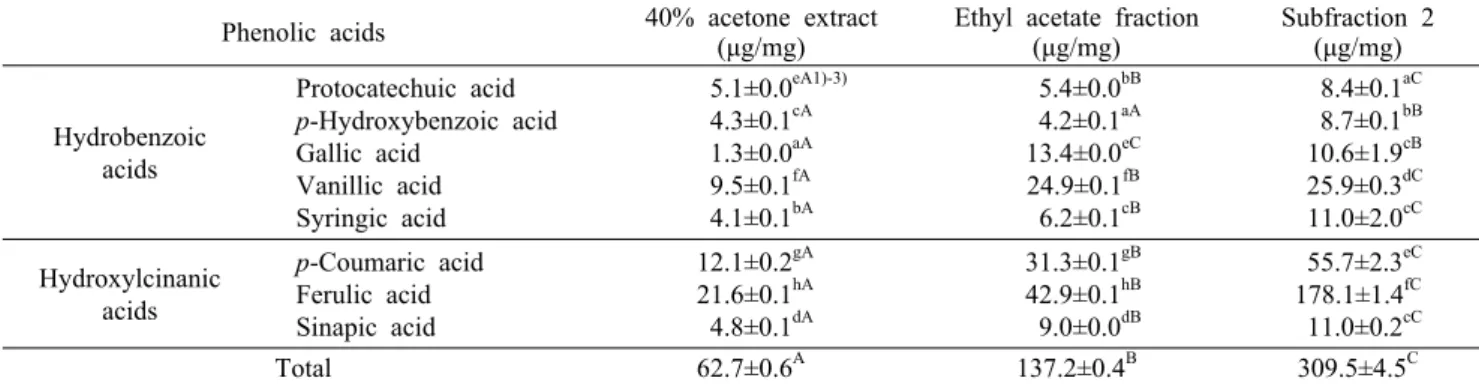
40% acetone으로 추출한 적미 미강 추출물을 비롯하여 분획물 중에서 항산화 활성이 가장 높은 ethyl acetate 분획 물과 subfraction 중에서 항산화 활성이 가장 높은 sub- fraction 2의 phenolic acid 조성 및 함량을 측정한 결과는 Table 5와 같다. 40% acetone 추출물의 total phenolic
Table 4. EC
50 values of various subfractions isolated ethyl acetate fraction from red rice bran1) (µg/mL) Antioxidant properties Comparison12)
Comparison 23)
Subfractions from ethyl acetate fraction Subfraction
1 Subfraction
2 Subfraction
3 Subfraction
4 Subfraction
5 Subfraction 6 DPPH radical assay (%)
ABTS radical assay (%) Reducing power
146.4±1.4bF4)-6) 153.3±1.3cC 127.2±3.7aE
134.9±4.1bE 145.5±2.4cB 125.5±2.9aE
>200
>200
>200
44.8±0.3aA 117.9±0.1cA 48.5±0.1bA
65.1±0.1aC 170.9±2.2cE 87.2±2.4bC
60.9±0.2aB 157.0±2.0cD 75.4±0.3bB
83.7±4.9aD 183.0±0.2cF 98.2±3.0bD
146.0±0.2F
>200
>200
1)EC50 value is expressed as the effective concentration at which antioxidant activity using DPPH radicals, ABTS radicals, and pyrogallols were scavenged by 50%; absorbance was 0.5 for reducing power, respectively.
2)Comparison 1 is butylated hydroxytoluene (BHT) for DPPH radical assay, ABTS radical assay; and reducing power.
3)Comparison 2 is ferulic acid for DPPH radical assay, ABTS radical assay, and reducing power.
4)Values are mean±SD (n=3).
5)Different lower-case letters (a-c) in the same column indicate a significant difference according to Duncan’s multiple range test (P<0.05).
6)Different upper-case letters (A-F) in the same row indicate a significant difference according to Duncan’s multiple range test (P<0.05).
Table 5. Phenolic acid composition of 40% acetone extract, ethyl acetate fraction, and subfraction 2 from red rice bran
Phenolic acids 40% acetone extract(μg/mg) Ethyl acetate fraction
(μg/mg) Subfraction 2 (μg/mg)
Hydrobenzoic acids
Protocatechuic acid
p-Hydroxybenzoic acid
Gallic acidVanillic acid Syringic acid
5.1±0.0eA1)-3) 4.3±0.1cA 1.3±0.0aA 9.5±0.1fA 4.1±0.1bA
5.4±0.0bB 4.2±0.1aA 13.4±0.0eC 24.9±0.1fB 6.2±0.1cB
8.4±0.1aC 8.7±0.1bB 10.6±1.9cB 25.9±0.3dC 11.0±2.0cC Hydroxylcinanic
acids
p-Coumaric acid
Ferulic acid Sinapic acid12.1±0.2gA 21.6±0.1hA 4.8±0.1dA
31.3±0.1gB 42.9±0.1hB 9.0±0.0dB
55.7±2.3eC 178.1±1.4fC 11.0±0.2cC
Total 62.7±0.6A 137.2±0.4B 309.5±4.5C
1)Values are mean±SD (n=3).
2)Different lower-case letters (a-h) in the same column indicate a significant difference according to Duncan’s multiple range test (P<0.05).
3)Different upper-case letters (A-C) in the same row indicate a significant difference according to Duncan’s multiple range test (P<0.05).
acid 함량은 추출물 mg당 62.7 μg이었으며, phenolic acid 조성은 61%의 hydroxylcinnamic 계열(38.5 μg/mg)과 39
%의 hydrobenzoic acid 계열(24.3 μg/mg)로 구성되어 있 었다. 이와 같은 결과는 흑미와 현미 미강의 phenolic acid 조성에서 hydroxylcinnamic acids가 hydrobenzoic acid 보다 높았다는 Laokuldilok 등(28)의 보고와 유사한 경향이 었다.
적미 미강 추출물에서 가장 주된 phenolic acid는 ferulic acid로 total phenolic acid 함량의 약 34%에 해당하는 추출 물 mg당 21.6 μg이었으며, 그다음으로는
p
-coumaric acid 12.1 μg(약 19%)과 vanillic acid 9.5 μg(약 15%)이었다.Butsat와 Sirithon(4)도 유색미 미강의 주된 phenolic acid 가 ferulic acid, vanillic acid 및
p
-coumaric acid라고 보 고하여 본 연구 결과와 일치하였다. 한편 Jung 등(29)은 미 강에 존재하는 ferulic acid,p
-coumaric acid 및 sinapic acid는 분자 내에 hydroxyl 또는 methoxyl group을 가지고 있어 미강의 항산화 활성을 나타내는 중요한 성분으로 작용 하며, 특히 benzene ring의 hydroxyl group 수와 ortho 위 치의 치환기에 따라서 free radical scavenging ability가달라지는 것으로 보고하였다.
Ethyl acetate 분획물의 total phenolic acid 함량은 137.2 μg/mg으로 나타났으며, 주된 phenolic acid 성분은 hy- droxylcinnamic 계열의 ferulic acid와
p
-coumaric acid로 나타났다. 또한 ethyl acetate 분획물의 phenolic acid는 약 61%의 hydroxylcinnamic acids(83.2 μg/mg)와 약 39%의 hydrobenzoic acids(54.1 μg/mg)로 구성되어 있었다. 기 존의 연구에서도 현미 미강의 ethyl acetate 추출물과 이를 분획한 ethyl acetate 분획물의 주된 phenolic acid 성분이 ferulic acid와p
-coumaric acid이며, total phenolics와 total phenolic acid를 많이 함유한 ethyl acetate 분획물의 항산화 활성이 높은 것으로 보고되어(29), 본 연구 결과와 비슷한 경향이었다.Subfraction 2의 total phenolic acid 함량은 309.5 μg/mg 으로 나타났으며, phenolic acid는 79%의 hydroxylcin- namic acids(244.8 μg/mg)와 21%의 hydrobenzoic acids (64.6 μg/mg)로 구성되어 ethyl acetate 분획물보다 hy- droxylcinnamic acids의 조성 비율이 높은 것으로 나타났 다. Subfraction 2의 주된 phenolic acid 성분은 ethyl ace-
tate 분획물과 마찬가지로 hydroxylcinnamic 계열의 fer- ulic acid와
p
-coumaric acid로 확인되었다. 특히 ferulic acid의 함량은 total phenolic acid 함량의 약 57.5%를 차지 하였으며, 결과적으로 적미의 항산화 활성에 가장 크게 영향 을 주는 phenolic acid는 ferulic acid인 것으로 추정된다.요 약
적미 미강의 항산화 활성을 연구하기 위하여 적미 미강 40%
acetone 추출물을 용매 분획과 Sephadex LH-20 chroma- tography로 분리하여 단계별 항산화 물질의 수율, 총 페놀 과 총 플라보노이드 함량, 항산화 활성 및 phenolic acid 조성을 분석하였다. 다양한 용매 분획물 중에서 총 페놀과 총 플라보노이드 함량은 ethyl acetate 분획물에서 가장 높 게 나타났으며, ethyl acetate 분획물의 EC50 값은 대조구 (BHT)보다 DPPH radical assay가 약 2.1배, ABTS radi- cal assay가 약 2.5배, 그리고 환원력이 2.6배 낮게 나타났 다. 적미 미강 ethyl acetate 분획물을 Sephadex LH-20 chromatography로 분리한 subfraction 중에서 총 페놀과 총 플라보노이드 함량은 subfraction 2에서 가장 높았으며, subfraction 2의 EC50 값은 대조구보다 DPPH radical as- say에서 약 3.3배, ABTS radical assay에서 약 1.3배, 그리 고 환원력에서 약 2.6배 낮게 나타나 subfraction 중에서 가장 강한 항산화 활성을 보였다. 적미 미강 40% acetone 추출물의 phenolic acid 조성은 61%의 hydroxylcinnamic acids와 39%의 hydrobenzoic acids로 구성되어 있었으며, ethyl acetate 분획물과 subfraction 2의 주된 phenolic acid 성분은 ferulic acid였다. 결론적으로 적미 미강은 천연 항산화 소재로서의 가능성이 확인되었으며, 분리과정 중의 항산화 활성의 증가는 강력한 활성 물질인 ferulic acid의 증가 때문으로 판단된다.
REFERENCES
1. Jung EH, Ha TY, Hwang IK. 2010. Anti-hyperglycemic and antioxidative activities of phenolic acid concentrates of rice bran and hydroxycinnamic acids in cell assays. Korean J
Food Nutr 23: 233-239.
2. Iqbal S, Bhanger MI, Anwar F. 2005. Antioxidant properties and components of some commercially available varieties of rice bran in Pakistan. Food Chem 93: 265-272.
3. Choi Y, Jeong HS, Lee J. 2007. Antioxidant activity of meth- anolic extracts from some grains consumed in Korea. Food
Chem 103: 130-138.
4. Butsat S, Siriamornpun S. 2010. Antioxidant capacities and phenolic compounds of the husk, bran and endosperm of Thai rice. Food Chem 119: 606-613.
5. Oh SK, Choi HC, Cho MY, Kim SU. 1996. Extraction meth- od of anthocyanin and tannin pigments in colored rice. Agric
Chem Biotechnol 39: 327-331.
6. Seo SJ, Choi Y, Lee SM, Kong S, Lee J. 2008. Antioxidant activities and antioxidant compounds of some specialty rices.
J Korean Soc Food Sci Nutr 37: 129-135.
7. Park SH, Cho IJ, Kim YS, Ha TY. 2007. Effect of methanol extracts of red colored rices on antioxidant activity and growth inhibitory activities of cancer cells. J Korean Soc
Food Sci Nutr 35: 1365-1370.
8. Chotimarkorn C, Benjakul S, Silalai N. 2008. Antioxidant components and properties of five long-grained rice bran ex- tracts from commercial available cultivars in Thailand. Food
Chem 111: 636-641.
9. Lai P, Li KY, Lu S, Chen HH. 2009. Phytochemicals and antioxidant properties of solvent extracts from Japonica rice bran. Food Chem 117: 538-544.
10. Liu Q, Yao HY. 2007. Antioxidant activities of barley seeds extracts. Food Chem 102: 732-737.
11. Zhao B, Hall CA 3rd. 2008. Composition and antioxidant activity of raisin extracts obtained from various solvents.
Food Chem 108: 511-518.
12. Kim SR, Ahn JY, Lee HY, Ha TY. 2004. Various properties and phenolic acid contents of rices and rice brans with differ- ent milling fractions. Korean J Food Sci Technol 36: 930- 936.
13. Chun HS, You JE, Kim IH, Cho JS. 1999. Comparative anti- mutagenic and antioxidative activities of rice with different milling frations. Korean J Food Sci Technol 31: 1371-1377.
14. Kong SH, Choi Y, Lee SM, Lee J. 2008. Antioxidant com- pounds and antioxidant activities of the methanolic extracts from milling fractions of black rice. J Korean Soc Food Sci
Nutr 37: 815-819.
15. Jun HI, Shin JW, Song GS, Kim YS. 2015. Isolation and identification of phenolic antioxidants in black rice bran.
J Food Sci 80: C262-C268.
16. Cha MN, Jun HI, Lee WJ, Kim MJ, Kim MK, Kim YS.
2013. Chemical composition and antioxidant activity of Ko- rean cactus (Opuntia humifusa) fruit. Food Sci Biotechnol 22: 523-529.
17. Amarowicz R, Naczk M, Shahidi F. 2000. Antioxidant ac- tivity of various fractions of non-tannin phenolics of canola hulls. J Agric Food Chem 48: 2755-2759.
18. Dewanto V, Wu X, Adom KK, Liu RH. 2002. Thermal proc- essing enhances the nutritional value of tomatoes by increas- ing total antioxidant activity. J Agric Food Chem 50: 3010- 3014.
19. Zhishen J, Mengcheng T, Jianming W. 1999. The determi- nation of flavonoid contents in mulberry and their scaveng- ing effects on superoxide radicals. Food Chem 64: 555-559.
20. Brand-Williams W, Cuvelier ME, Berset C. 1995. Use of a free radical method to evaluate antioxidant activity. Le-
bensm Wiss Technol 28: 25-30.
21. Arts MJ, Haenen GR, Voss HP, Bast A. 2004. Antioxidant capacity of reaction products limits the applicability of the Trolox equivalent antioxidant capacity (TEAC) assay. Food
Chem Toxicol 42: 45-49.
22. Oyaizu M. 1986. Studies on products of browning reaction:
Antioxidant activities of products of browning reaction pre- pared from glucosamine. Jpn J Nutr 44: 307-315.
23. Abdel-Aal ESM, Rabalski I. 2008. Bioactive compounds and their antioxidant capacity in selected primitive and mod- ern wheat species. Open Agric J 208: 7-14.
24. Jun HI, Song GS, Yang EI, Youn Y, Kim YS. 2012. Antiox- idant activities and phenolic compounds of pigmented rice bran extracts. J Food Sci 77: C759-C764.
25. Lee KS, Oh CS, Lee KY. 2005. Antioxidantive effect of the fractions extracted from a catus Cheonnyuncho (Opuntia hu-
mifusa). Korean J Food Sci Technol 37: 474-478.
26. Park S, Yang S, Ahn D, Yang JH, Cho CH, Kim HY, Lee
JH, Park JS, Kim DK. 2010. Antioxidant constituents of the heartwood of Cedrela sinensis A. Juss. Kor J Pharmacogn 41: 245-249.
27. Moein MR, Moein S, Ahmadizadeh S. 2008. Radical scav- enging and reducing power of Salvia mirzayanii subfractions.
Molecules 13: 2804-2813.
28. Laokuldilok T, Shoemaker CF, Jongkaewwattana S, Tulya- than V. 2011. Antioxidants and antioxidant activity of sev- eral pigmented rice brans. J Agric Food Chem 59: 193-199.
29. Jung EH, Hwang IK, Ha TY. 2010. Properties and antioxi- dative activities of phenolic acid concentrates of rice bran.