Jour. Korean For. Soc. Vol. 99, No. 5, pp. 682~685 (2010)
682
J
OURNAL OFK
OREANF
ORESTS
OCIETYAccuracy Test of Coring for Measuring Annual Increment in Quercus mongolica , Kalopanax septemlobus , and Pinus densiflora
Byung Bae Park
1*, Jong Hwan Lim
1,2, Pil Sun Park
3and Kyeong Hak Lee
41Division of Forest Ecology, Korea Forest Research Institute, Seoul 130-712, Korea
2Division of International Cooperation, Korea Forest Service, Taejon 302-701, Korea
3Department of Forest Sciences, Seoul National University, Seoul 151-921, Korea
4Department of Forest Management, Korea Forest Research Institute, Seoul 130-712, Korea
Abstract :
Coring has been widely used to measure annual increment in temperate forest ecosystems. This method is attractive because cores can be taken in just one visit. However, the accuracy of this method has not been tested. We expected coring to be less accurate than band dendrometers because of the eccentricity of tree growth. We studied 41 trees at the Long Term Experimental Forest in Mt. Gyebang, which has been monitored with band dendrometers since 1996. We collected two tree cores from the south and north face of each tree, 10 cm below the growth band. Increment cores were measured to 0.01 mm under stereomicroscopy.
Annual growth from 1997 to 2006 was 3.2 mm yr
−1for
Quercus mongolica, 3.5 mm yr
−1for
Kalopanax septemlobus, and 5.7 mm yr
−1for
Pinus densiflora. The difference between the two methods was 10% for
Q. mongolica, 14% for
K. septemlobus, and 4% for
P. densiflora. Compaction in the corer and shrinkage during drying decreased diameter increment by 5.6% and 1.0% on
P. densiflora, respectively. This study suggests that the two methods for annual increment measurement are very similar, but species specificity should be concerned for direct comparison.
Key words :band dendrometers, Mt. Gyebang, forest production, temperate forest ecosystems
Introduction
Forest ecosystems become a more important sector to sequester atmospheric CO
2as concentration of CO
2in the atmosphere rapidly increased due to combustion of fossil fuel and deforestation (Nadelhoffer
et al., 1999;
Fahey
et al., 2005). Forest ecologists, foresters, and policy makers have frequently required accurate data of sequestered carbon by forest ecosystems.
In growth and production studies, increment borers and band dendrometers have been widely used in tem- perate forest ecosystems (Maeglin, 1979; Forster
et al., 2000). The use of increment corers is attractive to mea- sure annual increment and tree ages because cores can be taken in just one visit. However, it may lower timber value, alters growth rates of cambium, and might increase tree mortality (Forster
et al., 2000; Fritts 2001; Van Mantgem and Stephenson, 2004). As an alternative method, band dendrometers are installed on trunks and are read to obtain annual growth. The disadvantage of band dendrom- eters is the annual growth was determined by hydration
of the xylem and phloem rather than annual growth increments (Kozlowski and Winget, 1964; Herzog
et al., 1995).
Tree growth of both the canopy and stem is commonly asymmetric, owing to wind, competition with neighboring trees, or topography of the site (Behre, 1925; Robards, 1965;
Stokes and Berthier, 2000; Getzin and Wiegand, 2007).
Reaction wood is formed on the side of a displaced stem or branch that will help restore it to its original position (Sjostrom, 1993). In conifers, compression wood is formed on the lower side of inclined stem; in hardwoods, tension wood is developed on the upper side of inclined stem.
Because coring methods sample the stem at only one radius, they don't capture the variation in ring-width around the stem.
To our knowledge, coring methods have never been com- pared to measurements of diameter increment in spite of the importance of accurate increment measurements to global carbon budgets. The objective of this study was to compare coring method with band dendrometer for measuring annual ring increments in two broad-leaved and one conifer species. We expected coring to be less accurate than band dendrometers because of the eccen- tricity of tree growth. We also compared tree cores to
*Corresponding author E-mail: [email protected]
Measuring Annual Increment by Coring and Band Dendrometers 683
disks to estimate the compaction caused by coring and
shrinkage caused by drying.
Materials and Methods 1. Site description
This study was conducted in a mixed deciduous forest in Mt. Gyebang (37
o44'N, 128
o29'N), South Korea. The altitude of the study sites is 900-960 m asl. The mean temperature is 3
oC in January and 25
oC in July. The mean annual precipitation is 1,402 mm. The soil is a sandy loam formed in granitic parent material with an organic matter content of 5.2%. The study site has not been disturbed by wild fire or human disturbance for more than 100 years.
Mt. Gyebang is a montane forest dominated by Q
uercus mongolicaand
Kalopanax septemlobus. The mean density of trees (> 5 cm at DBH) is 2,950 ha
−1and basal area is 36.3 m
2ha
−1(Lee
et al.2006).
We studied 41 trees of
Q. mongolica, K. septemlobus, and
Pinus densiflora,which have been monitored with band dendrometers since 1996 (Figure 1). The band den- drometers were installed at breast height (1.2 m) around the trunk of dominant trees. The selected trees had no signs of wounding or visible stem irregularity. The average diameter and height of studied
Q. mongolica, K. septemlobus, and
P. densifloraare 28.1 cm and 15.2 m, 26.3 cm and 15.0 m, and 38.2 cm and 16.0 m, respectively. Most of studied trees were located in the north and south slopes.
Annual increments were measured in spring every year from 1997 to 2007.
2. Annual increment measurement
We extracted tree cores in spring 2007 from the south and north face of each tree, 10 cm below the band den- drometer, using an increment borer (Haglöf, Sweden, Ø
4.3 mm). Tree cores were air-dried and sliced with a razor blade to expose a clean surface. The most recent ten rings were measured every year to obtain the recent annual growth rate. Increment cores were measured to 0.01 mm under stereomicroscopy (Leica MZ16, Switzerland).
The measurements were taken two times per tree core to reduce measurement error.
To measure compaction inside the increment borer, we compared annual growth rates obtained by coring with those from stem discs. We selected 5
P. densiflorafrom each age group: 30, 40, and 70 years at the national forest plantations close to Mt. Gyebang. We got two tree cores from the south and north face at breast height and then felled the trees. Fresh stem discs were cut just 2 cm above the location of coring. Fresh discs and cores were transferred to the laboratory. Width of last 10 years was measured on fresh discs and cores within one day. Cores were air dried for three days, measured again, and oven dried at 65
oC and measured a third time.
3. Statistical analysis
Correlation analyses were applied to verify the rela- tionships: 1) increment borers and band dendrometers, 2) three topographic positions: north-facing, south-facing, and ridge top, and 3) south and north faces in coring.
Annual growth was compared using paired t-test between increment borers and band dendrometers. Tree basal area in 1997 was included as a covariate in all statistical analyses.
Results and Discussion
Diameter increments measured by band dendrometers showed no similar patterns during 10 years' measurement in all species (Figure 2), but there was only marginally cor- related between
K.
septemlobusand
Q. mongolica(
P= 0.10). The average diameter increment was 3.2 mm yr
−1for
Q. mongolica, 3.4 mm yr
−1for
K. septemlobus,and 5.7 mm yr
−1for
P. densiflora. The diameter increment of
P. densiflorawas almost twice that of
Q. mongolica. No consistence in annual increment pattern among trees are not surprising because the change of competition with neighboring trees is the most influential factor. Fritts (2001) reported that there was no general pattern to describe all variations in annual increment growth since lots of fac- tors can contribute to variations in ring growth.
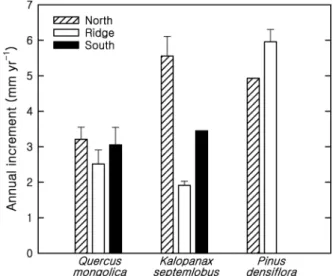
Growth rates differed with topographic position (Figure 3). Diameter increment in two hardwoods is the lowest at the ridge compared to the north and south aspect (
P= 0.05). Diameter increment in
P.
densiflorawas higher at the ridge than at the slopes, but not statistically significant (
P= 0.34). The differences in growth among species and topographic positions can be explained by variations in limiting factors of the environment as well as biological Figure 1. A band dendrometer attaching on the studied
tree.
684 Jour. Korean For. Soc. Vol. 99, No. 5 (2010)
and ecological traits (Fritts, 2001). For example,
K. sep- temlobushad higher growth rates on north-facing than south-facing slopes because soil moisture and nutrient availability are probably lower in the south-facing slopes (Bower
et al., 2005).
P. densiflorais drought tolerant and has little competition for light on the ridge tops, which might explain its high rates of growth in this envi- ronment (Farrar, 1961).
We expected coring to be less accurate than band den- drometers because of the eccentricity of tree growth.
Surprisingly, we found coring systematically underesti- mated diameter increment compared to band dendrom- eters (Figure 4). The error rate was significantly higher in
K. septemlobusthan two other species (
P= 0.05). The difference between the two methods was 9.8% for
Q.mongolica
, 14.2% for
K. septemlobus, and 4.0% for
P.densiflora
. We assumed the reasons of the underestima-
tion by coring are core compaction during coring and core shrinkage during drying. We tested compaction and shrinkage rate for
P. densiflora. Coring underestimated diameter increment by 5.6% and 1.0% owing to core compaction and drying in the air, respectively. If we assumed two other species received the same compac- tion and shrinkage rate by coring, 3.2% for
Q. mongol- icaand 7.6% for
K. septemlobuswere underestimated by coring compared to band dendrometer.
As Kozlowski and Winget (1964) and Herzog
et al. (1995) pointed out, band dendrometer measurement could be biased owing to seasonal swelling and shrinking of the cortex, phloem, and xylem. Because we measured annual increment by band dendrometer around mid April (dry season in Korea) every year, the changes in dimen- sions by swelling and shrinking are ignorable. This means the eccentricity of tree growth was not expected by topography and coring face.
Figure 2. Annual diameter increment for 10 years from 1997 to 2006 measured by band dendrometers. Bars represent standard errors.
Figure 3. Mean annual diameter increment for 10 years by standing position of the trees at three topographies.
Bars represent standard errors.
Figure 4. Comparison of diameter increment (mm yr
−1) between increment corer and band dendrometers measurement from
1997 to 2006. Dotted lines represent 1 : 1 of increment corer and band dendrometers.
Measuring Annual Increment by Coring and Band Dendrometers 685
Coring method can be conveniently used in production
and yield studies. However, this study suggests methods and species specificity should be considered in annual growth rate measurement. More species and multiple sites should be investigated to generate the conversion factors between coring and band dendrometer measurement.
Literature Cited
1. Behre, C.E. 1925. Notes on the cause of eccentric growth in trees. Journal of Forestry 23: 504-507.
2. Bower, A.D., Adams, W.T., Birkes, D. and Nalle, D. 2005.
Response of annual growth ring components to soil moisture deficit in young, plantation-grown Douglas-fir in coastal British Columbia. Canadian Journal of Forest Research 35: 2491-2499.
3. Fahey, T.J., Siccama, T.G., Driscoll, C.T., Likens, G.E., Campbell, J., Johnson, C.E., Aber, J.D., Cole, J.J., Fisk, M.C., Groffman, P.M., Holmes, R.T., Schwarz, P.A. and Yanai, R.D. 2005. The biogeochemistry of carbon at Hubbard Brook. Biogeochemistry 75: 109-176.
4. Farrar, J.L. 1961. Longitudinal variation in the thick- ness of the annual ring. Forest Chronicle 37(4): 323- 5. Forster, T., Schweingruber, F.H. and Denneler, B. 2000. 331.
Increment puncher - A tool for extracting small cores of wood and bark from living trees. IAWA Journal 21(2): 169-180.
6. Fritts, H.C. 2001. Tree rings and climate. The Black- burn Press, New Jersey, U.S.A.
7. Getzin, S. and Wiegand, K. 2007. Asymmetric tree growth at the stand level: Random crown patterns and the response to slope. Forest Ecology and Management 242: 165-174.
8. Herzog, K., Haesle,r M.R. and Thum, R. 1995. Diurnal
changes in the radius of a subalpine Norway spruce stem: their relation to the sap flow and their use to esti- mate transpiration. Trees 10: 94-101.
9. Kozlowski, T.T. and Winget, C.H. 1964. Diurnal and seasonal variation in radii of tree stems. Ecology 45:
149-155.
10. Lee, I.K., Lim, J.H., Kim, C.S. and Kim, Y.K. 2006.
Nutrient dynamics in decomposing leaf litter and litter production at the long-term ecological research site in Mt. Gyebangsan. Journal of Ecology and Field Biology 29(6): 585-591.
11. Maeglin, R.R. 1979. Increment cores - How to collect, handle, and use them. Forest Service, United States Department of Agriculture. General Technical Report FPL 25. 18p.
12. Nadelhoffer, K.J., Emmett, B.A., Gundersen, P., Kjùn- aas, O.J., Koopmansk, C.J., Schleppi, P., Tietemak, A.
and Wright, R.F. 1999. Nitrogen deposition makes a minor contribution to carbon sequestration in tempera- ture forests. Nature 398: 145-148.
13. Robards, W. 1965. Tension wood and eccentric growth in crack willow (
Salix fragilis, L.).
Annals Botany29:
419-431.
14. Sjostrom, E. 1993. Wood Chemistry-Fundamentals and Applications. The Academic Press, San Diego, U.S.A.
15. Stokes, A. and Berthier, S. 2000. Irregular heartwood formation in
Pinus pinasterAit. is related to eccentric, radial, stem growth. Forest Ecology and Management 135: 115-121.
16. Van Mantgem, P.J. and Stephenson, N.L. 2004. Does coring contribute to tree mortality? Canadian Journal of Forest Research 34: 2394-2398.
(Received June 11, 2010; Accepted July 7, 2010)