gq$$q ~8 q q ~ ] 4 15 3 4]33(2005~12+l) J K o m Soc Occup Environ Hyg 2QO5;15(3):232-238
A Study on Introduction of Accreditation Program for Industrial Hygiene Laboratories in Korea
Deok Mook Park . Jeonglm Park') . Yong Chul Shinzi . Jeong Young Cha3j Jee Yeon Jeong" . Boo Wook Kimz' . Narn Won Paik3'
Busan Regional Headquater, Korea Occupational Safety and Health Agency . 'JGlobal Environment Research Center, Korea Environment Institute . 2JDepartment of Occupational Health and Safety Engineering, lnje University .
"Graduate School of Public Health, Seoul National University
4)Occupational Safety and Health Research Institute, Korea Occupational Safety and Health Agency There are growing needs for improving the general
performances of the domestic working environment evaluation organizations. For this purpose, introduction of laboratory accreditation program has been suggested. This study was conducted as a part of thls effort. With a questionnaire developed in accordance with the ISOIIEC 17025, the current status of industrial hygiene (M) laboratories in terms of manpower, management and technical aspects. The results of this study were as follows:
1. The average working staffs' number of the working environment evaluation organizations was 6.8 f 3.3 persons. In addition, 49% of all organizations are run by less than 5 persons.
This suggests that manpower of Korean M W o r i e s is very limited.
2. IH laboratories surveyed in this study obtained 53% of the points by the intemational standard. And there is significant correlation between the number of sMing and total scores cP4.05,.
3. The period of work experience is one of the most important factors to determine the working capability. The average year of work experience of the laboratories' directors was 13.5
+
5.3 years. Directors with more wok expenemsobtained higher scores on the questions that ask to prove the appropriateness of the research methodology 0 . 0 5 ) .
4. As for academic quhtications of laboratory dimtors, 14%
had Ph.D., 31% with Master's, 29% with Bachelor's, and 4%
had Associate degree. There was si&~cant correlation between the total scores and the general managers' academic background (~4.05). 7he 27% of laboratory dkctm have majored in either industrial hygiene or health, 8% majored in medicine, another 8% majored environmental studies, and 6% majored in chemistry.
5. Only 14% of all IH laboratories surveyed employ directors with Certified Industrial Hygienist licence, 41% have general managers with Cetthd Associate Industrial Hygienist (Level 1) licence, and 45% of all laboratories either employ directors without relevant quallficalion or did not respond. When the laboratory manger holds relevant quahfication, laboratory health and safety management was better (pd.05).
6. When compared to the general international standard in terms of the management, and 55% in terms of technological level.
Key Words : w o h g environment evahalion, a d t a t i o n , I S O E 17025, qual~ty control
q " d a G 3 0 1 @ t z z \ q
a7oF
"11 ;"dFqgs f %+ 9 4 4 , qq zj, ~8g+q4 g ql+qzjg
921- g o t q i L , 93, gq, g
7F3)2 4 4 01°F. 531 qq-4 +q 9x14 kg3j7\g 3\71 q d A j k 4 H l EAF, 93 3++ g , 9 3 717q 23, AIs.314, A J z q $9 _r 2
3, gq, z\g3jq 5q
+a@
4 3 % 7-1474 513, 8 ~ ~ f j o l a ? %"F. qtF4 %l7\ 3 4 4 3 W S 4
%4"11Aj O l 7 o l x l k AlZS-.l-ln,FO 3 9 4 %
+
30q1 631~1&AF?-E4 z ~ a 4 4 ~ 1 8 ~ " 1 1 z ~4
j49 Fqs 7 1 8 q o ) @q(Y%$!
5, 1999).
A158 o]T g 34441 q @ g44 %*S 22 xi, A ) " d f 9 0"Fq
*"da
3 g 7 F g AFO~ 4 1 A j r $331 %A$ 8) 93 +3 34q 3qxq 4 3 4 2 s
%kQAl7]7] q@ !sGjOS 1992$l+-
~1 3raqA1rs ~ ~ 8 8 4 23 9
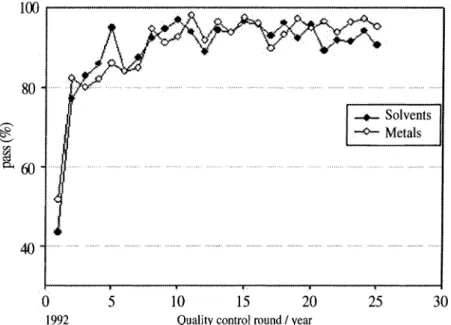
q. Fig. 1 olJ4 250) 4114 3sg
i q 4 1 A j +371ggq 3 4 Zj$Lsg +71 -$A] 30)7\ 43.3%, %+30)7F
51.7%0]23, f 30) p? pq9 713s 31%4] xl(JLFz1 % % q . 8)x)
9 01 q zj- 771ggq %4+Gj&
ve51
ilkQq61 106c]$l~l 43 4 2q+ W o o ] Q q qqsp 2 0 1 3%q;F(Oh et al., 1993; @T2q 33 $
3, 2005).
3 r 3 4 4 l r 7 F 43713q -11s.
gq+qp 3151 qp$."]ax]* q q '301 71"Fg AFP1ZAllz q F 5 1 3 -^,Fq q A$ 3 o i q 9347) g;T1 713 q"F 3\01
s
2 6 1 3 2q ( k g n,F 5,2004) qqg3g3 4441 q @ 4 45s -q%8)% 3+4 9 + E g
0 5 10 15 20 25 30
1992 Quality control round / year
Fig. 1. Analysis proficiency of participating laboratories for organic solvents and metals in the Korean Quality Control.
%-Cf(@q+q
ga$q,
2004; 71934%, 2000).
q"d3944157\ "188 g T 9
$ 4 1 ~ s= as8)t qaol 7 251 ; F l J A ) q 3 924 qqga+;Tj
7 1 3 4 l A j t 94s 97148)6c] qq
@ $ 0 ) +-2+3)3 qq@ 2 H I . g 2
f q 0) 3 ) k x l k 741 4 0 2 a \ % 801 ++@ 4 4 o J - C f .
4tFAj
s
9 7 4 1 A j k "1?4713011g 9 4 0 z 4-$q+ q 4 1 l f F q 9
Intema!ional Organization for S m o n /International Electrotechnical Commission 17025 (014 ISO/IEC 17025) ol] 27-1 8)
acl 7H%9 +Ex13 T4 qq83 +3713q 9 4qg qq8)q 9
+
111%$.5; 714%+
92 P,F",F$D A N 3 ) 7 ] q@ 71% z\s.gj ;I1J+3)
-'-1
34 + B q % q .
*qo,F4+5! +q",F&La$j7$!q qj+g : 203g 11% 179, jflqg : 20059 12% 239
A j 4 A ] 8 ) 2 qq93q3713 3 r
T J ~ ~ z ) : d%g (~j-1852~) $27 94% 2 8 @ ~ ] A j $ d r ] q i i ! $LZjqq$
Tel: 02-74-8883, Fax: 02-765-9105, E-mail: [email protected]) 3 4 i%Z3@4] @ q S \ X 25 131
+4-ILFq ."?-~38937134 %
9 7 1 G i L k 4 3 4 4 q s qq
471 q iiH 3413£$@ 71 7 4 A1 71
3 9 9 7712 9 I S 0 /IEC 17025:
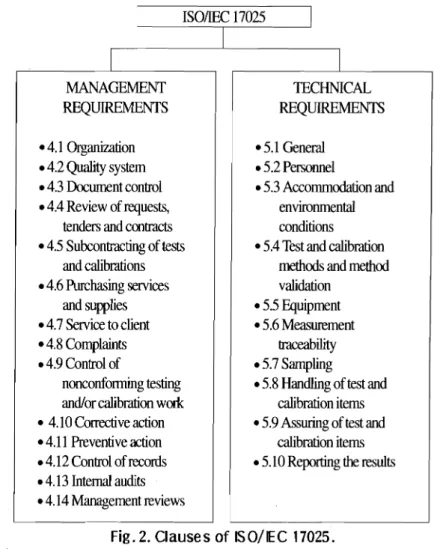
General requirements for the competence of testing and calibmtion M e s(IS0 /EC, 1999)q -)Sh)g(Fig. 2 @Z)$ 7 1 s
0 3 7H93 + l s x ] g ~l-g-'t;Fq
z
-
h\g 4 h ] ~ \ % L ) . ~ F Z I ~ 9*%
_%f gF 941 +901 !g$ijF%il,
tHaF44 -17611 a;F+ a x \ + $ $
9 s x l g ~ 3 % w ~ ~ 3 4 7 1
E g q . 9 3 x 1 q98% S6171 q 8l.q 71 9 4 713611 $*S 7124
3s
-1?js)%q.3. XtZZ] 21 gq
7_F FBFgg g.Cd-4 gxg $7)
3)q % 3 7 ] 9 4 ] S 7 h ) g 5 W o
0]$16) q? %L%q 1 % ~ ) $$g $F
%% 9 6 F J L % q . 6 0 % g 71$oz
++
3s 934154 4xlgF q-$,9% HJ,FtCj 5611 38\q 7+qBgZ$
3 7 1 3 0 1 713% +3 014%\3 9
58%
+
$Jzg 5\71 qg @A1497 1 2 0 1 4 1 4 @ 36lq. 94457)
A188 q 3 4 q s d 4 1 qq 01 712s 4%) Iso/IEc1702561l $481 25-)£
3 e3qqb) @ q ( @ q $ w a %
q, 2004; ISO/IEC, 1999). 71 Fg4
%FfLt71q 4 4 ( 7 ) 3 q Q ) q h j 1 4 (7)5k +-4 SL), 5% AJq + $J+
2 7 1 4 1 4 4 q-cc]ijFdcJ 383
4 9 4 0 z q 3 , gq- 4 + g P+
g$ *%0g q 7134 eqg 3 q%q. 6 1 5 71334 %*
3\01 4% gq q q , 93 4 ) s £ 3 611
3 ~ 1 7 ) Hlzq 2 q q $ J + 7 1 3 q
X ~ Z ] 53 7134 5 4 % HlZS)
3di.
x \ S 4 57419 4 $ SAS system version 8.1 (SAS Institute Inc ., USA) 2
REQUIREMENS REQUIREMENTS
4.1 Organization 4.2 Quahty system 4.3 Document control 4.4 Review of requests,
tenders and contracts 4.5 Subcontracting of tests
and caliMons 4.6 Purchasing services
and supplies 4.7 Service to client 4.8 Complaints 4.9 Control of
nonconforming testing andlor calibration work 4.10 Corrective action 4.1 1 Preventive action 4.12 Conb-ol of records 4.13 Internal audits 4.14 Management reviews
5.1 General 5.2 Personnel
5.3 Accommodation and environmental conditions
5.4 Test and calibration methods and method vahdalion
5.5 Equipment 5.6 Measurement
traceability 5.7 Samphg
5.8 Handling of test and ahbration items 5.9 Assuring of test and
calibration items 5.10 Reporting the results
Fig. 2. Clauses of IS O/E C 17025.
*1Q3%di. 4 s 7 F 3fFA& 44-4
x1 %o\ H I 2 9 5;rll?jqq-%q. 2 E % 3 7 ] 3 $ ) q 4
-)a3
71]
+
Speamaan correlation% 61 -$ 8) qg q z \ % 3 , 7 1 3 -$;-41 g *2qg
~ ) q %Ad611 4 s $ 9 3\01?
Wllcoxn tests 61 -$ s\q 5% -$;-q 92 6114 4 3 4%di.
3.7%q] z]L+x] gsg 3qg lq g
7;H qq719q +q g q 0 3 2 q q93+3 Ajiq $381 4153
9
!a%$
2 q 2 q .+ $ $ 7 ] 3 5 i q Z @ + S $I71 +
3s
$3 3833 g 3173, q x j 3 +2 1244 0) 23, s,$$ 202
+
4 5 3 03 L+LFEF!dq. 0 1 2 .;FA149 93715 $2 q 53%4 giq8)L-t. 93
;F1JEg 59371 q q A j 2 q-3 7 1 3 s q 8 9 2 771g 9 3 q +2$
g g
+
%$ HJ901 &7+j$ eJ$ %q. 3 E 9 4 E S I L q 4 1 @ q
42 51 7~ 7133q 3.; g e +
Fig. 33% 2q.
4393$37134 3 9 $ 3+
+
qqiq + q 3 +,a.'jp qqq%.F(p<0.05). god 9 4 xl+cdlAj2 531 ";'" +q .'d 01 qq q21 2%
dr. x\"JI+$.!713P 71gicl]q 8 9
~1&90l q++s@, tH?j 94 5 4 1 Aj g 9 q $ qq@g+i-;d qg713
r
$ 3 4 -19 4 9 . i ; ~ ~ s 341 3\01 421"d.s
g o 3 =.q-fl,q. @ q q ] 7lf 9 8 4 5 . 2 2 4 7
Aij 2 x]q, 5.5 $HI, 5.8 A J 2 ~ z 8 g+q 4 2 g $9 5 4 $I+
s
gqiq z-fi]qsLs + q 3 A J 3931s ~LFEF~E.!Z q"dG!+371 3 q + g q g + p q ) A J p q q Aj?
71Gq03 9q0) q25lqdF g$
eJ
+
% q .719 +?jg #,+$ q q 7 ) 9 2 q
x\41%37134 4+7i f+k % 9 z 1
q 531 4 0 s +q 3 3)0) 2 2 5 1
437134 -17 + q j + q q ~ j 4 g 4 q *$!9x\7\ 399 s q++ 3r+(Paik et al., 1997; %$, 1994; qg+
s,
1993). 3% %Frf 9 5171 7194 +%%qU,Odx\g ~ $ q%]q $jg3+4 374g eJo]2%
q.
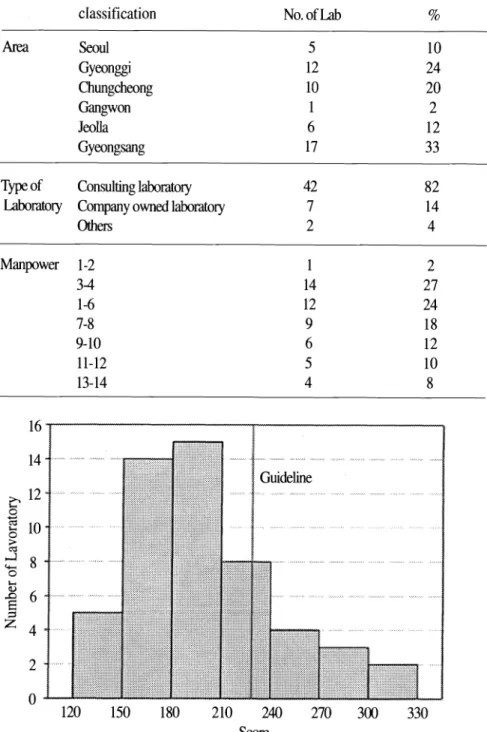
Table 1. Geographic distribution, type, and size o f the industrial
hygiene laboratories surveyed -
classification No. of Lab %
Area Seoul
Gyeongsi Chungcheong Gangwon JeoIla Gymnssang
Type of Consulting laboratory 42 82
Laboratory Company owned laboratory 7 14
Others 2 4
Manpower 1-2 3-4 1-6 7-8 9-10 11-12 13-14
" 120 150 180 210 240 270 300 330
Score - ~ ~
Fig. 3. Distribution of industrial hygiene laboratories by score.
4 1 2
xg
77194 ".1 11%, ilgq@ g 63%, 4q9q+J4 $3 26%
z
3 + q -lSsAJ$ 3+
9q. 't;Fzlyl 4 9 4 93x8 a q q ] g @ 8 4 1 7194 497) 1 0 0 4 2 3 @ 3
;i;FQ 333 503q1 x]+x] % O p 3 9 8 2 d q l 4 Z F q 8 E 7 1 9 4 1 A j 4
38s e3
+
4 4 %x # z ) p 1 , 98x8 @ a $ 7H44
71 % @ 44 F47) %]297jFgq(4
#+, 1998; a d ] 7 $ 2000; Abellet al., 1991).
3 . 3 % 87;!
(Manage me nt Requirements)
* g @ 3 + 4 7 ] 9 4 3 9 Q8$
.;F419$37174 "172719 9e71 g g ISO/lEC 170254 S;Lh)%kq] t 45iq 3 4 4 3 q .
'9371gq 3 03 .&a q7)qlAj
9+-$3 100$2.Z @+Iij)%$ 3
+
3333+7) 6 0 3 % ";1 % k + g'4.1 Eq 4 3 9' (693 ) , '4.3 zAj
$ q ' ( 7 2 3 ) , '4.6 ~ j ~ l h 2 gg7
uH' (653 ) , '4.7 3 4 q] I$ @ ~j H]
5' ( 7 2 3 ) , '4.12 7]594' ( 6 4 4 ) $ 0 1 3 x , 6 0 3 uply!-g %I+$ '4.2 g -15g (441, '4.5 A]% 2 3 4
4 % q 41Q+"(29.$), '4.10 ~ 1 3 ~
31' (5031, '4.13 497,Fh)' ( 4 8 3 ) 5
01 3 q(Fig. 4 ~ F E ) .
2-70 54
8 9 2x8 3 4 1 4 333 -,-Ti=
323 ISO/lEC 170254 S;LA)361]
3 0 1 9+8)A1 LFq!dq. 4% @ a 44719 93611 49s XlJ9iiFx 92 %k+-($.;F*q98*g, 2004)
n+7) 712 ~190s ~ 4 4 0 s
7H45;146) Q ~ F ~ s o J q . 4.71$87;!
(Technical Requirements)
71Q 9 - 4 8 4 1 4 333 + 2 & 7.
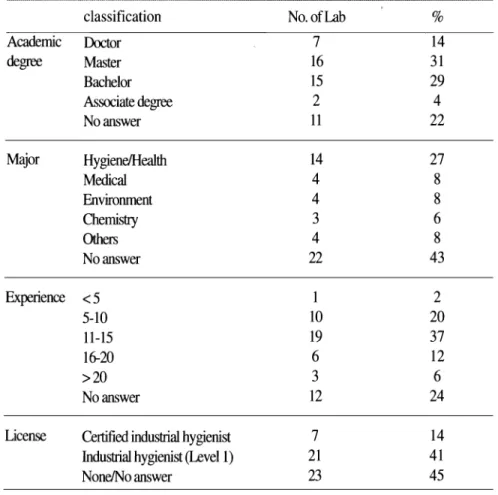
Table 2. Professional qualification and experience of laboratory
directors ( n = j l )
classification No, of Lab %
Academic Doctor 7 14
degree Master 16 3 1
Bachelor 15 29
Associate degree 2 4
No answer 11 22
Major H ygienmealth Medical Environment Chemistry Others No answer Experience <5
5-10 11-15 1620
> 20 No answer
License Certified industrial hygienist 7 14
Industrial hygienist (level 1) 2 1 41
None/No answer 23 45
414 9 9377124 5 5 4 2 s el$ijF
311 L F q k i q . 5.5 4 ~ ] ( 6 6 4 ) , 5.6 A]
gB44 & 3 ~ 2 ( 6 2 3 ) , 5.7 ~1s z
4 ( 6 9 4 ) 0 ] 712% L;1%0uj, 5.2
4
% ( 5 9 4 ) , 5.3 A 1 4 2 $ $ 3 3 3 ( 4 4
w ) ,
5.4 A J ~ B J+g4 ~ ~ q g ( 4 2 4 1 , 5.8 2 q%P % + q 43 ( 4 9 4 ) ,5.9 B 4 q 44 4 g g ( 3 8
4 ) , 5.10 @ + g z ( 5 2 4 ) 2 6 0 3 71
2 p l 9 O z LFE+%q. (Fig. 5 % ~ )
qq g 3 4 l J r 329 AJ %Q@ 327)
4 4 3 s ISO/IEC 170254 7 1 $ 9 3
O Z q A j * q g7\4494 3 3 F 4-8-4 3 5 A l - S 9lq 3.7. 1371 43
719% BJEijFq q g @ 34 qq 3 4 7]%01 719 a d q l yq-Ji)%
33)s qgil 3x1 3 3 3 q 1 $@
7 l W @j *7F q6-1 9x1 % o F ~ j
" d 7 F 2311 .Fa+ 32s .FE+ki q. g$;F]JZ% S.9471 qijHAj+
+-4402 Z A j g q ] q @ Z + o )
O l F 6 - 1 4 O F 9 3 0 1 q .
2sfl q g f 4 71$01 %b%Pqil, Management Requirements
g & q o l J 4 q g
+
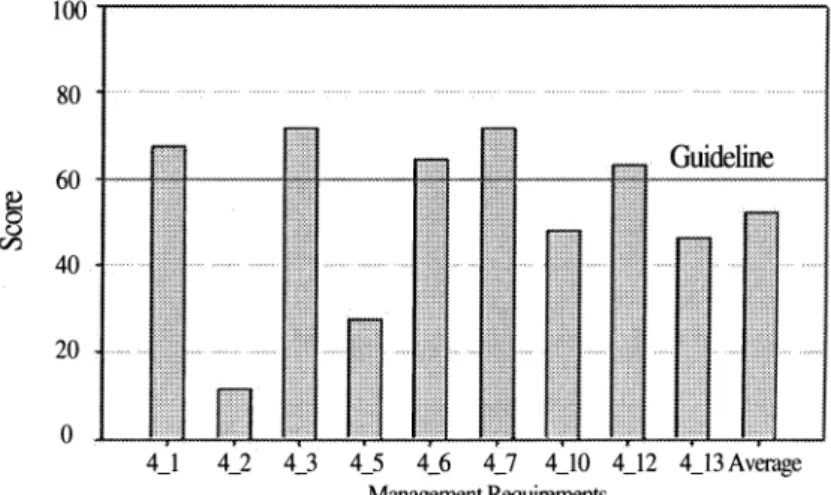
35 Fig. 4. Ma.nagemen t requirements scores for the industrial hygiened4 'l laboratories surveyed.
o ] F q x ] u j , ?g-Ji)3 %412 71% 4-1 organization 4-2 ~uahty s y e m 4-3 Document control
2 3~1 q 94 g +XI 7) 7)%73'Fq. 4-4 ~ e G e w of requests, tendek and contracts 4-5 Subcontracting of tests and calibrations 4-6 Purchasing senices and supplies 4-7 Senice to client 4-8 Complaints
%@ 418149 ~ 8 0 1 olF6-1xI q, 4-9 Control of nonconforming &ng andlor dbration work 4-10 Cormtive d o n 4-1 1 Preventive action 4-12Control of records 4-13 Internal audits
z q 4 97s
+
3311a
4-14Management reviewsq(Halevy,2003; q5-&,2001).
loo 1
5 3 5 3 5-4 515 5 6 J' 5i8 5 9 5i10 Average Technical Reqirements
Fig. 5 . Technical requirements scores for the industrial hygiene laboratories surveyed.
5-1 General 5-2 Personnel 5 3 Accwnmodation and environmental conditim 5-4 Test and cahlnation methods and method validation 5-5 Equipment
5-6 Measmment W i t y 5-7 Sampling 5-8 Handling of test and calibration items 5-9 Assuring of test and calibration items 5-10 Repxikg the results
REFERENCES
1988 ;17 75 -84 k
g '
?
!
, 449, 4 3 9 , q-$fF, E 71&, ?W%, $ 8 9 , 8 x 1 9 , 6 1 4 7 , ",F%41, ~ 1 ~ 1 9 . 9-3
.",FWAJ 3 5 3 4 4 W*J
",F-94;a'lr q-$"as4
ax-
e l q * @ AJ q q ~ 1 2 0 0 4 ; . L
14(1) 86-91
*%9, 44-3, o l i t 7 , 0 1 % $ 9 P
~ w . -w
q+ z\@ 8 3 ~ 3 7 1 3 g y + q q l 39 3%. 9-3 3 ~ Aq q Jxl 1993; 3 ( 2 ) : 194 -203*'&+!, q++, +g-*?.
*@Qag
4 g 337). 43&$9A); 1999.
Hj%+j. PqLFtF $@Q3 %'-;2713
4 + A ? & ,-, * q q
m$
~131" L9 & . 3 q $ @ q - 1 J q q ~ l 1994;4(1):5
-$A1
+,
k g 9, $47, $3 9. 9q- + @ g a g @ 7134 9 4 4ga
*aga0]]
39 4qq- q q . $ q $ g q ~ J q q x ] 2000 ;10(2) :150-164
q+p. +$gy 3 s 3 q g $ l B J
9. + q $ y q q q x ) 1993;
6(3 ) 33-95
$q+"dFzq. $34 -)J 9 1 7 4 . Retrieved November 1, 2005 from the World Wide Web : http: / /home.
kosha.net /-yigy /kqc-text.htm
@q$"dalq. q :'"d @ 3 98
7 1 3 4 +$)~37) 7]$, $31,
$9 $41 39 91". $ 9 2
8 $ i a 9 7 $ ; 2004.
$ q $ " d d % q . 2?L @ g 3 $ 3 3r843~7)2+ $ @ * J % ~ ] A ]
2001 97234. 3 9 9428
917%; 2002.
ISO/IEC 17025, General requirements for the competence of testing and calibration laboratories. 1999.
%7118. + 9 . AlZ@&;c11 A l s g
g 3 z ) a . Retrieved November 1, 2005 from the World Wide Web:
http://kosis.nso.go.kr/cgi- bdsws-777pop.cgi?A-REPORT-D
=MA&A-CONTENTS3803&A-L ANG=1
P&NW,Levine SP, Schork MA.
Development and Application of a Quality Control Program for Industrial Laboratories in Korea. Appl Occup Environ Hyg 1997;12(1):46-53 Oh SM, Park DY, Chung KC, Park DU,
Shin YC, Lee NR. Fmt Year Report of Analytical Porficiency Testing Program for Industrial Hygiene Laboratories. c+j $3 9 4 q q x]
1993;5(2):25@261