1.
서 론조립된 가설기자재는 단일부재인 수직재, 수평재와 가새재 등을 조립하여 가설구조물을 형성하는 것을 말 한다. 현행 가설기자재의 안전인증 및 자율안전확인 신고 기준은 수직재, 수평재, 가새재 등 가설구조물을 구성하고 있는 각각의 단위 부재별로 재료, 구조 및 성
능기준을 적용하고 있다1-2). 이러한 안전인증 및 자율 안전확인 신고의 주요 부재인 동바리, 비계 등 가설구 조물 설치를 위해 현장 조립을 하는 경우에는 일부 부 재의 누락 또는 연결부 작업불량 등으로 가설구조물의 안전성이 저하되거나 붕괴사고를 유발하는 등의 위험 성에 대한 고려가 미흡한 실정이다. 또한, 건축 및 건 설구조물의 대형화, 복잡화 등으로 인하여 가설기자재
****안전보건공단 산업안전보건연구원 선임연구위원 (Occupational Safety and Health Research Institute, Korea Occupational Safety and Health Agency)
****안전보건공단 산업안전보건인증원 부장 (Occupational Safety and Health Certification Institute, Korea Occupational Safety and Health Agency)
****충북대학교 안전공학과 교수 (Department of Safety Engineering, Chungbuk National University)
****안전보건공단 산업안전보건연구원 실장 (Occupational Safety and Health Secearch Institute, Korea Occupational Safety and Health Agency)
Vol. 35, No. 3, pp. 32-42, June 2020
https://doi.org/10.14346/JKOSOS.2020.35.3.32
ISSN 2383-9953 (Online) http://www.kosos.or.kr/jkosos
조립된 가설기자재 안전인증제도 도입의 타당성 분석
정성춘*⋅권준혁**⋅원정훈***⋅권용준****†
Feasibility Analysis for the Introduction of Safety Certification System for Assembled Temporary Equipment and Materials
Seong Choon Jeong*⋅Jun Hyuk Kwon**⋅Jeong Hun Won***⋅Yong Jun Kwon****†
†
Corresponding Author Yong Jun Kwon Tel : +82-52-703-0840 E-mail : [email protected]
Received : March 17, 2020 Revised : May 6, 2020 Accepted : May 29, 2020
Abstract : In this study, in order to secure the necessity of introducing the safety certification system for the assembled temporary equipment and materials, the feasibility of the introduction was analyzed through literature review, structural analysis, and actual experiments and surveys related to the assembled temporary equipment and materials. In the previous studies, it was found that the research on the assembled temporary equipment and materials was insufficient, and it was possible to grasp the necessity of introducing the safety certification system for the assembled temporary equipment and materials. In addition, in the results of the serious accident analysis, it was found that the soundness of the temporary equipment and materials is determined by the structural characteristics after it was assembled. As a result of the feasibility analysis of the introduction of the safety certification of the assembled temporary equipment and materials through structural analysis, it is possible to effectively and rationally reflect the main geometrical influence factors, and to introduce the safety certification system that can test the procedures and procedures of the assembled temporary equipment and materials and based on it. It was found that there is a need. As a result of feasibility analysis on the necessity of introducing the safety certification system for assembled temporary equipment and materials through actual experiments, the existing single member performance evaluation has limitations in evaluating the structural performance of the assembled temporary equipment and materials. It was found that there is a need to introduce a safety certification system. As a result of gathering opinions on the feasibility of introducing the safety certification system for assembled temporary equipment and materials of manufacturers and users through the survey, it was found that the overall positive response result was high and the effectiveness was high.
Key Words : assembled temporary equipment and meterials, safety certification, introduction, feasibility
Copyright@2020 by The Korean Society
of Safety All right reserved.
재료, 구조 등의 다양화에 대한 시장 요구에 따라 현행 안전인증 및 자율안전확인의 신고 고시에 정의되지 않 은 특수구조 제품 또는 완성품 형태의 가설기자재 개 발과 사용이 증가하고 있는 실정이다. 따라서 현재와 같은 가설구조물 구성 부재에 대한 단품 인증이 아닌 부재간의 결합과 구성 방법을 포함한 조립된 가설기자 재(시스템) 전체 인증에 대한 제도 및 기준 설정의 필 요성이 확대되고 있다.
현재 국내에서 사용중인 조립된 가설기자재(시스템) 현황은 파이프 서포트 및 동바리용 부재(틀형 동바리 용 부재, 시스템 동바리용 부재), 조립식 비계용 부재 (틀형 비계용 부재, 시스템 비계용 부재) 및 이동식 비 계용 부재 등이 있다. 국내의 가설기자재 안전인증 및 자율안전 확인의 신고 체계에서는 단위 부재별로 안전 인증을 수행하기 때문에 가설기자재를 조립하여 사용 할 경우 서로 다른 회사의 제품을 사용하여 내력이 저 하되거나 응력전달 체계가 불안전화될 우려가 높다. 그리고 가설기자재의 설치⋅유지⋅해체 작업 시 연결 부위 체결 분리가 어려운 문제점이 있다. 또한 가설기 자재 관련 특수구조, 신소재 및 신제품의 개발을 저해 할 우려가 높다. 이러한 문제점들을 해결하고 가설기 자재를 사용하는 사업장에서의 산업재해를 감소시키 기 위해서는 외국의 경우와 같이 조립된 가설기자재 (시스템) 안전인증 체계를 도입할 필요성이 있다.
본 연구는 조립된 가설기자재(시스템) 안전인증 체 계로의 전환을 위한 타당성을 제시하는 것을 연구의 목표로 설정하였다. 이러한 목표를 달성하기 위하여 문헌고찰, 구조해석, 실물실험과 설문조사를 통하여 조 립된 가설기자재 안전인증 도입에 대한 타당성을 분석 하였다. 타당성 분석 결과 조립된 가설기자재 안전인 증제도를 도입하여 실행하면 안전성 확보와 품질보증 측면에서 효과가 있을 것으로 나타났다.
2.
국내⋅
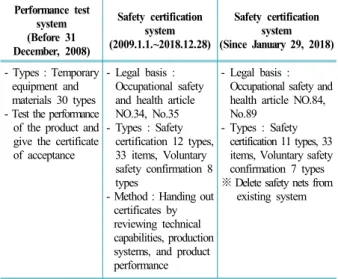
외 조립된 가설기자재 안전인증 및 성능평가 2.1 국내가설기자재에 대한 안전성 확보와 품질보증을 위하 여 2009년부터 성능검정제도가 안전인증제도로 전환 되었다. 이는, 산업안전보건법 제83조(안전인증기준)과 제84조(안전인증), 제89조(자율안전확인의 신고)에서 정한 가설기자재의 안전인증 등은 제조자의 기술능력 및 생산체계와 제품의 성능을 종합적으로 심사하여 안 전인증기준 등에 적합한 경우 안전인증표시( )를 사 용할 수 있도록 하는 제도이다3).
가설기자재 성능검정제도에서 안전인증제도로 전환
Table 1. Domestic safety certification system for temporary equipment and materials
Performance test system (Before 31 December, 2008)
Safety certification system (2009.1.1.~2018.12.28)
Safety certification system (Since January 29, 2018) - Types : Temporary
equipment and materials 30 types - Test the performance
of the product and give the certificate of acceptance
- Legal basis : Occupational safety and health article NO.34, No.35 - Types : Safety
certification 12 types, 33 items, Voluntary safety confirmation 8 types
- Method : Handing out certificates by reviewing technical capabilities, production systems, and product performance
- Legal basis : Occupational safety and health article NO.84, No.89
- Types : Safety certification 11 types, 33 items, Voluntary safety confirmation 7 types
※ Delete safety nets from existing system
된 세부적인 내용은 Table 1과 같다4). 추락⋅낙하 및 붕괴 등의 위험방호에 필요한 가설기자재는 단위품목 대한 심사 및 성능평가를 실시하여 안전인증을 받도록 산업안전보건법에서 정하고 있다. 즉, 조립된 가설기자 재에 대해서는 안전인증제도가 마련되어 있지 않은 실 정이다. 또한, 성능평가도 단일 품목에 대해서만 안전 인증기준이 마련되어 있고 조립된 가설기자재에 대해 서는 안전인증기준 및 매뉴얼이 마련되어 있지 않다5). 2.2 국외
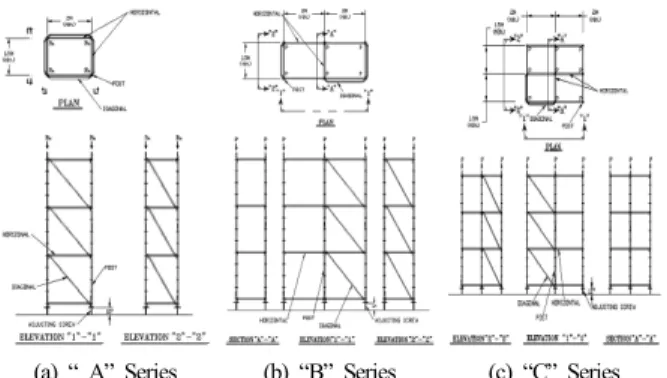
미국 및 유럽 등은 조립된 가설기자재의 안전성 확 보와 품질보증을 위한 표준 및 제도를 가지고 있다. 또 한 조립된 가설기자재의 성능평가를 위한 실험기준을 두고 있다. 미국은 ANSI의 ‘Standards for testing and rating scaffold assemblies and components(2002)’, 영국은 BS의 ‘Temporary works equipment: Part 3 Loading test (BS 128AA-3:2002)’, 독일은 DIN의 시험기준에 의해 시스템 비계 및 동바리 등 조립된 가설기자재의 성능 평가를 하도록 하고 있다. 미국의 조립된 가설기자재 성능평가는 3단 높이의 실험 단위의 정의를 통해 “A”,
“B”, “C” Series 실험으로 규정하고 있다. “A” Series는 필수, “B” 및 “C” Series는 추가 선택(Optional) 조건으 로 성능평가를 수행하고 있다6-7)(Fig. 1 참조).
일본의 가설기자재 성능검정제도는 우리나라와 유 사한 방식으로 시행된다. 즉, 가설기자재의 단위 부재 에 대한 성능평가 방식으로 안전인증이 이루어진다. 또한 승인제도를 통하여 조립된 가설기자재 및 구조물 에 대한 성능평가를 통하여 안전성 확보와 품질 보증 을 하고 있다. 성능평가 실험체의 높이는 5단을 기준으
(a) “ A” Series (b) “B” Series (c) “C” Series Fig. 1. Unit of system scaffolding performance evaluation system in ANSI.
Fig. 2. Examples of performance evaluation of prefabricated temporary equipment and materials by the scaffolding and construction association of Japan.
로 실험을 수행하고, 별도의 수평력은 가하지 않는다8) (Fig. 2 참조).
이와 같이 외국의 경우는 대부분이 가설기자재 관련
규격 및 표준에 의거 조립된 가설기자재의 안전성 확 보와 품질을 보증하는 반면, 우리나라에는 가설기자재 단일부재에 대해서만 안전인증을 받아 안전성 확보와 품질을 보증하는 것으로 파악되었다. 이러한 국내 제 도는 세계화 추세에 부합되지도 않는다. 또한, 건설물 의 대형화, 복잡화로 기인한 가설기자재의 재료, 구조 다양화에 대한 시장의 요구 등에도 부합되지 않는 한 계점이 있다. 조립된 가설기자재의 세계화 및 다양한 시장의 요구 등에 부합하기 위해서는 조립된 가설기자 재 안전인증제도를 받아들여야 한다.
본 연구는 조립된 가설기자재의 시스템 안전인증제 도의 도입을 위해 조립된 가설기자재 관련 문헌고찰, 구조해석, 실물실험과 설문조사를 통하여 타당성을 분 석하였다. 현행 가설기자재 중에서 조립체 또는 실험 체를 형성할 수 있는 시스템 비계 및 동바리에 한정하 여 안전인증제도의 도입에 대한 타당성을 분석하였다.
3.
연구 결과조립된 가설기자재(시스템)에 대한 안전인증제도 도 입 타당성 분석을 문헌고찰, 구조해석, 실물실험과 설 문조사를 통하여실시하였다.
3.1 문헌 고찰을 통한 도입 타당성 분석
3.1.1 선행연구 고찰
가설기자재 관련 연구는 가설기자재 인증제도 관련 연구와 가설구조물 시스템 거동 특성 연구로 구분할 수 있다. 국내의 가설기자재 안전인증제도에 관한 연 구는 2009년 이전 성능검정제도와 2009년 이후 안전인 증제도로 분류할 수 있다. 대표적인 연구내용을 분석 하여 정리하면 Table 2와 같다9).
Classification Key research contents
“A comparative study on the performance testing system of temporary equipment and materials domestic and foreign”
(2002, Woo, Kwnag Min⋅Lee, Hak-Ki)
Point out the distribution of non-verified or performance-tested products as reasons for continuous accidents caused by temporary equipment and materials. Suggest consistent standards and institutional improvements for managing temporary equipment and materials
“A Study on the improvement and application of performance testing of temporary equipment and materials”
(2002, Bae, Chan-Woo⋅Lee, Hak-Ki)
An analysis of the installation pattern of temporary structures and temporary materials in the site
Despite the implementation of the performance test system for the temporary equipment and materials, it is pointed out that the defective equipment is being distributed at the actual site, resulting in continuous accidents.
“A feasibility study of safety certification for finished product of fabricated temporary equipment”
(2013, J. S. Lee and J. W. Choi)
Understanding a more reasonable safety certification system, a proposal to introduce a safety certification system that can reflect the structural characteristics of fabricated temporary equipment and materials
“Survey and improvement scheme for safety certification system of temporary equipment and materials”
(2016, B. H. Won, K. W. Yoon and S. S. Jeon)
Comparing domestic and foreign systems and standards for the safety certification of the temporary equipment and materials, the direction of improvement is suggested.
“A Study on the Improvement of Safety Certification Marks Displayed on the surface of Temporary Equipments at Construction Site (I)”
(2017, D. W. Kim, J. H. Won, Y. K. Park)
A Study on the perception of safety certification marking system
Providing safety and quality assurance measures for temporary equipment and materials by improving safety certification marking system
Table 2. A study on the performance test and safety certification system of temporary equipment and materials
국내의 가설기자재 관련 제도 연구는 성능검정제도, 안전인증제도와 안전인증 표시 등에 대한 연구가 주류 를 이루고 있다. 이 중에서 “조립식 가설기자재의 완성 품에 대한 안전인증 타당성 연구”를 집중 분석해 보면 일체화 부재로서 이동 또는 구성되기 때문에 다른 회 사의 제품이 혼용되지 않아 품질관리가 쉽다는 장점이 있다. 그러나 일체화된 부재로서 이동 또는 구성되기 때문에 부피가 크고, 무겁다. 이로인하여 작업의 효율 성과 편리성은 낮아질 것으로 판단된다.
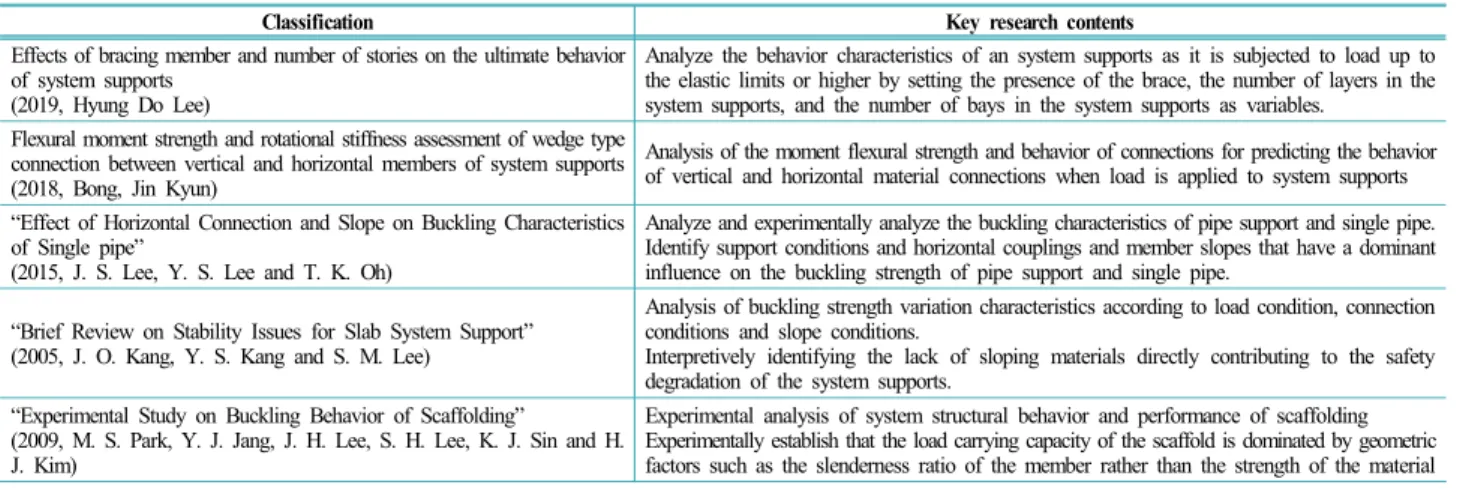
국내 가설기자재 거동 특성 관련 연구의 특징은 Table 3과 같이 파이프서포트, 시스템 동바리와 비계의 좌굴 거동과 특성 등에 대한 연구를 수행하였다.
선행 연구에서 시스템 비계 및 동바리의 명확한 구 조성능평가를 위해서는 수직재와 수평재 간 연결조건 및 휨강성비, 가새재의 설치 유무, 하중 및 기초부 편 심조건 등의 요소들을 고려한 합리적인 평가가 수행되 어야 한다는 것을 시사하고 있다. 이러한 합리적인 성 능평가를 위해서는 기존의 단일부재의 성능평가 방식 이 아닌 조립된 가설기자재(시스템)의 전체적 구조성 능을 포괄하여 평가할 수 있는 안전인증제도의 도입과 기준이 필요할 것으로 분석되었다.
3.1.2 가설기자재 관련 중대재해 분석
2008년부터 2017년까지의 10년간 발생한 조립된 가 설기자재(시스템)의 안전인증이 가능한 비계(강관비계, 시스템비계)와 거푸집동바리(파이프서포트, 시스템동 바리) 관련 17건의 중대재해를 분석하였다. 재해일, 피 해정도, 기인 가설기자재, 재해개요 등으로 분류하여 Table 4과 같이 정리 분석하였다.
비계 및 동바리와 같은 조립식 가설구조물의 구조성 능은 부재 자체의 구조강도와 조립된 후 구성된 구조 특성에 의해 결정된다. 즉, 모든 구조부재가 결합된 상
Table 4. Serious accidents related to assembled temporary equipment and materials
No Accident date
Degree of damage (person)
Temporary equipment
and materials Accident overview 1 ‘08.01.08 Death 1
Injury 1 (Collapse)
Steel tubular
scaffolding Collapse during external scaffold dismantle work
2 ‘08.12.28 Death 1 (Collapse) Pipe support
Collapse of formwork support during slab concrete pouring work in ramp section of underground parking lot 3 ‘09.02.06 Death 1 (Collapse) Steel tubular
scaffolding Collapse of the scaffolding during plastering at the scaffolding 4 ‘10.04.05 Death 1
Injury 6 (Collapse)
System support
Collapse of the system support during slab concrete pouring from the upper part of the swimming pool 5 ‘10.07.29 Death 1
Injury 10 (Collapse)
System scaffolding
Collapse of the system scaffolding during the demolition of exterior walls from the top of the system scaffolding 6 ‘11.04.16 Death 2 (Collapse) System
support
Collapse of the system support during the pouring of slab and wall concrete in the machine room
7 ‘11.11.01 Death 1 Injury 3 (Collapse)
Steel tubular scaffolding
Collapse of the scaffolding during stone construction at the top of the scaffolding
8 ‘11.03.01 Death 1 (Collapse) System support
Collapse of the system support that was supporting PC girder during slab PC assembly work
9 ‘11.02.03 Death 1 Injury 8 (Collapse)
System
support Collapse of the system support during slab concrete pouring
10 ‘11.03.17 Death 2 Injury 2 (Collapse)
Steel tubular scaffolding
Collapse of scaffolding during loading masonry materials on an external scaffolding
11 ‘11.02.08 Death 1 Injury 2
(Collapse) Pipe support Collapse of the pipe support during concrete pouring of multipurpose auditorium roof layer
12 ‘12.04.26 Death 1 (Collapse) Pipe support Collapse of the pipe support during concrete pouring of columns and slabs 13 ‘15.07.04 Death 3
Injury 4 (Collapse)
Steel tubular
scaffolding Collapse of the scaffolding during external scaffolding dismantling
14 ‘15.03.25 Death 1 Injury 8 (Collapse)
System support
Collapse of the system support during the pouring of slab concrete on the upper part of the bridge
15 ‘15.02.11 Injury 11 (Collapse) System support
Collapse of the system support during the pouring of concrete in the roof slab of the gym
16 ‘16.11.15 Injury 8 (Collapse) System support
Collapse of the system support during concrete pouring work on the top of deck plate
17 ‘17.08.12 Death 1 Injury 1 (Collapse)
Steel tubular
scaffolding Collapse of the external scaffolding during school building construction
Classification Key research contents
Effects of bracing member and number of stories on the ultimate behavior of system supports
(2019, Hyung Do Lee)
Analyze the behavior characteristics of an system supports as it is subjected to load up to the elastic limits or higher by setting the presence of the brace, the number of layers in the system supports, and the number of bays in the system supports as variables.
Flexural moment strength and rotational stiffness assessment of wedge type connection between vertical and horizontal members of system supports (2018, Bong, Jin Kyun)
Analysis of the moment flexural strength and behavior of connections for predicting the behavior of vertical and horizontal material connections when load is applied to system supports
“Effect of Horizontal Connection and Slope on Buckling Characteristics of Single pipe”
(2015, J. S. Lee, Y. S. Lee and T. K. Oh)
Analyze and experimentally analyze the buckling characteristics of pipe support and single pipe.
Identify support conditions and horizontal couplings and member slopes that have a dominant influence on the buckling strength of pipe support and single pipe.
“Brief Review on Stability Issues for Slab System Support”
(2005, J. O. Kang, Y. S. Kang and S. M. Lee)
Analysis of buckling strength variation characteristics according to load condition, connection conditions and slope conditions.
Interpretively identifying the lack of sloping materials directly contributing to the safety degradation of the system supports.
“Experimental Study on Buckling Behavior of Scaffolding”
(2009, M. S. Park, Y. J. Jang, J. H. Lee, S. H. Lee, K. J. Sin and H.
J. Kim)
Experimental analysis of system structural behavior and performance of scaffolding
Experimentally establish that the load carrying capacity of the scaffold is dominated by geometric
factors such as the slenderness ratio of the member rather than the strength of the material
Table 3. A study on the buckling behavior and characteristics of temporary equipment and materials
태에서 합리적인 성능평가가 가능하다. Table 4에서의 비계 및 동바리의 무너짐 사고가 이를 대변한다고 볼 수 있다. 이와 같은 결과는 조립된 가설기자재의 안전 성 확보와 품질보증을 위해서는 조립된 가설기자재(시 스템)의 안전인증제도 도입을 통한 합리적인 성능평가 가 선행되어야 함을 보여주는 것이다.
3.2 구조해석을 통한 도입 타당성 분석
본 분석에서는 기본적으로 4가지 시스템동바리 형상 을 기본 해석 모델로 고려하였다. 해석모델 case 1과 case 2는 3단 시스템동바리로 설계하고, case 3와 case 4는 2단 의 시스템동바리로 설계하였다. ABAQUS V6.17를 이용 한 구조해석을 통해 시스템동바리의 전체적 구조거동특 성을 분석하여 조립된 가설기자재의 안전인증제도 도입 의 타당성을 제시하였다. 즉 수직재-수평재 간 연결부 회전강성을 변수로 하여 가새재 및 수직재-수평재 간 연 결부 회전강성이 좌굴강도 및 좌굴모드에 미치는 영향 을 분석하였다. 수직재와 수평재의 연결부 회전강성은 구조물의 탄성강도에 직접적인 영향을 미치는 것을 확 인하였다. 실험연구를 통해 도출된 최소 회전강성(16.0 kN⋅m/rad) 적용 시 탄성좌굴강도는 Table 5와 같이 나 타났다.
해석을 통해 탄성좌굴강도를 평가한 결과, 검토한 모든 해석 모델은 의미있는 탄성좌굴강도의 증가율을 보였다. 특히 가새재가 미설치되고, 수직재의 유효좌굴 길이가 긴 구조모델일수록 연결부 회전강성의 영향성 이 큰 것으로 분석되었다.
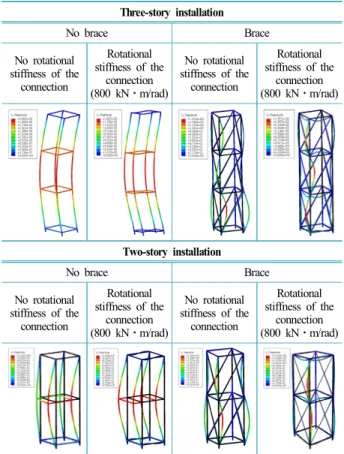
Table 6은 연결부 회전강성에 따른 좌굴형상변화를 나타내는데 수직재의 현격한 좌굴변형과 함께 수평재
Table 5. Elastic buckling strength with rotational stiffness(16.0 kN⋅m/rad)
Three-story installation Two-story installation
No brace Brace No brace Brace
Elastic buckling
strength (kN)
rotational No stiffness vs growth ratio (%)
Elastic buckling
strength (kN)
rotational No stiffness vs growth ratio (%)
Elastic buckling strength (kN)
rotational No stiffness vs growth ratio (%)
Elastic buckling strength (kN)
rotational No stiffness vs growth ratio (%) 25.05 73.56 132.89 11.44 43.58 38.04 149.71 11.86
case 1 case 2 case 3 case 4
Table 6. Comparison of buckling deformation with and without rotational stiffness
Three-story installation
No brace Brace
No rotational stiffness of the
connection
Rotational stiffness of the
connection (800 kN⋅m/rad)
No rotational stiffness of the
connection
Rotational stiffness of the
connection (800 kN⋅m/rad)
Two-story installation
No brace Brace
No rotational stiffness of the
connection
Rotational stiffness of the
connection (800 kN⋅m/rad)
No rotational stiffness of the
connection
Rotational stiffness of the
connection (800 kN⋅m/rad)
역시 상당한 휨변형이 발생하는 것이 잘 나타난다. 이 는 연결부 회전강성의 반영에 따라 수직재의 좌굴변형 발생 시 수평재의 휨강성이 이에 저항하는 구조적 특 성임을 의미한다. 결과적으로, 가설기자재는 단일 부재 성능평가를 통한 안전인증 보다는 조립된 후 시스템 가설기자재의 성능평가를 확인하여야 한다는 것을 보 여준다.
이러한 구조해석은 단일 부재의 실험으로는 해석하 는데에 어려움이 있으며, 인위적인 변수 조정 등도 비 합리적인 것으로 파악되었다. 실제 시스템 비계 및 동 바리를 설치하는 현장에서 조립되고 설치된 상태에서 의 주요 기하학적 영향인자를 효과적이고 합리적으로 반영할 수 있는 실험방법, 절차 및 이를 근거할 수 있 는 제도 도입이 필요한 것으로 나타났다.
3.4 실물 실험을 통한 도입 타당성 분석
본 분석에서는 시스템동바리에 가새재 설치 유무, 시스템동바리 단수를 다르게 적용하여 전체 4가지 Case별로 구분하였으며, 각 Case에 압축하중을 가하여 실물 실험을 진행하였다. 시스템동바리를 설치할 때 단수가 증가함에 따른 조립체의 내하력 차이 특성과
가새재 설치 유무에 따른 조립체의 내하력 차이 특성, 단수와 가새재의 설치 유무가 발생할 경우의 내하력 차이 특성과 응력상태를 분석하였다. 이 분석결과를 토대로 조립된 가설기자재(시스템동바리)의 안전인증 제도 도입에 대한 타당성을 제시하였다.
3.4.1 시스템동바리 조립체의 실물 실험
본 실험에서는 시스템동바리 조립체를 4가지 Case로 구분하여 실험을 진행하였다. Case 1은 가새재를 설치 하지 않은 3단 시스템동바리, Case 2는 가새재를 설치 한 3단 시스템동바리, Case 3는 가새재를 설치하지 않 은 2단 시스템동바리, Case 4는 가새재를 설치한 2단 시스템동바리로서 Table 7과 같이 구성되어 있다. 조립 체 압축실험에 적용한 시험하중은 100 Ton이며, 분당 8 mm로 압축하중을 가하여 하중이 가해짐에 따라 발 생하는 변위와 하중의 최댓값을 측정하였다.
Table 7. Composition of experiments by case
Three-story system support Two-story system support
No brace brace No brace brace
Cace 1 Cace 2 Cace 3 Cace 4
실험체 구성에 사용한 각 부재의 제원은 Table 8과 같다.
Table 8. Specification of members used in assembly experiments Classifi
cation Vertical (P-17) Vertical
(P-2) Horizontal
(H-12) Brace Jack base
Material STK490 SS400
Length 1,725 mm 600 mm 1,219 mm 2,112 mm 600 mm Size 60.5 mm×2.6 mm 42.7 mm×2.2 mm 140 mm×140 mm
3.4.2 시스템동바리 조립체 실물실험 결과 분석
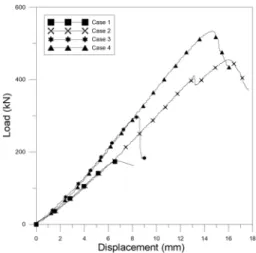
시스템동바리 실험 조립체 각 Case별로 수직하중을 가하면서 발생하는 변위를 분석하여 Fig. 3에 하중-변 위곡선으로 나타내었으며, 각 Case별 시스템동바리 조 립체의 극한하중과 극한하중의 수직변위를 분석하여 Table 8에 나타냈다.
Fig. 3. Load-displacement curve of the system support.
Table 8. Ultimate load and vertical displacement of vertical members
Case Ultimate load(kN) Vertical displacement(mm)
Case 1 174.60 6.7
Case 2 454.20 15.95
Case 3 296.80 8.4
Case 4 534.00 14.6
시스템동바리 조립 실험체의 하중-변위곡선을 분석 한 결과 가새재의 유무에 상관없이 극한 하중에 도달 하기 전까지 시스템동바리 동바리 조립체의 성능은 단 수별로 거의 비슷한 경향을 나타내는 것으로 분석되었 다. 또한 단수가 증가함에 따라 극한 하중은 감소하며, 가새재 유무에 따라 극한 하중의 편차는 매우 큰 것으 로 나타났다. 시스템동바리 조립 실험체의 가새재 설 치유무에 따른 극한하중 및 수직변위는 3단으로 구성 된 조립체의 경우 가새재를 설치하지 않은 모델(Case 1)이 가새재를 설치한 모델(Case 2)의 38.44% 극한하중 수준이며, 수직변위는 2.38배 더 많은 변위를 나타냈 다. 2단으로 구성된 조립체의 경우 가새재를 설치하지 않은 모델(Case 3)은 가새재를 설치한 모델(Case 4)의 약 55.8% 수준의 극한하중 값을 나타냈으며, 수직변위 는 약 1.74배 더 많은 변위를 나타냈다. 따라서 시스템 동바리를 조립할 때 가새재 설치 유무에 따라서 최대 2배 이상 내하력의 차이가 발생한다. 이는 건설현장에 서 가설기자재를 조립하여 높은 단수의 가설구조물의 사용할 때에는 수직재, 수평재 및 가새재 등 전체 구성 부재로 구조안전성 검토가 수행되어야 함을 보여주는 결과이다. 즉 조립된 가설기자재(시스템)의 안전성 확 보와 품질보증을 위해서는 조립된 가설기자재의 안전 인증제도의 도입과 기준 및 매뉴얼이 마련되어야 할 것으로 판단된다.
3.5 설문조사를 통한 도입 타당성 분석
3.5.1 설문 개요
본 분석에서는 조립된 가설기자재에 대한 안전인증 제도의 도입과 관련하여 이해당사자 그룹(제조자/사용 자)의 의견을 수렴하고자 설문조사를 실시하였다. 본 설문조사의 주된 내용은 조립된 가설기자재 안전인증 제도 도입의 필요성에 대한 인식과 기대효과에 대한 설문자의 의견을 청취하기 위한 문항들로 구성하였다. 제조업체의 경우 25명이 응답하였고, 사용자의 경우 272명이 응답하였다. 응답한 결과를 중심으로 설문내 용을 분석⋅정리하여 조립된 가설기자재(시스템동바 리)의 안전인증제도 도입에 대한 타당성을 제시하였다.
3.5.2 설문서의 구성
본 설문조사에 사용된 설문서의 구성은 일반사항과 조립된 가설기자재(시스템) 안전인증제도 항목으로 분 류하여 작성하였다. 세부적으로 일반사항의 경우는 소 속, 업무분야, 성별, 나이, 근무경력, 직급, 안전인증 업 무 경험 등으로 구성하였고, 조립된 가설기자재 안전 인증제도와 관련한 사항으로는 가설기자재 안전인증 제도의 인지도, 조립된 가설기자재 안전인증제도 도입 의 필요성, 조립된 가설기자재 안전인증제도 도입 시 적용대상 가설기자재, 조립된 가설기자재 안전인증제 도 도입 시 기존 안전인증제도(단품 또는 부재별 안전 인증) 관리방안, 안전인증 기준 설정 방향, 기타 조립 된 가설기자재 안전인증 도입에 대한 의견 등으로 구 성되어 있다.
3.5.3 설문내용 분석
본 설문조사에서는 가설구조물 및 가설기자재에 대 한 직접적 이해당사자인 가설기자재 제조자 및 사용자 (시공자 포함) 그룹을 대상으로 서면 설문조사를 수행 하여 조립된 가설기자재 안전인증제도의 도입 필요성, 적용대상, 성능기준 제정 및 시험법 등의 문항에 대한 의견을 청취하였다. 설문조사 분석 결과는 다음과 같 이 요약할 수 있다.
(a) Manufacturer group (b) User group
Fig. 4. Necessity of introducing safety certification for assembled temporary equipment and materials.
첫째, 조립된 가설기자제 안전인증제도의 필요성에 대하여 ‘그렇다’ 이상의 응답은 제조자 그룹의 경우 64.0%, 사용자 그룹의 경우 81.3%의 나타나 제조자와 사용자 모두 Fig. 4와 같이 긍정적인 답변을 보였다.
둘째, 조립된 가설기자재 안전인증 도입 시 적용대 상 가설기자재에 대한 설문에 있어 제조자와 사용자 그룹 모두 시스템비계(제조자 : 37.0, 사용자 : 31.9%) 와 시스템동바리(제조자 38.9%, 사용자 : 39.1%)를 선 택하여 시스템 안전인증제도의 적용대상으로 Fig. 5와 같이 시스템비계와 시스템동바리를 선호하는 것으로 나타났다.
(a) Manufacturer group (b) User group
Fig. 5. Objects when introducing the safety certification of assembled temporary equipment and materials.
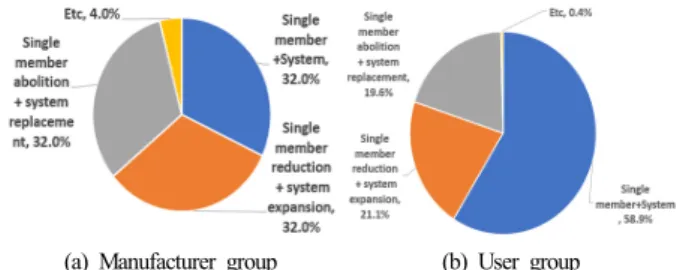
셋째, 조립된 가설기자재 안전인증제도 도입 시 기 존 안전인증제도 관리 방안에 대한 설문에서는 제조자 와 사용자가 Fig. 6과 같이 상반된 의견을 제시했다.
사용자 그룹에서는 응답자의 58.5%가 조립된 가설 기자재 단위의 인증기준과 단일 부재 인증기준을 함께 적용해야 한다고 응답하였다. 21.0%가 단일 부재 인증 기준을 완화하고 조립된 가설기자재 안전인증의 비중 을 늘려야 한다고 응답하였다. 또한 19.5%가 단일 부 재 인증기준의 완전폐지 및 조립된 가설기자재 인증기 준으로의 완전대체가 적절하다고 응답하였다. 제조자 그룹에서는 상기에서 언급한 3가지의 질의에 대하여 동일한 선택비율(각 32.0%)을 나타내어 제조자는 단일 부재 인증기준의 활용여부에 대해 비교적 다양한 의견 을 갖고 있는 것으로 조사되었다.
넷째, 조립된 가설기자재 안전인증 기준 설정 방향
(a) Manufacturer group (b) User group
Fig. 6. Current safety certification system management plan.
(a) Manufacturer group (b) User group Fig. 7. Safety certification standard setting direction.
에 대한 설문조사에 대해 사용자는 전체 응답자 중 54.8%가 기존 단일부재 성능기준을 근거로 설정하는 것이 적절한 것으로 응답하였고, 44.9%가 실물실험과 구조해석 연구를 수행하여 새롭게 설정하는 것이 바람 직할 것이라고 응답하였다. 그러나 제조사의 경우 기 존 단일 부재 성능기준을 근거로 설정하는 안이 32%
차지하였고, 새로운 연구를 통한 설정을 60% 선택하여 사용자 그룹과 상반된 의견을 보였다. 이것은 제조자 의 경우 조립된 가설기자재 안전인증제도의 도입과 함 께 새로운 안전인증기준의 제정을 기대하는 것으로 Fig. 7과 같이 분석되었다.
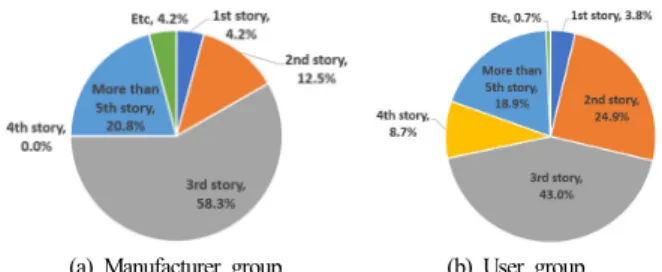
다섯째, 조립된 가설기자재 안전인증 시 시스템비계 및 시스템동바리의 수직성능시험 실험체에 대한 설문 조사는 Fig. 7과 Fig. 8과 같이 유사한 응답추이를 나타 냈다. 즉, 수직방향 조립단수는 제조자와 사용자 모두 3단 설치가 가장 많은 점유율을 나타냈다. 이는 높은 단수로 설치될 경우 내하력이 저하되는 점과 좌굴파괴
(a) Manufacturer group (b) User group
Fig. 8. System scaffolding experimental structure unit (vertical direction).
(a) Manufacturer group (b) User group Fig. 9. System support experimental structure unit (vertical direction).
의 위험에 노출될 우려가 높다는 것에 기인하는 것으 로 판단된다.
제조자와 사용자 그룹 모두 기본적으로 조립된 가설 기자재 안전인증제도 도입의 필요성을 긍정적으로 인 식하는 것으로 조사되었다. 다만, 안전인증제도와 현장 설치기준과의 연계성 문제, 과도한 인증기준 적용에 따른 새로운 가설기자재의 개발에 대한 부정적 영향 우려 등을 보였다. 이 의견을 토대로 새로운 안전인증 제도의 준비과정에서 여러 의견에 대해 적극적으로 반 영하여 안전성을 확보하고, 인증절차의 효율성을 증대 시키며 동시에 신제품 개발활동을 활성화할 수 있도록 면밀히 검토하여 준비해야 할 것으로 판단된다.
3.6 조립된 가설기자재 안전인증제도 도입 제안
기존의 단일 부재 안전인증체계에서는 조립된 상태 에서의 가설기자재(시스템) 구조성능평가가 어렵기 때 문에 조립된 가설기자재의 경우 조립된 상태(시스템) 의 성능평가 필요성이 있는 것으로 파악되었다. 따라 서 국내 가설기자재의 단일 부재 안전인증체계에서의 조립된 가설기자재 안전인증제도의 도입 방안을 분석 하여 다음과 같이 제시하였다.
3.6.1 조립된 가설기자재 안전인증 적용대상
국내에서의 가설기자재는 산업안전보건법에 의거 안전인증 및 자율안전확인신고 대상품목으로 분류되 어 관리되고 있다. 즉 조립된 가설기자재를 형성하여 설치될 수 있는 것은 방호장치 안전인증고시와 자율안 전확인신고의 절차에 따라 적용대상 가설기자재 품목 을 나타낸다. 현행 고용노동부고시 체계에서 언급된
‘파이프 서포트 및 동바리용 부재’와 ‘조립식 비계용 부재’를 ‘조립된 비계’와 ‘조립된 동바리’로 구분하여 재정의하여 관련 고시 개정안을 제안하였다.
3.6.2 조립된 가설기자재 안전인증 적용 방안
조립된 가설기자재 안전인증제도 도입의 타당성 분 석 결과 조립된 가설기자재의 명확한 성능평가를 위한 안전인증제도의 도입이 필요하고, 이를 실행하기 위한 제도의 개정(안)을 Table 9와 같이 도출하였다.
Table 9. Measures to implement of safety certification for temporary equipment and materials
Classification Measures to implement of safety certification 1 proposal Single member safety certification + system safety
certification
2 proposal system safety certification
1안에 대한 예상되는 기대효과는 가설기자재를 구 성하는 기본 단위 부재의 성능을 확보하면서 동시에 조립된 상태의 구조성능 확보가 가능하다는 것이다. 반면에 2안의 예상 기대효과는 안전인증절차의 간소화 가 가능하고 요구성능을 만족하는 다양한 구조형태의 신제품 개발이 가능하다는 것이다. 개별 단위 부재 성 능의 확보와 조립된 상태의 전체적 구조성능 확보를 위해 도입하는 조립된 가설기자재 안전인증제도의 근 본적인 취지를 고려할 때 ‘1안’이 더 적합할 것으로 판 단된다.
3.6 타당성 분석 결과 및 도입방안 요약
조립된 가설기자재의 전체적 구조성능을 직접적으 로 평가할 수 있는 안전인증제도 도입의 당위성에 대
Table 10. Summary of the feasibility analysis results of the safety certification system for the assembled temporary equipment and materials
Classification Feasibility analysis results
F e a s I b I l I y t
A n a l y s I s
Review of literature
Previous research analysis
It was analyzed that reasonable performance evaluation of the temporary equipment and materials would require the introduction of a safety certification system and criteria for comprehensive evaluation of the overall structural performance of axxembled temporary equipment and materials(systems) rather than the performance evaluation method of existing single components.
Serious accident analysis
In order to secure safety and quality assurance of assembleded temporary equipment and materials, reasonable performance evaluation by introducing safety certification systems for assembled temporary equipment and materials(systems) should precede the analysis of serious accidents related to temporary equipment and materials.
Structural analysis
It has been shown that the introduction of experimental methods, procedures and systems that can be based on effective and reasonable reflection of the major geometric factors in the assembled and installed conditions of the actual system scaffolding and support installation site is necessary.
Practical experiment
It was analyzed that structural safety reviews should be carried out for all components such as vertical, horizontal, and bracing when the construction site is assembled and used by a high number of temporary structures.
Survey
Both manufacturers and users showed that they recognized the reason for the necessity of introducing the assembled safety certification system for temporary equipment and materials in positive aspects such as securing structural safety of the temporary equipment and materials and guaranteeing quality.
Improving system at the time of introduction (proposal)
Safety certification notice for protective devices (Ministry of Employment and Labor Notice No.2020-33) Notice on Safety Certification and voluntary safety Confirmation Report Procedure (Ministry of Employment and Labor Notice No. 2020-40)
Safety Certification Sysem
Scaffolding / Support
Component ⇒
Fabricated temporary equipment and materials
해 문헌고찰, 구조 해석, 실물 실험과 설문조사를 통하 여 분석하였다. 타당성 분석결과와 그 결과를 토대로 조립된 가설기자재의 안전인증제도 도입방안을 Table 10과 같이 요약하여 제시하였다.
문헌고찰(선행연구, 중대재해), 구조 해석, 실물 실험 과 설문조사를 통한 조립된 가설기자재의 안전인증제 도 도입에 대한 타당성 분석 결과 도입할 필요성이 높 은 것으로 파악되었다.
5.
결 론본 연구에서는 조립된 가설기자재의 안전인증제도 도입의 필요성 확보를 위하여 조립된 가설기자재 관련 문헌고찰, 구조해석, 실물 실험과 설문조사를 통하여 도입에 대한 타당성을 분석하였으며 다음과 같은 결론 을 얻었다.
1. 조립된 가설기자재의 안전인증제도 도입에 관련 된 연구로는 크게 가설기자재 단위 부재에 대한 성능 검정 및 안전인증제도에 대한 연구와 가설구조물 시스 템 거동특성 관련 연구를 수행하여 온 것으로 파악되 었다. 우리나라의 경우, 단일 부재에 대한 안전인증제 도를 운영하는 것으로 나타났다. 국외의 경우, 조립된 가설기자재의 전체적 성능평가를 매우 중요하게 고려 하고 있다. 이에 대한 명확한 시험방법을 두고 있으며, 규격에 부합하지 않는 신제품 개발 또는 제조사 자체 의 필요성 및 발주자의 요구가 있을 경우에는 공인된 시험기관에서 조립된 가설기자재의 전체적 성능평가 가 가능하도록 하고 있는 것으로 분석되었다. 가설기 자재 관련 중대재해 분석 결과 가설기자재 자체의 구 조강도와 전체적 구조의 건전성은 조립된 후 구조특성 에 의하여 결정되는 것으로 파악되었다. 이것은 모든 가설기자재 구조부재가 조립된 상태에서 합리적인 성 능평가가 가능하다는 것을 나타낸다. 따라서 우리나라 도 조립식으로 구성되는 가설기자재에 대해서는 조립 된 가설기자재 안전안전인증제도의 도입이 필요한 것 으로 판단된다.
2. ABAQUS V6.17을 이용한 구조해석을 통해 시스 템동바리의 전체적 구조거동특성을 분석하였다. 시스 템비계 및 동바리의 수직재는 수직재의 재료 및 기하 학적 인자뿐 만 아니라 수직재-수평재 간 연결조건, 가 새재 유무가 지배적인 영향을 미치는 것을 확인하였다. 이러한 주요 영향인자들은 단일 부재의 실험으로는 해 석하기 어려운 것으로 파악되었다. 실제 현장에서 조 립되고 설치된 상태에서의 주요 기하학적 영향인자를
효과적이고 합리적으로 반영할 수 있고, 가설기자재의 안전성 확보와 품질보증을 위해서라도 조립된 가설기 자재의 실험방법, 절차 및 법적 근거가 포함된 안전인 증제도의 도입이 필요하다고 판단된다.
3. 시스템동바리의 수직하중 실물실험 결과 특정조 건에 대해 가새재를 설치하지 않은 경우(수직재, 수평 재를 설치한 경우)와 가새재를 설치한 경우(수직재, 수 평재, 가새재를 설치한 경우)의 구조성능은 명확한 차 이를 보이는 것으로 나타났다. 가새재가 설치된 상태 라도 수직방향으로 조립된 단수 역시 평가된 구조성능 에 영향을 미치는 것으로 확인되었다. 따라서 기존의 단일부재 성능평가를 포함한 안전인증제도로는 조립 된 가설기자재의 구조 성능을 평가하는 데에 명확한 한계가 있으므로 조립된 가설기자재(시스템)의 성능평 가가 포함된 안전인증제도의 도입이 필요한 것으로 판 단된다.
4. 국내 가설기자재 제조자 및 사용자에 대하여 서 면으로 조립된 가설기자재 안전인증제도 도입의 필요 성에 대한 의견을 수렴한 결과 도입의 필요성, 적용대 상, 성능기준 제정, 실험체 대상 등에 대하여 대부분이 긍정적인 답변이 높은 비율을 차지하는 것으로 파악되 었다. 이것은 두 그룹 모두 가설기자재 구조적 안전성 확보와 품질보증 등 긍정적인 측면에서의 조립된 가설 기자재 안전인증제도 도입의 필요성이 높은 것으로 나 타났다.
향후 조립된 가설기자재 안전인증 도입방안 정착을 통한 안전성 확보, 품질보증, 대국민 신뢰도 확보와 국 외 가설기자재 시장에 대한 활발한 진출을 위해서는 성능평가형식과 시험방법을 정립하고, 추가 연구를 통 해 설계기준과 연계된 시험 성능기준을 마련할 필요가 있다. 또한 조립된 가설기자재 관련 생산, 운반, 설치, 운용, 해체, 보수 등을 포함한 매뉴얼을 정립할 필요성 이 있다.
References
1) Ministry of Employment and Labor (MOEL), Ministry of Employment and Labor Notice No. 2020-33 “Safety Certification Notice for Protection Systems)”, 2020.
2) Ministry of Employment and Labor (MOEL), Ministry of Employment and Labor Notice No. 2020-40 “Notice on the Process of Reporting Safety Certification and Voluntary Safety Confirmation(Ministry of Employment and Labor Notice”, 2020.
3) Ministry of Employment and Labor (MOEL), Occupational
Safety and Health Act, Article 83 (Safety Certification Criteria), Article 84 (Safety Certification), 2019.
4) Korea Occupational Safety and Health Agency (KOSHA), Occupational Safety and Health Research Institute, “A Study on Measures to Ensure Safety of the Temporary Equipment and Materials”, 2015.
5) Korea Occupational Safety and Health Agency (KOSHA), Occupational Safety and Health Research Institute, “A Feasibility Study of Safety Certification for Finished Product of Fabricated Temporary Equipment”, 2013.
6) American National Standards Institute(ANSI), “Standards for Testing and Rating Scaffold Assemblies and Components”, 2002.
7) British Standards Institution(BSI), “Temporary Works Equipments-Part 3 Load Testing(BS EN 12811-3)”, 2002.
8) Scaffolding and Construction Equipment Association of Japan, “http://www.kasetsu.or.jp/system/system02/”, 2020.
9) Korea Occupational Safety and Health Agency (KOSHA),
“Construction Serious Accident Invetigation”, 2008-2017.
10) K. M. Woo and H. K. Lee, “A Study on the Improvement and Application of Performance Testing of Temporary Equipment and Materials”, Vol. 3, No. 1, pp. 74-82, 2002.
11) C. W. Bae and H. K. Lee, “A Study on the Improvement and Application of Performance Testing of Temporary Equipment and Materials”, Journal of the Architectural Institute of Korea, Vol. 18, No. 7, pp. 131-138, 2002.
12) J. S. Lee and J. W. Choi, “A Feasibility Study of Safety Certification for Finished Product of Fabricated Temporary Equipment”, Korea Safety Management & Science Association, An Autumn Conference, Vol. 16, pp. 39-48, 2013.
13) B. H. Won, K. W. Yoon and S. S. Jeon, “Survey and Improvement Scheme for Safety Certification System of Temporary Equipment and Materials”, Journal of the Korea Academia-Industrial Cooperation Society, Vol. 17, No. 7, pp. 92-102, 2016.
14) D. W. Kim, J. H. Won and Y. K. Park, “A Study on the Improvement of Safety Certification Marks Displayed on the surface of Temporary Equipments at Construction Site (I)”, J. Korean Soc. Saf., Vol. 32, No. 4, pp. 59-65, 2017.
15) H. D. Lee, “Effects of Bracing Member and Number of Stories on the Ultimate Behavior of System Supports”
Chungbuk National University Graduate School, Doctor's Thesis, 2019.
16) J. K. Bong, “Flexural Moment Strength and Rotational Stiffness Assessment of Wedge Type Connection between Vertical and Horizontal Members of System Supports”,
Chungbuk National University Graduate School, Doctor's Thesis, 2018.
17) J. S. Lee, Y. S. Lee and T. K. Oh, “Effect of Horizontal Connection and Slope on Buckling Characteristics of Single Pipe”, J. Korean Soc. Saf., Vol. 30, No. 2, pp. 48-55, 2015.
18) J. O. Kang, Y. S. Kang and M. S. Lee, “Brief Review on Stability Issues for Slab System Support”, Journal of the Korea Institute for Structural Maintenance Inspection, Vol.
9, No. 2, pp. 57-61, 2005.
19) M. S. Park, Y. J. Jang, J. H. Lee, S. H. Lee, K. J. Sin and H. J. Kim, “Experimental Study on Buckling Behavior of Scaffolding”, Journal of Korean Society of Steel Construction, Journal of Academic Presentation Conference, 2009.
20) Korea Occupational Safety and Health Agency (KOSHA), Occupational Safety and Health Research Institute (OSHRI), “A Study on the Certification System and Standard of Fabricated Temporary Equipment and Materials”, 2018.