• 검색 결과가 없습니다.

Aluminizing and Corrosion of Carbon Steels in N<sub>2</sub>/0.5%H<sub>2</sub>S Gas at 650-850℃

N/A
N/A
Protected

Academic year: 2021

Share "Aluminizing and Corrosion of Carbon Steels in N<sub>2</sub>/0.5%H<sub>2</sub>S Gas at 650-850℃"

Copied!
5
0
0

로드 중.... (전체 텍스트 보기)

전체 글

(1)

한국표면공학회지 J. Kor. Inst. Surf. Eng.

Vol. 48, No. 3, 2015.

http://dx.doi.org/10.5695/JKISE.2015.48.3.110

<연구논문>

ISSN 1225-8024(Print) ISSN 2288-8403(Online)

Aluminizing and Corrosion of Carbon Steels in N 2 /0.5%H 2 S Gas at 650-850 o C

Muhammad Ali Abro, Dong Bok Lee

*

School of Advanced Materials Science & Engineering, Sungkyunkwan University, Suwon, 440-746, Korea (Received June 16, 2015 ; revised June 26, 2015 ; accepted June 26, 2015)

Abstracts

The effect of hot-dip aluminizing on the corrosion of the low carbon steel was studied at 650-850

o

C for 20-50 h in N

2

/0.5% H

2

S gas. The aluminized steel consisted primarily of the Al topcoat and the underlying Al-Fe alloy layer. Aluminizing drastically improved the corrosion resistance by forming the α-Al

2

O

3

surface scale. Without aluminizing, the steel formed nonadherent, fragile, thick scales, which consisted of FeS as the major phase and iron oxides such as FeO, Fe

3

O

4

and Fe

2

O

3

as minor ones.

Keywords : Hot Dipping, Aluminizing, Sulfidation, Oxidation, H

2

S Corrosion

1. Introduction

Low carbon steels are cheaper than high alloyed steels, but cannot be used in high-temperature corrosive environments due to their insufficient high- temperature corrosion resistance

1,2)

. Hence, they should be protected by the suitable coating in order to be used as high-temperature structural components in automobile exhaust systems, heating/ventilation systems, chemical, power, or refinery plants. aluminum is commonly employed as an alloying element or protective coating in steels. The aluminum coating modified the steel surface to iron aluminides, which enhanced the resistance to corrosion, wear, and high- temperature oxidation, sulfidation, and carburization

3)

. For the aluminum coating, the hot dipping method is widely used due to its availability, easy process, and low cost. Aluminum easily oxidizes to the thin, dense α-Al

2

O

3

oxide scale to cover and protect the steel in high-temperature corrosive environments

4)

. The Al-hot dipped steel consisted primarily of an outer Al topcoat, whose composition is similar to that of the bath composition, and the inner Al-Fe alloy layer, whose composition is determined by the

interdiffusion between the outer Al topcoat and the steel substrate during aluminizing. The inner Al-Fe alloy layer frequently consists of Al

3

Fe as the minor phase at the exterior, and Al

5

Fe

2

as the major phase at the interior. The interface between the inner Al-Fe alloy layer and the steel substrate exhibits a tongue-like morphology

5)

, which has been explained in terms of grain size and grain boundary

6)

or diffusion mechanism

7-9)

. When heated, the tongue-like morphology expands into the planar, smooth interface, and the interdiffusion transforms the Al-rich alloy layer to Fe-rich alloy layer

10)

. The objective of this work is to study the corrosion behavior of the hot-dip aluminized low carbon steel at 650-850

o

C in the N

2

/0.5%H

2

S gas. No metals can resist corrosion in the H

2

S gas without the suitable coating.

2. Experimental Procedures

The commercially available low carbon steel plate with a nominal composition (wt.%) of Fe-0.04C- 0.15Mn-0.012P-0.01S-0.02Si-0.05Cu-0.03Sn-0.006N was cut to the size of 30 × 10 × 2 mm

3

. These sliced coupons were ultrasonically cleaned in methanol, immersed in a solution of 10 vol.% HCl to remove surface oxides, and subjected to liquid flux treatment with 20 vol.% KCl + AlF

3

(in 4 : 1 weight ratio) solution in water, and dried. The coupons were then aluminized

* Corresponding Author : Dong Bok Lee

School of Advanced Materials Science & Engineering, Sungkyunkwan University

E-mail : [email protected]

(2)

in the 99.99% pure aluminum molten bath at 800°C for 10 min, on top of which the solid flux (KCl + NaCl + AlF

3

in 2 : 2 : 1 weight ratio) was spread to prevent oxidation. The flux that adhered on the surface of the aluminized coupons was cleaned using 5 vol.% HNO

3

solution at room temperature. The aluminized coupons were placed in the alumina boat, loaded into the quartz reaction tube, and corroded at 650-850

o

C for 20-50 h in the N

2

/0.5%H

2

S gas using an electric tube furnace. After the corrosion testing, the aluminized coupons were analyzed by X-ray diffraction (XRD), and field emission scanning electron microscopy (FE-SEM) equipped with energy dispersive spectroscopy (EDS).

3. Results and Discussion

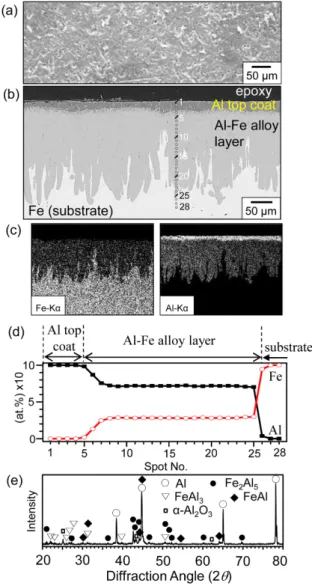
Figure 1 shows the SEM/EDS/XRD results of the hot-dip aluminized carbon steel. The SEM top view showed a smooth aluminized surface with some pores (Fig. 1(a)). The SEM cross-sectional image indicated the smooth, shiny Al topcoat with a thickness of about 15-30 µm, and the inner Al-Fe alloy layer with a thickness of about 35-230 µm (Figs. 1(b), (c)). The interface between the Al-Fe alloy layer and the substrate exhibited the tongue-like morphology with variable peaks oriented toward the substrate. This morphology was attributed to the preferential growth of Fe

2

Al

5

that had 30% voids along the c-axis

7,9)

. Through voids, Al diffused inwardly

9)

, or Fe diffused outwardly

11)

, or Al diffused inwardly and Fe diffused outwardly at the same time

5)

. The tongue-like morphology may be also attributed to the atomic size mismatch between Al (atomic radius = 0.143 nm) and Fe (atomic radius = 0.126 nm)

7)

. The EDS spot analysis indicated that the spot 1-5 and 5-26 corresponded to the Al topcoat and the Al-Fe alloy layer, respectively (Fig. 1(d)). Between the spot 5 and 8, the concentration of Al and Fe gradually decreased and increased, respectively. The concentration of the spot 7 corresponded to FeAl

38)

, and that of the spot 8-25 corresponded to Fe

2

Al

5

. Hence, it is seen that Fe

2

Al

5

was the major phase in the Al-Fe alloy layer

7)

. The amount of Al was 3.5at.% at the spot 26, below which there was no Al.

In Fig. 1(e), the major peaks of Al came from the Al topcoat, the minor ones such as FeAl, Fe

2

Al

5

and FeAl

3

came from the Al-Fe alloy layer

4)

, and the weak α-Al

2

O

3

peaks came from α-Al

2

O

3

that formed on the Al topcoat during pulling the sliced substrate coupon out of the molten Al bath.

Figure 2 shows the SEM/EDS/XRD results of the aluminized steel after corrosion at 650

o

C for 50 h.

The surface exhibited the acicular microstructure

12)

owing to the partial melting of the Al topcoat, and the subsequent oxidation (Fig. 2(a)). The XRD pattern shown in Fig. 2(b) indicated the uncorroded Al topcoat, the α-Al

2

O

3

layer that formed during hot- dipping or by the oxidation of the Al topcoat, and the Fe

2

Al

5

, FeAl

3

, and FeAl phases that constituted the Al-Fe alloy layer. In Figs. 2(c) and (d), the Al topcoat, the Al-Fe alloy layer, and the substrate were recognizable, however the thin α-Al

2

O

3

surface scale was hardly visible owing to its thinness. The EDS spot analysis indicated that the composition (at.%) of the spot ①, ②, and ③ was 92Al-1Fe-7O, 71Al-29Fe, and 100Fe, respectively. These compositions corres- ponded to the (Fe, oxygen)-dissolved Al topcoat, the

Fig. 1. Aluminized carbon steel. (a) SEM top view, (b)

SEM cross-sectional image, (c) EDS maps of

(b), (d) concentration profiles of Fe and Al along

the spots 1-28 shown in (b), (e) XRD pattern.

(3)

Al

5

Fe

2

phase in the Al-Fe alloy layer, and the α-Fe steel substrate, respectively. Oxygen, which was the impurity gas in the N

2

/0.5%H

2

S gas, was hardly recognizable in the oxygen map shown in Fig. 2(d), because the α-Al

2

O

3

surface scale was thin. The good corrosion resistance of the aluminized steel should be attributed to the α-Al

2

O

3

surface scale, which effectively prevented the serious corrosion that could occur in the highly corrosive H

2

S environment at high temperatures.

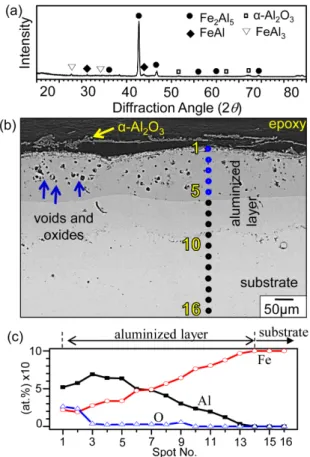
Figure 3 shows the XRD/SEM/EDS results of the aluminized steel after corrosion at 750

o

C for 50 h.

In Fig. 3(a), the diffraction pattern of the Al topcoat was missing, because the Al topcoat was partially oxidized to α-Al

2

O

3

, and became diffuse owing to the interdiffusion among the Al topcoat, the Al-Fe alloy layer, and the substrate. The α-Al

2

O

3

was weakly detected in Fig. 3(a). The other phases identified in Fig. 3(a) were Fe

2

Al

5

as the major phase, and FeAl

3

and FeAl as the minor ones. These iron aluminides existed in the Al-Fe alloy layer. In Fig. 3(b), the α-Al

2

O

3

surface scale was thin, but partially broken and detached off from the aluminized layer owing to H

2

S that released hydrogen and sulfur, and the difference in thermal expansion coefficients between α-Al

2

O

3

and the aluminized layer. H

2

S is quite harmful to corrosion resistance, because hydrogen causes embrittlement and forms hydrogen clusters, whereas sulfur forms nonprotective, fast-growing sulfides. Kirkendall voids formed in the Al-Fe alloy layer, owing to the interdiffusion among the Al topcoat, the Al-Fe alloy layer, and the substrate. The concentration profiles shown in Fig. 3(c) indicated that oxygen progressively Fig. 2. Aluminized carbon steel after corrosion at 650

o

C

for 50 h in the N

2

/0.5%H

2

S gas. (a) SEM top view, (b) XRD pattern, (c) SEM cross-sectional back scattered electron (BSE) image, (d) EDS maps of (c).

Fig. 3. Aluminized carbon steel after corrosion at 750

o

C

for 50 h in the N

2

/0.5%H

2

S gas. (a) XRD pattern,

(b) SEM cross-sectional BSE image, (c) EDS

concentration profiles of Fe, Al and O along

spots 1-16.

(4)

diffused inwardly down to the spot 9, and formed some internal oxides. The concentration of the spot 3 corresponded to Fe

2

Al

5

, spot 4-5 corresponded to FeAl

2

, spot 6-9 corresponded to FeAl, and spot 10-11 corresponded to Fe

3

Al. Clearly, iron aluminides rich in Fe formed, as moving toward the interior.

Aluminum existed down to the spot 13 (340 µm).

This width was larger than the original width of aluminized layer (average width = 190 µm) because of the interdiffusion.

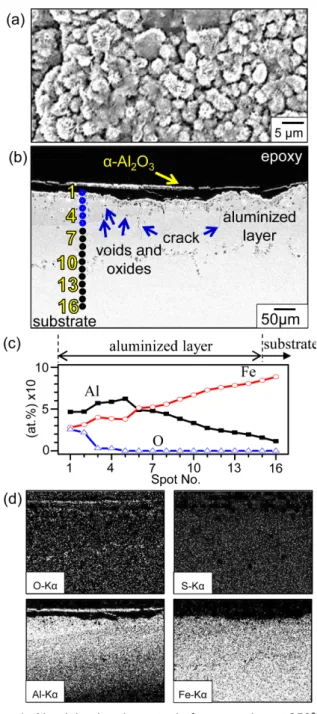
Figure 4 shows the SEM/EDS results of the aluminized carbon steel after corrosion at 850

o

C for 50 h. Round grains that formed during corrosion covered the surface (Fig. 4(a)). They were α-Al

2

O

3

(Fig. 4(b)). The α-Al

2

O

3

surface scale was 10 μm- thick, but partially broken and detached off from the aluminized layer (Fig. 4(b)). Cracks, voids and internal oxides existed in the aluminized layer.

Although cracks and voids could act as easy diffusion paths, the preferential corrosion around them did not occur. This indicated that the breakage and detachment of the α-Al

2

O

3

surface scale occurred during cooling after corrosion. In Fig. 4(c), Al existed beyond the spot 16 (viz., the width of the aluminized layer was more than 225 µm), oxygen existed down to the spot 4 (viz., 60 µm in depth), but sulfur was not detected. In Fig. 4(d), the oxygen map indicated that fine, internal oxides scattered in the aluminized layer, particularly around the spot 1-3 and 9-11, implying that oxygen diffused down to 150 µm (viz., down to spot 11 locally). Aluminum in the aluminized layer was consumed by the outward diffusion of Al to form the α-Al

2

O

3

surface layer, and became diluted by the inward diffusion toward the steel substrate, which occurred owing to the concentration gradient

4)

. The S map shown in Fig. 4(d) indicated that sulfur was present at the background noise level. This suggested that the aluminized layer corroded mainly via oxidation.

Figure 5 shows the XRD/SEM/EDS results of the uncoated steel after corrosion at 750

o

C for 20 h. The corrosion of the uncoated steel proceeded so fast that the corrosion time was limited to 20 h. In Fig. 5(a), FeS was the major phase and iron oxides such as FeO, Fe

3

O

4

and Fe

2

O

3

were minor ones. This happened because the highly nonstoichiometric FeS grew much faster than the less stoichiometric iron oxides even though FeS is thermodynamically less stable than iron oxides. The outer scale consisted of excessively coarse, facetted grains, and detached off from the inner scale (Fig. 5(b)). Cracks propagated over the outer scale owing to the excessively large growth stress aroused owing to the fast corrosion rate, thermal stress generated in the thick scale during the cooling stage after corrosion, and H

2

S gas that embrittled the scale much. The cross-sectional image shows the outer scale with a thickness of about 70 µm, and the inner scale with a thickness of about 50 µm (Fig. 5(c)). These scales were entirely nonadherent, fragile, and nonprotective. They tended to spall as powders. In Fig. 5(d), the sulfur signal was stronger than the oxygen signal, because FeS Fig. 4. Aluminized carbon steel after corrosion at 850

o

C

for 50 h in the N

2

/0.5%H

2

S gas. (a) SEM top

view, (b) SEM cross-sectional BSE image, (c)

concentration profiles of O, Al and Fe along the

spots 1-16, (d) EDS maps of (b).

(5)

was the major corrosion product, and iron was rather uniformly distributed in the scale. It was found that sulfidation prevailed for the uncoated steel, whereas the selective oxidation of Al to form the highly stable α-Al

2

O

3

dominated for the aluminized steel.

4. Conclusions

The uncoated low carbon steel displayed quite poor

corrosion behavior, because of the formation of FeS, which formed together with FeO, Fe

3

O

4

and Fe

2

O

3

. Hot-dip aluminizing significantly improved the corrosion resistance of the low carbon steel by forming the α-Al

2

O

3

surface scale. This scale was thin, but susceptible to detachment and breakage.

During the high-temperature corrosion, interdiffusion occurred among the Al topcoat, the Al-Fe alloy layer, and the steel substrate. Interdiffusion increased the thickness of the aluminized layer, and made the tongue-like morphology at the interface of the Al-Fe alloy layer and the steel substrate smooth, planar, and diffuse.

Acknowledgement

This work was supported by the Human Resource Development Program (No. 20134030200360) of the Korea Institute of Energy Technology Evaluation and Planning (KETEP) grant funded by the Korea government Ministry of Trade, Industry and Energy.

References

1. Y. N. Chang, F. I. Wei, J. Mater. Sci. 24 (1989) 14.

2. B. Schmid, N. Aas, Q. Grong, R. Qdegard, Oxid.

Met. 57 (2002) 116.

3. L. L. Shreir, R. A. Jarman, G. T. Burstein, Corrosion Control, 3rd ed, Vol. 2, Butterworth- Heinemann, UK. (1994) 13.

4. C. J. Wang, S. M. Chen, Surf. Coat. Technol. 200 (2006) 6601.

5. G. H. Awan, F. Ul. Hasan, Mater. Sci. Eng. A, 472 (2008) 157.

6. S. Kwon, J. Lee, Can. Metall. Quart. 20 (1981) 351.

7. K. Bouche, F. Barbier, A. Coulet, Mater. Sci. Eng.

A, 249 (1998) 167.

8. N. A. El. Mahallawy, M. A. Taha, M. A. Shady, A. R. El. Sissi, A. N. Attia, W. Reif, Mater. Sci.

Technol. 13 (1997) 832.

9. W. Deqing, Appl. Surf. Sci. 254 (2008) 3026.

10. H. Glasbrenner, K. Stein-Fechner, J. Konys, J. Nucl.

Mater. 283 (2000) 1302.

11. W. J. Cheng, C. J. Wang, Surf. Coat. Technol. 204 (2009) 824.

12. T. Maitra, S. Gupta, Mater. Charact. 49.4 (2002) 293.

Fig. 5. Uncoated low carbon steel after corrosion at

750

o

C for 20 h in the N

2

/0.5% H

2

S gas. (a) XRD

pattern, (b) SEM top view, (c) SEM cross-

sectional BSE image, (d) EDS maps of (c).

수치

Figure 1 shows the SEM/EDS/XRD results of the hot-dip aluminized carbon steel. The SEM top view showed a smooth aluminized surface with some pores (Fig
Figure 3 shows the XRD/SEM/EDS results of the aluminized steel after corrosion at 750  o C for 50 h.
Figure 4 shows the SEM/EDS results of the aluminized carbon steel after corrosion at 850  o C for 50 h
Fig. 5. Uncoated low carbon steel after corrosion at 750 o C for 20 h in the N 2 /0.5% H 2 S gas

참조

관련 문서

 Polymers are light, cheap, high strength/wt, tough, corrosion- resistant, insulating, low friction, ---.

(Adapted from Atlas of Time-Temperature Diagrams for Irons and Steels, G. Reprinted by permission of ASM International, Materials Park, OH.). Solution to Part (b)

The results of this study are as follows: ⑴ 4 basic directions, 16 themes, and 64 sub-themes of the vocational high school development are established, and

pottery, tableware, cookware, building materials, aerospace materials, to nuclear materials (e.g., UO 2 pellets, waste forms, etc.)... A’ a’ B’ b’ C’

Among the sub-factors of self-esteem, positive, male was higher than female, and on the contrary, negative In this study, females were higher than males,

Eighth, the difference in life satisfaction according to the grade level of junior high school is a sub-factor of friendship, relationship a teacher,

§ Null-path-length balancing: comparing the null-path-length of each of the two sub-trees (the length to the closest null sub- tree/empty node). § Weight balancing:

- The basic materials were Reinforced Carbon-Carbon, Low- and High-Temperature Reusable Surface Insulation tiles, and Felt Reusable Surface Insulation blankets.. -