2017. The Korean Astronomical Society. All rights reserved. c https://doi.org/10.5303/PKAS.2017.32.1.331
THE NEXT-GENERATION INFRARED SPACE MISSION SPICA: PROJECT UPDATES Takao Nakagawa
1, Hiroshi Shibai
2, Hidehiro Kaneda
3, Kotaro Kohno
4, Hideo Matsuhara
1,
Hiroyuki Ogawa
1, Takashi Onaka
5, Peter Roelfsema
6, Toru Yamada
7, and SPICA Team
1
Institute of Space and Astronautical Science, Japan Aerospace Exploration Agency, Kanagawa 252-5210, Japan
2
Graduate School of Science, Osaka University, Osaka 560-0043, Japan
3
Graduate School of Science, Nagoya University, Aichi 464-8602, Japan
4
Institute of Astronomy, University of Tokyo, Tokyo 181-0015, Japan
5
Department of Astronomy, University of Tokyo, Tokyo 113-0033, Japan
6
SRON Netherlands Institute for Space Research, Groningen, The Netherlands
7
Department of Astronomy, Tohoku University, Miyagi 980-8578, Japan E-mail: [email protected]
(Received August 28 2015; Revised October 20, 2016; Accepted October 20, 2016)
ABSTRACT
We present project updates of the next-generation infrared space mission SPICA (Space Infrared Tele- scope for Cosmology and Astrophysics) as of November 2015. SPICA is optimized for mid- and far-infrared astronomy with unprecedented sensitivity, which will be achieved with a cryogenically cooled (below 8 K), large (2.5 m) telescope. SPICA is expected to address a number of key questions in various fields of astrophysics, ranging from studies of the star-formation history in the universe to the formation and evolution of planetary systems. The international collaboration framework of SPICA has been revisited.
SPICA under the new framework passed the Mission Definition Review by JAXA in 2015. A proposal under the new framework to ESA is being prepared. The target launch year in the new framework is 2027/28.
Key words: Space vehicles — Space vehicles: instruments — Telescopes
1. INTRODUCTION
Since most of the star-formation activities take place in heavily obscured regions and star-forming galaxies are often heavily dust obscured, mid- to far-infrared ob- servations are expected to play essential roles to reveal the history of star-formation in the universe. The effec- tiveness of mid- and far-infrared observations has been clearly demonstrated by the previous infrared missions (IRAS, IRTS, ISO, SPITZER, AKARI, and Herschel).
Among the missions, AKARI (Murakami et al., 2007) played unique roles (see many papers in this volume) by carrying out the second-generation all-sky survey (along with pointed observations) in the mid- to far-infrared.
AKARI provided us with extensive point-source cata- logs. However, more than half of the sources in the
http://pkas.kas.org
AKARI catalogs are still unidentified, and follow-up ob- servations in the mid- to far-infrared have been strongly required. Moreover, the recent, great success of the Herschel Space Observatory (Pilbratt et al., 2010) has clearly shown the effectiveness of far-infrared observa- tions in space with a large telescope.
Following the successful missions, we are proposing
the SPICA (Space Infrared Telescope for Cosmology
and Astrophysics) mission, which is optimized for mid-
and far-infrared astronomy with a cryogenically cooled
2.5 m telescope (Figure 1 and Table 1). Although Her-
schel was a very powerful observatory, its telescope was
not cold enough (80 K), and its thermal emission was
brighter than natural background radiation by many or-
ders of magnitude (Figure 2). Hence the fluctuation
of this thermal emission caused degradation of the sen-
sitivity. To achieve superior sensitivity, SPICA’s tele-
331
Figure 1. The new configuration of SPICA
scope is cooled below 8 K (Table 1), and the thermal emission from the telescope is reduced down to the level smaller than or comparable to natural background ra- diation (Figure 2). Hence, being basically limited only by the fluctuation of natural background radiation, the sensitivity of SPICA is expected to show huge improve- ment. The combination of a large-aperture telescope (2.5 m) and the very low-background condition achieved by a cryogenically cooled instrument enables unprece- dented sensitivity in the mid- and far-infrared. This is the main advantage of the SPICA mission.
Nakagawa et al. (2015) discussed the SPICA mission as of the summer of 2014. In this paper, we summarize the latest status of the SPICA mission as of November 2015, updating the information after the AKARI con- ference.
2. SCIENCE RATIONALE 2.1. Science Goals
This section discusses science rationale of SPICA on the basis of SPICA Team (2015).
How our universe has evolved since the Big Bang and how our solar system became habitable as it is in the present-day universe are among the most fundamental questions that modern astronomy strives to answer. We hence set the top-level science goal of SPICA to answer this question, i.e., “to reveal the process that enriched the universe with metal and dust, leading to the forma- tion of habitable worlds.”
The top-level goal consists of two distinct science goals. One is to unveil how stars have formed in galax- ies and enriched the universe with metal and dust in
Table 1
Main specifications of the SPICA mission
Item Description
Telescope Effective aperture of 2.5 m Actively cooled below 8 K Focal-Plane Instruments
SPICA Mid-infrared Instrument (SMI) SPICA Far-infrared Instrument (SAFARI) Orbit Halo orbit around S-E L2 Launch Year 2027/28
the history of the universe (Metal and dust enrichment through galaxy evolution). The other is to unveil how planets have formed in disks around forming stars and how they have evolved to become habitable (Planetary system formation to habitable systems).
In the following subsections, we discuss details of the two science goals.
2.2. Metal and Dust Enrichment through Galaxy Evolution At the very beginning of the universe, the first stars were born in a metal-poor environment. These stars are thought to be very massive because the cooling processes provided by dust grains and heavy elements were not ef- ficient at that time and thus a large mass was required to start stellar contraction. The situation changed quickly when dust grains were formed, as their thermal emis- sion provided efficient cooling of gas, triggering frag- mentation of the gas of even less than one solar mass.
Hence, although the dust and metal are the products of the star formation activity, the enrichment of dust and metal consequently influences the efficiency of radiation feedback to star formation and the subsequent evolution of galaxies.
Following the early period mentioned above, the star formation activity increased, peaking at around 8 - 11 Gyr ago (at redshifts (z) between 1 and 3). The majority of present-day stars have been produced in that period in obscured galaxies. Hence the enrichment of the uni- verse with heavy metal progressed most efficiently dur- ing this period, probably because the metal enrichment was more accelerated by the active interplay between the dust enrichment and galaxy evolution.
In spite of the importance of this interplay, we have
very limited knowledge about its true nature. This is
primarily due to the effect of dust absorption on stellar
radiation; most galaxies with active star formation are
!" ! !"#
!"$
!"%
!"&
!"' !"(
!") !"*
!"
+,-.,/0-12ν+ν 3425"*2 /-.6" 7
' & % $
! * ) ( ' & % $
!! * ) ( ' & % $
!!!
489.:.,;-<23µ57
=>?
@8:8A-0A2=066B/
CDE08A8:
F50//0D,
$!G23H.6/A<.:7
('G3I4JK7
*!G
$G23JL+=M7
Figure 2. Natural background radiation (black lines) and radi- ation from telescopes as a function of temperature (blue and red lines). The telescope on-board SPICA is to be cooled below 8 K, so that the background radiation is to be re- duced significantly compared with that of Herschel in the far-infrared. The low background condition is expected to improve the sensitivity of SPICA dramatically.
heavily obscured by dust. Especially, in the peak pe- riod of star formation activity, most of the energy emit- ted in the star formation process was converted into the infrared and less than 10% remained visible at the ul- traviolet to optical wavelengths (Madau & Dickinson, 2014). The era of the highest star formation activity is really a “dusty era”.
SPICA is the must tool to reveal the true nature of interplay between galaxy evolution and dust/metal enrichment in the universe, since SPICA has unprece- dented sensitivity in the mid- to far-infrared, where we have excellent diagnostics both for the star formation activity and nature of dust.
Another important factor that has been thought to affect evolution of galaxies is black hole accretion activ- ity or the Active Galactic Nuclei (AGNs). The current theoretical models have great difficulty in reproducing a small number of observed high-mass galaxies without the AGNs feedback by outflows especially for the forma- tion of high-mass galaxies. However, very little is known about AGN outflows at z = 0.5 − 2, where the outflow is supposed to start dominating in regulating the star formation in the universe.
SPICA is quite powerful for the study of AGN feed- back, since (1) majority of the AGNs were heavily ob- scured at z = 0.5 − 2 and (2) SPICA covers important lines, such as those of OH, for the study of AGN feed- back.
!"#
!"#!
!" $ !" % !" &
!" '
()*+,-./0,12,3"# 4,5σ4,6*+,76/89
! # : ; 5 ' & % $
!! # :
2<=+.+*>?7,1µ39
@2ABCDEFE
@2ABCDEFE AGEBHIFCEFA
JIFAKJI(CGLKAJIFAKJI(CAGEFI
!"#$% &"'
' !"#$% $($)"
'
F,M,#5!!!
,F,M,#!!!
F,M,:!!
F,M,:!!!
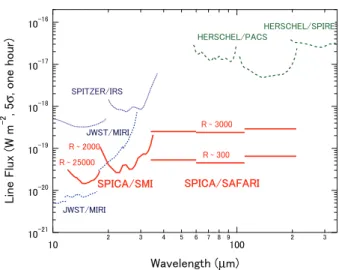
Figure 3. Comparison of the updated SPICA’s sensitivity (solid lines) with those of other missions (dotted lines). The SPICA’s sensitivity is preliminary and is subject to change in the future study.
2.3. Planetary-System Formation to Habitable Systems Planets are believed to form while the proto-planetary disk (PPD) evolves. In the process of evolution of the PPD, dust grains grow and settle down on the mid-plane, while gas is dissipated either by photo- evaporation or by the disk wind. A PPD becomes a debris disk at the end of its evolution (Williams & Cieza, 2011). This is our rough idea how planets are formed and how planetary systems evolve. However, we have very little knowledge on what the critical elements to de- termine the diversity of planets observed in our Galaxy are.
During the planet formation process, the gas plays a crucial role in constraining the dust motion and growth, while the dust controls the energy balance and chemistry of the gas. Hence, to obtain a complete picture of the planet formation process, we have to reveal the evolution processes both in gas and solid phases.
Firstly, we need to understand the gas properties and
dissipation process in terrestrial planet forming regions
(∼1 AU) of individual PPDs. This is essential to ob-
tain a complete picture of the planet formation pro-
cess, since the gas dissipation critically affects planet-
formation and the properties of forming planets. SPICA
is expected to play crucial roles in this area by reveal-
ing the gas dissipation in planet-forming disks; SPICA
offers the most robust estimate of the mass of molecular
gas as a whole with infrared rotational lines of hydro-
gen deuteride, HD. SPICA is expected also to reveal the
dissipation process of molecular gas in 1-2 AU regions of
evolved disks with velocity-resolved observations of H
2lines.
Secondly, it is also essential to reveal the evolution of physical properties and transport of dust grains within disks along the evolution from PPDs to debris disks.
This is a key element for the understanding of the for- mation of our solar system and habitable environments.
For this study, SPICA has a perfect wavelength cov- erage, which contains most of important dust and ice features.
3. SPICA MISSION 3.1. Mission Overview
Figure 1 shows the configuration of the updated design of the SPICA satellite under the new framework. The configuration is based on ESA (2015) with additional study mainly on PLM by JAXA.
The satellite consists of the Payload Module (PLM) and the Service Module (SVM). PLM contains the SPICA Telescope Assembly (STA), which is a 2.5 m telescope cooled below 8 K and is set horizontally above SVM. Attached to STA are two focal plane instruments:
SPICA Mid-infrared Instrument (SMI) and SPICA Far- Infrared Instrument (SAFARI). With the two instru- ments, SPICA covers the the mid- to far-infrared (17 to 210µm) wavelength range continuously.
Figure 3 shows comparison of the expected sensitiv- ity of SPICA with those of other missions. SPICA is expected to exceed the other missions in the sensitivity by orders of magnitude in the far-infrared.
3.2. Cryogenics
One of the biggest technical challenges for SPICA is to cool the large telescope below 8 K. The required cooling capability is obtained by a combination of passive cool- ing (via dedicated Sun and thermal shields combined with radiators) and active cooling (including mechani- cal coolers).
Mechanical coolers for SPICA consist of a set of ad- vanced Joule-Thompson and Stirling coolers. We plan to use two types of Joule-Thompson coolers: one is for the 4.5 K stage (with
4He as working gas) and the other for the 1.7 K stage (with
3He as working gas). Two- stage Stirling coolers (2ST) are used as precoolers for the Joule-Thompson coolers.
3.3. SPICA Mid-Infrared Instrument (SMI)
SMI (SPICA Mid-infrared Instrument) is the instru- ment dedicated to mid-IR spectroscopy in a wavelength range from 12 to 36 µm. Table 2 summarizes current
specifications of SMI. SMI has three spectroscopic chan- nels: low-resolution spectroscopy (LRS), mid-resolution spectroscopy (MRS), and high-resolution spectroscopy (HRS). LRS is a multi-slit spectrometer with R = 50–
120 for effective surveys of extragalactic sources mainly with PAH features. MRS is a general-purpose spectrom- eter optimized for line-spectroscopy with R = 1300–
2300. HRS covers shorter wavelength range (12–17 µm), which contains important molecular lines such as H
2and H
2O. With very high spectral resolution of R = 25000–
26000, we expect to derive kinematic information from proto-planetary disks.
3.4. SPICA Far-Infrared Instrument (SAFARI)
The SPICA Far-Infrared Instrument (SAFARI) is a spectrometer that covers the far-infrared part (34–210 µm) of SPICA with the spectral resolution of R ∼ 300 and ∼ 3000. Table 3 summarizes the current spec- ifications of SAFARI. The current design of SAFARI employs a grating spectrometer with Transition-Edge Sensors (TES). With combination of sensitive TES and the large cryogenically cooled telescope, the SAFARI in- strument provides unprecedented sensitivity in the far- infrared.
4. NEW FRAMEWORK
SPICA is an international mission, originally proposed as a JAXA-led project with important contribution by ESA.
In order to ensure a more secure (feasible and afford- able) program, extensive efforts have been made both in programmatic and technical aspects of SPICA, and the international collaboration framework is being revis- ited. In the new framework, ESA is expected to play a larger role than that in the original plan. The renewed project plan of SPICA passed the Mission Definition Re- view by JAXA in 2015. A new SPICA proposal for the medium-class mission in the ESA Cosmic Vision pro- gram is under preparation The current target launch year of SPICA is 2027/28.
ACKNOWLEDGMENTS
The travel support by JSPS is greatly appreciated.
REFERENCES
ESA 2015, NG-CryoIRTel, Assessment of Next Generation Cryogenic Infra Red Telescope (CDF Study Report: CDF- 152(A)), Noordwijk: ESA/ESTEC
Madau, P. & Dickinson, M. 2014, Cosmic Star-Formation
History, ARAA, 52, 415
Table 2
Specifications of SPICA Mid-Infrared Instrument (SMI)
Parameter Channel
LRS MRS HRS
Wavelength Range 17–36 µm 18–36 µm 12–17
aµm
Spectral Resolution
b50–120 1300–2300 25000–26000
Field of View 600
00× 3.7
00× 4 slits 60
00× 3.7
00(slit) 4
00× 1.7
00(slit)
Detector Si:Sb 1K×1K Si:Sb 1K×1K Si:As 1K×1K
Continuum Sensitivity(1hr, 5σ) 20–140 µJy 200–4000 µJy 2–4.2 mJy Line Sensitivity(1hr, 5σ)
c(6–23)×10
−20W m
−2(3–40)×10
−20W m
−2(1.5–3)×10
−20W m
−2a Continuous coverage up to 17.3 µm with partial coverage for H2O 17.77 and 18.66 µm lines.bSpectral resolution for point sources.
c Sensitivity for unresolved lines of point sources. The instrument parameters are those as of November 2015. Details are subject to change in the future study.
Table 3
Specifications of SPICA Far-Infrared Instrument (SAFARI)
Parameter Band
SW MW LW
Band Center 47 µm 85 µm 160 µm
Wavelength Range 34–60 µm 60–110 µm 110–210 µm
Band Center Beam FWHM 4.7
008.6
0016
00Point Source Spectroscopy with R ∼ 300 (1hr, 5σ)
Continuum Sensitivity 0.25 mJy 0.36 mJy 0.92 mJy
Line Sensitivity 5.3×10
−20W m
−24.5×10
−20W m
−26.5×10
−20W m
−2Point Source Spectroscopy with R ∼ 3000 (1hr, 5σ)
Continuum Sensitivity 12 mJy 20 mJy 41 mJy
Line Sensitivity 2.5×10
−19W m
−22.4×10
−19W m
−22.9×10
−19W m
−2The instrument parameters are those as of November 2015. Details are subject to change in the future study.