․교신저자: 강석봉 대구시 수성구 상동 165번지
대구한의학교 부속 대구한방병원 신계내과학교실 TEL: 010-6512-0189 FAX: 053-770-2055 E-mail: [email protected]
黃連地黃湯이 Streptozotocin으로 誘發된 糖尿病에 미치는 영향
유동조, 윤경민, 강석봉
대구한의대학교 한의과대학 신계내과학교실
Effects of Hwangryungeehwang-tang Aqueous Extracts on Streptozotocin-induced Diabetic Rat
Dong-jo Yu, Gyeong-min Yoon, Seok-bong Kang
Dept. of Oriental Internal Medicine, College of Oriental Medicine, Daegu Haany University
ABSTRACT
Objectives :
The object of this study was to observe the effects of Hwangryungeehwang-tang (HRGHT), which has traditionally been used in Korean medicine for treating diabetes, by administering aqueous extracts to streptozotocin-induced diabetic rats.
Methods :
Three different dosages of HRGHT extracts were orally administered once a day for 28 days from 3 weeks after streptozotocin treatment (60 mg/kg, single intraperitoneally administered). 6 groups, of 8 rats per group were used in the present study, selected 3 weeks after streptozotocin treatment based on blood glucose levels and body weights. Changes to the body weights, blood glucose levels, serum low density lipoprotein (LDL), high density lipoprotein (HDL), triglyceride and total cholesterol levels were observed, as well as changes on the pancreatic, hepatic and kidney malondialdehyde (MDA) contents for lipid peroxidation and glutathione contents for antioxidant effects. The results were compared with a potent antioxidant silymarin 100 mg/kg, of which the effects on streptozotocin-induced diabetes and related complications are already confirmed.
Results :
Significant decrease of blood glucose levels, serum LDL, total cholesterol, triglyceride levels, pancreatic, hepatic and renal MDA contents and significant increase of body weights, serum HDL levels, pancreatic, hepatic and renal GSH contents were detected in HRGHT extracts 100 and 200㎎/㎏ administered groups as compared to the streptozotocin control group. The lowest dosage of HRGHT treated group, 50 mg/kg, did not show any favorable effects as compared with the streptozotocin control.
Conclusions :
HRGHT has favorable effects on diabetes and related hyperlipidemia. Therefore, more detailed mechanism studies should be conduced in future with efficacy tests of individual herbal compositions of HRGHT and screening of the biological active compounds in the herbs.
Key words :
Hwangryungeehwang-tang (Huangliandihuang-tang), diabetes, hyperlipemia, antioxidant, silymarin
Ⅰ. 서 론
당뇨병은 한의학에서 消渴의 범주에 속하며, 消 渴은 渴而多飮하는 上消, 消穀善飢하는 中消, 渴而
尿數하는 下消로 분류된다
1. 消渴은 인체 내부의 燥熱에서 기인된 소모성 만성질환으로 파악되었고, 多渴, 多食, 多尿를 主症候로 제시하고 있는 病證 으로 당뇨병을 포괄하고 있는 넓은 범위의 병증으 로 이해될 수 있다
2.
당뇨병은 insulin분비의 절대적 또는 상대적 부
족이나 insulin 표적 세포에서의 insulin의 생물학적
효과 감소로 인하여 발생되는 고혈당 및 이에 수
반되는 대사장애가 장기간 지속되는 상태로 특징 지워지는 질환이다
3. 당뇨병은 발병원인에 따라 췌 장 β세포의 파괴로 인슐린이 결핍되어 발생되는 제 1형 당뇨병과 가장 흔한 형태인 인슐린 저항성 과 인슐린 분비장애에 의해 발생되는 제 2형 당뇨 병 및 기타 당뇨병 등으로 분류되고 있다
4.
고혈당에 기인한 손상을 유발시키는 병인기전 중 중요한 공통적인 과정이 미토콘드리아의 전자 수송 연쇄에 의한 과산소(superoxide)의 과다 생산 이다
5. Glutathione(GSH)은 심장병, 협심증, 동맥경 화, 재확산(refer-fusion) 손상을 예방하는데 도움을 주는 것으로 알려져 있고, 몸안의 발암물질과 변형물 질을 제거하고 세포내 DNA와 다른 민감한 구조물의 산화적 손상을 감소시킨다
6. 또한 malondialdehyde (MDA)는 지질과산화물의 지표로 사용되는데 과 산화지질은 세포막의 다중불포화지방산과 지단백 질에서 유리기와 연쇄반응하여 부산물로 MDA를 생산한다
7.
黃連地黃湯은 龔
8의《萬病回春》에 처음 수록되 어 있으며 三消를 치료한다고 알려져 있다. 최근까 지 당뇨병의 한약재 연구로는 참당귀
9, 八味元
10, 大 補陰丸
11, 消平湯
12, 生地黃飮子
13등이 있으나 현재 까지 黃連地黃湯에 대한 연구는 찾아볼 수 없다.
본 연구에서는 黃連地黃湯(HRGHT)이 당뇨병 에 미치는 영향을 알아보기 위하여 streptozotocin 으로 당뇨병을 유발한 흰 쥐에 HRGHT 50, 100 및 200 mg/kg을 투여한 후 체중, 혈당, 혈청 성분 의 변화, 췌장, 간 및 신장내 MDA, GSH 함량을 측정하고 이를 통하여 유의성 있는 결과를 얻었기 에 보고하는 바이다.
Ⅱ. 재료 및 방법
1. 재 료 1) 실험동물
암컷 Sprague-Dawely(SD) 랫트(SLC, Japan) 96마리를 실험실 환경에 7일간 순화시킨 다음 실험
에 사용하였으며, 온도는 20-25 ℃, 습도는 30-35%, 명암주기는 12시간 주기로 조절된 환경에서 사육 하였다. 사료(Samyang, Korea)와 음수는 자유롭게 공급하였고, STZ 투여일과 약물 투여시작일 및 최 종 희생일에는 18시간 정도 절식시켰으며, picric acid로 개체를 식별하였다. 본 실험에 사용된 모든 실 험동물은 "Guide for the Care and Use of Laboratory Animals”
14에 준하여 취급하였다.
2) 실험약재
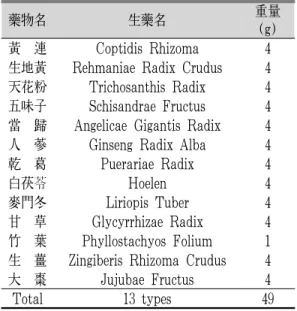
본 실험에 사용된 약재는 대구한의대 의료원 약 제과에서 매입한 것을 현미경하에서 관능검사를 통하여 선정하여 사용하였으며, 본 실험에 사용된 HRGHT1貼 분량의 조성은 Table 1과 같다.
藥物名 生藥名 重量
(g) 黃 連 Coptidis Rhizoma 4 生地黃 Rehmaniae Radix Crudus 4 天花粉 Trichosanthis Radix 4 五味子 Schisandrae Fructus 4 當 歸 Angelicae Gigantis Radix 4 人 蔘 Ginseng Radix Alba 4 乾 葛 Puerariae Radix 4
白茯苓 Hoelen 4
麥門冬 Liriopis Tuber 4
甘 草 Glycyrrhizae Radix 4 竹 葉 Phyllostachyos Folium 1 生 薑 Zingiberis Rhizoma Crudus 4 大 棗 Jujubae Fructus 4
Total 13 types 49
All individual herbs were purchased from the pharmacy department of Daegu Haany University after confirm the morphology under microscopy.
Table 1. Composition of Hwangryungeehwang-tang (HRGHT) Used in This Study
2. 방 법
1) 黃連地黃湯 물 추출물(HRGHT) 제조
선정된 약제 2貼 분량(98 g)을 취하여 증류수
1,000 ml로 가열 추출한 후, 흡인 여과한 여과액을
rotary vacuum evaporator(N-N type; LAB Camp, Daejeon, Korea)로 감압⋅농축하여 점조성의 추출물 을 얻은 다음 programmable freeze dryer(PVTFD10A;
Ilshin Lab., Seoul, Korea)를 사용하여 동결 건조시 켜, 총 18.87 g(수율 약 19.26%)의 연갈색의 추출물 을 얻어 실험에 사용하였다. 준비한 HRGHT는 -20 ℃의 냉동고에 보관 후 실험에 사용하였으며, 본 실험에서 사용한 용매인 증류수에 40 mg/ml의 농도까지 비교적 잘 용해되었다.
2) 당뇨병의 유발
총 96 마리의 실험동물 중 80 마리는 streptozotocin (Sigma, MO, USA) 60 mg/kg을 50 mM citrate buffer에 용해시켜, 실험동물 체중 kg 당 5 ml의 농 도로 1회 복강투여하였으며, 정상 대조군에서는
streptozotocin 대신 50 mM citrate buffer만 동일한 방법으로 투여하였다. Streptozotocin은 실험물질 투여 3주 전에 투여하였다.
3) 실험군 분리 및 약물의 투여
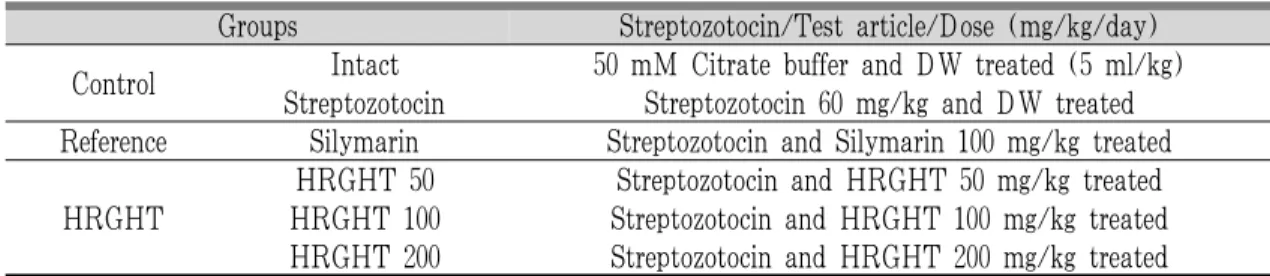
실험동물은 각 군당 8마리씩 배치하였으며 당뇨를 유발하지 않은 정상대조군, streptozotocin 투여로 당 뇨를 유발한 후 멸균 증류수를 투여한 streptozotocin 대조군, 당뇨 유발 후 silymarin(Sigma, MO, USA) 100 mg/kg을 투여한 silymarin 투여군, 당뇨 유발 후 HRGHT 50, 100, 200 mg/kg을 투여한 HRGHT 50, HRGHT 100, HRGHT 200의 6군으로 구분하 였으며(Table 2), HRGHT 및 silymarin은 멸균 증 류수에 용해시켜 5 ml/kg의 용량으로 매일 1회 28 일간 경구 투여하였다.
Groups Streptozotocin/Test article/Dose (mg/kg/day) Control Intact 50 mM Citrate buffer and DW treated (5 ml/kg)
Streptozotocin Streptozotocin 60 mg/kg and DW treated Reference Silymarin Streptozotocin and Silymarin 100 mg/kg treated HRGHT
HRGHT 50 Streptozotocin and HRGHT 50 mg/kg treated HRGHT 100 Streptozotocin and HRGHT 100 mg/kg treated HRGHT 200 Streptozotocin and HRGHT 200 mg/kg treated
HRGHT, Hwangryungeehwang-tang aqueous extracts; HRGHT, silymarin or vehicle (distilled water; DW) were dosed at 5 ml/kg volume, once a day for 28 days from 3 weeks after streptozotocin treatment; 8 rats per group, total 6 groups were used this study; Diabetes and related hyperlipidemia were induced by single intraperitoneal injection of streptozotocin;
All animals were sacrificed after 28 days of test article treatment, at 7 weeks after streptozotocin treatment.
Table 2. Experimental Design Used in Single Dose Toxicity Test
4) 체중 측정
Streptozotocin 투여일, 약물 투여 시작일, 투여 7, 14, 21, 27일 및 최종 희생일에 각각 체중을 측정 하였으며, 개체 차이에 의한 체중 변화를 최소화하 기 위해 약물 투여 전후의 체중변화량인 증체량 (body weight gains)을 측정하였다.
5) 혈당의 측정
Streptozotocin 투여 21일 후 및 최종 희생일에 안와정맥총(orbital plexus)에서 NaF glucose vacuum tube(Becton Dickinson, USA)에 약 0.3 ml의 혈액 을 채취한 다음 3,000 rpm으로 원심분리하여 혈장
(plasma)을 분리한 후 자동혈액분석장치(Toshiba 200 FR, Japan)를 이용하여 혈당을 각각 측정하였다.
6) 혈중 HDL(high-density lipoprotein), LDL(low- density lipoprotein), total cholesterol 및 triglyceride 함량의 측정
Streptozotocin 투여 21일 후 및 최종 희생일에
안와정맥총과 후대정맥에서 각각 약 0.5 및 6 ml의
혈액을 채취하였으며, 상온에서 1시간 정도 방치한
다음 3,000 rpm으로 원심분리하여 혈청을 분리한
후 자동혈액분석장치(Toshiba 200 FR, Japan)를
이용하여 혈중 HDL, LDL, total cholesterol 및
triglyceride 함량을 각각 측정하였다.
7) 조직 내 MDA(malondialdehyde) 및 GSH (glutathione) 함량의 측정
최종 희생일에 모든 실험동물의 췌장, 간 및 신 장을 적출한 다음, 멸균 생리식염수로 세척하고 주 변 지방조직을 제거한 후 Kavutcu et al
15의 방법 으로 9 vols ice-cold 0.15 M/L KCl 및 1.9 mM/L ethylenediaminetetraacetic acid가 함유된 용액에서 homogenize하고, 상층액을 분리하여 MDA 및 GSH 함량을 측정하였다. 조직내 단백질 함량은 Lowry 등
16의 방법으로 bovine serum albumin을 standard 로 이용하여 측정하였으며, 지질 과산화 정도(lipid peroxidation)는 Draper와 Hadley
17의 방법으로 2-thiobarbituric acid를 이용하여 MDA (nmole)/g protein 단위로 측정하였다. 또한 항산화 정도를 판 단하기 위해, Eyer 와 Podhradsky
18의 방법으로 microplate reader에 적응시킨 enzymatic recycling procedure를 이용하여 GSH (μmole)/g protein 단 위로 측정하였다.
3. 통계처리
모든 수치는 평균±표준편차로 표시하였으며, 다 중비교 검증을 이용하여 통계처리를 실시하였고, 분산 동질성을 Levene’s test를 실시하여 검증하였 다. 등분산일 경우, one way ANOVA test를 실시 한 다음 least-significant differences(LSD) test로
사후 검증을 실시하여 군간의 유의성을 측정하였 다. 비등분산일 경우에는 비모수 검증인 Kruskal- Wallis H test를 실시하여 유의성이 인정된 경우에 는, Mann-Whitney U-Wilcoxon Rank Sum W(MW) 를 실시하여 군간의 유의성을 검증하였다. 모든 통 계처리는 SPSS for Windows(Release 14.0K, SPSS Inc., USA)를 이용하여 평가하였으며, p<0.05 이하 인 경우 통계적 유의성을 인정하였다.
Ⅲ. 결 과
1. 체중의 변화
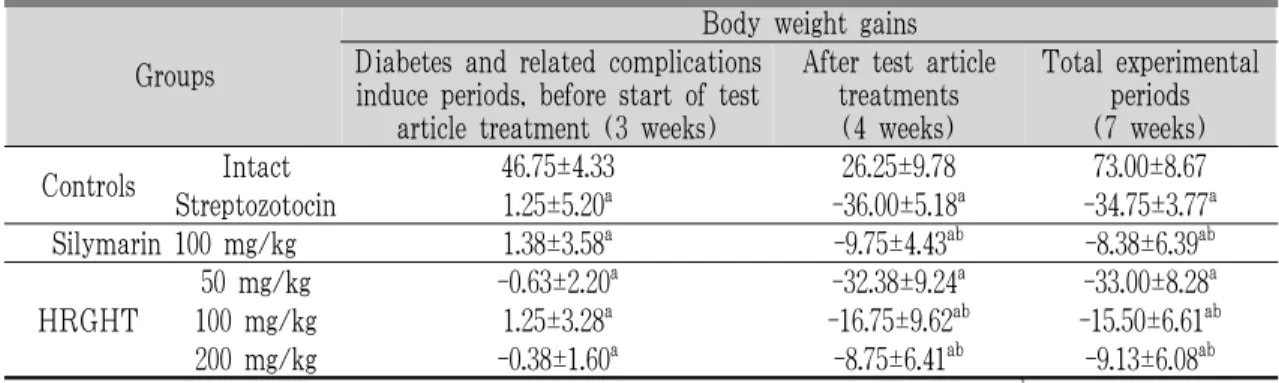
Silymarin 및 HRGHT 200 mg/kg 투여군에서 각각 streptozotocin 대조군에 비해 유의성 있는 (p<0.01 또는 p<0.05) 체중의 증가가 투여 21 일후 부터 인정되었으며, 약물투여 기간 및 전체 실험 기간 동안의 증체량 역시 각각 streptozotocin 대조군에 비해 유의성 있는(p<0.01) 증가를 나타내었다. 한편 HRGHT 100 mg/kg 투여군에서는 streptozotocin 대조 군에 비해 유의성 있는(p<0.01) 체중의 증가가 투여 27 일 후부터 인정되었으며, 약물투여 후 및 실험 전 기간 동안의 증체량 역시 각각 streptozotocin 대조 군에 비해 유의성 있는(p<0.01) 증가를 나타내었다.
한편, HRGHT 50 mg/kg 투여군에서는 streptozotocin 대조군과 유사한 체중 및 증체량의 변화를 나타내 었다(Table 3).
Groups
Body weight gains Diabetes and related complications
induce periods, before start of test article treatment (3 weeks)
After test article treatments (4 weeks)
Total experimental periods (7 weeks)
Controls Intact 46.75±4.33 26.25±9.78 73.00±8.67
Streptozotocin 1.25±5.20
a-36.00±5.18
a-34.75±3.77
aSilymarin 100 mg/kg 1.38±3.58
a-9.75±4.43
ab-8.38±6.39
abHRGHT
50 mg/kg -0.63±2.20
a-32.38±9.24
a-33.00±8.28
a100 mg/kg 1.25±3.28
a-16.75±9.62
ab-15.50±6.61
ab200 mg/kg -0.38±1.60
a-8.75±6.41
ab-9.13±6.08
ab Values are expressed mean ± S.D. of eight rats (g); a p<0.01 compared with intact control; b p<0.01 compared with streptozotocin control.Table 3. Changes on the Body Weight Gains after Streptozotocin and Test Article Administration
2. 혈당의 변화
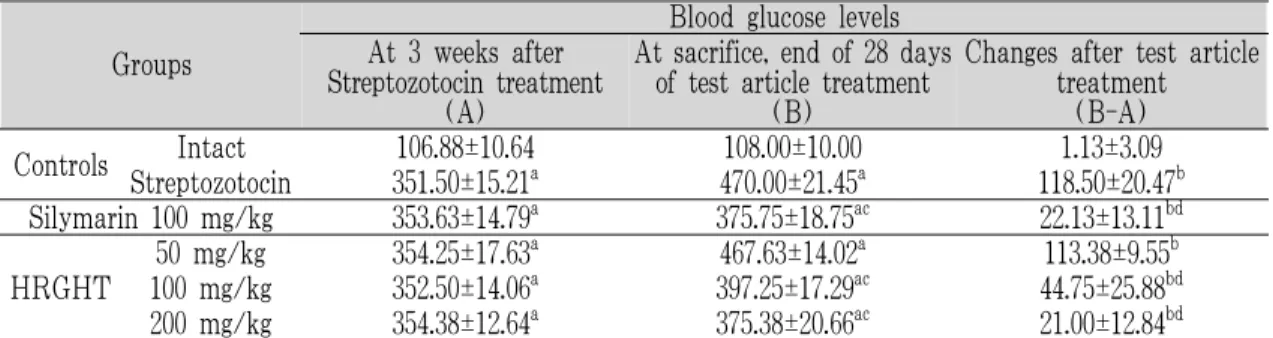
Silymarin, HRGHT 100 및 200 mg/kg 투여군에 서 각각 streptozotocin 대조군에 비해 유의성 있는 (p<0.01) 최종 희생일의 혈당 및 투여 전후 혈당 변화량의 감소가 인정되었다. 한편 HRGHT 50
mg/kg 투여군에서는 streptozotocin 대조군과 유사 한 혈당의 변화를 나타내었으며, 모든 투여군에서 약물 투여 전 혈당은 streptozotocin 대조군과 유사 하게 관찰되었다(Table 4).
Groups
Blood glucose levels At 3 weeks after
Streptozotocin treatment (A)
At sacrifice, end of 28 days of test article treatment
(B)
Changes after test article treatment
(B-A) Controls Intact 106.88±10.64 108.00±10.00 1.13±3.09
Streptozotocin 351.50±15.21
a470.00±21.45
a118.50±20.47
bSilymarin 100 mg/kg 353.63±14.79
a375.75±18.75
ac22.13±13.11
bdHRGHT
50 mg/kg 354.25±17.63
a467.63±14.02
a113.38±9.55
b100 mg/kg 352.50±14.06
a397.25±17.29
ac44.75±25.88
bd200 mg/kg 354.38±12.64
a375.38±20.66
ac21.00±12.84
bd Values are expressed mean ± S.D. of eight rats (mg/dl); a p<0.01 compared with intact control; b p<0.01 compared with intact control; c p<0.01 compared with streptozotocin control; d p<0.01 compared with streptozotocin control.Table 4. Changes on the Blood Glucose Levels after Streptozotocin and Test Article Administration
3. 혈중 HDL 및 LDL 함량의 변화
Silymarin, HRGHT 100 및 200 mg/kg 투여군에서 각각 streptozotocin 대조군에 비해 유의성 있는(p<0.01) 최종 희생일의 혈중HDL 함량 및 투여 전후 혈중 HDL 함량 변화량의 증가가 인정되었다. 한편 HRGHT 50 mg/kg 투여군에서는 streptozotocin 대조군과 유사한 혈중 HDL 함량의 변화를 나타내었으며, 모든 투여군에서 약물 투여 전 혈중 HDL 함량은 streptozotocin 대조군과 유사하게 관찰되었다(Table 5).
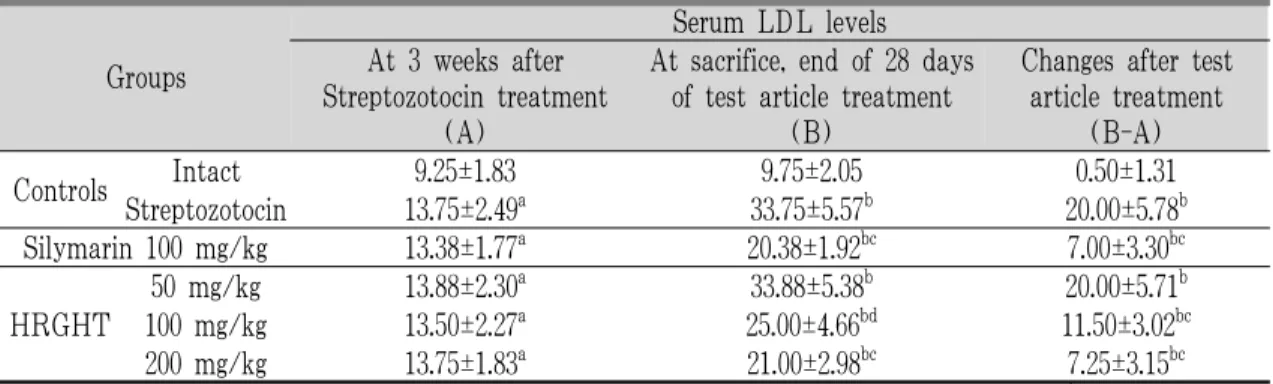
Silymarin, HRGHT 100 및 200 mg/kg 투여군에 서 각각 streptozotocin 대조군에 비해 유의성 있는 (p<0.01 또는 p<0.05) 최종 희생일의 LDL 함량 및 투여 전후 혈중 LDL 함량 변화량의 감소가 인정 되었다. 한편 HRGHT 50 mg/kg 투여군에서는 streptozotocin 대조군과 유사한 혈중 LDL 함량의 변화를 나타내었으며, 모든 투여군에서 약물 투여 전 혈중 LDL 함량은 streptozotocin 대조군과 유사 하게 관찰되었다(Table 6).
Groups
Serum HDL levels At 3 weeks after
Streptozotocin treatment (A)
At sacrifice, end of 28 days of test article treatment
(B)
Changes after test article treatment
(B-A) Controls Intact 75.63±16.65 77.13±14.67 1.50±3.25
Streptozotocin 35.75±8.86
b21.88±5.00
b-13.88±6.88
aSilymarin 100 mg/kg 35.38±9.46
b35.50±10.77
bd0.13±3.00
cHRGHT
50 mg/kg 35.88±7.97
b22.38±2.07
b-13.50±7.31
a100 mg/kg 35.88±5.67
b33.38±4.60
bd-2.50±4.41
c200 mg/kg 35.75±7.09
b36.63±9.12
bd0.88±4.76
c Values are expressed mean ± S.D. of eight rats (mg/dl); a p<0.01 compared with intact control; b p<0.01 compared with intact control; c p<0.01 compared with Streptozotocin control; d p<0.01 compared with Streptozotocin control.Table 5. Changes on the Serum HDL Levels after Streptozotocin and Test Article Administration
Groups
Serum LDL levels At 3 weeks after
Streptozotocin treatment (A)
At sacrifice, end of 28 days of test article treatment
(B)
Changes after test article treatment
(B-A)
Controls Intact 9.25±1.83 9.75±2.05 0.50±1.31
Streptozotocin 13.75±2.49
a33.75±5.57
b20.00±5.78
bSilymarin 100 mg/kg 13.38±1.77
a20.38±1.92
bc7.00±3.30
bcHRGHT
50 mg/kg 13.88±2.30
a33.88±5.38
b20.00±5.71
b100 mg/kg 13.50±2.27
a25.00±4.66
bd11.50±3.02
bc200 mg/kg 13.75±1.83
a21.00±2.98
bc7.25±3.15
bc Values are expressed mean ± S.D. of eight rats (mg/dl); a p<0.01 compared with intact control; b p<0.01 compared with intact control; c p<0.01 and d p<0.05 compared with streptozotocin control.Table 6. Changes on the Serum LDL Levels after Streptozotocin and Test Article Administration
4. 혈중 triglyceride 및 total cholesterol 함량의 변화 Silymarin과 HRGHT 100 및 200 mg/kg 투여군 에서 각각 streptozotocin 대조군에 비해 유의성 있 는(p<0.01 또는 p<0.05) 최종 희생일의 triglyceride 함량 및 투여 전후 혈중 triglyceride 함량 변화량의 감소가 인정되었다. 한편 HRGHT 50 mg/kg 투여 군에서는 streptozotocin 대조군과 유사한 혈중 triglyceride 함량의 변화를 나타내었으며, 모든 투 여군에서 약물 투여 전 혈중 triglyceride 함량은 streptozotocin 대조군과 유사하게 관찰되었다(Table 7).
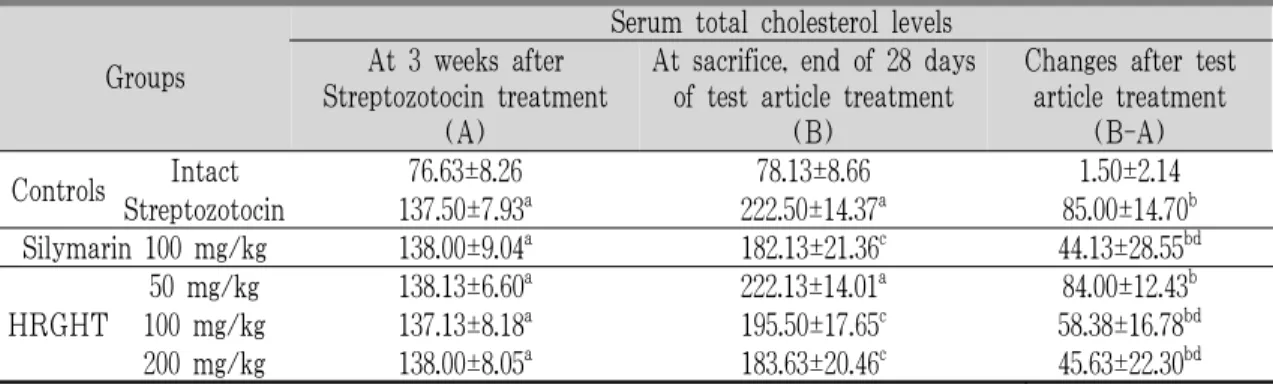
Silymarin, HRGHT 100 및 200 mg/kg 투여군에 서 각각 streptozotocin 대조군에 비해 유의성 있는 (p<0.01) 최종 희생일의 total cholesterol 함량 및 투여 전후 혈중 total cholesterol 함량 변화량의 감 소가 인정되었다. 한편 HRGHT 50 mg/kg 투여군 에서는 streptozotocin 대조군과 유사한 혈중 total cholesterol 함량의 변화를 나타내었으며, 모든 투여 군에서 약물 투여 전 혈중 total cholesterol 함량은 streptozotocin 대조군과 유사하게 관찰되었다(Table 8).
Groups
Serum triglyceride levels At 3 weeks after
Streptozotocin treatment (A)
At sacrifice, end of 28 days of test article treatment
(B)
Changes after test article treatment
(B-A)
Controls Intact 38.25±4.50 39.13±4.67 0.88±1.36
Streptozotocin 326.63±23.29
a570.75±91.25
a244.13±93.69
aSilymarin 100 mg/kg 327.00±30.07
a425.00±38.59
ab98.00±33.72
abHRGHT
50 mg/kg 322.50±21.76
a573.63±79.59
a251.13±71.23
a100 mg/kg 323.88±20.79
a462.00±57.09
ad138.13±50.56
ad200 mg/kg 325.75±17.69
a429.25±43.73
ac103.50±55.12
ac Values are expressed mean ± S.D. of eight rats (mg/dl); a p<0.01 compared with intact control. b p<0.01 and c p<0.05 compared with streptozotocin control.Table 7. Changes on the Serum Triglyceride Levels after Streptozotocin and Test Article Administration
Groups
Serum total cholesterol levels At 3 weeks after
Streptozotocin treatment (A)
At sacrifice, end of 28 days of test article treatment
(B)
Changes after test article treatment
(B-A)
Controls Intact 76.63±8.26 78.13±8.66 1.50±2.14
Streptozotocin 137.50±7.93
a222.50±14.37
a85.00±14.70
bSilymarin 100 mg/kg 138.00±9.04
a182.13±21.36
c44.13±28.55
bdHRGHT
50 mg/kg 138.13±6.60
a222.13±14.01
a84.00±12.43
b100 mg/kg 137.13±8.18
a195.50±17.65
c58.38±16.78
bd200 mg/kg 138.00±8.05
a183.63±20.46
c45.63±22.30
bd Values are expressed mean ± S.D. of eight rats (mg/dl); a p<0.01 compared with intact control; b p<0.01 compared with intact control; c p<0.01 compared with streptozotocin control; d p<0.01 compared with streptozotocin control.Table 8. Changes on the Serum Total Cholesterol Levels after Streptozotocin and Test Article Administration
5. 췌장 내 MDA 및 GSH함량의 변화
Silymarin 및 HRGHT 100과 200 mg/kg 투여군 에서 각각 streptozotocin 대조군에 비해 유의성 있 는(p<0.01) 췌장내 MDA함량의 감소가 인정되었다.
한편 HRGHT 50 mg/kg 투여군에서는 streptozotocin 대조군과 유사한 췌장 내 MDA 함량의 변화를 나 타내었다(Fig. 1).
Fig. 1. Changes on the pancreatic malondialdehyde contents after streptozotocin and test article administration.
Note that the pancreatic malondialdehyde (MDA) contents was significantly (p<0.01) increased in streptozotocin control as compared with intact control. It means, lipid peroxidation was increased by treatment of streptozotocin. However, these
pancreatic MDA contents increases were significantly (p<0.01) inhibited by treatment of silymarin, Hwangryungeehwang-tang 100 and 200 mg/kg, respectively. No meaningful changes on the pancreatic MDA contents were detected in Hwangryungeehwang -tang 50 mg/kg treated group as compared with streptozotocin control in this study.
Values are expressed mean ± S.D. of eight rats (nmole/g protein); Silymarin was dosed as 100 mg/kg of body weights; STZ, streptozotocin; a p<0.01 compared with intact control ; b p<0.01 compared with streptozotocin control.
Silymarin, HRGHT 100 및 200 mg/kg 투여군에 서 각각 streptozotocin 대조군에 비해 유의성 있는 (p<0.01) 췌장 내 GSH 함량의 증가가 인정되었다.
한편 HRGHT 50 mg/kg 투여군에서는 streptozotocin
대조군과 유사한 췌장 내 GSH 함량의 변화를 나
타내었다(Fig. 2).
Fig. 2. Changes on the Pancreatic Glutathione Contents after Streptozotocin and Test Article Administration.
Note that the pancreatic glutathione (GSH) content was significantly (p<0.01) decreased in streptozotocin control as compared with intact control. It means, oxidative stress was induced by treatment of streptozotocin. However, these pancreatic glutathione contents decreases were significantly (p<0.01) inhibited by treatment of silymarin, Hwangryungeehwang-tang 100 and 200 mg/kg, respectively. No meaningful changes on the pancreatic GSH contents were detected in Hwangryungeehwang-tang 50 mg/kg treated group as compared with streptozotocin control in this study.
Values are expressed mean ± S.D. of eight rats (μmole/g protein); Silymarin was dosed as 100mg/kg of body weights; STZ, streptozotocin;
a p<0.01 compared with intact control; b p<0.01 compared with streptozotocin control.
6. 간 내 MDA 및 GSH 함량의 변화
Silymarin, HRGHT 100 및 200 mg/kg 투여군에 서는 각각 streptozotocin 대조군에 비해 유의성 있 는(p<0.01) 간 내 MDA함량의 감소가 인정되었다.
한편 HRGHT 50 mg/kg 투여군에서는 streptozotocin 대조군과 유사한 간 MDA 함량의 변화를 나타내 었다(Fig. 3).
Fig. 3. Changes on the Hepatic Malondialdehyde Contents after Streptozotocin and Test Article Administration.
Note that the hepatic malondialdehyde (MDA) contents was significantly (p<0.01) increased in streptozotocin control as compared with intact control. It means, lipid peroxidation was increased by treatment of streptozotocin. However, these hepatic MDA contents increases were significantly (p<0.01) inhibited by treatment of silymarin, Hwangryungeehwang-tang 100 and 200mg/kg, respectively. No meaningful changes on the hepatic MDA contents were detected in Hwangryungeehwang -tang 50mg/kg treated group as compared with streptozotocin control in this study.
Values are expressed mean ± S.D. of eight rats (nmole/g protein); Silymarin was dosed as 100 mg/kg of body weights; STZ, streptozotocin; a p<0.01 compared with intact control ; b p<0.01 compared with streptozotocin control.
Silymarin, HRGHT 100 및 200 mg/kg 투여군에
서는 각각 streptozotocin 대조군에 비해 유의성 있
는(p<0.01 or p<0.05) 간 내 GSH 함량의 증가가 인
정되었다. 한편 HRGHT 50 mg/kg 투여군에서는
streptozotocin 대조군과 유사한 간 내 GSH 함량의
변화를 나타내었다(Fig. 4).
Fig. 4. Changes on the Hepatic Glutathione Contents after Streptozotocin and Test Article Administration.
Note that the hepatic glutathione (GSH) content was significantly (p<0.01) decreased in streptozotocin control as compared with intact control. It means, oxidative stress was induced by treatment of streptozotocin. However, these hepatic glutathione contents decreases were significantly (p<0.01) inhibited by treatment of silymarin, Hwangryungeehwang-tang 100 and 200 mg/kg, respectively. No meaningful changes on the hepatic GSH contents were detected in Hwangryungeehwang-tang 50 mg/kg treated group as compared with streptozotocin control in this study.
Values are expressed mean ± S.D. of eight rats (μmole/g protein); Silymarin was dosed as 100 mg/kg of body weights; STZ, streptozotocin;
a p<0.01 compared with intact control ; b p<0.01 compared with streptozotocin control.
7. 신장 내 MDA 및 GSH 함량의 변화
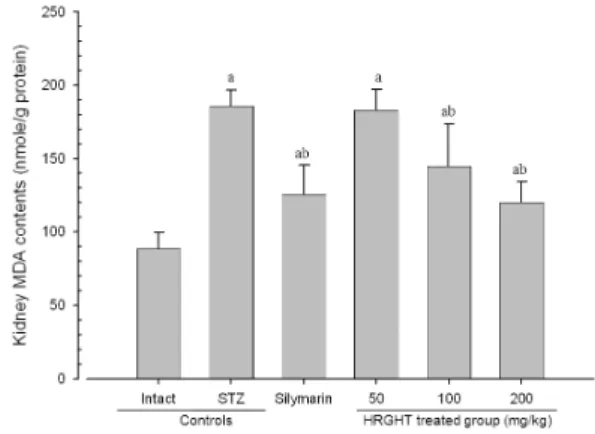
Silymarin, HRGHT 추출물100 및 200 mg/kg 투 여군에서는 각각 streptozotocin 대조군에 비해 유 의성 있는 (p<0.01) 신장 내 MDA 함량의 감소가 인정되었다. 한편 HRGHT 50 mg/kg 투여군에서 는 streptozotocin 대조군과 유사한 신장 내 MDA 함량의 변화를 나타내었다(Fig. 5).
Fig. 5. Changes on the Kidney Malondialdehyde Contents after Streptozotocin and Test Article Administration.
Note that the kidney malondialdehyde (MDA) contents was significantly (p<0.01) increased in streptozotocin control as compared with intact control. It means, lipid peroxidation was increased by treatment of streptozotocin. However, these kidney MDA contents increases were significantly (p<0.01) inhibited by treatment of silymarin, Hwangryungeehwang-tang 100 and 200 mg/kg, respectively. No meaningful changes on the kidney MDA contents were detected in Hwangryungeehwang -tang 50 mg/kg treated group as compared with streptozotocin control in this study.
Values are expressed mean ± S.D. of eight rats (nmole/g protein); Silymarin was dosed as 100 mg/kg of body weights; STZ, streptozotocin; a p<0.01 compared with intact control; b p<0.01 compared with streptozotocin control.
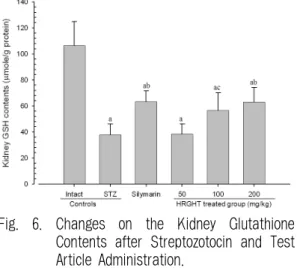
Silymarin, HRGHT 100 및 200 mg/kg 투여군에
서는 각각 streptozotocin 대조군에 비해 유의성 있
는 (p<0.01 or p<0.05) 신장 내 GSH 함량의 증가가
인정되었다. 한편 HRGHT 50 mg/kg 투여군에서
는 streptozotocin 대조군과 유사한 신장 내 GSH
함량의 변화를 나타내었다(Fig. 6).
Fig. 6. Changes on the Kidney Glutathione Contents after Streptozotocin and Test Article Administration.
Note that the kidney glutathione (GSH) content was significantly (p<0.01) decreased in streptozotocin control as compared with intact control. It means, oxidative stress was induced by treatment of streptozotocin. However, these kidney glutathione contents decreases were significantly (p<0.01 or p<0.05) inhibited by treatment of silymarin, Hwangryungeehwang -tang 100 and 200 mg/kg, respectively. No meaningful changes on the kidney GSH contents were detected in Hwangryungeehwang -tang 50 mg/kg treated group as compared with streptozotocin control in this study.
Values are expressed mean ± S.D. of eight rats (μmole/g protein); Silymarin was dosed as 100 mg/kg of body weights; STZ, streptozotocin;
a p<0.01 compared with intact control; b p<0.01 and c p<0.05 compared with streptozotocin control.