산욕초기 산모의 모성역할 수행 자신감 영향요인
하주영·김윤지
부산대학교 간호대학
Factors Influencing Self-confidence in the Maternal Role among Early Postpartum Mothers
Ha, Ju-young · Kim, Yoon-ji
College of Nursing, Pusan National University, Yangsan, Korea
Purpose: The purpose of this study was to identify the influencing factors of mothers' confidence in their maternal role during the early postpartum period. Methods: Participants were 178 postpartum women who delivered at three specialized obstetrics and gynecology facilities and used the postpartum care facility in city B. Data were collected from February to April, 2012 using the scales of measurements of self-confidence in maternal role performance, ma- ternal self-esteem, mother-to-infant attachment, social support, and childcare stress. Descriptive statistics, Pearson correlation coefficients, and stepwise multiple regression were used with the SPSS/WIN 18.0 program to analyze the data. Results: The scores for self-confidence in the maternal role showed significant negative correlations with the scores of childcare stress (r=-.40, p<.001). Parity and maternal attachment were significant predictors and ac- counted for 97.4% of the variance in self-confidence in the maternal role. Conclusion: To strengthen self-confidence in the maternal role of early postpartum mothers, prenatal class programs need to be complemented in order to reduce childcare stress and promote mother-to-infant attachment.
Key Words: Mothers, Postpartum period, Role
주요어: 산모, 산욕기, 역할
Corresponding author: Kim, Yoon-ji
Department of Preventive Medicine, Kosin University College of Medicine, 34 Amnamdong, Seo-gu, Busan 602-703, Korea Tel: +82-10-6369-1812, Fax: +82-51-990-3036, E-mail: [email protected]
- 본 연구는 부산대학교 간호과학연구소의 지원으로 수행되었음.
- This study was supported by Research Institute of Nursing Science, Pusan National University.
투고일: 2012년 9월 7일 / 수정일: 2012년 12월 7일 / 게재확정일: 2013년 1월 21일
This is an open access article distributed under the terms of the Creative Commons Attribution Non-Commercial License (http://creativecommons.org/license/
by-nc/3.0), which permits unrestricted non-commercial use, distribution, and reproduction in any medium, provided the original work is properly cited.
INTRODUCTION
The trend towards nuclear families due to the rapid economic development and social change made it diffi- cult to expect surrogate parenting from grandparents by reducing the support of the family and increasing the parents' responsibility for child-rearing. The decreasing number of household members caused by the trend to- wards nuclear families has reduced the burden of house- wives on housekeeping services and so on. However, it also increased burden on the maternal role because
83.1% of infants younger than 1 year are mainly brought up by mothers (Kim, Kim, Jo, Kim, & Lim, 2009).
The maternal role means to establish the maternal
identity and to perform acts based on the needs of a ba-
by (Mercer, 2004) and by accepting a new family mem-
ber after childbirth, interaction among family members
occurs and the maternal role begins while recognizing
each role (White, Wilson, Elander, & Persson, 1999) and
is strengthened as a child grows throughout his/her
life-cycle (Mercer). The maternal role of a mother is im-
portant because it has a decisive effect on the lifetime of
a child, it develops and maintains the ideal mother- to-infant relationship and forms the foundation of nor- mal growth and development of a child (Chae, 2005).
However, a woman experiences major changes phys- ically and mentally along with the transition of the ma- ternal role in the development process called childbirth.
These changes give joy and fulfillment to a woman but also give burden and the responsibility of having to re- adjust activities and roles at the same time (Cho & Yang, 2001). Therefore, the stressful situation due to the bur- den of having to adapt herself to a new role of being a mother can cause negative results such as lack of caring for the baby and inappropriate mother-to-infant inter- action (Assel et al., 2002). In addition, a mother having difficulty in the transition of the maternal role may cause growth retardation, behavioral problems and cognitive developmental disabilities in a child (Belsky & Fearon, 2004).
In case of the transition of a successful maternal role, a mother’s psychological state appearing from the end of pregnancy to early delivery becomes an important clue and self-confidence in the maternal role means that this transition was made successfully (White et al., 1999).
If a woman feels that she can take good care of a baby, self-esteem increases and interaction with the baby be- comes positive and she shows an affectionate reaction to her baby. On the other hand, if self-confidence of car- ing for a baby decreases, there is difficulty in performing the maternal role (Lee & Kwon, 2006)
Most previous studies on self-confidence in the ma- ternal role were conducted targeting the mothers of chil- dren with health problem such as babies with health problems (mental diseases, premature babies and so on)(Kwon & Kwon, 2007) and there are only a few stud- ies whose subject is pregnant women. The subject is de- fined by the comprehensive women; 4 weeks after childbirth, 8 weeks after childbirth and 5~7 months after childbirth. So, it is difficult to explain self-confidence in maternal role performance in the early puerperium. Also, childcare stress, social support (Emmanuel, Creedy, St Johm, & Brown, 2011), maternal self-esteem, mother's health status (Emmanuel et al.,), mother-to-infant at- tachment (White et al., 1999) and whether the preg- nancy was planned or not (Lowdermilk & Perry, 2007) are explained for the factors which have effect on mater- nal role performance, but those related variables are considered at the same time. So, there is no study ex- plaining the factors contributing to self-confidence in maternal role performance the early postpartum stage.
Therefore, this study should consider that the number
of mothers who spend important periods of puerperium in postpartum care facilities rather than at home has in- creased because of the nuclearization. It should also ex- amine self-confidence in maternal role performance for women who gave birth to healthy newborn babies and are using postpartum care facilities so as to exclude the babies' health status causing the difference of maternal role performance, an exogeneous variable, and grasp the effective factors.
The purpose of this study is to identify the factors af- fecting self-confidence in the maternal role targeting early postpartum mothers. The specific purposes are as follows.
y To identify general characteristics, self-confidence in the maternal role, maternal self-esteem, moth- er-to-infant attachment, social support and child- care stress
y To identify self-confidence in the maternal role de- pending on the general characteristics
y To identify the interrelation of self-confidence in the maternal role, maternal self-esteem, mother- to-infant attachment, social support and childcare stress
y To identify the influencing factors of self-confi- dence in the maternal role
METHODS
1. Study Design
This study is a descriptive research to understand self- confidence in the maternal role, maternal self-esteem, mother-to-infant attachment, social support and child- care stress of early postpartum mothers as well as to identify the influencing factors of self-confidence in the maternal role.
2. Sample and Setting
This study set the mothers, who participated in the
breast-feeding training class or visited a breast-feeding
room, among the mothers using a postpartum care fa-
cility after giving birth at the three specialized obstetric
and gynecology hospitals located in B city. The subjects
were randomly selected from the mothers who met the
following criteria: Mothers who understood the purpose
of this study and who agreed to be participants. The
specific criteria for selecting study subjects included
mothers within 3 weeks after childbirth using the post-
partum care facility after giving birth with a gestational
period of over 37 weeks, and who had a neonate who weighed more than 2,500mg at birth without congenital anomaly.
As the number of subjects needed for this study, 138 people were presented while setting five independent variables used in the regression analysis, power of test.
95, significance level .05, effect size of mid-level .15, by using G*Power 3.1.2 program. Thus, this study was con- ducted targeting 180 people by considering a 30.0% fail- ure rate.
3. Instrument
1) General characteristics
The general characteristics of subjects included dem- ographic characteristics (age, level of education, wheth- er they are employed or not, monthly income of total household members) and obstetric characteristics (child- birth experience, type of childbirth, gestational period of the newborn, sex of the newborn, whether the preg- nancy was planned or not, presence of prenatal educa- tion, whether there is a person who will help after leav- ing postpartum care facility).
2) Self-confidence in the maternal role
Self-confidence in the maternal role was measured us- ing the 5 dimension measuring mother's confidence in her ability to cope with the tasks of motherhood of the postpartum self-evaluation scale including a total of 87 questions of 8 dimensions developed by Lederman, Weingarten and Lederman (1981) and translated into Korean by Lee (1992). This tool was designed to meas- ure the anxiety or doubt on the ability to meet the needs of an infant and the ability to interpret the behaviors of an infant and the parental role of a mother. This in- ventory consists of 14 questions rated on a 4-point scale with higher scores indicating higher self-confidence in the maternal role. When developed, the reliability of the tool was Cronbach's ⍺=.62~.82 in each area and Cron- bach's ⍺=.94 in the study of Lee and Cronbach's ⍺=.77 in this study
3) Maternal self-esteem
This study used the maternal self-esteem tool that Han and Bang (1999) adaptedㆍmodified and the mater- nal self-report inventory developed by Shea and Tronick (1988) targeting korean women. It consists of a total of 25 questions rated on a 5-point Likert scale and a high score means high maternal self-esteem. When devel- oped, the reliability of the tool was Cronbach's ⍺=.83
in each area and Cronbach's ⍺=.83 in the study of Han and Bang and Cronbach's ⍺=.79 in this study.
4) Mother-to-infant attachment
Mother-to-infant attachment means the degree of at- tachment to an infant that a mother evaluates herself and the tool that Han (2001) adapted and modifiedㆍ supplemented by the maternal attachment inventory de- vised by Muller (1994). It consists of a total of 26 ques- tions rated on a 4-point scale and a high score means a high mother-to-infant attachment. When developed, the reliability of the tool was Cronbach's ⍺=.85 and Cron- bach's ⍺=.89 in the study of Han and Cronbach's ⍺
=.96 in this study.
5) Social support
For social support of postpartum women, the social support scale modified by Song (1992) based on an in- directly perceived social support scale developed by Park (1985) was used. This tool consists of a total of 25 questions of 4 sub factors, emotional., informational., evaluative, material support and is a 5-point Likert scale with higher scores indicating higher social support.
When developed, the reliability of the tool was Cron- bach's ⍺=.93 and Cronbach's ⍺=.97 in the study of Song and Cronbach's ⍺=.98 in this study.
6) Childcare stress
Childcare stress was measured using the childcare stress inventory (CSI) developed by Cutrona (1984) and translated to Korean by Chun (1998). The CSI consists of 16-items rated on a 5-point Likert scale (1 to 5) with higher scores indicating a higher degree of childcare stress as perceived by the mother. The internal con- sistency reliability (Cronbach’s ⍺=.87) and content val- idity were established for use in Korean postpartum women (Kwon, 1997). In this study, the Cronbach’s ⍺
=.79.
4. Data collection Procedure
After IRB approval (E-2011051), this study was con- ducted from February 2012 to April 2012 after explain- ing the study objectives and methods to the directors of 3 specialized obstetrics and gynecology hospitals lo- cated in city B and after obtaining permission.
After checking to see if the mothers were appropriate
for the criteria of selecting subjects, the researcher and
research assistants explained that mothers who do not
want to answer according to the purpose and proce-
dures of this study can be withdrawn at any time and the collected data would be processed anonymously and the survey information will not be used for purposes other than for research. Then if agreed to participate voluntarily, they had mothers write a written agreement and read and fill out a structured questionnaire, and then collected data and presented a thank-you gift to the respondents. The research assistants were 2 sophomores in the department of nursing and pre-training on the cri- teria of selecting subjects, ethical considerations of re- search, research purpose, contents of questionnaire, re- search methods were carried out and the researcher checked them through evaluation. Of the distributed 180 copies, a total of 174 copies excluding 6 question- naires containing insincere responses and missing an- swers were finally analyzed.
5. Data analyses
The collected data was analyzed using the SPSS/WIN 18.0 program. For general characteristics and self-con- fidence in the maternal role, maternal self-esteem, mother- to-infant attachment, social support and childcare stress of subjects, frequency and percentages, mean and stand- ard deviation were calculated. The difference of self- confidence in the maternal role depending on general characteristics of subjects was analyzed with a t-test. The correlations between self-confidence in the maternal role, maternal self-esteem, mother-to-infant attachment, social support and childcare stress of subjects were found by Pearson's correlation. To determine the influ- encing factors of self-confidence in the maternal role of subjects, stepwise multiple regression was conducted.
RESULTS
1. General characteristics and self-confidence in the maternal role
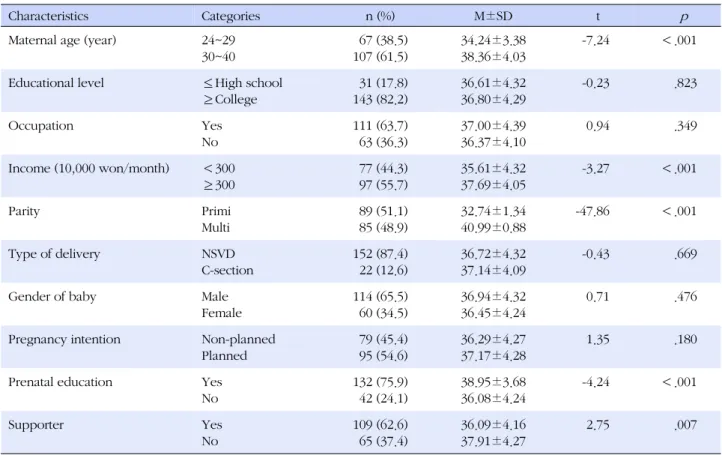
In case of general characteristics of subjects, demo- graphic characteristics and obstetrical characteristics were investigated. Looking at the demographic charac- teristics, the ages of subjects were between 24~40 years old and the mean age was 30.6 years old. In case of the level of education, 82.2% were college graduates or higher and 63.7% were full-time housewives and the monthly income of 55.7% was 3 million won or higher which was the case for most. In case of obstetric charac- teristics, 51.1% were primipara and the gestational age of the baby at birth was an average of 39.2 weeks and
87.4% gave birth through vaginal delivery. In case of ne- onatal sex, 65.5% had boys and 54.6% planned their pregnancy. For whether or not there was a person who could help other than their husband after leaving the postpartum care facility, 62.6% answered ‘yes’ and for whether they would participate in prenatal class or not, 75.9% answered ‘yes’(Table 1).
The difference of self-confidence in the maternal role depending on general characteristics is as shown in Table 1. Women in their 30s or older showed higher self-confidence in the maternal role than those in their 20s (t=-7.24, p <.001) and women earning more than a monthly income of 3 million won showed a higher self-confidence in the maternal role than those earning less than that (t=-3.27, p <.001). And self-confidence in the maternal role of multipara was higher than that of primipara (t=-47.86, p <.001). Also, self-confidence in the maternal role of women who received prenatal edu- cation (t=-4.24, p <.001) and did not have anyone giv- ing help (t=2.75, p =.007) was higher.
2. Self-confidence in the maternal role and inde- pendent variables
The average score of self-confidence in the maternal role which is a dependent variable of this study was 36.77±4.28, maternal self-esteem was 86.94±8.10, mother-to-infant attachment was 81.95±12.89, social support was 91.44±15.09 and childcare stress was 52.79±6.62 (Table 2).
3. Correlations among the study variables
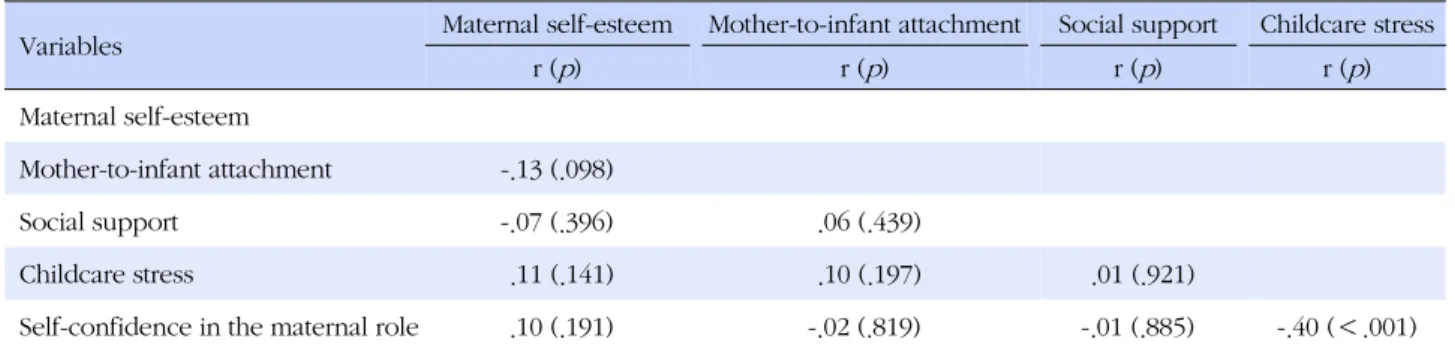
The correlation between self-confidence in the mater- nal role and relevant factors was identified and as a re- sult, it turned out to be a negative correlation with child- care stress (r=-.40, p <.001)(Table 3).
4. Influencing factors on the self-confidence in the maternal role
An analysis to verify factors that will influence the
self-confidence of mothers in playing the maternal role
in the initial stages after the childbirth was conducted by
stepwise multiple regression with maternal age, income,
parity, prenatal education supporter, self-confidence in
the maternal role, maternal self-esteem, mother-to-in-
fant attachment, social support and childcare stress des-
ignated as independent variables. The results of the
analysis are presented in Table 4. Prior to analyzing the
Table 1. General Characteristics and Differences in Self-confidence in the Maternal Role (N=174)
Characteristics Categories n (%) M±SD t p
Maternal age (year) 24~29
30~40
67 (38.5) 107 (61.5)
34.24±3.38 38.36±4.03
-7.24 <.001
Educational level ≤High school
≥College
31 (17.8) 143 (82.2)
36.61±4.32 36.80±4.29
-0.23 .823
Occupation Yes
No
111 (63.7) 63 (36.3)
37.00±4.39 36.37±4.10
0.94 .349
Income (10,000 won/month) <300
≥300
77 (44.3) 97 (55.7)
35.61±4.32 37.69±4.05
-3.27 <.001
Parity Primi
Multi
89 (51.1) 85 (48.9)
32.74±1.34 40.99±0.88
-47.86 <.001
Type of delivery NSVD
C-section
152 (87.4) 22 (12.6)
36.72±4.32 37.14±4.09
-0.43 .669
Gender of baby Male
Female
114 (65.5) 60 (34.5)
36.94±4.32 36.45±4.24
0.71 .476
Pregnancy intention Non-planned
Planned
79 (45.4) 95 (54.6)
36.29±4.27 37.17±4.28
1.35 .180
Prenatal education Yes
No
132 (75.9) 42 (24.1)
38.95±3.68 36.08±4.24
-4.24 <.001
Supporter Yes
No
109 (62.6) 65 (37.4)
36.09±4.16 37.91±4.27
2.75 .007
NSVD=normal spontaneous vaginal delivery; C-section=cesarean section.
Table 2. Mean Scores of Variables (N=174)
Variables M±SD
Self-confidence in the maternal role 36.77±4.28
Maternal self-esteem 86.94±8.10
Mother-to-infant attachment 81.95±12.89
Social support 91.44±15.09
Childcare stress 52.79±6.62
influencing factor, the result of verifying Multicolli- nearity between variables included in the analysis showed that the relationship between concepts that showed the highest correlation between independent variables is 0.47, less than 0.80 and the range of toler- ance is 0.95, more than 0.10. The variation inflation fac- tor (VIF) is 1.06 not exceeding the standard 10. Thus it turned out that Multicollinearity of data had no pro- blems. Also, to test the independence of residuals, the Durbin-Watson test was carried out and the result was 1.86, close to 2 and independence between the error terms was satisfied. Therefore, this material turned out to be appropriate for regression analysis. Through multi-
ple regression analysis, the influencing factor on self- confidence in the maternal role of subjects was checked.
As a result, prediction explanation of parity and moth- er-to-infant attachment was 97.4%(R
2=.974). That is, the stronger the mother-to-infant attachment of the multi- para, the higher the self-confidence in the maternal role.
The regression model used in this study was significant (F=3,248.95, p <.001).
DISCUSSION
Targeting mothers experiencing the transition process
of the maternal role in the early postpartum period, this
study confirmed the influencing factors of self-con-
fidence in the maternal role based on general character-
istics and self-confidence in the maternal role, maternal
self-esteem, mother-to-infant attachment, social support
and childcare stress. The average age of all subjects was
30.6 years old and depending on the delivery experi-
ence, primipara accounted for 51.1% and multipara
48.9%. These characteristics were similar to the average
childbirth age of 31 years-old, and the ratio of primipara
51.7%, multipara 48.3% depending on the delivery ex-
perience of the total population of Korea in 2009
Table 3. Correlations among Variables (N=174)
Variables Maternal self-esteem Mother-to-infant attachment Social support Childcare stress
r (p) r (p) r (p) r (p)
Maternal self-esteem
Mother-to-infant attachment -.13 (.098)
Social support -.07 (.396) .06 (.439)
Childcare stress .11 (.141) .10 (.197) .01 (.921)
Self-confidence in the maternal role .10 (.191) -.02 (.819) -.01 (.885) -.40 (<.001)
Table 4. Factors Influencing Self-confidence in the Maternal Role (N=174)
Variables B SE β t p Collinearity statistics
Tolerance VIF
Parity .619 0.008 1.01 80.60 <.001 .947 1.056
Mother-to-infant attachment .133 0.008 .22 17.17 <.001 .947 1.056
Adjusted R2=.974, F=3,248.95, p<.001 Durbin-Watson=1.860
(Korean Statistical Information Service [KOSIS], 2010).
Compared to the results of previous studies, this study attempts to seek nursing measures and strategies to pro- mote self-confidence in the maternal role of early post- partum mothers.
In this study, mothers whose average monthly house- hold income is greater than 3 million won showed high- er self-confidence in the maternal role than mothers with less than 3 million won and this indicates that the higher the economic level is, the higher the adaptation to the maternal role is. These findings are similar with the previous study that mothers with a high economic status adapted to the maternal role better (Chae, 2005).
Given that the average monthly income per household is 3.29 million won (KOSIS, 2010), Nursing Intervention Programs that strengthen self-confidence in the mater- nal role of mothers at low socioeconomic levels are necessary.
A multipara who experienced delivery showed higher self-confidence in maternal role performance than a primipara. This result was consistent with the findings of Oh (2001) that the degree of self-confidence in maternal role performance of a postpartum primipara was lower than that of a multipara. It is considered to be the result caused by the experience of parenting a baby in case of a multipara who experienced delivery. However, the study of Lee (1994) targeting postpartum 4-month moth- ers reported that multipara showed higher maternal role
strain than primipara and like primipara, multipara also experienced the transition to maternal role for a new ba- by after childbirth. There was also a difference from the study reporting that just simple delivery experience and parenting did not lead to self-confidence in maternal role performance (Kronborg, Vaeth, Olsen, Iversen, &
Harder, 2007). Therefore, in future studies, repetitive studies identifying the relationship of self-confidence in maternal role performance depending on the experi- ence of birth may be needed.
Mothers who participated in prenatal classes showed higher self-confidence in the maternal role than mothers who did not, and it turned out that prenatal education has a positive effect on self-confidence in the maternal role. This is consistent with the study of Oh, Sim and Kim (2002) which reported that a group that received prenatal education showed a more significant difference in postnatal self-confidence in the maternal role than a group that did not receive it. Also, the study of Chae (2005) reported that mothers who prepared for delivery well by participating in a prenatal class adjusted to the maternal role better, but there was no significant differ- ence depending on the people who helped with post- natal care. Thus it is considered that after being preg- nant, preparing for delivery, can give practical help to postnatal maternal role performance.
The average score of self-confidence in the maternal
role of early postpartum mothers was 36.77±4.28. It
turned out to be approximately in the middle. This result is similar to the result of Lee (1992)’s study who used the same tool as used in this study. In the study of Lee and Kwon (2006) targeting mother-infant that also used the same tool, self-confidence in the maternal role was 3.06 points and it turned out to be slightly higher than in this study. These results may be due to the fact that while the study of Lee and Kwon targeted 5~7-month-old moth- er-infants, this study targeted early postpartum women.
Therefore, since formation of the maternal role shows different patterns depending on the rearing environ- ment and time (Emmanuel et al., 2011), a longitudinal study comparing formation of the maternal role depend- ing on the period after childbirth will be needed in fu- ture studies.
It turned out that there was a negative correlation be- tween childcare stress and self-confidence in the mater- nal role of early postpartum mothers. Not many studies explained the relevance between childcare stress and self-confidence in the maternal role targeting mothers.
So, we must pay close attention because the measure- ment tools are not the same but the findings of this study are the results supporting the study of Lee and Kwon (2006) showing that self-confidence in the maternal role is inversely correlated with the degree of childcare stress.
However, in the study of Kronborg et al.,(2007), women who had experienced giving birth before made the tran- sition to the maternal role in a similar manner as women who gave birth for the first time. It is different from the study that high stress is experienced because of the bur- den for raising other children including the new baby. It can be difficult to compare them directly, but this study showed that there is no significant relationship between childcare stress and maternal self-esteem. In the study of Song, Chang, & Kim (2008), parity was explained as an important variable for the effective factors of childcare stress of women using postpartum care facility, so fol- lowing studies must verify the relationship between self-confidence in maternal role performance and child- care stress by controlling or considering it importantly.
In this study, mother-to-infant attachment was one of the major influencing factors in self-confidence in the maternal role of early postpartum mothers. However self-confidence in maternal role performance and moth- er-to-infant attachment showed weak negative correla- tion although it was not statistically significant. It is sim- ilar to the result of Kim, Park, Lee, Moon, & Park (2005)'s study whose subject was women using postpartum care facilities. The result was that the score for self-con- fidence in the maternal role of experimental groups us-
ing massage to increase mother-to-infant attachment was slightly reduced from a score of 32.0 before the experi- ment to 31.6 after the experiment. The cause is that mothers requests for rest rather than consider childcare although they have affection for the new baby. However, they are accustomed to motherly behavior when the premise is that they are with their children, so it is neces- sary to let them recognize the importance of the room- ing in system and is also necessary to encourage moth- ers' efforts while in postpartum care facility.
Also, self-confidence in maternal role performance and mother-to-infant attachment are not statistically sig- nificant with social support, but there was a weak neg- ative correlation. In the study of Suh and Huh (cited in Song et al.,, 2008), the things that mothers regard as im- portant in postpartum care facility are in this order: sani- tation (50.0%), physical recovery of the mother (27.4%), breast-feeding (11.3%). And full caring and social sup- port right after childbirth should be expected from de- pendent and passive mothers, so the process of obtain- ing maternal role is reduced. Therefore, for the culture of Korean postpartum care, mothers should be espe- cially cared for, during the first three weeks after child- birth, so care is needed when interpreting the correla- tion between self-confidence in maternal role perform- ance and social support. Also, following studies must re-verify the correlation between self-confidence in ma- ternal role performance and social support.
Therefore, based on the results mentioned above, this study proposes further research concerning the verifi- cation of the effects of the mother-to-infant attachment promotion program in the postpartum care facility after childbirth through a prenatal classroom that strengthens prenatal information and childcare stress management.
However, since this study selected subjects by the random expression method, while targeting mothers in only one postpartum care facility, generalizing the find- ings to all mothers belonging to the early postpartum period should be done with caution.
CONCLUSION
This study is a descriptive research aiming to under-
stand the level of self-confidence in the maternal role of
a mother in early postpartum period who is using a
postpartum care facility, and to identify its related influ-
encing factors. As a result of this study, it was found that
self-confidence in the maternal role had a negative cor-
relation with childcare stress, and the influencing factors
on the self-confidence in the maternal role were parity
and mother-to-infant attachment. Accordingly, in case of multiparas, this is seen as the influence of previous childbirth and parenting experience so primipara should also be encouraged to actively participate in prenatal classes and get help from exchange of information by forming a network with other prenatal class participants.
Also, when making prenatal class programs, the con- tents of the measures to reduce childcare stress of moth- ers and to improve mother-to-infant attachment need to be complemented.
REFERENCES
Assel, M. A., Landry, S. H., Swank, P. R., Steelman, L., Miller- Loncar, C., & Smith, K. E. (2002). How do mothers' child- bearing histories, stress and parenting affect children's be- havioral outcomes? Child: Care, Health & Development, 28, 359-368. http://dx.doi.org/10.1046/j.1365-2214.2002.00285.x Belsky, J., & Fearon, R. M. (2004). Exploring marriage-parenting
typologies and their contextual antecedents and devel- opmental sequelae. Development and Psychopathology, 16, 501-523. http://dx.doi.org/10.1017/S095457940400464X Chae, Y. S. (2005). Adaptation of maternal roles and postpartum depression of primiparas during early postpartum period.
Journal of Clinical Nursing, 8, 113-124.
Cho, B. H., & Yang, M. S. (2001). Relationship between post- partum depression and parenting stress of mother with in- fant. Research Institute of Science for Human Life, 5, 79-87.
Chun, Y. H. (1998). Comparison of group and individual social support on burden and family functioning in families with asthmatic children. Unpublished doctoral thesis, Yonsei Uni- versity, Seoul.
Cutrona, C. E. (1984). Social support and stress in the transition to parenthood. Journal of Abnormal Psychology, 93, 378-390.
Emmanuel, E. N., Creedy, D. K., St John, W., & Brown, C. (2011).
Maternal role development: the impact of maternal distress and social support following childbirth. Midwifery, 27, 265- 272. http://dx.doi.org/10.1016/j.midw.2009.07.003 Han, K. E. (2001). The relationship of maternal self-esteem and
maternal sensitivity with mother-to-infant attachment. Un- published doctoral thesis, Hanyang University, Seoul.
Han, K. J., & Bang, K. S. (1999). Confirmatory analysis of mater- nal self-report inventory [maternal self-esteem]. The Acad- emic Society of Parent-Child Health, 2, 64-82.
Kim, S. D., Park, H. R., Lee, S. Y., Moon, Y. I., & Park, J. H.
(2005). Effects of maternal massage to newborn on stress, immune function and self-confidence of mothers during the postpartum period. Korean Journal of Women Health Nurs- ing, 11, 265-272.
Kim, S. K., Kim, Y. K., Jo, A. J., Kim, H. R., & Lim, S. E. (2009).
2009 national fertility and family and family health survey.
Seoul: Korea Institute for Health and Social Affairs.
Korean Statistical Information Service [KOSIS]. (2010). House- hold survey data and distinctive birth power. Retrieved May 1, 2012, from http://kosis.kr/news/news_02List.jsp Kronborg, H., Vaeth, M., Olsen, J., Iversen, L., & Harder, I. (2007).
Effect of early postnatal breastfeeding support: A cluster- randomized community based trial. Acta Paediatrica, 96, 1064-1070. http://dx.doi.org/10.1111/j.1651-2227.2007.003 41.x
Kwon, H. K., & Kwon, M. K. (2007). Effect of discharge education program for mothers of premature infants on maternal role confidence and parenting stress. Journal of Korean Acad- emy of Child Health Nursing, 13, 58-65.
Kwon, J. H. (1997). A test of a vulnerability-stress model of post- partum depression. Korean Journal of Clinical Psychology, 16, 55-66.
Lederman, R. P., Weingarten, C. G., & Lederman, E. (1981). Post- partum self-evaluation questionnaire: Measure of maternal adaptation. Birth Defects Original Article Series, 17, 201- 231.
Lee, H. K. (1994). A comparison of primiparous and mutiparous mothers on maternal role strain and maternal role attain- ment. Journal of Korean Academy of Nursing, 24, 241-250.
Lee, S. Y., & Kwon, I. S. (2006). A comparative study on maternal role confidence and parenting stress according to the in- fant's feeding method. Korean Journal of Women Health Nursing, 12, 231-239.
Lee, Y. E. (1992). An experimental study on the impact of an agreement on the means to achieve nursing goals in the ear- ly postpartum period of primiparous mothers and enhance their self-confidence and satisfaction in maternal role per- formance. Journal of Korean Academy of Nursing, 22, 81- 115.
Lowdermilk, D. L., & Perry, S. E. (2007). Maternity & women's health care. St. Louis, MO: Mosby Elsevier.
Mercer, R. T. (2004). Becoming a mother versus maternal role attainment. Journal of Nursing Scholarship, 36, 226-232.
Muller, M. E. (1994). A questionnaire to measure mother to infant attach. Journal of Nursing Measurement, 2, 129-141.
Oh, H. E. (2001). The relationship among maternal identity, role attainment and postpartum depression. Journal of the Korean Society of Maternal and Child Health, 5, 255-266.
Oh, H. E., Sim, G. S., & Kim, J. S. (2002). The effects of prenatal education on primiparas' perception of delivery experi- ence, self-confidence and satisfaction in maternal role per- formance. Korean Journal of Women Health Nursing, 8, 268-277.
Park, J. W. (1985). Development of the social support scale.
Unpublished master's thesis, Yonsei University, Seoul.
Shea, E., & Tronick, E. (1988). The maternal self-report inventory:
A research and clinical instrument for assessing maternal self-esteem. In H. E. Fitzgerald, B. H. Lester, & M. W.
Yogman (Eds.), Theory and research in behavioral pedia- trics (Vol. 4.). New York: Plenum.
Song, J. E., Chang, S. B., & Kim, S. (2008). Childcare stress, post- partum depression, and postpartum fatigue between wom- en who used and not used sanhujori facility. Journal of the
Korean Society of Maternal and Child Health, 12, 33-46.
Song, J. M. (1992). In the parenting stress situation, the effect of social support to parental perceptions of child behavior.
Unpublished master's thesis, Sookmyung Women's Univer- sity, Seoul.
White, M. A., Wilson, M. E., Elander, G., & Persson, B. (1999).
The swedish family: Transition to parenthood. Scandina- vian Journal of Caring Science, 13, 171-176.
Summary Statement
■
What is already known about this topic?
In case of self-confidence in the maternal role, research was conducted mainly targeting mothers who gave birth to premature infants and was related to maternal self-esteem, child care stress and social support.
■
What this paper adds
Self-confidence in the maternal role of early postpartum mothers with healthy normal baby was correlated with child care stress; and parity and mother-to-infant attachment were the influencing factorsof mothers' confidence in their maternal role.
■
Implications for practice, education and/or policy
To strengthen self-confidence in the maternal role of early postpartum mothers, prenatal class programs need to be complemented to reduce childcare stress and promote mother-to-infant attachment by providing actual information on parenting.