- 175 -
1Department of Agronomy, College of Agriculture and Life Science, Chungnam National University, Daejeon 305-764, Korea(충남 대학교 농업생명과학대학 응용식물학과, 305-764 대전광역시 유성구 궁동 220).
* 연락저자(Corresponding author):Phone) +82-42-821-5726, Fax) +82-42-822-2631, E-mail) [email protected]
(Received May 24, 2011; Examined June 11, 2011; Accepted June 16, 2011)
Herbicidal Activities and Crop Injury of Hairy Vetch Residues
Ok Jae Won1, Md Romij Uddin and Jong Yeong Pyon*
헤어리벳치 잔류물이 제초활성 및 작물 약해에 미치는 영향
원옥재1, 로미즈 우딘1, 변종영1*
ABSTRACT This study was conducted to evaluate the growth inhibition of weeds and selectivity of crop species by hairy vetch residues. The growth of all the weed species was suppressed greater than 90% at the ratio 60:40 of hairy vetch residues and no weeds were emerged at 90:10 mixture in the greenhouse. It was noticed that broadleaf weed species were more suppressed compared to grass weed species. Growth of weeds was significantly reduced and the inhibition percent was increased with increasing application depths of hairy vetch mixture both in vinylhouse and in field conditions. Among the different application depths of hairy vetch mixture, 0.75 cm depth of application tended to inhibit more, but statistically no significant difference was observed between 0.5 cm and 0.75 cm application depth. The growth of weed species such as Galium spurium, Chenopodium album, Plantago asiatica, and Rumex japonicus was greatly suppressed in the vinylhouse and the growth of G. spurium, R. japonicus and Amaranthus retroflexus was suppressed significantly in the field condition. The growth inhibition of all the above mentioned sensitive weed species was approximately 80% at the application depth of 0.5 cm. Crop growth was not hampered by using the residues of hairy vetch. This study demonstrated that rotation crop residues of hairy vetch contained high allelopathic potential to different weed species without hampering the growth of crop species.
Key words: allelopathy; hairy vetch; application depth; weed control; crop selectivity.
INTRODUCTION
Growth inhibition or stimulation resulting from the release of secondary plant compounds is termed allelopathy (Molisch 1937). Allelopathy also includes plant derived compounds that possess allelopathic properties after microbial transformation. Weed suppression has been in some cases attributed to physical interference (Teasdale 1996; Samarajeewa et al. 2006) and in others to chemical competition (Singh et al. 2003; Weston and Duke 2003).
Crop residues are defined as crop or its parts left in field for decomposition after it has been thrashed or harvested (Kumar and Goh 2000). Earlier these were regarded merely as waste, but now because of their usefulness they are considered an important resource that can bring significant physical, chemical, and biological changes in the agricultural soil after amendment. In the conservation tillage system, the retention of crop residues improves soil, increases water filtration, reduces labor, and suppresses weeds under some situations by bringing a shift in weed flora or directly suppressing them (Jones et al.
1999; Kumar and Goh 2000). The presence of crop residues on the soil surface as mulch suppresses weeds through allelopathy and thus reduces a greater reliance on herbicides (Batish et al. 2001).
Some residues are also known to enhance the efficiency of herbicides (Teasdale et al. 1991);
however, much depends on crop residues, its placement, environmental conditions, and cropping patterns.
Hairy vetch (Vicia villosa Roth) is a winter annual cover crop in no-till cropping system (Hoffman et al. 1993). Among the crop residues, hairy vetch is known as a benefit crop, as it provides a number of advantages in agro-ecosystems. These are nitrogen fixation, the quick addition of biomass, prevention of soil erosion, promotion of soil porosity, amelioration
of the microclimate and, above all, weed suppression owing to its allelopathic effect (Fujii 2001) and its competition for environmental resources (Teasdale and Daughtry 1993). The use of hairy vetch as a cover crop in subtropical regions in order to suppress weeds, reduce soil erosion, and increase organic matter to improve the level of soil fertility has been proposed in order to enhance the sustainability of agricultural practices (Zougmore et al. 2006;
Anugroho et al. 2009a). Anugroho et al. (2009b) reported that the weed biomass was suppressed by living hairy vetch by 62.8% during the spring fallow period. The weed biomass was suppressed by living hairy vetch by 62.8% during the spring fallow period. The effect of hairy vetch incorporation on increases in the grain yield of corn and P availability in soils has been documented (Astier et al. 2006; Zougmore et al. 2006).
Currently, there is interest in legumes species especially hairy vetch for its easily decomposable potential to use as cover crop or rotational crop or use as crop residues to suppress weed growth.
Information regarding crop resides of hairy vetch used for the suppression of weed growth is very limited yet. This study intends to examine the growth inhibition of weeds and crop selectivity to hairy vetch residues applied in different conditions.
MATERIALS AND METHODS
Plant materials
Fresh hairy vetch was collected from Rural Development Administartion (RDA), Korea. Different weed species used in this study was collected from the Experimental Farm of Chungnam National University. Crop seeds used in this study was purchased from market.
Preparations of plant material
After collection, the hairy vetch was dried under shade in a vinylhouse, Chungnam National Univer- sity. Then residues were cut as small as possible and then used a disc type mill (Laboratory Mill 3600, Korea) to grind the samples.
Effect of different mixture of hairy vetch on weed control and crop injury
Hairy vetch residues was mixed with soil as mixture ratio of 0/100, 20/80, 40/60, 60/40, 80/20 and 90/10 (hairy vetch residues/soil) by volume.
The allelopathic potential of different ratio of hairy vetch residues against several weeds and crop species were evaluated. Ten weed species and six different crop species were grown in Wagner pots (1/5000 a). Each pot was filled up with upland cultivated soil up to 14.5 cm and then an amount of soil (that can cover 2 cm length of pot) was taken in a plastic bowl and 10 seeds of each weed species were mixed with this soil those were seeded above 14.5 cm soil surface and then the next 0.5 cm portion was filled with above mentioned ratio of hairy vetch residues and soil. Ten seeds of each crop species were sown in the pots. Treatments were replicated four times and arranged as a completely randomized design within the greenhouse.
Pots were watered as required to prevent drying out and to allow sufficient moisture on the soil surface for germination of weed seeds. Thirty days after treatment, shoots portion of weed and crop species were collected and then placed in an electric oven at 72℃ for 3 days for shoot biomass. Efficacy of hairy vetch mixture was measured based on dry matter of weeds and crop species.
Weed control effect and crop injury of hairy vetch residue in the vinylhouse
A mixture, 60/40 of rotation crop residues/soil by
volume was applied. Three different depth i.e, 0.75, 0.5 and 0.25 cm of mixture ratio were used including one control. Ten weed species (fifty seeds of each) and ten different crop species (20 seeds of each) were grown. Hairy vetch mixture were applied three days after seeding of all crop and weed seed species. Treatments were replicated three times as completely randomized design. Thirty days after treatment, shoot portion of weed and crop species were collected for shoot biomass. Efficacy of hairy vetch mixture was measured based on dry matter of weeds and crop species.
Weed control effect and crop injury of hairy vetch residue in the field
A mixture, 60/40 of rotation crop residues/soil by volume was applied in three different depth i.e, 0.75, 0.5 and 0.25 cm including one control in a upland cropping field. Eight different crop species (20 seeds of each) were grown. Weeds were allowed to grow from the field. No extra weed seeds were seeded in the field. Hairy vetch mixture was applied three days after seeding of all crop species. Treatments were replicated three times as completely randomized design. Thirty days after treatment, shoot portion of weed and crop species were collected to have shoot biomass. Efficacy was measured based on dry matter of weeds and crop species.
RESULTS
Weed control effect of different mixture of hairy vetch residue
Hairy vetch crop resides significantly reduced the growth of all weed species applied in different ratio (Table 1). The degree of inhibition was increased with increasing the mixture ratio of hairy vetch
Mixture ratio Weed control efficacy (%)
Hairy vetch Soil Ec1) Ds Pa Af Gs Ar Rj Ca Bb Ai
20 40 60 80 90
80 60 40 20 10
38.7 58.0 86.6 99.6 100
60.1 79.5 96.1 100 100
58.3 79.2 100 100 100
43.5 59.4 100 100 100
57.1 100 100 100 100
73.7 100 100 100 100
100 100 100 100 100
80.0 100 100 100 100
89.4 97.7 100 100 100
100 100 100 100 100
1)Ec, Echinochloa crus-galli; Ds, Digitaria sanguinalis; Pa, Poa annua; Af, Avena fatua; Gs, Galium spurium, Ar, Amaranthus retroflexus; Rj, Rumex japonicus; Ca, Chenopodium album; Bb, Bidens bipinnata; Ai, Aeschynomene indica.
Table 1. Effect of different mixture of hairy vetch residues on control of weeds.
Different depth (cm)
Efficacy of weed control (%)
Ec1) Ds Ca Ar Po Ea Ai Rj Pa Gs
0.25 0.5 0.75
37.9b 67.2a 75.8a
36.3b 65.0a 76.3a
47.6b 76.2a 85.7a
30.0b 70.0a 80.0a
35.7b 71.4a 80.0a
44.4c 66.7b 77.8a
48.0b 72.0a 80.0a
46.1c 73.1b 84.6a
41.3b 74.1a 82.8a
47.2c 77.3b 90.5a
1)Ec, Echinochloa crus-galli; Ds, Digitaria sanguinalis; Ca, Chenopodium album; Ar, Amaranthus retroflexus; Po, Portulaca oleracea; Ea, Eclipta alba; Ai, Aeschynomene indica; Rj, Rumex japonicus; Pa, Plantago asiatica; Gs, Galium spurium.
Table 2. Effect of hairy vetch application under different application depths on control of weeds in vinylhouse.
residues. Generally it was noticed that broadleaf weeds were suppressed more than grasses. The most susceptible weed species were Rumex japonicus and Aeschynomene indica where weeds were suppressed completely at the lowest mixture ratio (20:80) of hairy vetch followed by the species Bidens bipinnata, Chenopodium album and Amaranthus retroflexus, respectively. The growth inhibition of all grass weed species was less at the lower ratio of hairy vetch compared to broadleaf species, i.e.
the growth inhibition of broadleaf weed species were greater than 80%, whereas it was approximately 50% for the grasses at the lowest ratio of hairy vetch (20:80). No weeds were emerged at 90:10 mixture of hairy vetch residues and at 60:40 weed growth was suppressed greater than 90% irrespective of weed species.
Weed control effect of hairy vetch residue in the vinylhouse
Growth of weeds was significantly reduced in all weed species and the degree of inhibition increased with increasing application depth of hairy vetch mixture (60:40) in the vinylhouse (Table 2). Among the different application depths of hairy vetch mixture, 0.75 cm depth of application inhibited more but statistically no significant difference was observed between 0.5 cm and 0.75 cm depth. For most of the broadleaf weed species, growth inhibition was almost 80% when application depth of hairy vetch was 0.5 cm and it was more than 80% for the application depth of 0.75 cm. The weed species Galium spurium, C. album, Plantago asiatica and R. japonicus were most sensitive to hairy vetch. The trend of suppressing broadleaf
Different depth (cm)
Efficacy of weed control (%)
Ec1) Ds Ca Ar Ph Rj Gs
0.25 0.5 0.75
17.2c 45.4b 63.2a
20.6c 49.0b 60.8a
20.0c 60.0b 70.0a
27.03c 63.6 b 81.8 a
39.9b 59.4a 71.3a
28.6c 71.4b 85.7a
41.0c 71.8b 89.7a
1)Ec, Echinochloa crus-galli; Ds, Digitaria sanguinalis:Ca, Chenopodium album; Ar, Amaranthus retroflexus; Ph, Polygonum hydropiper; Rj, Rumex japonicus; Gs, Galium spurium.
Table 3. Effect of hairy vetch mixture using different application depths on control of weeds in field condition.
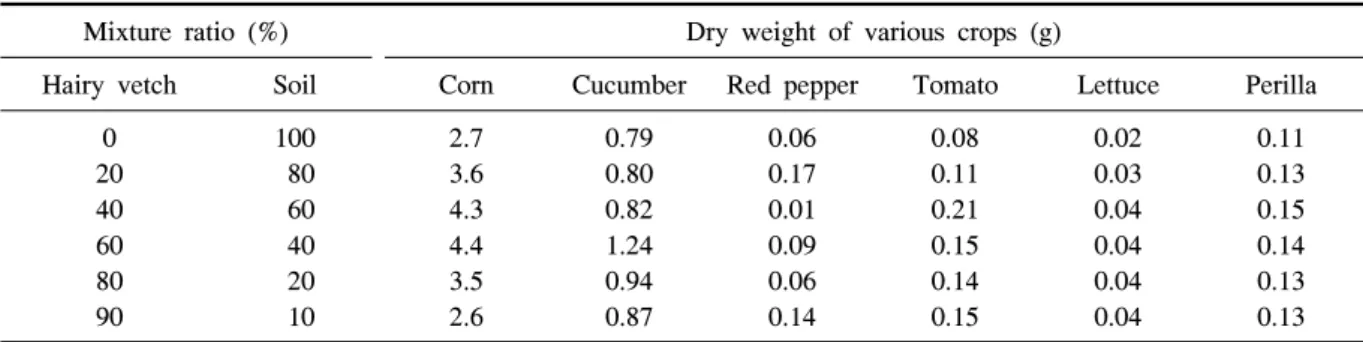
Mixture ratio (%) Dry weight of various crops (g)
Hairy vetch Soil Corn Cucumber Red pepper Tomato Lettuce Perilla
0 20 40 60 80 90
100 80 60 40 20 10
2.7 3.6 4.3 4.4 3.5 2.6
0.79 0.80 0.82 1.24 0.94 0.87
0.06 0.17 0.01 0.09 0.06 0.14
0.08 0.11 0.21 0.15 0.14 0.15
0.02 0.03 0.04 0.04 0.04 0.04
0.11 0.13 0.15 0.14 0.13 0.13
Table 5. Effect of hairy vetch mixture using different application depths on dry weight of crops in vinylhouse.
Different depth (cm)
Dry weight (g 5 plants-1)
Corn Soy
bean Radish Red
pepper Tomato Cucumber Chinese
cabbage Lettuce Perilla 0
0.25 0.50 0.75
2.6 3.9 4.1 5.3
1.5 2.3 2.4 1.6
8.2 9.1 13.7 15.6
0.16 0.22 0.23 0.23
0.33 0.40 0.69 0.86
6.1 6.2 6.4 7.5
5.2 6.2 7.8 8.5
0.35 0.37 0.42 0.29
0.19 0.23 0.24 0.27 Table 4. Effect of different mixture of hairy vetch residues on dry weight of crops.
weed species was also higher than grasses in vinylhouse condition. The growth inhibition was 67.2% and 65% for the species of Echinochloa crus-galli and Digitaria sanguinalis, respectively at 0.5 cm application of hairy vetch.
Weed control effect of hairy vetch residue in the field
Application depth of hairy vetch mixture significantly reduced the growth of all weed species in the field conditions showing slightly lower
inhibition than vinylhouse condition (Table 3). The trend of inhibition of different weeds were almost same those of vinylhouse but showing a lower inhibition both broadleaf and grasses. The weed species G. spurium, R. japonicus, and A. retroflexus were more sensitive than other broadleaf weeds.
The trend of suppressing broadleaf weed species was also higher than grasses in the field condition.
The growth inhibition was 63.2% and 60.8% to E.
crus-galli and D. sanguinalis, respectively at 0.75 cm application of hairy vetch.
Different depth (cm)
Dry weight of crops (g 5 plants-1)
Corn Soybean Radish Red
pepper Tomato Cucum
ber
Chinese
cabbage Perilla 0
0.25 0.50 0.75
15.9 15.5 18.8 21.4
8.2 8.4 8.3 8.5
6.2 6.0 5.9 5.9
0.2 0.3 0.3 0.4
1.1 2.2 2.3 2.5
12.2 13.1 13.5 14.5
1.3 1.4 1.5 1.7
0.5 0.6 0.6 0.7 Table 6. Effect of hairy vetch mixture using different application depths on dry weight of crops in field condition.
Effect of hairy vetch residue on crop injury A different scenario was found in case of hairy vetch residues effect on crop species. The growth of crop species did not hamper by the mixture of hairy vetch crop residues. Corn was affected less at the highest level of hairy vetch mixture (90:10) (Table 4). Lettuce showed a little growth inhibition using hairy vetch mixture at 0.75 cm application depth in the vinylhouse (Table 5). Radish was slightly affected applied hairy vetch mixture at 0.75 cm depth in the field condition (Table 6).
DISCUSSION
Plant residue may play a role in affecting weed growth by reducing light and modifying soil temperature. However, in cases where residue was of a similar physical consistency, differences in weed dry matter production are more likely to be attributed to allelopathic activity. In this study we found inhibitory effect of hairy vetch residues on different weeds in different growth conditions.
Recently one study was done using methanol and ethanol extraction of hairy vetch and found inhibitory effect on different weeds (Hill et al. 2007). It seems hairy vetch crop residues have allelochemicals and thus help to reduce weed growth. Cyanamide was identified as a major plant growth inhibitor in the leaves and stems of hairy vetch (Kamo et al. 2003),
accounting for the major proportion of the crude extract’s inhibitory effect on the elongation of lettuce hypocotyl. Other less-contributing phyto- toxic compounds in the crude extract could also contribute to the total inhibitory activity on elongation of lettuce radicle. Kamo et al. (2003) reported that cyanamide is a possible major allelochemical in hairy vetch and they mentioned that to demonstrate a significant role of allelopathy in the weed suppression by hairy vetch, it would be necessary to demonstrate that a sufficient concentration of cyanamide is present in the soil to inhibit the growth of other plants (Gershenzon 1998). Weed species exhibited greater phytotoxic responses to hairy vetch than to crimson clover in the debris and extract studies (White et al. 1989). Weed growth was reduced using winter cereals and their cover crop mulch (Dhima et al. 2006). The annual medic residues reduced the density and dry weight of summer annual weeds (Fisk et al. 2001). The emergence, root and shoot growth, and root dry weight of the bioassay species were reduced when grown in soil mixed with the leaves of L. radiate (Iqbal et al. 2006). Aqueous extracts of the fresh leaves at various concentrations inhibited the root and shoot growth of all tested plant species.
In this study we found the inhibitory effect of hairy vetch crop residues applied in different depth on different weeds in different conditions, whereas the growth of crop species did not hamper and even
somewhat stimulated when grown with the mixture of hairy vetch crop residues. Thus, hairy vetch residue mixed with soil at a ratio of 60:40 and applied in a depth of 0.5 cm could be an alternate approach for weed management in upland organic farming.
요 약
헤어리벳베치 잔류물의 제초효과와 작물안전성에 미치는 영향을 연구하기 위하여 헤어리벳치 잔류물 을 온실, 비닐하우스 및 포장조건에서 복토처리하여 실험을 수행하였다. 온실조건에서 헤어리벳치와 토양 (60:40) 혼합처리에서 90% 이상 방제효과를 나타 냈으며 90:10 혼합비율에서는 100% 고사되었다.
제초효과는 일반적으로 화본과잡초에 비해 광엽잡초 에서 높은 경향을 나타났다. 헤어리벳치 잔류물은 비 닐하우스에서는 갈퀴덩굴, 명아주, 질경이와 소리쟁 이에서 우수한 제초효과를 보였고, 포장조건에서는 갈퀴덩굴, 소리쟁이와 털비름에서 제초효과가 높았 다. 헤어리벳치 혼합비물(60:40)을 0.5~0.75cm 깊 이로 복토하였을 때 비닐하우스와 포장조건에서 약 80% 이상의 제초효과를 나타냈다. 헤어리벳치 잔류 물은 상추를 제외한 옥수수, 콩, 무, 고추, 배추, 오이, 토마토, 들깨에서 모두 작물의 생장에 영향이 없었다.
LITERATURE CITED
Anugroho, F., M. Kitou, F. Nagumo, K. Kinjo and Y. Tokashiki. 2009a. Growth, N fixation, and nutrient uptake of hairy vetch as a cover crop in a subtropical region. Weed Biol. Manag.
9:63-71.
Anugroho, F., M. Kitou, F. Nagumo, K. Kinjo and Y. Tokashiki. 2009b. Effect of the sowing date on the growth of hairy vetch (Vicia villosa) as a cover crop influenced the weed biomass and
soil chemical properties in a subtropical region.
Weed Biol. Manag. 9:129-136.
Astier, M., J. M. Maass, J. D. Etchevers-Barra, J.
J. Pen and F. De Leon Gonzalez. 2006. Short- term green manure and tillage management effects on maize yield and soil quality in an Andisol. Soil Till. Res. 88:153-159.
Batish, D. R., H. P. Singh, R. K. Kohli and S.
Kaur. 2001. Crop allelopathy and its role in ecological agriculture. J. Crop Prod. 4:121-161.
Dhima, K. V., I. B. Vasilakoglou, I. G. Eleftherohorinos and A. S. Lithourgidis. 2006. Allelopathic potential of winter cereals and their cover crop mulch effect on grass weed suppression and corn development. Crop Science. 46:345-352.
Fisk, J. W., O. B. Hesterman, A. Shrestha, J. J.
Kells, R. R. Harwood, J. M. Squire and C. C.
Sheaffer. 2001. Weed suppression by annual legume cover crops in no-tillage corn. Agron J.
93:319-325.
Fujii, Y. 2001. Screening and future exploitation of allelopathic plants as alternative herbicides with special reference to hairy vetch. J. Crop Prod. 4:257-275.
Gershenzon, J. 1998. Plant defenses:surface protec- tants and secondary metabolites, pp. 347-376, In L. Taiz and E. Zeiger (eds.). Plant Physiology, 2nd ed. Sinauer Associates, Sunderland, Massa- chusetts.
Hill, E. C., M. Ngouajio and M. G. Nair. 2007.
Allelopathic potential of hairy vetch (Vicia villosa) and cowpea (Vigna unguiculata) meth- anol and ethyl acetate extracts on weeds and vegetables. Weed Technol. 21:437-444.
Hoffman, M. L., E. E. Regnier and J. Cardina.
1993. Weed and corn (Zea mays) responses to a hairy vetch (Vicia villosa) cover crop. Weed Technol. 7:594-599.
Iqbal, H., H. Nasir, S. Hiradate and Y. Fujii. 2006.
Plant growth inhibitory activity of Lycoris radiate Herb. and the possible involvement of lycorine as an allelochemical. Weed Biol. and Manag. 6:221-227.
Jones, E., R. S. Jessop, B. M. Sindel and A. Hoult.
1999. Utilising crop residues to control weeds.
In:Proc. 12th Australian Weed Conference, pp. 373-376. Bishop, A., Boersma, M., and Bames, C. D., Eds., Tasmanian Weed Science Society, Devonport, Australia.
Kamo, T., S. Hiradate and Y. Fujii. 2003. First isolation of natural cyanamide as a possible allelochemical from hairy vetch Vicia villosa.
J. Chem. Ecol. 29(2):275-283.
Kumar, K., and K. M. Goh. 2000. Crop residues and management practices:effects on soil quality, soil nitrogen dynamics, crop yield, and nitrogen recovery. Adv. Agron. 68:197-319.
Molisch, H. 1937. Der einfluk einer pflanze auf die andere-Allelopathie. Jena, Germany Gustave Fischer.
Samarajeewa, K. B., T. Horiuchi and S. Oba. 2006.
Finger millet (Eleucince corocana L. Gaertn.) as a cover crop on weed control, growth and yield of soybean under different tillage systems.
Soil Till. Res. 90:93-99.
Singh, H. P., D. R. Batish and R. K. Kohli. 2003.
Allelopathic interactions and allelochemicals:
new possibilities for sustainable weed manage- ment. Crit. Rev. Plant Sci. 22:239-311.
Teasdale J. R., and C. S. Daughtry. 1993. Weed suppression by live and desiccated hairy vetch (Viciav illosa). Weed Sci. 41:207-212.
Teasdale, J. R. 1996. Contribution of cover crops to weed management in sustainable agricultural systems. J. Prod. Agric. 9:457-479.
Teasdale, J. R., C. E. Beste and W. E. Potts. 1991.
Response of weeds to tillage and cover crop residues. Weed Sci. 39:195-199.
Weston, L. A., and S. O. Duke. 2003. Weed and crop allelopathy. Crit. Rev. Plant Sci. 22:367- 389.
White, R. H., A. D. Worsham and U. Blum. 1989.
Allelopathic potential of legume debris and aqueous extracts. Weed Sci. 37:674-679.
Zougmore, R., F. Nagumo and A. Hoshikawa.
2006. Nutrient uptakes and maize productivity as affected by tillage system and cover crops in a subtropical climate at Ishigaki, Okinawa, Japan. Soil Sci. Plant Nutr. 52:509-518.