The Korean Journal of Mycology 한국균학회지
© The Korean Society of Mycology Kor. J. Mycol. 40(1) : 7-10 (2012)
http://dx.doi.org/10.4489/KJM.2012.40.1.007
7
순천만에 자생하는 염생식물의 뿌리로부터 분리된 내생진균의 유전적 다양성
서영교†·김미애†·유영현·윤혁준·우주리·이경민·김종국*
경북대학교 생명과학부
Genetic Diversity of Endophytic Fungi Isolated from the Roots of Halophytes Naturally Growing in Suncheon Bay
Yeonggyo Seo
†, Miae Kim
†, Young-Hyun You, Hyeokjun Yoon, Ju-Ri Woo, Gyeongmin Lee and Jong-Guk Kim *
Department of Life Sciences and Biotechnology, Kyungpook National University, Daegu 702-701, Korea (Received March 22, 2012. Accepted March 27, 2012)
ABSTRACT : Endophytic fungi were isolated from the roots of halophytes, Suaeda japonica and Carex scabrifolia in the Suncheonbay. The ITS region in rDNA of 15 endophytic fungal strains were amplified using PCR with uni- versal primers ITS1 and ITS4, and those amplified fragments were sequenced. Based on ITS sequence, five fungal genera were identified in S. japonica and seven fungal genera were identified in C. scabrifolia. The Shannon's diver- sity index (H') of endophytic fungi isolated from S. japonica and C. scabrifolia was 1.561 and 1.889, respectively.
In phylogenetic analysis, it was shown that Ascomycota and Pezizomycotina was widely distributed both in S. japon- ica and C. scabrifolia. Also, Sordariomycetes, Dothideomycetes and Eurotiomycetes were shown to be distributed in these halophytes used in this experiment.
KEYWORDS :Carex scabrifolia, Endophytic fungi, Halophyte, Suaeda japonica, Suncheonbay
해안 염습지는 강 또는 바다로부터 유기물이 침전되어 이루어진 해변과 하구에 발달하며 주기적으로 해수의 영 향을 받으면서 관속 식물이 분포하는 곳이다(Chapman, 1974). 우리나라의 서·남해안에는 조석간만의 차가 크고, 수심이 얕으며, 경사가 완만하기 때문에 넓은 면적의 해 안 염습지가 발달해 있다. 그리고 우리나라의 대표적인 해안 염습지인 순천만은 람사르 습지(2006년)로 등재되었 으며, 식생연구결과로 33 분류군의 염생식물(Halophyte) 이 자생하고 있는 것으로 알려져 있고, 대표적인 염생식 물로는 나문재(Suaeda asparagoides), 칠면초(Suaeda japonica), 갈대(Phragmites australis), 천일사초(Carex scabrifolia), 갯잔디(Zoysia sinica) 등이 알려져 있다(Ihm et al., 1998). 내생진균은 식물과 공생하며 식물생장에 중 요한 역할을 한다고 보고되고 있으며 고온, 건조, 염 등과 같은 식물의 생장을 방해하는 환경조건들에 대한 저항성 에 기여하고, 영양분 습득 및 항균효과로 인한 면역 활성을 가지는 것이 알려져 있다(Arnold et al., 2003; Saikkonen et al., 1998; Redman et al., 2002; Rodriguez et al., 2004; Waller et al., 2005; Rodriguez et al., 2008). 그리 고 염생식물과 공생하는 내생진균은 염분토양에 대해 내
염성을 가질 수 있도록 한다고 알려져 있다(Rodriguez et al., 2004, 2008).
본 연구에서는 우리나라의 대표적인 해안 염습지로 잘 알려져 있는 순천만을 조사지로 선정하였으며, 순천만 자 생식물인 칠면초와 천일사초의 뿌리에 공생하는 내생진균 을 순수 분리하여 rDNA ITS 염기서열로 내생진균들 간 의 유전적 유연관계를 규명하기 위하여 실시하였다.
순천만에 자생하고 있는 칠면초와 천일사초를 채취하여 식물시료로 사용하였다. 식물시료를 채취한 지리적 좌표 는 칠면초의 경우 34o52'27.46"N 127o29'55.06"E이며, 천 일사초는 34o52'27.51"N 127o29'46.53"E이다. 미생물시료 는 순천만 자생식물 칠면초와 천일사초의 뿌리로부터 형 태적으로 다른 내생진균을 선별하여 순수 분리 하여 실험 균주로 사용하였다.
순천만에서 채취한 식물 시료의 토양을 모두 제거한 후, 계면활성제(Tween 80)를 첨가하여 10분간 처리한 후에 증류수로 세척하였다. 그리고 과염소산(Perchloric acid) 1%에 10분간 2회 처리하여 증류수로 세척하였으며, 3~
4 cm로 절단하여 수분을 제거하였다. 내생진균들을 분리 하기 위하여 스트렙토마이신(streptomycin) 80 ppm이 포 함된 Hagem minimal medium 을 사용하여 25oC에서 배 양하였다(Vazquez et al., 2000; Yamada et al., 2001). 그 리고 potato dextrose agar(PDA)에 계대배양(subculture)
*Corresponding author <E-mail : [email protected]>
†Both authors contributed equally to this work.
8 서영교 등 하여 순수 분리하였다(Khan et al., 2008; Khan et al., 2009c; You et al., 2011).
칠면초와 천일사초에서 순수 분리한 내생진균들을 배양 하기 위하여 potato dextrose broth(PDB) 배지에 접종하 여 25oC에서 7일간 진탕배양(shake culture) 하였고(Khan et al., 2009a), 균류배양액을 여과하여 내생진균의 균체를 확보하였다. 그리고 내생진균의 균체(mycobiont)는 균류 의 동정을 위하여 동결건조를 수행하였다.
동결건조를 수행한 내생진균들은 DNeasy Plant mini kit(QIAgen)를 이용하여 genomic DNA를 추출하였다 (Khan et al., 2009a). 추출된 genomic DNA는 universal primer인 ITS1(5'-TCC GTA GGT GAA CCT GCG G-3') 과 ITS4(5'-GGA AGT AAA AGT CGT AAC AAG G- 3')를 사용하여 rDNA-ITS영역을 증폭하였다(Khan et al., 2009c). Polymerase chain reaction(PCR) 조건은 최종농 도 10 mM Tris-HCl(pH 8.5), 40 mM KCl, 1.5 mM MgCl2, 200 nM dNTPs이고, 10 pmol의 primer와 0.1 unit 의 Ex-Taq DNA polymerase(Takara)를 사용하였다. 반응 조건은 predenaturation(95oC, 2 min), denaturation(95oC, 30 sec), annealing(54.5oC, 1 min), extension(72oC, 1 min), total cycles(35 cycles), final extension(72oC, 7 min)으로 수행하여 증폭된 PCR 산물은 1.5% Agarose gel에서 전 기영동 후, Ethidium bromide(EtBr)을 사용하여 15분 염 색한 후, UV transilluminator를 이용하여 전기영동밴드를 확인 하였다(Park et al., 2010; You et al., 2011). 그리고 증폭된 전기영동 단편들은 QIAquick PCR purification kit(Qiagen Inc., Germany)를 사용하여 정제하였고, ABI PRISM BigDye Terminator Cycle Sequencing Kit(PE Biosystems, Foster City, CA, USA)를 사용하였으며, 생 산된 DNA 단편들은 ABI 310 DNA sequencer(Perkin
Elmer, Foster City, CA, USA)를 사용하여 염기서열을 결 정하였다(Khan et al., 2009a; Seo et al., 2009). 결정된 염기서열은 ClustalX 프로그램을 사용하여 다중정렬을 수 행한 후, Lasergene 7과 BioEdit 프로그램을 사용하여 염 기서열을 정리하였다. 그리고 분석된 내생진균의 계통분 석은 MEGA 4.1 프로그램의 Neighbor-Joining(NJ) 방법 으로 분석하였다(Khan et al., 2009b; Park et al., 2010).
내생진균들의 분자적인 동정을 위하여 rDNA-ITS 영역의 염기서열을 blastn 프로그램을 이용하여 분석하였고, Shannon’s diversity index(H')를 이용하여 동정된 내생진 균들의 종 다양성을 분석하였다(Pielou, 1975).
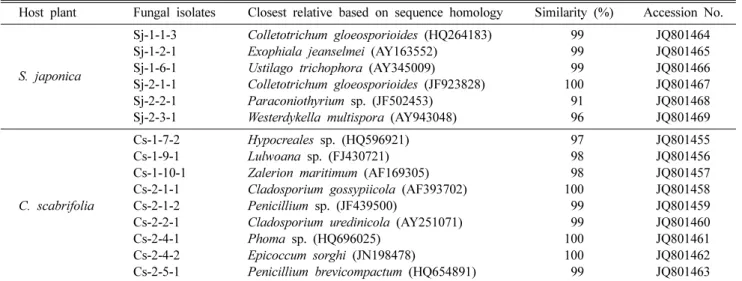
칠면초 뿌리로부터 5속의 내생진균들이 확인되었으며, 자낭균문(Ascomycota)에 속하는 Colletotrichum(2 균주), Exophiala(1), Paraconiothyrium(1), Westerdykella(1)과 담자균문(Basidiomycota)에 속하는 Ustilago(1)이었다. 그리 고 천일사초의 뿌리로부터 7속이 확인되었으며, 자낭균문 (Ascomycota)에 속하는 Cladosporium(2 균주), Epicoccum (1), Hypocreales(1), Lulwoana(1), Penicillium(2), Phoma (1), Zalerion(1)이었다. 동정된 내생진균들의 서열은 GenBank에 등록하여 accession No.를 제공받았다(Table 1).
계통분석은 NCBI의 blastn 방법을 이용하여 다른 균주 들과 비교하였다. 그리고 NJ 방법은 계통수 분석에서 많 이 이용되고 있으며, 1000 bootstrap replicates 조건으로 분석하여 내생진균에 대한 계통수를 작성하였다(Fig. 1).
본 연구 결과로 얻어진 칠면초의 내생진균에 대한 계통 수는 자낭균문과 담자균문인 2 가지 문(phylum)으로 분 류 할 수 있었으며(Table 2), 자낭균문은 Pezizomycotina 아문과, 담자균문은 Ustilaginomycotina 아문으로 분류되 는 것이 확인되었다. 그리고 자낭균문 Pezizomycotina 아문 에 속하며 Sordariomycetes 강에 속하는 Colletotrichum(2
Table 1. The identification of endophytic fungi isolated in this study
Host plant Fungal isolates Closest relative based on sequence homology Similarity (%) Accession No.
S. japonica
Sj-1-1-3 Colletotrichum gloeosporioides (HQ264183) 099 JQ801464
Sj-1-2-1 Exophiala jeanselmei (AY163552) 099 JQ801465
Sj-1-6-1 Ustilago trichophora (AY345009) 099 JQ801466
Sj-2-1-1 Colletotrichum gloeosporioides (JF923828) 100 JQ801467
Sj-2-2-1 Paraconiothyrium sp. (JF502453) 091 JQ801468
Sj-2-3-1 Westerdykella multispora (AY943048) 096 JQ801469
C. scabrifolia
Cs-1-7-2 Hypocreales sp. (HQ596921) 097 JQ801455
Cs-1-9-1 Lulwoana sp. (FJ430721) 098 JQ801456
Cs-1-10-1 Zalerion maritimum (AF169305) 098 JQ801457
Cs-2-1-1 Cladosporium gossypiicola (AF393702) 100 JQ801458
Cs-2-1-2 Penicillium sp. (JF439500) 099 JQ801459
Cs-2-2-1 Cladosporium uredinicola (AY251071) 099 JQ801460
Cs-2-4-1 Phoma sp. (HQ696025) 100 JQ801461
Cs-2-4-2 Epicoccum sorghi (JN198478) 100 JQ801462
Cs-2-5-1 Penicillium brevicompactum (HQ654891) 099 JQ801463
The endophytic fungi were identified by using universal primer ITS1 and ITS4 in PCR reaction and analyzing to compare the ITS regions with the BLAST program of NCBI. As a result of ITS-region analysis, total 15 fungal strains were identification. Among these, 6 speices were iso- lated from the roots of S. japonica and 9 species were isolated from C. scabrifolia.
순천만에 자생하는 염생식물의 뿌리로부터 분리된 내생진균의 유전적 다양성 9
균주)와 Dothideomycetes 강에 속하는 Paraconiothyrium (1), Westerdykella(1), 그리고 Eurotiomycetes 강에 속하는 Exophiala(1)가 확인되었고, 담자균문은 Ustilaginomycotina 아문에 속하며 Ustilaginomycetes 강에 속하는 Ustilago (1)가 확인되었다.
천일사초의 내생진균에 대한 계통수는 자낭균문인 1가 지 문(phylum)으로 분류 할 수 있었으며, Pezizomycotina 아문으로 분류되는 것이 확인되었다. 그리고 자낭균문
Pezizomycotina 아문에 속하며 Sordariomycetes 강에 속 하는 Hypocreales(1 균주), Lulwoana(1), Zalerion(1)과 Dothideomycetes 강에 속하는 Cladosporium(2), Phoma (1), Epicoccum(1), 그리고 Eurotiomycetes 강에 속하는 Penicillium(2)이 확인되었다. 그리고 칠면초와 천일사초 로부터 분리된 내생진균들의 종 다양성은 각각 1.561과 1.889로 확인되었다.
결론적으로, 본 연구에서는 순천만 자생식물인 칠면초와 천일사초의 내생진균에서 자낭균문 Pezizomycotina 아문이 많이 분포하고 있음을 알 수 있었으며, Pezizomycotina 아문 중에서도 Sordariomycetes 강, Dothideomycetes 강, Eurotiomycetes 강에 속하는 내생진균이 칠면초와 천일사 초에 모두 분포하는 것이 확인되었다.
적 요
순천만에 자생하는 2종의 염생식물의 뿌리로부터 내생 진균을 분리하였다. 사용 되어진 염생식물은 칠면초와 천 일사초이며, 스트렙토마이신이 포함된 최소배지를 사용하 여 내생진균을 배양한 후 순수 분리하였다. 분리된 15 내 생진균 균주 rDNA의 ITS 영역의 염기서열을 분석한 결 과 칠면초에서 5속, 천일사초에서 7속의 내생진균이 확인 되었다. 그리고 Shannon’s diversity index(H')를 이용하여 칠면초와 천일사초로부터 분리된 내생진균들의 종 다양성 은 각각 1.561과 1.889로 확인되었으며 유연관계를 확인하 기 위하여 계통분석을 수행하였다. 순천만 자생식물인 칠면 초와 천일사초의 내생진균에서 자낭균문 Pezizomycotina 아 문이 많이 분포하고 있음을 알 수 있었으며, Pezizomycotina 아문 중에서도 Sordariomycetes 강, Dothideomycetes 강,
Table 2. Overview of endophytic fungi isolated from S. japonica and C. scabrifolia
Fungal strain Suncheon Bay
S. japonica C. scabrifolia Taxona
Cladosporium sp. 2 Ascomycota
Colletotrichum sp. 2 Ascomycota
Epicoccum sp. 1 Ascomycota
Exophiala sp. 1 Ascomycota
Hypocreales sp. 1 Ascomycota
Lulwoana sp. 1 Ascomycota
Paraconiothyrium sp. 1 Ascomycota
Penicillium sp. 2 Ascomycota
Phoma sp. 1 Ascomycota
Ustilago sp. 1 Basidiomycota
Westerdykella sp. 1 Ascomycota
Zalerion sp. 1 Ascomycota
Shannon’s diversity index (H')b 1.561 1.889
Fifteen kinds of Endophytic fungi was isolated from roots of both halophytes in Suncheonbay. The table showed that Ascomycota and Basid- iomycota were distributed S. japonica, while Ascomycota were only distributed C. scabrifolia. Especially, Ascomycota was more widely dis- tributed than Basidiomycota in S. japonica.
aPhylogenetic classification was arranged with phylum.
bThe Shannon’s diversity index (H') is representative of species diversity.
Fig. 1. Phylogenetic tree of endophytic fungi using rDNA-ITS sequences. The neighbour joining tree (1000 bootstrap replications) was constructed using 6 or 9 taxa. (A) five fungal genera were isolated from S. japonica, (B) seven fungal genera were isolated from C. scabrifolia.
Phylogenetic analysis showed that endophytic fungal strains were belong to the phylum Ascomycota and Basidiomycota.
10 서영교 등 Eurotiomycetes 강에 속하는 내생진균이 칠면초와 천일사 초에 모두 분포는 것을 확인하였다.
감사의 글
본 연구는 환경부 “차세대 에코이노베이션기술개발사업”
으로 지원 받은 연구이며, 연구비 지원에 감사를 드립니다.
참고문헌
Arnold, E. A., Mejia, L. C., Kyllo, D., Rojas, E., Maynard, Z., Robbins, N. and Herre, E. A. 2003. Fungal endophytes limit pathogen damage in a tropical tree. PNAS, USA 100: 15649- 15654.
Chapman, V. J. 1974. Salt Marshes and Salt Deserts of the World.
In Ecology of Halophytes. Academic Press, New York. pp. 3- 22.
Ihm, B. S., Leem, J. S., Kim, J. W., Kim, H. S. and Ihm, H. B.
1998. Studies on the vegetation at the wetland of Suncheon- man. Bull. Inst. Litt. Envi. Mokpo Nat. Univ. 15:1-8 (in Korean).
Khan, S. A., Hamayun, M., Kim, H. Y., Yoon, H. J., Lee, I. J.
and Kim, J. G. 2009a. Gibberellin production and plant growth promotion by a newly isolated strain of Gliomastix murorum.
World J. Microbiol. Biotechnol. 25:829-833.
Khan, S. A., Hamayun, M., Kim, H. Y., Yoon, H. J., Seo, J. C., Choo, Y. S., Lee, I. J., Kim, S. D., Rhee, I. K. and Kim, J. G.
2009b. A new strain of Arthrinium phaeospermum isolated from Carex kobomugi Ohwi is capable of gibberellin produc- tion. Biotechnol. Lett. 31:283-287.
Khan, S. A., Hamayun, M., Kim, H. Y., Yoon, H. J., Seo, J. C., Choo, Y. S., Kil, Y. J., Eo, J. K. and Eom, A. H. 2009c.
Molecular identification and diveristy of endophytic fungi iso- lated from Pinus densiflora in Boeun, Korea. Kor. J. Mycol.
37:130-133.
Khan, S. A., Hamayun, M., Rim, S. O., Lee, I. J., Seu, J. C., Choo, Y. S., Jin., I. N., Kim, S. D., Lee, I. K. and Kim, J. G.
2008. Isolation of endophytic fungi capable of plant growth promotion from monocots inhibited in the coastal sand dunes of Korea. Kor. J. Life Sci. 18:1355-1359.
Park, S. J., Song, I. G., Park, S. J. and Lim, D. O. 2010. The Flora and Vegetation of Dokdo Island in Ulleung-gun, Gyeong- sanbuk-do. Korean J. Env. Eco. 24:264-278.
Pielou, E. C. 1975. Ecological diversity. John Wiley, New York.
p. 165.
Redman, R. S., Sheehan, K. B., Stout, R. G., Rodriguez, R. J. and Henson, J. M. 2002. Thermotolerance conferred to plant host and fungal endophyte during mutualistic symbiosis. Science 298:1581.
Rodriguez, R. J., Henson, J., Van Volkenburgh, E., Hoy, M., Wright, L., Beckwith, F., Kim, Y. and Redman, R. S. 2008.
Stress tolerance in plants via habitat-adapted symbiosis. ISME J. 2:404-416.
Rodriguez, R. J., Redman, R. S. and Henson, J. M. 2004. The role of fungal symbioses in the adaptation of plants to high stress environments. Mitigation and Adaptation Strategies for Global Change. 9:261-272.
Saikkonen, K., Faeth, S. H., Helander, M. and Sullivan, T. J.
1998. Fungal endophytes: a continuum of interations with host plants. Annu. Rev. Ecol. Syst. 29:319-343.
Seo, S. T., Kim, K. H., Kim, M. J., Hong, J. S., Park, J. H. and Shin, S. C. 2009. Diversity of fungal endophytes from Pinus koraiensis leaves in Korea. Kor. J. Mycol. 37:108-110.
Vazquez, M. M., Cesar, S., Azcon, R. and Barea, J. M. 2000.
Interaction between arbuscular mycorrhizal fungi and other microbial inoculants (Azospirillum, Pseudomonas, Tricho- derma) and their effects on microbial population and enzyme activities in the rhizosphere of maize plants. Appl. Soil Ecol.
15:261-272.
Waller, F., Achatz, B., Baltruscha, T. H., Fodor, J., Becker, K., Fischer, M., Heier, T., Hckelhoven, R., Neumann, C., Wet- tstein, D. V., Franken, P. and Kogel, K.-H. 2005. The endo- phytic fungus Piriformospora indica reprograms barley to salt- stress tolerance, disease resistance, and higher yield. PNAS, USA 102: 13386-13391.
Yamada, A., Takeo, O., Yosuke, D. and Masatake, O. 2001. Isola- tion of Tricholoma matsutake and T. bakamatsutake cultures from field-collected ectomycorrhizas. Mycoscience. 42:43-50.
Yoshikuni, H., Kako, O. and Hidenobu, K. 2009. Genetic analy- sis of salt-marsh sedge Carex scabrifolia Steud. populations using newly developed microsatellite markers. Conserv. Genet.
10:1361-1364.
You, Y. H., Yoon, H. J., Lee, G. S., Woo, J. R., Shin, J. H., Lee, I. J., Rim, S. O., Choo, Y. S. and Kim, J. G. 2011. Diversity and plant growth-promotion of endophytic fungi isolated from the roots of plants in Dokdo islands. Korean J. Life Sci. 21:
992-996.