• 검색 결과가 없습니다.

The Effects of Trunk Stabilization Training Emphasizing Transverse Abdominis Contraction on Static Balance and Game Records for Archers

N/A
N/A
Protected

Academic year: 2021

Share "The Effects of Trunk Stabilization Training Emphasizing Transverse Abdominis Contraction on Static Balance and Game Records for Archers"

Copied!
9
0
0

로드 중.... (전체 텍스트 보기)

전체 글

(1)

| Abstract |

Purpose: The purpose of this study was to investigate the effects of trunk stability training on static balance and game records among archers.

Methods: The subjects comprised 24 voluntary archers in middle and high school (aged 14–19 years). All the subjects received trunk stability training for an hour per day 3 days a week for 4 weeks. The Tetrax balance system was used to measure the stability index of the subjects’ static balance. The subjects’ game records were scored using a single FITA round system. All the subjects were measured before the intervention, 2 weeks into the intervention, and 4 weeks after the intervention, with a follow-up measurement 2 weeks later.

Results: The results of this study showed that the stability index was significantly different across all the measuring positions after the intervention (p<0.05). Furthermore, the results of the measurements of the standing position with eyes open and closed were significantly different before the intervention compared to 4 weeks after the intervention (p<0.05). The archery position with the head turned to the left and eyes closed was also significantly different pre-intervention compared to 2 weeks after the start of the intervention (p<0.05). Additionally, the archery records were significantly different after the intervention (p<0.05), as well as before the intervention and 4 weeks after the intervention (p<0.05).

Conclusion: Trunk stability training can improve static balance in archers. It may also be helpful in improving athletic performance and maintaining the life of the athlete. Accordingly, trunk stability training may prevent and resolve injuries through

†Corresponding Author : Yeon-Woo Jeong ([email protected]) PNF and Movement, 2019; 17(2): 283-291

https://doi.org/10.21598/JKPNFA.2019.17.2.283

Print ISSN: 2508-6227 Online ISSN: 2508-6472

Original Article Open Access

배가로근 수축을 강조한 체간 안정화 훈련이 양궁선수들의 정적 균형 및 경기기록에 미치는 영향

이소영⋅서태화

1

⋅정연우

1†1)

본한방병원 물리치료실,

1

광주여자대학교 물리치료학과

The Effects of Trunk Stabilization Training Emphasizing Transverse Abdominis Contraction on Static Balance and Game Records for Archers

So-Young Lee⋅Tae-Hwa Seo

1

⋅Yeon-Woo Jeong

1†

Department of Physical Therapy, Bon Oriental Hospital

1
Department of Physical Therapy, Kwangju Women’s University

Received: May 15, 2019 / Revised: May 31, 2019 / Accepted: June 4, 2019

ⓒ 2019 Journal of Korea Proprioceptive Neuromuscular Facilitation Association

This is an Open Access article distributed under the terms of the Creative Commons Attribution Non-Commercial License

(http://creativecommons.org/licenses/by-nc/3.0) which permits unrestricted non-commercial use, distribution, and reproduction

in any medium, provided the original work is properly cited.

(2)

ԺՀԼ ք ՘ՖՎԨթնլԨՕշվխյխնռԨ՞շմԶԨԹԿԴԨՖշԶԨԺ

careful management when playing one-side sports.

Key Words: Trunk stabilization training, Archers, Static balance, Performance

Ⅰ. 서 론

양궁은 신체의 흔들림 없이 정확한 자세를 유지한 상태에서 화살을 자신이 원하는 목표에 맞추는 경기 로서 , 안정된 상태에서 정확하고 일정한 슈팅 동작이 요 구된다(Kim, 2000). 반복적인 움직임이 나타나는 양궁 의 슈팅 동작은 일관성과 안정성이 매우 중요한 요소 이며 , 화살의 정확성을 높이기 위해서는 적절한 힘의 배분과 안정된 호흡 , 자세의 균형, 집중력 등의 요소들 이 갖추어져야 한다(Kim & Kim, 2005; McGuine, 2006).

모든 스포츠에 있어서 신체 활동의 기본은 안정성 이라고 할 수 있으며, 편측성 운동 종목인 양궁, 사격 등에서의 안정성이 경기력에 많은 영향을 미친다 (Hah &

Yi, 2008; Han, 2012; Kim, 2007; Kim, 2010, An, 2017).

장시간의 편측성 움직임이나 잘못된 훈련 자세는 신 체 좌, 우 근육의 불균형을 가져오며 체형의 변화를 일으킨다(Kim, 2008). 이러한 체형의 변화는 신체 주변 근육의 특성을 변형시키고(Ford et al., 1984), 신체의 분절 간 상호작용의 변화가 서 있는 자세에서의 불안 정성을 일으켜 균형능력이 감소하게 된다(Nault et al., 2002). 불균형된 근육은 골격의 형태적 변형과 통증을 일으키고, 관절의 움직임을 제한하여 경기력을 저하 하며 더 악화하면 스포츠 상해로 진행되어 경기를 수 행하지 못하는 상황이 발생할 수 있는데(Park, 2010), 가장 큰 심각성은 선수들에게 있어서 운동 수명 단축 에 절대적인 영향을 미치게 된다는 데 있다 (Lee, 2009).

최근 균형과 움직임 조절에 관한 연구 중 체간 중심 안정화에 관련된 연구들이 관심을 받고 있다(Nam et al., 2015). 체간 근육의 활동은 중력에 대해 자세 조절 과 일상생활 활동을 위한 사지의 움직임을 준비하여 (Verheyden et al., 2006), 신체의 조화롭고 기능적인 움직임을 만들어 낸다(Tyson et al., 2006). 이는 곧 스포

츠 특정 기술을 수행하는 동안 필요한 신체적 반응이 며 , 만약 체간 근육의 약화 및 불균형이 발생하면 각각 의 근력 발휘에 지장을 초래하게 되고, 경기력 저하의 원인이 될 수 있으므로 근 기능이 원활하게 이루어지 기 위해서는 체간 안정화가 이루어져야 한다 (Harvey &

Tanner, 1991).

지금까지 양궁에 관련된 연구의 방향은 주로 어깨 에 초점이 맞춰진 어깨뼈 안정화 운동을 집중하여 수 행하거나(Kang, 2014; Kim, 2018), 심리적인 면을 중요 시하는 심리학적인 연구(Kim, 2013; Heo, 2018), 슈팅 동작의 정확성을 위한 슈팅 기술에 관하여 집중적으 로 연구됐다 (Kim, 2005; Kim, 2007; Kim, 2012). 하지만 훈련 방법의 과학화 , 첨단 장비의 개발에 비해 스포츠 손상의 발생 빈도는 감소하지 않고 있으며(Marshall &

Golightly, 2007), 손상 예방을 위한 신체 균형을 유지하 는 노력 또한 부족한 실정이다(Yun & Kim, 2012).

따라서 본 연구의 목적은 체간 안정화 훈련 프로그 램을 양궁선수들에게 적용하였을 때 정적 균형 및 경 기기록에 어떠한 영향을 미치는지를 알아보아 양궁 선수의 부상 방지와 경기력 향상을 위한 훈련 및 지도 에 도움이 될 수 있는 기초자료를 제공하고자 한다.

Ⅱ. 연구 방법

1. 연구 대상

본 연구는 광주광역시 K 체육 중, 고등학교에 재학

중인 양궁부 24명을 대상으로 8주간에 걸쳐 측정 및

실험을 하였다 . 본 연구에 참여한 대상자들에게 연구

자가 직접 실험의 목적, 내용 및 진행 과정에 대해

충분히 설명한 후 연구에 자발적으로 동의한 자에 한

(3)

᤮ࣾᕚૺԨ἖⪓⑂Ԩओ╮㉚Ԩ⦲ंԨ≆┓㍒Ԩ㏆ᔦ⑲Ԩ⊏੿Ḟ἖ᇢ⑖Ԩ┓⓿Ԩ૞㌓ԨᤍԨ঻ମମᕛ⋎Ԩ᣶⭖ྒԨ⋿㊣ ք ԺՀԽ

하여 선정하였고 , 본 연구에 영향을 줄 수 있는 제외기 준은 다음과 같다.

1) 근, 골격계 수술적 경험이 있는 자 2) 계통적 질환이 있는 자

3) 류머티즘 질환이 있는 자 4) 신경계, 정신적 이상이 있는 자

5) 통증 경감을 위한 치료나 주기적으로 약물을 복 용하고 있는 자

2. 측정 방법 및 도구

측정은 대상자들의 중재 시기에 따른 변화를 알아 보고자 중재 전 , 중재 2주 후, 중재 4주 후, 중재 종료 2주 후 총 4회 측정하였다.

1) 정적 균형

양궁선수들의 정적 균형을 측정하기 위하여 Tetrax Balance System (Tetrax, Sunlight Medical, Israel)을 이용 하였다 . Tetrax®는 4개의 분리된 힘 판으로 구성되어 있으며, 힘 판은 발앞부와 발뒤부 각각의 수직 압력 변화를 측정한다(Kohen-Raz, 1991).

대상자는 분리된 힘 판 위에 맨발로 위치하고 , 집중 이 가능한 조용한 주위 환경에서 편안한 자세로 측정 하였다. 측정은 눈 뜨고 바로 선 자세, 눈 감고 바로 선 자세, 불안정한 지지 면에서 눈 뜨고 선 자세, 활 들고 왼쪽으로 머리를 돌리고 선 자세에서 이루어졌 으며, 주어지는 압력에 대한 정보는 Tetrax® 소프트웨 어 프로그램으로 분석한 안정성 지수 (stability index)를 자료로 사용하였다.

2) 경기기록

경기기록은 Single FITA Round System을 이용하여 선 수들의 연습 경기기록을 사용하였다 (An, 2010)(Table 1).

3. 실험 절차 및 방법

본 연구는 대상자 24명을 체계적으로 중재하기 위 하여 연구자가 학교를 직접 방문하여 주 3회, 4주간 총 12회에 걸쳐 진행되었다.

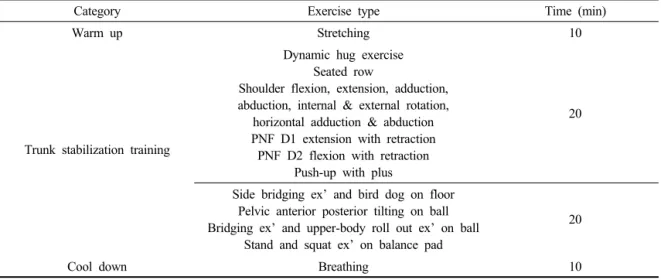
배가로근을 강조한 체간 안정화 훈련 단계는 Kim (1998)의 4가지 단계별 안정화 훈련 방법 중에서 1단 계(신경근 조절)와 2단계(본격적인 훈련)에 중점을 두었고, 훈련 부하의 원칙에 따라 단순한 운동에서 복잡한 운동으로, 느린 운동에서 빠른 운동으로, 안 정적인 상태에서 불안정한 상태로 진행되도록 하였 다 (Kim et al., 2001). 훈련 시간은 Kim 등(2008)의 연구 와 같이 동작당 10회를 1세트로, 총 3세트씩 실시하였 고, 한 동작 당 유지 시간 10초, 동작 간 휴식 시간 15초, 세트 간 휴식 시간 30초로 하였으며, 훈련은 총 40분간 진행하였다(Table 2). 본 운동에서 상지를 이용한 체간 안정화 운동 시 Page와 Ellenbecker (2004)의 운동방법에 근거하여 탄력밴드(Hygenic Corporation, USA)를 이용하였고, 하지를 이용한 체간 안정화 운동 시 Marshall과 Murphy (2005), McGill과 Karpowicz (2009), O’Sullivan (2000)의 훈련 방법에 근거하여 짐볼 , 매트와 발란스 패드를 혼용하여 단계 적으로 적용하였다.

Category Game method

Private exhibition

Middle school Male, Female 60, 50, 40, 30(m)

High school Male 90, 70, 50, 30(m)

Female 70, 60, 50, 30(m)

36 shots per street (Total 144 shots)

Table 1. Single FITA Round system

(4)

ԺՀԾ ք ՘ՖՎԨթնլԨՕշվխյխնռԨ՞շմԶԨԹԿԴԨՖշԶԨԺ

4. 자료 분석

본 연구의 통계학적 분석은 수집된 대상자의 자료 들을 SPSS version 18.0을 이용하여 통계처리 하였다.

대상자들의 일반적인 특성은 기술통계를 이용하였 고, 각 검사에 대한 신뢰도 검정을 위하여 Cronbach’s α 값을 얻었다. 정적 균형 검사, 경기기록의 자료들은 Kolmogorov-Smirnov 검정에서 모든 변수가 정규성 가 정을 만족하여 각 측정 시기에 따른 효과검정은 모수 분석 방법인 반복측정 분산분석(repeated ANOVA analysis)을 이용하였고, 각 중재 시기별 차이를 검정하 기 위해 LSD (least square difference) 대비검정을 하였 다 . 모든 통계 분석에서 유의성을 검정하기 위한 유의 수준 α는 0.05로 하였다.

Ⅲ. 연구 결과

1. 연구 대상자의 일반적인 특성

본 연구에 참여한 대상들은 총 24명으로 남자 11명, 여자 13명이고, 그중 중학생 11명, 고등학생 13명이었 다. 평균 연령은 16세이고, 선수 경력은 60개월이며, 신장 165.4cm, 체중 60.6kg이었다(Table 3).

2. 중재 시기에 따른 정적 균형능력의 변화

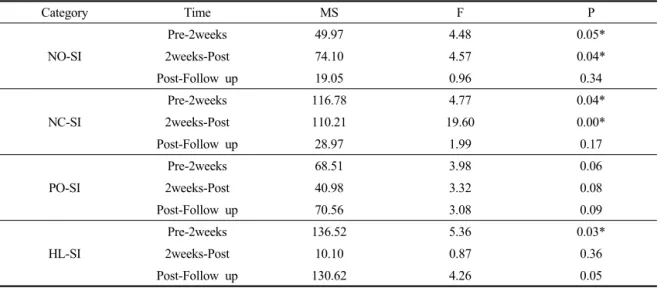
눈 뜨고 바로 선 자세에서 중재 시기에 따라 통계적 으로 유의한 차이가 있었다(p<0.05). 시기별 차이를 검정한 결과 중재 전부터 중재 4주 후까지 통계적으로 유의한 차이가 있었고 (p<0.05), 중재 4주 후부터 중재 종료 2주 후에는 통계적으로 유의한 차이가 없었다 (p>0.05).

눈 감고 바로 선 자세에서 중재 시기에 따라 통계적 으로 유의한 차이가 있었다(p<0.05). 시기별 차이를 검정한 결과 중재 전부터 중재 4주 후까지 통계적으로 유의한 차이가 있었고 (p<0.05), 중재 4주 후부터 중재 종료 2주 후까지는 통계적으로 유의한 차이가 없었다 (p>0.05).

Category Exercise type Time (min)

Warm up Stretching 10

Trunk stabilization training

Dynamic hug exercise Seated row

Shoulder flexion, extension, adduction, abduction, internal & external rotation,

horizontal adduction & abduction PNF D1 extension with retraction PNF D2 flexion with retraction

Push-up with plus

20

Side bridging ex’ and bird dog on floor Pelvic anterior posterior tilting on ball Bridging ex’ and upper-body roll out ex’ on ball

Stand and squat ex’ on balance pad

20

Cool down Breathing 10

Table 2. Trunk stabilization training program

Age (Year)

Career (Month)

Height (cm)

Weight (kg)

Gender (Male/Female)

Grade (Middle/High)

16.08±2.04 59.88±33.64 165.43±6.98 60.59±10.33 11/13 11/13

Table 3. General characteristics of subjects (n=24)(Mean±SD)

(5)

᤮ࣾᕚૺԨ἖⪓⑂Ԩओ╮㉚Ԩ⦲ंԨ≆┓㍒Ԩ㏆ᔦ⑲Ԩ⊏੿Ḟ἖ᇢ⑖Ԩ┓⓿Ԩ૞㌓ԨᤍԨ঻ମମᕛ⋎Ԩ᣶⭖ྒԨ⋿㊣ ք ԺՀԿ

불안정한 지지 면에서 눈 뜨고 선 자세에서 중재 시기에 따라 통계적으로 유의한 차이가 있었다 (p<0.05). 시기별 차이를 검정한 결과 중재 전부터 중재 종료 2주 후까지 통계적으로 유의한 차이가 없었다 (p>0.05).

활 들고 좌측으로 머리를 돌리고 선 자세에서 중재 시기에 따라 통계적으로 유의한 차이가 있었다 (p<0.05). 시기별 차이를 검정한 결과 중재 전부터 중재 2주 후까지 통계적으로 유의한 차이가 있었으나 (p<0.05), 중재 2주 후부터 중재 종료 2주 후까지는

통계적으로 유의한 차이가 없었다(p>0.05)(Table 4, 5).

3. 중재 시기에 따른 양궁 기록의 변화

중재 시기에 따라 통계적으로 유의한 차이가 있었 다(p<0.05)(Table 6). 시기별 차이를 검정한 결과 중재 전부터 중재 4주 후까지 통계적으로 유의한 차이가 있었으나 (p<0.05), 중재 4주 후부터 중재 종료 2주 후까 지는 통계적으로 유의한 차이가 없었다 (p>0.05)(Table 7).

Category Mean±SD

F P

Pre 2weeks Post Follow up

NO-SI 18.33±6.07 16.88±4.92 15.13±3.74 16.02±5.52 3.25 0.04*

NC-SI 19.83±5.59 17.63±3.80 15.48±3.77 16.58±4.37 7.85 0.00*

PO-SI 19.65±3.82 17.96±4.05 16.66±3.33 18.37±5.24 3.88 0.01*

HL-SI 22.89±6.00 20.50±4.60 19.85±4.75 22.19±6.72 3.83 0.01*

NO-SI (normal position with eyes open-stability index) NC-SI (normal position with eyes closed-stability index)

PO-SI (neutral head position with eyes opened and standing on pillows-stability index) HL-SI (position with head turned to the left and eyes closed with archery-stability index)

*p<0.05

Table 4. Test of effects on stability index within-subjects

Category Time MS F P

NO-SI

Pre-2weeks 49.97 4.48 0.05*

2weeks-Post 74.10 4.57 0.04*

Post-Follow up 19.05 0.96 0.34

NC-SI

Pre-2weeks 116.78 4.77 0.04*

2weeks-Post 110.21 19.60 0.00*

Post-Follow up 28.97 1.99 0.17

PO-SI

Pre-2weeks 68.51 3.98 0.06

2weeks-Post 40.98 3.32 0.08

Post-Follow up 70.56 3.08 0.09

HL-SI

Pre-2weeks 136.52 5.36 0.03*

2weeks-Post 10.10 0.87 0.36

Post-Follow up 130.62 4.26 0.05

*p<0.05

Table 5. Test of contrasts on stability index within-subjects

(6)

ԺՀՀ ք ՘ՖՎԨթնլԨՕշվխյխնռԨ՞շմԶԨԹԿԴԨՖշԶԨԺ

Ⅳ. 고 찰

반복적인 편측 운동을 해야 하는 양궁 종목의 특성 상 신체의 불균형은 균형능력의 저하를 가져와 경기력 에 영향을 미치게 되고 , 이는 스포츠 손상 발생 가능성 또한 증가시킨다 (Dalleau et al., 2012; Kim et al., 2011).

근골격계 불균형이 유발될 수 있는 스포츠 종목의 선수들은 체간 안정화를 위한 훈련 및 지도가 필요하 다고 여러 연구에서 보고되고 있다(Akuthota & Nadler, 2004; Christopher et al., 2004; Renkawitz et al., 2007).

체간 안정화를 구성하는 근육들은 척추와 신체를 안 정화하는 코르셋처럼 작용하여 신체 정렬을 유지하 고, 협응 수축을 통해 기능적인 자세와 움직임 조절 능력을 향상해 더욱 효과적인 움직임을 유도하기에 (Akuthota & Nadler, 2004; Hodges & Richardson, 1997), 신체의 기능적 안정성을 위해서는 반드시 체간 안정 화 훈련이 시행되어야 한다(McGill et al., 2003).

Kim 등(1993)은 슈팅 동작 시 활이 상하로 움직이는 것은 신체 중심의 변화와 관련이 있으며 , 이를 방지하 기 위해서는 신체의 전후 움직임을 감소시키기 위한 훈련이 필요하다고 하였다. Carpes 등(2008)의 연구에 서는 체간 안정화 훈련 후 눈 뜨고 감은 상태의 한발 서기 동안 동요 거리가 감소했으며 통계학적으로 유 의한 차이를 보였다 . 본 연구에서도 중재 후 모든 측정 자세의 안정성 지수에서 통계학적으로 유의한 차이를

보여 전체적으로 정적 균형능력이 향상되면서 안정성 이 증가하였음을 확인할 수 있었다. 이러한 결과는 체간 안정화 훈련을 통해 신체 중심의 안정성이 확보 되어 체중 부하 자세 시 양측 다리에 체중을 균등하게 분산시키기에 균형능력이 향상되었다고 생각되며 , 양 궁 슈팅 동작 시 양발의 균형성은 고득점을 획득하는 데 밀접한 관련이 있다고 보고한 연구와 같이(An, 2018), 활 들고 선 자세에서의 안정성이 화살의 정확도 를 높여 경기기록에도 긍정적인 영향을 미친 것으로 판단된다. 앞으로의 연구에서도 양궁 훈련 시 정적 균형능력 향상을 위하여 체간 안정화 훈련을 병행한 다면 효과를 극대화할 수 있을 것으로 생각된다.

An (2018)은 신체의 동요 없이 지속적인 균형성이 유지될 때 양궁 경기에서 높은 기록의 수립이 가능하 다고 하였으며, 특히 짧은 슈팅 순간에 활을 지지하는 왼발의 좌우 균형능력이 중요한 요인이라고 하였다.

Kim 등(2015)의 연구에서 균형성을 평가하는 척도인 압력 중심의 범위가 그룹 간 통계적으로 유의한 차이 를 보이진 않았으나, 우수한 선수일수록 작게 나타나 는 경향을 보인다고 보고하였다. 본 연구에서는 중재 후 경기기록에서 통계학적으로 유의한 차이가 있어, 양궁선수들의 경기기록 향상에 영향을 미치는 것을 알 수 있었다 . 그리고 시기별 차이에서 중재 전부터 중재 4주 후까지 유의한 차이를 보였고 이후에도 기록 이 유지되었음을 확인할 수 있었다 . 이는 앞서 논의된

Category Mean±SD

F p

Pre 2weeks Post Follow up

Record 1265.63±65.64 1279.42±59.07 1287.63±60.19 1287.58±55.19 13.38 0.00*

*p<0.05

Table 6. Test of effects on archery record within-subjects

Category Time MS F p

Record

Pre-2weeks 4565.04 10.30 0.00*

2weeks-Post 1617.04 7.78 0.01*

Post-Follow up 0.04 0.00 0.99

*p<0.05

Table 7. Test of contrasts on archery record within-subjects

(7)

᤮ࣾᕚૺԨ἖⪓⑂Ԩओ╮㉚Ԩ⦲ंԨ≆┓㍒Ԩ㏆ᔦ⑲Ԩ⊏੿Ḟ἖ᇢ⑖Ԩ┓⓿Ԩ૞㌓ԨᤍԨ঻ମମᕛ⋎Ԩ᣶⭖ྒԨ⋿㊣ ք ԺՀՁ

것처럼 체간 안정화 훈련이 정적 균형능력을 향상시 키고 활 들고 선 자세에서도 안정성이 확보되어 화살 의 정확도를 높이는 데 도움을 주고 경기기록에도 긍 정적인 영향을 줄 것으로 생각되어 체간 안정화 훈련 을 통해 긍정적인 효과를 기대할 수 있을 것으로 판단 된다.

지금까지 체간 안정화 훈련의 선행연구에서는 환 자의 통증 및 일상생활을 위한 치료를 목적으로 하거 나 운동선수들의 스포츠 손상 후 재활 목적으로 적용 되었고, 일부 스포츠 종목에서 한정적으로 보강 운동 을 위해 사용됐다 . 이 연구를 통해 과도한 편측 운동으 로 인해 발생할 수 있는 스포츠 손상을 해결하고 방지 하는 데 도움이 될 것으로 생각된다 . 하지만 본 연구가 양궁이라는 종목에 국한되어 있고, 심리적인 부분을 다루지 않았을 뿐만 아니라 비교 대상이 존재하지 않 아 일반화하기에는 부족함이 있기에 향후 연구에는 이를 보완할 수 있는 평가와 그룹 간의 비교 연구가 이루어진다면 더욱더 좋은 연구가 될 것으로 생각된다 .

Ⅴ. 결 론

본 연구는 양궁선수들을 대상으로 체간 안정화 훈 련이 정적 균형 및 경기기록에 미치는 영향을 알아보 고자 하였다. 그 결과 정적 균형능력을 볼 수 있는 안정성 지수가 감소하여 균형능력 향상을 확인할 수 있었고 정적 균형 및 체간 안정화가 경기기록 향상으 로 연결됨을 알 수 있었다. 중재 시기의 흐름에 따른 변화에서는 전반적으로 중재 2주 후에서 4주까지 분 명한 효과와 향상을 보였고 , 중재 종료 2주 후에 지속 해서 효과가 유지되고 있음을 확인할 수 있었다. 이를 통해 과도한 편측 사용으로 인해 훈련 및 경기 중에 발생할 수 있는 스포츠 손상을 예방하고 해결하여 경 기력 상승과 지속적인 선수 생활이 가능한 훈련 방법 으로 지도하는 데 도움이 될 것으로 생각된다.

References

Akuthota V, Nadle SF. Core strengthening. Archives of Physical Medicine and Rehabilitation. 2004;85(3 Suppl1):

S86-92.

An HS. Effects of balance and kinematic factors on archery score during archery shooting. Journal of the Korea Convergence Society. 2018;9(5):239-246.

An HS. Influence of kinematic factors for the upper limbs affect record during extending in archery. Korea National Sport University. Dissertation of Master’s Degree. 2010.

An JS. The effects of the balance exercise using aero equipment on game performance and balance ability in middle school shooters. Chosun University. Dissertation of Master’s Degree. 2017.

Carpes FP, Reinehr FB, Mota CB, et al. Effects of a program for trunk strength and stability on pain, low back and pelvis kinematics, and body balance: a pilot study.

Journal of Bodywork and Movement Therapies.

2008;12(1):22-30.

Christopher J, Standaert CJ, Stanley A, et al. Rehabilitation of the athlete with low back pain. Current Sports Medicine Reports. 2004;3(1):35-40.

Dalleau G, Leroyer P, Beaulieu M, et al. Pelvis morphology, trunk posture and standing imbalance and their relations to the Cobb angle in moderate and severe untreated AIS. Plos One. 2012;7(7):e36755.

Ford DM, Bagnall KM, McFadden KD, et al. Paraspinal muscle imbalance in adolescent idiopathic scoliosis. Spine.

1984;9(4):373-376.

Hah CK, Yi JH. Evaluation on kinematic factors affecting scores of Olympic round game during the follow through in archery. Korean Journal of Sport Biomechanics. 2008;18(1):227-234.

Han MW. The effects of PST on psychological variables and

performance of a female archer showing learned

(8)

ԺՁԸ ք ՘ՖՎԨթնլԨՕշվխյխնռԨ՞շմԶԨԹԿԴԨՖշԶԨԺ

helplessness phenomena: a case study. Korean Journal of Sport Science. 2012;23(4):845-857.

Harvey J, Tanner S. Low back pain in young athletes. Sport Medicine. 1991;12(6):394-406.

Heo YK. Analysis of psychological skill factors during the competition of archery excellence and non-excellence athletes. Chosun University. Dissertation of Master’s Degree. 2018.

Hodges P, Richardson C. Contraction of the abdominal muscles associated with movement of the lower limb. Physical Therapy. 1997;77(2):132-142.

Kang BH. The effect of scapular stabilization exercise during 8 weeks on shoulder joint muscle function in women archery players. Changwon University. Dissertation of Master’s Degree. 2014.

Kim BH. The effects of self-monitor training on the psychological states during the archery field training and event. Korean Society of Sport Psychology.

2010;21(2):47-61.

Kim HM, Jeon HJ, Woo SY. Biomechanical analysis of the shooting skills for female middle and high school in archery. Journal of Korean Physical Education Association for girls and women. 2012;26(2):111-125.

Kim HS, Hyong IH, Kim EY, et al. The effects of trunk stabilization exercise on the isometric muscle power and muscle activation in chronic low back pain. Korean Journal of Sport Biomechanics. 2008;18(4):115-124.

Kim HT, Jang YS, Hong ST, et al. Archery: theory and practice.

Seoul. Korea Archery Association. 2011.

Kim JH, Kim HY. Kinematic analysis on the release movement for expert archers. Korean Journal of Physical Education. 2005;44(4):415-424.

Kim JH, Kim KC, An HS, et al. Comparisons between expert and non-expert players’ balance in compound bow of archery. Sport Science. 2015;33(1):11-18.

Kim JH, Kim KC, Lee IH. Application and effect of psychological skills training program for archers. The

Korean Journal of Sport. 2013;11(1):113-124.

Kim JK. The effect of balance exercise on postural control and shooting record in archers. Korean Journal of Sport Biomechanics. 2008;18(2):65-74.

Kim JP. The correlation of the physical stability and the performance of archers in non-shooting and shooting.

Korean Journal of Sports Biomechanics. 2000;10 (1):133-147.

Kim JP. The effect of balance exercise on postural control and shooting record in archers. Korean Journal of Sports Biomechanics. 2008;18(2):65-74.

Kim JS, Ju MY, Bae SS, et al. The effect of dynamic lumbar stabilization exercise on low back pain patients. Daegu University. Dissertation of Master’s Degree. 2001.

Kim JT. An 8 week scapular stabilization exercise program in an elite archer with scapular dyskinesis presenting joint noise: a case report with one year follow up.

Daejeon University. Dissertation of Master’s Degree.

2018.

Kim KC, Ryu JS, Yoon HJ, et al. A study of relationship between body stability and a bow stability. The Research Institute of Physical Education & Sport Science. 1993;12(1):13-19.

Kim KC. Exploration of tension in archery. Journal of Korea Sport Research. 2007;18(1):337-348.

Kim SY. Lumbo-pelvic stabilization approach for lower back dysfunction. Journal of Korean Academy of Ortho- paedic Manual Therapy. 1998;(1):7-20.

Kohen-Raz, R. Application of tetra-ataxiametric posturograghy in clinical and developmental diagnosis. Percept Mot Skills. 1991;73(2):635-656.

Lee SH. A study on the sports injury conditions of amateur golfer. Paichai University. Dissertation of Master’s Degree. 2009.

Marshall PW, Murphy BA. Core stability exercises on and

off a Swiss ball. Archives of Physical Medicine and

Rehabilitation. 2005;86(2):242-249.

(9)

᤮ࣾᕚૺԨ἖⪓⑂Ԩओ╮㉚Ԩ⦲ंԨ≆┓㍒Ԩ㏆ᔦ⑲Ԩ⊏੿Ḟ἖ᇢ⑖Ԩ┓⓿Ԩ૞㌓ԨᤍԨ঻ମମᕛ⋎Ԩ᣶⭖ྒԨ⋿㊣ ք ԺՁԹ

Marshall SW, Golightly YM. Sports injury and arthritis. NC Medical Journal. 2007;68(6):430-433.

McGill SM, Grenier S, Kavcic N, et al. Coordination of muscle activity to assure stability of the lumbar spine. Journal of Electromyography and Kinesiology. 2003;13(4):

353-359.

McGill SM, Karpowicz A. Exercises for spine stabilization:

motion/motor patterns, stability progressions and clinical technique. Archives of Physical Medicine and Rehabilitation. 2009;90(1):118-126.

McGuine T. Sports injuries in high school athletes: a review of injury-risk and injury-prevention research. Clinical Journal of Sport Medicine. 2006;16(6):488-499.

Nam HC, Jo YJ, Kang BJ, et al. A study on the effect of trunk stabilization program on body balance, lung capacity, muscular activity of healthy adults. Journal of The Korean Society of Integrative Medicine.

2015;3(4):43-51.

Nault ML, Allard P, Hinse S, et al. Relations between standing stability and body posture parameters in adolescent idiopathic scoliosis. Spine. 2002;27(17):1911-7.

O’Sullivan PB. Lumbar segmental ‘instability’: clinical presen- tation and specific stabilizing exercise management.

Manual Therapy. 2000;5(1):2-12.

Page P, Ellenbecker TS. The scientific and clinical application

of elastic resistance. Physical Therapy. 2004;84(1):

109-110.

Park CG. The study of low back pain self-awareness scale and spinal lateral deformity between unilateral exercise athletics in adolescents. Journal of Coaching Deve- lopment. 2010;12(3):139-144.

Renkawitz T, Boluki D, Linhardt O, et al. Neuromuscular imbalances of the lower back in tennis players-the effects of a back exercise program. Sportverletz Sportschaden. 2007;21(1):23-28.

Tyson SF, Hanley M, Chillala J, et al. Balance disability after stroke. Physical Therapy. 2006;86(1):30-38.

Verheyden G, Vereeck L, Truijen S, et al. Trunk performance after stroke and the relationship with balance, gait and functional ability. Clinical Rehabilitation.

2006;20(5):451-8.

Yoo HN, Lee MG, Sung SC, et al. Comparison of figures of the vertebra and pelvis by sports type in collegiate athletes. Korean Journal of Physical Education.

2009;48(1):411-421.

Yun MJ, Kim KJ. Effects of 8 weeks pilates for the body balance, posture and pain in players of tennis, archery, and athletics. The Asian Journal of Kinesiology.

2012;14(3):103-113.

수치

Table 2. Trunk stabilization training program
Table 5. Test of contrasts on stability index within-subjects
Table 7. Test of contrasts on archery record within-subjects

참조

관련 문서

The purpose of this study is to analyze the effects of sports marketing strategy fit on organizational attitude and organizational citizenship behavior

Objective: The purpose of this study was to investigate the effect of clinical practice satisfaction on professional self-concept among dental hygiene students.. Methods:

Objectives : The purpose of this study was to investigate the effects of general characteristics, health characteristics, mental health characteristics, suicidal

The purpose of this study was to examine the effects of 8 weeks of Zumba dance exercise for obese middle-aged women on blood lipid index and vascular aging.. The subjects of

The purpose of this study was to investigate the impact of social capital and positive psychology capital on the will of start-up according to experience

The purpose of this study was to investigate how the Da Vinci body board exercise program affects the body balance and physical stress of women with body imbalance.. For

The purpose of this study was to examine the parents' perceptions on the current status, effects and satisfaction of personal assistant service for students

The purpose of this study was to provide primary material in discussing methods to activate the treatment effects of diabetes and reduce the rate of