온도 및 CO
2농도 상승에 따른 무의 건물생산 및 일반 영양성분 변화
서태철1*·장윤아1·남춘우1·오상석1·엄영철1·한점화2
1국립원예특작과학원 채소과, 2과수과
Changes of Plant Biomass and Proximate Composition of Radish Exposed to Elevated Temperature and CO
2Concentration
Tae Cheol Seo1*, Yoonah Jang1, Chun Woo Nam1, Sang Seok Oh1, Yeong Cheol Um1, and Jeom Hwa Han2
1Vegetable Research Division,
2Fruit Research Division, National Institute of Horticultural and Herbal Science, RDA, Suwon 440-706, Korea
Abstract. This experiment was conducted to evaluate the long-term effect of the elevated temperature and CO2 concentration on the plant biomass, C/N ratio, and proximate composition of radish. Elevated temper- ature by 2~2.5 higher than ambient temperature decreased plant biomass by 39% in the spring and 26% in the autumn, respectively. Elevated CO2 concentrationby 220~230µmol mol−1 higher than ambient CO2 con- centration increased plant biomass especially in root. The elevated CO2 concentration, however, could not compensate for the negative effect of elevated temperature on the plant biomass entirely. Elevated tempera- ture increased T/R ratio by 86% in the spring and 60% in the autumn, respectively. Elevated temperature lowered C/N ratio and raised crude protein, crude fat, and ash content in radish root. On the contrary, ele- vated CO2 concentration raised C/N ratio and lowered the crude protein, crude fiber, and ash contents. These results indicate that climate change affect the biomass yield and internal materials of radish depending on the extent of temperature and CO2 concentration rise in the future.
Key words : biomass, elevated CO2,elevated temperature, proximate composition, radish
서 론
지구의 평균 표면 온도는 인구 증가와 산업 발달 정도에 따른 CO2와 CH4등의 온실가스의 상승 시나 리오에 따라서 21세기 말에는 현재보다 1~4oC 범위에 서 높아질 것으로 예상하고 있다(IPCC, 2007). 온도 와 CO2 농도는 식물의 생장과 발달에 직간접적으로 영향을 주는 환경 인자로서 지구온난화에 따른 온도 상승과 CO2농도 상승은 식물의 종류에 따라서 다양 한 분야에 영향을 준다(Morison과 Morecroft, 2006).
기후변화가 단기간에는 식물의 생장에 이로운 효과를
주지만 온도 상승, 강우량 증가, 그리고 토양에 증가된 질소 축적 등의 작용에 의해 식물생장을 감소시킨다 (ScienceDaily, 2002). Reddy 등(2010)은 조사한 49 종의 식물 중에 C3 식물 대부분은 CO2농도 증가가 정의 효과, C4 식물 중에는 Sorghum과 Panicum만 부의 효과, 그리고 CAM 식물인 Ananas, Agave, 그 리고 Kalanchoe는 정의 효과가 있지만, 상승 CO2농 도와 다른 환경요인인 온도, 토양 질소함량, 수분이용 성 등의 상호작용이 건물생산, T/R율, 광합성, 양분흡 수, 단백질, 탄수화물, C/N율 등에 미치는 효과와 광 합성의 중요한 역할을 하는 Rubisco의 활성에 관한 분자생물학적 연구에 대해서는 아직 더 많은 연구가 필요하다고 하였다. 무는 C3 식물로서 상승 CO2농 도 조건에서 광합성, C/N율, 그리고 경엽과 뿌리의 건
*Corresponding author: [email protected]
*Received October 13, 2011; Revised January 30, 2012;
*Accepted February 3, 2012
물분배에 관한 생리적 기작 구명의 대상 식물로 연구 가 이루어졌지만(Chu 등, 1992; Usuda와 Kousuke, 1998; Usuda, 2006), 아직 건물분배와 관련된 이론에 대한 확실한 결론은 나지 않은 상태에 있다.
국내에서도 2000년도 이후에 지구 온난화에 온도 상승과 CO2 농도 상승에 따른 원예작물의 생육반응에 대한 연구는 꾸준히 이루어지고 있다. 채소의 경우에는 고추(Lee 등, 2005), 배추(Choi 등, 2011; Kang 등, 2002; Lee 등, 2006; Lee 등, 2009), 무(Choi 등, 2011; Lee 등, 2006; Lim 등, 2000; Park 등, 2002) 에서 연구된 바가 있다. 그러나 연구의 내용적인 측면 에서 상승 온도와 상승 CO2농도의 상호작용에 의한 생육반응과 광합성 등에 대한 연구가 대부분이며, 식물 체의 양분흡수, 건물분배, C/N율, 영양성분, 2차 대사 산물 등에 미치는 효과 분석에 대한 연구는 아직도 미흡한 실정이다.
본 연구는 기상의 영향을 크게 받는 노지 채소인 무를 대상으로 상승 온도와 상승 CO2 농도 처리에 따른 건물생산, C/N율, 그리고 뿌리 위치별 일반 영양 성분 등에 미치는 효과에 관한 기초자료를 얻기 위하 여 수행하였다.
재료 및 방법
실험은 국립원예특작과학원 라이조트론에서 수행되 었다. 라이조트론은 유리온실 구조로 4개의 구역으로 나누어져 각각 온도와 CO2를 조절할 수 있도록 구성 되었다. 실험 처리는 대기 온도 + 대기 CO2농도, 대 기 온도 + 상승 CO2(650µmol mol−1), 상승 온도(대기 온도 + 3oC) +대기 CO2, 그리고 상승 온도(대기 온 도 + 3oC) +상승 CO2(650µmol mol−1)로 하였다. 무 의 재배는 높이 40cm, 직경 30cm 크기의 플라스틱 포트를 이용하였다. 재배용토는 시판상토(흥농바이오1 호, (주)흥농)와 토양을 8 : 2(v/v)로 혼합하여 사용하였 다. 이 때 재배용토의 pH는 6.5, EC는 6.1dS m−1였
다(Table 1). 관수는 1L 크기의 플라스틱 링거를 이용 하여 수시로 충분히 하였으며 시비는 생육 중후기부터 육묘전용 양액(EC 1.5dS/m)으로 액비상태로 충분히 공급되도록 하였다. 실험 재료로는 봄 재배 시에는
‘춘하’, 가을 재배 시에는 ‘청운’ 품종을 사용하였다.
무 종자는 한 포트내 다섯 곳에 2개씩 파종하였으며, 발아되어 떡잎이 전개되었을 때 5주만 남기고 솎아내 었고, 1차, 2차 생육 조사 시 마다 2주씩 조사하였으 며 나머지 1주는 수확 시에 생육 조사를 하였다. 봄 재배는 5월 19일 파종하여 7월 23일까지 65일간 재 배하였으며, 가을 재배는 8월 25일 파종하여 무는 11 월 3일까지 70일간 재배하였다. 최종 생육 조사 무는 엽과 뿌리로 나누어 70의 건조기에서 건조한 후 CNS 분석기(Reco-2000, Reco, USA)로 C/N율을 분석하였 으며, 무 뿌리의 부위별 일반 영양성분 (수분, 조단백, 조지방, 조섬유, 조회분)을 분석하기 위하여 뿌리를 윗 부분, 중간부분, 아랫부분으로 3등분하여 깍두기 모양 으로 자른 후 −70oC의 극저온 냉동기에서 얼린 후 동결건조기로 건조한 것을 마쇄하여 농업기술실용화재 단에 분석의뢰(FACT, 2010)하여 그 결과를 이용하였 다. 실험구 배치는 라이조트론 시설의 제한으로 시설의 반복 처리를 할 수 없어서 Hartly 등(2000)의 방법에 따라 포트를 1반복으로 하여 처리조건 별로 4반복으로 임의배치 하였으며, 위치에 따른 오차를 줄이기 위해 포트 위치를 수시로 변경하였다. 통계분석은 상승 온도 와 상승 CO2 농도의 두가지 요인의 개별 효과와 상 호작용 효과를 보기 위하여 SAS프로그램(SAS9.2, SAS Institute Inc., USA)을 이용하여 난괴법 2요인 분석법으로 분석하였다.
결과 및 고찰
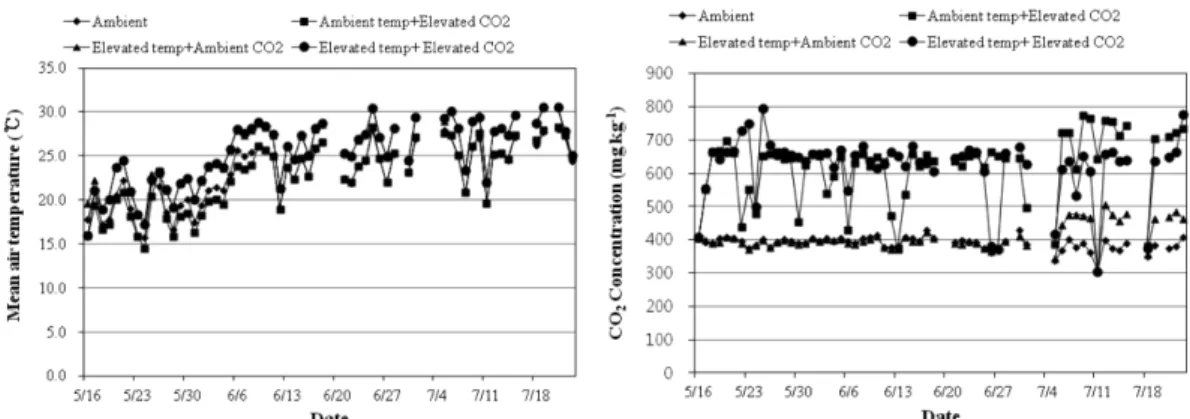
실험 기간 중의 라이조트론에서 계측된 실험구내 기 온과 CO2 농도의 평균치를 조사한 결과(Fig. 1, 2), 온도는 봄 재배기간 중에는 평균 기온이 15~28oC 범 Table 1. The chemical characteristics of the used soil mix.
pH EC
(dS m−1)
O.M.
(%)
NO3-N NH4-N Avail. P2O5 K Ca Mg
(mg kg−1) (cmol+ kg−1)
6.5 ± 0.04z 6.1 ± 0.18 5.6 ± 0.09 255 ± 13.0 115 ± 10.3 670 ± 47.2 4.3 ± 0.31 17.9 ± 0.44 6.37 ± 0.21
zStandard deviation, n = 3.
위로 점차 상승하였으며, 가을에는 18~28oC 범위로 점차 하강하였다. 라이조트론에서 계측이 안 된 날이 봄에는 9일, 가을에는 15일로 나타나 완벽한 상승온도 처리가 되지 않았지만, 상승 온도 처리에 따라서 봄 재배에서는 대기 온도보다 평균 기온이 당초 목표인 대기 온도 + 3oC 보다 0.5oC 낮은 약 2.5oC 높게 나
Fig. 1. The change of mean air temperature and CO2 concentration during the experimental period in spring season.
Fig. 2. The change of mean air temperature and CO2 concentration during the experimental period in Autumn season.
Table 2. Dry weight and T/R ratio of radish ‘Chunha’ exposed to either ambient CO2 or elevated CO2 concentrationin both ambient and elevated temperature for 65 days after sowing (DAS) in spring season.
Treatment Dry weight (g/plant)
T/R ratio
Temperature (A) CO2 conc. (B) Leaf Root Total Index
Ambient Ambient
Elevated
41.2 46.5
59.0 63.5
100.2 109.5
100 109
0.70 0.73 Elevated Ambient
Elevated
34.9 36.9
26.9 48.1
060.9 085.0
061 085
1.30 0.77 LSD 0.05 A
LSD 0.05 B LSD 0.05 A*B
* ns ns
* ns ns
**
* ns
* ns ns
ns,*,**Nonsignificant or significant at P < 0.05 or 0.01 by LSD, respectively.
타났으며, 가을 재배 시에는 약 2oC 높게 나타났다.
CO2농도의 경우에도 당초 대기 농도 + 350ppm으로 처리하려고 하였으나 실제로는 봄에는 약 + 220ppm, 가을에는 + 230ppm으로 처리되었음을 알 수 있었다.
이러한 처리 조건에서 무의 생장량과 TR율을 조사 한 결과(Table 2, 3, Fig. 3), 봄 재배에서는 상승 온
도에 따른 잎과 뿌리의 생장량의 감소 효과가 있었으 며, 상승 CO2 농도에 따른 총생장량의 증가 효과가 있었다. TR율은 상승 온도에 따른 증가 효과가 있었 다. 그러나 상승 온도와 상승 CO2의 상호작용 효과는 인정되지 않았다. 가을 재배에서는 온도 상승에 따른 뿌리의 생장량 감소 효과가 있었으며, 상승 CO2 농도 에 따른 뿌리 생장량의 증가 효과가 있었으며, T/R율 은 상승 온도에 따른 증가 효과가 있었다. 총건물중은 상승 온도에 따라 봄에는 39%, 가을에는 26%가 감 소하였고, CO2농도를 높여주면 상승 온도 조건에서 봄에는 15%, 가을에는 9%만 감소하였다. 본 실험 조 건에서는 상승 온도에 의한 건물생산에 대한 부의 효 과가 상승 CO2 농도에 의한 정의 효과(Chu 등, 1992; Usuda, 2006)보다 더 컸음을 알 수 있었다.
T/R율은 상승 온도 조건에서 높아지는 결과를 보였는 데 이것은 고온에 의한 호흡증가로 동화양분의 뿌리로 의 분배가 적었기 때문으로 판단된다(Prasad, 2005).
T/R율은 작물의 종류, 투입 요소, 그리고 실험 요인에 따라 차이가 있다(Rogers 등, 1996). 본 실험에서도 품종간의 차이가 있겠지만, 무 뿌리의 비대기에 온도가 높았던 봄이 가을보다 T/R율이 더 높음을 알 수 있다.
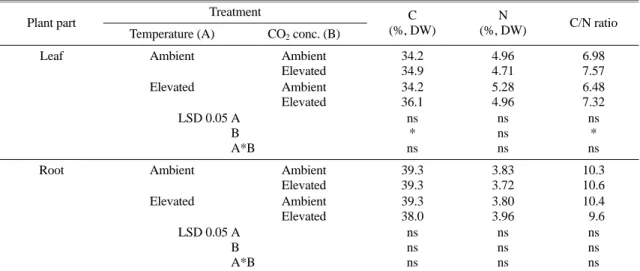
최종 수확한 무의 잎과 뿌리의 탄소(C), 질소(N), 그리고 C/N율을 측정한 결과(Table 4, 5), 봄 재배에 서는 잎에서는 상승 CO2농도에 따른 C 함량과 C/N 율의 증가 효과가 있었으나 뿌리에서는 처리 효과가 없었다. 가을 재배에서는 잎에서는 상승 온도에 따른 C 함량의 감소 효과가 있었지만, N과 C/N율에 미치 는 효과는 없었다. 상승 CO2 농도에 따른 C 함량의 차이는 없었고 N 함량은 감소 효과, C/N율은 증가 효과가 있었다. 상승 온도와 상승 CO2 농도의 상호작 용은 질소와 C/N율에서 나타났다. 뿌리의 경우에는 온 도 상승에 따른 C 함량은 감소, N 함량은 증가, 그 리고 C/N율은 감소 효과가 있었고, 상승 CO2농도에 따른 N 함량은 감소, C/N율은 증가 효과가 있었다.
Table 3. Dry weight and T/R ratio of radish ‘Cheongun’ exposed to either ambient CO2 or elevated CO2 concentration in both ambient and elevated temperature for 70 days after sowing (DAS) in autumn season.
Treatment Dry weight (g/plant)
T/R ratio
Temperature (A) CO2 conc. (B) Leaf Root Total Index
Ambient Ambient
Elevated
33.9 36.3
71.9 74.5
105.8 110.8
100 105
0.47 0.49
Elevated Ambient
Elevated
33.3 36.3
44.5 59.7
077.8 096.0
074 091
0.75 0.61 LSD 0.05 A
LSD 0.05 B LSD 0.05 A*B
ns ns ns
***
* ns
***
* ns
**
ns ns
ns,*,**,***Nonsignificant or significant at P < 0.05 or 0.01 by LSD, respectively.
Fig. 3. Photos of the harvested radish in the spring (left) and autumn (right) exposed to either ambient CO2 or elevated CO2
in both ambient and elevated temperature for 65 days and 70 days after sowing (DAS) in spring and autumn season, respectively.
상승 온도와 상승 CO2 농도에 의한 상호작용은 N 함량에서만 인정되었다. 식물체 C은 상승 CO2농도 조건에서 증가하는 것으로 보고되고 있다(Ainsworth 등, 2007; Urbonaviciute 등, 2006). 식물체 N함량은 N의 흡수에 의해 좌우되므로 기후 요인, 질소 형태, 토양의 N함량, 토양 온도 등의 영향을 받는다 (Bassirirad, 2,000). 봄 재배에서는 처리 효과가 없었 지만 가을에는 상승 온도 처리에서 N함량이 높음을
알 수 있다. 결과적으로 온도 상승은 C함량은 낮추고, N함량을 높이며, 상승 CO2농도는 C함량을 높임으로 써 C/N율을 높이는 것으로 나타났다.
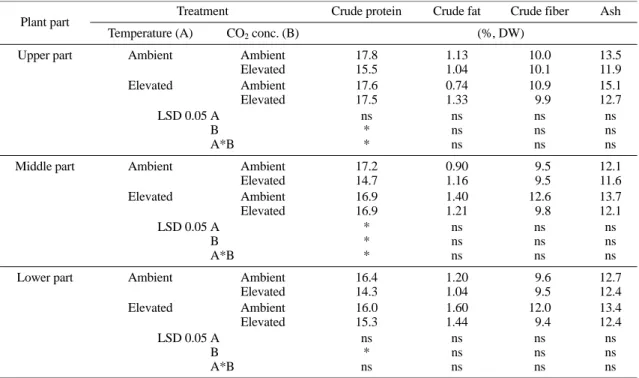
최종 수확한 무 뿌리의 일반영양성분을 분석한 결과 (Table 6, 7), 봄 재배에서는 상승 온도에 따른 뿌리 의 중간 부분에서 조단백질의 증가 효과가 인정되었지 만, 다른 성분은 모든 부위에서 차이가 없었다. 상승 CO2농도에 따라서는 모든 부위에서 조단백질의 감소 Table 5. Contents of carbon and nitrogen, and C/N ratio of radish ‘Cheongun’ exposed to either ambient CO2 or elevated
CO2 in both ambient and elevated temperature for 70 days after sowing (DAS) in autumn season.
Plant part Treatment C
(%, DW)
N
(%, DW) C/N ratio Temperature (A) CO2 conc. (B)
Leaf Ambient Ambient
Elevated
36.2 36.7
3.64 ± 0.60 2.974 ± 0.42
10.2 12.6
Elevated Ambient
Elevated
35.0 35.9
4.084 ± 0.37 2.754 ± 0.40
8.6 13.3 LSD 0.05 A
LSD 0.05 B LSD 0.05 A*B
* ns ns
ns
***
*
ns
***
*
Root Ambient Ambient
Elevated
40.74 ± 0.9 40.14 ± 1.0
2.244 ± 0.14 2.064 ± 0.18
18.2 19.7
Elevated Ambient
Elevated
39.54 ± 0.1 39.74 ± 0.4
2.924 ± 0.09 2.354 ± 0.14
13.5 17.0 LSD 0.05 A
LSD 0.05 B LSD 0.05 A*B
* ns ns
***
***
*
***
**
ns
ns,*,**,***Nonsignificant or significant at P < 0.05 or 0.01 by LSD, respectively.
Table 4. Contents of carbon and nitrogen, and C/N ratio of radish ‘Chunha’ exposed to either ambient CO2 or elevated CO2
in both ambient and elevated temperature for 65 days after sowing (DAS) in spring season.
Plant part Treatment C
(%, DW)
N
(%, DW) C/N ratio Temperature (A) CO2 conc. (B)
Leaf Ambient Ambient
Elevated
34.2 34.9
4.96 4.71
6.98 7.57
Elevated Ambient
Elevated
34.2 36.1
5.28 4.96
6.48 7.32 LSD 0.05 A
LSD 0.05 B LSD 0.05 A*B
ns
* ns
ns ns ns
ns
* ns
Root Ambient Ambient
Elevated
39.3 39.3
3.83 3.72
10.3 10.6
Elevated Ambient
Elevated
39.3 38.0
3.80 3.96
10.4 09.6 LSD 0.05 A
LSD 0.05 B LSD 0.05 A*B
ns ns ns
ns ns ns
ns ns ns
ns,*Nonsignificant or significant at P < 0.05 or 0.01 by LSD, respectively.
Table 6. Contents of crude protein, crude fat, crude fiber, and ash of freeze-dried ‘Chunha’ radish root exposed to either ambient CO2 or elevated CO2 in both ambient and elevated temperature for 65 days after sowing (DAS) in spring season.
Plant part Treatment Crude protein Crude fat Crude fiber Ash
Temperature (A) CO2 conc. (B) (%, DW)
Upper part Ambient Ambient
Elevated
17.8 15.5
1.13 1.04
10.0 10.1
13.5 11.9
Elevated Ambient
Elevated
17.6 17.5
0.74 1.33
10.9 09.9
15.1 12.7 LSD 0.05 A
LSD 0.05 B LSD 0.05 A*B
ns
*
*
ns ns ns
ns ns ns
ns ns ns
Middle part Ambient Ambient
Elevated
17.2 14.7
0.90 1.16
09.5 09.5
12.1 11.6
Elevated Ambient
Elevated
16.9 16.9
1.40 1.21
12.6 09.8
13.7 12.1 LSD 0.05 A
LSD 0.05 B LSD 0.05 A*B
*
*
*
ns ns ns
ns ns ns
ns ns ns
Lower part Ambient Ambient
Elevated
16.4 14.3
1.20 1.04
09.6 09.5
12.7 12.4
Elevated Ambient
Elevated
16.0 15.3
1.60 1.44
12.0 09.4
13.4 12.4 LSD 0.05 A
LSD 0.05 B LSD 0.05 A*B
ns
* ns
ns ns ns
ns ns ns
ns ns ns
ns,*Nonsignificant or significant at P < 0.05 or 0.01 by LSD, respectively.
Table 7. Contents of crude protein, crude fat, crude fiber, and ash of freeze-dried ‘Chunha’ radish root exposed to either ambient CO2 or elevated CO2 in both ambient and elevated temperature for 70 days after sowing (DAS) in autumn season.
Plant part Treatment Crude protein Crude fat Crude fiber Ash
Temperature (A) CO2 conc. (B) (%, DW)
Upper part Ambient Ambient
Elevated
09.4 07.9
0.95 0.97
4.6 4.4
7.3 6.6
Elevated Ambient
Elevated
10.5 08.9
1.53 1.28
5.0 4.4
8.2 7.3 LSD 0.05 A
LSD 0.05 B LSD 0.05 A*B
**
***
ns
**
ns ns
ns ns ns
**
**
ns
Middle part Ambient Ambient
Elevated
09.3 08.2
1.06 0.96
4.4 4.2
7.4 7.1
Elevated Ambient
Elevated
10.3 09.0
1.55 1.24
4.9 4.2
7.6 7.3 LSD 0.05 A
LSD 0.05 B LSD 0.05 A*B
*
**
ns
* ns ns
ns
* ns
ns
* ns
Lower part Ambient Ambient
Elevated
09.4 08.2
1.12 0.96
4.5 4.1
8.2 7.7
Elevated Ambient
Elevated
10.0 08.5
1.18 1.15
4.6 4.1
7.7 7.6 LSD 0.05 A
LSD 0.05 B LSD 0.05 A*B
ns
***
ns
ns ns ns
ns
* ns
ns ns ns
ns,*,**,***Nonsignificant or significant at P < 0.05 or 0.01 by LSD, respectively.
효과가 있었지만, 다른 성분은 모든 부위에서 상승 CO2농도 효과가 없었다. 가을 재배에서는 상승 온도 에 따라서 뿌리 윗부분은 조단백질, 조지방, 그리고 회 분의 증가 효과가 있었고, 중간 부분에서는 조단백질과 조지방의 증가 효과가 있었다. 상승 CO2농도에 따라 서 뿌리 윗부분은 조단백질과 회분의 감소 효과가 있 었고, 중간부분에서는 조단백질, 조섬유, 그리고 회분함 량의 감소 효과가 있었으며, 아랫부분에서는 조단백질 과 조섬유의 감소 효과가 있었다.
봄 재배에서 뿌리 중간 부위에서 온도 효과가 있는 것을 제외하면 온도 효과는 거의 없으며, 상승 CO2
농도 효과가 큰 것을 알 수 있고, 가을 재배에서는 온도 상승은 조단백질, 조지방의 함량을 증가시키고, 반대로 상승 CO2 농도는 조단백질, 조섬유, 회분 함 량을 감소시킨다는 것을 알 수 있다. 그리고 부위별로 보면 온도 효과는 뿌리 윗부분과 중간부분에서 차이가 많고, 아랫부분으로 갈수록 줄어들며, CO2효과는 뿌 리의 모든 부위까지 영향을 준다는 것을 알 수 있다.
본 실험에서 나타난 상승 CO2 농도 효과는 Uprety 등(2010)과 Karowe 등(1997)의 결과와 일치한다. 또 한 Taub 등(2008)은 Meta analysis 기법으로 분석한 결과, 상승 CO2농도에서 많은 식물에서 단백질 함량 이 감소하여 앞으로 먹는 식품에 단백질 함량이 낮아 질 것이라고 보고한 바 있다.
이상의 결과, 대기 온도가 현재보다 2~2.5oC 높아지 게 되면 봄과 가을무의 건물생산은 26~39% 감소하는 것으로 나타나며, 온도 상승과 더불어 CO2농도가 현 재보다 220~230ppm 더 상승하더라도 현재보다 건물생 산은 9~15% 정도 줄어들 것으로 판단된다. 또한 온도 상승에 의해 무 뿌리의 C함량 감소, N함량 및 단백질 함량 증가가 나타나고, CO2농도 상승에 의해 C함량 증가, N함량 감소, C/N율 상승, 그리고 단백질과 회분 의 감소 효과가 더 크게 나타나는 것을 볼 때 어떤 형 태로든 내적 성분 변화가 예상된다. 그리고 C와 N을 기초로 하는 많은 2차 대사산물의 생성과 분배(Bae와 Sicher, 2004; Mattson 등, 2005; Urbonaviciute 등,
2006)에 영향을 주어 무의 품질 변화를 가져올 것으로
추측된다. 앞으로 온도 상승과 CO2농도 상승에 따른 작물의 종류, 품종 육종, 토양 수분, 그리고 무기양분과 의 상호관계 등에 대한 추가적인 연구가 필요할 것으로 판단된다.
적 요
상승 온도와 상승 CO2 농도 처리가 무의 생장량, C/N율, 그리고 식품 일반 영양성분에 미치는 효과를 검토한 결과, 대기 온도보다 2~2.5oC 범위의 온도 상 승은 무의 건물생산을 26~39% 범위의 감소를 가져오 며, 대기 CO2농도가 220~230ppm 상승함에 따라서 건물생산의 감소가 9~15% 범위로 어느 정도 줄어들 지만, 온도 상승에 의한 감소 효과를 극복하지 못했다.
온도 상승은 무의 T/R율을 봄에는 86%, 가을에는 60% 증가시켰으며, C/N율을 낮추고, 조단백질, 조지방, 그리고 회분의 함량을 높이는 결과를 나타내었다. 반면 에 상승 CO2처리는 C/N율은 높이고 조단백질, 조섬 유, 그리고 회분의 함량을 저하시키는 결과를 나타내었 다. 따라서 앞으로 온도 상승과 CO2농도 상승 정도 에 따라 무의 건물생산, T/R율, C/N율, 그리고 일반 영양성분에 상당한 영향을 미칠 것으로 판단된다.
주제어 : 건물생산, 상승 CO2,상승 온도, 일반 영양성 분, 무
인 용 문 헌
1. Ainsworth, E.A., A. Rogers, A.D.B. Leakey, L.E.
Heady, Y. Gibon, M. Stitt, and U. Schurr. 2007. Does Elevated Atmospheric [CO2] Alter Diurnal C Uptake and the Balance of C and N Metabolites in Growing and Fully Expanded Soybean Leaves? J. Expt. Bot.
58(3):579-591.
2. Bae, H. and R. Sicher. 2004. Changes of Soluble Pro- tein Expression and Leaf Metabolite Levels in Arabi- dopsis Thaliana Grown in Elevated Atmospheric Carbon Dioxide. Field Crops Res. 90:61-73.
3. Bassirirad, H. 2000. Kinetics of Nutrient Uptake by Roots: Responses to Global Change. New Phytol.
147:155-169.
4. Choi, E.Y., T.C. Seo, S.G. Lee, I.H. Cho, and J.
Stangoulis. 2011. Growth and Physiological Responses of Chinese Cabbage and Radish to Long-term Expo- sure to Elevated Carbon Dioxide and Temperature.
Hort. Environ. Biotechnol. 52(4):376-386.
5. Chu, C.C., J.S. Coleman, and H.A. Mooney. 1992.
Controls of Biomass Partitioning between Roots and Shoots: Atmospheric CO2 Enrichment and the Acqui- sition and Allocation of Carbon and Nitrogen in Wild Radish. Oecologia 89:580-587.
6. FACT. 2010. Method of Forage Analysis. FACT. Suwon,
Korea.
7. Hartly, S.E., C.G. Jones, G.C. Couper, and T.H. Jones.
2000. Biosynthesis of Plant Phenolic Compounds in Elevated Atmospheric CO2. Global Change Biol.
6:497-506.
8. Intergovernmental Panel on Climate Change (IPCC).
2007. Climate Change 2007: Synthesis Report. IPCC.
Geneva. Switzerland.
9. Kang, H.J., J.S. Lee, K.R. Ryu, and J.T. Lee. 2002.
Chinese Cabbage Cultivation. R.D.A. Suwon. Korea.
10. Karowe, D.N., D.D. Seimens, and T. Mitchell-olds.
1997. Species-specific Response of Glucosinolate Content to Elevated Atmosphere CO2. J. Chem. Ecol.
23:2569-2582.
11. Lee, I.B., J.H. Lim, H.L. Kim, and S.B. Kang. 2005.
Survey of Growth Response of Pepper Under Global Warming. NHRI Annual Research Report. Suwon (CD version). pp. 37-46.
12. Lee, J.W., S.Y. Kim, Y.A. Jang, J.H. Moon, and W.M.
Lee. 2006. Growth Response and CO2 Biomass of Chinese Cabbage and Radish Under High Tempera- ture and CO2 Concentration. J. Bio-Environ. Control 15:364-368.
13. Lee, S.G., J.H. Moon, Y.H. Jang, W.M. Lee, I.H. Cho, S.Y. Kim, and K.D. Ko, 2009. Photosynthetic Charac- teristics and Cellular Tissue of Chinese Cabbage are Affected by Temperature and CO2 Concentration. J.
Bio-Environ. Control 18:148-152.
14. Lim, M.S., K.Y. Shin, J.G. Woo, Y.S. Kwon, S.W.
Jang, W.B. Kim, J.N. Lee, J.T. Lee, H.J. Kwon, J.T.
Seo, J.H. Ahn, Y.G. Kang, Y.I. Ham, M. Kwon, and K.R. Ryu. 2000. Vegetable Cultivation Technique in Highland Area. Kwahakwonhae Press. Seoul. pp. 52- 56.
15. Mattson, W.J., R. Julkunen-Tittoo, and D.A. Herms.
2005. CO2 Enrichment and Carbon Partitioning to Phenolics: Do Plant Responses Accord Better with the Protein Competition or the Growth-differentiation Bal-
ance Models? OIKOS 111:337-347.
16. Morison, J.I.L. and M.D. Morecroft. 2006. Plant Growth and Climate Change. Wiley-Blackwell, Black- well Publishing Co. Ltd., London, U.K.
17. Park, S.H., J.S. Lee, M.H. Seo, and J.S. Lee. 2002.
Radish Cultivation, RDA, Suwon, Korea. pp. 39-40.
18. Reddy, R.A., G.H. Rasineni, and A.S. Raghavendra.
2010. The Impact of Global Elevated CO2 Concentra- tion on Photosynthesis and Plant Productivity. Current Sci. 99:46-57.
19. Rogers, H.H., A.P. Stephen, G.B. Runion, and R.J.
Mitchell. 1996. Root to Shoot Ratio of Crops as Influ- enced by CO2. Plant Soil 187:229-248.
20. ScienceDaily, 2002. http://www.sciencedaily.com/releases/
2002/12/021206075233.htm.
21. Taub, D.R., B. Miller, and H. Allen. 2008. Effects of Elevated CO2 on the Concentration of Food Crops: A Meta-analysis. Global Change Bio. 14:565-575.
22. Uprety, D.C., S. Sen, and N. Dwivedi. 2010. Rising Atmospheric Carbon Dioxide on Grain Quality. Phys- iol. Mol. Biol. Plants 16(3):215-227.
23. Urbonaviciute, A., G. Samuoliene, and J. Sakalaus- kaite. 2006. The Effect of Elevated CO2 Concentra- tions on Leaf Carbohydrate, Chlorophyll Contents and Photosynthesis in Radish. Polish J. Environ. Studies 15(6):921-925.
24. Usuda, H. 2006. Effects of Elevated CO2 on the Capacity for Photosynthesis of a Single Leaf and a Whole Plant, and on Growth in a Radish. Plant Cell Physiol. 47(2):262-269.
25. Usuda, H. and K. Shimogawara. 1998. The Effects of Increased Atmospheric Carbon Dioxide on Growth, Carbohydrate, and Photosynthesis in Radish, Rapha- nus sativus L. Plant Cell Physiol. 39:1-7.
26. Prasad, P.V.V., L.H. Allen, Jr., and K.J. Boote. 2005.
Crop Responses to Elevated Carbon Dioxide and Inter- action with Temperature: Grain Legumes. J. Crop Improvement 13:113-155.