자폐 스펙트럼 장애에 대한 한국과 중국의 한방치료 연구 동향 비교
조연수․백정한
대구한의대학교 부속 대구한방병원 한방소아과
Received: April 25, 2018 ∙ Revised: May 18, 2018 ∙ Accepted: May 21, 2018 Corresponding Author: Baek Jung Han
Department of Oriental Pediatrics, Daegu Haany University, 136, Sincheondong-ro, Suseong-gu, Daegu 42158, Republic of Korea
Tel: +82-53-770-2134 E-mail: [email protected]
ⓒ The Association of Pediatrics of Korean Medicine. All rights reserved. This is an open-access article distributed under the tenus of the Creative Commons Attribution Non-Commercial License (http://creativecommons.org/licenses/by-nc/3.0/), which permits unrestricted non-commercial use, distribution, and reproduction in any medium, provided the original work is properly cited.
Abstract
A Comparison between Korean and Chinese Clinical Studies for the Treatment of Autism Spectrum Disorder
Cho Youn Soo․Baek Jung Han
Department of Korean Pediatrics, Daegu Korean Medicine Hospital of Daegu Haany University Objectives
The purpose of this study is to figure out the recent trend of the treatment for autism spectrum disorder (ASD) by comparing Korean and Chinese clinical studies.
Methods
National Digital Science Library (NDSL), Oriental medicine Advanced Searching Integrated System (OASIS), Research Information Sharing Service (RISS) and Korean Traditional Knowledge Portal (KTKP) were used to search Korean studies which were published from January, 2011 to May, 2017. Also Chinese National Knowledge Infrastructure (CNKI) and Wanfang data were used to search Chinese studies which were published from the same period. Key words of 'Autism' and 'Autism spectrum disorder' were used.
Results
3 Korean studies and 21 Chinese studies were selected and analyzed to find out the most commonly used diagnostic criteria, treatments, including herbal medicine and acupuncture, and treatment assessment procedures.
Conclusions
As a result of comparing Korean and Chinese clinical studies for the treatment of ASD, both Korean and Chinese medicine treatments showed their effectiveness. However, there were some differences between two countries' clinical trends. In order for this study to be helpful, more highly evidenced clinical studies should be followed.
Key words: Autism spectrum disorder, Herbal medicine, Acupuncture
J Pediatr Korean Med. May, 2018;32(2):26-42 ISSN 1226-8038(Print), 2287-9463(Online), https://doi.org/10.7778/jpkm.2018.32.2.026
자폐 스펙트럼 장애에 대한 한국과 중국의 한방치료 연구 동향 비교 27
Ⅰ. Introduction
자폐 스펙트럼 장애 (Autism spectrum disorder, ASD) 는 사회적 의사소통 및 상호작용의 지속적 결함과 제 한적이고 반복적인 행동 또는 관심을 보이는 것을 특 징으로, 미국정신의학회가 발간한 Diagnostic and stat- istical manual of mental disorders, 5th edition (DSM-5)에 서 전반적 발달장애 (Pervasive developmental disorders, PDDs)와 그 하위항목을 포괄하는 단일범주의 공식 명 칭으로 인정되었다1). 이러한 진단기준의 변화로 진단 의 정확성이 높아짐에 따라 최근 통계상 유병률이 증 가하여 ASD의 세계적인 유병률은 1%까지 보고되고 있으며2), 국내에서도 8세 미만 아동의 68명 중 1명이 이환 중인 것으로 보고된 바 있다3).
그러나 서양의학에서는 현재까지도 ASD의 명확한 원인을 특정할 수 없기 때문에 치료 역시 체계적일 수 없으며, 행동치료와 약물치료, 그 외에 다양한 보완대 체치료가 복합적으로 이루어지고 있다. 특히 약물치료 는 주로 분노발작, 공격성, 자해행동과 같은 위험한 증 상 또는 동반된 다른 정신과적 질환을 목표로 사용되 고 있어 원인에 근거한 치료라고 보기 어렵고, 그 효과 역시 일차적이지 않다. 뿐만 아니라, ASD 아동이 보이 는 증상의 대부분은 만성적으로 지속되므로 이러한 정 신과적 약물의 사용이 점점 증가하고 있는데 반해 장 기간 투여시 안전성에 대한 연구는 부족한 편이다4). 이에 ASD의 한의학적 치료에 대한 관심이 늘어나, 김 등2)에 따르면 ASD 아동의 약 27.3%가 한약치료를 받고 있는 것으로 조사되었다. 부모들이 담당 의사에 게 알리는 비율이 저조한 것을 감안한다면 실제로는 이보다 더 많은 아동이 한의학적 치료를 받고 있을 것 으로 생각된다. 그러나 국내에는 ASD의 한의학적 치료 에 대한 일차적인 진료 지침이 마련되어 있지 않고, 관 련된 연구도 절대적으로 부족하다. 반면 중국에서는 다양한 치료방법을 적용한 연구가 비교적 활발히 발표 되고 있다. 이에 본 연구에서는 ASD에 관한 한국과 중 국의 연구를 비교 분석함으로써 각국의 최근 연구 동 향을 고찰하여, ASD의 한의학적 치료 방향 설정에 도 움이 되고자 한다.
Ⅱ. Materials and Methods
1. 문헌검색
본 연구의 한의학 문헌검색은 국가과학기술정보센터 (National Digital Science Library, NDSL), 전통의학정보 포털 (Oriental medicine Advanced Searching Integrated System, OASIS), 학술연구정보서비스 (Research Information Sharing Service, RISS), 한국전통지식포탈 (Korean Traditional Knowledge Portal, KTKP)을 이용하였고, 중 의학 문헌검색은 中國知識基礎施設工程 (China National Knowledge Infrastructure, CNKI), 万方数据知识服务平 台 (Wanfang data)를 이용하였다. 검색어는 ‘Autism’ 또 는 ‘Autism spectrum disorder’로 동일하게 하여 2011년 1월부터 2017년 5월까지 발표된 문헌을 검토하였다.
2. 선정 및 배제기준
검색된 문헌 중 제목, 초록 및 필요시 원문을 확인하 여 ASD 환자를 대상으로 한의학 또는 중의학 치료를 적용하여 그 효과를 평가한 임상 연구를 선별하였다.
실제 임상에서 이루어지는 다양한 증례를 수집하기 위 해 Review를 제외한 것 외에 연구설계에는 제한을 두 지 않았고, 두 가지 이상의 치료방법을 병용하여 종합 적 중재를 시행한 연구도 포함하였다. 단, 인체를 대상 으로 하지 않은 연구는 제외하였다.
3. 자료추출
선정된 문헌에서 국가별로 발행연도에 따라 각 연구 의 연구설계, 연구대상, 진단기준, 치료방법, 치료기간, 평가방법 및 치료결과 등을 중심으로 자료를 추출하였 다. 그 중 연구대상은 대상자 수, 성별 및 연령에 대한 정보를 추출하였고, 치료방법은 약물치료, 침치료, 기타 치료로 나누어 각각에 대한 정보를 추출하였다.
Ⅲ. Results
1. 검색결과
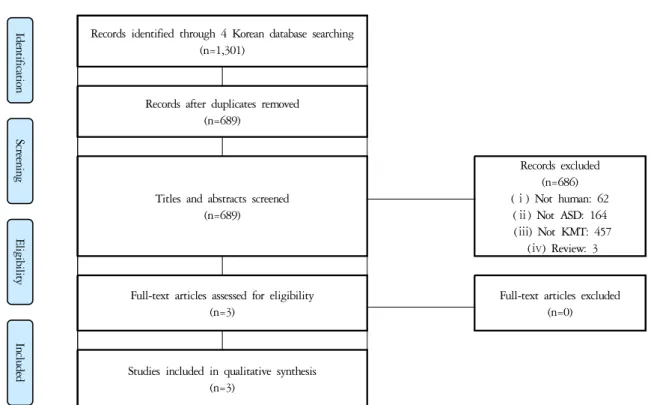
검색된 문헌 중 중복 게재된 문헌을 제외하고, 제목, 초록, 필요시 원문을 통해 선정 및 배제기준에 의거하 여 본 연구에 적합한 문헌을 선별하였다. 그 과정은
Preferred reporting items for systematic reviews and meta-analyses (PRISMA) 순서도로 나타내었다. 최종적 으로 한의학 논문 총 3편, 중의학 논문 총 21편이 선정 되었다 (Fig. 1, 2).
2. 연구설계
한의학 논문 3편5-7)은 모두 Case study였고, 중의학 논문 중 5편8-12)은 Case study, 나머지 16편13-28)은 Control study였다.
entificationScreeningEligibilityIncluded Id
Records identified through 4 Korean database searching (n=1,301)
Records after duplicates removed (n=689)
Titles and abstracts screened (n=689)
Records excluded (n=686) (ⅰ) Not human: 62
(ⅱ) Not ASD: 164 (ⅲ) Not KMT: 457
(ⅳ) Review: 3
Full-text articles assessed for eligibility (n=3)
Full-text articles excluded (n=0)
Studies included in qualitative synthesis (n=3)
Fig. 1. The PRISMA flow diagram of Korean study screening and selection
IdentificationScreeningEligibilityIncluded
Records identified through 2 Chinese database searching (n=5,927)
Records after duplicates removed (n=4,336)
Titles and abstracts screened (n=4,336)
Records excluded (n=4,283)
Full-text articles assessed for eligibility (n=53)
Full-text articles excluded (n=32) (ⅰ) Not human: 2 (ⅱ) Not TCM: 12 (ⅲ) Duplicate: 8
(ⅳ) Review: 8 (ⅴ) Full-text not provided: 2
Studies included in qualitative synthesis (n=21)
Fig. 2. The PRISMA flow diagram of Chinese study screening and selection
자폐 스펙트럼 장애에 대한 한국과 중국의 한방치료 연구 동향 비교 29
한의학 Case study 3편5-7)은 모두 약물치료만 단독으 로 시행하였고, 침치료 및 기타치료는 시행되지 않았다.
중의학 Case study의 경우 약물치료만 단독으로 시 행한 연구가 2편11,12), 침치료만 단독으로 시행한 연구
가 2편8,10), 침치료와 재활치료를 병행한 연구가 1편9)이
었다. Control study 중 Randomized controlled trial (RCT)이 12편13,16-24,27,28)이었으나, 이중맹검된 연구는 없었고, 나머지 4편14,15,25,26)은 Case controlled trial (CCT) 이었다. 실험군과 대조군은 2군 또는 3군으로 나누어 져 2-arm study가 14편13-15,17-25,27,28)
, 3-arm study가 2편
16,26)이었다. 2-arm study 중 상용 재활치료를 시행한 대
조군과 상용 재활치료와 한방치료를 병행한 실험군을
비교한 연구가 8편13,17,18,20,21,25,27,28)으로 가장 많았고, 상 용 재활치료를 시행한 대조군과 한방치료를 시행한 실 험군을 비교한 연구가 5편14,15,19,23,24), 상용 침치료를 시 행한 대조군과 새로운 침치료를 시행한 실험군을 비교 한 연구가 1편22)이었다. 실험군에 시행된 한방치료 중 침치료를 중심으로 한 연구가 10편13,16,17,19-23,25,27)으로 가장 많았고, 그 중 2편16,22)은 기존의 상용 침치료와 새로운 침치료의 효과를 비교하였다. 약물치료는 다른 치료와 병행하여 2편15,28)에서 시행되었고, 그 외 기타 치료로 추나치료 및 음악치료14,24), 혈위신경요법18), 혈 위주사요법26) 등이 시행되었다 (Table 1, 2, 3).
Table 1. Korean Case Studies for Autism Spectrum Disorder Author
(Year) Size Criteria Intervention Treatment
Period
Evaluation Method Lee SJ5)
(2011) 1 None - Herbal medicine 3 months Clinical symptoms
Lee JN6)
(2015) 7 K-ASQ* - Herbal medicine 80 days Clinical symptoms
Lee JN7)
(2016) 130 None - Herbal medicine 80 days Clinical symptoms
* K-ASQ: Korean ages & stages questionnaires
Table 2. Chinese Case Studies for Autism Spectrum Disorder Author
(Year) Size Criteria Intervention Treatment
Period
Evaluation Method
Zhao Y8)
(2011) 24 DSM-Ⅳ*
- Auricular acupuncture: CO12, CO10, CO15, AT2, AT3, AT4i
- Scalp acupuncture: Zhijiu zhen (智九鍼) (Ewu zhen (額五鍼), EX-HN1), Sensory area
4 months ABC+
Zeng HH9)
(2011) 30 ICD-10†
- Jin's three needling therapy: Sishen zhen (四神鍼), Naosan zhen (腦三鍼), Niesan zhen (顳三鍼), Nieshangsan zhen (顳 上三鍼), Shesan zhen (舌三鍼), Shouzhi zhen (手智鍼), Zuzhi zhen (足智鍼), Xingshen zhen (醒神鍼)
- Applied behavioral analysis (ABA), Treatment and education of autistic and related communication handicapped children (TEACCH), Play and culture intervention (PCI), Sensory integration & hearing integration training, Language integration training
6 months PEP‡
CARS§
Xie QL10)
(2014) 27
DSM-Ⅳ Gesell developmental
score
- Scalp acupuncture: Zhijiu zhen (智九鍼) (Ewu zhen (額五鍼),
EX-HN1), Sensory area, Heart liver area) 3 months
Quality of life CARS
ABC Gesell developmental
score Zhou NY11)
(2015) 49 DSM-Ⅳ
ICD-10 - Herbal medicine Not
reported
CARS (language items)
Jiang XY12)
(2016) 29 DSM-Ⅳ
ICD-10 - Herbal medicine 3 months
CARS Clinical symptoms
(frequency of stereotyped movements)
* DSM-Ⅳ: Diagnostic and statistical manual of mental disorders, 4th edition, + ABC: Autism behavior checklist, †ICD-10: International classification of disease, 10th edition, ‡PEP: Psychoeducational profile, § CARS: Childhood autism rating scale
Table 3. Chinese Control Studies for Autism Spectrum Disorder Author (Year)Study DesignSizeObservationMean Age / Gender (M:F)CriteriaInterventionTreatment PeriodEvaluation MethodControl Li N13) (2011)RCT* 7030NR† / 27:3ICD‡ DSM§ CCMDⅡ
- Scalp acupuncture: Zhijiu zhen (智九鍼) (Ewu zhen (額五鍼), EX-HN1), Sensory area, Heart liver area - Electroacupuncture - Music therapy, Structured exercise therapy10 weeks
CABS¶ CARS** ABC++ Gesell developmental score40NR / 33:7- Music therapy, Structured exercise therapy Liu ZH14) (2012)CCT+ 7030NR / 27:3DSM-Ⅳ CCMD
- Scalp acupuncture: Zhijiu zhen (智九鍼) (Ewu zhen (額五鍼), EX-HN1), Sensory area, Heart liver area - Chuna therapy (acupressure): GV24, GB13, EX-HN1, ST8, GV23, GV17, GV15, GB20, HT7, HT5, PC6, PC8, CV23, CV17, CV12, CV4, CV6 - Five elements music therapy10 weeks
CABS CARS ABC Gesell developmental score40NR / 33:7- Structured education therapy Ye ZF15) (2012)CCT90485.51y / 36:12 DSM
- Herbal medicine - Hyperbaric oxygen therapy, Sensory integration therapy6 monthsClinical symptoms 42NR / NR- Rehabilitation therapy Tang Q16) (2013)RCT56
204.526 ± 1.623y / 14:6 DSM-Ⅳ CCMD -2-R
- Scalp acupuncture during rehabilitation therapy: MS1, MS10, MS11, MS12, MS14, MS6, Frontal area (額區), Temporal area (顳區), Occipital area (枕區), Suboccipital area (枕下區), Top area (頂區) - Rehabilitation therapy 24 weeksCARS 184.436 ± 1.520y / 13:5- Scalp acupuncture 30 mins after rehabilitation therapy: MS1, MS6, MS7, MS10, MS12, MS13, MS14 - Rehabilitation therapy 183.954 ± 1.572y / 14:4- Rehabilitation therapy Xiong YH17) (2014)RCT64
327.48 ± 3.26y / 18:14 CCMD-3
- Scalp acupuncture: Frontal area (額區), Temporal area (顳區), Occipital area (枕區), Suboccipital area (枕下區), Top area (頂區) - Rehabilitation therapy: Education training, Sensory training, Behavior modification, Speech training6 monthsCARS 327.56 ± 3.12y / 17:15- Rehabilitation therapy: Education training, Sensory training, Behavior modification, Speech training Chen SQ18) (2014)RCT60305.06 ± 1.32y / 36:24CCMD-3
- Acupoint nerve stimulate therapy: GV20, GV24, EX-HN3, HT7, EX-HN22, SP6, KI3 - Rehabilitation therapy: Cognitive behavior therapy 2 monthsCHSQ†† 30- Rehabilitation therapy: Cognitive behavior therapy Gao XQ19) (2015)RCT100
505.7 ± 0.8y / 29:21 ICD-10 - Jin's three needling therapy: Sishen zhen (四神鍼), Naosan zhen (腦三鍼), Niesan zhen (顳三鍼), Left nieshangsan zhen (顳上三鍼), Dingshen zhen (定神鍼), Xingshen zhen (醒神鍼), Shouzhi zhen (手智鍼), Zuzhi zhen (足智鍼), Shesan zhen (舌三鍼)20 weeksPEP‡‡ 505.4 ± 0.7y / 31:19- Physiotherapy - Rehabilitation therapy: Cognition training, Behavior modification, Speech training
31
Author (Year)Study DesignSizeObservationMean Age / Gender (M:F)CriteriaInterventionTreatment PeriodEvaluation MethodControl Wang J20) (2015)RCT62 325.12 ± 1.42y / 18:14 NR
- Jin's three needling therapy: Sishen zhen (四神鍼), Zhisan zhen (智三鍼), Naosan zhen (腦三鍼), Niesan zhen (顳三鍼), Shouzhi zhen (手智鍼), Zuzhi zhen (足智鍼), Shesan zhen (舌三鍼), Xingshen zhen (醒神鍼) - Rehabilitation education: Speech training, Directed jamming education, ABA, Music therapyNRCARS 305.10 ± 3.4y / 15:15- Rehabilitation education: Speech training, Directed jamming education, ABA, Music therapy Zhao NX21) (2015)RCT6030NR / NRStandard for Chinese medical diagnosis ICD-10
- Scalp electroacupuncture during rehabilitation therapy: GV20, EX-HN1, GV24, GB13, ST8, GV23, Dingshen zhen (定神鍼), GV17, GB19 - Electroacupuncture - Rehabilitation therapy: Behavior modification3 monthsABC 30NR / NR- Rehabilitation therapy: Behavior modification Zhao Y22) (2015)RCT68
34 34.12 ± 7.12m / 54:14DSM-Ⅳ - Lim’s scalp acupuncture: 1st, 2nd, 3rd area - Scalp acupuncture: GV24, GB13, EX-HN1, 1st, 2nd, 3rd speech area, Sensory area - Electroacupuncture: 1st speech area, Sensory area, Niesan zhen (顳三鍼), 1st, 3rd area - Rehabilitation therapy: Speech training, Special education15 weeks
ABC Gesell developmental score 34
- Scalp acupuncture: GV24, GB13, EX-HN1, 1st, 2nd, 3rd speech area, Sensory area - Electroacupuncture: 1st speech area, Sensory area - Rehabilitation therapy: Speech training, Special education Wu S23) (2015)RCT80
406.5 ± 2.3y / 28:12 DSM-5
- Jin's three needling therapy: Exact points are not reported 20 weeksClinical symptoms 406.2 ± 2.1y / 30:10- Rehabilitation therapy Wang G24) (2016)RCT98
497.5 ± 4.0y / 28:21
DSM-Ⅳ Chinese medical diagnostic standard
- Acupuncture: Exact points are not reported - Chuna therapy (acupressure): GV24, GB13, EX-HN1, ST8, GV23, GV17, GB20, HT7, PC6, PC8, CV12, CV4, CV6 - Five elements music therapyNR
CARS ABC Gesell developmental score 497.8 ± 3.5y / 27:22- Rehabilitation therapy: Sensory integration training, Behavior modification Hu CW25) (2016) CCT56
314.8 ± 1.79y / 28:3DSM-Ⅳ ABC CARS - Scalp acupuncture: GV20, EX-HN1, GV24, GB13, GV17, GB19, Shesan zhen (舌三鍼) - Rehabilitation therapy: ABA, Speech therapy, Music therapy, Sensory integration training 10 monthsPEP-3 254.7 ± 1.87y / 23:2- Rehabilitation therapy: ABA, Speech therapy, Music therapy, Sensory integration training
Author (Year)Study DesignSizeObservationMean Age / Gender (M:F)CriteriaInterventionTreatment PeriodEvaluation MethodControl Hao YM26) (2016)CCT59
2237.12 ± 3.57m / 19:3 DSM-Ⅳ
- Mouse nerve growth factor (mNGF) acupoint injection: GB20, BL23, GV15, GV16, ST36, PC6, ST40 - Scalp acupuncture: ST8, GV24, GV20, EX-HN1, 1st, 2nd speech area, Esan zhen (額三鍼), Balance area, EX-HN3 - Rehabilitation therapy: Structured education, ABA, Sensory integration training, Speech therapy 3 monthsABC CARS PPVTIIII 2236.86 ± 9.26m / 19:3
- Scalp acupuncture: ST8, GV24, GV20, EX-HN1, 1st, 2nd speech area, Esan zhen (額三鍼), Balance area, EX-HN3 - Rehabilitation therapy: Structured education, ABA, Sensory integration training, Speech therapy 1536.61 ± 8.15m / 13:2- Rehabilitation therapy: Structured education, ABA, Sensory integration training, Speech therapy Zeng R27) (2017)RCT54
275.21 ± 1.39y / 18:9 DSM-Ⅳ
- Scalp acupuncture during rehabilitation education: EX-HN1, GV24, GB13, EX-HN3, GV17, GB19, 1st, 2nd, 3rd speech area, CV23 - Rehabilitation therapy: Speech training, Behavior training, Sensory integration training4 monthsCARS ABC 274.98 ± 1.24y / 19:8- Rehabilitation therapy: Speech training, Behavior training, Sensory integration training Fan YN28) (2017)RCT48244.7y / NR
Standard for Chinese medical diagnosis ICD-10
- Herbal medicine - Acupuncture: GV20, EX-HN1, Dingshen zhen (定神鍼), 1st, 2nd, 3rd speech area, Shouzhi zhen (手智鍼), Zhisan zhen (智三鍼), HT7, LR3, LR2, GB34 - Rehabilitation therapy: Sensory integration training, Music therapy, Speech training6 monthsCARS ABC 24- Rehabilitation therapy: Sensory integration training, Music therapy, Speech training * RCT: Randomized controlled trial, + CCT: Case controlled trial,† NR: Not reported, ‡ ICD: International classification of disease,§ DSM: Diagnostic and statistical manual of mental disorders, II CCMD: The Chinese classification of mental disorders,¶ CABS: Clancy autism behavior scale, ** CARS: Childhood autism rating scale, ++ ABC: Autism behavior checklist,†† CHSQ: Children’s sleep of habits questionnaire, ‡‡ PEP: Psychoeducational profile, IIII PPVT: Peabody picture vocabulary test