2009년도 춘계 학술발표회 논문집 대한방사선방어학회
90 _
http://www.karp.or.krAKT activation inhibits radiation-induced apoptosis via acinus gene regulation
Hyung Sun Park, Hyeong Ho Seo, Cha Soon Kim,
Kwang Hee Yang, Meeseon Jeong, Young-Woo Jin and Seon Young Nam Radiation Health Research Institute, Korea Hydro & Nuclear Power Co., LTD, Seoul, Korea
E-mail: [email protected]
Key words : Ionizing radiation, AKT, Acinus
Introduction
The serine/threonine kinase AKT (protein kinase B, PKB) promotes cell survival by phosphorylating and inhibiting components of the intrinsic cell death machinery. AKT has been shown to be potently activated in response to a wide variety of growth factors and ionizing radiation (Soderlund et al., 2005). AKT predominantly localizes to the cytoplasm and translocates to the nucleus upon cellular stimulation (Lu et al.,, 1998). AKT regualtion of apoptosis is correlated with the control of key downstream substrates within the nucleus.
Acinus predominantly locates within the nucleus and is known to be a member of the apotosiss- and slicing-associated protein (ASAP) complex (Schwerk et al., 2003). It was reported that AKT phosphorylated acinus and inhibits acinus proteolytic cleavage by caspases (Hu et al., 2005). Therefore, we investigated the role of AKT activation on cell survival and acinus regulation in response to ionizing radiation.
Here, we show that AKT activation inhibits cell death during radiation-induced apoptosis through the regulation of acinus gene expression in normal human cells.
Materials and Methods
Human lung fibroblast CCD-18Lu cells and B lymphoblast IM-9 cells were irradiated with γ -rays at a dose of 0.05 to 10 Gy. Colony formation assay and MTT assay were used to measure radiation-induced cell death.
Immunoblot analysis and quantitative RT-PCR were also performed.
Result
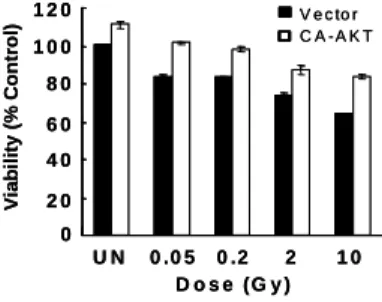
AKT activation protects cells from radiation- Induced cell death
We examined the role of AKT on the radiation
induced cell death, we established stable cell
lines from CCD-18Lu cells infected with a
retrovirus expressing constitutively active AKT
(CA-AKT). CCD-18Lu.CA-AKT cells were
irradiated with γ-rays at a dose in the range of
0.05 to 10 Gy and cell viability was assessed
after 48 hours of irradiation. CA-AKT
overexpression significantly inhibited
radiation-induced cell death compared to that of
the controls (fig. 1).
2009년도 춘계 학술발표회 논문집 대한방사선방어학회
대한방사선방어학회_
91
Vector CA-AKT UN 0.2 2 UN 0.2 2 (Gy) Acinus S, S’
β-Actin
Vector CA-AKT UN 0.2 2 UN 0.2 2 (Gy) Acinus S, S’
β-Actin
U N 0 .0 5 0 .2 2 1 0
0 2 0 4 0 6 0 8 0 1 0 0 1 2 0
Viability (% Control) V e c to rC A - A K T
D o s e (G y )
U N 0 .0 5 0 .2 2 1 0
0 2 0 4 0 6 0 8 0 1 0 0 1 2 0
Viability (% Control) V e c to rC A - A K T
D o s e (G y )
0 0.2 0.4 0.6 0.8 1.0 1.2
Acinus L Acinus S
Relative mRNA Levels VectorIκBαM
* *
0 0.2 0.4 0.6 0.8 1.0 1.2
Acinus L Acinus S
Relative mRNA Levels VectorIκBαM
0 0.2 0.4 0.6 0.8 1.0 1.2
Acinus L Acinus S
Relative mRNA Levels VectorIκBαM
* *
fig 1. Effect of AKT activation on radiation-induced cell death.
AKT activation causes upregulation of Acinus expression
We further investigated whether acinus expression is regulated by AKT activity.
CA-AKT overexpression induced an increase in acinus expression in both untreated control and irradiated cells (fig. 2).
fig 2. Acinus expression in CCD-18Lu.Vector and CCD-18Lu.CA-AKT, which were irradiated with 0.2 and 2 Gy of γ-rays.
NF-kB activation regulates acinus gene expression To investigate whether NF-κB has a role in acinus L and acinus S expression, we produced stable CCD-18Lu cells overexpressing the NF- κB repressor mutant of IkBα (IκBαM). We investigated acinus mRNA levels in CCD-18Lu.I κBαM cells by using quantitative RT-PCR analysis. The mRNA levels of acinus L and acinus S were decreased in CCD-18Lu.IκBαM cells when compared to controls. This result shows that NF-κB regulates both acinus L and acinus S expression at the transcriptional level (fig. 3).
fig 3. The mRNA levels of acius L and acinus S were measured by quantitative RT-PCR
Discussion
In the present study, we examined the novel regulatory mechanism responsible for the radiation induced cell death in normal human cells and found that AKT activation is closely associated with the inhibition of ionizing radiation-induced cell death. In addiation, we showed that AKT activation regulates acinus gene expression via NF-κB pathway. In conclusion, our data demonstrate that the AKT activation increases the expression of acinus via NF-κB pathway and then blocks ionizing radiation-induced cell death.
Referances
1. Soderlund et al., 2005 Activation of the phosphatidylinositol 3-kinase/Akt pathway prevents radiation-induced apoptosis in breast cancer cells. Int. J. Oncol. 26, 25-32.
2. Lu et al.,, 1998 Phosphoinositide 3-kinase in rat liver nuclei. Biochemistry 37, 5738-5745. o 3. Schwerk et al., 2003 ASAP, a novel protein
complex involved in RNA processing and apoptosis.
Mol. Cell. Biol. 23, 2981-2990.
4. Hu et al., 2005 AKT phosphorylates acinus and inhibits its proteolytic cleavage, preventing chromatin condensation. EMBO J. 24, 3543-3554.