• 검색 결과가 없습니다.

Quercetin Sensitizes Human Leukemic Cells to TRAIL-induced Apoptosis: Involvement of DNA-PK/Akt Signal Transduction Pathway

N/A
N/A
Protected

Academic year: 2021

Share "Quercetin Sensitizes Human Leukemic Cells to TRAIL-induced Apoptosis: Involvement of DNA-PK/Akt Signal Transduction Pathway"

Copied!
10
0
0

로드 중.... (전체 텍스트 보기)

전체 글

(1)

Quercetin Sensitizes Human Leukemic Cells to TRAIL-induced Apoptosis:

Involvement of DNA-PK/Akt Signal Transduction Pathway

Jun-Ik Park, Mi-Ju Kim, Hak-Bong Kim, Jae-Ho Bae, Jae-Won Lee, Soo-Jung Park

1

, Dong-Wan Kim

2

, Chi-Dug Kang and Sun-Hee Kim*

Department of Biochemistry, Pusan National University School of Medicine, Busan 602-739, South Korea

1

Division of Intractable Diseases, Center for Biomedical Sciences, National Institute of Health, Seoul 122-701, South Korea

2

Department of Microbiology, College of Natural Sciences, Chang Won National University, Chang Won 641-773, South Korea Received April 6, 2009 /Accepted May 28, 2009

Despite the fact that many cancer cells are sensitive to TNF-related apoptosis-inducing ligand (TRAIL)-induced apoptosis, some cancer cells show either partial or complete resistance to TRAIL.

Human leukemic K562 and CEM cells also show resistance to TRAIL-induced apoptosis. Novel molec- ular target and treatment strategies are required to overcome TRAIL resistance of human leukemia cells. Therefore, the purpose of this study was to target key anti-apoptotic molecules deciding TRAIL resistance for sensitization of TRAIL-resistant K562 and CEM cells, and to evaluate the effect of quer- cetin as a TRAIL sensitizer on these TRAIL-resistant cells. We found that quercetin acted in synergy with TRAIL to enhance TRAIL-induced apoptosis in K562 cells by inhibition of the DNA-PK/Akt sig- naling pathway, which leads to enhancement of TRAIL-mediated activation of caspases and con- current cleavage of PARP and up-regulation of Bax. The findings suggest that the DNA-PK/Akt sig- naling pathway plays an essential role in regulating cells to escape from TRAIL-induced apoptosis, and quercetin could act in synergy with TRAIL to increase apoptosis by inhibition of the DNA-PK/Akt signaling pathway, which overcomes TRAIL-resistance of K562 and CEM cells. This study suggests that DNA-PK might interfere with TRAIL-induced apoptosis in human leukemic cells through activation of the Akt signaling pathway.

Key words : Quercetin, DNA-PK/Akt signaling pathway, TRAIL, K562 cells, CEM cells

*Corresponding author

*Tel:+82-51-510-8080, Fax:+82-51-510-8086

*E-mail : ksh7738@ pusan.ac.kr

Introduction

TNF-related apoptosis-inducing ligand (TRAIL) is a promising cancer therapy that preferentially induces apopto- sis in cancer cells [3,21,27,40]. TRAIL is a transmenbrane pro- tein that functions by binding to two closely related re- ceptors, DR4 and DR5. TRAIL is capable of inducing apopto- sis in a wide variety of cancer cells but some cancer cell lines show either partial or complete resistance to the pro-apoptotic effects of TRAIL [9,22,28,32,34]. The reason for the TRAIL resistance is not regulated solely by the differ- ential expression of the receptors. Instead, it appears to be more likely that intracellular inhibitors acting downstream of TRAIL receptors render some cells insensitive to TRAIL since the resistance of many types of cancer cells to TRAIL can be reversed by treatment with chemotherapeutic agents or protein synthesis inhibitors [3,4,10,13,14,17,29,38]. It has

been reported that human leukemic cells showed resistant to TRAIL-induced apoptosis [6,25,31]. The study of the intra- cellular mechanisms that control TRAIL resistance of these leukemic cells might enhance our knowledge of death re- ceptor-mediated signaling and help to develop TRAIL-based approaches for treatment of human leukemia.

There are many factors contributing to the resistance to TRAIL-induced apoptosis. Among the cellular signaling pathways that promote cell survival, Akt, a serine/threonine protein kinase, is one of the important survival factors that contribute resistance to TRAIL [7,23,24,30]. Previous studies have shown that Akt is implicated in mediating a variety of biological responses and plays an important role in sur- vival when cells are exposed to various kinds of apoptotic stimuli [2,26,36]. In fact, Akt has been demonstrated to in- hibit apoptosis and cytochrome c release induced by several pro-apoptotic Bcl-2 family members [18]. A recent report suggests that phosphorylation of Akt at Ser473 may be medi- ated by DNA-dependent protein kinase (DNA-PK) [11].

DNA-PK, a member of the PI3K-related kinase subfamily

of protein kinases, is a three-protein complex consisting of

(2)

a 470-kDa catalytic subunit (DNA-PKcs) and the regulatory DNA binding subunits, Ku heterodimer (Ku70 and Ku80) and DNA-PK plays an important role in DNA repair and protects cells from apoptosis induced by DNA damaging agents [39]. DNA-PKcs colocalized with Akt and enhanced Akt phosphorylation. Although Akt plays a critical role in cell survival, the involvement of DNA-PK in the anti- apoptotic function of Akt has not been investigated.

Resistance to TRAIL is an important therapeutic problem that may be circumvented by combination treatments that act by various mechanisms including a decrease in c-FLIP levels or restoration of caspase 8 expression [15,33]. As most agents used in such combinations are inherently toxic, it is imperative to find nontoxic agents. It has been shown that quercetin, a ubiquitous bioactive plant flavonoid, promotes TRAIL-induced apoptotic death by dephosphorylation of Akt in Human prostate adenocarcinoma cells [20]. Quercetin has a wide range of biological activities including induction of apoptosis and inhibition of various enzymes involved in proliferation and in the signal transduction pathway [12].

Here, we suggest a new resistance mechanism of TRAIL that the DNA-PK pathway plays an essential role in regulat- ing cells to escape from TRAIL-induced apoptosis. We found that quercetin could act in synergy with TRAIL to increase apoptosis by down-regulation of DNA-PK and thus over- come TRAIL-resistance of human leukemic K562 or CEM cells. This study is the first to show that the DNA-PK path- way could interfere with TRAIL-induced apoptotic signaling in human leukemic cells through activation of Akt signaling pathway.

Materials and Methods Cell culture

Human chronic myelogenous leukemia (CML) K562 cells and human leukemic lymphoid CCRF-CEM (CEM) cells were maintained in culture in RPMI medium containing 10%

fetal bovine serum and antibiotics.

Proliferation assays

Cell proliferation was measured either by counting viable cells by using the 3-(4, 5-dimethylthiazol-2-yl)-2,5- diphenyltetrazolium bromide (MTT; Sigma Chemical Company, St. Louis, MO) colorimetric dye-reduction method. Following the removal of conditioned medium after 5 days of TRAIL and/or quercetin exposure, cells in 96-well

plates were incubated with 5 mg/ml MTT for 4 h. After cen- trifugation, the medium was aspirated and MTT-formazan crystals solubilized in 100 μl DMSO. The optical density of each sample at 570 nm was measured using ELISA reader.

The optical density of the media was proportional to the number of viable cells. The level of inhibition was measured as a percentage of control growth (no drug in the sample).

All experiments were repeated at least two experiments in triplicate.

Western blot analysis

Protein samples were separated by SDS-PAGE and blotted to nitrocellulose membrane (Hybond-ECL, GE Healthcare).

The membrane was incubated with antibody as specified, followed by secondary antibody conjugated with horse- radish peroxidase. Specific antigen-antibody complexes were detected by enhanced chemiluminescence (PerkinElmer, Life science). Western blot analysis was performed with the fol- lowing antibodies: anti-Ku70/Ku80, p-Bad, Caspase 3, PARP, Bcl-2, p53 and Bax antibodies (Santa Cruz Biotechnology, CA), anti-Akt, phospho-Akt (Ser 473), Caspase 8 and Caspase 9 antibodies (Cell Signaling Technology, MA), anti-Hsp70 and β-actin antibodies (Sigma- Aldrich), anti-DNA-PKcs antibody (Thermo Fisher Scientific, CA), anti-DR5 (Calbiochem, Germany) and anti-DR4 anti- body (R&D Systems, MN). Secondary antibodies were ob- tained from GE Healthcare.

Cell extract preparation and electrophoretic mobility shift assay (EMSA)

Nuclear extracts were prepared from TRAIL and/or quer-

cetin cells as described previously [37]. In brief, 3×10

6

cells

were washed with cold phosphate buffered saline and har-

vested quickly and resuspended in 300 μl of lysis buffer [10

mM HEPES, pH 7.9, 1.5 mM MgCl

2

, 10 mM KCl, 0.5 mM

dithiothreitol (DTT), 0.5 mM phenyl methyl sulphonyl fluo-

ride (PMSF)]. The cells were allowed swelling in ice for 10

min. After 0.05% Nonidet P40 was added, the tube was vigo-

rously mixed 3 times for 3 sec on a vortex, and centrifuged

at 250× g for 10 min to pallet the nuclei. The nuclear pellet

was resuspended in 30 μl of ice-cold nuclear extraction buf-

fer (5 mM HEPES, pH 7.9, and 26% glycerol (v/v), 1.5 mM

MgCl

2

, 0.2 mM EDTA, 0.5 mM DTT, 0.5 mM PMSF), and

then incubated on ice for 30 min with intermittent mixing,

and centrifuged at 24,000× g for 20 min at 4

o

C. The nuclear

extract was either used immediately or stored at -70

o

C for

(3)

later use. 10 μg of nuclear extract was incubated with

32

P-la- beled double-stranded oligonucleotide, 5'-AGTTGAGGGGA CTTTCCCAGGC-3' for Ku binding in binding buffer [10 mM Tris-HCl, pH 7.9, 50 mM NaCl, 1 mM MgCl

2

, 0.5 mM EDTA, 4% glycerol containing 50 μg/ml of poly (dI-dC)]. The DNA-protein complex was separated from free oligonucleo- tide on 4% nondenaturing polyacrylamide gel using 0.5×

TBE buffer (44.4 mM Tris-HCl, pH 8.0, 44.5 mM boric acid, 1 mM EDTA) for 3 hr at 120 V. The gels were dried and autoradiographed.

DNA-dependent protein kinase assay

The kinase activity of DNA-PK was determined using the Signa TECT

TM

DNA-dependent Protein Kinase Assay System (Promega Corp., Madison, WI). In brief, 10 μg of nuclear extract was incubated with activator DNA, a biotinylated p53-derived peptide substrate, and [γ-

32

P] ATP at 30

o

C for 5 min. The sample was terminated by adding termination buffer. Each termination reaction sample was spotted onto SAM

2TM

Biotin Capture Membrane and washed with 2 M NaCl and 2 M NaCl in 1% H

3

PO

4

. The SAM

2TM

Membrane squares were analyzed using Molecular Imager System (Bio-Rad Laboratories, Inc., Model GS 525, Hercules, CA).

Apoptosis assessment by Annexin V staining

K562 and CEM cells (2×10

5

cells/ml) were treated with or without TRAIL and/or quercetin for 24 hr. After this, the cells were centrifuged and resuspended in 500 μl of the stain- ing solution containing Annexin V fluorescein (FITC Apoptosis detection kit; BD ParMingen San Diego, CA) and propidium iodide in PBS. After incubation at room temper- ature for 15 min, cells were analyzed by flow cytometry.

Annexin V binds to those cells that express phosphatidyl serine on the outer layer of the cell membrane, and propi- dium iodide stains the cellular DNA of those cells that have a compromised cell membrane. This allows for the discrim- ination of live cells (unstained with either fluorochrome) from apoptotic cells (stained only with Annexin V) and ne- crotic cells (stained with both Annexin V and propidium io- dide).

Results

Quercetin induced sensitization of TRAIL- resistant K562 cells to TRAIL

Primary or cultured leukemia cells are resistant to TRAIL

(TNF-related apoptosis-inducing ligand)-induced apoptosis [16]. The molecular factors regulating the sensitivity to TRAIL are still incompletely understood in the TRAIL-re- sistant cells. Therefore, to investigate the potential mecha- nism of leukemic cells resistant to TRAIL, we determined the susceptibility to TRAIL-induced apoptosis of K562 cells.

When K562 cells were treated with TRAIL (10- and 50 ng/ml) for 24 hr, TRAIL-induced apoptosis in K562 cells was not observed with TRAIL alone (Fig. 1A).

In search of novel strategy to target TRAIL-resistant K562 cells, the effect of chemopreventive, natural compound quer- cetin on sensitivity of TRAIL in K562 cells was determined since it is known that quercetin possesses the activity of Akt dephosphorylation, one of critical modulator of TRAIL sensitivity. We therefore examined whether quercetin could promote and sensitize to TRAIL-induced apoptosis in TRAIL-resistant K562 cells by combined treatment of querce- tin and TRAIL (Fig. 1B). When K562 cells were treated with TRAIL (10- and 50 ng/ml) in the presence or absence of quercetin (20 μM) for 24 hr, TRAIL-induced apoptosis in K562 cells was not observed with TRAIL alone but combined

(A)

(B)

Fig. 1. Synergistic effect of quercetin on TRAIL-induced apopto-

sis in K562 cells. Cells were treated with TRAIL (10 or

50 ng/ml) (A) in the presence or absence quercetin (20

μ M) of for 48 hr (B). Thereafter, the percentage of apop-

totic cells in each cell population was determined by

Annexin V staining and flow cytometry. Each point is

the average of triplicate determinants (P<0.05).

(4)

treatment of TRAIL and quercetin resulted in an increase of apoptosis in K562 cells. This result indicated that querce- tin and TRAIL acted synergistically to induce apoptosis.

Down-regulation of DNA-PK is associated with an increase in susceptibility to TRAIL-induced apoptosis

It has been reported that constitutively active Akt is an important regulator of TRAIL sensitivity and elevated Akt activity inhibited TRAIL-induced apoptosis [5]. Since DNA-PKcs phosphorylates Akt at Ser473 [29] and the high level of phosphorylated Akt (p-Akt) is closely correlated with TRAIL resistance, we investigated whether DNA-PK could be involved in modulation of TRAIL sensitivity. To determine the effect of quercetin on DNA-PK signaling path- way against K562 cells, the cells were treated with various doses of quercetin (20~200 μM), and the changed levels of DNA-PKcs, p-Akt and total Akt (t-Akt) were determined (Fig. 2). The levels of DNA-PKcs and p-Akt were sig- nificantly reduced by quercetin at high concentrations (100- and 200 μM) but the level of t-Akt was not changed under same condition. We further determined whether cleavage of PARP and modulation of Ku, the other components of the DNA-PK, by quercetin treatment. K562 cells treated with quercetin showed cleavage of PARP and reduction of Ku70/

Ku80 and its DNA-binding activity, dose-dependently.

Fig. 2. Effect of quercetin on DNA-PK/Akt signaling pathway in K562 cells. Cells were exposed to indicated doses of quercetin for 24 hr, and subjected to western blot analy- sis to monitor levels of DNA-PKcs, Ku70/80, p-Akt, total Akt, and PARP. EMSA was carried out to measure level of Ku DNA-binding activity in quercetin-treated cells.

These results suggest that down-regulation of DNA-PK might be associated with an increase in susceptibility to TRAIL-in- duced apoptosis via reduction of Akt phosphorylation.

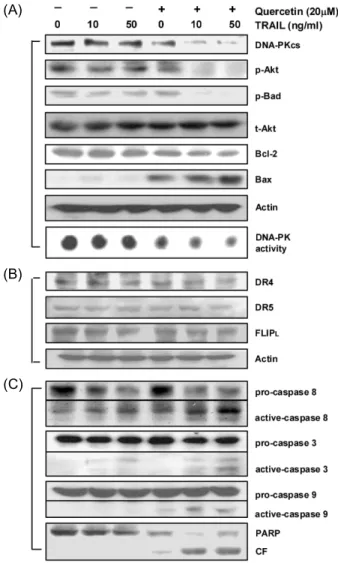
We next determined whether inhibition of DNA-PK/Akt pathway and subsequently activation of apoptosis machi- nery occurred in K562 cells by combined treatment of quer- cetin (20 μM) and TRAIL (10- or 50 ng/ml) (Fig. 3A). As

(A)

(B)

(C)

Fig. 3. Effect of quercetin on TRAIL-induced modulation of DNA-PK/Akt signaling- and apotosis-related molecules and its effect on modulation of caspases in K562 cells.

Cells were treated with quercetin (20 μM) in the pres- ence or absence of TRAIL (10 or 50 ng/ml) for 24 hr.

Thereafter, western blot analysis was performed to

monitor levels of DNA-PKcs, p-Akt, total Akt, pBad,

Bcl-2 and Bax (A), DR4, DR5, and c-FLIPL (B). PARP,

EMSA was carried out to measure level of Ku

DNA-binding activity in the cells. DNA-PK activity was

measured by kinase activity assay of whole DNA-PK

complex. The activation of caspases 3,-8 and -9 and

PARP cleavage were determined by western blot analy-

sis (C). CF: cleavage fragment.

(5)

expected, the levels of both DNA-PKcs and p-Akt synergisti- cally reduced but total Akt did not affect level by co-treat- ment of K562 with TRAIL and quercetin. Also, synergistic reduction of DNA-PK kinase activitity and subsequently ac- tivation of apoptosis machinery was observed in K562 cells treated with quercetin and TRAIL. The cleavage of PARP and concurrent down-regulation of Bcl-2 and up-regulation of Bax were occurred in K562 cells co-treated with TRAIL and quercetin, whereas the cells treated with TRAIL alone showed neither cleavage of PARP nor changed level of Bcl-2 and Bax. Because the antiapoptotic protein Bad, a down- stream target of Akt, which is phosphorylated by Akt, we also investigated the level of phosphorylation of Bad (pBad).

In K562 cells co-treated with TRAIL and quercetin, the level of p-Bad as well as p-Akt was decreased. Our results re- vealed that inhibition DNA-PK and subsequent Akt signal- ing pathway is required for TRAIL-induced apoptosis and therefore quercetin might be enhanced TRAIL sensitivity in K562 cells through inhibition of DNA-PK/Akt signaling pathway.

Effect of quercetin on TRAIL-induced apoptosis of K562 cells by caspase activation

Since it has been known that TRAIL-induced apoptosis can be increase by increasing TRAIL receptor expression and down-regulation of c-FLIP, we also determined whether quercetin promotes TRAIL-induced apoptotic death by mod- ulating the level of DR4/DR5 or c-FLIP

L

. Data from Western blot analysis revealed that the combined treatment of TRAIL (10- or 50 ng/ml) and quercetin (20 μM) did not significantly alter the level of DR4/DR5 or c-FLIP

L

protein expression.

From these results, inactivation of DNA-PK/Akt signaling pathway but not receptor-dependent death signals by quer- cetin could be required for sensitization of K562 cells to TRAIL (Fig. 3B).

On the other hand, TRAIL-induced apoptosis requires the activation of caspases and PARP cleavage is a hallmark of caspase activation. TRAIL-induced activation of caspase 8 leads to activation of downstream caspases including cas- pase 9 and -3. To determine whether quercetin enhances TRAIL-induced apoptosis by increasing the activation of cas- pases, K562 cells were treated quercetin (20 μM) in the pres- ence or absence of TRAIL (10- or 50 ng/ml), and then changed activity of caspase was determined (Fig. 3C).

Combined treatment of quercetin and TRAIL gradually and synergistically induced the proteolytic processing of procas-

pase 8, quercetin dose-dependently but quercetin or TRAIL alone did not induce significant level of proteolytic process- ing of procaspase 8. Similar results were observed for cas- pase 9 and caspase 3 activation by combined quercetin and TRAIL treatment. K562 cells co-treated with quercetin and TRAIL showed activation of both caspase 9 and caspase 3, whereas quercetin or TRAIL alone did not in and degrada- tion of PARP duce the activation of these caspases.

Moreover, the combined treatment of quercetin and TRAIL causes severe cleavage of PARP, a well known endogenous substrate of caspase 3, whereas quercetin or TRAIL alone failed to induce cleavage of PARP. These results showed that quercetin enhanced TRAIL-induced activation of the cas- pases 8, -9, -3 and the associated cleavage of PARP, and thus sensitization of TRAIL-induced apoptosis by treatment with quercetin is associated with an increase in the activation of caspases 8, -9, and -3.

We conversely confirmed whether TRAIL also affects quercetin-mediated modulation of DNA-PK/Akt signaling- and apotosis-related molecule (Fig. 4A). Data from western blot analysis clearly showed that high dose of quercetin or TRAIL alone could not cleave DNA-PKcs but degradation of DNA-PKcs that cleaved by caspase 3 was observed in K562 cells co-treated with quercetin and TRAIL in a querce- tin-dose dependent manner, which parallels that p-Akt and subsequent Hsp70 levels as well as Ku DNA-binding activity were severely reduced when the cells co-treated with quer- cetin and TRAIL but the combined treatment did not alter the level of total Akt. Consequently, up-regulation of Bax and concurrent down-regulation of Bcl-2 were occurred in K562 cells co-treated with TRAIL and quercetin.

In addition, K562 cells were treated with various concen-

trations of quercetin (20-, 100- and 200 μM) in the presence

or absence of TRAIL (50 ng/ml) for 4 hr, and then changed

activity of caspase was determined (Fig. 4B). TRAIL gradu-

ally and synergistically induced the proteolytic processing

of procaspase 8, quercetin dose-dependently by quercetin

but quercetin or TRAIL alone did not induce significant level

of proteolytic processing of procaspase 8. Similar results

were observed for caspase 9 and caspase 3 activation by

combined quercetin and TRAIL treatment. K562 cells

co-treated with quercetin and TRAIL showed activation of

both caspase 9 and caspase 3, whereas quercetin or TRAIL

alone did not in and degradation of PARP duce the activa-

tion of these caspases. Moreover, the combined treatment

of quercetin and TRAIL causes severe cleavage of PARP,

(6)

(A)

(B)

Fig. 4. The effect of TRAIL molecule on quercetin-induced modu- lation of DNA-PK/Akt and apotosis-related molecules and its effect on modulation of caspases in K562 cells. Cells were treated with graded doses of quercetin (20-, 100- and 200 μM) in the presence or absence of TRAIL (50 ng/ml) for 4 hr, and then harvested. Western blot analysis was performed to monitor levels of DNA-PKcs, total Akt, p-Akt, Hsp70, Bax and Bcl-2 (A). The activation of cas- pases 3,-8 and -9 and PARP cleavage were determined by western blot analysis (B). CF: cleavage fragment.

whereas quercetin or TRAIL alone failed to induce cleavage of PARP. These results showed that TRAIL enhanced quer- cetin-induced activation of the caspases 8, -9, -3 and the asso- ciated cleavage of PARP.

Sensitization of CEM cells to TRAIL by quercetin

Since we found that quercetin enhanced TRAIL response of K562 cells by inhibition of DNA-PK signaling pathway, we also examined whether quercetin promotes TRAIL-in- duced apoptosis in other human leukemic cells (Fig. 5).

When human leukemic lymphoid CEM cells were treated

Fig. 5. Effect of quercetin on TRAIL-induced apoptosis in CEM cells. Cells were treated with quercetin (20 μM) in the presence or absence of TRAIL (2 or 10 ng/ml) for 48 hr. Thereafter, the percent of apoptotic cells in each cell population was determined by Annexin V staining and flow cytometry. Each point is the average of triplicate determinants (P<0.05).

with TRAIL (2- and 10 ng/ml) for 24 hr, TRAIL-induced apoptosis in CEM cells was not observed with TRAIL alone.

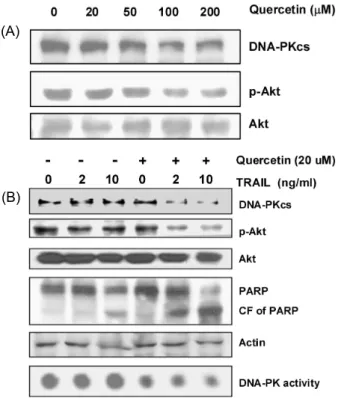
However, CEM cells, like K562 cells, clearly showed that TRAIL-mediated apoptosis was synergistically enhanced by quercetin. We observed that quercetin acted in synergy with TRAIL to increase apoptosis in CEM cells in a dose-depend- ent manner. To check the effect of quercetin on DNA-PK signaling pathway against CEM cells, the cells were treated with various doses of quercetin (20~200 μM), and the changed levels of DNA-PKcs, p-Akt, total Akt and were de- termined (Fig. 6A). CEM cells showed that the levels of DNA-PKcs and p-Akt were significantly reduced but the lev- el of total Akt was not changed by treatment of quercetin at high concentrations (100- and 200 μM), which is almost the same results in K562 cells. We next determined whether quercetin enhances TRAIL-induced apoptosis by increasing the inhibition of DNA-PK/Akt signaling cascade and PARP cleavage (Fig. 6B). The levels of both DNA-PKcs and p-Akt in CEM cells were synergistically decreased but total Akt did not affect level by co-treatment of TRAIL and quercetin.

The kinase activity of whole DNA-PK complex was also de- creased in CEM cells by combined treatment of quercetin and TRAIL. PARP cleavage was remarkably accelerated in the cells co-treated with TRAIL and quercetin than TRAIL or quercetin alone.

Therefore, our results suggest that activation of DNA-PK

pathway limits TRAIL-induced apoptosis via Akt activation

and thus quercetin acts in synergy with TRAIL to enhance

(7)

(A)

(B)

Fig. 6. Effect of quercetin on expression of DNA-PKcs/Akt and synergistic effect of quercetin and TRAIL on DNA-PK/

Akt signaling-related molecules in CEM cells. Cells were indicated doses of quercetin for 24 hr, and subjected to western blot analysis to monitor levels of DNA-PKcs, p-Akt, and t-Akt (A). Cells were treated with quercetin (20 μM) in the presence or absence of TRAIL (2 or 10 ng/ml) for 24 hr, and then harvested. Western blot analysis was performed to monitor levels of DNA-PKcs, total Akt, p-Akt, and cleavage of PARP. DNA-PK activity was meas- ured by kinase activity assay of whole DNA-PK complex.

TRAIL-induced apoptosis in human leukemia cells such as K562 and CEM cells by inhibition of DNA-PK as well as Akt signaling pathway, which leads to TRAIL-mediated acti- vation of caspase, and PARP cleavage. This model provides a framework for overcoming of TRAIL resistance of other cancer cells by combined treatment of TRAIL and agent that targeted inhibition of DNA-PK activity.

Discussion

Induction of apoptosis in cancer cells by TRAIL is a prom- ising therapeutic principle in oncology, although toxicity and resistance against TRAIL are limiting factors. Indeed, many tumors remain resistant towards treatment with TRAIL, which has been related to the dominance of an- ti-apoptotic signals. Therefore, the purpose of this study was to target key anti-apoptotic molecules deciding TRAIL resist-

ance for sensitization of TRAIL-resistant human leukemic cells such as K562 and CEM cells. We found that DNA-PK could interfere with TRAIL-induced apoptosis in human leu- kemic cells through activation of Akt signaling pathway and DNA-PK/Akt signaling pathway plays an essential role in regulating cells to escape from TRAIL-induced apoptosis.

A variety of reports has suggested the role of Akt in che- motherapeutic resistance to apoptosis and indicated its pro- survival function [7,23,24,26,30]. Indeed, it has been reported that activated Akt subsequently phosphorylates and in- activates several proapoptotic molecules including TRAIL and thus down-regulation of Akt activity promotes TRAIL cytotoxicity [2,36].

In addition to having a role in DSB repair of DNA-PK, the DNA-PK catalytic subunit, a member of PI3K family, performs an essential phosphorylation on Akt Ser-473 [8].

Since DNA-PKcs physiologically interacts with and activates Akt, it is very possible that both DNA-PK and Akt activities contribute to cancerous cell survival.

In this study, we suggest that the susceptibility to TRAIL-induced cytotoxicity is associated with inhibition of DNA-PK/Akt signaling cascade in human leukemic cells.

K562 cells expressing constitutive high level of p-Akt and DNA-PKcs exhibited resistant to TRAIL, whereas K562/R3 variant isolated from K562 cells displaying loss of DNA- PKcs/p-Akt level and their kinase activities through in- activation of DNA-PK/Akt signaling cascade exhibited rath- er hypersensitivity to TRAIL (data not shown). Therefore, our data indicated the possibility that K562 cells protect against TRAIL-induced apoptosis by activation of DNA-PK/

Akt signaling pathway, and target them to induce growth inhibition and apoptosis in response to TRAIL. It indicated that targeting of DNA-PK as a key modulator of TRAIL re- sponsiveness could help to design TRAIL-based combina- tions for treatment of human leukemia cells.

DNA-PK acts upstream to Akt and is important for both phosphorylation and activation of Akt. Indeed, it has been reported that tumor cells resistant to anticancer drugs show increases in both DNA-PK expression and its kinase activity [35], and the use of inhibitor that possesses inhibitory action of DNA-PK activity improved the effectiveness of anticancer drug [19,41], suggesting that DNA-PK may play an im- portant role in the development of drug resistance.

Therefore, TRAIL in combination with agents that down-reg-

ulate DNA-PK can have clinical applicability in treating

TRAIL-insensitive human leukemic cells.

(8)

Quercetin is known to inhibit Akt phosphorylation as well as expert multiple effects on cellular growth and apoptosis [34]. We found that quercetin possesses inhibitory action of expression and activity of both DNA-PK and Akt at high concentration, suggesting possibility that quercetin could potentiate TRAIL-induced apoptosis by inhibition of DNA-PK and p-Akt signaling cascade.

Our data showed that quercetin potentiated TRAIL-medi- ated cytotoxicity and synergistically enhanced apoptosis when K562 cells were co-treated with TRAIL and quercetin, suggesting the possibility that TRAIL-resistance of leukemic cells could be overcome and restored TRAIL sensitivity by quercetin. We revealed the molecular mechanism that quer- cetin acted in synergy with the TRAIL to increase apoptosis in leukemic cells. By combination of these agents, inhibition of Akt phosphorylation via down-regulation of DNA-PK was occurred in the cells, which consequently led to TRAIL-mediated activation of caspase such as caspase 3, -8 -9 and cleavage of PARP. Concurrently, up-regulation of Bax and down-regulation of Bcl-2 were observed in the cells treated with these agents but treatment with quercetin or TRAIL alone did not significantly modulate this signaling cascade. From these results, inhibition of DNA-PK/Akt sig- naling pathway but not receptor-dependent death signals by quercetin could be required for sensitization of K562 cells to TRAIL. A similar mechanism is operative in other human leukemic CEM cells. Quercetin sensitizes TRAIL-resistant CEM cells expressing constitutive high level of DNA-PK and p-Akt to TRAIL-induced apoptosis by inhibition of DNA- PK/Akt signaling pathway.

Therefore, quercetin is a potent promoter of TRAIL-in- duced apoptosis and thus might be candidate to overcome resistance of TRAIL-insensitive other cancer cells expressing constitutive high level of DNA-PK. Therefore, selective in- hibition of DNA-PK/Akt signaling pathway may be benefi- cial for anticancer therapy of TRAIL.

Overall, our study provides important insights into how quercetin promotes TRAIL-induced apoptotosis against TRAIL-resistant human leukemic cells and this model pro- vides a framework for overcoming of TRAIL resistance of other cancer cells including prostate, lung, ovarian and breast cancer cells.

Acknowledgement

This work was supported for two years by Pusan National

University Research Grant.

References

1. Almasan, A. and A. Ashkenazi. 2003. Apo2L/TRAIL: apop- tosis signaling, biology, and potential for cancer therapy.

Cytokine Growth Factor Rev. 14, 337-348.

2. Asakuma, J., M. Sumitomo, T. Asano, T. Asano, and M.

Hayakawa. 2003. Selective Akt inactivation and tumor ne- crosis actor-related apoptosis-inducing ligand sensitization of renal cancer cells by low concentrations of paclitaxel.

Cancer Res . 63, 1365-1370.

3. Baritaki, S., S. Huerta-Yepez, T. Sakai, D. A. Spandidos, and B. Bonavida. 2007. Chemotherapeutic drugs sensitize cancer cells to TRAIL-mediated apoptosis: Up-regulation of DR5 and inhibition of Yin Yang 1. Mol. Cancer Ther. 6, 1387-1399.

4. Butler, L. M., V. Liapis, S. Bouralexis, K. Welldon, S. Hay, M. Thaile, A. Labrinidis, W. D. Tilley, D. M. Findlay, and A. Evdokiou. 2006. The histone deacetylase inhibitor, sub- eroylanilide hydroxamic acid, overcomes resistance of hu- man breast cancer cells to Apo2L/TRAIL. Int. J. Cancer 119, 944-954.

5. Chen, X., H. Thakkar, F. Tyan, S. Gim, H. Robinson, C. Lee, S. K. Pandey, C. Nwokorie, N. Onwudiwe, and R. K.

Srivastava. 2001. Constitutively active Akt is an important regulator of TRAIL sensitivity in prostate cancer. Oncogene 20, 6073-6083.

6. Cheng, J., B. L. Hylander, M. R. Baer, X. Chen, and E. A.

Repasky. 2006. Multiple mechanisms underlie resistance of leukemia cells to Apo2 Ligand/TRAIL. Mol. Cancer Ther . 5, 1844-1853.

7. Downward, J. 2004. PI 3-kinase, Akt and cell survival.

Semin. Cell Dev. Biol . 15, 177-182.

8. Dragoi, A. M., X. Fu, S. Ivanov, P. Zhang, L. Sheng, D. Wu, G. C. Li, and W. M. Chu 2005. DNA-PKcs, but not TLR9, is required for activation of Akt by CpG-DNA. EMBO J.

24, 779-789.

9. Dyer, M. J., M. MacFarlane, and G. M. Cohen. 2007. Barriers to effective TRAIL-targeted therapy of malignancy. J. Clin.

Oncol . 25, 4505-4506.

10. Elrod, H. A. and S. Y. Sun. 2008. Modulation of death re- ceptors by cancer therapeutic agents. Cancer Biol. Ther. 7, 163-173.

11. Feng, J., J. Park, P. Cron, D. Hess, and B. A. Hemmings.

2004. Identification of a PKB/Akt hydrophobic motif Ser-473 kinase as DNA-dependent protein kinase. J. Biol.

Chem . 279, 41189-41196.

12. Gamet-Payrastre, L., S. Manenti, M. P. Gratacap, J. Tulliez, H. Chap, and B. Payrastre. 1999. Flavonoids and the in- hibition of PKC and PI 3-kinase. Gen. Pharm a col . 32, 279-286.

13. Griffith, T. S. and D. H. Lynch. 1998. TRAIL: a molecule with multiple receptors and control mechanisms. Curr.

Opin. Immunol . 10, 559-563.

14. Guo, F., C. Sigua, J. Tao, P. Bali, P. George, Y. Li, S.

Wittmann, L. Moscinski, P. Atadja, and K. Bhalla. 2004.

(9)

Cotreatment with histone deacetylase inhibitor LAQ824 en- hances Apo-2L/tumor necrosis factor-related apoptosis in- ducing ligand-induced death inducing signaling complex activity and apoptosis of human acute leukemia cells.

Cancer Res. 64, 2580-2589.

15. Hesry, V., C. Piquet-Pellorce, M. Travert, L. Donaghy, B.

Jégou, J. J. Patard, and T. Guillaudeux. 2006. Sensitivity of prostate cells to TRAIL-induced apoptosis increases with tu- mor progression: DR5 and caspase 8 are key players.

Prostate . 66, 987-995.

16. Hietakangas, V., M. Poukkula, K. M. Heiskanen, J. T.

Karvinen, L. Sistonen, and J. E. Eriksson. 2003. Erythroid differentiation sensitizes K562 leukemia cells to TRAIL-in- duced apoptosis by downregulation of c-FLIP. Mol. Cell Biol . 23, 1278-1291.

17. Insinga, A., S. Monestiroli, S. Ronzoni, V. Gelmetti, F.

Marchesi, A. Viale, L. Altucci, C. Nervi, S. Minucci, and P. G. Pelicci. 2005. Inhibitors of histone deacetylases induce tumor-selective apoptosis through activation of the death receptor pathway. Nat. Med. 11, 71-76.

18. Kennedy, S.G., E. S. Kandel, T. K. Cross, and N. Hay. 1999.

Akt/Protein kinase B inhibits cell death by preventing the release of cytochrome c from mitochondria. Mol. Cell Biol . 19, 5800-5810.

19. Kim, S. H., J. H. Um, D. W. Kim, B. H. Kwon, D. W. Kim, B. S. Chung, and C. D. Kang. 2000. Potentiation of chemo- sensitivity in multidrug-resistant human leukemia CEM cells by inhibition of DNA-dependent protein kinase using wortmannin. Leuk. Res . 24, 917-925.

20. Kim, Y. H. and Y. J. Lee. 2007. TRAIL apoptosis is enhanced by quercetin through Akt dephosphorylation. J. Cell Biochem . 100, 998-1009.

21. Kruyt, F. A. 2008. TRAIL and cancer therapy. Cancer Lett . 263, 14-25.

22. Kurbanov, B. M., L. F. Fecker, C. C. Geilen, W. Sterry, and J. Eberle. 2007. Resistance of melanoma cells to TRAIL does not result from upregulation of antiapoptotic proteins by NF-kappaB but is related to downregulation of initiator cas- pases and DR4. Oncogene 26, 3364-3377.

23. Lane, D., V. Robert, R. Grondin, C. Rancourt, and A. Piché.

2007. Malignant ascites protect against TRAIL-induced apoptosis by activating the PI3K/Akt pathway in human ovarian carcinoma cells. Int. J. Cancer 21, 1227-1237.

24. Larribere, L., M. Khaled, S. Tartare-Deckert, R. Busca, F.

Luciano, K. Bille, G. Valony, A. Eychene, P. Auberger, J.

P. Ortonne, R. Ballotti, and C. Bertolotto. 2004. PI3K medi- ates protection against TRAIL-induced apoptosis in primary human melanocytes. Cell Death Differ. 11, 1084-1091.

25. MacFarlane, M., N. Harper, R. T. Snowden, M. J. Dyer, G.

A. Barnett, J. H. Pringle, and G. M. Cohen. 2002.

Mechanisms of resistance to TRAIL-induced apoptosis in primary B cell chronic lymphocytic leukaemia. Oncogene 21, 6809-6818.

26. McDunn, J.E., J. T. Muenzer, L. Rachdi, K.C. Chang, C. G.

Davis, W. M. Dunne, D. Piwnica-Worms, E.

Bernal-Mizrachi, and R. S. Hotchkiss. 2008. Peptide-medi-

ated activation of Akt and extracellular regulated kinase sig- naling prevents lymphocyte apoptosis. FASEB J . 22, 561-568.

27. Mérino, D., N. Lalaoui, A. Morizot, E. Solary, and O.

Micheau. 2007. TRAIL in cancer therapy: present and future challenges. Expert Opin. Ther. Targets 11, 1299-1314.

28. Morales, J. C., M. J. Ruiz-Magaña, and C. Ruiz-Ruiz. 2007.

Regulation of the resistance to TRAIL-induced apoptosis in human primary T lymphocytes: role of NF-kappaB inhibition. Mol. Immunol. 44, 2587-2597.

29. Nagane, M., G. Pan, J. J. Weddle, V. M. Dixit, W. K.

Cavenee, and H. J. Huang. 2000. Increased death receptor 5 expression by chemotherapeutic agents in human gliomas causes synergistic cytotoxicity with tumor necrosis fac- tor-related apoptosis-inducing ligand in vitro and in vivo . Cancer Res. 60, 847-853.

30. Parcellier, A. and L. A. Tintignac, E. Zhuravleva, and B.

A. Hemmings. 2008. PKB and the mitochondria: Akting on apoptosis. Cell Signal 20, 21-30.

31. Riccioni, R., L. Pasquini, G. Mariani, E. Saulle, A. Rossini, D. Diverio, E. Pelosi, A. Vitale, A. Chierichini, M. Cedrone, R. Foà, F. Lo Coco, C. Peschle, and U. Testa. 2005. TRAIL decoy receptors mediate resistance of acute myeloid leuke- mia cells to TRAIL. Haematologica 90, 612-624.

32. Rieger, J., B. Frank, M. Weller, and W. Wick. 2007.

Mechanisms of resistance of human glioma cells to Apo2 ligand/TNF-related apoptosis-inducing ligand. Cell Physiol.

Biochem. 20, 23-34.

33. Syed, V., K. Mukherjee, S. Godoy-Tundidor, and S. M. Ho.

2007. Progesterone induces apoptosis in TRAIL-resistant ovarian cancer cells by circumventing c-FLIPL overexpression. J. Cell Biochem. 102, 442-452.

34. Thakkar, H., X. Chen, F. Tyan, S. Gim, H. Robinson, C. Lee, S. K. Pandey, C. Nwokorie, N. Onwudiwe, and R. K.

Srivastava. 2001. Pro-survival function of Akt/protein kin- ase B in prostate cancer cells. Relationship with TRAIL resistance. J. Biol. Chem. 276, 38361-38369.

35. Tian, X., G. Chen, H. Xing, D. Weng, Y. Guo, and D. Ma.

2007. The relationship between the down-regulation of DNA-PKcs or Ku70 and the chemosensitization in human cervical carcinoma cell line HeLa. Oncol. Rep. 18, 927-932.

36. Uchida, M., M. Iwase, S. Takaoka, S. Yoshiba, G. Kondo, H. Watanabe, M. Ohashi, M. Nagumo, and S. Shintani. 2007.

Enhanced susceptibility to tumor necrosis factor-related apoptosis-inducing ligand-mediated apoptosis in oral squ- amous cell carcinoma cells treated with phosphatidylinosi- tol 3-kinase inhibitors. Int. J. Oncol . 30, 1163-1171.

37. Um, J. H., C. D. Kang, J. H. Bae, G. G. Shin, D. W. Kim, D. W. Kim, B. S. Chung, and S.H. Kim. 2004. Association of DNA-dependent protein kinase with hypoxia inducible factor-1 and its implication in resistance to anticancer drugs in hypoxic tumor cells. Exp. Mol. Med . 36, 233-242.

38. Wajant, H., E. Haas, R. Schwenzer, F. Muhlenbeck, S. Kreuz, G. Schubert, M. Grell, C. Smith, and P. Scheurich. 2000.

Inhibition of death receptor-mediated gene induction by a

cycloheximide-sensitive factor occurs at the level of or up-

stream of Fas-associated death domain protein (FADD). J.

(10)

Biol. Chem. 275, 24357-24366.

39. Weterings, E. and D. J. Chen. 2007. DNA-dependent protein kinase in nonhomologous end joining: a lock with multiple keys? J. Cell Biol . 179, 183-186.

40. Yagita, H., K. Takeda, Y. Hayakawa, M. J. Smyth, and K.

Okumura. 2004. TRAIL and its receptors as targets for can-

cer therapy. Cancer Sci. 95, 777-783.

41. Zhong, X. and A. R. Safa. 2007. Phosphorylation of RNA helicase A by DNA-dependent protein kinase is indis- pensable for expression of the MDR1 gene product P-glyco- protein in multidrug-resistant human leukemia cells.

Biochemistry 46, 5766-5775.

초록:Quercetin 에 의한 사람백혈병 세포의 TRAIL에 대한 감수성 증가: DNA-PK/Akt 신호전달경 로의 관여

박준익․김미주․김학봉․배재호․박수정

1

․김동완

2

․강치덕․김선희*

(부산대학교 의학전문대학원 생화학교실,

1

국립보건원 만성질환연구부,

2

창원대학교자연과학대학 미생물학과)

TNF-related apoptosis-inducing ligand (TRAIL) 는 암세포에만 작용하고 정상세포에는 영향을 주지 않는 항암제 로서 알려져 있지만, TRAIL에 내성을 나타내는 암세포의 출현이 문제점으로 지적되고 있다. 사람 백혈병세포인 K562 및 CEM 세포는 TRAIL에 내성을 나타낸다. 본 연구에서는 이러한 백혈병 세포의 TRAIL 내성에 대한 새로운 표적 분자의 발굴과 이를 토대로 한 새로운 내성극복 방법을 연구하였다. 새로운 TRAIL sensitizer로서 quercetin을 발굴하고, 이를 K562 세포에 TRAIL과 병용 투여하므로서 TRAIL의 효과 증강에 의한 내성극복을 시도하였다.

Quercetin은 DNA-PK/Akt 신호전달경로를 억제하므로서, caspases 활성 증강과 PARP cleavage, 이에 따른 Bax의

발현을 증강시키는 기전으로 K562 세포의 TRAIL에 의한 apoptosis를 증대시키는 활성이 있음을 밝혔다. 이러한

quercetin 병용 처리에 의한 TRAIL 의 활성 증강으로 TRAIL 내성이 극복됨을 CEM 세포에서도 확인하였다. 이러한

연구 결과는 DNA-PK 발현 증강에 의한 Akt의 활성화가 TRAIL 내성을 유발하는 기전을 토대로 함을 밝힘으로써,

DNA-PK 활성 억제제를 TRAIL과 병용하므로서 TRAIL 내성을 나타내는 암세포에 내성 극복 효과를 얻을 수

있는 새로운 약제 병용 방법을 제시하였다.

수치

Fig. 1. Synergistic effect of quercetin on TRAIL-induced apopto- apopto-sis in K562 cells
Fig. 2. Effect of quercetin on DNA-PK/Akt signaling pathway in K562 cells. Cells were exposed to indicated doses of quercetin for 24 hr, and subjected to western blot  analy-sis to monitor levels of DNA-PKcs, Ku70/80, p-Akt, total Akt, and PARP
Fig. 5. Effect of quercetin on TRAIL-induced apoptosis in CEM cells. Cells were treated with quercetin (20 μM) in the presence or absence of TRAIL (2 or 10 ng/ml) for 48 hr
Fig. 6. Effect of quercetin on expression of DNA-PKcs/Akt and synergistic effect of quercetin and TRAIL on DNA-PK/

참조

관련 문서