11
Comparison of linear and non-linear equation for the calibration of roxithromycin analysis using liquid chromatography/mass spectrometry
Jong-Hwan Lim
1,2, Hyo-In Yun
1,*
1
Research Institute of Veterinary Science, Chungnam National University, Daejeon 305-764
,Korea
2
B&C Biopharm, Suwon 443-759, Korea
(Accepted: March 11, 2010)
Abstract : Linear and non-linear regressions were used to derive the calibration function for the measurement of roxithromycin plasma concentration. Their results were compared with weighted least squares regression by usual weight factors. In this paper the performance of a non-linear calibration equation with the capacity to account empirically for the curvature,
y= a
xb+ c (b 1) is compared with the commonly used linear equation,
y= a
x+ b, as well as the quadratic equation,
y= a
x2+ b
x+ c. In the calibration curve (range of 0.01 to 10
µg/mL) of roxithromycin, both heteroscedasticity and non- linearity were present therefore linear least squares regression methods could result in large errors in the determination of roxithromycin concentration. By the non-linear and weighted least squares regression, the accuracy of the analytical method was improved at the lower end of the calibration curve. This study suggests that the non-linear calibration equation should be considered when a curve is required to be fitted to low dose calibration data which exhibit slight curvature.
Keywords : heteroscedastisity, LC/MS, non-linear calibration, roxithromycin
Introduction
A completely validated, accurate and reproducible bioanalytical method is an important requirement in pharmacokinetic and biopharmaceutical studies [2, 4, 6]. The quality of bioanalytical data is highly dependent on the quality of calibration model used to generate the standard curve; therefore, the choice of an appropriate calibration model is necessary for reliable quantification [4, 6]. However, unlike the pharmaceutical analysis, the concentration range in the bioanalysis test samples is dynamic, broad and normally of the order of three or more [4]. Although using two or more standard curves with different calibration ranges is common, a single standard curve that encompasses the entire dynamic concentration range in a pharmacokinetic study is of great use during routine analysis [4, 6].
Usually, linear models are preferable, but, if needed, the use of non-linear models should be considered [4, 18]. On the other hand, one of the basic assumptions
of the ordinary least squares regression method is constancy of variance or homoscedasticity for all response values [5, 6]. Many examples in analytical chemistry indicate that this assumption is not often fulfilled, i.e. the variability of the response often increases with the response level [6, 15]. In such a situation, some remedial actions like transformation or using weighted least regression must be done in order to stabilize the variance of the response and thus it can be accounted for heteroscedasticity [6, 15].
In such cases, an ordinary least square linear regression equation, by virtue of minimizing the residuals, gives less importance to the concentrations at or near the lowest limit of quantitation (LLOQ) and gives more importance in minimizing residuals at higher concen- trations [6]. This might result in incorrect measure- ments of unknown samples near the LLOQ and thus propose to question of the validity of the assay method.
Data transformations or the application of suitable weights are generally employed to overcome heterosce-
≠
*Corresponding author: Hyo-in Yun
Research institute of Veterinary Science, Chungnam National University, Daejeon 305-764, Korea
[Tel: +82-42-821-6759, Fax: +82-42-822-5780, E-mail: [email protected]]
dasticity [4, 6, 15].
Roxithromycin is an acid-stable oxime derivative of erytrhomycin which has similar
in vitroactivity to erythromycin, but it is better absorbed after oral administration, and has a considerably longer half-life [3, 9, 13]. Various methods including high-performance liquid chromatography have been used to determine roxithromycin concentration in biological fluids for pharmacokinetic studies and therapeutic drug monitoring purposes [10, 11, 14, 17]. Most of the time, it is necessary to quantify roxithromycin over a wide concentration range in plasma or serum after adminis- tration of this drug. This fact can result in heteroscedasticity of response, so that the ordinary least squares regression methods cannot be used [10, 11, 14, 17]. The use of ordinary least squares regression in these situations could lead to the inaccurate estimation of roxithromycin concentration. In our previous studies, the calibration range of roxithromycin was divided into low and high concentration regions [10, 11].
The aim of the present study was to define a calibration function for determination of roxithromycin in dog plasma by a liquid chromatographic mass spectrometric (LC/MS) method over a 1,000-fold roxithromycin concentration range from 0.01 to 10
µg/mL. In this regard it was shown that the simple linear equation is not a suitable model. In addition, statistical methods such as linear and non-linear weighted least squares regression were evaluated to select the best model.
Materials and Methods
Chemicals
Roxithromycin as the standard was supplied by Shinil Biogen (Korea). HPLC grade methanol and acetonitrile were purchased from Mallinckrodt Baker (USA). Other analytical grade chemicals were purchased from Sigma (USA). Whole blood was obtained from healthy male beagle dogs.
Instruments and chromatographic conditions Samples were analyzed on a Hewlett-Packard 1100 series LC/MSD system. Separation was achieved on Watchers120 ODS-BP C
18reverse phase column (5
µm, 4.6 mm × 150 mm; Daiso, Japan). Mobile phase composed of 20% of 10 mM ammonium acetate (pH 3.5) and 80% of acetonitrile. The column was held at ambient temperature and the flow rate was 0.8 mL/min.
The electrospray mass spectrometry (ES-MS) analysis was performed on a Hewlett-Packard 5989 electrospray mass spectrometer with a Hewlett-Packard atmospheric pressure ionization interface fitted with a hexapole ion guide. The instrument was tuned and optimized for the transmission of the nominal positive ion of roxithromycin (m/z 837.5). The optimal condition for the analysis of roxithromycin employed pneumatic nebulization with nitrogen (45 p.s.i.) and a counterflow of nitrogen (9 L/min) heated to 350
oC for the nebulization and desolvation of the introduced liquid.
Mass spectrometer was employed using the positive ion mode and the selected ion monitoring, detecting m/
z 837.5 with a dwell time of 300 ms.
Sample preparation and calibration standards A stock solution of 1,000
µg/mL roxithomycin was prepared in methanol and working calibration standards for five replicates at concentrations of 0.01, 0.1, 0.5, 1, 2.5, 5 and 10
µg/mL were prepared in blank plasma.
Plasma blank sample was analyzed in each run. Quality control (QC) samples were prepared at four different levels for three replicates, lower level (the LLOQ), low level (ten times LLOQ), middle level and high level (the upper limit of quantitation limit, ULOQ). QC samples were prepared daily by spiking different plasma samples to produce a final concentration equivalent to 0.01, 0.1, 5 and 10
µg/mL of roxithromycin.
Sample preparation of roxithromycin was followed by the method of Lim
et al.[10, 11] with some modifications. Briefly, to 200
µL of spiked plasma, 10
µ
L of 2 N NaOH and 800
µL of ethyl acetate were added. To prevent the formation of an emulsion, extraction was performed gently for 10 min on a test- tube rotator. After centrifugation, the organic phase was transferred to tube and evaporated at 30
oC under a stream of nitrogen and then the residue dissolved in 200
µL of 0.1% acetic acid in methanol. To the reconstituted sample, 800
µL of the
n-hexane were added and vigorously shaken for 10 min. The lower layer was transferred to other tube and evaporated to dryness under a gentle stream of nitrogen at 37
oC. The dry extract was reconstituted in 40
µL of the mobile phase, of which 10
µL was injected onto the chromato- graphic system.
Calibration models
Data analysis was conducted on the pooled data
using SPSS statistical packages. Variance test (
F-test) was used in order to check for the presence of heteroscedasticity in the response data [6]. Because of the wide concentration range of roxithromycin, various types of models and weighting schemes were considered. The models were:
A:
y= a
x+ b B:
y= a
x2+ b
x+ c C:
y= a
xb+ c
where
yis peak area of roxithromycin and
xis roxithromycin concentration and a, b and c are parameters of the models. Weighting factors (w) were 1, 1/
x, 1/
x2, 1/
yand 1/
y2.
The best regression model and weighting factor was chosen according to the sum of absolute percentage relative error (%RE) values [1]. The %RE was compared with the regressed concentration (C
detected) computed from the found regression equation obtained for each weighting factor, with the nominal standard concentration (C
nominal):
The best model will be that which gives rise to a narrow horizontal band of randomly distributed %RE around the concentration axis and presents the least sum of the %RE across the whole concentration range.
Results
The homogenicity of response variance at different levels of roxithromycin was rejected through one-tailed
F
-test between highest and lowest concentrations of the calibration curve (
p< 0.01). Also, examination of the studentized residual plots of various models without
%RE = C
detectedC
nominal−C
nominal× 100
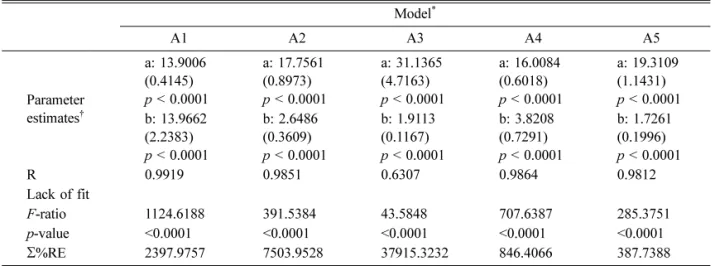
Table 1. Summary of the estimated parameters and results of lack-of-fit test for linear regression models (
y= a
x+b) fitted to data through weighted least squares regression using usual weight factors
Model
*A1 A2 A3 A4 A5
Parameter estimates
†a: 13.9006 (0.4145)
p
< 0.0001
a: 17.7561 (0.8973)
p
< 0.0001
a: 31.1365 (4.7163)
p
< 0.0001
a: 16.0084 (0.6018)
p
< 0.0001
a: 19.3109 (1.1431)
p
< 0.0001 b: 13.9662
(2.2383)
p
< 0.0001
b: 2.6486 (0.3609)
p
< 0.0001
b: 1.9113 (0.1167)
p
< 0.0001
b: 3.8208 (0.7291)
p
< 0.0001
b: 1.7261 (0.1996)
p
< 0.0001
R 0.9919 0.9851 0.6307 0.9864 0.9812
Lack of fit
F
-ratio 1124.6188 391.5384 43.5848 707.6387 285.3751
p
-value <0.0001 <0.0001 <0.0001 <0.0001 <0.0001
Σ
%RE 2397.9757 7503.9528 37915.3232 846.4066 387.7388
*
Linear regression models (
y= a
x+ b) fitted using weight factors 1 (A1), 1/
x(A2), 1/
x2(A3), 1/
y(A4) and 1/
y2(A5).
†
Standard error of parameter estimate is given in the first parenthesis below the parameter value.
Fig. 1. Studentized residual plots of the regression models fitted to data without weighting factor. (A)
y= a
x+ b; (B)
y
= a
x2+ b
x+ c; (C)
y= a
xb+ c.
any weight factor confirmed the heterogeneity of variance (Fig. 1). Therefore, each model was fitted again to the pooled data using weighted least squares regression.
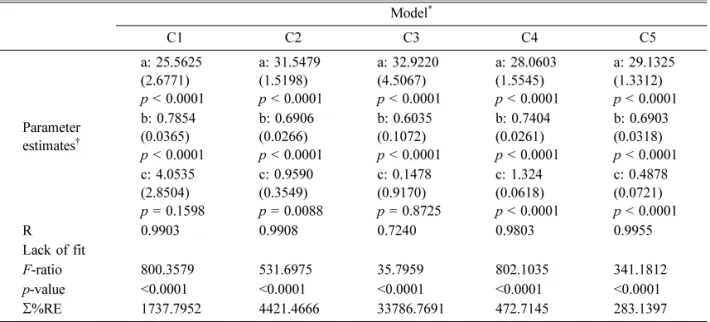
The estimated parameters and the result of lack of fit test for models fitted by weighted linear (or non-
linear) least squares regression method to data are shown in Table 1, Table 2 and Table 3. According to the results, models (A3, B3, C3) using weighting factor of 1/
x2should be discarded because of lower correlation coefficient,
R, values (
R< 0.8) or non-significance of parameters.
Table 2. Summary of the estimated parameters and results of lack-of-fit test for quadratic regression models (
y= a
x2+ b
x+ c) fitted to data through weighted least squares regression using usual weight factors
Model
*B1 B2 B3 B4 B5
Parameter estimates
†a: -0.2513 (0.0551)
p
< 0.0001
a: -0.546 (0.1079)
p
< 0.0001
a: -2.0892 (0.9541)
p
= 0.0325
a: -0.3982 (0.0685)
p
< 0.0001
a: -0.6955 (0.1608)
p
< 0.0001 b: 18.2044
(1.0119)
p
< 0.0001
b: 23.2533 (1.3294)
p
< 0.0001
b: 38.789 (5.7661)
p
< 0.0001
b: 20.6791 (0.942)
p
< 0.0001
b: 24.1742 (1.515)
p
< 0.0001 c: 8.6594
(2.2827)
p
= 0.0003
c: 2.434 (0.311)
p
< 0.0001
c: 1.8275 (0.1198)
p
< 0.0001
c: 3.0765 (0.6095)
p
< 0.0001
c: 1.6214 (0.1789)
p
< 0.0001
R 0.9888 0.9968 0.6626 0.9715 0.9942
Lack of fit
F
-ratio 741.1496 281.5199 25.4427 546.5847 190.3029
p
-value <0.0001 <0.0001 <0.0001 <0.0001 <0.0001
Σ
%RE 2081.6697 6339.7829 36167.9266 704.7675 352.7847
*
Quadratic regression models (
y= a
x2+ b
x+ c) fitted using weight factors 1 (B1), 1/
x(B2), 1/
x2(B3), 1/
y(B4) and 1/
y2(B5).
†
Standard error of parameter estimate is given in the first parenthesis below the parameter value.
Table 3. Summary of the estimated parameters and results of lack-of-fit test for power regression models (
y= a
xb+ c) fitted to data through weighted least squares regression using usual weight factors
Model
*C1 C2 C3 C4 C5
Parameter estimates
†a: 25.5625 (2.6771)
p
< 0.0001
a: 31.5479 (1.5198)
p
< 0.0001
a: 32.9220 (4.5067)
p
< 0.0001
a: 28.0603 (1.5545)
p
< 0.0001
a: 29.1325 (1.3312)
p
< 0.0001 b: 0.7854
(0.0365)
p
< 0.0001
b: 0.6906 (0.0266)
p
< 0.0001
b: 0.6035 (0.1072)
p
< 0.0001
b: 0.7404 (0.0261)
p
< 0.0001
b: 0.6903 (0.0318)
p
< 0.0001 c: 4.0535
(2.8504)
p
= 0.1598
c: 0.9590 (0.3549)
p
= 0.0088
c: 0.1478 (0.9170)
p
= 0.8725
c: 1.324 (0.0618)
p
< 0.0001
c: 0.4878 (0.0721)
p
< 0.0001
R 0.9903 0.9908 0.7240 0.9803 0.9955
Lack of fit
F
-ratio 800.3579 531.6975 35.7959 802.1035 341.1812
p
-value <0.0001 <0.0001 <0.0001 <0.0001 <0.0001
Σ
%RE 1737.7952 4421.4666 33786.7691 472.7145 283.1397
*
Power regression models (
y= a
xb+ c) fitted using weight factors 1 (C1), 1/
x(C2), 1/
x2(C3), 1/
y(C4) and 1/
y2(C5).
†
Standard error of parameter estimate is given in the first parenthesis below the parameter value.
The best fitting regression model and weighting factor was chosen taking in to account the sums of the
%RE calculated for the each regression model. The regression models with the 1/
y2weighting factor produced relatively smaller %RE sum, and the most random distribution around the x-axis at the lower end of the calibration curve. Reconsideration of residual plots for all of the weighted regression models with weighting factor 1/
y2showed that the use of these weight factors could lead to stabilization of variance (Fig. 2). The power regression equation with weighting factor 1/
y2produced the least sum of %RE for roxithromycin calibration data set providing the most adequate approxi- mation of variance. Therefore, this model was used for determination of roxithromycin as calibration curve.
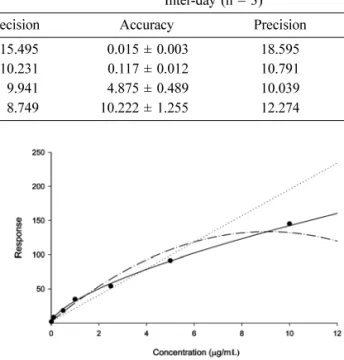
Seven concentrations of roxithromycin from 0.01 to 10
µg/mL in dog plasma were prepared to calibrate the instrument. Peak area of roxithromycin was used for regression and the standard curves were fitted to a 1/
y2
weighted power regression, where y represents the peak area of roxithromycin (Fig. 3). The accuracy and precision of the back-calculated concentrations were excellent. The limit of quantitation was defined as the lowest standard on the calibration curve as analyte peaks by which both compounds in blank plasma were identifiable, discrete and reproducible with a precision of 20% and accuracy of 80-120%. The validation data on the precision and accuracy for three replicates of QC samples are summarized in Table 4. These precision and accuracy values indicated reproducible LC/MS conditions and that the assay is consistent and reliable.
Discussion
Unlike pharmaceutical analysis, the concentration ranged in bioanalytical methods is usually dynamic and broad, presenting three or more orders of magnitude, Table 4. Inter- and intra-day accuracy and precision for the determination of roxithromycin in Beagle dog plasma
Nominal conc. (ìg/mL) Intra-day (n = 3) Inter-day (n = 3)
Accuracy Precision Accuracy Precision
0.01 0.011 ± 0.002 15.495 0.015 ± 0.003 18.595
0.1 0.124 ± 0.013 10.231 0.117 ± 0.012 10.791
5 5.445 ± 0.541 9.941 4.875 ± 0.489 10.039
10 10.130 ± 0.886 8.749 10.222 ± 1.255 12.274
Fig. 2. The residual plots for the weighted regression models with weighting factor 1/
y2. (A)
y= a
x+ b; (B)
y= a
x2+ b
x+ c; (C)
y= a
xb+ c.
Fig 3. Comparison of the calibration curves using linear regression and non-linear regression model with weighting factor 1/
y2. (A) Dotted line,
y= a
x+ b; (B) Dash-dot line,
y