• 검색 결과가 없습니다.

Correlations in the results of virus neutralization test, hemagglutination inhibition test, and enzyme-linked immunosorbent assay to determine infectious bronchitis virus vaccine potency

N/A
N/A
Protected

Academic year: 2021

Share "Correlations in the results of virus neutralization test, hemagglutination inhibition test, and enzyme-linked immunosorbent assay to determine infectious bronchitis virus vaccine potency"

Copied!
4
0
0

로드 중.... (전체 텍스트 보기)

전체 글

(1)

pISSN 2466-1384 eISSN 2466-1392 大韓獸醫學會誌 (2016) 第 56 卷 第 3 號 Korean J Vet Res(2016) 56(3) : 189~192 http://dx.doi.org/10.14405/kjvr.2016.56.3.189

189

<Short Communication>

Correlations in the results of virus neutralization test, hemagglutination inhibition test, and enzyme-linked immunosorbent assay to determine

infectious bronchitis virus vaccine potency

Mi-Ja Park

1

, Seong-Joon Joh

1

, Kang-Seuk Choi

2

, Aeran Kim

1

, Min-Goo Seo

1

, Jae-Young Song

1

, Seon-Jong Yun

1,

*

1

Veterinary Medicine and Biologics Division and

2

Avian Diseases Division, Animal and Plant Quarantine Agency, Gimcheon 39660, Korea

(Received: April 18, 2016; Revised: June 20, 2016; Accepted: July 1, 2016)

Abstract: The virus neutralization (VN) test was used to determine potency of the infectious bronchitis (IB) vaccine.

The results of VN, hemagglutination inhibition (HI), and enzyme-linked immunosorbent assay (ELISA) were compared with those of the IBV M41. The r

2

values between VN and HI titers and the ELISA antibody titer were 0.8782 and 0.0336, respectively, indicating a high correlation between VN and HI, but not VN and ELISA. The Cohen’s kappa coefficient between the VN titer of 2 log

10

and HI titer of 5 log

2

was 0.909. Our results showed that VN could be replaced with HI for testing the potency of IBV M41.

Keywords: Massachusetts 41 vaccine, hemagglutination inhibition, infectious bronchitis, potency test

Infectious bronchitis (IB) causes a highly contagious, acute respiratory disease in chickens [8]. High mortality rates from this bronchitis (especially nephropathogenic IB) may occur in young chicks. However, more substantial economic losses result from a drop in egg production and quality in laying hens with IB and growth retardation and rejection of broilers with IB during processing. IB virus (IBV), the pathogen that causes this disease, belongs to group III of the genus Coro- navirus in the Coronaviridae family [14]. It is an enveloped virus containing an unsegmented, positive-sense, single-stranded RNA genome of approximately 27.6 kb [7]. The virion has four major structural proteins, including the nucleocapsid (N) protein, envelope (E) protein, membrane (M) glycoprotein, and spike (S) glycoprotein. The S glycoprotein is post-transla- tionally cleaved into the S1 and S2 subunits [6], with the S1 subunit, located on the outside of the virion, containing virus neutralization (VN) and serotype-specific epitopes and con- ferring hemagglutination (HA) activity. Thus, S1 induces anti- bodies involved in VN and hemagglutination inhibition (HI) in the IBV host.

The severity of IB depends on many factors, including the strain of the virus and the age, nutrition, and rearing environ- ment of the chicken affected. The pathogen is highly conta- gious and ubiquitous in most of the world; thus, it is difficult to keep chickens free of IBV, especially in areas where bio- security is insufficient. Consequently, vaccination using live

attenuated and/or inactivated vaccines has been used to con- trol IBV for several decades. Although numerous vaccine strains are available, Massachusetts-type strains, including M41 and H120, have been widely used in immunizations across the world [5, 13].

Several serological tests are routinely employed for anti- body detection. These include the VN test, HI assay, and enzyme-linked immunosorbent assay (ELISA) [10, 11]. In addition, these methods have been employed to assess the potency of vaccines. The VN test is the gold standard for testing of vaccine potency. The HI test, another serological assay, has also been used to test IBV vaccine potency in many countries, including the USA, Europe, Japan and some Asian countries. However, in Korea, the HI test is still not used for potency testing of IBV vaccines. In this study, we investigated the correlations among results of three com- monly used serological tests, VN, HI, and ELISA, performed on vaccinated chicken sera.

IBV M41 strain was used for the VN and HI tests. The virus was propagated in 9- to 10-day-old specific pathogen- free (SPF) white leghorn-type embryonated chicken eggs (ECEs) (Lohmann, Germany), and the virus stock was used as viral seed stocks for VN and HI tests. The SPF chickens were administered mono and multivalent IBV vaccines via the intramuscular and intratracheal route at 6 to 8 weeks of age. Three weeks post-inoculation, 230 IBV sera were obtained

*Corresponding author

Tel: +82-54-912-0592, Fax: +82-54-912-0584

E-mail: [email protected]

(2)

190 Mi-Ja Park, Seong-Joon Joh, Kang-Seuk Choi, Aeran Kim, Min-Goo Seo, Jae-Young Song, Seon-Jong Yun

from chickens in 22 flocks, and sera were pooled by flock.

Accordingly, twenty-two sera were used for the comparison among serological tests and then stored at the Veterinary Medicine and Biologics Division, Animal and Plant Quaran- tine Agency, Korea. Prior to testing, IBV was propagated in 9- to10-day-old SPF ECEs, with incubation at 37

o

C for 32 h.

The allantoic fluid was collected and pooled. Following clar- ification at 600 × g for 10 min, ultra-centrifugation was per- formed at 58,267 × g for 150 min. The pellets were suspended in 1/100 of the original volume in phosphate buffered saline (pH 7.4). The IBV was treated with neuraminidase (Sigma, USA) at a final concentration of 200 U/mL and incubated at 37

o

C for 2 h. The antigens were stored for 8 months at 4

o

C and −20

o

C, with or without 50% glycerol, respectively [2].

The VN test was performed using the alpha method described previously [9]. Briefly, each of the ten-fold dilutions of IBV was mixed with test sera of an equal volume, and the virus/

serum mixture was incubated at 37

o

C for 1 h. After incuba- tion, 200 µL of the mixture was inoculated into 5 SPF ECEs via the allantoic cavity, and the eggs were then incubated for 7 days at 37

o

C. IBV alone was titrated in parallel as a virus control. Embryos were examined for clinical signs such as dwarfing and death on the final day, and virus titers (EID

50

) were calculated using the Reed and Muench method [12].

The virus neutralization index (VI) test was expressed by log10 difference in the titers of virus between virus/test serum mixture and virus/SPF serum mixture. HI was per- formed in V-bottom plates using 4 HA units of M41 antigen.

Before the test, all sera were heat inactivated at 56

o

C for 30 min and then treated with three volumes of 12.5% (w/v) kaolin in HEPES-buffered saline (pH 6.5) at room tempera- ture for 1 h. A 25 µL aliquot of each of the two-fold dilu- tions of test sera was mixed with the same volume of 4 HA units of IBV antigen and held at 4

o

C for 30 min. After incu- bation, 25 µL of 1% (v/v) chicken red blood cells (RBCs) was added to each well. The HI antibody titer was presented as the reciprocal of the highest dilution of sera causing com- plete inhibition of blood agglutination. The ELISA was per- formed using a commercial indirect ELISA kit (IDEXX Laboratories, USA) following the manufacture’s protocol.

Briefly, sera were diluted at 1 : 500, added to wells of a 96- well microtiter plate, and incubated at room temperature for 30 min. Secondary antibody, supplied with the kit, was incu- bated at room temperature for 30 min. The plates were read at 650 nm in an ELISA microplate reader. Titers are expressed according to the manufacturer’s recommendations. The r

2

, a measure of the correlation of the HI and VN titers and the ELISA titer, was calculated using Microsoft Excel software (Microsoft, USA), and Cohen’s kappa coefficient was calcu- lated to determine concordance between VN and HI test results [4].

For production of the IBV antigen, 30 ECEs were used for propagation of the IBV M41 strain, and allantoic fluid from inoculated eggs was harvested and pooled. The harvested fluid containing IBV was concentrated to 1/100 volume (3.5

mL) of the original fluid by ultracentrifugation. The IBV concentrates were treated with neuraminidase at 37

o

C for 2 h to expose the chicken RBC binding site on the surface glyco- protein. The treated IBV preparation was titrated by HA test in V-bottomed microtiter plates, and the IBV antigen was found to have1024 HA units per 25 µL. The IBV antigen was stored up for 8 months at 4

o

C and −20

o

C with/without glycerol. Samples were tittered on a monthly basis, and titers of HA stored at 4

o

C and −20

o

C in glycerol remained more than 8 log

2

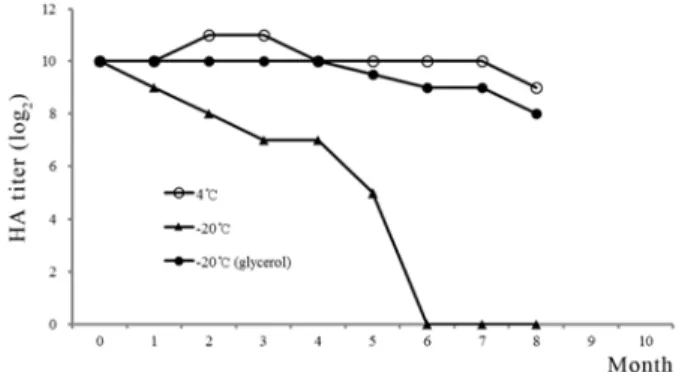
for 8 months. However, IBV antigen stored at

−20

o

C without glycerol showed a significant reduction in HA titer after 4 months (Fig. 1).

Antibody titers of 22 sera, each pooled from one of 22 flocks, were measured by standard VN, HI, and ELISA tests.

The means of VN, HI, and ELISA antibody titers were 2.1, 5, and 300, respectively. The VN titer ranged from 0.2 to 4.2, the HI titer ranged from 2 to 8, and the ELISA titer ranged from 11 to 2045 (Table 1). The r

2

value of VN and HI titers and ELISA titers were 0.8782 and 0.0336, respectively (Fig.

2). The results showed a high correlation between results of VN and HI tests, but not between the VN test and ELISA.

The Cohen’s kappa coefficient for the concordance between the VN titer of 2 log

10

and HI titer of 5 log

2

was 0.909.

HI and VN tests have been used for IBV testing in the USA, Europe, Japan, and other Asian countries. However, VN has been the only test applied in Korea

.

Although VN is the gold standard, the test has shortcomings: subjectivity in the end-point reading, labor- and time-intensiveness, expense, and concerns about animal welfare. HI was more useful than the VN test in Korea and company of vaccine manufacture.

As a result, potency testing of mono and multi-valent IB M41 vaccines by VN could be replaced by HI testing

.

How- ever, correlation was only seen between homogeneous IBV M41 serotypes (Fig. 2).

There was good agreement between our results and those of Alexander et al. [1] and Alexander and Gough [3]. There was a high correlation between results of the VN and HI tests. These results indicate that VN and HI antibodies are primarily induced against the S1 subunit and intact S pro- tein, which may be a major requirement for the induction of protective immunity.

Fig. 1. Stability of hemagglutination (HA) antigen for M41 vac-

cine strain.

(3)

Correlations in VN, HI, and ELISA of the IB vaccine 191

Acknowledgments

This work was supported by the Animal and Plant Quaran- tine Agency, Republic of Korea.

References

1. Alexander DJ, Bracewell CD, Gough RE. Preliminary evaluation of the haemagglutination and haemagglutination inhibition tests for avian infectious bronchitis virus. Avian Pathol 1976, 5, 125-134.

2. Alexander DJ, Chettle NJ. Procedures for the haemaggluti- nation and the haemagglutination inhibition tests for avian infectious bronchitis virus. Avian Pathol 1977, 6, 9-17.

3. Alexander DJ, Gough RE. A long-term study of the pathogenesis of infection of fowls with three strains of avian infectious bronchitis virus. Res Vet Sci 1978, 24, 228-233.

4. Blackman NJM, Koval JJ. Interval estimation for Cohen’s kappa as a measure of agreement. Stat Med 2000, 19, 723- 741.

5. Britton P, Armesto M, Cavanagh D, Keep S. Modification of the avian coronavirus infectious bronchitis virus for vaccine development. Bioeng Bugs 2012, 3, 114-119.

6. Cavanagh D. Coronavirus IBV: structural characterization of the spike protein. J Gen Virol 1983, 64, 2577-2583.

7. Cavanagh D, Davis PJ, Cook JKA, Li D, Kant A, Koch G. Location of the amino acid differences in the S1 spike glycoprotein subunit of closely related serotypes of infectious bronchitis virus. Avian Pathol 1992, 21, 33-43.

8. Cavanagh D, Gelb J. Infectious bronchitis. In: Saif YM, Barnes HJ (eds.). Diseasse of Poultry. 12th ed. Blackwell, Ames, 2008.

9. Dawson PS, Gough RE. Antigenic variation in strains of avian infectious bronchitis virus. Arch Gesamte Virusforsch 1971, 34, 32-39.

10. de Wit JJ, Mekkes DR, Kouwenhoven B, Verheijden JH.

Sensitivity and specificity of serological tests for infectious bronchitis virus antibodies in broilers. Avian Pathol 1997, 26, 105-118.

11. King DJ, Hopkins SR. Evaluation of the hemagglutination- Table 1. Comparison of titer tested by virus neutralization (VN), hemagglutination inhibition (HI) and enzyme-linked immunosorbent

assay (ELISA) using antisera against M41 strain in mono and multi-valent vaccines

Test

Titer of antisera against M41 vaccine

B NB BBN BNG ABBN ABNE BNEP RBNG ABBNE

1* 2 3 4 5 6 7 8 9 10 11 12 13 14 15 16 17 18 19 20 21 22

VN

(log

10

) 2 2.2 3 0.4 0.8 1.8 4.2 0.6 3 3.6 1.6 2.6 3.2 3.2 0.2 0.8 0.9 1.6 1.8 2.8 3 3 HI

(log

2

) 5 6 8 2 3 5 8 2 8 6 3 7 8 7 2 3 2 4 4 7 6 6

ELISA

(titer) 300 892 2405 20 19 587 170 210 139 146 828 170 146 146 26 65 11 87 11 72 35 120

*Number of vaccine flocks. B, infectious bronchitis virus; N, newcastle disease virus; G, infectious bursal disease virus; A, low pathogenic avian influenza virus; E, duck adenovirus; P, avian metapneumo virus; R, reovirus.

Fig. 2. Correlation of HI and ELISA titers against VN of homologous M41 vaccine strain.

(4)

192 Mi-Ja Park, Seong-Joon Joh, Kang-Seuk Choi, Aeran Kim, Min-Goo Seo, Jae-Young Song, Seon-Jong Yun

inhibition test for measuring the response of chickens to avian infectious bronchitis virus vaccination. Avian Dis 1983, 27, 100-112.

12. Kim BY, Lee DH, Jang JH, Lim TH, Choi SW, Youn HN, Park JK, Lee JB, Park SY, Choi IS, Song CS.

Cross-protective immune responses elicited by a Korean variant of infectious bronchitis virus. Avian Dis 2013, 57, 667-670.

13. Lashgari MS, Newman JA. Determination of the antigenic relationships within the Massachusetts (M41) type of infectious bronchitis virus using the hemagglutination-inhibition test.

Avian Dis 1984, 28, 444-452.

14. Yan F, Zhao Y, Yue W, Yao J, Lihua L, Ji W, Li X, Liu

F, Wu Q. Phylogenetic analysis of S1 gene of infectious

bronchitis virus isolates from China. Avian Dis 2011, 55,

451-458.

수치

Fig. 1. Stability of hemagglutination (HA) antigen for M41 vac- vac-cine strain.
Fig. 2. Correlation of HI and ELISA titers against VN of homologous M41 vaccine strain.

참조

관련 문서

The main effects of rooting medium composition, growth regulators and node parts of shoot on rooting and growth of plug plantlets using stem cuttings of

Distribution of Citrus Tristza Virus or Satsusma Dwarf Virus at various parts of virus infected Satsuma mandarin

Full genome cloning and nucleotide sequence analysis of hepatitis C virus from sera of chronic hepatitis patients in Korea. Detection of hepatitis C virus RNA

Antimicrobial therapy of unexplained fever in neutropenic patients--guidelines of the Infectious Diseases Working Party (AGIHO) of the German Society of Hematology

group member들이 서로 도와 각자 연필로 밑줄 그어진 부분을 최대한 해결하고 group 전체가 모르는 부분을 빨간

management of community-acquired pneumonia: an evidence- based update by the Canadian Infectious Diseases Society and the Canadian Thoracic Society. The

GDP impact of COVID-19 spread, public health response, and economic policies. Virus spread and public

Tenofovir alafenamide versus tenofovir disoproxil fumarate for the treatment of patients with HBeAg-negative chronic hepatitis B virus infection: a randomised, double-blind,