Clostridium 종을 이용한 미역으로부터 아세톤, 부탄올, 에탄올
(ABE)
생산권정은1, 곽승희1, 김진아1, 류지아2, 박상언2, 백윤서3, 허아정3, 김성구1*
1부경대학교생물공학과
2양산제일고등학교
3예문여자고등학교
Received: May 25, 2017 / Revised: September 19, 2017 / Accepted: September 19, 2017
서 론
최근화석연료의고갈로인한불안정한유류가격과이산 화탄소에의한환경문제로인해신재생자원으로만든바 이오연료의개발이각광받고있다. 전통적으로옥수수, 밀그 리고사탕수수를사용하여바이오연료를만들어왔지만원료 의높은가격과식용작물이라는점에서적합하지못한바이 오매스였다. 따라서대체원료로서짚과나무등농업폐기 물이고려되었지만 lignocellulosic biomass의특징인리그닌
을쉽게분해하지못한다는단점을아직도해결하지못하고 있는실정이다[1].
해조류는바이오에탄올, 바이오부탄올, 바이오디젤, 바이 오가스및바이오수소등바이오연료생산을위한가장유 망한신재생자원중하나이다. 해조류는적은경작지사용, 빠른성장률이라는장점을가지고있다. 또한높은탄수화물 함량과 lignocellulosic biomass보다훨씬쉽게단당으로전
환된다[2, 3]. 해조류는광합성을통한대기중의이산화탄소
의감소와산소의증가로환경문제도해결할수있다[4]. 그
중갈조류는한국에서대량생산되고있는바이오매스이며
본 연구에 사용된 미역의 탄수화물 구성은 alginate,
laminaran, fucoidan 그리고 mannitol로구성되어있다[2].
이러한다당류의분해를위해초고온열산가수분해(hyper
Acetone, Butanol, Ethanol Production from Undaria pinnatifida Using Clostridium sp.
Jeong Eun Kwon1, Seung Hee Gwak1, Jin A Kim1, Ji A Ryu2, Sang Eon Park2, Yoon Seo Baek3, A Jeong Heo3, and Sung-Koo Kim1*
1Department of Biotechnology, Pukyong National University, Busan 48513, Republic of Korea
2Yangsanjeil High School, Yangsan 50593, Republic of Korea
3Yeamoon Girls’ High School, Busan 48570, Republic of Korea
The conversion of marine biomass to renewable energy has been considered an alternative to fossil fuels.
Butanol, in particular, can be used directly as a fuel. In this experiment, the brown alga Undaria pinnatifida was selected as a biomass for biobutanol production. Hyper thermal (HT) acid hydrolysis was used as an acid hydrolysis method to produce monosaccharides. The optimal pretreatment conditions for U. pinnatifida were determined as slurry with 10% (w/v) U. pinnatifida content and 270 mM H2SO4, and heating at 160℃ for 7.5 min. Enzymatic saccharification was carried out with Celluclast 1.5 L, Viscozyme L, and Ultraflo Max. The optimal saccharification condition was 12 U/ml Viscozyme L. Fermentations were carried out for the production of acetone, butanol, and ethanol by Clostridium acetobutylicum KCTC 1724, Clostridium beijerinckii KCTC 1785, and Clostridium tyrobutyricum KCTC 5387. The fermentations were carried out using a pH-control. The optimal ABE fermentation condition determined using C. acetobutylicum KCTC 1724 adapted to 160 g/l mannitol. An ABE concentration of 9.05 g/l (0.99 g/l acetone, 5.62 g/l butanol, 2.44 g/l ethanol) was obtained by the consumption of 24.14 g/l monosaccharide with YABE of 0.37 in pH 5.0.
Keywords: Undaria pinnatifida, hyper thermal acid hydrolysis, biobutanol, Clostridium sp., pH-control
*Corresponding author
Tel: +82-51-629-5868, Fax: +82-51-629-5863 E-mail: [email protected]
© 2017, The Korean Society for Microbiology and Biotechnology
thermal acid hydrolysis)와효소당화(enzymatic saccharifi- cation)를진행하였다.
열산가수분해방식으로전처리를진행하면 5-hydroxy-
methylfurfural (HMF), levulinic acid 그리고 formic acid 와같은저해물질이생성된다. 이러한저해물질들은균의생 장을저해하고생산성을감소시킨다. 이를보완하기위하여 온도를높임으로써열처리시간을감소시키는초고온전처 리방식을이용하였다[3].
부탄올은높은에너지함량, 낮은증기압과부식성을가졌 고가솔린과비슷한특성을지니고있는액체연료이다[5].
부탄올은 Clostridium종을사용한혐기조건에서생산되며, 먼저 acetic acid와 butyric acid가생성되고난이후아세톤 과부탄올, 에탄올이생성된다[6]. Clostridium종은 5탄당과
6탄당과같은다양한당을이용해아세톤, 부탄올, 에탄올을
생산한다[7, 8]. 따라서본연구에서는해조류인미역에서초
고온 열산 가수분해와 효소 당화를 거쳐 당을 얻은 후, Clostridium종세가지를사용하여아세톤, 부탄올, 에탄올 의생산을최대화하는연구를진행하고자한다.
재료 및 방법
실험재료 및 균주
본 실험에서는 부탄올 생성을 위해 갈조류인 미역(U.
pinnatifida)을사용하였다. 미역은자연건조후분쇄기로갈 아서입자크기가 355 μm (45 mesh) 이하의분말을사용하 였다. 구성성분분석은부경대학교사료영양연구소에의뢰하 여 AOAC 방법에의해분석을실시하였다[9]. 배지는 PGY 배 지(3 g/l peptone, 20 g/l glucose, 1 g/l yeast extract 그리고 cysteine 0.15 g/l)를사용하였고 N2 incubator에서 120 rpm, 37℃로 24시간동안 배양한 Clostridium acetobutylicum KCTC 1724, Clostridium beijerinckii KCTC 1785와 Clostridium tyrobutyricum KCTC 5387을사용하였다. 초고온 열산 가수분해와 효소당화
해조류의농도범위는 6−14% (w/v)로하였고, 황산의농 도범위는 90−450 mM로설정, 열처리시간은 160℃에서 2.5−10분간처리하였다. 온도는 140−200℃까지진행하여초 고온열산가수분해를수행하였다. 초고온열산가수분해의 효율(Ep, %)은식 (1)로나타낼수있다.
Ep (%) = (1)
여기서 ΔSmono는가수분해시생성되는단당의농도(g/l)이며, TC는 U. pinnatifida의총탄수화물함량(g/l)이다[3].
효소당화를위해전처리후 10 N NaOH를이용하여 pH
5.0로중화하였다. 효소당화는 ViscozymeL (121 β-glucanase unit/ml; Novozymes, Denmark)과 Celluclast 1.5 L (854 endo-glucanase unit/ml; Novozymes, Bagsvaerd, Denmark), Ultraflo Max (700 endo-glucanase unit/ml; Novozymes, Denmark)를 16 U/ml로희석하여단일혹은혼합하여 50℃ 에서 48 시간동안반응시켰다. 또한세가지효소중최적
이라판단되는효소를선택하여효소의최적농도를 4, 8, 12,
16 U/ml로처리하여확인하였다. Cellulase와β-glucosidase 의효소활성은 Mandels 등[10] 및 Kubicek [11]의방법에 의해분석을실시하였다.
아세톤, 부탄올, 에탄올 발효
미역가수분해산물을사용하여 120 ml serum bottle에 working volume 70 ml로하여 N2 incubator에서 120 rpm, 37℃로 8일동안발효를진행하였다. 종배양배지는 120 ml serum bottle에 working volume 70 ml으로 PGY medium (3 g/l peptone, 20 g/l glucose, 1 g/l yeast extract 그리고 cysteine 0.15 g/l)을사용하여 24시간동안 C. acetobutylicum KCTC 1724, C. beijerinckii KCTC 1785, C. tyrobutyricum
KCTC 5387 균을배양한다. 고농도의당에서순치한균은
당흡수율을증가시켜아세톤, 부탄올, 에탄올의생산을증 가시킨다고 보고되어 있다[12]. 따라서 1차 종 배양된 C.
acetobutylicum KCTC 1724, C. beijerinckii KCTC 1785, C. tyrobutyricum KCTC 5387 균을 고농도의 mannitol을 첨가한 PMY medium (3 g/l peptone, 60 g/l mannitol, 1 g/l yeast extract 그리고 cysteine 0.15 g/l)에 24시간동안 2차 종배양을 한다. 2차 종배양된 C. acetobutylicum KCTC 1724, C. beijerinckii KCTC 1785, C. tyrobutyricum KCTC
5387 균을발효영양분을첨가한미역가수분해산물에 7 ml
를접종하여발효를진행하였다. 발효첨가영양분으로 YPC (84 g/l yeast extract, 140 g/l peptone, cysteine 4.2 g/l) 2.4 ml, 140 g/l ammonium acetate 1 ml, 140 g/l MgSO4 0.5 ml, 140 g/l KH2PO4 0.5 ml, 140 g/l K2HPO4 0.5 ml를 미역가수분해산물에첨가하였다. 발효도중 pH를일정하 게유지하기위해 HCl과 NaOH를첨가하였다.
다양한단당및아세톤, 부탄올, 에탄올함량분석을위해 시료를 14,240 ×g에서 20분동안원심분리를한후상층액 을 HPLC (Agilent 1100 Series, Agilent, USA)와 gas chromatography (YL 6100, YoungLin, Korea)를이용하여 분석하였다. 아세톤, 부탄올, 에탄올수율(YABE, g/g)은식 (2) 로나타낼수있다.
YABE (g/g) = (2)
여기서 [ABE]는발효로생산되는아세톤, 부탄올, 에탄올의 Smono
Δ
--- 100TC ×
[ABE] monosaccharide
[ ]
---
최대 농도(g/l)이며, [monosaccharide]는 발효 초기 단당 (glucose + mannitol)의농도(g/l)이다.
분석방법
단당인 glucose와 mannitol, 저해물질인 5-hydroxymethyl- furfural (HMF), levulinic acid 그리고 formic acid의양측 정은 HPLC (Agilent 1100 Series, Agilent, USA)와 RID (refractive index detector)를 이용하였다. 컬럼은 Biorad Aminex HPX-87H column (300.0 × 7.8 mm)를사용하여온 도 65℃, 이동상 5 mM 황산, 유속 0.6 ml/min로하여각시 료를 35분간분석하였다[2]. 아세톤, 부탄올, 에탄올, acetic acid, butyric acid는 gas chromatography (YL 6100, YoungLin, Korea)와 FID (flame ionization detector)를이 용하였다. 컬럼은 silica capillary column HP-INNOWAX (30 m × 0.32 mm × 0.5μm, Agilent Technologies, USA)를이 용하여분석하였다[10]. 통계학적인분석방법 (SPSS, USA) 으로일원분산분석(one way analysis of variance, ANOVA) 의 post-processing인 Duncan’s multiple range test를이용하 여각 group간의유의적인차이를분석하였다(p < 0.05).
결과 및 고찰
미역의 성분 분석
미역의구성성분을 AOAC 방법으로분석한결과 48.5% 탄 수화물, 3.5% 섬유, 18.2% 단백질, 1.8% 지방, 28.0% 회분으 로구성되어있다.
초고온 열산 가수분해
미역에서아세톤, 부탄올, 에탄올발효를위한단당을생 산하기위해 one factor at a time 방법으로초고온열산가 수분해를 수행하였다. Fig. 1은 6−14%의 미역분말, 90− 450 mM의황산, 2.5분에서 10분까지의열처리시간, 그리 고 140−200℃까지의온도에대한결과를나타냈다.
Fig. 1A는다양한미역분말농도에따른초고온열산가
수분해결과이며, 온도는 160℃, 황산농도는 180 mM, 열처 리시간은 10분으로고정하여실험을진행하였다. 슬러리농 도가증가할수록가수분해되는단당과저해물질의농도도 증가하는경향을나타냈다. 하지만 10%에서초고온열산가
수분해효율(Ep)이 32.8%로가장높게나타났으며농도가
Fig. 1. Effect of optimal conditions of HT acid hydrolysis on the degradation of inhibitory compounds and monosaccharides : (A) slurry contents, (B) H2SO4 concentration, (C) thermal hydrolysis time, (D) reaction temperature. Control group of thermal acid hydrolysis was carried out with 10% (w/v) slurry content, 270 mM H2SO4, at 121℃ for 60 min.
높아질수록효율이떨어짐을확인하였다.
Fig. 1B는슬러리농도 10%, 온도는 160℃, 열처리시간 은 10분으로고정하고황산농도를 90−450 mM로처리한결
과이다. Mannitol의양은모든황산농도에서비슷한수치
를나타냈으나황산농도가 270 mM일때, 가장많은 glucose 양이생성됨을확인하였다. 그에따른초고온열산가수분해 효율(Ep)도 34.7%로가장높음을확인할수있다.
Fig. 1C는슬러리농도 10%, 황산농도 270 mM, 온도는
160℃로고정한후열처리시간을다르게하여수행한결과
이다. Glucose의농도는모두비슷하게나타났지만 7.5분에
서 mannitol의농도가가장높게나타났고그에따른초고
온열산가수분해효율(Ep)도 37.2%로가장높게나타났다. Fig. 1D는슬러리농도 10%, 황산농도 270 mM, 열처리 시간 7.5분으로고정한후온도를 140−200℃로수행하였다. 160℃를기점으로온도가높아질수록저해물질이증가하고 당이감소하는것을확인하였다. 초고온열산가수분해효율 (Ep)도 160℃에서 37.2%로가장높으며그전후로는감소하 였다. 비교를 위해 control로열산가수분해인 121℃에서 60분동안반응시켰다, control은초고온열산가수분해에비 해생성되는당은적고, 저해물질은많이생성됨을확인하였 다. 따라서이번연구에서는온도를올림으로써열처리시간 을줄일수있고그에따라저해물질의농도가낮게나타나 며그에비해생성되는당의농도는초고온열산가수분해 가더많음을확인하였다.
효소 당화
초고온전처리를최적조건으로실시한후 10 N NaOH를
이용하여 pH 5.0으로중화한뒤효소당화를실시하였다. 효 소는 Viscozyme L과 Celluclast 1.5 L, Ultraflo Max를 16 unit/ml로희석해서사용하였다. Fig. 2A는단일효소와
복합효소를사용하여가수분해를실시하였으며 50℃에서
72시간동안당화를진행한결과, 48시간이후는당이증가
하지않음을확인하여 48시간의효소당화효과를나타냈 다. 그결과, ViscozymeL (β-glucanase, Novozymes)을단 일로사용했을때, 23.9 g/l로가장높은수치를나타냈다. 이 는 다른 두 효소인 Celluclast 1.5 L (endo-glucanase, Novozymes)와 Ultraflo Max (endo-glucanase, Novozymes)의 효과가 Viscozyme L (β-glucanase, Novozymes)보다떨어짐 을알수있다. 이후, Fig. 2B와같이효소의유닛을 4, 8, 12, 16 unit/ml로각각다르게하여 pH 5.0.에서 50℃로 48시 간동안효소당화를진행한결과, 12 unit/ml에서 25.1 g/l로 16 unit/ml보다더많은당을얻었다. 최종적으로효소당화 의최적조건으로는 12 unit/ml의 Viscozyme L을사용하는 것으로확립하였다.
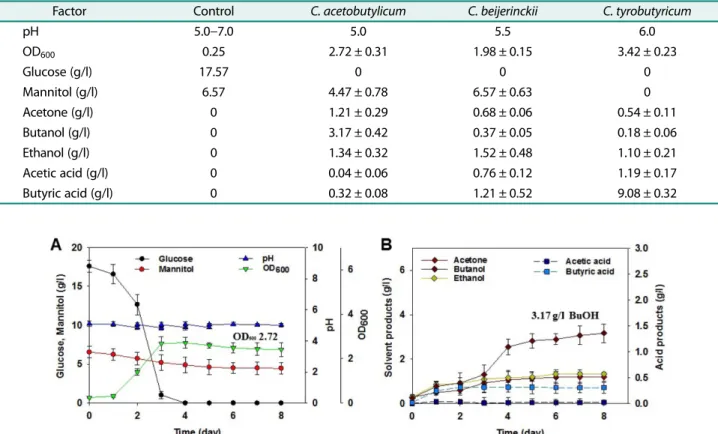
Clostridium sp.를 이용한 아세톤, 부탄올, 에탄올 발효 발효는 10% (w/v) 미역 가수분해 산물과 wild type의 Clostridium acetobutylicum KCTC 1724과 Clostridium beijerinckii KCTC 1785, Clostridium tyrobutyricum KCTC 5387 균주를이용하여 working volume 70 ml으로 120 rpm, 37℃로 8일동안수행하였다. 세균주모두 OD600 = 1.0일때 건조균체량은 0.70 g dcw/l로나타났다. Table 1은순치하 지않은 (wild type) 세균주의발효를진행할 때, pH 5.0, 5.5, 6.0, 6.5, 7.0으로 각각 고정하여 발효하였고, 초기 glucose농도는 17.57 g/l, mannitol 농도는 6.57 g/l이다. 세 균주의최적 pH에대한발효결과최적 pH가세균모두다 르게 나타났다(data not shown). C. acetobutylicum KCTC 1724는 pH 5.0에서가장많은아세톤, 부탄올, 에탄올(ABE) 이 생성되었고, C. beijerinckii KCTC 1785는 pH 5.5, C.
tyrobutyricum KCTC 5387은 pH 6.0으로나타났다. 균체수
Fig. 2. Effects of single and mixed enzyme of Celluclast 1.5L, Viscozyme L, Ultraflo Max treatments (A) and dosage of Viscozyme L (B) on monosaccharide concentration of U. pinnatifida hydrolysate at 10% (w/v) slurry after HT acid hydrolysis at pH 5.0, 45℃ for 48 h. The initial monosugar was 18 g/l after HT acid hydrolysis.
도다르게나타났는데단당의소비에있어서는 glucose는모 두소비하지만 mannitol의경우 C. acetobutylicum KCTC 1724은 2.1 g/l 정도의 소량만 소비하였고 C. beijerinckii
KCTC 1785는 아예 소비하지 못하였다. 그에 비해 C.
tyrobutyricum KCTC 5387은모두소비하는것을알수있 었다. 단당의소비에따라균체수도 C. tyrobutyricum KCTC 5387이 3.42로가장많았고이어 C. acetobutylicum KCTC 1724이 2.72, C. beijerinckii KCTC 1785가 1.98로가장작 았다. 생산된 아세톤, 부탄올, 에탄올(ABE)의 경우 C.
tyrobutyricum KCTC 5387가당을모두소비하고균체수도 가장많지만 ABE가 1.82 g/l로가장낮은값을나타냈다. 반 면 C. acetobutylicum KCTC 1724은 mannitol을거의섭취 하지못해균체수가상대적으로작았지만 ABE는 5.72 g/l로 가장높은값을나타냈다. 이는아세톤, 부탄올, 에탄올과같 은 solvent products와 acetic acid, butyric acid와 같은 acid products의생산이 pH 5.1을기점으로 pH가높으면 acid products가생산되고 pH가낮으면 solvent products가 생산된다는보고와일치되는것을알수있었다[13]. 따라서 본 연구에서는 pH 5.0에서 가장 많은 ABE를 생성한 C.
acetobutylicum KCTC 1724을선택하여 ABE 발효를진행 하였다.
순치 하지 않은 wild type C. acetobutylicum KCTC
1724의발효과정을확인하기위해시간별로진행되는단당
(glucose, mannitol)과균체수(OD600), pH, solvent products, 그리고 acid products를 Fig. 3에나타냈다. Fig. 3A에나타 낸바와 같이 단당은 glucose가 4일만에 모두소비되었고
mannitol의경우에는거의소비되지않음을확인하였다. 그
에따른 OD600 값도 3일차에 2.72로더이상증가하지않았 다. pH는 5.0으로유지하기위해 NaOH와 HCl을사용하였 다. 그에 따라생성된결과로 Fig. 3B에나타낸바와같이 solvent products는아세톤이 1.21 g/l, 부탄올이 3.17 g/l, 에 탄올이 1.34 g/l였고, acid products의 경우 acetic acid는 0.04 g/l로매우소량이생성되었고 butyric acid도 0.32 g/l 로적은양이생성되었다. 아세톤, 부탄올, 에탄올의수율을 계산했을때, YABE 값이 0.24로나타났다.
Fig. 4는 mannitol을모두소비하지못하는단점을해결 하기위해고농도의 mannitol 60 g/l를첨가한배지(PMY)에 서순치를한 C. acetobutylicum KCTC 1724을이용하여발
Table 1. Summary of acetone, butanol, ethanol production by non-adapted C. acetobutylicum KCTC 1724, C. beijerinckii KCTC 1785 and C. tyrobutyricum KCTC 5387 using U. pinnatifida hydrolysate.
Factor Control C. acetobutylicum C. beijerinckii C. tyrobutyricum
pH 5.0−7.0 5.0 5.5 6.0
OD600 0.25 2.72 ± 0.31 1.98 ± 0.15 3.42 ± 0.23
Glucose (g/l) 17.57 0 0 0
Mannitol (g/l) 6.57 4.47 ± 0.78 6.57 ± 0.63 0
Acetone (g/l) 0 1.21 ± 0.29 0.68 ± 0.06 0.54 ± 0.11
Butanol (g/l) 0 3.17 ± 0.42 0.37 ± 0.05 0.18 ± 0.06
Ethanol (g/l) 0 1.34 ± 0.32 1.52 ± 0.48 1.10 ± 0.21
Acetic acid (g/l) 0 0.04 ± 0.06 0.76 ± 0.12 1.19 ± 0.17
Butyric acid (g/l) 0 0.32 ± 0.08 1.21 ± 0.52 9.08 ± 0.32
Fig. 3. Acetone, butanol, ethanol production by non-adapted C. acetobutylicum KCTC 1724 with 10% (w/v) U. pinnatifida hydro- lysates at 37℃, 120 rpm for 8 days with pH controlled fermentation.
효를진행한결과이다. Glucose, mannitol 모두 4일차에소 비되는것을확인하였고그에따라 OD600 값도 5일차에 5.12 를나타내며순치하지않은균을사용했을때보다약 1.9배 증가하였다. pH는 5.0으로유지하여생성물의양을확인하 였다. 그결과, acetic acid는 0.04 g/l로변함이 없었으며, butyric acid는 0.46 g/l, 아세톤은 0.99 g/l로순치하지않은 균을사용했을때와크게다르지않았다. 하지만부탄올은 5.62 g/l, 에탄올은 2.44 g/l로순치를하지않았을때보다각 각 2.45 g/l, 1.10 g/l가증가한것을알수있었다. 수율을계 산했을때, YABE 값이 0.37로 0.13만큼증가하였다.
요 약
본연구에서는미역을이용하여초고온열산가수분해, 효 소당화, 발효과정을거쳐아세톤, 부탄올, 에탄올을생성하 는실험에대해진행하였다. 초고온열산가수분해에서의최 적 조건은 10%의 slurry, 270 mM의 황산, 160℃에서의 7.5분이었다. 초고온열산가수분해는열처리시간을줄이고 적은농도의황산을사용해도더많은당과적은저해물질 을생성해낸다는장점이있다. 효소당화에서는 Viscozyme L (β-glucanase, Novozymes)을 12 unit/ml으로처리하는것 이 25.1 g/l로가장 많은 단당을생성했다. 발효에서는 C.
acetobutylicum KCTC 1724이비교적낮은 pH 5.0에서많 은 아세톤, 부탄올, 에탄올을 생성하는 장점이 있었지만
mannitol을 모두 소비하지못하는 단점이 있어 고농도의
mannitol 배지에순치한 C. acetobutylicum KCTC 1724을 사용하여발효를진행하였다. 그결과, 아세톤, 부탄올, 에탄 올이 각각 0.99 g/l, 5.62 g/l, 2.44 g/l로 순치하지않은 C.
acetobutylicum KCTC 1724를이용해발효했을때보다부 탄올은 2.45 g/l, 에탄올은 1.10 g/l 증가했으며수율(YABE)은 0.24에서 0.37로증가했다.
Acknowledgments
This work was supported by the National Research Foundation of Korea(NRF) and Center for Women In Science, Engineering and Tech- nology(WISET) grant funded by the Ministry of Science, ICT & Future Planning of Korea(MSIP) under the team research program for female engineering students (WISET-2016-116-001).
This research was supported by Basic Science Research Program through the National Research Foundation of Korea, funded by the Ministry of Education (2016R1D1A1A09918683).
References
1. Jang JS, Cho YK, Jeong GT, Kim SK. 2012. Optimization of sac- charification and ethanol production by simultaneous saccha- rification and fermentation (SSF) from seaweed, Saccharina japonica. Bioprocess Biosyst. Eng. 35:11-18.
2. Cho YK, Kim HJ, Kim SK. 2013. Bioethanol production from brown seaweed, Undaria pinnatifida, using NaCl acclimated yeast. Bioprocess Biosyst. Eng. 36:713-719.
3. Ra CH, Nguyen TH, Jeong GT, Kim SK. 2016. Evaluation of hyper thermal acid hydrolysis of Kappaphycus alvarezii for enhanced bioethanol production. Bioresour. Technol. 209: 66-72.
4. Roesijadi G, Jones SB, Snowden-Swan LJ, Zhu Y. 2010. Macroal- gae as a Biomass Feedstock: A Preliminary Analysis, PNNL 19944. Pacific Northwest National Laboratory, Washington, USA.
5. Li J, Chen X, Qi B, Luo J, Zhang Y, Su Y, et al. 2014. Efficient pro- duction of acetone–butanol-ethanol (ABE) from cassava by a fermentation-pervaporation coupled process. Bioresour. Tech- nol.169: 251-257.
6. Yu M, Zhang Y, Tang IC, Yang ST. 2011. Metabolic engineering of Clostridium tyrobutyricum for n-butanol production. Metab.
Eng. 13: 373-382.
7. Hetty VDW, Sperber BL, Houweling-Tan B, Bakker RR, Branden- burg W, López-Contreras AM. 2013. Production of acetone, Fig. 4. Acetone, butanol, ethanol production by adapted C. acetobutylicum KCTC 1724 with 10% (w/v) U. pinnatifida hydroly- sates at 37℃, 120 rpm for 8 days with pH controlled fermentation.
butanol, and ethanol from biomass of the green seaweed Ulva lactuca. Bioresour. Technol. 128: 431-437.
8. Jiang W, Wen Z, Wu M, Li H, Yang J, Lin J, et al. 2014. The effect of pH control on acetone-butanol-ethanol fermentation by Clostridium acetobutylicum ATCC 824 with xylose and D-glu- cose and D-xylose mixture. Chin. J. Chem. Eng. 22: 937-942.
9. Sanchez-Machado DI, Lopez-Cervantes J, Paseiro-Losada P, Lopez-Hernandez J. 2004. Fatty acids, total lipid, protein and ash contents of processed edible seaweeds. Food Chem. 85:
439-444.
10. Mandels M, Andreotti R, Roche C. 2009. Measurement of sac- charifying cellulase. Biotechnol. Bioene. Symp. 6: 21-23.
11. Kubicek CP. 1982. β-Glucosidase excretion by Trichoderma pseudokoningii: correlation with cell wall bound β-1.3-gluca- nase activities. Arch. Microbiol. 132: 349-354.
12. Cho HY, Ra CH, Kim SK. 2014. Ethanol production from the sea- weed, Gelidium amansii using specific sugar acclimated yeasts.
J. Microbiol. Biotechnol. 24: 264-269.
13. Grupe H, Gottschalk G. 1992. Physiological events in Clostrid- ium acetobutylicum during the shift from acidogenesis to sol- ventogenesis in continuous culture and presentation of a model for shift induction. Appl. Environ. Microbiol. 58: 3896- 3902.