Trends in Agriculture & Life Sciences, Vol. 53, 2016. 12.
농업생명과학연구동향, 제53권
Brassica 속에서 자가불화합성에 대한 연구사
김동선·김성길*
전남대학교 농업생명과학대학 원예학과
A study on self-incompatibility in Brassica
Dong-Seon Kim and Sunggil Kim*
Department of Plant Biotechnology, College of Agriculture & Life Science, Chonnam National University, Gwangju 61186, South Korea
*Corresponding author: [email protected]
ABSTRACT
Self-incompatibility (SI) is defined as the inability to produce zygote after self-pollination or cross the same haplotype in a fertile hermaphrodite plant, which has stamens and pistils in the same flower. This mechanism of hermaphrodite plant have evolved to avoid inbreeding depression and low genetic diversity. Self-incompatibility can be observed in Brassica crops, including cabbage, broccoli, radish and turnip. Since the Brassica genus can produce F1 hybrid varieties through self-incompatibility, many studies have been carried out on practical aspects.
In other respects, it has been shown that pollen-stigma cognition and cell-cel linteraction, much research has been done as a model on plant signaling cascade.
Additional key words: Self-incompatibility, Brassica, Sporophytic SI
서 언
자가불화합성은 식물체에서 자가수정을 방지할 수 있는 유전적인 체계로 약 40%의 속씨식물 종 에 분포되어져 있다. 자가불화합성은 종자가 결실 되지 않는 결과가 웅성불임의 결과와 동일 했기 때문에 구별할 수 없었고, 이를 처음에는 self- sterility라고 명명하였다. 하지만 생물학적 기작에 반해서 자가불화합성과 웅성불임은 명백하게 다르 다. 웅성불임은 정상적으로 기능을 하지 못하는 수 술 또는 암술에 의해서 나타나는 현상인 반면, 자
가불화합성은 수술과 암술이 모두 정상적으로 기 능을 함에도 불구하고 특정 조합에 의해서 수정이 되지 않는 현상이다. 대부분의 자가불화합성은 다 양한 대립유전자를 갖는 하나의 유전자좌에 의해 서 조절되는데 이 유전자좌를 sterility의 ‘S’를 따 서 S-locus로 명명하였다. 자가불화합성은 꽃의 형 태학적인 특징에 따라서 이형 자가불화합성과 동 형 자가불화합성으로 분류할 수 있다. 이형 자가불 화합성의 경우 암술이 길고 수술이 짧은 thrum과 암술이 짧고 수술이 긴 pin이 있으며, 다른 꽃 형 태 사이에 수분 시 종자가 결실되는 화합성이 나
타나고, 같은 꽃 형태 사이에 수분 시 불화합성이 나타난다(Stevens and Murray 1982). 반면에, 동 형 자가불화합성은 같은 꽃 모양을 갖는 것으로 유전 양상에 따라서 Gametophytic SI와 Sporophytic SI로 분류된다(Hinata et al. 1993). Gametyphytic SI는 화분의 S phenotype이 자신의 haploid S haplotype에 의해 결정된다(Stone and Goring 2001; Watanabe et al. 2012). 이는 Rosaceae, Solanaceae, Poaceae, Onagraceae과에 속하는 식 물체에서 관찰되어진다. Sporophytic SI 는 화분의 S phenotype이 화분을 생성한 모체의 diploid S haplotype의 상호작용에 의해 결정되기 때문에 diploid S haplotype 사이에 우열관계가 나타난다 (Thompson et al. 1996; Hatakeyama et al. 1998).
Sporophytic SI에 속하는 식물 종들은 Asteraceae, Brassicaceae, Convolvulaceae과가 있다. Sporophytic SI는 주로 Brassica 속의 식물 종에서 연구가 이 루어 졌고, 자가불화합성을 결정하는 결정인자와 인지반응에 따른 신호전달 과정 등에 중점적으로 연구되었다.
자가불화합성을 결정하는 인자가 무엇인지 초기 에 연구되었고 Brassica oleracea에서 S-locus glycoprotein (SLG)을 암호화하는 유전자를 처음 발견하여 SLG 유전자가 모계결정인자로 작용할 것으로 추정되었다(Nasrallah et al. 1985). 하지만 Takasaki et al. (2000)의 연구에 따르면 형질전환 실험을 통해 S receptor kinase (SRK)를 암호화하 는 유전자가 모계결정인자로 작용함을 확인하였다.
이후 화분에서 자가불화합성을 결정하는 cysteine- rich protein을 발견하였고 이는 서로 다른 연구팀 에서 비슷한 시기에 보고되었기 때문에 S-locus cysteine-rich protein (SCR) / S-locus protein11 (SP11)로 명명되었다(Schopfer et al. 1999; Takayama et al. 2000). 이를 통해 SRK와 SCR/SP11이 특이 적인 상호작용을 통해서 자가불화합 반응이 나타 남을 확인하였고, 이후 신호전달 과정에 M-locus protein kinase (MLPK) (Murase et al. 2004), Arm-repeat containing1 (ARC1) (Stone et al.
2003), rdr6 (RNA-dependent RNA polymerase) (Tantikanjana et al. 2009)을 암호화하는 유전자들 이 관여하는 것으로 보고되었다.
1. S-locus glycoprotein (SLG)
자가불화합성에 관여하는 단백질을 찾기 위한 초기 연구에서 많은 연구자들은 주로 Brassica와 Nicotiana 종을 사용했다. 이들 두 종은 female S gene으로부터 유래한 단백질이 암술머리(stigma)와 암술대(style)에서 많이 발견된다고 알려져 있었기 때문이다(Nettancourt et al. 2001). Brassica 종의 경우, immunological cross reactivity와 isoelectric focusing (IEF)을 사용해 S gene에 대한 allelic diversity가 확인되었다(Nasrallah et al. 1967;
Nishio et al. 1978). 이렇게 확인된 단백질이 식물 lectin인 concanavalin A와 반응한다는 것을 토대 로 이 단백질이 carbohydrate moiety라는 것을 추 론했고, 이를 S-locus glycoprotein (SLG)이라 명 명했다(Nettancourt et al. 2001). 이후 많은 식물 재료로부터 정제된 SLG 단백질이 추출되었고, 이 를 통해 Brassica rapa와 B. oleracea에서 SLG 유 전자를 암호화(coding)하고 있는 cDNA clone을 확보하게 되었다. 이때부터, SLG유전자는 몇가지 근거를 바탕으로 자가불화합성에 관여하는 female S gene으로 추측되었다. 첫째, SLG는 소수성 신호 단백질(hydrophobic signal peptide)에 의해 세포벽 으로 분비된다(Nasrallah et al. 1985; Takayama et al. 1987; Kishi-Nishizawa et al. 1990). 둘째, 서로 다른 S allele로부터 얻은 30가지 이상의 SLG 유전자 서열정보를 비교해 본 결과, 염기서열 이 완벽하게 보존된 지역(conserved region)과 염 기서열의 다양성이 큰 지역(variable regions)이 각 각 존재했는데, 염기서열의 다양성이 큰 지역은 male S gene과 상호작용을 하는데에 적합한 특성 이라 추정되었다(Watanabe et al. 1999). 셋째, SLG유전자의 잘 보존된 지역을 바탕으로 PCR을 수행해 S allele을 분류해 본 결과, Brassica F1
hybrid 품종을 육성하는데 실질적으로 도움이 되 었다. 하지만 이러한 근거들에도 불구하고 자가불 화합성의 인식과정에서 SLG 단백질이 어떤 기능 을 하는지는 알 수 없었다(Watanabe et al. 1999).
이 후 실제 female Sgene인 SRK 유전자가 확인되 면서 SLG 유전자의 역할에 대한 연구자들의 관심 은 사라져갔다.
2. Female S determinant(S-locus receptor kinase)에 대한 연구
SLG 단백질에 대한 발견 이후, S locus에 대한 중점적인 연구가 진행되었다. 그러던 중 옥수수에 서 receptor-like protein kinase인 ZmPK1이 발견 되었는데, 이 유전자의 수용체 부분(receptor domain) 은 SLG 유전자와 높은 상동성을 가지고 있었다 (Walker et al. 1990). 이러한 발견을 토대로 B.
rapa, B. oleracea, B. napus에서 S-locus receptor like kinase를 암호화하는 다양한 allele의 SRK 유 전자가 발견되고, 그 특징들이 규명되었다. SRK 유전자는 기능적으로 세 가지 domain으로 구분된 다 : Receptor domain (S domain), transmembrane domain, serine/threonine protein kinase domain (Watanabe et al. 1994; Stein et al. 1991; Goring et al. 1992; Hatakeyama et al. 1998). 흥미로운 점은, 같은 S allele간에는 SRK 유전자의 S domain 과 SLG 유전자 사이의 아미노산 서열의 유사성이 80% 이상이라는 점인데, 이는 이 두 지역이 S locus내에서 복제(duplication)된 것이라는 추측을 가능케 한다. SLG와 SRK 유전자의 확인 이후, 연 구자들의 관심은 개별 유전자가 아닌 S locus 지 역 전체를 확인 하는 데에 초점이 맞춰졌다. 이에 따라 B. rapa에서 처음으로 SLG와SRK 유전자를 모두 포함하는 76kb 크기의 genomic fragment가 성공적으로 cloning되었다(Cui et al 1999; Shiba et al 2003). 다음으로, SLG와 SRK 중 어떤 유전 자가 암술머리(stigma) 측면에서 자가불화합성 인 지(recognition) 과정에 결정적으로 관여하는 유전 자인지를 밝혀내기 위한 형질전환 실험이 진행되 었다. Takasaki 연구진의 형질전환 실험에서 SLG 유전자를 형질전환한 개체는 암술머리 측면에서 S phenotype이 바뀌지 않은 반면, SRK 유전자를 형 질전환한 개체는 S phenotype이 바뀌는 것을 확인 함으로써, SRK 유전자가 female Sdeterminant라는 것이 밝혀졌다(Takasaki et al. 2000).
3. Male S determinant (S-locus cysteine rich protein / S-locus protein 11)에 대한 연구 Female S determinant에 대한 확인 이후, male S determinant를 찾기 위해 S locus에 위치한 몇몇
유전자들에 대한 연구를 수행해 본 결과, 이들은 자가불화합성의 인지(recognition) 과정에 관여하지 않는 것으로 확인되었다(Watanabe et al. 1991;
Boyes et al. 1995; Yu et al. 1996; Watanabe et al. 1999). Pollen coat proteins (PCPs)에 대한 연 구를 통해 male S determinant를 찾게 되었다.
Brassica 종에서 anther tapetum으로부터 만들어진 PCPs는 pollen 형성에 필수적이다. 초기 연구에서 는 SLG 단백질과 상호작용을 하는 PCPs를 조사 했는데, 그 결과 cysteine-rich small protein이 SLG 단백질과 상호작용 할 수 있는 것으로 밝혀 졌다. 이 후, Bioassay를 통해 10kDa이하의 PCP 가 Male S determinant라는 것이 확인되었고, PCP-like protein을 암호화하고 있는 유전자가 S locus에 위치함을 확인했다(Suzuki et al. 1999).
SP11유전자가 Male S determinant라는 확실한 증 거를 보이기 위해 B. rapa에서 형질전환 실험이 진행되었고, 이를 통해 SP11 유전자가 Male S determinant라는 것이 확인되었다.
4. S-haplotype에 대한 연구
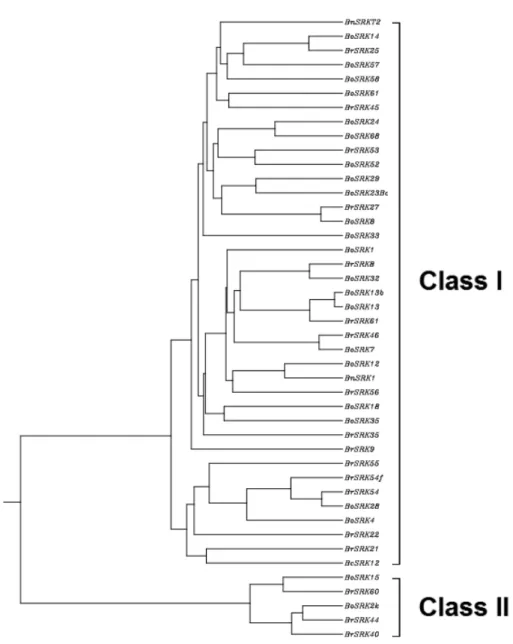
자가불화합을 결정하는 유전자좌의 SLG, SRK, SCR/SP11 유전자가 하나의 조합으로 다음 세대에 유전되기 때문에 이를 S-haplotype으로 명명하였다 (Nasrallah et al. 1993). 지금까지 밝혀진 바 S-haplotype은 Brassica rapa에서 약 100가지 이 상으로 보고되었고, Brassica oleracea에서 약 50 여가지의 haplotype이 보고되었다. S-haplotype은 SLG 또는 SRK S domain의 아미노산 서열에 따 라서 두 가지 그룹으로 분류할 수 있다(Fig. 1).
SLG 또는 SRK Sdomain의 아미노산 서열이 같은 그룹안에서는 약 72%의 유사성을 보이며, 다른 그 룹 사이에서는 70% 이하의 유사성을 보인다 (Nishimo and Kusaba et al. 2000). 두 가지 그룹 을 가지는 S-haplotype의 특징을 조사한 결과 일반 적으로 화분에서 ClassⅠ S-haplotype이 ClassⅡ S-haplotype에 대해 우성인 특징을 가지고 있으며, 평균적으로 ClassⅠ S-haplotype에서 더 강한 자가 불화합성을 가지는 것으로 보고되었다(Nasrallah et al. 1991).
Fig. 1. B.rapa, B.oleracea S-locus receptor kinase(SRK) ClassⅠ과 ClassⅡ phylogenetic tree.
초 록
자가불화합성은 암술과 수술이 같은 꽃 안에 모 두 갖춘 양성자 식물체에서 자가수분 또는 같은 계통 간의 수분이 발생하였을 때 수정이 되지 않 는 현상이다. 이러한 기작은 식물체가 자가수정시 발생하는 근교약세 현상과 낮은 유전적 다양성의 발생을 방지하고자 진화시켜온 기작이다. 자가불화
합성의 기작은 배추, 브로콜리, 무, 순무 등 Brassica속 식물체에서 관찰되어진다. Brassica속 식물체들은 자가불화합성의 기작을 통해 F1 hybrid 품종을 생산할 수 있기 때문에 실용적 측면에 많 은 연구가 되어졌고 다른 관점으로는 pollen- stigma의 상호 인지작용과 세포-세포 상호작용, 신 호 전달과정의 중요한 모델로써 많은 연구가 되어 졌다.
참고문헌
1. Boyes, D.C. and Nasrallah, J.B. (1995) An anther-specific gene encoded by an S locus haplotype of brassica produces complementary and differen-tially regulated transcripts. Plant Cell. 7: 1283-1294.
2. Cui, Y., Brugiere, N., Jackman, L., Bi, Y.-M.
and Rothstein, S.J. (1999) Structural and transcriptional comparative analysis of the S locus regions in two self-incompatible brassica napus lines. Plant Cell. 11: 2217-2231.
3. Goring, D.R. and Rothstein, S.J. (1992) The S-locus receptor kinase gene in a self- incompatible Brassica napus line encodes a functional serine/threonine kinase. Plant Cell.
4: 1273-1281.
4. Hatakeyama K, Watanabe M, Takasaki T, Ojima K, Hinata K (1998) Dominance relationships between S-alleles in self-incompatible brassica campestris L. Heredity. 80: 241-247.
5. Hinata, K., Watanabe, M., Toriyama, K. and Isogai, A. (1993) A review of recent studies on homomorphic self-incompatibility. Int. Rev.
Cytol. 143: 257-296.
6. Kishi-Nishizawa, N., Isogai, A., Watanabe, M., Hinata, K., Yamakawa, S., Shojima, S. and Suzuki, A. (1990) Ultrastructure of papillar cells in brassica campestris revealed by liquid helium rapid-freezing and substitution-fixation method.
Plant Cell Physiol. 31: 1207-1219.
7. Murase K., Shiba H., Iwano M., Che F.S., Watanabe M., Isogai A., Takayama S. (2004):
A membrane-anchored protein kinase involved in Brassica self-incompatibility signaling.
Science. 303: 1516-1519.
8. Nasrallah, M.E and Wallace, D.H. (1967) Immunogenetics of self-incompatibility in brassica oleracea, Heredity. 22: 519-527.
9. Nasrallah JB, Kao TH, Goldberg ML, Nasrallah ME (1985) A cDNA clone encoding an
S-locus-specific glycoprotein from brassica oleracea. Nature. 318: 263-267.
10. Nasrallah J.B., Nasrallah M.E. (1993):
Pollen-stigma signaling in the sporophytic self-incompatibility response. Plant cell. 5:
1325-1335.
11. Nettancourt, D. (2001) Incompatibility and Incongruity in Wild and Cultivated Plants, 2nd ed., Springer, Berlin, Heidelberg, New York, pp.1-322.
12. Nishio, T. and Hinata, K. (1978) Stigma proteins in self-incompatible brassica campestris L. and self-compatible relatives, with special reference to S allele specificity. Jpn. J. Genet. 53: 27-33.
13. Schopfer CR, Nasrallah ME, Nasrallah JB (1999) The male determinant of self-incompatibility in Brassica. Science. 286: 1697-1700.
14. Stein, J.C., Howlett, B., Boyes, D.C., Nasrallah, M.E. and Nasrallah, J.B. (1991) Molecular cloning of a putative receptor protein kinase gene encoded at the self-incompatibility locus of brassica oleracea. Proc. Natl. Acad. Sci. U.S.A.
88: 8816-8820.
15. Stevens VAM, Murray BG (1982) Studies on heteromorphic self-incompatibility systems : physiological aspects of the incompatibility system of primula obconica. Theor Appl Genet.
61: 245-256.
16. Stone SL, Goring DR (2001) The molecular biology of self-incompatibility.
17. Stone S.L., Anderson E.M., Mullen R.T., Goring D.R. (2003): ARC1 is an E3 ubiquitin ligase and promotes the ubiquitination of proteins during the rejection of self-incompatible Brassica pollen.
Plant Cell, 15: 885-898.
18. Suzuki, G., Kai, N., Hirose, T., Fukui, K., Nishio, T., Takayama, S., Isogai, A., Watanabe, M. and Hinata, K. (1999) Genomic organization of the S locus: identification and characterization of genes in SLG/SRK region of S9 haplotype of brassica campestris (syn. rapa). Genetics. 153:
391-400.
19. Takasaki T, Hatakeyama K, Suzuki G, Watanabe M, Isogai A, Hinata K (2000) The S receptor kinase determines self-incompatibility in brassica stigma. Nature. 403: 913-916.
20. Takayama, S., Isogai, A., Tsukamoto, C., Ueda, Y., Hinata, K., Okazaki, K. and Suzuki, A. (1987) Sequences of S-glycoproteins, products of the brassica campestris self-incompatibility locus.
Nature. 326: 102-104.
21. Takayama S, Shiba H, Iwano M, Shimosato H, Che F, Kai N, Watanabe M, Suzuki G, Hinata K, Isogai A (2000) The pollen determinant of self-incompatibility in brassica campestris. Proc Natl Acad Sci USA. 97: 1920-1925.
22. Thompson, K.F. and Taylor, J.P. (1996) Non-linear dominance relationships between S alleles. Heredity. 21: 345-362.
23. Walker, J.C. and Zhang, R. (1990) Relationship of a putative receptor protein kinase from maize to the S-locus glycoprotein of brassica. Nature.
345: 743-746.
24. Watanabe, M., Shiozawa, H., Isogai, A., Suzuki, A., Takeuchi, T. and Hinata, K. (1991) Existence of S-glycoprotein-like proteins in anthers of
self-incompatible species of brassica. Plant Cell Physiol. 32: 1039-1047.
25. Watanabe, M., Takasaki, T., Toriyama, K., Yamakawa, S., Isogai, A., Suzuki, A. and Hinata, K. (1994) A high degree of homology exists between the protein encoded by SLG and the S receptor domain encoded by SRK in self-incompatible brassica campestris L. Plant Cell Physiol. 35: 1221-1229.
26. Watanabe, M., Suzuki, G., Toriyama, K., Takayama, S., Isogai, A. and Hinata, K. (1999) Two anther-expressed genes downstream of SLG9: identification of a novel S-linked gene specifically expressed in anthers at the uninucleate stage of brassica campestris (syn.
rapa) L. Sex. Plant Reprod. 12: 127-134.
27. Watanabe M, Suwabe K, Suzuki G (2012) Molecular genetics, physiology and biology of self-incompatibility in brassicaceae. Proc Jpn Acad Ser B. 88: 519-535.
28. Yu, K., Schafer, U., Glavin, T.L., Goring, D.R.
and Rothstein, S.J. (1996) Molecular characterization of the S locus in two self-incompatible brassica napus lines. Plant Cell. 8: 2369-2380.