Annual Report on External Quality Assessment Scheme for Clinical Microbiology in Korea (2014)
Young Jin Ko
1, Mi-Na Kim
1, Eui Chong Kim
2, Jong Hee Shin
3, Nam Yong Lee
4, Sunjoo Kim
5, Seok Hoon Jeong
6, Jae- Seok Kim
7, Chang Ki Kim
8, Hye Gyung Bae
9, Nam Surp Yoon
1, Se Ik Joo
2, Yu Yeon Hwang
4, Keonhan Kim
6, In Ho Jang
10, and Jin Heo
11, as Clinical Microbiology Subcommittee, Korean Association of External Quality Assessment Service
1Department of Laboratory Medicine, University of Ulsan and Asan Medical Center, Seoul; 2Department of Laboratory Medicine, Seoul National University Hospital, Seoul;
3Department of Laboratory Medicine, Chonnam National University Hospital, Gwangju; 4Department of Laboratory Medicine and Genetics, Samsung Medical Center, Sungkyunkwan University School of Medicine, Seoul; 5Department of Laboratory Medicine, Kyungsang National University Hospital, Jinju;
6Department of Laboratory Medicine, Gangnam Severance Hospital, Yonsei University College of Medicine, Seoul; 7Department of Laboratory Medicine, Kangdong Sacred Heart Hospital, Hallym University College of Medicine, Seoul; 8Department of Laboratory Medicine, Korean Institute of Tuberculosis, Cheongju;
9Department of Laboratory Medicine, Greencross Reference Laboratory, Yongin; 10Department of Laboratory Medicine, Wonju Severance Christian Hospital, Wonju; 11Department of Laboratory Medicine, Korea University Ansan Hospital, Ansan, Korea
Annual proficiency surveys were performed in March, June and September 2014 by clinical microbiology division of The Korean Association of Quality Assurance for Clinical Laboratory. Parasitology part has been newly incorporated in this survey. For each trial, three sets which were composed of different combinations of five bacteria and yeast were distributed for gram stain, culture, identification, and antimicrobial susceptibility tests of general bacteriology and five fixed sputum smear on slides were distributed for acid fast bacilli stain. Two advanced bacteriology survey materials for culture and identification of anaerobic bacteria and mold were distributed to the voluntary participants in every trial and five mycobacterial culture and identification specimens, five anti-tuberculosis susceptibility testing specimens, and two Mycobacterium tuberculosis strains for rapid detection of rifampin and isoniazid resistance were distributed to the voluntary participants in March and June trials. Five virtual microscopic slides for stool parasite examination were open for the registered participants in June trial. A total of 340 laboratories were enrolled and 330 (97.0%), 331 (97.4%), and 331 (97.4%) returned the results on trial I, II, and III, respectively.
For bacterial identification, the percent acceptable identification of Burkholderia cepacia, Klebsiella pneumoniae, Streptococcus pyogenes, Staphylococcus aureus, Pseudomonas aeruginosa, Streptococcus pneumoniae, Streptococcus agalactiae, Plesiomonas shigelloides, and Enterococcus faecalis were greater than 95%. Group C and group D Salmonella species challenged as the different sets of M1422 resulted in the acceptable rate lower than 95%
because nine participants reported the identification of different sets. Surveillance cultures for methicillin-resistant S. aureus and vancomycin-resistant enterococci were correctly determined by 89.6% and 69.0% of the respondents, respectively. Correct identification to species level of Candida albicans, Candida auris, Candida glabrata, and Candida parapsilosis were 86.1%, 1.6%, 48.1%, and 83.8%. Vancomycin disk diffusion test in S. aureus, missing oxacillin screen or penicillin susceptibility test in S. pneumoniae and lack of reliable methods of quinolone resistance detection in Salmonella species caused unacceptable results in antimicrobial susceptibility testing. Advanced bacteriology trials revealed low performance in species identification of mold. Mycobacterial culture, identification and susceptibility test performance was kept in excellence. The performance of identification of stool parasites was acceptable >90% for detection of helminth eggs and amebic cysts but 28.6% false positive responses resulted from negative specimens. In conclusion, species-level identification of fungi of both candida species and mold were challenging to clinical microbiology laboratories. Vancomycin disk diffusion method for S. aureus and lack of proper penicillin susceptibility test for S. pneumoniae were still common cause of inaccurate results. Virtual microscopic survey has been successfully introduced in parasitology.
(J Lab Med Qual Assur 2015;37:153-178)
Key Words: Proficiency survey, Parasitology, Bacteriology, Clinical microbiology,
Mycobacterial culture, Susceptibility testing
Corresponding author:
Mi-Na Kim
Department of Laboratory Medicine, Asan Medical Center, 88 Olympic-ro 43-gil, Songpa-gu, Seoul 05505, Korea
Tel: +82-2-3010-4511 Fax: +82-2-478-0884 E-mail: [email protected] pISSN: 2384-2458
eISSN: 2288-7261
서론
대한임상검사정도관리협회 임상미생물학분과는 전체 분과 신빙도조사 참여기관들을 대상으로 그람염색, 항산균염색, 세 균 배양동정과 감수성 검사에 관한 신빙도조사 기본 모듈을 실 시하고, 자발적인 참여신청기관을 대상으로 항산균배양 및 동 정, 항결핵제 감수성 검사, 항결핵제 신속내성 검사, 까다로운 세균, 혐기성세균, 미호기성세균, 털곰팡이류 등을 포함하는 심화세균배양과 동정검사 등 네 가지 선택 모듈의 신빙도조사 를 제공하고 있다.
국제적으로 임상미생물학 검사실의 질 향상과 유지를 위 해 미국의 College of American Pathologist (CAP), 영국의 United Kingdom National External Quality Assessment Scheme, 세계보건기구(World Health Organization, WHO) 에서 다양한 수준의 신빙도조사를 실시하고 있다[1-3]. CAP 은 가장 광범위한 신빙도조사 프로그램을 제공하지만, 국내 검사실들이 참여하기에는 고비용이고, WHO는 무료이지만, WHO의 관심사인 결핵이나 항균제 내성균 검출에만 집중하 는 프로그램을 운영한다.
대한임상검사정도관리협회 임상미생물학분과는 국내 임상 미생물검사실의 수준이 발전하는 데 따라 모든 항목들에 대해 종합적인 신빙도조사 프로그램을 제공하는 것을 목표로 지난 10년간 모듈을 확대해왔지만, 아직 미흡한 부분이 있다. 기생 충학을 위해 대변 기생충동정을 위한 선택모듈을 시범사업으 로 실시했고, 연구 모듈로 털곰팡이류 동정을 위한 조사 1회, 카바페넴 내성 장내세균 선별 및 확인검사 1회 등 3가지 새로 운 모듈을 시도하였고, 이를 바탕으로 이들 분야에 대해 신빙 도조사 사업을 지속적으로 실시하고자 한다. 하지만 임상미생 물학 분야에서 가장 새롭고 빠르게 발전하고 있는 바이러스 배 양, 항원, 항체검사와 감염분자진단 분야에 대한 신빙도조사가 실시된 적이 없어서 이를 위한 모듈 개발이 시급하다. 2014년 에도 항균제감수성 검사 부분은 최근의 중요한 판독기준과 특 이적인 검사법을[4-6] 반영할 수 있는 다양한 시도를 하였다.
임상미생물학분과는 2014년 전국적인 신빙도조사에서 각 모듈별 결과를 종합적으로 분석하고, 질 관리수준, 문제점 분 석, 향상방안 등을 제시하고자 하였다. 특히 Salmonella 종의 fluoroquinolone 내성 검출의 질 향상이 필요함을 제시하였다.
재료 및 방법
1. 신빙도조사 방법
2014년 신빙도조사 사업은 3, 6, 9월에 걸쳐 3회 검체를 발
송했으며, 그람염색, 항산균염색, 일반세균의 배양, 동정, 감수 성 검사는 다섯 검체씩 모든 참여기관에 배부하였다. 항산균염 색용 슬라이드는 대한결핵연구원에서 객담 검체에 항산균을 정량결과 기대치에 따라 배합한 후 멸균처리하여 유리슬라이 드에 도말을 하여 다섯 검체씩 배부하였다 그람염색, 일반세균 의 배양, 동정, 감수성 검사는 검체는 생균을 이용하여 Amies 운송배지(Copan Italia S.P.A., Brescia, Italy)에 담긴 면봉 검체를 다섯 개씩 만들었고, 임상 검체를 가상하여 가상환자의 임상적인 배경을 제시하였고, 다양한 검체와 임상상황을 조건 으로 임상적으로 의미 있는 수준의 배양과 동정을 하도록 요구 하였다. 각 생균 검체는 Amies 운송배지에서 생존능을 실온에 서 1주일간 매일 계대배양하여 검증하였다. 항균제감수성 검 사 또한 균종과 검체에 따라 적절하게 선택하고, 판독하는지 검증하고자 하였다. 각 차수에 일반세균검사 분야는 기관별로 다섯 가지의 균주를 한 세트로 배부하였으며, 3가지 세트를 준 비하여 한 세트가 참여기관 삼분의 일 정도씩 배부되도록 무작 위로 배정하였다. 특수세균, 항산균 배양과 동정, 항결핵제 감 수성 검사, 결핵 신속내성 검사 등 네 가지 모듈은 참여를 신청 한 기관에 배부하였다. 특수세균 분야는 까다로운 세균, 혐기 성 세균, 미호기성 세균, 털곰팡이류 진균 등 난이도가 높은 균 주를 각 차수별로 2개씩 구성하여 참여를 신청한 기관에 배부 하였다. Amies 운송배지로 생존능을 만족할만큼 유지할 수 없 을 때는 냉동동결건조를 하여 배부하였다. 항산균 배양과 동 정, 항결핵제 감수성 검사, 결핵 신속내성 검사에 대한 검체는 각각 5, 5, 2개씩 대한결핵연구원에서 생균상태로 준비하였다.
모든 신청과 결과입력, 결과판정 등은 대한임상검사정도관리 협회 홈페이지에 구축된 임상미생물학분과 신빙도조사 프로 그램(http://keqas.org/)을 이용하였다.
2. 관리물질
그람염색, 세균배양 동정, 감수성 검사는 1차는 M1401-M1405,
2차 M1421-M1425, 3차 M1431-M1435 등 5개씩 검체를 준
비하였고, M1404, M1412, M1413, M1422, M1423 등은 각 2
종류의 검체를 준비하여 조합함으로써 A, B, C 3가지 세트를
구성하였다. 모든 시도에서 5개의 일반배양 검체는 그람염색,
배양과 동정을 실시하고, 각 회차의 앞 번호 두 개의 검체에 대
해 항균제 감수성 검사를 같이 실시하도록 하였다. 모든 세균
과 진균은 서울아산병원 진단검사의학과에서 배양된 임상분
리주들이었다. 세균은 혈액한천배지 또는 쵸콜렛 한천배지에
키우고, 진균은 SDA (Sabouraud Dextrose Agar) 한천배지
에 키워서 얻은 집락을 배부하여 검사하도록 하였다. 모든 검
체는 운송을 위해 Amies 배지 또는 charcoal이 포함된 Amies
배지에 담긴 면봉(Copan Italia)에 도말 검체상태로 운송하였 다. 특수세균 분야는 1차 S1401, S1402, 2차 S1403, S1404, 3 차 S1405, S1406 등 차수별로 2개씩 구성하였다. 감염성 검체 의 안전한 운송과 생존능 보존을 위해 모든 검체는 녹십자임상 검사센터와 서울임상검사센터의 임상 검체 배송시스템을 통 해 전국 참여기관에 다음날까지 배송하도록 하였다.
항산균도말은 1차 M1406-M1410, 2차 M1416-M1420, 3차 M1426-M1430 등 5개씩 도말 검체를 배부하였고, 항산균 배 양과 동정 검체는 1, 2차에 T1401-T1405, T1411-T1415 각 5 개씩 생균을 배합한 객담 검체를 배부하였고, 항결핵제 감수성 검사용으로 1, 2차에 T1406-T1410, T1416-T1420, 각 5개씩 Ogawa 배지에 자란 집락을 배부하였고, 결핵 신속내성 검사 용으로 1차에 R1401, R1402, 2차에 R1403, R1404 각 2개씩 생균을 배합한 객담 검체를 배부하였다.
기생충학은 대변 기생충 검사 도말 슬라이드 5개를 400배 배율까지 스캔하여 P1401-P1405까지 가상현미경프로그램에 등록하였다. 각 참여기관은 이 프로그램을 결과입력 사이트를 통해 접속할 수 있도록 하였다. 연구용 모듈로서 1차에 가톨릭 대학교 의과대학 이승옥교수가 털곰팡이류 배양 및 동정을 위 한 진균 검체 5개, 3차에 한림대학교 의과대학 송원근교수가 카바페넴 내성 장내세균에서 modified Hodge test (MHT)와 carbapenemase inhibition test 검사 수행능 평가를 위해 3개 검체를 Amies 운송배지에 면봉도말상태로 제작하여 배부하였다.
3. 결과 판정 및 해석
그람염색과 항산균염색은 검체당 2점씩 총 10점을 배점하 여 평가하였다. 항산균염색은 음성은 음성만을 정답 처리한 반 면, 양성은 정량값을 3단계씩 묶었을 때 90% 이상의 검사실 이 포함되는 3단계를 모두 정답으로 처리하였다. 검체를 배부 할 때 검체종류, 검사항목, 결과 판정기준을 제시하였다. 균종 동정은 종수준까지 맞는 경우를 ‘우수(good)’로, 임상적으로 속수준의 동정이 의미가 있다면 속수준까지 맞는 경우를 ‘적 절(acceptable)’하다고 판정하였다. 이 기준에 맞지 않은 답 을 하거나 답하지 않은 경우 ‘부적절(not acceptable)’로 판정 하였다. 항균제감수성 검사는 균종별로 2014년 Clinical and Laboratory Standards Institute (CLSI) M100-S24의 기준 [5]에 따라 판정했으며, 가상 검체의 종류에 따라 기준을 달 리 적용하여 해석하였다. 감수성 검사방법을 잘못 적용하였거 나 감수성 검사결과 판독이 틀린 경우와 필수적인 항균제에 대 해 검사하지 않았거나 보고하지 않도록 권하는 항균제를 결과 에 포함시킨 경우 각 0.5점씩 감점하였다. 15기관 이상에서 감 수성 검사를 보고한 항균제에 대해서만 평가를 하였고, 전체
기관의 결과 값의 일치도가 85%에 미달이면 판정을 보류하였 지만, 참고방법으로 확인검사를 통해 정답을 판단할 수 있으 면 평가하였다. 균배양검사를 하지 않거나 배양에 실패한 경 우는 감수성 검사 배정점수를 총점에서 제외하였다. 동정검 사는 각 8점, 항균제감수성 검사는 두 검체에 대해서 각 20점 을 기준으로 하였다. 항산균 배양과 동정, 항결핵제 감수성 검 사, 결핵 신속내성 검사는 각각 100점씩 배점하여 평가하였 다. Acid fast bacilli (AFB) 염색까지만 하고 동정을 하지 않 는 기관은 AFB 검출 여부로 평가를 했으며, 동정을 하는 기관 들에 대해서는 결핵과 비결핵항산균으로 동정하는 수준까지 를 acceptable로 해서 결핵을 비결핵으로 동정하거나 비결핵 을 결핵으로 동정하면 not acceptable로 평가했다. 종수준 동 정이 맞으면 good으로 평가했다. 특수세균, 기생충학 모듈, 연 구용모듈은 기관별 평가없이 해석적 보고만 하였다.
결과
2014년 임상미생물학분과 참여기관은 340기관이었고, 이 중 1차에서 330기관(97.0%), 2차에서 331기관(97.4%), 3차 에서 331기관(97.4%)이 회신하였다. 3차례의 조사 중 M1425 Haemophilus parainfluenzae의 균배양에 실패한 기관이 과 반수여서 이 세균의 생존능도 잘 보존되지 못했던 것으로 판단 하고 평가에서 제외하였다. 다른 일반세균 검체는 균배양 실패 가 매우 드물었고, S1405 Corynebacterium jeikeium, S1406 Clostridium tertium 각 1기관씩만 배양실패를 답해서 전반적 으로 다른 조사물질은 생존능이 잘 유지되었던 것으로 추정하 였다. 항산균배양 및 동정은 1, 2차 86기관이 신청하였고, 항 결핵제감수성 검사 6, 7기관, 결핵균 신속내성 검사는 23, 24 기관이 참여하였다. 액체배지 배양기관은 응답한 79기관 중 60곳이고 고체배지를 병용하는 기관이 51곳이었다. 특수세균 은 1차 91, 2차 86, 3차 85기관이 신청하였다. 기생충 검사는 118기관이 신청하였다. 카바페네메제생산 장내세균 검출에 102기관이 신청했으나 실제로 입력한 기관은 72기관이었다.
1. 그람염색과 항산균 염색
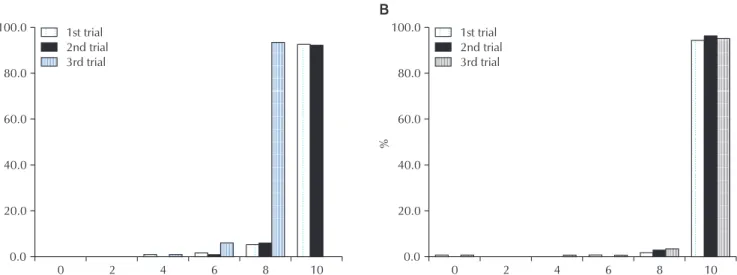
1, 2, 3차 모두에서 그람염색은 90% 이상, 항산균염색은
95% 이상의 기관들이 정답을 보고하였다(Fig. 1). 3차 신빙도
조사에서 M1425 H. parainfluenzae가 평가에서 제외되어 그
람염색 배점이 총 8점이 되었다. 그람염색은 사무적인 입력오
류가 항상 비슷한 비율로 반복되어 차수와 상관없이 비슷한 점
수분포를 보였다.
2. 세균 동정검사
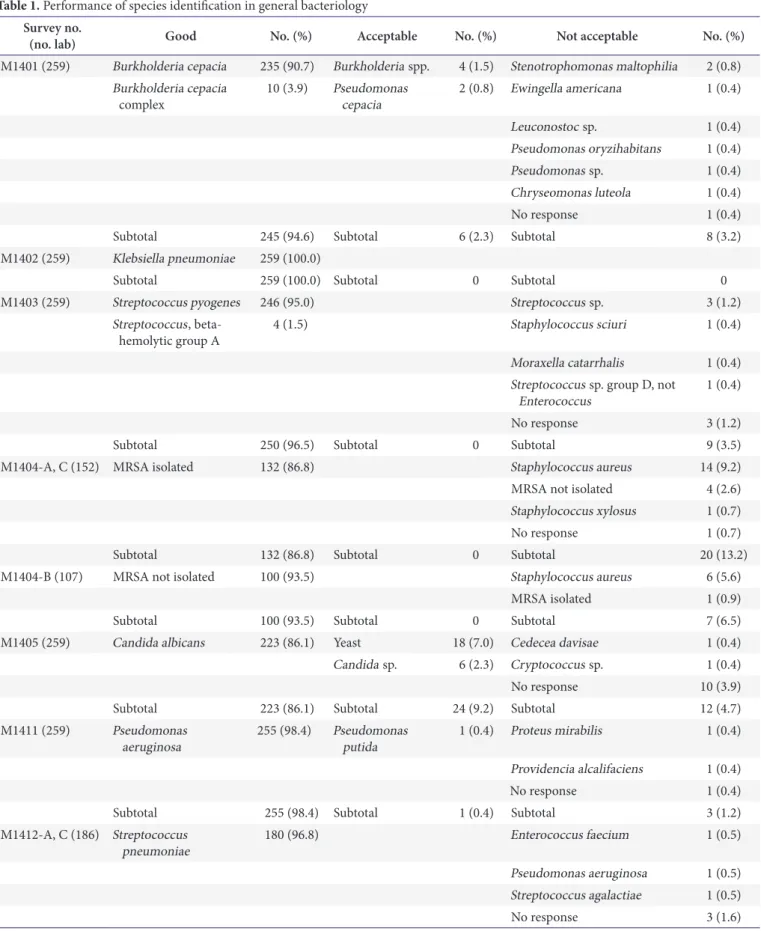
1차는 Burkholderia cepacia, Klebsiella pneumoniae, Streptococcus pyogenes, Candida albicans 균종 동정결과 의 acceptable% (good%)는 97.3 (95.0), 100 (100.0), 97.7 (97.7), 99.2 (89.6)으로 모든 균종의 동정 정확도가 90.0%
이상으로 높았다. 2차는 M1411 Pseudomonas aeruginosa, M1412 Streptococcus pneumoniae, Streptococcus agalactiae, M1415 Plesiomonas shigelloides 종수준 동정률은 99%, 96.9%, 98.4%, 91.5%로 비교적 높았다. M1413 B, C set는 vancomycin-resistant enterococci (VRE) isolated로 보고한 기관이 60%에 불과하고 VRE not isolated가 37%였던 것은 대변 상재균으로 혼합시킨 반코마이신 감수성 Enterococcus faecalis를 분리동정해서 보고한 것으로 VRE 감시배양의 높은 오답률을 초래하였다. M1414 Candida auris는 종수 준 동정까지 정확한 기관은 4기관에 불과하였다. 3차에서 Salmonella 종은 serogroup까지 맞는 것을 good으로 평가하 였고, Salmonella 속 중 serovar Typhi, Paratyphi로 동정하 거나 다른 serogroup으로 동정하면 not acceptable로 평가하 였다. M1422의 Salmonella를 포함한 검체가 혈액임에도 불 구하고, 검체 준비과정에서 대변 검체에 준해서 장관의 정상상 재균인 Escherichia coli를 섞는 오류가 발생해서 검체우송 후 이 균을 제외하도록 공지하였고, 한 기관만 E. coli를 동정보고 하였다. M1421 Staphylococcus aureus, M1422 Salmonella group C, Salmonella group D, M1423 Candida glabrata, Candida parapsilosis, M1424 Enterococcus faecium의 동정 정확도는 acceptable% (good%)가 99.6% (99.6%), 94.4%
(80.7%), 89.1% (75.0%)이었다, M1422 검체에 대해 다른
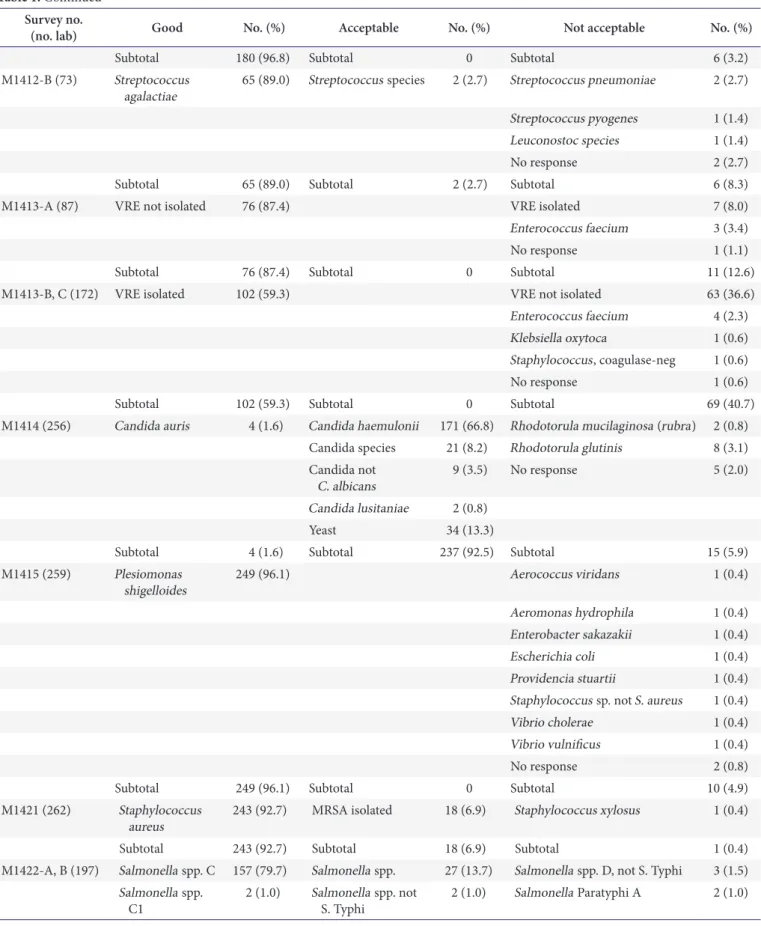
세트의 serogroup을 보고한 기관이 총 9곳이 있었고, M1423 검체의 A세트 검체를 받았는데 C. parapsilosis로 보고한 곳이 4곳, B, C세트의 검체를 받았는데 C. glabrata로 보고한 기관 이 1곳으로 여전히 다른 기관과 검사결과를 공유하는 곳이 있 다고 추정되었다(Table 1).
3. 항균제감수성 검사
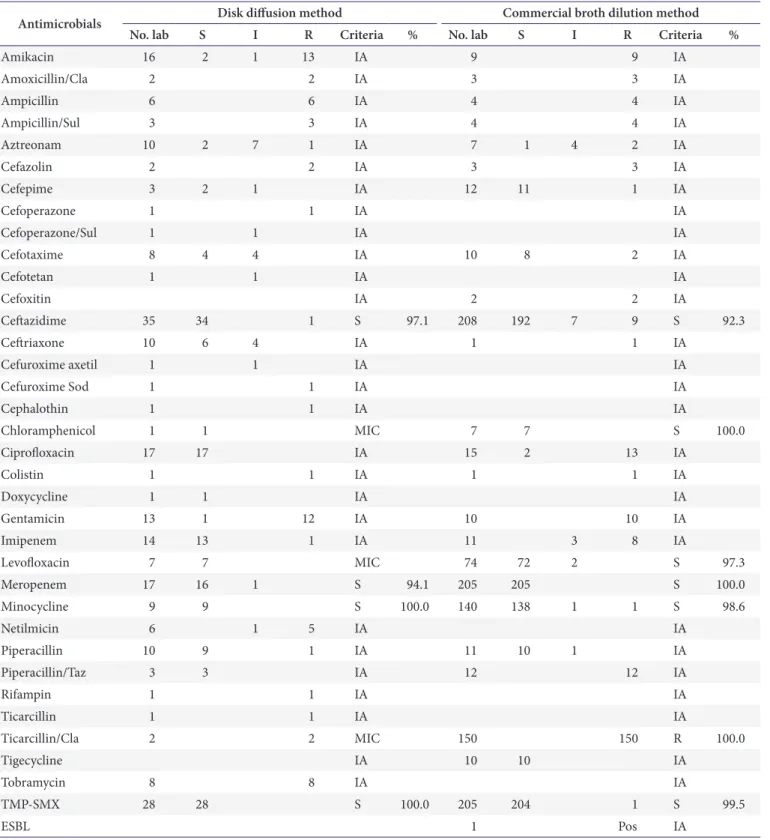
M1401 B. cepacia의 ceftazidime에 대한 디스크확산법 감 수성 검사 억제대가 25 mm로 확실한 감수성인데도 minimal inhibitory concentration (MIC)법으로 검사한 기관에서 I 또는 R로 보고한 기관 16곳(7.7%)은 모두 MicroScan (Siemens, Sacramento, CA, USA)을 사용하였고, MicroScan NC44 패 널에 반복적으로 검사하면 MIC가 8 μg/mL (S)와 16 μg/mL (I)가 교대로 나와 2배 희석배수 안에서 결과가 바뀌는 내성 쪽으로 편향된 오류가 발생하였다(Table 2).
M1402 DHA-1 plasmid-mediated AmpC β-lactamase 에 의해 광범위 세팔로스포린에 내성인 K. pneumoniae 에 대해 Vitek2를 사용하는 기관에서 extended-spectrum β-lactamase (ESBL) 양성으로 판독하여 검사기관의 30%가 위양성으로 보고하였다. Amikacin, gentamicin의 일치율이 매우 낮았는데 디스크확산법으로 감수성기관은 76%, 72%에 서 내성으로 보고하였는데, MIC법에서는 Vitek2 (bioMerieux SA, Marcy l’Etoile, France) 사용 기관에서 다수가 감수성 으로 보고하였다(Table 3). 디스크확산법에서 이중 억제대 (double zone) 현상으로 안쪽 직경이 amikacin, gentamicin, tobramycin, arbekacin 모두 6 mm로 확실한 내성이었으며, arbekacin까지 내성을 초래하는 16 rRNA methylase에 의한
0 0.0
%
2 4 6 10
100.0
80.0
60.0
40.0
20.0
8
A
1st trial 2nd trial 3rd trial
0 0.0
%
2 4 6 10
100.0
80.0
60.0
40.0
20.0
8
B
1st trial 2nd trial 3rd trial
Fig. 1. Distribution of score accomplished by participating laboratories for the first, second and third trials of (A) Gram stain and
(B) AFB stain.
Table 1. Performance of species identification in general bacteriology Survey no.
(no. lab) Good No. (%) Acceptable No. (%) Not acceptable No. (%)
M1401 (259) Burkholderia cepacia 235 (90.7) Burkholderia spp. 4 (1.5) Stenotrophomonas maltophilia 2 (0.8) Burkholderia cepacia
complex 10 (3.9) Pseudomonas
cepacia 2 (0.8) Ewingella americana 1 (0.4)
Leuconostoc sp. 1 (0.4)
Pseudomonas oryzihabitans 1 (0.4)
Pseudomonas sp. 1 (0.4)
Chryseomonas luteola 1 (0.4)
No response 1 (0.4)
Subtotal 245 (94.6) Subtotal 6 (2.3) Subtotal 8 (3.2)
M1402 (259) Klebsiella pneumoniae 259 (100.0)
Subtotal 259 (100.0) Subtotal 0 Subtotal 0
M1403 (259) Streptococcus pyogenes 246 (95.0) Streptococcus sp. 3 (1.2)
Streptococcus, beta-
hemolytic group A 4 (1.5) Staphylococcus sciuri 1 (0.4)
Moraxella catarrhalis 1 (0.4) Streptococcus sp. group D, not
Enterococcus 1 (0.4)
No response 3 (1.2)
Subtotal 250 (96.5) Subtotal 0 Subtotal 9 (3.5)
M1404-A, C (152) MRSA isolated 132 (86.8) Staphylococcus aureus 14 (9.2)
MRSA not isolated 4 (2.6)
Staphylococcus xylosus 1 (0.7)
No response 1 (0.7)
Subtotal 132 (86.8) Subtotal 0 Subtotal 20 (13.2)
M1404-B (107) MRSA not isolated 100 (93.5) Staphylococcus aureus 6 (5.6)
MRSA isolated 1 (0.9)
Subtotal 100 (93.5) Subtotal 0 Subtotal 7 (6.5)
M1405 (259) Candida albicans 223 (86.1) Yeast 18 (7.0) Cedecea davisae 1 (0.4)
Candida sp. 6 (2.3) Cryptococcus sp. 1 (0.4)
No response 10 (3.9)
Subtotal 223 (86.1) Subtotal 24 (9.2) Subtotal 12 (4.7)
M1411 (259) Pseudomonas
aeruginosa 255 (98.4) Pseudomonas
putida 1 (0.4) Proteus mirabilis 1 (0.4)
Providencia alcalifaciens 1 (0.4)
No response 1 (0.4)
Subtotal 255 (98.4) Subtotal 1 (0.4) Subtotal 3 (1.2)
M1412-A, C (186) Streptococcus
pneumoniae 180 (96.8) Enterococcus faecium 1 (0.5)
Pseudomonas aeruginosa 1 (0.5) Streptococcus agalactiae 1 (0.5)
No response 3 (1.6)
(Continued to the next page)
Table 1. Continued Survey no.
(no. lab) Good No. (%) Acceptable No. (%) Not acceptable No. (%)
Subtotal 180 (96.8) Subtotal 0 Subtotal 6 (3.2)
M1412-B (73) Streptococcus
agalactiae 65 (89.0) Streptococcus species 2 (2.7) Streptococcus pneumoniae 2 (2.7) Streptococcus pyogenes 1 (1.4) Leuconostoc species 1 (1.4)
No response 2 (2.7)
Subtotal 65 (89.0) Subtotal 2 (2.7) Subtotal 6 (8.3)
M1413-A (87) VRE not isolated 76 (87.4) VRE isolated 7 (8.0)
Enterococcus faecium 3 (3.4)
No response 1 (1.1)
Subtotal 76 (87.4) Subtotal 0 Subtotal 11 (12.6)
M1413-B, C (172) VRE isolated 102 (59.3) VRE not isolated 63 (36.6)
Enterococcus faecium 4 (2.3)
Klebsiella oxytoca 1 (0.6)
Staphylococcus, coagulase-neg 1 (0.6)
No response 1 (0.6)
Subtotal 102 (59.3) Subtotal 0 Subtotal 69 (40.7)
M1414 (256) Candida auris 4 (1.6) Candida haemulonii 171 (66.8) Rhodotorula mucilaginosa (rubra) 2 (0.8) Candida species 21 (8.2) Rhodotorula glutinis 8 (3.1) Candida not
C. albicans 9 (3.5) No response 5 (2.0)
Candida lusitaniae 2 (0.8)
Yeast 34 (13.3)
Subtotal 4 (1.6) Subtotal 237 (92.5) Subtotal 15 (5.9)
M1415 (259) Plesiomonas
shigelloides 249 (96.1) Aerococcus viridans 1 (0.4)
Aeromonas hydrophila 1 (0.4) Enterobacter sakazakii 1 (0.4)
Escherichia coli 1 (0.4)
Providencia stuartii 1 (0.4) Staphylococcus sp. not S. aureus 1 (0.4)
Vibrio cholerae 1 (0.4)
Vibrio vulnificus 1 (0.4)
No response 2 (0.8)
Subtotal 249 (96.1) Subtotal 0 Subtotal 10 (4.9)
M1421 (262) Staphylococcus
aureus 243 (92.7) MRSA isolated 18 (6.9) Staphylococcus xylosus 1 (0.4)
Subtotal 243 (92.7) Subtotal 18 (6.9) Subtotal 1 (0.4)
M1422-A, B (197) Salmonella spp. C 157 (79.7) Salmonella spp. 27 (13.7) Salmonella spp. D, not S. Typhi 3 (1.5) Salmonella spp.
C1 2 (1.0) Salmonella spp. not
S. Typhi 2 (1.0) Salmonella Paratyphi A 2 (1.0) (Continued to the next page)
내성기전을 가지고 있을 것으로 추정되었다.
M1411 P. aeruginosa는 imipenem, meropenem Etest MIC가 각각 12, 4 μg/mL로 2012년 이후의 CLSI breakpoint 를 적용하면 R과 S에 해당한다. 디스크억제대 직경도 15, 16 mm로 MIC에 일치하였다. Imipenem MIC 검사기관 199개
중 188개 기관이 내성, 11개 기관이 I로 보고하여 내성이 확실 했던 데 비해 meropenem MIC 결과를 보고한 148개 기관 중 S, I, R 분포가 52, 71, 25기관씩으로 일치도가 낮아서 평가에 서 제외하였다(Table 4). MicroScan 장비를 사용했다고 답 한 31기관 중 17기관, Vitek 장비를 사용했다고 답한 105기관
Table 1. ContinuedSurvey no.
(no. lab) Good No. (%) Acceptable No. (%) Not acceptable No. (%)
Escherichia coli* 1 (0.5) Salmonella spp. E, 1 (0.5)
Salmonella Typhi 1 (0.5)
Staphylococcus xylosus 1 (0.5)
Subtotal 159 (80.7) Subtotal 30 (15.2) Subtotal 8 (4.1)
M1422-C (65) Salmonella spp. D, not
S. Typhi 48 (73.8) Salmonella spp. 9 (13.8) Salmonella spp. C 6 (9.2)
Salmonella Typhi 1 (1.5)
Unsatisfactory specimen 1 (1.5)
Subtotal 48 (73.8) Subtotal 9 (13.8) Subtotal 8 (12.4)
M1423-A (77) Candida glabrata 37 (48.1) Candida spp. not
C. albicans 3 (3.9) Candida parapsilosis 4 (5.2)
Candida sp. 2 (2.6) Candida albicans 2 (2.6)
Yeast 21 (27.3) No response 8 (10.4)
Subtotal 37 (48.1) Subtotal 26 (33.8) Subtotal 14 (18.1)
M1423-B, C (185) Candida parapsilosis 152 (82.2) Candida not
C. albicans 5 (2.7) Candida guilliermondii 1 (0.5) Candida parapsilosis
complex 3 (1.6) Candida sp. 6 (3.2) Candida albicans 1 (0.5)
Yeast 11 (5.9) Candida famata 1 (0.5)
Candida glabrata 1 (0.5)
Escherichia coli 1 (0.5)
No response 3 (1.6)
Subtotal 158 (83.8) Subtotal 22 (11.9) Subtotal 8 (4.3)
M1424 (262) Enterococcus faecalis 251 (95.8) Enterococcus sp. 2 (0.8) Enterococcus faecium 1 (0.4) Enterococcus gallinarum 1 (0.4)
Neisseria sp. 1 (0.4)
Streptococcus pyogenes 1 (0.4) Streptococcus spp. 1 (0.4) Salmonella spp. D, not S. Typhi 1 (0.4) Salmonella spp. C 1 (0.4)
No response 2 (0.8)
Subtotal 251 (95.8) Subtotal 2 (0.8) Subtotal 9 (3.4)
M1425†
(not graded) Haemophilus parainfluenzae
*Escherichia coli was contained in the survey materials for purpose of contamination; †Not graded due to poor viability of survey material.
Table 2. Performance of antimicrobial susceptibility test of M1401 Burkholderia cepacia
Antimicrobials Disk diffusion method Commercial broth dilution method
No. lab S I R Criteria % No. lab S I R Criteria %
Amikacin 16 2 1 13 IA 9 9 IA
Amoxicillin/Cla 2 2 IA 3 3 IA
Ampicillin 6 6 IA 4 4 IA
Ampicillin/Sul 3 3 IA 4 4 IA
Aztreonam 10 2 7 1 IA 7 1 4 2 IA
Cefazolin 2 2 IA 3 3 IA
Cefepime 3 2 1 IA 12 11 1 IA
Cefoperazone 1 1 IA IA
Cefoperazone/Sul 1 1 IA IA
Cefotaxime 8 4 4 IA 10 8 2 IA
Cefotetan 1 1 IA IA
Cefoxitin IA 2 2 IA
Ceftazidime 35 34 1 S 97.1 208 192 7 9 S 92.3
Ceftriaxone 10 6 4 IA 1 1 IA
Cefuroxime axetil 1 1 IA IA
Cefuroxime Sod 1 1 IA IA
Cephalothin 1 1 IA IA
Chloramphenicol 1 1 MIC 7 7 S 100.0
Ciprofloxacin 17 17 IA 15 2 13 IA
Colistin 1 1 IA 1 1 IA
Doxycycline 1 1 IA IA
Gentamicin 13 1 12 IA 10 10 IA
Imipenem 14 13 1 IA 11 3 8 IA
Levofloxacin 7 7 MIC 74 72 2 S 97.3
Meropenem 17 16 1 S 94.1 205 205 S 100.0
Minocycline 9 9 S 100.0 140 138 1 1 S 98.6
Netilmicin 6 1 5 IA IA
Piperacillin 10 9 1 IA 11 10 1 IA
Piperacillin/Taz 3 3 IA 12 12 IA
Rifampin 1 1 IA IA
Ticarcillin 1 1 IA IA
Ticarcillin/Cla 2 2 MIC 150 150 R 100.0
Tigecycline IA 10 10 IA
Tobramycin 8 8 IA IA
TMP-SMX 28 28 S 100.0 205 204 1 S 99.5
ESBL 1 Pos IA
Abbreviations: S, susceptible; I, intermediate; R, resistance; Amoxicillin/Cla, Amoxicillin/clavulanic acid; Ampicillin/Sul, Ampicillin/
sulbactam; Piperacillin/Taz, Piperacillin/tazobactam; Ticarcillin/Cla, Ticarcillin/clavulanic acid; TMP-SMX, trimethoprim-sulfamethoxazole;
ESBL, extended-spectrum β-lactamase.
Table 3. Performance of antimicrobial susceptibility test of M1402 Klebsiella pneumoniae
Antimicrobials Disk diffusion method Commercial broth dilution method
No. lab S I R Criteria % No. lab S I R Criteria %
Amikacin 17 16 1 S 94.1 57 57 S 100.0
Amoxicillin/Cla 9 9 S 100.0 35 35 S 100.0
Ampicillin 16 1 15 R 93.8 61 3 58 R 95.1
Ampicillin/Sul 4 3 1 S 75.0 9 9 S 100.0
Aztreonam 5 5 S 100.0 8 8 S 100.0
Cefamandole 1 1
Cefazolin 7 6 1 S 85.7 51 49 1 1 S 96.1
Cefepime 4 4 S 100.0 51 51 S 100.0
Cefmetazole 1 1
Cefoperazone 1 1
Cefotaxime 12 12 S 100.0 53 53 S 100.0
Cefotetan 2 2 2 2 S 100.0
Cefoxitin 1 1 S 100.0 37 37 S 100.0
Ceftazidime 10 10 S 100.0 9 9 S 100.0
Ceftriaxone 9 9
Cefuroxime axetil 1 1
Cefuroxime sod 2 2
Cephalothin 5 5 Urine Only
Chloramphenicol 3 3
Ciprofloxacin 19 19 S 100.0 43 43 S 100.0
Ertapenem 22 22 S 100.0
Gentamicin 18 18 S 100.0 67 67 S 100.0
Imipenem 14 14 S 100.0 50 50 S 100.0
Kanamycin 1 1
Levofloxacin 2 2 S 7 7 S 100.0
Meropenem 6 6 S 100.0 7 7 S 100.0
Netilmicin 3 3
Piperacillin 6 6 S 100.0 8 7 1 S 87.5
Piperacillin/Taz 2 2 S 100.0 28 28 S 100.0
Rifampin 1 1 IA
Tetracycline 3 3 R
Ticarcillin 1 1 R 100.0
Ticarcillin/Clav 1 1 1 1
Tigecycline 1 1 IA
Tobramycin 5 4 1 S 80.0 8 8 S 100.0
TMP-SMX 13 13 S 100.0 46 46 S 100.0
ESBL 34 Neg Neg 100.0
Abbreviations: S, susceptible; I, intermediate; R, resistance; Amoxicillin/Cla, Amoxicillin/clavulanic acid; Ampicillin/Sul, Ampicillin/
sulbactam; Piperacillin/Taz, Piperacillin/tazobactam; Ticarcillin/Cla, Ticarcillin/clavulanic acid; TMP-SMX, trimethoprim-sulfamethoxazole;
ESBL, extended-spectrum β-lactamase.
Table 4. Performance of antimicrobial susceptibility test of M1411 Pseudomonas aeruginosa
Antimicrobials Disk diffusion method Commercial broth dilution method
No. lab S I R Criteria % No. lab S I R Criteria %
Amikacin 38 38 S 100.0 206 206 S 100.0
Amoxicillin/Cla 3 3 IA
Ampicillin 4 4 IA
Ampicillin/Sul 1 1 IA 1 1 IA
Aztreonam 16 14 2 S 87.5 189 167 20 2 S 88.4
Carbenicillin 1 1 IA
Cefazolin 2 2 IA
Cefepime 8 8 S 100.0 206 205 1 S 99.5
Cefixime IA 1 1 IA
Cefoperazone 4 4
Cefotaxime 8 1 4 3 IA 4 1 3 IA
Cefotetan 1 1 IA
Ceftazidime 35 35 S 100.0 213 210 1 2 S 98.6
Ceftriaxone 9 1 3 5 IA 1 1 IA
Cefuroxime axetil 1 1 IA
Cephalothin 2 2 IA
Chloramphenicol 1 1 IA
Ciprofloxacin 36 36 S 100.0 206 206 S 100.0
Clinafloxacin 1 1 IA
Colistin 1 1 S 100.0 28 28 S 100.0
Doxycycline 1 1 IA
Gentamicin 33 33 S 100.0 213 212 1 S 99.5
Gentamicin-high 1 1 IA 1 1 IA
Imipenem 33 2 5 26 R 78.8 199 11 188 R 94.5
Levofloxacin 9 9 S 100.0 41 41 S 100.0
Meropenem 11 3 1 7 148 52 71 25
Minocycline IA 1 1 IA
Netilmicin 6 6 S
Piperacillin 24 24 S 100.0 186 182 2 2 S 97.8
Piperacillin/Taz 7 7 S 100.0 190 188 2 S 98.9
Ticarcillin 5 3 2
Ticarcillin/Cla 11 10 1 S 90.9
Tigecycline 1 1 IA
Tobramycin 20 20 S 100.0 55 55 S 100.0
TMP-SMX 4 4 IA 8 8 IA
Abbreviations: S, susceptible; I, intermediate; R, resistance; Amoxicillin/Cla, Amoxicillin/clavulanic acid; Ampicillin/Sul, Ampicillin/
sulbactam; Piperacillin/Taz, Piperacillin/tazobactam; Ticarcillin/Cla, Ticarcillin/clavulanic acid; TMP-SMX, trimethoprim-sulfamethoxazole;
ESBL, extended-spectrum β-lactamase.
중 32기관, Pheonix 장비(Becton Dickinson, Sparks, MD, USA)를 사용했다고 답한 5기관 중 2기관이 meropenem 감수 성으로 보고하였고, 이들 감수성으로 보고한 기관들 중 Vitek 사용기관 모두와 MicroScan 사용기관 5곳, Pheonix 사용기관 2곳은 MIC를 4 μg/mL로 입력했음에도 S로 보고하여 개정 전 의 기준으로 판독한 것이 부적절한 답변의 원인이었다(Table 4).
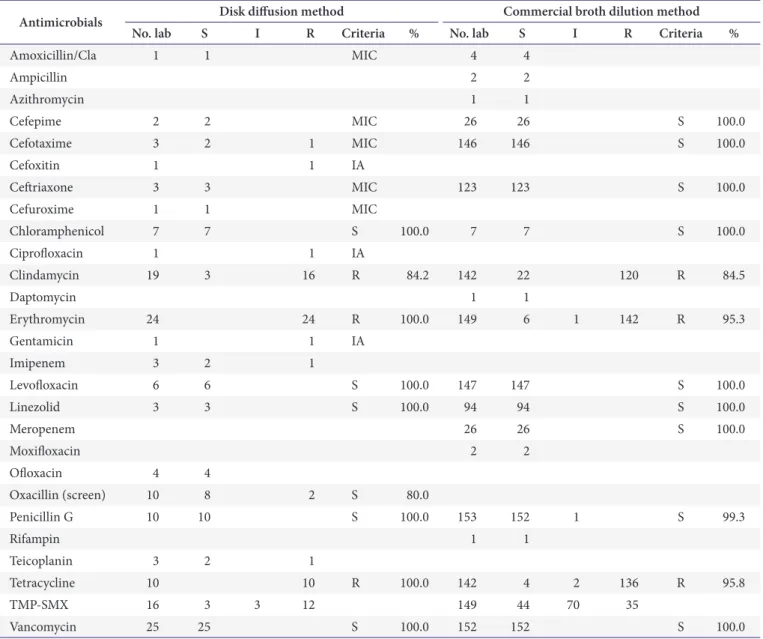
M1412 S. pneumoniae에서 clindamycin 내성이 MIC법 과 디스크확산법 모두 84%에 불과했지만, 디스크확산법으 로 확인했을 때 억제대가 6 mm로 내성이 확실하였고, MIC
법에서 감수성으로 보고한 기관들 모두 MicroScan 사용기 관으로 MICroSTREP 사용기관 22곳 중 20기관이 감수성으 로 보고하여 이 패널의 very major error로 판단하였다. Tri- methoprim/sulfamethoxazole은 일치율이 낮아서 판정할 수 없었다. Penicillin 감수성결과를 보고하지 않거나 oxacillin 선 별검사도 실시하지 않은 기관은 부적절한 검사를 한 것으로 평 가했으며 oxacillin R로 보고하면 penicillin MIC를 실시해야 S, I, R로 감별할 수 있어서 R로 보고한 2기관 또한 부적절하다고 평가하였다(Table 5).
Table 5. Performance of antimicrobial susceptibility test of M1412-A, C Streptococcus pneumoniae
Antimicrobials Disk diffusion method Commercial broth dilution method
No. lab S I R Criteria % No. lab S I R Criteria %
Amoxicillin/Cla 1 1 MIC 4 4
Ampicillin 2 2
Azithromycin 1 1
Cefepime 2 2 MIC 26 26 S 100.0
Cefotaxime 3 2 1 MIC 146 146 S 100.0
Cefoxitin 1 1 IA
Ceftriaxone 3 3 MIC 123 123 S 100.0
Cefuroxime 1 1 MIC
Chloramphenicol 7 7 S 100.0 7 7 S 100.0
Ciprofloxacin 1 1 IA
Clindamycin 19 3 16 R 84.2 142 22 120 R 84.5
Daptomycin 1 1
Erythromycin 24 24 R 100.0 149 6 1 142 R 95.3
Gentamicin 1 1 IA
Imipenem 3 2 1
Levofloxacin 6 6 S 100.0 147 147 S 100.0
Linezolid 3 3 S 100.0 94 94 S 100.0
Meropenem 26 26 S 100.0
Moxifloxacin 2 2
Ofloxacin 4 4
Oxacillin (screen) 10 8 2 S 80.0
Penicillin G 10 10 S 100.0 153 152 1 S 99.3
Rifampin 1 1
Teicoplanin 3 2 1
Tetracycline 10 10 R 100.0 142 4 2 136 R 95.8
TMP-SMX 16 3 3 12 149 44 70 35
Vancomycin 25 25 S 100.0 152 152 S 100.0
Abbreviations: S, susceptible; I, intermediate; R, resistance; Amoxicillin/Cla, Amoxicillin/clavulanic acid; Ampicillin/Sul, Ampicillin/
sulbactam; Piperacillin/Taz, Piperacillin/tazobactam; Ticarcillin/Cla, Ticarcillin/clavulanic acid; TMP-SMX, trimethoprim-sulfamethoxazole;
ESBL, extended-spectrum β-lactamase.
Table 6. Performance of antimicrobial susceptibility test of M1412-B Streptococcus agalactiae
Antimicrobials Disk diffusion method Commercial broth dilution method
No. lab S I R Criteria % No. lab S I R Criteria %
Amikacin 1 1 IA
Amoxicillin/Cla 1 1 IA 2 2 IA
Ampicillin 12 10 2 S 83.3 34 34 S 100.0
Ampicillin/Sul 1 1 IA
Azithromycin 1 1 1 1
Cefazolin 2 2 IA
Cefepime 2 2 5 5
Cefoperazone 1 1
Cefotaxime 11 9 1 1 S 81.8 24 24 S 100.0
Cefotetan 1 1 IA
Ceftazidime 2 2 IA
Ceftriaxone 8 7 1 S 87.5 18 18 S 100.0
Cephalothin 2 2 IA
Chloramphenicol 3 3 5 4 1
Ciprofloxacin 3 3 IA 1 1 IA
Clindamycin 20 19 1 S 95.0 38 37 1 S 97.4
Daptomycin MIC 1 1
Doxycycline 1 1 IA
Erythromycin 19 19 S 100.0 36 36 S 100.0
Gentamicin 2 2 IA
Gentamicin-H 1 1 IA
Imipenem 1 1 IA
Kanamycin 1 1 IA
Levofloxacin 7 7 R 100.0 30 30 R 100.0
Linezolid 1 1 S 100.0 29 29 S 100.0
Meropenem 1 1 MIC
Netilmicin 1 1 IA
Ofloxacin 3 3
Oxacillin 2 2 1 1 IA
Penicillin G 13 12 1 S 92.3 29 29 S 100.0
Quinupristin/Dal 7 7
Tetracycline 4 4 S 100.0 12 11 1 S 91.7
TMP-SMX 3 1 2 IA 6 6 IA
Vancomycin 21 20 1 S 95.2 38 38 S 100.0
ICR 6 6
Abbreviations: S, susceptible; I, intermediate; R, resistance; Amoxicillin/Cla, Amoxicillin/clavulanic acid; Ampicillin/Sul, Ampicillin/
sulbactam; Piperacillin/Taz, Piperacillin/tazobactam; Ticarcillin/Cla, Ticarcillin/clavulanic acid; TMP-SMX, trimethoprim-sulfamethoxazole;
ESBL, extended-spectrum β-lactamase; ICR, inducible clindamycin resistance; Gentamicin-H, high level resistance to gentamicin;
Quinupristin/Dal, Quinupristin/dalfopristin.
Table 7. Performance of antimicrobial susceptibility test of M1421 Staphylococcus aureus
Antimicrobials Disk diffusion method Commercial broth dilution method
No. lab S I R Criteria % No. lab S I R Criteria %
Amikacin 1 1
Amoxicillin/Cla 2 2 1 1
Ampicillin 6 6 4 4
Azithromycin 1 1 R 100.0 13 13 R 100.0
Cefazolin 3 3 IA 1 1 IA
Cefepime 1 1 IA
Cefmetazole 1 1 IA
Cefotaxime 3 3 IA 1 1 IA
Cefotetan 1 1 IA
Cefoxitin 5 5 R 100.0 1 1 R 100.0
Ceftazidime 1 1 IA
Ceftriaxone 6 6 IA
Cefuroxime 2 2 IA
Cephalothin 3 3 IA
Chloramphenicol 5 5 3 3
Ciprofloxacin 26 26 R 100.0 125 125 R 100.0
Clarithromycin 2 2
Clindamycin 33 33 R 100.0 218 218 R 100.0
Daptomycin 17 17 S 100.0
Doxycycline 2 2
Erythromycin 30 30 R 100.0 215 215 R 100.0
Fosfomycin 1 1
Fusidic Acid 1 1
Gentamicin 22 22 R 100.0 97 97 R 100.0
Imipenem 5 5 IA
Levofloxacin 4 4 2 2
Linezolid 5 5 S 100.0 194 194 S 100.0
Meropenem 2 2 IA
Mupirocin 4 4
Nitrofurantoin 2 2 Urine only
Ofloxacin 1 1
Oxacillin 35 35 MIC only 219 219 R 100.0
Penicillin G 30 30 R 100.0 200 200 R 100.0
Piperacillin/Taz 1 1
Quinupristin/Dal 7 7
Rifampin 5 5 S 100.0 151 151 S 100.0
Teicoplanin 12 11 1 S 91.7 40 40 S 100.0
Telithromycin 13 13 R 100.0
Tetracycline 14 14 R 100.0 188 188 R 100.0
Tigecycline 3 1 2 IA
TMP-SMX 31 31 S 100.0 212 212 S 100.0
Vancomycin 22 21 1 MIC only 224 223 1 S 100.0
Abbreviations: S, susceptible; I, intermediate; R, resistance; Amoxicillin/Cla, Amoxicillin/clavulanic acid; Ampicillin/Sul, Ampicillin/
sulbactam; Piperacillin/Taz, Piperacillin/tazobactam; Ticarcillin/Cla, Ticarcillin/clavulanic acid; TMP-SMX, trimethoprim-sulfamethoxazole;
ESBL, extended-spectrum β-lactamase; ICR, inducible clindamycin resistance; Gentamicin-H, high level resistance to gentamicin;
Quinupristin/Dal, Quinupristin/dalfopristin.
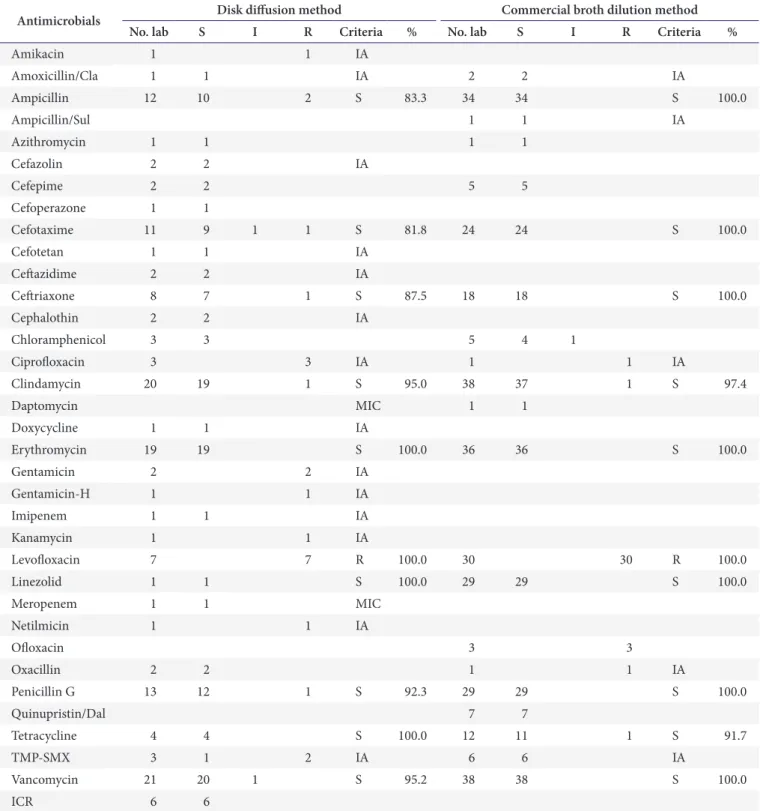
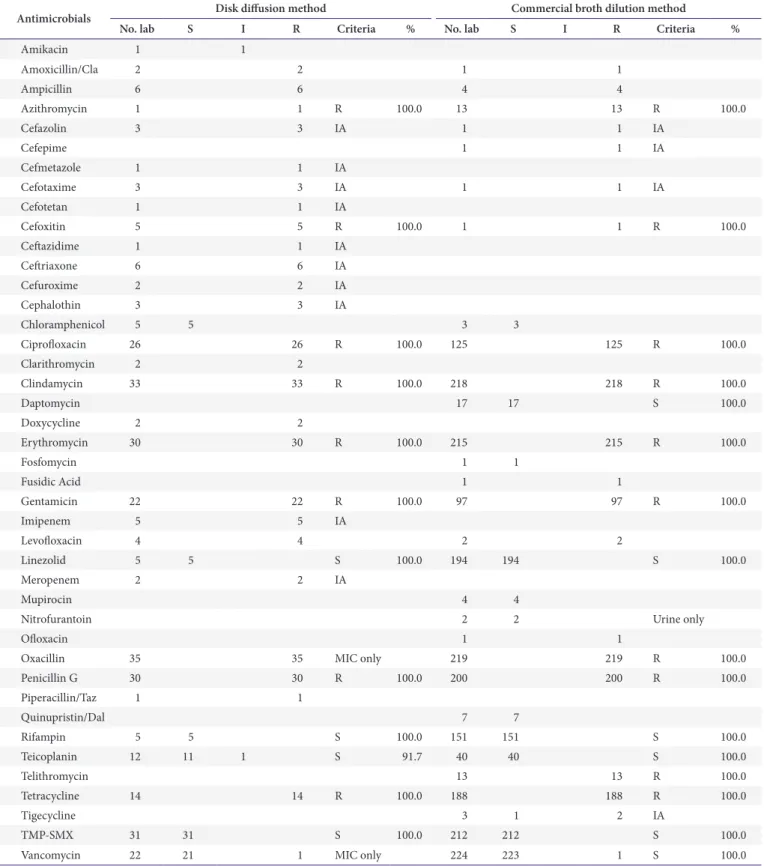
M1421 Staphylococcus aureus 균주는 methicillin- resistant S. aureus (MRSA)의 전형적인 다제내성 균으로 서 높은 정답률을 보였지만, 가장 빈번한 부적절한 결과의 요 인은 보고할 항균제 선택이었다. 디스크확산법으로 검사하는 기관들 중 cephalosporin, imipenem, meropenem 보고한 곳 이 1-6곳, oxacillin과 vancomycin은 35, 22곳에 달했다. MIC M1412에 포함된 S. agalactiae는 levofloxacin 내성이 있
는 균주로서 MIC법을 사용하는 기관들은 모든 항균제에 매 우 높은 정답률을 보여준 데 비해 디스크확산법을 사용한 기 관들은 β-lactam계 항균제에 내성을 보고한 경우가 있어서 ampicillin, cefotaxime, ceftriaxone 정답률이 80%대에 불과 하였다(Table 6).
Table 8. Performance of antimicrobial susceptibility test of M1422-A, B Salmonella spp. serogroup C
Antimicrobials Disk diffusion method Commercial broth dilution method
No. lab S I R Criteria % No. lab S I R Criteria %
Amikacin 10 9 1 IA 10 1 9 IA
Amoxicillin/Cla 3 3 IA 13 12 1 IA
Ampicillin 26 26 R 100.0 151 151 R 100.0
Ampicillin/Sul 3 3 IA 5 2 3 IA
Aztreonam 1 1 S 10 9 1 S
Cefaclor 1 1 IA IA
Cefazolin 2 2 IA 11 2 9 IA
Cefepime 3 3 S 100.0 37 37 S 100.0
Cefoperazone 1 1 IA
Cefotaxime 16 16 S 100.0 149 148 1 S 99.3
Cefoxitin 1 1 IA 7 1 6 IA
Ceftazidime 14 14 S 100.0 118 116 2 S 98.3
Ceftriaxone 6 6 S 100.0 9 9 S 100.0
Chloramphenicol 7 7 R 100.0 5 5 R 100.0
Ciprofloxacin 42 18 23 1 I, S 97.6 123 49 53 21 I, S 82.9
Doxycycline 1 1 IA IA
Ertapenem 14 14 IA
Gentamicin 7 7 IA 13 2 11 IA
Imipenem 10 10 IA 24 24 IA
Levofloxacin 3 3 S 100.0 15 10 4 1 I, S 93.3
Meropenem 2 2 IA 8 8 IA
Minocycline 1 1 IA
Netilmicin 1 1 IA IA
Piperacillin 4 1 3 IA 2 1 1 IA
Piperacillin/Taz 1 1 IA 18 18 IA
Tetracycline 1 1 IA 2 2 IA
Ticarcillin/Cla 1 1 IA
Tigecycline 5 5 IA
Tobramycin 3 3 IA 1 1 IA
TMP-SMX 22 1 21 R 95.5 152 152 R 100.0
Abbreviations: S, susceptible; I, intermediate; R, resistance; Amoxicillin/Cla, Amoxicillin/clavulanic acid; Ampicillin/Sul, Ampicillin/
sulbactam; Piperacillin/Taz, Piperacillin/tazobactam; Ticarcillin/Cla, Ticarcillin/clavulanic acid; TMP-SMX, trimethoprim-sulfamethoxazole;
ESBL, extended-spectrum β-lactamase.
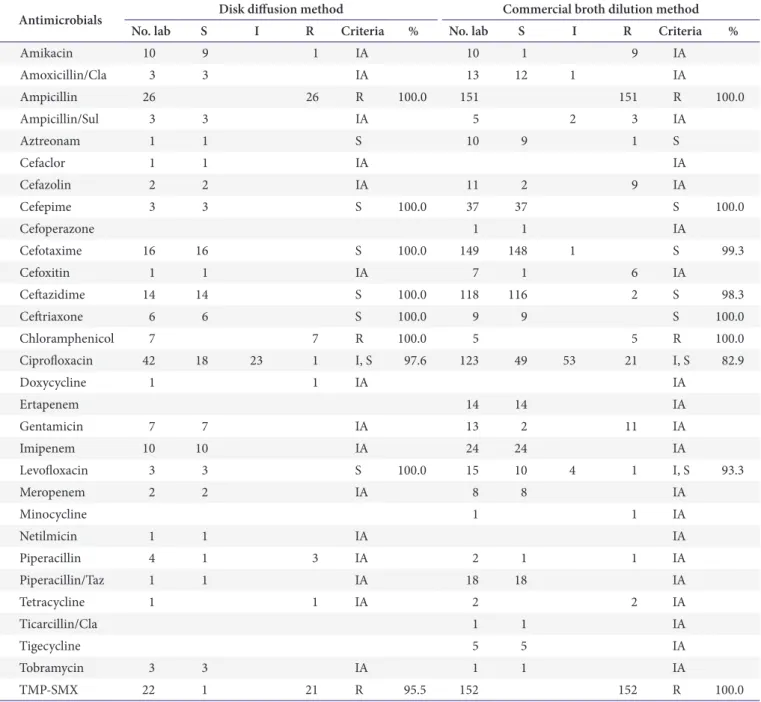
성이었는데 이들 항균제 감수성 검사는 높은 정답률을 보였 다. Ciprofloxacin 감수성 검사는 불일치율이 높았다(Tables 8, 9). Group C 균주는 디스크억제대가 30 mm, ciprofloxacin Etest MIC 0.38 μg/mL이고, group D 균주는 디스크억제 대가 28 mm, ciprofloxacin Etest MIC 0.19 μg/mL로 둘 다 intermediate 범위에 해당한다. 하지만 nalidixic acid가 group C는 ≤16 μg/mL, 19 mm인데 비해 group D는 ≥32 μg/mL, 6 mm로 큰 차이를 보였다(Fig. 2). 둘 다 MicroScan NC72는 ≤1 μg/mL, MIC 패널인 NM44에서는 ≤0.5 μg/mL 로 intermediate를 포함하는 결과를 보이는 반면, Vitek 2 GN 법 사용 기관 중에는 소변 검체에 대해서만 보고해야 하는
nitrofurantoin 감수성 검사를 보고한 2곳과 tigecycline 감수 성 검사를 보고한 3곳은 부적절한 평가를 받았다. S. aureus 에서 베타락탐 항균제에 대한 감수성 검사로서 꼭 필요한 penicillin, oxacillin 감수성 검사를 보고하지 않거나 MRSA에 서 필수적으로 검사해야 할 vancomycin 감수성 검사를 누락 한 31, 7, 15곳은 이로 인해 부적절 평가를 받았다(Table 7).
M1422 Salmonella serogroup C (A, B set)/Salmonella serogroup D (C set) 중 group C 균주는 ampicillin 내성, group D 균주는 ampicillin과 3, 4세대 cephalosporin까지 내
Table 9. Performance of antimicrobial susceptibility test of M1422-C Salmonella spp. serogroup D
Antimicrobials Disk diffusion method Commercial broth dilution method
No. lab S I R Criteria % No. lab S I R Criteria %
Amikacin 3 3 IA 5 1 4 IA
Amoxicillin/Cla 1 1 IA 9 9 IA
Ampicillin 6 1 5 R 83.3 48 48 R 100.0
Ampicillin/Sul IA 1 1 IA
Aztreonam 2 1 1 2 2
Carbenicillin 1 1 IA IA
Cefazolin IA 7 7 IA
Cefepime R 12 12 R 100
Cefoperazone 1 1 IA IA
Cefotaxime 2 2 R 100.0 43 43 R 100.0
Cefoxitin IA 2 1 1 IA
Ceftazidime 4 2 1 1 R 25.0 39 39 R 100.0
Ceftriaxone 3 1 2 4 4
Cephalothin 2 1 1 IA IA
Chloramphenicol 3 3 1 1
Ciprofloxacin 12 4 8 S, I 100.0 37 26 11 S, I 100.0
Ertapenem IA 2 2 IA
Gentamicin 4 2 2 IA 7 7 IA
Imipenem 2 2 IA 8 8 IA
Levofloxacin 3 3
Meropenem 1 1 IA 1 1 IA
Nalidixic acid 1 1 1 1
Piperacillin 1 1 IA IA
Piperacillin/Taz IA 8 8 IA
Tobramycin 1 1 IA IA
TMP-SMX 5 3 1 1 S 60.0 46 46 S 100.0
Abbreviations: S, susceptible; I, intermediate; R, resistance; Amoxicillin/Cla, Amoxicillin/clavulanic acid; Ampicillin/Sul, Ampicillin/sul- bactam; Piperacillin/Taz, Piperacillin/tazobactam; Ticarcillin/Cla, Ticarcillin/clavulanic acid; TMP-SMX, trimethoprim-sulfamethoxazole;
ESBL, extended-spectrum β-lactamase.
카드에서 group C 균주는 0.12-0.5, 1, 2 μg/mL 등 다양한 결 과를 보여 25, 47, 16곳이 S, I, R로 답했다. 이에 비해 디스크 확산법 사용자들은 17, 23, 1곳이 S, I, R로 답해서, I, S를 정 답으로 처리하였다. Group D 균주는 디스크확산법과 MIC 검 사자 100.0%가 S, I로 답해서 이를 정답으로 처리하였다. 하 지만 MicroScan 사용자는 MIC가 ≤1 μg/mL로 모두 S라고 답한 반면, Vitek 사용자는 012-0.5 μg/mL의 값을 보이고, 15곳이 S, 8곳이 I라고 답했습니다. 디스크확산법에서 21-30 mm 결과를 많은 기관에서 S로 판독하였고, 12 mm를 S라고 답한 곳도 1기관이 있는 등 Salmonella의 fluoroquinolone 감 수성 판독에 오류가 많았다.
4. 특수세균배양 및 동정
특수세균으로 S1401 그람양성 막대균인 Erysipelothrix rhusiopathiae, S1402 혐기성세균인 Finegoldia magna의 종 수준 동정률은 91.4%, 89.7%이었고, S1403 Scedosporidium apiospermum, S1404 Actinomyces odontolyticus는 종수 준 동정률은 낮았으나 속수준은 90.5%, 93.7% 정도였다.
Scedosporidium apiospermum는 Scedosporidium 속으 로 보고한 기관이 33%인데 기인했지만, A. odontolyticus는 Actinomyces meyeri나 Actinomyces naeslundii로 오동정하 는 기관이 41%로 많았고 이는 Vitek2 동정결과였다. S1405
Table 10. Performance of species identification in advanced bacteriology Survey no (no. lab)Expected in species levelNo. (%)Expected in genus levelNo. (%)OthersNo. (%) S1401 (82)Erysipelothrix rhusiopathiae75 (91.5)Erysipelothrix sp.4 (4.9)Finegoldia magna2 (2.4) Arcanobacterium sp.1 (1.2) Subtotal75(91.5)Subtotal4 (4.9)Subtotal3 (3.6) S1402 (78)Finegoldia magna70 (89.7)Finegoldia sp.2 (2.6)Erysipelothrix rhusiopathiae2 (2.6) Peptostreptococcus magnus1 (1.3)Alloiococcus otitidis1 (1.3) Clostridium sp. not perfringens1 (1.3) Veillonella sp.1 (1.3) Subtotal71 (91.0)Subtotal2 (2.6)Subtotal5 (6.4) S1403 (82)Scedosporium apiospermum44 (53.7)Scedosporium sp.27 (32.9)Scedosporium prolificans1 (1.2) Pseudallescheria boydii2 (2.4)Acremonium sp.1 (1.2) Pseudallescheria boydii complex1 (1.2)Aspergillus sp.1 (1.2) Penicillium sp.1 (1.2) Plesiomonas shigelloides1 (1.2) (Continued to the next page) Fig. 2. The results of nalidixic acid disk diffusion test and
ciprofloxacin Etest of M1422 Salmonella (A) group C and (B) group D strains.
A B
Table 10. Continued Survey no (no. lab)Expected in species levelNo. (%)Expected in genus levelNo. (%)OthersNo. (%) Trichophyton sp.1 (1.2) Trichothecium sp.1 (1.2) Dermatophyte, refer for ID1 (1.2) Mold, refer for ID1 (1.2) Subtotal47 (57.3)Subtotal27 (32.9)Subtotal8 (9.8) S1404 (82)Actinomyces odontolyticus21 (25.6)Actinomyces sp.19 (23.2)Actinomyces meyeri31 (37.8) Actinomyces naeslundii3 (3.7) Clostridium sp.1 (1.2) Eggerthella lenta1 (1.2) Scedosporium apiospermum1 (1.2) Unidentified Gram positive rods1 (1.2) Aerobic Actinomycetes, not Nocardia1 (1.2) No growth3 (3.7) Subtotal21 (25.6)Subtotal19 (23.2)Subtotal42 (51.2) S1405 (84)Corynebacterium jeikeium76 (90.4)Corynebacterium spp.4 (4.8)Micrococcus spp.1 (1.2) Unidentified Gram positive rods2 (2.4) No growth1 (1.2) Subtotal76 (90.4)Subtotal4 (4.8)Subtotal4 (4.8) S1406 (84)Clostridium tertium72 (85.7)Clostridium spp.6 (7.1)Clostridium clostridioforme1 (1.2) Clostridium septicum1 (1.2) Pseudomonas paucimobilis1 (1.2) Unsatisfactory specimen1 (1.2) No growth1 (1.2) No response1 (1.2) Subtotal72 (85.7)Subtotal6 (7.1)Subtotal6 (7.1)
Table 11. Performance of species identification in mycobacteriology Survey no.
(no. lab) Good No. (%) Acceptable No. (%) Not acceptable No. (%)
T1401 (79) Mycobacterium kansasii 16 (20.3) Mycobacterium other than M. tuberculosis complex
55 (69.6) Nonphotochromogen (not M.
tuberculosis), refer for ID 3 (3.8) Rapid grower, refer for ID 1 (1.3)
No response 4 (5.1)
Subtotal 16 (20.3) Subtotal 55 (69.6) Subtotal 8 (10.1)
T1402 (79) Mycobacterium tuberculosis
complex 68 (86.1) Negative for Mycobacteria 2 (2.5)
Mycobacterium tuberculosis (not M. africanum, M.
bovis, or M. microti)
6 (7.6) No response 3 (3.8)
Subtotal 74 (93.7) Subtotal 0 Subtotal 5 (6.3)
T1403 (79) Mycobacterium tuberculosis
complex 65 (82.3) Negative for Mycobacteria 4 (5.1)
Mycobacterium tuberculosis (not M. africanum, M.
bovis, or M. microti)
6 (7.6) No response 4 (5.1)
Subtotal 71 (89.9) Subtotal 0 Subtotal 8 (10.1)
T1404 (79) Negative for Mycobacteria 73 (92.4) Mycobacterium other than
M. tuberculosis 1 (1.3) Mycobacterium intracellulare
(not M. avium) 1 (1.3)
No response 4 (5.1)
Subtotal 73 (92.4) Subtotal 0 Subtotal 6 (7.6)
T1405 (79) Mycobacterium intracellulare (not M. avium)
15 (19.0) Mycobacterium other than M. tuberculosis complex
54 (68.4) Scotochromogen, refer for ID 1 (1.3)
Nonphotochromogen (not M. tuberculosis), refer for ID
3 (3.8) No response 5 (6.3)
Mycobacterium nonchromogenicum (not M. terrae or M.
triviale)
1 (1.3)
Subtotal 15 (19.0) Subtotal 58 (73.4) Subtotal 6 (7.6)
T1411 (81) Mycobacterium tuberculosis
complex 68 (84.0) Mycobacterium
tuberculosis (not M.
africanum, M. bovis, or M. microti)
6 (7.4) Mycobacterium other than M.
tuberculosis complex 2 (2.5)
No response 4 (4.9)
Refer for ID 1 (1.2)
Subtotal 68 (84.0) Subtotal 6 (7.4) Subtotal 7 (8.6)
T1412 (81) Negative for Mycobacteria 78 (96.3) No response 3 (3.7)
Subtotal 78 (96.3) Subtotal 0 Subtotal 3 (3.7)
(Continued to the next page)
단 T1401 M. kansasii를 nonchromogenic, rapid grower로 판독한 것과 T1405의 M. intracellulare를 대표적인 오염균 인 scotochromogen으로 보고한 기관은 부적절하다고 판정하 였다(Table 11). 2차 T1411-T1415에서 항산균 배양에 실패한 기관은 없었고, 항산균 음성인 T1412 검체에서 항산균이 자랐 다고 보고한 기관도 없었다. T1411 M. tuberculosis complex 가 아닌 항산균으로 보고한 2기관만을 동정실패로 평가하여 전반적으로 매우 우수한 동정능을 보였다(Table 11).
항결핵제 감수성 검사에서 T1417 ofloxacin, levofloxacin, T1418 levofloxacin, T1419 moxifloxacin 내성 검출에 실패한 기관이 1곳씩 있었다. Pyrazinamide 검사에서 T1418 위내성 Cory nebacterium jeikeium, S1406 Clostridium tertium 동
정은 각각 90.5%, 85.7%의 종수준 정확도를 보였다(Table 10).
5. 항산균배양 동정, 항결핵제 감수성 검사, 결핵 신속내성 검사
T1402와 T1403은 Mycobacterium tuberculosis HR37Ra 주를 농도를 달리해서 제조한 검체로 농도가 높았던 T1402는 2기관, 낮았던 T1403은 4기관에서 배양음성으로 보고하였다.
동정결과의 Acceptable%는 94.7-100.0%로 높았으며, T1401 M. kansasii를 결핵균으로 잘못 동정하거나 T1402, T1403 M.
tuberculosis을 비결핵항산균으로 잘못 동정한 기관은 없었다.
Table 11. Continued Survey no.
(no. lab) Good No. (%) Acceptable No. (%) Not acceptable No. (%)
T1413 (81) Mycobacterium kansasii 16 (19.8) Mycobacterium other than
M. tuberculosis complex 57 (70.4) No response 4 (4.9)
Refer for ID 1 (1.2)
Nonphotochromogen (not M. tuberculosis),
refer for ID
2 (2.5)
Photochromogen, refer for
ID 1 (1.2)
Subtotal 16 (19.8) Subtotal 60 (74.1) Subtotal 5 (6.1)
T1414 (81) Mycobacterium avium
(not M. intracellulare) 13 (16.0) Mycobacterium other than
M. tuberculosis complex 57 (70.4) No response 4 (4.9) Mycobacterium avium
complex 2 (2.5) Refer for ID 1 (1.2)
Nonphotochromogen (not M. tuberculosis),
refer for ID
3 (3.7)
Mycobacterium intracellulare (not M. avium)
1 (1.2)
Subtotal 13 (16.0) Subtotal 63 (77.8) Subtotal 5 (6.2)
T1415 (81) Mycobacterium tuberculosis
complex 69 (85.2) Mycobacterium other than
M. tuberculosis complex 1 (1.2)
Mycobacterium tuberculosis (not M. africanum, M. bovis, or M. microti)
6 (7.4) No response 4 (4.9)
Refer for ID 1 (1.2)
Subtotal 75 (92.6) Subtotal 0 Subtotal 6 (7.4)
Table 12. Performance of anti-tuberculosis drug susceptibility test DrugsExpected susceptibility results and no.(%) correct of each survey materials T1406T1407T1408T1409T1410T1416T1417T1418T1419T1420 IsoniazidS6 (100)S6 (100)R6 (100)S6 (100)S6 (100)S7 (100)R7 (100)R7 (100)S7 (100)R7 (100) RifampinR6 (100)R6 (100)S6 (100)R6 (100)S6 (100)R7 (100)R7 (100)R7 (100)S7 (100)R7 (100) StreptomycinS4 (100)S4 (100)S4 (100)R4 (100)S4 (100)S5 (100)S5 (100)R5 (100)S5 (100)R5 (100) EthambutolS4 (100)S4 (100)S4 (100)S4 (100)S4 (100)S5 (100)S5 (100)R5 (100)S5 (100)R5 (100) KanamycinS4 (100)S4 (100)S4 (100)R4 (100)S4 (100)S5 (100)S5 (100)S5 (100)R5 (100)R5 (100) AmikacinS3 (100)S3 (100)S3 (100)S3 (100)S3 (100)S5 (100)S5 (100)S5 (100)R5 (100)R5 (100) CapreomycinS4 (100)S4 (100)S4 (100)S4 (100)S4 (100)S5 (100)S5 (100)S5 (100)R5 (100)R5 (100) OfloxacinS4 (100)S4 (100)S4 (100)S4 (100)R4 (100)S5 (100)R4 (80)R5 (100)S5 (100)S5 (100) LevofloxacinS3 (100)S3 (100)S3 (100)S3 (100)R3 (100)S5 (100)R4 (80)R4 (80)S5 (100)S5 (100) MoxifloxacinS3 (100)S3 (100)S3 (100)S3 (100)R3 (100)S5 (100)S5 (100)R5 (100)S4 (80)S5 (100) ProthionamideS2 (100)S2 (100)S2 (100)S2 (100)S2 (100)S3 (100)S3 (100)S1 (33)S3 (100)S3 (100) CycloserineS4 (100)S4 (100)S4 (100)S4 (100)S4 (100)S5 (100)S5 (100)S5 (100)S4 (80)S4 (80) PASS4 (100)S4 (100)S4 (100)S4 (100)S4 (100)S5 (100)S5 (100)S5 (100)S5 (100)S5 (100) RifabutinR4 (100)R4 (100)S4 (100)R4 (100)S4 (100)R5 (100)R5 (100)R5 (100)S5 (100)R5 (100) PyrazinamideS4 (100)S4 (100)S4 (100)S4 (100)S4 (100)S5 (100)S5 (100)S4 (80)S5 (100)R3 (60) Abbreviations: S, susceptible; R, resistance.
Table 14. Performance of microscopic examination of stool preparation in parasitology Survey no.
(no. lab) Good No. (%) Acceptable No. (%) Not acceptable No. (%)
P1401 (102) Hook worm eggs 87 (85.3) Hookworm
larvae 2 (2.0) Ascaris sp. eggs 6 (5.9)
Trichostrongylus eggs 4 (3.9)
Diphyllobothrium sp. eggs 2 (2.0)
No parasite seen 1 (1.0)
Subtotal 87 (85.3) Subtotal 2 (2.0) Subtotal 4 (12.7)
P1402 (102) Trichuris trichiura 102 (100.0)
Subtotal 102 (100.0) Subtotal 0 Subtotal 0
P1403 (98) No parasite seen 70 (71.4) Entamoeba coli 15 (15.3)
Ascaris sp. eggs 6 (6.1)
Enterobius vermicularis eggs 3 (3.1) Clonorchis / Metagonimus eggs 1 (1.0)
Hookworm eggs 1 (1.0)
Paragonimus sp. eggs 1 (1.0)
Trichostrongylus eggs 1 (1.0)
Subtotal 70 (71.4) Subtotal 0 Subtotal 28 (28.6)
P1404 (102) Giardia intestinalis (lamblia) 94 (92.2) Entamoeba histolytica /disper 3 (2.9) Diphyllobothrium sp. eggs 1 (1.0)
Endolimax nana 1 (1.0)
Pentatrichomonas (Trichomonas)
hominis 1 (1.0)
No parasite seen 2 (2.0)
Subtotal 94 (92.2) Subtotal 0 Subtotal 8 (7.8)
P1405 (102) Diphyllobothrium sp. eggs 92 (90.2) Paragonimus sp. eggs 7 (6.9)
Clonorchis / Metagonimus eggs 2 (2.0) Fasciola hepatica / Fasciolabuski eggs 1 (1.0)
Subtotal 92 (90.2) Subtotal 0 Subtotal 10 (9.8)
Table 13. Rapid detection of rifampin and isoniazid resistance Drugs mutations
R1401 R1402 R1403 R1404
Expected No. (%)
correct Expected No. (%)
correct Expected No. (%)
correct Expected No. (%) correct
Rifampin S 23 (100) S 23 (100) R 24 (100) R 24 (100)
rpoB mutation S531L 19 (79) H526T 18 (75)
No response 5 (21) No response 6 (25)
Isoniazid R 20 (100) S 20 (100) R 19 (100) S 20 (100)
katG mutation S315T 20 (100) S 20 (100) S315T 17 (89) S 19 (100)
No response 2 (11)
inh mutation S 19 (100) S 19 (100) S 19 (100) S 20 (100)
Abbreviations: S, susceptible; R, resistance.
1곳, T1420 위감수성 2곳이 있었다(Table 12). 결핵균 신속내 성 검사에서 isoniazid와 rifampin 내성 검출 모두 100.0% 정 답률을 보였다(Table 13).
6. 기생충검사
P1401 Hookworm eggs 85.3%, P1402 Trichuris trichiura 는 100.0%. Giardia intestinalis 94.2%, Diphy lobothrium latum eggs 90.2%의 정답률을 보였는데 기생충이 없었던 P1403의 정답률이 71.4%로 가장 낮았다(Table 14).
7. 연구용 털곰팡이류 배양 및 동정, 카바페네메제 생산 장내세 균 검출
털곰팡이류 배양 동정검사 신빙도조사에 참여해서 동 정결과를 입력한 기관 중 F1401 Aspergillus terreus, F1402 Aspergillus fumigatus, F1403 Aspergillus flavus, F1404 Trichophyton rubrum, F1405 Trichophyton men- tagrophyte 등의 종수준 동정 정확도는 78.5%, 92.1%, 82.0%, 65.6%, 48.4%로 A. fumigatus의 정확도가 가장 높았고, Tri- chophyton 종의 동정능은 Aspergillus 종보다 낮았다(Table 15).
카바페네메제생산 장내세균 검출에서 선별 시험인 MHT 에 C1401 위음성이 7.5%, C1402, C1403의 위양성이 49.5%, 15.4% 발생하였다. C1402 AmpC β-lactamase를 생산하는 E. cloacae를 Klebsiella pneumoniae carbapenemase (KPC) 생산 균주로 보고한 기관이 45곳(63.4%)에 달했다(Table 16).
고찰
세균 분야의 회원기관 수나 응답률은 2013년 신빙도조사 때와 유사하였다[7]. 그람음성간균에 대해서는 배양과 동정 검사 수행능이 우수한데 Salmonella 혈청형 검사를 실시하 지 않거나 혈청형 오류가 20.0%를 넘어서 혈청형 검사에 대 한 질 관리가 필요함을 알 수 있었다. 가장 동정 정확도가 떨어 지는 균종은 비교적 흔하지 않은 Candida의 종수준 동정으로 C. glabrata, C. auris는 48.0%, 1.6%에 불과하였다. 특히 C.
auris는 표현형적으로나 유전형적으로 Candida haemulonii 와 유사하여 complex를 이루는 균종으로 2009년 일본에서 처 음 외이도에서 분리되어 C. auris로 명명되었다[8]. 국내에 서 만성중이염환자의 이루에서 흔히 분리되는 Candida 종 으로, 분자역학적으로도 C. auris의 확산이 클론성인 것으로 보고된 바 있다. 국내 한 대학병원에서 진균혈증 3예가 보고
될 때 azole 내성으로 인한 치료실패와 치명률을 보였다. 따 라서 이 균종이 임상 검체에서 분리될 때 종동정을 정확히 해 주는 것이 임상적으로 중요하다. 현재 상업화된 동정키트로 는 종수준 동정이 안 되지만, M1414에서 대부분 종수준 동 정이 C. haemoulonii였던 것처럼 Vitek YST 카드에서는 C.
haemulonii로 동정되고, API 20에서는 Rhodotorula glutinis 로 동정된다는 것이 실마리가 될 수 있다. C. haemulonii 또 는 R. glutinis로 동정되는 균이 집락성상이 Rhodotorula와 달 리 Candida 종으로 생각되고, fluconazole 내성이 있다면 C.
auris를 추정할 수 있을 것이다. CHROMagar Candida 배지 에서는 pink colony로 나타나서 C. haemoulonii의 lavender colony와 감별할 수 있다. Vitek YST에서 C. haemulonii로 동정되는 균종은 C. haemulonii complex에 속하는 C. pseu- dohaemulonii, C. auris 등을 포함하기 때문에 종수준의 신뢰 성은 없고, 현재 정확한 종수준 동정을 위해서는 ITS 부위의 염기서열분석이 필요하다.
2014년에는 특수세균 신빙도조사 참여기관 수가 86기관 으로 증가하였다. 배양과 동정이 까다로운 그람양성 간균으 로 E. rusiopathiae, C. jeikeium, 혐기성세균으로 F. magna, A. odontolyticus, C. tertium, 털곰팡이류로 Scedosporium apiospermum 등을 배양 동정하는 시도를 통해 혐기성 균과 털곰팡이류에 대한 수행능을 평가할 수 있었다. A.
odontolyticus는 A. meyeri로 동정하는 오류가 많아서 Actinomyces 종동정에 생화학적 동정방법을 대체하는 동정 방법이 필요하다는 것을 알 수 있다. Matrix-assisted laser desorption ionization-time of flight mass spectrometry는 Actinomyces 등 혐기성균 동정에 유용하게 사용될 수 있을 것 이다[9].
M1402 K. pneumoniae 주의 광범위 세팔로스포린 내성 은 ESBL 음성, AmpC β-lactamase 양성에서 기인하는데도 Vitek2를 사용하는 기관에서 ESBL 양성으로 판독하여 검사 기관의 30.0%가 위양성으로 판독하고, cefepime MIC ≤1 μg/
mL임에도 내성으로 보고하였다. Vitek 2의 expert 알고리즘 을 사용하여 감수성판독결과를 변경하는 것은 표준법은 아니 기 때문에 ESBL 위양성 판독 위험성에 주의해야 할 것이다.
이 균주는 amikacin, gentamicin의 일치율이 매우 낮았는데
이 균주는 16S rRNA methylase에 의한 내성기전을 가지고
있을 것으로 추정되며, 2010년 보고[10]에서 국내 임상분리
K. pneumoniae는 16.0%가 이 기전에 의한 내성을 가지고 있
어서 그람음성간균 중 가장 높은 빈도였고, 외국보다 훨씬 흔
하다고 발표된 바 있다. Vitek2에서 Acinetobacter baumannii
의 ArmA 16S rRNA methylase에 의한 aminoglycoside 내성
을 놓친다는 것과 디스크확산법에서 이중 억제대를 보인다는 것이 이미 발표된 바 있다[11]. 16S rRNA methylase 내성기 전이 흔한 국내에서 16-20시간의 배양 후 MIC를 측정하는 표 준법과 달리 더 신속한 판독 알고리즘으로 감수성 검사를 하는 키트를 사용할 때 aminoglycoside 내성을 놓칠 수 있다는 것을 보여준 결과로서 임상검사실에서 감수성 검사의 질 관리에 참 고해야 할 것으로 판단하였다.
M1411 P. aeruginosa의 meropenem 감수성 결과 판정을 보류하였다. 이는 2012년 변경된 기준을 제대로 적용하지 않 았던 것과 meropenem MIC 가 중등도 내성범위에서 더욱 일 치율이 낮았던데 기인하여 P. aeruginosa 카바페넴 감수성판 독에 대한 질 관리의 중요함을 보여주었다.
B. cepacia, S. aureus, S. pneumoniae 항균제 감수성 검 사에서 여전히 보고할 항균제를 빠뜨리거나 잘못된 감수성 검 사법으로 검사하거나 검체에 따라 보고해서는 안 되는 항균제 를 보고하는 것 등이 부적절한 평가의 중요한 원인이었으며, vancomycin 내성 등 불가능한 내성을 보고하는 기관들도 1-2 기관 있었다. 따라서 이들 기관들은 항균제감수성 검사의 중요
Table 15. Performance of culture and identification of molds in theexperimental challenge of F1401-F1405 Survey
no. Expected results Species identification
results No. lab (%) F1401 Aspergillus terreus Aspergillus terreus 51 (56.0)
Aspergillus sp. 5 (5.5) Aspergillus flavus 3 (3.3) Aspergillus fumigatus 1 (1.1) Aspergillus nidulans 1 (1.1) Cryptococcus
laurentii 1 (1.1)
Mold, refer for
identification 1 (1.1 Penicillium marneffei 1 (1.1) Scedosporium
apiospermum 3 (3.3) Test not performed 1 (1.1) No response 23 (25.3)
Total 91 (100.0)
F1402 Aspergillus fumigatus Aspergillus fumigatus 58 (63.7) Aspergillus sp. 3 (3.3) Aspergillus nidulans 1 (1.1) Mold, refer for
identification 4 (4.4) Test not performed 1 (1.1) No response 24 (26.4)
Total 91 (100.0)
F1403 Aspergillus flavus Aspergillus flavus 50 (54.9) Aspergillus sp. 6 (6.6) Aspergillus terreus 2 (2.2) Aspergillus niger 1 (1.1) Aspergillus versicolor 1 (1.1) Mold, refer for
identification 4 (4.4) Test not performed 1 (1.1) No response 26 (28.6)
Total 91 (100.0)
F1404 Trichophyton
rubrum Trichophyton rubrum 42 (46.2) Trichophyton sp. 7 (7.7) Trichophyton
mentagrophytes 5 (5.5) Trichophyton
tonsurans 4 (4.4)
Aspergillus flavus 1 (1.1) (Continued to the next page)
Table 15. Continued Survey
no. Expected results Species identification results No. lab (%) Aspergillus nidulans 1 (1.1) Aspergillus terreus 1 (1.1) Coccidioides immitis 1 (1.1) Penicillium sp. 1 (1.1) Yeast like organism 3 (3.3) Test not performed 1 (1.1)
No response 25 (27.5)
Total 91 (100.0)
F1405 Trichophyton
mentagrophytes Trichophyton
mentagrophytes 30 (33.0) Trichophyton tonsurans 12 (13.2) Trichophyton sp. 9 (9.9) Trichophyton rubrum 8 (8.8) Aspergillus niger 1 (1.1) Paecilomyces sp. 1 (1.1) Yeast like organism 3 (3.3)
No growth 1 (1.1)
Test not performed 1 (1.1)
No response 25 (27.5)
Total 91 (100.0)
한 질 관리방안으로 균종별 검사할 항균제 패널의 선정, 가능 성이 매우 희박한 균종-항균제내성 조합 등에 대한 기준을 설 정하는 것을 우선해야 할 것이다.
M1422 Salmonella serogroup C와 Salmonella serogroup D 두 주 모두 fluoroquinolone 계열의 감수성 검사에 부적 합 결과가 많았다. CLSI는 장내세균속에 대한 ciprofloxacin, levofloxacin breakpoint로는 Salmonella 내성을 검출을 할 수 없기 때문에 nalidixic acid를 지시항균제로 사용할 것을 권 장해왔다. 하지만 90년대 말부터 Salmonella에서 plasmid 에 의해 확산되는 qnr 유전자의 변이나 aac(6‘)Ib-cr로 인 한 낮은 수준의 fluoroquinolone 내성이 문제가 되는데 이 들 내성은 nalidixic acid 선별만으로 검출이 어려워서[12]
nalidixic acid를 지시자로 사용해도 모든 fluoroquinolone 내 성을 검출할 수는 없다고 기술하고 있다. 2012년 Salmonella 만을 위한 ciprofloxacin breakpoint를 독립적으로 만들면서 nalidixic acid를 사용하는 기관이라도 ciprofloxacin의 새로 운 breakpoint를 적용하면 추가적으로 내성을 검출하는 장점 이 있다고 권장하였고, 2014년에는 levofloxacin breakpoint가 추가되었다. 하지만 자동화된 MIC검사법 장비를 주로 사용하 는 임상검사실로서 ciprofloxacin, levofloxacin 항균제의 농도 가 이 정도로 낮은 범위를 포함한 패널은 국내에 없기 때문에 nalidixic acid를 적극 활용하거나 ciprofloxacin Etest 등 보 완적인 검사방법을 마련할 필요가 있을 것이다. 이에 CLSI도
2012년에 비해 2014년 오히려 최신 breakpoint를 도입하기 전에는 nalidixic acid를 사용할 수 있다고 권장하고 있다[5].
다제내성균 감시배양에 해당하는 검체 중 M1404 MRSA 감 시배양은 비교적 높은 정답률을 보인 반면 M1413 반코마이신 감수성인 장구균과 VRE 를 혼합한 검체에 대해 매우 낮은 정 답률을 보였다. 이는 감시배양은 목표를 선별적으로 민감하게 키울 수 있는 선택배지를 사용해야 질을 높일 수 있음을 보여 준다.
기생충 검경은 처음 시도였는데 hookworm 충란의 동정률 이 85.3%로 가장 낮았고, 편충란은 100.0% 정확도를 보였다.
가장 작은 양성 충체라고 할 수 있는 원충류인 G. intestinalis 의 동정능도 92.2%에 달해서 가상현미경에 의한 검경이 성공 적이었음을 보여준다. 하지만 기생충이 없는 검체에 대해 정답 률이 가장 낮았던 이유는 가상현미경상에서 1,000배 배율까지 확대해 보지 못하는 한계점 때문일 수 있어서 향후 보완이 필 요하다.
털곰팡이류 연구모듈은 Trichophyton 종동정능이 Aspergillus보다 낮다는 것을 보여주었고, 카바페네메제 검 출검사 모듈은 MHT가 AmpC β-lactamase에 위양성이 있 을 수 있음을 주의해야 한다는 것을 보여 주었다. DHA-1, ACT-1, CMY-2 등은 carbapenem을 분해하는 활성도가 있 는 AmpC β-lactamase라서 위양성이 자주 발생한다[13].
특히 국내 carbapenem 내성 장내세균은 대부분 ‘AmpC
Table 16. Performance of modified Hodge test and combined disk inhibition test of C1401, C1402, and C1403Survey no. Carbapenemase activity
No. (%) of participants Modified Hodge test Combined disk inhibition
test with Final typing results of Carbapenemase Meropenem Ertapenem Boronic acid EDTA
C1401 Negative 3 (7.5) 0 56 (87.5) 2 (3.2) Negative 3 (4.2)
VIM-positive Weak 7 (17.5) 4 (10.8) 0 1 (1.6) Class A (KPC) 1 (1.4)
Klebsiella pneumoniae Positive 30 (75.0) 33 (89.2) 8 (12.5) 60 (95.2) Class B (MBL) 65 (90.3) Total 40 (100.0) 37 (100.0) 64 (100.0) 63 (100.0) Class D (OXA) 0
C1402 Negative 23 (60.5) 26 (70.3) 4 (6.2) 59 (96.7) Negative 23 (32.4)
AmpC-positive Weak 3 (7.9) 3 (8.1) 0 0 Class A (KPC) 45 (63.4)
Enterobacter cloacae Positive 12 (31.6) 8 (21.6) 61 (93.3) 2 (3.3) Class B (MBL) 0 Total 38 (100.0) 37 (100.0) 64 (100.0) 63 (100.0) Class D (OXA) 1 (1.4)
C1403 Negative 33 (84.6) 34 (91.9) 62 (93.9) 61 (93.8) Negative 63 (88.7)
Escherichia coli Weak 2 (5.1) 0 0 0 Class A (KPC) 0
Positive 4 (10.3) 3 (8.1) 4 (6.1) 2 (3.2) Class B (MBL) 1 (1.4)
Total 39 (100.0) 37 (100.0) 64 (100.0) 63 (100.0) Class D (OXA) 5 (7.0) Abbreviations: KPC, Klebsiella pneumoniae carbapenemase; MBL, metallobetalactamase; OXA, Oxacillinase; Weak, weak positive.