Functional Surface Coating Technologies of Steel Industry
Changhoon Choi1,†, Sung Ho Park1, and Jong Sang Kim
1POSCO Technical Research Laboratories, 699, Gumho-dong, Gwangyang-si, Jeonnam, 545-090, Korea (Received November 2, 2009; Revised November 5, 2010; Accepted November 8, 2010)
Technical issues of steel industry change along with other industrial progresses. Traditionally, steel protection from corrosion environment was the major issue and galvanic metal coatings were mainly used to extend the lifetime of steel products. Nowadays, requirements for steel have become more diversified. More various surface and material properties are required from different field of applications. Naturally, functional surface coating has become one of the most studied areas in steel industry. For functional surface coating, various process technologies and coating products are investigated. In this article, recent trends of functional coating technologies and products are introduced with brief technical descriptions of representative coating products.
Keywords : protection, corrosion, coating, steel
†Corresponding author: [email protected]
1. Introduction
Steel is applied in industry very broadly. Technical de- velopment goes along with other industrial progresses.
Traditionally, the biggest issue in steel industry was corro- sion protection to extend the lifetime of steel. As the tech- nical development is proliferated, requirement on steel products becomes more varied. Lighter, thinner, more flex- ible, stronger steel sheets with lots of functional surface properties have been required from different field of applications. The roles of functional coatings are high- lighted to expand application areas or to satisfy customers' requirements.
The history of functional surface coating on steel surface is not very long. It was 1980s that functional coatings were introduced to extend the lifetime of steel products.1) Cr- free coating was adopted to replace environmentally haz- ardous chromate coating. Since then, it was realized that more functions could be incorporated to surface coatings and a lot of novel concept coatings have been developed.
Nowadays, functional surface coating plays a crucial role to expand application areas and to design advanced surface coating steel sheet products. Fig. 1 shows the number of international patents published for various areas in steel industry from Korea between Sep. 2008 and Sep. 2009.
Functional surface coating has the second largest number of patent publications next to steel making area, which
demonstrates that functional surface coating is currently one of the most studied areas in steel industry.
Application of functional surface coatings on steel sheets are generally achieved by coating wet solution onto steel sheet coils followed by drying and curing process.
Roll coating is the most widely used method for con- tinuous application. In order to obtain maximum pro- ductivity, coating speed needs to be as high as possible, which brings surface defects together. Various approaches are possible to increase coating speed while minimizing surface defects. Thermal convection is the most common drying and curing technology, which heats up the temper- ature of air and steel strip by electric resistance. Recently,
Fig. 1. The number of international patents published from different areas in steel industry from Korea between Sep. 2008 and Sep. 2009.
more energy efficient and environment-friendly appro- aches are studied. Induction heating and several photo radi- ations are included. In this article, the trends of process technologies for functional coatings and a few examples of surface coating steel sheet products are discussed with brief technical details.
2. Process technologies for functional coatings
Several process technologies are involved to produce functional surface coating steel sheets. Solution coating and curing technologies are mainly studied process technologies. Solution coating technologies are used to ap- ply wet chemicals onto steel strip continuously and they are dried and cured by subsequent drying and curing process. Technical descriptions and trends for these techni- ques are introduced in this section.
2.1 Coating technologies
Roll coating is the most widely used to apply chemical solutions onto steel sheet coils. Rolls revolve to pick up and transfer solutions to steel surface. Steel coil con- tinuously passes for surface coating. Coating thickness and surface state are controlled by various process variables including nip force, relative roll speed, direction of roll revolution, etc. In order to obtain maximum productivity, coating speed needs to be maximized. However, faster coating process has more chances of surface defects like ripples, ribbings, etc. Coating solutions have various rheo- logical properties i.e. solid content, viscosity, etc. Process variables of roll coating must be carefully controlled to minimize defects while increasing coating speed for vari- ous solutions. However, it is sometimes difficult to in- crease coating speed with simple roll coating no matter how the process variables are optimized.
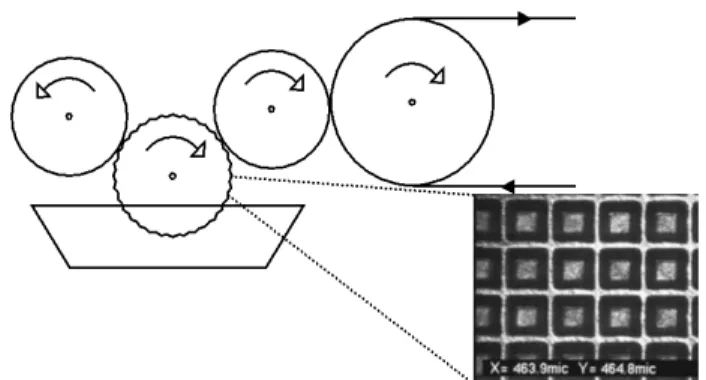
A few different approaches are investigated. One of them includes patterned roll coating. Patterned roll coating utilizes an engraved roll to pick up solution from solution reservoir (Fig. 2). Flat pick-up roll in normal roll coating system causes surface defects due to inconsistent amount of coating solution. Engraving on a pick-up roll delivers rather consistent amount of solution and reduces surface defects while increasing coating speed. Not only surface defects are reduced but also the uniformity of coating thickness is greatly improved. In spite of the high quality coating, major drawback of patterned roll coating, ex- pensive roll price and maintenance fees, makes it difficult for line application.
Another modern concept of coating technology is touch- less coating, where the application of wet solution onto steel strip is carried out without mechanical contact be-
Fig. 2. Schematic of patterned roll coating and the surface image of an engraved roll.
(a) (b) (c)
Fig. 3. Schematics of touchless coating methods. (a) slide coating;
(b) slot coating; (c) curtain coating.
tween coating equipment and steel strip. A lot of different approaches are possible for touchless coating and sche- matics of a few examples are illustrated in Fig. 3, which includes slide coating (a), slot coating (b), and curtain coat- ing (c). Touchless coating reduces maintenance fees of coating equipment significantly due to its different coating mechanism. However, rather expensive installation and difficulty to obtain thin coating thickness need to over- come for line application.
2.2 Drying and curing technologies
Drying and curing process change liquid phase of sol- ution to solid phase. It not only dries wet coating but also causes polymeric network structure to form. Polymer is a macro molecule with repeating structural units connected by covalent bonds and cross-link connects linear polymeric chain to form physically different materials.
Traditionally the most common curing method is heat treatments such as thermal convection. Steel strip with wet chemical solution passes through a heated zone where en- ergy is transferred from air to coating solution and cause curing. Thermal convection curing is very effective to pro- duce high quality coating surfaces. However, it is quickly being replaced from production line due to a couple of main disadvantages. One is its inefficiency of energy con- sumption. Thermal convection requires high electrical en- ergy to reach the temperature that is necessary to start
curing. This is due to the indirect heating mechanism of thermal convection. Electrical resistance of coil inside oven generates heat that is transferred to the air next to it. Heated air is circulated inside oven and transfers heat to coated solution on steel strip. The other is its require- ment of long production line for complete curing. Heat transmission from the heated air to steel strip takes a long time which requires long curing line. Long production line is a huge disadvantage in industry.
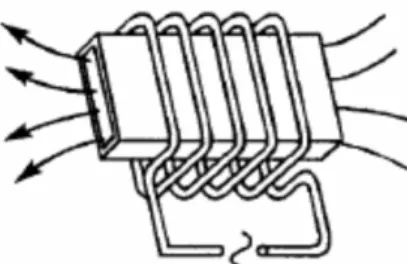
Several principles and approaches are possible to re- place thermal convection oven. One of them is induction heating. Induction heating is a direct heating technique for electrically conductive materials (mainly metals). Major components of induction heater consist of AC power sup- ply, induction coil, and a workpiece to be heated. AC pow- er supply sends alternating current that passes through in- duction coil, which generates electromagnetic field. When a workpiece is placed inside the coil, eddy current is in- duced and heat is generated due to the workpiece's elec- trical resistance (Joule effect, Fig. 4). Frequency of AC current needs to be carefully selected for the size of target product. The induced current is concentrated at the surface of specimen and decayed exponentially. The depth at which the current density drops to a value of 37% is called skin depth or penetration depth, δ, and all of the current value is considered to be held within this depth. The skin depth is a function of frequency following the equation
f f
0252 .
=0
= πμ
δ ρ (1)
where ρ is electrical resistivity of strip [Ωm], μ is magnet- ical permeability of strip [H m-1], and f is frequency of AC current [Hz]. The Eq. 1 shows the relationship between skin depth and frequency, which means the skin depth de- pends on frequency control. Therefore, frequency needs to be considered when selecting heater specification.
Replacing thermal convection with induction curing can reduce line length by 50 % or so. Further technical details are available from commercial suppliers and articles.2,3
Fig. 4. Concept of strip induction heating.
More advanced curing techniques involve photo radia- tion. Near infrared (NIR) radiation curing is one of them and utilizes light with wavelength of 780~1400 nm as a thermal source. NIR radiation increases temperature of surface coating and metal substrates. It has several advan- tages over conventional thermal curing method. It takes only 0.2~3.0 sec for complete drying and curing compared to 1~3 sec of induction heating and about 30 sec of con- vection oven. Temperature profile generated by NIR is very uniform over strip regardless of surface irregularities.
Energy density of NIR can reach up to 1500 kW/m2, which is much higher than convection oven having less than 1 kW/m2. Energy efficiency is more than 85%. Curing tem- perature using NIR is normally lower than induction heater by 5~10 % or so. Further readings are available.4,5 Ultra-violet (UV) light curing is another photo radiation method using light with wavelength of 200~400 nm.
Mechanism of UV curing is different from NIR. In princi- ple, UV curing utilizes light induced chemical chain re- action or polymerization while NIR is thermal curing. UV light has a higher energy than NIR by having lower wave- length and higher frequency. Radiation of UV light on some chemical materials generates radicals which are ther- modynamically very unstable. Unstable radicals react with other molecules generating other radicals, which causes continuous chemical reactions. These chain reactions con- nect molecules and tighten molecular network, which is cross-linking. The initiation of chain reactions requires a special photoinitiator in coating solution that absorbs UV light and produces reactive radicals. Oligomers, mono- mers, and additives are included in UV coating solution as main components. UV coating has many advantages over conventional curing methods. The biggest advantage is extremely small floorspace requirement. Only a quarter of line length compared with convection oven is enough for UV curing. Another big advantage is zero emission of volatile organic compound (VOC). Conventional ther- mal curing systems require coating solution to involve macromolecules suspended in a solvent or emulsified in water. Thermal treatment dries solvent and forms inter- molecular networks which produce solid surface layer. In UV coating system, solution can be made up of 100 % reactive components without using solvent and hence no solvent is evaporated (no VOC). VOC-free process also removes facilities for waste and emission treatment. In ad- dition, no cooling line is needed for UV curing since it is not thermal curing and curing temperature is low, which is why UV curing is called cold curing. Cold curing not only removes cooling line but also provides another ad- vantage like possibility to coat heat-sensitive substrates i.e.
bake hardening (BH) steel. The penetration depth of light
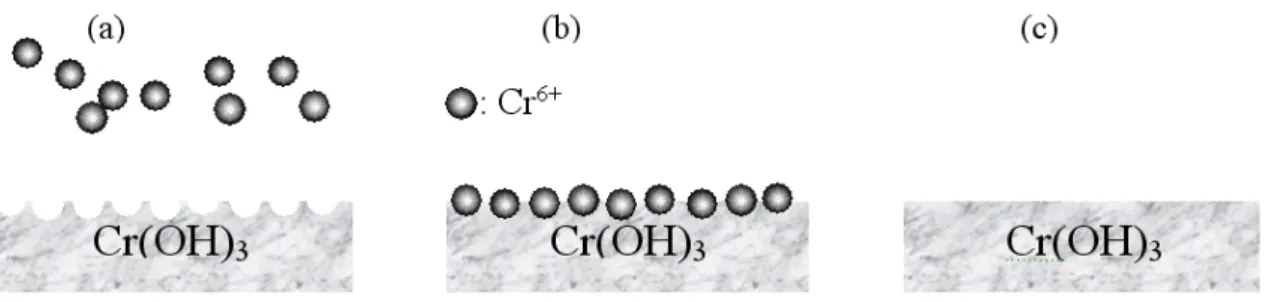
Fig. 5. Illustrtion of self healing effect by chromate coating. (a)mobile Cr6+ ions move around chromate layer; (b) Cr6+ ions adheres to the defect surface of chromate layer; (c) surface defects are healed.
into coating solution is deeper than NIR. More information is available from the webpage of the association for UV
& EB technology.6
The state-of-the-art of curing technology is electron beam (EB) curing. It has not been known to be applied in line production so far. EB curing equipment generates accelerated electron that strikes metal surface. Electron beam has high energy and triggers polymerization or cur- ing when it collides with coating solution. EB curing has a lot of advantages i.e. high energy efficiency, no VOC emission, no requirement of photo initiator, etc. Penetra- tion depth of EB is even much higher than NIR curing.
One disadvantage of EB curing is the generation of hazard- ous X-ray. X-ray is generated when electron beam hits metal surface and hence X-ray shield is required to protect line workers. Further readings are available.6,7,8,9
3. Functional coating technology and products
Steel has a number of products and modern technology advancement requires more various products with different surface as well as material properties. Surface coating on steel plays a crucial role for product diversification. In this section, a few examples of chemical coating steel products from POSCO are introduced with their technical descriptions.
3.1 Cr-free coated steel
Steel is double protected from corrosive environment by galvanic and chromate coating. Zinc coating prevents steel corrosion by sacrificial or cathodic protection. Electric potential of zinc oxidation is lower than that of steel, which means zinc corrodes before steel does when they are in contact. Steel is protected from corrosion until zinc is depleted. Exact mechanism of protection by chromate coating is not proven yet. However, two effects are gen- erally known to function as corrosion protection mechanisms.
One of them is known as barrier effect. Chromate coating has a network structure through which corrosive elements
can hardly pass. This tight molecular structure works as a barrier and protects zinc and steel. The other mechanism is known as self-healing effect. Chromate coating consists of Cr3+ combined with hydroxide ions to form Cr(OH)3. Cr6+ ions move around chromate coating surface and fill in cavities to recover tight molecular structure and corro- sion resistance (Fig. 5).
The combination of galvanic coating or zinc coating and chromate layer system is very efficient for protecting steel sheets from corrosion and for coating another layer on top with high adhesiveness. However, Cr6+ has been re- vealed as a carcinogen and prohibited to use by EU re- striction of hazardous substances directive (RoHS) effec- tive since July 1st 2007. Various substances have been studied to replace chromate coating layer, including metal phosphate,10,11,12,13 silicates and titanates,14,15,16 lantha- nide,16,17,18,19,20 permanganate,10,11,21 and other metal oxides i.e. yittrium18,20 and molybdenium.22 These are normally called Cr-free coatings and their main ideas to obtain chro- mate coating properties are to imitate molecular structure of chromate layer. None of Cr-free coatings has been known to have better performance than chromate layer and only a few of them are commercially available.
POSCO has developed various Cr-free products based on different substrates like galvanized iron (GI), hot galvanized iron (HGI), electrolytic galvanized coil (EG), etc. EG based Cr-free products have a commercial name of POS E-GREEN. POS E-GREEN has mainly two types of coating layer, namely 1coat-1bake and 2coat-2bake.
Cr-free coating is generally required to have particular functions like anti-fingerprint property. 2coat-2bake type POS E-GREEN products contains functional properties and Cr-free characteristics in two separate layers while 1coat-1bake type products require only one layer. 1coat- 1bake system is advantageous in process since it requires only one coating and curing process. 2coat-2bake system is simpler in coating solution design but lowers produc- tivity. Therefore, 1coat-1bake system is considered for most applications. 1coat-1bake Cr-free coating normally
has double layer structure, where the bottom layer is for maximum adhesion between metal substrate and Cr-free coating while the top layer embraces functional properties.
Further products properties are available from our website.23 3.2 Black resin coated steel
Electronic industry commonly uses black panels for dis- play rear cover materials. Conventionally, plastic or pre- coated metal (PCM) is used for electronic display rear cover. Recently, black resin coated steel has been devel- oped having rather thinner coating thickness. As a rear cover material, plastic, PCM, and black resin coated steel has several advantages and disadvantages over the others.
Plastic has several benefits including light weight, com- plex formability, and higher bending stiffness. Plastic is normally lighter than steel panels. More complex for- mation is possible for plastic since injection molding can be used for plastic while steel panels are press formed.
When the panels are thin, low bending stiffness of steel panel is a disadvantage for handling while plastic has high- er bending stiffness. On the other hand, plastic is normally more expensive than steel panel and productivity is quite low. Conventional PCM has quite thick coating layer of 20 ~ 25 ㎛, which is the main reason of expensive price.
Black resin coated steel has several advantages over plastic and PCM. It has thinner coating of 10 ~ 12 ㎛ and Cr-free coating is applied, which is environmentally-friendly. The speed of part formation is faster than plastic which means higher productivity. Although it is heavier than plastic and has lower bending stiffness, major advantage of low pro- duction cost would make black resin coated steel sheet a major rear cover material for electronic display in near future.
Thin coating layer of black resin coated steel with equiv- alent or better surface property is obtained by forming self-gradient layer of black coating. Wet coating of black resin contains hard components like silica and they are lifted up to the top during the drying and curing process.
This self gradient layer formation enables the thin black coating to show maximum performance. Silica-rich top layer is beneficial for formability and silica-deficient bot- tom layer is soft and good for adhesion to Cr-free bottom coat.
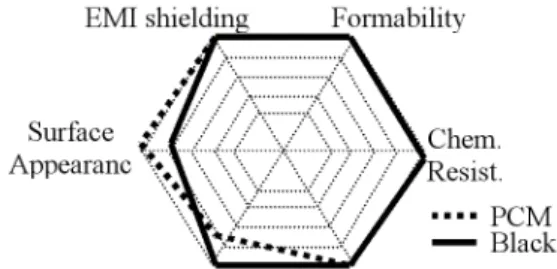
The performance of black resin coated steel is com- petitive to PCM. The required properties of panel as dis- play rear cover include electromagnetic interference (EMI) shielding, formability, chemical resistance, corrosion re- sistance, hardness, appearance, etc. Fig. 6 shows the per- formance comparison between PCM and black resin coat- ed steel sheet. Quite recently, the quality of black resin coated steel from POSCO has been certified by a few elec-
Fig. 6. Performance comparison between PCM and black resin coated steel.
tronics companies.
3.3 Self cleaning steel
A lot of novel concepts of functional coatings are re- ported and self cleaning surface is one of the most high- lighted coatings. Surface contamination on steel provides shelter for corrosion elements. It has been found that some surfaces from nature i.e. lotus leaf surface are preserved very clean without manual cleaning. More detailed inves- tigation on its surface revealed the surface has lots of mi- cro bumps that make the surface super hydrophobic. Super hydrophobic surface makes the contact angle of water drop very high and flow away easily along with surface dirt and potential corrosion factors. Further study discovered that two approaches are possible for obtaining self cleaning property. One is super hydrophobic and the other is super hydrophilic surface. Both approaches make water drop on the surface flow easily carrying away dirt particles.
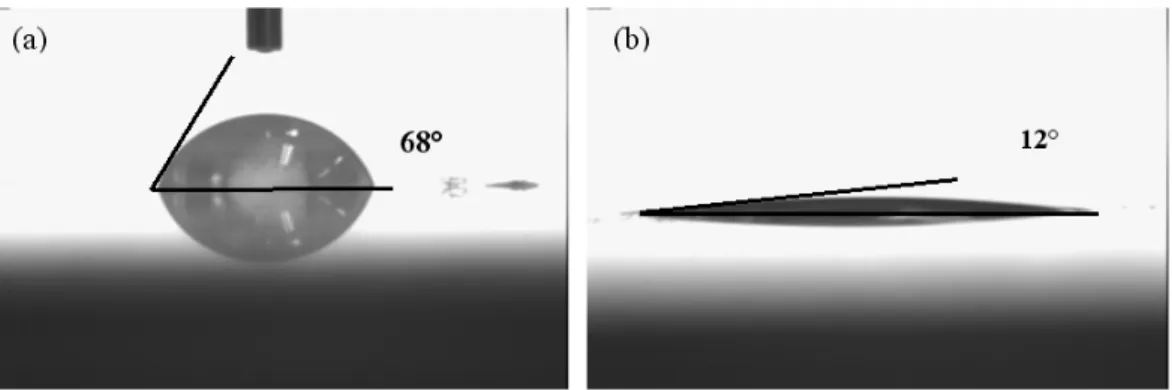
POSCO adopted light sensitive super hydrophilic sur- face to manufacture self cleaning steel. Light sensitive hy- drophilic surface become super hydrophilic by UV radia- tion. Contact angle of water drop is about 12° compared with conventional PCM surface showing 68° (Fig. 7). In order to check the self cleaning capability, mist was sprayed for the same time on both conventional PCM and self cleaning steel surface, where the self cleaning surface shows excellent self cleaning performance (Fig. 8).
4. Summary
Steel products are applied in industry very broadly and their technical trends follow other industrial fashion.
Nowadays, the most significant trends are environmental protection and energy saving. In addition, steel industry is required to keep pace with other industrial advancement.
Fast changing business environment demands more vari- ous steel products having upgraded material and surface characteristics. Functional surface coating plays a crucial role to diversify and enhance product qualities. Solution coating and curing technologies are essential process tech-
Fig. 7. Contact angle difference of water drop on the surface of conventional PCM (a) and self cleaning surface (b).
Fig. 8. Comparison of dirty steel surface after spraying water. Self cleaning surface (a) becomes much cleaner than conventional PCM surface (a).
niques in order to produce high quality functional coating steel sheets. They are investigated to increase productivity and surface quality and to reduce energy consumption and line length.
References
1. Takashi Hada, Nippon steel technical report, 63, 1 (1994).
2. Jean Callebaut, Laborelec, Power Quality & Utilisation Guide, Leonardo Energy (2007).
3. M. Abdallah, R. Diabi, and A. Belhamra, Journal of Engineering and Applied Sciences, 2, 1178 (2007).
4. R. Knischka, U. Lehmann, U. Stadler, M. Mamak, and J. Benkhoff, Prog. Org. Coat., 64, 171 (2009).
5. www.beckers-bic.com 6. www.radtech.org
7. A. J. Berejka, Radtech report, Sep/Oct (2003) 47-53.
8. R. Sanders, Radtech report, Mar/Apr (2006) 20-22.
9. M. Laksin and J. Epstein, Radtech report, Mar/Apr (2007) 15-18.
10. J. W. Bibber, J. Appl. Surf. Finish., 2, 273 (2007).
11. J. W. Bibber, Met. Finish., Apr (2008) 41-46.
12. P. E. Tegehall and N. G. Vannerberg, Corros. Sci., 32, 635 (1991).
13. J. Sinko, Prog. Org. Coat., 42, 267 (2001).
14. B. R. W. Hinton, Met. Finish., Oct (1991) 15-20.
15. T. L. Metroke, R. L. Parkhill, and E. T. Knobbe, Prog.
Org. Coat., 41, 233 (2001).
16. A. S. Hamdy, Surface & Coatings Technology, 200, 3786 (2006).
17. A. J. Aldykiewicz, Jr., A. J. Davenport, and H. S. Isaacs, J. Electrochem. Soc., 143, 147 (1996).
18. F. Mansfeld, C. Chen, C. B. Breslin, and D. Dull, J.
Electrochem. Soc., 145, 2792 (1998).
19. S. Lin, H. Shih, and F. Mansfeld, Corros. Sci., 33, 1331 (1992).
20. M. Bethencourt, F. J. Botana, J. J. Calvino, M. Marcos, and M. A. Rodriguez-Chacon, Corros. Sci., 40, 1803 (1998).
21. US patent 4,755,224.
22. W. A. Badawy, F. M. Al-Kharafi, and A. S. El-Azab, Corros. Sci., 41, 709 (1999).
23. www.steel-n.com