Introduction
Hair loss is dramatically growing trend to modern civilized people, and can be occurred by hereditary causes, aging, diseases, malnutrition, psychological stress, hormonal imbalances, etc
1). Clinically, hair loss is considered a non-inflammatory disease. However, recent studies show that the oxidative stress and inflammation also play a
pathogenic role in hair loss. The perifollicular inflammation is observed in the scalp of hair loss patients
2,3).
The hair growth is a dynamic and processes in repeated growth cycles divided into anagen (growth stage), catagen (regression stage), and telogen (resting stage). The anagen stage enlarge the hair follicles and promote the differentiation and proliferation of hair matrix keratinocytes.
The Promoting Effect of Rumex japonicas Houttuyn ethanol extract on Hair Growth
Jang-won Jeong
1, Kyung-Hwa Kang
2, Sung-Woo Cho
1*1Department of Korean Rehabilitation Medicine, College of Korean Medicine, Dong-eui University
2Department of Korean Physiology, College of Korean Medicine, Dong-eui University Original Article
⋅Received:21 September 2020 ⋅Revised:19 November 2020 ⋅Accepted:20 November 2020
⋅Correspondence to:Sung-Woo Cho
Department of Korean Rehabilitation Medicine, College of Korean Medicine, Dong-eui University 52-57 Yangjeong-ro, Busanjin-gu, Busan 47227, Korea
Tel:+82-51-850-8671, Fax:+82-51-867-5162, E-mail:[email protected]
Objectives: This study was conducted to evaluate the hair growth-promoting effects by Rumex japonicas Houttuyn ethanol extract (RJHEE) in C57BL/6N mice and HaCaT cells.
Methods: The hair growth effect was examined by topical application of RJHEE on the shaved dorsal skin of C57BL/6 mice. Six-week old mice were depilated and separated in 4 groups; CON (vehicle treatment), MXD (2% Minoxidil), and RJHEE (2% and 4%). The treatments were applied daily for 17 days. The hair growth was determined photographically and the hair density, thickness and length were identified by Folliscope. In dorsal skin tissue, the expression of hair growth-related protein was analyzed by Western blotting. In HaCaT cells, the cell proliferation and the protection against H2O2-induced cell damage by RJHEE were analyzed.
Results: Our results indicate that RJHEE promote the hair growth, hair density, thickness and length. RHE activate the Wnt/β-catenin signaling and induced the expression of cell survival-related proteins, such as pERK/ERK and Bcl-2/Bax.
In HaCaT, RJHEE accelerated the cell proliferation and protected the H2O2-induced cell damage.
Conclusions: Our results strongly suggest that RJHEE promotes hair growth by regulating the activation of Wnt/β-catenin signaling and cell survival signaling and protects oxidative stress-induced hair damage. Therefore, RJHEE has a hair growth activity and can be useful for the treatment of alopecia.
Key Words : Rumex japonicas Houttuyn ethanol extract (RJHEE), Hair Growth, C57BL/6N, HaCaT
The catagen stage induce apotosis-deriven regression of hair follicles and the telogen stage keeps hair rest. Dysregulation of growth cycle is closely associated with hair loss and anagen-catagen transformation is important to understand the hair growth disorder
4).
Minoxidil, the most popular drug for hair loss treatment, accelerates hair growth by extending anagen stage. However, minoxidil has a transient and unpredictable efficacies and may cause adverse effects such as local irritation and dermatitis
5).
Rumex japonicas Houttuyn (RJH) is a traditional Chinese medicine with multiple beneficial effects to treat skin disease such as itch, psoriasis, abscess, dermatitis
6). Recent study has reported RJH contains anti-bacterial, anti-malarial, anti-oxidant, and anti-inflammatory activity in skin disease
7-11). It was also showed that RJH has hair growth promotion effects in mouse models and proliferate effects in keratinocytes and dermal papilla cells
12).
In this study, we further investigated and the effects of H
2O
2-induced oxidative toxicity and Reactive oxygen species(ROS) generation in addition to the hair growth promotion effect of Rumex japonicas Houttuyn ethanol extract (RJHEE). For this, we investigated the effect of RJHEE on C57BL/6 mice and cultured human keratinocyte (HaCaT) cells.
Materials and Methods
1. Materials
C57BL/6N mice (SAMTAKO BIO KOREA Co., LTD., Osan, Kyungkido, Korea) and human keratinocyte (HaCaT) cells (American Type Culture Collection, Manassas, VA, USA) bikiro cream (Tai Guk Pharm. co. LTD, Hwaseong, Korea),
and minoxidil (MXD, Hyundae Pharm. Co., LTD, Cheonan, Korea) were purchased from indicated sources. Antibodies and reagents used in this study were as follows: anti-Wnt3α, anti-phospho GSK3β(Ser9), anti-β-catenin, anti-ERK, anti-phospho ERK, Bax, Bcl-xl, Bcl-2, and β-actin (Cell Signaling Technology, Danvers, MA, USA), goat anti-mouse IgG (HRP)-conjugated secondary antibody (Enzo Life Sciences, Inc., Farmingdale, NY 11735 USA), hematoxylin (BBC Biochemical, Mount Vernon, Washington, USA), eosin (Shimakyu’s Pure Chemicals, Osaka, Japan), Fetal bovine serum (FBS), Dulbecco's Modified Eagle's Medium (DMEM), phosphate -buffered saline (PBS) and other tissue culture reagents (Gibco BRL Co. Carlsbad, CA, USA).
Propyleneglycol,3-(4,5-Dimethylthiazol-2-yl)-2,5- diphenyltetrazolium bromide (MTT), Dimethyl sulfoxide (DMSO) and reagents without indication were purchased from Sigma Chemical Co. (St.
Louis, MO, USA).
2. Preparation of Rumex japonicas Houttuyn ethanol extract(RJHEE)
The dried roots of RJH, were purchased from
Omniherb Co., Ltd. (Daegu, Korea) and the
roots were washed 3 times with distilled water
to eliminate impurities. A total 50 g of the dried
roots were extracted with 500 ml of 25% ethyl
alcohol for 48 hours at 37℃. The 25% Rumex
japonicas Houttuyn ethanol extracts (RJHEE)
were filtered and evaporated using a rotary
evaporator (Tokyo Rikakikai Co., Ltd, Tokyo,
Japan) under a reduced pressure. The extract was
subsequently lyophilized, and the extract yield
was ~21%. A voucher specimen (DKMP 201606
RJHEE) was deposited at Korean Medical
Physiology Laboratory, Dongeui University. The
extracted powder was stored at 20˚C until further use.
3. Animals and treatment
C57BL/6 male mice were purchased from SamtacoBioKorea Co., LTD (Osan, Korea) and were 6 weeks old at the initiation of the study.
Mice were kept in a temperature controlled room (at 23 ± 1°C) with relative humidity of 50 ± 10% and a 12 h light/dark cycle. The mice were housed in polystyrene cages at Dongeui University and given standard rodent chow and water ad libitum. The animals in this study were cared for according to the Guide for the Care and Use of Laboratory Animals (National Academy Press, Washington, D.C., U.S.A.). The experimental protocol was approved by the Institutional Animal Research Committee of Dongeui University on Animal Care and Use (approval number: DEU-R2017-027), and all efforts were made to minimize animal suffering and reduce the number of animals used for the experiments.
It has been reported that the depilation-induced hair cycle has a well-regulated course. The hair follicles get into the final stage of the anagen around day 9 after depilation, the catagen around day 17 after depilation, and the telogen around day 20 after depilation
13). The 6-week-old male C57BL/6N mice were shaved to trigger a new anagen phase and used to observe skin colorimetric and early pigmentation changes
14).
From the following day (day 1), C57BL/6 mice were randomized into four groups of 8 animals each: the vehicle mixture(ethanol:propyleneglycol, 3:7%v/v)-treated group (CON), 2% RJHEE-treated group (RJHEE2%), 4% RJHEE-treated group (RJHEE4%), and 2% minoxidil-treated group
(MXD). RJHEE and minoxidil were dissolved in the same vehicle mixture described. Experimental groups topically applied with 200 μl of the vehicle mixture, 2% and 4% RJHEE, and 2%
minoxidil to the back skin of mice daily for 17 days, respectively. Changes in hair growth were recorded by photographs using a digital camera and Folliscope (Lead M, Seoul, Korea) on days 1, 7, 10, 13, and 17. After the completion of the experiments, the mice were sacrificed by diethyl ether inhalation, and the backskin tissues were removed and stored at -70 °C until analysis.
4. Determination of hair growth-promoting activity
On days 1, 7, 10, 13 and 17 after shaving, the mice were lightly anesthetized with diethyl ether, and changes in hair morphology were photographed by a digital camera (DSLT A57, SONY, Japan) on their backsides. Digital pictures were analyzed using Image J software (National Institutes of Health, Bethesda, MD, U.S.A.) to estimate the ratio of hair regrowth (regrown area/total shaved area) in each mouse. Body weight was measured on days 1, 7, 10, 13 and 17 and hair thickness, density, and length were evaluated in each mouse using the Folliscope (ver. 2.8, Lead M, Korea) on days 7, 10, and 13.
5. Histopathology
After 17 days following anagen induction, mice were anesthetized with diethyl ether, and the tissues of the dorsal skin were excised. Part of the excised tissue was fixed in 4%
paraformaldehyde (Sigma, St. Louis, MO, USA)
for 24 h and, embedded in paraffin, and 5-μm
sections were prepared. The sections were
deparaffinized in xylene, rehydrated, and stained
with Hematoxylin and Eosin (H&E). The sections were examined under a light microscope (Olympus).
6. Western blotting
The skin tissue of mouse was homogenized with ice cold lysis buffer, which consisted of 20 mmol/l Tris HCl (pH 8.0), 150 mmol/l NaCl, 2 mmol/l ethylenediami-netetraacetic acid, 1 mmol/l NaF, 1%
Igepal CA 630, 1 mmol/l phenylmethylsulfonyl fluoride, 1 mmol/l Na3VO4, and protease inhibitor cocktail. Following a 10 min incubation on ice, the homogenized suspension was centrifuged at 2,000 x g for 15 min at 4˚C, and the supernatant was used to determine protein concentrations. The protein concentration in the tissue lysates was determined using a protein assay kit (Bio Rad Laboratories, Inc., Hercules, CA, USA). Total proteins (20 μg from each sample) were then separated by l0% sodium dodecyl sulfate polyacrylamide gel electrophoresis and were transferred to nitrocellulose transfer membranes (Whatman; GE Healthcare Europe GmbH, Freiburg, Germany). The membranes were blocked with 5% skim milk in TBS Tween (TBST) buffer [10 mmol/l Tris HCl (pH 7.5), 150 mmol/l NaCl and 0.05% Tween 20) for 1 h, and were then incubated with total antibodies to Wnt3α, β-catenin, ERK, Bcl-xL, Bcl-2, Bax, and β-actin and phospho specific antibodies to ERK and GSK3β. The membranes were incubated with the primary antibodies (diluted in 5% skim milk in TBST) overnight at 4˚C and were then washed. The membranes were subsequently incubated for 1 h at room temperature with horseradish peroxidase conjugated anti mouse IgG or anti rabbit IgG anti¬bodies (diluted in 5% skim milk in TBST). Immunoreactive bands
were developed using enhanced chemiluminescence (ECL) regents (Pierce ECL Western Blotting Substrate; Thermo Fisher Scientific, Inc.) according to the manufacturer's protocol.
7. Cell culture
Human keratinocytes (HaCaT) were cultured in RPMI-1640 supplemented with 10% FBS and penicillin/streptomycin (100 units/ml and 100 μ g/ml, respectively) at 37oC in a 5% humidified CO
2incubator. The culture medium was passaged every 3 days.
8. MTT assay
Cell proliferation and H
2O
2-induced oxidative toxicity were determined using a 3-(4,5 -dimethylthiazol-2-yl)-2,5-diphenyltetrazolium bromide (MTT) assay. For cell proliferation assay, HaCaT cells (1.5ⅹ10
4cells/ml) were seeded into 96 well plates, and then treated with RJHEE (0.1, 0.2, and 0.4 mg/ml), 0.01 μ Mminoxidil (MXD) or RJHEE plus MXD for 5 days. MTT solution was then added to each well and the plates were incubated for 4 h.
For H
2O
2-induced oxidative toxicity, HaCaT cells (5ⅹ10
4cells/ml) were seeded in 96 well plates. RJHEE (0.1, 0.2, and 0.4 mg/ml) was pretreated in the wells of plates for 24 h and followed by 1 mM H
2O
2for 30 min treatment.
MTT solution was then added to each well and the plates were incubated for 4 h. The crystallized formazan was dissolved in DMSO and the absorbance was measured at 540 nm by a microplate reader, Spectramax M2 (Molecular Devices, LLC, Sunnyvale, CA, USA).
9. Reactive oxygen species (ROS) assay
HaCaT cells were seeded on black 96-well
plate at density of 1.5x10
5cells/ml. Cells were stained with 100 μM DCF-DA in Hank's balanced salt solution (HBSS) for 30 min. The cells were then washed once with HBSS and treated RJHEE (0.1, 0.2 and 0.4 mg/ml for 30 min. Then, the cells were washed once and treated 1 mM H
2O
2for 30 min. The fluorescence intensity was determined at 485 nm excitation and 530 nm emission using a fluorescence microplate reader (SpectraMax M2, Molecular Device, LLC, Sunnyvale, CA, USA).
10. Statistical analyses
Statistical analysis was performed using GraphPad Prism ver. 5.01(GraphPad Software, Inc., CA, USA). All data are presented as mean
± standard error (SE). Body weight and hair density, thickness, and length levels were compared using two-way ANOVA at each time point with post-hoc analysis by Bonferroni corrections. Cell viability, proliferation, and ROS levels were compared using one-way ANOVA with post-hoc analysis by followed by Dunett’s post hoc test. p<0.05 were considered to be statistically significant.
Results
1. RJHEE enhances hair growth in C57BL/
6Nmice
To evaluate the hair growth-promoting activity of RJHEE, we topically applied RJHEE onto the depilated back of C57BL/6 mice daily for 17 days. MXD was separately applied as a positive control. We evaluated the extent of hair growth by observing the skin color at intervals of three or four days. On 7 days, RJHEE group showed partly pale grey color and minute hair in the
depilated skin, while less visible grey color was observed in CON group. On 10 days, RJHEE group showed partly dark gray/black color and short hair in the depilated skin, while visible pale gray color was observed in CON group. On 13 days, RJHEE2% and RJHEE4% group showed markedly hair growth to a similar extent as MXD, whereas CON group showed relatively less hair growth. At 17 days, in RJHEE2% and RJHEE4% group, the mice back were covered with overall hair and Con group also showed progressive hair growth. In MXD group, the change in the color of back skin was earlier than in the other groups and covered completely after 17 days(Fig. 1a). The effect on hair growth of RJHEE treatment was assessed by measuring regrown area and shaved area. MXD group showed 92.83% of hair growth rate at 17 days compared with CON group which kept showing 76.49% of hair growth rate. Although less effective than MXD group, RJHEE group exerted 84.36% and 90.02% of hair growth rate at 2% and 4% at 17 days(Fig. 1b). However, there was no difference among groups during experimental periods(Fig. 1c).
2. RJHEE increase hair density, thickness, and lengthin C57BL/6N mice
Hair density, thickness, and length were examined by folliscope. Fig. 2 shows dermoscopic images of hair density at the 7, 10, and 13 days after depilation. Hair density was higher in the 2% and 4% RJHEE group and MXD group than in CON group. A significant difference in hair density was observed at 10 and 13 days(Fig. 2). Hair thickness was also larger in the 2% and 4% RJHEE group or MXD group than Con group at 10 and 13 days(Fig.
3). Hair length was shown no difference among
groups until 10 days; however, hair length was longer in the 2% and 4% RJHEE group or MXD group than Con group at 13 days(Fig. 2).
3. RJHEE enhances the formation of hair follicles
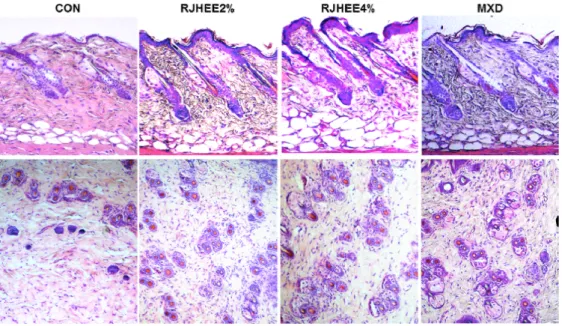
Histological analysis of dorsal skin tissues was conducted to define the effect of RJHEE on hair growth. RJHEE group increases the number, size, depth, and length of hair in dorsal skin tissues. The promoting effect of RJHEE on the hair development was confirmed visually by the histological analysis.
The numbers of hair follicles were much larger in RJHEE group than that of Con group. The observation indicated that hair cycle was accelerated in RJHEE group compared to Con group, representing normal murine hair cycle
pattern(Fig. 5). These findings suggested that RJHEE could contribute to accelerating the development of hair follicles.
4. RJHEE upregulates activation of β -catenin and Wnt3 α expression in the skin of C57BL/6N mice
To elucidate the mechanism underlying the induction of anagen stage in the RJHEE group, we performed western blot analysis using antibodies specific to Wnt3α, p-GSK3β and β -catenin, key molecule in tissue generation and anagen induction in the dorsal skin of C57BL/6 mice.
RJHEE group increased the expressions of Wnt3α, p-GSK3β and β-catenin compared to CON group. In CON group, Wnt3α, p-GSK3β
Fig. 1. Photograph of hair regrowth and changes of body weight in C57BL/6N mice.
(a) The dorsal skins of mice were shaved and applied hair removal cream externally, and the test treatments were applied daily for 17 days. The back skin was photographed on 1, 7, 10, 13, and 17 days after shaving. (b)Parts of the depilated and the hair growth area measured using the ImageJ software. The data shown are the mean± SE (n=8). Significant difference from CON group, ∗p<0.05,
**p<0.01, ***p<0.001.
and β-catenin was very weakly detected in skin tissues. However, its expression was increased in the skin of RJHEE group in dose-dependent manner(Fig. 6).
These results suggest that RJHEE can activate the development of hair follicles and the ingression into the anagen stage via Wnt3α, p-GSK3β and β-catenin signaling pathways.
Taken together, these findings suggest a potent role for RJHEE group in the hair-promoting activity related to hair morphogenesis.
5. RJHEE induces the expression of proteins related to cell survival in the skin of
Fig. 2. Folliscopic observation of hair density of C57BL/6N mice (X50 magnification).
Dorsal skins of mice were photographed by folliscope at the 7, 10, and 13 days after depilation. Hair density was expressed as the number of hairs per unit area. Compared to the skin of the mice in the CON group, the skin of the mice in the MXD or RJHEE group had increased hair density. The data shown are the mean ± SE of 8 mice per group. **p<0.01, ***p<0.001 vs.
CON group.
Fig. 3. Folliscopic observation of hair thickness of C57BL/6N mice (X100 magnification).
Dorsal skins of mice were photographed by folliscope at the 7, 10, and 13 days after depilation. RJHEE or MXD group had increased hair thickness compared to CON group. The data shown are the mean ± SE of 8 mice per group. **p<0.01,
***p<0.001 vs. CON group.
7 10 13
0.0 0.5 1.0 1.5 2.0
2.5 CON
RJHEE2%
RJHEE4%
******
**
MXD
Days
Length of hair (mm)
Fig. 4. Effect of RJHEE on hair length of C57BL/6N mice by Folliscope.
Hair length was measured at the 7, 10, and 13 days after depilation. RJHEE or MXD group had increased hair length compared to CON group at 13 days. The data shown are the mean ± SE of 8 mice per group. ***p<0.001 vs. CON group.
C57BL/6N mice
We investigated whether the expression of genes related to cell survival and apoptosis, ERK, Bax, Bcl-xL, and Bcl-2, was involved in promoting effect of RJHEE groups on hair growth.
RJHEE2% group increased the phosphorylation of ERK and the expressions of Bcl-xL and Bcl-2 compared to CON group. RJHEE4% group increased the phosphorylation of ERK and the expressions of Bcl-2 compared to CON group, and reduced the expression of Bax. MXD group increased the phosphorylation of ERK and the expressions of Bcl-xL and Bcl-2 compared to CON group, and reduced the expression of Bax.
These findings suggest RJHEE might prevent apoptosis of cells involved in hair grow in skin.
Taken together, these findings suggest a potent role for RJHEE group in the hair-promoting
activity related to hair morphogenesis.
6. RJHEE promotes proliferation of HaCaT cells
Fig. 5. Effect of RJHEE on the histological changes in C57BL/6N mice.
Sections of dorsal skin tissues were stained at 7days by H&E staining. X50. Histological findings of the hair follicles of depilated C57BL/6 mice.
Fig. 6. Effect of RJHEE on Wnt3α, p-GSK3β, and β -catenin expressions in skin tissue of C57BL/6N mice.
Dose-dependent effects of Wnt3α, p-GSK3β, and β-catenin were detected in RJHEE group using western blotting as described in Materials and Methods.
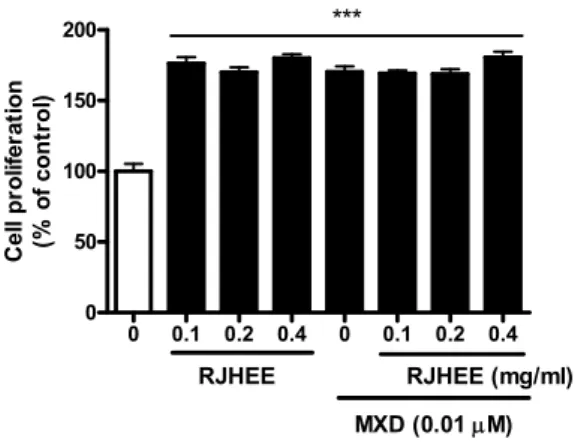
RJHEE (0.1, 0.2, and 0.4 mg/ml) significantly increased the proliferation of HaCaT compared with the vehicle-treated control. RJHEE (0.1, 0.2, and 0.4 mg/ml) plus MXD (0.01 μM) also increased the proliferation of HaCaT compared with the vehicle-treated control. However, The effect of the RJHEE (0.1, 0.2, and 0.4 mg/ml) in combination with MXD (0.01 μM) on the proliferation of HaCaT was not significantly greater than that of MXD alone or RJHEE alone(Fig. 8).
7. RJHEE suppresses H
2O
2-induced oxidative toxicity and reactive oxygen species (ROS) generation in HaCaT cells To evaluate oxidative toxicity induced by H
2O
2, we performed cell viability assay and ROS assay in HaCaT cells. As shown in Fig. 8, RJHEE (0.1, 0.2, and 0.4 mg/ml) did not show cytotoxicity in HaCaT cells. For cell viability assay, HaCaT cells with or without pretreatment
with RJHEE (0.1, 0.2, and 0.4 mg/ml) or MXD (0.01 μM) for 24 h were exposed to 1 mM H
2O
2for 30 min. Exposure to H
2O
2(1 mM) induced cell death of HaCaT cells and ~60% of the cells were dead after 30 min exposure. In contrast, cells treated with RJHEE (0.1, 0.2, and 0.4 mg/ml) showed cell viability of 47.53%, 49.72%, and 51.33% respectively. However, MXD (0.01 μM) showed no difference compared to H
2O
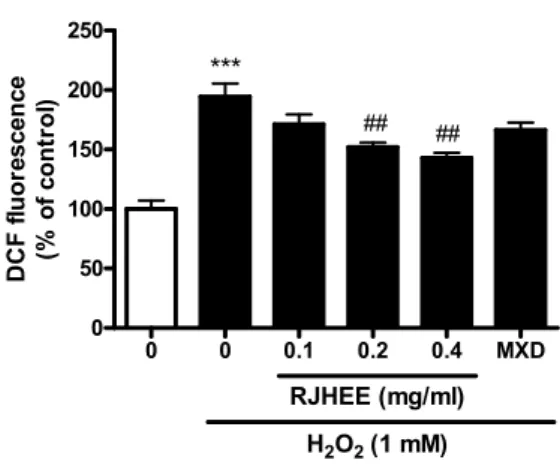
2alone on cell viability(Fig. 9). For ROS assay, HaCaT cells with or without pretreatment with RJHEE (0.1, 0.2, and 0.4 mg/ml) or MXD (0.01 μM) for 30 min were exposed to 1 mM H
2O
2for 30 min. Exposure to H
2O
2(1 mM) induced ROS generation of 194.5% after 30 min exposure. In contrast, cells treated with RJHEE (0.1, 0.2, and 0.4 mg/ml) showed ROS generation of 171.1%, 152.0%, and 142.8% respectively.
However, MXD (0.01 μM) showed no difference
0 0.1 0.2 0.4 0 0.1 0.2 0.4 0
50 100 150 200
RJHEE RJHEE (mg/ml) MXD (0.01M)
***
Cell proliferation (% of control)
Fig. 8. Effect of RJHEE on proliferation of HaCaT cells.
HaCaT cells were plated in 96 well plates at a density of 1.5x10⁵ cells/ml and then treated with the indicated doses of MXD and RJHEE for 5 d. The relative cell proliferation was evaluated by means of an MTT assay. Each value represents the means±S.E. of triplicate measurements performed on separate experiments. Values are shown as percentages of controls. ***
p<0.001 vs. vehicle control.
0 0 0.1 0.2 0.4 MXD
0 30 60 90 120
H2O2 (1 mM) RJHEE (mg/ml)
***
# ##
Cell viability (% of control)
Fig. 9. Effect of RJHEE on H2O2-induced oxidative toxicity in HaCaT cells.
HaCaT cells were plated in 96 well plates at a density of 5ⅹ104 cells/ml. After overnight, the cells were treated with the indicated doses of RJHEE for 24 h and then treated with H2O2
for 30 min. The relative cell proliferation was evaluated by means of an MTT assay. Each value represents the means±S.E.
of triplicate measurements performed on separate experiments.
Values are shown as percentages of controls. ***p<0.001 vs.
vehicle control. #p<.05, ##p<0.01 vs. H2O2 alone
compared to H
2O
2alone on cell viability(Fig.
10).
Discussion
RJH is a multiyearold plant belonging to Polygonaceae. It grows naturally all over our country and grows well in humid places such as forests and streams
15). RJH traditionally has been used in diverse skin diseases as an herbal medicine for external application in East-Asia region
6). It has antioxidant effect on human skin diseases. It is a native plant in Okinawa, Japan and has traditionally been used by local people for the treatment of acute and chronic skin diseases
16). Despite such many uses, in the past they did not have enough understanding of the pharmacological effects of RJH. In recent years, research on the pharmacology and components
of RJH has been actively conducted. About the content of RJH, Jang's
17)research has reported that 24-nor-Ursane type triterpenoids is contained in the stem, and Jiang
18)and Chen
19)have been studied the components which are separated from the roots. The antimicrobial activity of RJH also has been studied
20), and antioxidant effects have been studied
21). It has been reported that RJH has treats symptoms of dermatosis in oriental medicine literature. Experiments have been conducted to demonstrate the therapeutic effect of atopic dermatitis. Ahn’s reported on the treatment effect of RJH has hydrothermal extract on atopic dermatitis
22)and Lee studied on the inhibition effect of atopic dermatitis
23).Not only in the recent studies of RJH has, but also widely used remedy for a long time ago. According to the records of Compendium of Materia Medica (本草綱目), it is effective for skin diseases such as swollen area and swelling, and it is reported that there is no toxicity and no taste, and it is reported that it is effective for constipation, indigestion and intestinal bleeding in the private sector. According to the records of Donguibogam:
Principles and Practice of Eastern Medicine(東醫 寶鑑), it is reported that it is used as an external medicine because it treats scabies, ringworm, furuncle, and hemorrhoids and has an insecticidal effect. Based on the above results, it was suggested that of RJH could be used as an effective herbal medicine for hair loss caused by scalp dermatitis.
This study was performed to evaluate hair promoting effect using C57BL/6 mice model and keratinocyte protecting effect of RJH using HaCaT cells. Depilated C57BL/6 mice are a useful model for hair research and HaCaT cells, human keratinocyte as a main component of skin
0 0 0.1 0.2 0.4 MXD
0 50 100 150 200 250
RJHEE (mg/ml) H2O2(1 mM)
***
## ##
DCF fluorescence (% of control)
Fig. 10. Effect of RJHEE on H2O2-induced reactive oxygen species (ROS) generation in HaCaT cells.
HaCaT cells were plated in 96 well plates at a density of 1x10⁵ cells/ml. After overnight, the cells were treated with the indicated doses of RJHEE for 30 min and then treated with H2O2 for 30 min. The relative cell proliferation was evaluated by means of an MTT assay. Each value represents the means±S.E.
of triplicate measurements performed on separate experiments.
Values are shown as percentages of controls. ***p<0.001 vs.
vehicle control. ##p<0.01 vs. H2O2 alone