© 2012 The Korean Academy of Medical Sciences.
This is an Open Access article distributed under the terms of the Creative Commons Attribution Non-Commercial License (http://creativecommons.org/licenses/by-nc/3.0) which permits unrestricted non-commercial use, distribution, and reproduction in any medium, provided the original work is properly cited.
pISSN 1011-8934 eISSN 1598-6357
Clinical Characteristics and Prognostic Factors in Early-Onset Alopecia Totalis and Alopecia Universalis
Alopecia totalis (AT) and alopecia universalis (AU), severe forms of alopecia areata (AA), show distinguishable clinical characteristics from those of patch AA. In this study, we investigated the clinical characteristics of AT/AU according to the onset age. Based on the onset age around adolescence (< or ≥ 13 yr), 108 patients were classified in an early- onset group and the other 179 patients in a late-onset group. We found that more patients in the early-onset group had a family history of AA, nail dystrophy, and history of atopic dermatitis than those in the late-onset group. These clinical differences were more prominent in patients with AU than in those with AT. In addition, significantly more patients with concomitant medical disorders, especially allergic diseases were found in the early-onset group (45.8%) than in the late-onset group (31.2%). All treatment modalities failed to show any association with the present hair condition of patients. In the early- onset group, patients with AU or a family history of AA showed worse prognosis, whereas this trend was not observed in the late-onset group. Systemic evaluations might be needed in early-onset patients due to the higher incidence of comorbid diseases. It is suggested that patients with AU or family history of AA make worse progress in the early-onset group than in the late-onset group.
Key Words: Alopecia Totalis; Alopecia Universalis; Age of Onset Hyun Hee Cho1, Seong Jin Jo1,2,
Seung Hwan Paik1, Hye Chan Jeon1, Kyu Han Kim1,2, Hee Chul Eun1,2, and Oh Sang Kwon1,2
1Department of Dermatology, Seoul National University College of Medicine, 2Institute of Dermatological Science, Seoul National University, Seoul, Korea
Received: 10 October 2011 Accepted: 19 April 2012 Address for Correspondence:
Oh Sang Kwon, MD
Department of Dermatology, Seoul National University College of Medicine, 101 Daehak-ro, Jongno-gu, Seoul 110-744, Korea Tel: +82.2-2072-1996, Fax: +82.2-742-7344
E-mail: [email protected]
This study was performed by a grant from Seoul National University Hospital (Grant No. 2010-1089) and partially supported by National Research Foundation of Korea (NRF) Grant funded by the Korean Government (MEST) (No. 2011- 0001300).
http://dx.doi.org/10.3346/jkms.2012.27.7.799 • J Korean Med Sci 2012; 27: 799-802
ORIGINAL ARTICLE
Dermatology
INTRODUCTION
Alopecia areata (AA) is a common disorder that accounts for 1%-3% of patients visiting dermatology clinics (1). Although it usually presents as asymptomatic localized hair loss (patch AA), it is a disease of very broad spectrum. The hair of the entire scalp and the whole body can be affected, which are called alopecia totalis (AT) and alopecia universalis (AU), respectively. AT and AU are severe forms of AA and only 10% of patients with AT/AU experience full recovery (2, 3).
AA is characterized by a variety of clinical courses, and it is not easy for clinicians to predict prognosis and clinical outcome of each patient. However, several epidemiologic studies on clin- ical presentation of AA have reported that onset before adoles- cence is one of the important prognostic factors (4). The extent of involvement, ophiasis pattern of hair loss, long duration of hair loss, a positive family history, nail involvement, atopic dis- eases and other autoimmune diseases are also known as pre- dictors of poor prognosis in patients with AA (1, 2, 5-8). Howev- er, their correlations were identified mainly based on patients with patch AA, and AT/AU has rarely been studied separately although these severe forms of AA show different characteris- tics and clinical features from patch AA.
In this study, we investigated the clinical characteristics of AT/AU retrospectively by review of medical records and tele- phone-interview. Patients with AT/AU were classified into the early- or late-onset group by the onset-age (< or ≥ 13 yr), and demographic data, type of AA, family history of AA, comorbid disorders, treatment modalities and the present state of hair loss were assessed and compared in these groups.
MATERIALS AND METHODS Participants
A total of 287 patients diagnosed as AT or AU in Seoul National University Hospital (SNUH) from 1999 to 2010 were enrolled in this study. The medical records were reviewed retrospectively and the patients were interviewed by telephone. All subjects were classified into the early-onset or late-onset group based on the age at onset of < or ≥ 13 yr, respectively, and the clinical profiles of these two groups regarding alopecia and associated conditions were then compared.
Clinical profiles
Clinical details including type of alopecia, age at onset, family history of AA, concomitant disorders, and treatment history were
Cho HH, et al. • Early-Onset Alopecia Totalis and Alopecia Universalis
800 http://jkms.org http://dx.doi.org/10.3346/jkms.2012.27.7.799
obtained from the review of medical records. Treatment modal- ities were classified as follows: application of topical steroids, intralesional injection of triamcinolone, immunotherapy with diphencyprone or squaric acid dibutyl ester, and oral adminis- tration of corticosteroids or systemic immunosuppressant like cyclosporine. Information on the present state of AT/AU was obtained from medical records for a total of 161 patients; 83 pa- tients who recently visited our clinic and from telephone inter- views for the other 78 patients; we could not follow-up the other 126 patients. We compared the present state with the state at the first visit and graded the disease state as described above: aggra- vation or no improvement (< 25%), partial improvement (25%- 75%) and much improvement (> 75%). In case of telephone in- terview, we checked the compartment of hair re-growth (frontal, parietal, occipital, temporal, vertex) and percentage of that com- partment (7). If the patient could not answer as percentage, we asked about the subjective assessment of their current scalp status.
Statistical analysis
Using the statistical package program (SPSS Inc., Chicago, IL, USA), the chi-square test was performed to identify differences between groups; P values of < 0.05 were considered significant.
Ethics statement
Verbal informed consents were obtained from patients or their parents in case of under ages by the interviewer before conduct- ing the interview. The present study was approved by the insti- tutional review board of SNUH (IRB H-1005-066-319).
RESULTS
Demographics and clinical profiles
Clinical profiles of 287 patients (154 males, 133 females) with AT/AU were assessed. Among them, 137 patients had AT and the other 150 patients had AU. Their age of onset ranged from
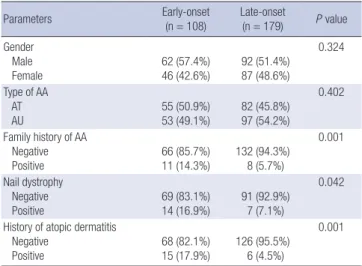
1 yr to 61 yr (mean 19.7 ± 14.1 yr). Based on the age at onset of < or ≥ 13 yr, 108 patients were classified to the early-onset group and the other 179 patients to the late-onset group, respec- tively. Regarding gender and type of AA, no significant differ- ence was found between the early- and late-onset groups. How- ever, significantly more patients in the early-onset group had family history of AA, concomitant nail dystrophy, and history of atopic dermatitis than in the late-onset group (Table 1). These clinical differences were more prominent in patients with AU than in those with AT. Analysis of patients with AU showed that family history of AA (P = 0.007), nail dystrophy (P = 0.058), and history of atopic dermatitis (P < 0.001) were more frequently seen in the early-onset group than in the late-onset group. These tendencies were similarly observed in patients with AT but were not statistically significant (Fig. 1).
Concomitant disorders in study population
Fifty-seven patients (38.4%) in the study population had a med- ical history of concomitant disorders, most of which were previ-
Table 1. Demographic data and clinical presentations (n = 279)
Parameters Early-onset
(n = 108)
Late-onset
(n = 179) P value Gender
Male
Female 62 (57.4%)
46 (42.6%) 92 (51.4%) 87 (48.6%)
0.324
Type of AA AT
AU 55 (50.9%)
53 (49.1%) 82 (45.8%) 97 (54.2%)
0.402
Family history of AA Negative
Positive 66 (85.7%)
11 (14.3%) 132 (94.3%) 8 (5.7%)
0.001
Nail dystrophy Negative
Positive 69 (83.1%)
14 (16.9%) 91 (92.9%) 7 (7.1%)
0.042
History of atopic dermatitis Negative
Positive 68 (82.1%)
15 (17.9%) 126 (95.5%) 6 (4.5%)
0.001
Fig. 1. Assessment of clinical characteristics of AT and AU by onset-age. *P < 0.1, †P < 0.01.
Proportion of patients (%)
Family history Atopic dermatitis
Nail change AT early
AT early
AT early AU early
AU early
AU early AT late
AT late
AT late
AU late AU late AU late
30 25 20 15 10 5 0
*
†
†
Cho HH, et al. • Early-Onset Alopecia Totalis and Alopecia Universalis
http://jkms.org 801
http://dx.doi.org/10.3346/jkms.2012.27.7.799
ously reported with AA. Significantly more patients with a con- comitant medical disorder were found in the early-onset group (n = 33, 45.8%) than in the late-onset group (n = 24, 31.2%). Al- lergic diseases such as atopic dermatitis, allergic rhinitis, and asthma were more common in the early-onset group (34.7%) than in the late-onset group (15.6%). After allergic diseases, thy- roid disease was the most common comorbid disorder in both groups (Table 2).
Treatment Modalities for AT/AU and Disease Progress Topical application (n = 217, 75.6%) and oral administration (n = 218, 76.0%) of steroids were most frequent treatment mo- dalities for AT/AU, followed by immunotherapy (n = 161, 56.1%), triamcinolone intralesional injection (n = 116, 40.4%), and cy- closporine A (n = 110, 38.3%) regardless of onset-age and type of AA.
Progress of alopecia was assessed in 161 patients (71 with AT, 90 with AU) by comparing the present hair state with the state at the first visit. In the AT group, 33 patients (46.5%) experienced partial improvement and 12 patients (16.9%) experienced much improvement. Among the other 26 patients, 12 cases (16.9%) experienced disease progress to AU. However, only 5 patients (5.6%) in the AU group experienced much improvement and the difference was statistically significant (P = 0.011). In the early-onset group, AU made worse progress than AT and pa- tients with family history of AA were significantly unimproved compared with those without family history of AA (P = 0.041), whereas there was no association with gender, atopic dermati- tis and nail dystrophy. In contrast, even a family history of AA was not associated with disease progress in the late-onset group.
Concerning the history of treatment modalities, we did not find any significant association between the present state of hair loss and the history of treatment modalities in either the early- or late-onset group.
DISCUSSION
AA is a disease of broad spectrum ranging from localized patch
hair loss to hair loss over the whole body, and the clinical fea- tures are very different according to the severity of the disease.
For example, AT/AU patients were younger at the age of onset and more likely to have concomitant disorders than those with patch AA (6). Several studies reported the clinical features and prognosis of AA (6, 9-11), but most subjects in these studies were patients with localized patch AA and the clinical features of AT/AU were therefore rarely assessed, especially by age at onset. The present study was performed on patients with AT/AU excluding patch AA. We classified patients into early- and late- onset groups based on the onset-age of 13 yr because previous epidemiologic studies have generally considered the onset-age of puberty as around 13 yr (12, 13). There was no significant dif- ference in gender and ratio of AT and AU between groups. Inter- estingly, some clinical features, such as family history, atopic disorders, and nail changes, showed significant differences be- tween early- and late-onset groups only in patients with AU, a more severe type of AA than AT.
As mentioned, several autoimmune diseases and atopic dis- orders are generally thought to be associated with AA (6, 7, 11).
According to Goh et al. (6), 56% of AA patients had comorbidi- ties other than AA and the proportion was higher in AT/AU than in patch AA. However, some studies reported that the incidence of concomitant disorders was not higher either in patients with severe type AA or in patients in whom AA had developed dur- ing childhood (7, 14). In our study, 38.4% of AT/AU patients had concomitant disorders and atopic dermatitis was most common, which was more prominent in the early-onset group.
The second most common comorbidity was thyroid disor- der in both groups. Thyroid disease, including Grave’s disease, Hashimoto’s thyroiditis and simple goiter, are reported in 8% to 28% of AA patients (1). In one Korean report, 1.4% of AA indi- viduals had autoimmune thyroid disease (15). Compared with those in a previous report, a relatively high rate (6.0%) of AT/AU individuals had thyroid diseases in this study, but no differenc- es were seen in the two groups. It has been known that AT/AU is less favorable than patch AA and fewer than 10% of AT/AU patients recover spontaneously (16), which was consistent with our result that 16.9% of AT patients and 5.6% of AU patients showed > 75% improvement.
The most common therapy used in AA is intralesional injec- tion of corticosteroids and 64%-97% of AA sites exhibit hair growth (17, 18). In this study, topical application and oral ad- ministration of steroid were the most frequently used treatment modalities for AT/AU. However, all treatment modalities includ- ing steroid failed to show any association with the present hair condition of patients in this study, which suggested that they cannot alter the long-term clinical course of the disease. In pre- vious studies, several poor prognostic factors were reported, including the extent of hair loss, long duration of hair loss, ato- py, a positive family history, the presence of other autoimmune Table 2. Comorbid disorders with alopecia areata
Concomitant disorders Early-onset
(n = 72) Late-onset (n = 77)
Atopic dermatitis 15 (20.8%) 6 (7.8%)
Allergic rhinitis 8 (11.1%) 6 (7.8%)
Thyroid disease 5 (6.9%) 4 (5.2%)
Psoriasis 2 (2.8%) 2 (2.6%)
Vitiligo 1 (1.4%) 2 (2.6%)
Asthma 2 (2.8%) 0 (0.0%)
Nephrotic syndrome 0 (0.0%) 2 (2.6%)
Inflammatory bowel disease 0 (0.0%) 1 (1.3%)
Behcet disease 0 (0.0%) 1 (1.3%)
No concomitant disorders 39 (54.2%) 53 (68.8%)
Cho HH, et al. • Early-Onset Alopecia Totalis and Alopecia Universalis
802 http://jkms.org http://dx.doi.org/10.3346/jkms.2012.27.7.799
diseases, nail involvement, and young age of onset (1). Howev- er, in the cases of AT/AU, the present state of disease was asso- ciated with the type of AA and a family history of AA only in the early-onset group, while no associated factors with disease progress were found in the late-onset group. The earlier age of onset and family history suggest a relationship with personal genetic susceptibility as previously reported (19-21).
Our study has certain limitations. First, this study was retro- spectively performed and recall bias might be involved because some clinical data were obtained by telephone interview. Sec- ondly, a larger number of subjects would be helpful to statisti- cally confirm the association between age at onset and clinical characteristics of AT/AU. For example, early-onset patients with AT seemed to be more associated with family history of AA, nail dystrophy, and history of atopic dermatitis than late-onset pa- tients with AT, but this finding was not statistically significant.
Data from more patients may be useful to demonstrate statisti- cal significance. Thirdly, in the chart review we checked the presence of any comorbid disorders when diagnosed by pri- mary physicians of the patients. Therefore, the some patients would not be included in rhinitis or asthma group even though they developed any suggestive symptom of rhinitis or asthma.
Finally, this study was cross-sectional study and reviewed non- standardized treatment method. Therefore, prospective stan- dardized study would be executed to investigate progress of the disease or treatment efficacy.
In summary, early-onset of AU was associated with family his- tory of AA, atopic disorders, and nail changes. Comorbid disor- ders, especially allergic disorders, were also more common with early-onset AT/AU than with late-onset disease. Assessment of the present hair state suggests that patients with AU or family history of AA make worse progress in the early-onset group than in the late-onset group.
REFERENCES
1. Chua-Ty G, Goh CL, Koh SL. Pattern of skin diseases at the National Skin Centre (Singapore) from 1989-1990. Int J Dermatol 1992; 31: 555-9.
2. Alkhalifah A, Alsantali A, Wang E, McElwee KJ, Shapiro J. Alopecia areata update: part I. Clinical picture, histopathology, and pathogenesis. J Am Acad Dermatol 2010; 62: 177-88.
3. MacDonald Hull SP, Wood ML, Hutchinson PE, Sladden M, Messenger AG; Brithsh Association of Dermatologists. Guidelines for the manage- ment of alopecia areata. Br J Dermatol 2003; 149: 692-9.
4. Walker SA, Rothman S. A statistical study and consideration of endocrine
influences. J Invest Dermatol 1950; 14: 403-13.
5. De Waard-van der Spek FB, Oranje AP, De Raeymaecker DM, Peere- boom-Wynia JD. Juvenile versus maturity-onset alopecia areata: a com- parative retrospective clinical study. Clin Exp Dermatol 1989; 14: 429-33.
6. Goh C, Finkel M, Christos PJ, Sinha AA. Profile of 513 patients with alopecia areata: associations of disease subtypes with atopy, autoimmune disease and positive family history. J Eur Acad Dermatol Venereol 2006;
20: 1055-60.
7. Tosti A, Bellavista S, Iorizzo M. Alopecia areata: a long term follow-up study of 191 patients. J Am Acad Dermatol 2006; 55: 438-41.
8. Kavak A, Yeşildal N, Parlak AH, Gökdemir G, Aydoğan I, Anul H, Baykal C. Alopecia areata in Turkey: demographic and clinical features. J Eur Acad Dermatol Venereol 2008; 22: 977-81.
9. Green J, Sinclair RD. Genetics of alopecia areata. Australas J Dermatol 2000; 41: 213-8.
10. McDonagh AJ, Tazi-Ahnini R. Epidemiology and genetics of alopecia areata. Clin Exp Dermatol 2002; 27: 405-9.
11. Shellow WV, Edwards JE, Koo JY. Profile of alopecia areata: a question- naire analysis of patient and family. Int J Dermatol 1992; 31: 186-9.
12. Shin N, Kim SH, Cho S, Whang KK, Hahm JH. The impact of childhood atopic dermatitis on their families. Korean J Dermatol 2000; 38: 494-9.
13. Kliegman RM. Adolescent development. In: Behrman RE, Kliegman R, Nelson WE, editors. Nelson textbook of pediatrics. 19th ed. Philadelphia:
W.B. Saunders, 2011, p 1778-80.
14. Sharma VK, Muralidhar S, Kumar B. Reappraisal of Ikeda’s classification of alopecia areata: analysis of 356 cases from Chandigarh, India. J Der- matol 1998; 25: 108-11.
15. Kim YJ, Kim BJ, Ro BI. A clinical and psychological study for alopecia areata in children. Korean J Dermatol 2003; 41: 179-86.
16. Paus R, Olsen EA, Messenger AG. Hair growth disorder. In: Wolff K, Goldsmith LA, Katz SI, Gilchrest BA, Paller AS, Leffell DJ, editors. Fitz- patrick’s dermatology In general medicine. 7th ed. New York: McGrow Hill, 2008, p 753-77.
17. Alkhalifah A, Alsantali A, Wang E, McElwee KJ, Shapiro J. Alopecia areata update: part II. Treatment. J Am Acad Dermatol 2010; 62: 191-202.
18. Porter D, Burton JL. A comparison of intra-lesional triamcinolone hex- acetonide and triamcinolone acetonide in alopecia areata. Br J Derma- tol 1971; 85: 272-3.
19. Akar A, Arca E, Erbil H, Akay C, Sayal A, Gür AR. Antioxidant enzymes and lipid peroxidation in the scalp of patients with alopecia areata. J Dermatol Sci 2002; 29: 85-90.
20. Colombe BW, Lou CD, Price VH. The genetic basis of alopecia areata:
HLA associations with patchy alopecia areata versus alopecia totalis and alopecia universalis. J Investig Dermatol Symp Proc 1999; 4: 216-9.
21. Lu W, Shapiro J, Yu M, Barekatain A, Lo B, Finner A, McElwee K. Alope- cia areata: pathogenesis and potential for therapy. Expert Rev Mol Med 2006; 8: 1-19.