서 론
폐쇄성 수면무호흡증은 한국인 성인 중년 남성에서 4,5%, 여성에서는 3.2%의 유병률을 지닌 흔한 질환이다.1) 많은
연구에서 폐쇄성 수면 무호흡증의 병인으로 상기도의 해부 학적인 이상을 주장해 왔지만 실제 대규모 연구에서 증명하 지는 못했다.2,3) 또한 기도가 좁은 사람이 모두 폐쇄성 수면 무호흡증을 가지는 것은 아니라는 보고도 있다.4) 더구나 폐
코골이 환자에서 수면무호흡 정도와 인슐린 저항성, 아디포넥틴 및 visfatin과의 관련성
계명대학교 의과대학 가정의학교실, 이비인후과학교실(1), 치과학교실(2), 신경과학교실(3)
서영성․안병훈(1)․황상희(2)․조용원(3)*
Relationship between AHI and Insulin Resistance, Serum Adiponectin, and Visfatin
Young Sung Suh, Byung Hoon Ahn(1), Sang Hee Hwang(2), Yong Won Cho(3)*
Department of Family Medicine, Otolaryngology(1), Dentistry(2), and Neurology(3), Keimyung University College of Medicine
요 약
연구배경: 폐쇄성 수면 무호흡증에서는 복부비만과 인슐린 저항성이 흔히 동반된다. 그러나 비만을 보정한 후 시행된 연구에서 인슐린 저항성과 무호흡-저호흡지수(AHI) 간의 관련성은 다양하게 보고되었다. 따라서 이 연구는 코골이 환자에서 수면무호흡 정도와 지방세포분비 단백질인 혈중 아디포넥틴과 visfatin 치 및 인슐린 저항성과의 관련성을 분석하고자한다.
방법: 이 연구는 20세 이상 코골이를 주소로 대구시내 모 대학병원 수면센타에서 수면다원검사를 시행한 성인 남녀 81명(남 70명, 여 11명)을 대상으로 하였다. 수면다원검사로 측정된 AHI에 따라 5 미만을 단순 코골이군으로 하였고, AHI 5~14.9까지를 경증 수면 무호흡증군, 15 이상을 중등도 및 중증무호흡증군으로 나누었다. 혈당, 인슐 린, 아디포넥틴, visfatin은 공복 정맥혈에서 채혈한 후 측정되었다.
결과: 1) 대상군은 AHI 5 미만인 군 24명, 5 이상 15 미만 군 19명, 15 이상인 군 38명이었다. 세 군 간 비교에 서는 성별 및 허리둘레에서 유의한 차이가 있었다(P = 0.003, P = 0.007). 연령, 성별 및 허리둘레를 보정한 후 세군간의 비교에서는 인슐린, 아디포넥틴, HOMA-IR 및 visfatin의 차이는 없었다.
2) 상관분석결과 아디포넥틴은 성별, 허리둘레 및 AHI 정도와 유의한 상관성이 있었다. 인슐린은 BMI, 허리둘 레 및 엉덩이둘레, AHI 정도와 유의한 상관성이 있었으며, HOMA-IR는 성별 이외의 모든 변수와 유의한 상관성이 있었다. Visfatin은 성별과 유의한 상관성이 있었다.
3) 단계별 회귀분석 결과 혈중 인슐린과 HOMA-IR을 가장 잘 설명하는 변수는 허리둘레였고, 아디포넥틴은 성 별과 허리둘레였다. Visfatin은 성별이 가장 잘 설명할 수 있는 변수였다.
결론: 이상의 연구결과 코골이 환자에서 인슐린 저항성 및 혈중 아디포넥틴은 허리둘레와 관련되었고 수면무호 흡 정도와는 무관하였다. 또한 혈중 visfatin치를 설명할 수 있는 변수는 성별 이외에는 없었다.
ꠏꠏꠏꠏꠏꠏꠏꠏꠏꠏꠏꠏꠏꠏꠏꠏꠏꠏꠏꠏꠏꠏꠏꠏꠏꠏꠏꠏꠏꠏꠏꠏꠏꠏꠏꠏꠏꠏꠏꠏꠏꠏꠏꠏꠏꠏꠏꠏꠏꠏꠏꠏꠏꠏꠏꠏꠏꠏꠏꠏꠏꠏꠏꠏꠏꠏꠏꠏꠏꠏꠏꠏꠏꠏꠏꠏꠏꠏꠏꠏꠏꠏꠏꠏꠏꠏꠏꠏꠏꠏꠏꠏꠏꠏꠏꠏꠏꠏꠏꠏꠏꠏꠏꠏ 중심단어: 코골이, 수면 무호흡 정도, 인슐린 저항성, 아디포넥틴, visfatin
ꠏꠏꠏꠏꠏꠏꠏꠏꠏꠏꠏꠏꠏꠏꠏꠏꠏꠏꠏꠏꠏꠏꠏꠏꠏꠏꠏꠏꠏꠏꠏꠏꠏꠏꠏꠏ
교신저자: 조용원, (700-712) 대구광역시 중구 동산동 194 계명대학교 의과대학 신경과학교실
Tel: 053)250-7831 Fax: 053)250-7840, E-mail: [email protected], Mobile: 011-521-5059
* 이 연구는 2005년 계명대학교 비사연구비 지원으로 이루어졌음.
쇄성 수면무호흡증은 목둘레나 체질량지수(body mass index, 이하 BMI)와 관련성이 높지만 허리둘레나 복부내장지방량 도 중요한 것으로 밝혀져 이에 대해서는 간과되고 있다.5)
인슐린 저항성은 심혈관계 및 대사질환의 주요 위험요소 로 간주되고 있으며6), 특히 비만과 밀접한 관련성이 있다.
인슐린 저항성과 폐쇄성 수면무호흡증 간의 높은 관련성은 BMI 때문이라는 보고가 있지만7), 몇몇 연구에서는 수면 시 이상호흡(sleep disordered breathing) 자체가 인슐린 저항성 에 대한 독립적인 요인인 것으로 보고되었다.8,9) 뿐만 아니 라 지속적 양압장치(Continuous positive airway pressure, 이하 CPAP)를 이용하여 폐쇄성 수면무호흡증을 치료하면 대사이상이 호전되었다는 연구보고도 몇몇 있다.10.11)
지방세포에서는 여러 가지 호르몬과 사이토카인을 분비 하고 있으며 이들은 대사증후군이나 인슐린 저항성 발병에 기여하는 것으로 알려져 있다.12) 1996년에 발견된 아디포넥 틴은 비만, 제2형 당뇨병, 심혈관질환 및 이상지혈증에서 감 소하는 것으로 알려져 있으며13), 낮은 아디포넥틴혈증은 심 혈관질환, 뇌혈관질환의 위험요인으로 생각되어지고 있다.14) 폐쇄성 수면무호흡증 환자에서는 인슐린 저항성이 증가하 고 인슐린 저항성이 증가된 환자에서 아디포넥틴이 감소하 는 것으로 보아 폐쇄성 수면무호흡증에 대한 아디포넥틴의 방어효과 가능성에 대한 보고가 있었다.15) 그러나 또 다른 연구에서 아디포넥틴은 무호흡-저호흡지수(apnea- hypopnea index, 이하 AHI) 정도를 설명할 수 있는 독립적인 설명변 수는 아닌 것으로 보고되었다.9)
2005년 보고된 visfatin은 복강 내 지방세포에서 분비되 는 것으로 알려졌으며 인슐린 저항성과 관련 있고 당대사 및 지방 대사에도 관련될 것으로 추정하고 있다.16) 즉, 혈중 visfatin의 농도는 피하 지방량보다 복강지방량과 관련성이 높고 인슐린과 유사하게 작용하며, 고지방식사를 하면 혈중 치가 증가하는 것으로 보아 식사 또는 비만 연관 인슐린 저 항성의 발생에 중요한 역할을 하는 것으로 추정해 볼 수 있 다.17) 또한 폐쇄성 수면무호흡증은 복부내장 지방량과도 관 련성이 높으므로5) 수면 무호흡 정도와 혈중 visfatin과의 관 련성도 추정해 볼 수 있을 것이다.
따라서 이 연구는 코골이 환자에서 수면무호흡 정도와 지방세포 분비 단백질인 혈중 아디포넥틴과 visfatin치 및 인슐린 저항성과의 관련성을 분석하고자한다.
연구대상 및 방법 1. 연구대상
연구대상군은 2004년 3월부터 2006년 5월까지 20세 이 상 성인이면서 코골이로 대구시내 모 대학병원 수면센타에 서 수면다원검사를 시행한 남녀 81명(남 70명, 여 11명)을 대상으로 하였다. 이 연구는 계명대학교 동산병원 임상연구
윤리심의위원회의 심의 후 시행되었다.
2. 신체계측
신체계측은 신장과 체중을 측정하였고 측정된 신장과 체 중으로 BMI (kg/m2)를 계산하였다. 허리둘레는 기립 시 호 기 후 줄자를 이용하여 배꼽을 지나는 둘레를 허리둘레로 하 였고 엉덩이둘레 중 가장 큰 둘레를 엉덩이둘레로 하였다.18) 3. 혈중 공복혈당, HOMA-IR, 아디포넥틴 및
Visfatin 측정
채혈은 10시간 공복 후 정맥혈에서 채혈하였고 채혈 즉 시 혈청을 분리한 후 -70℃에서 보관하였다. 공복 혈당은 자동분석기(Hitachi 7600-110, Hitachi, Japan)를 이용하였 고, 혈중 인슐린치는 radioimmunoassay (RIA) kit (Myria, TechnoGenetics, Milano, Italy)를 이용하여 측정하였다. 혈 중 아디포넥틴의 측정은 Human adiponectin ELISA kit (#EZHADP-61K, Linco Research, St. Charles MO)을 이 용하였고, 혈중 visfatin은 human visfatin ELISA kit (#K4907-100, Biovision Research, Mountain View, CA)를 이용하였다. 인슐린 저항성은 공복혈당과 인슐린을 곱한 후 22.5를 나누어 계산한 HOMA-IR (Homeostasis Model of Assessment for insulin resistance)을 이용하였다.19)
4. 수면 다원검사
수면다원검사는 미국 Glass-Telefactor사의 Aurora기종을 이용하여 하루 밤 동안 수면 검사실에서 시행하고 수면다원 검사의 판독은 Rechschaffe과 Kale법을 이용하였다. 무호흡 은 10초 이상 공기흐름이 기저선에 비해 50% 이상 감소하 는 경우로 정의하였으며 저호흡은 10초 이상 50% 이상 감 소하지는 않지만 산소 불포화도가 3% 이상이거나 각성이 동반되는 경우로 정의하였다.20) AHI는 야간 수면 중 나타 나는 무호흡 및 저호흡 회수를 수면시간으로 나눈 값이다.
이 연구에서는 수면다원검사결과 측정된 AHI 정도에 따라 5 미만을 단순 코골이 군으로 하였고, AHI 5~14.9까지를 경증, 15 이상의 중등도 및 중증무호흡증으로 나누었다.21)
5. 통계방법
대상군들을 AHI 정도에 따라 세 군으로 분류한 후 세 군 간 연령, BMI, 허리둘레 및 엉덩이둘레의 비교는 ANOVA 검정을 이용하였고, 성별 빈도차이는 χ2 검정을 이용하였다.
General linear model을 이용하여 성별, 나이 및 허리둘레를 보정한 후 세 군 간 혈중 인슐린, HOMA-IR 및 지방세포분 비 단백질의 차이를 알아보았다. 신체계측지수, AHI, 인슐 린, HOMA-IR 및 지방세포분비 단백질 간의 연관성은 Pearson 상관 분석을 이용하였다. 단계별 다중회귀분석을 이용하여 혈중 인슐린, HOMA-IR 및 혈중 지방세포분비
단백질을 가장 잘 설명할 수 있는 변수를 알아보았다. 세 군 간의 비교, 상관분석 및 다중회귀분석 시 인슐린, HOMA -IR, 혈중 지방세포 분비단백질의 농도는 로그변환 후 분석 되었다. 모든 자료의 처리는 SPSS 14.0프로그램(Chicago, IL)을 이용하였으며 통계학적인 유의수준은 0.05 미만으로 하였다.
결 과 1. AHI에 따른 각 변수의 차이
대상군은 모두 81명(남자 70명 여자 11명)으로, AHI 5 미만인 군 24명, 5 이상 15 미만 19명, 15 이상인 군 38명 이었으며, 세 군 간 남녀의 수는 차이가 있었다(P = 0.003).
AHI에 따른 신체계측지수는 허리둘레에서 차이가 있었고(P
= 0.007), BMI, 엉덩이둘레는 AHI가 높은 군에서 컸으나 통계학적인 차이는 없었다(Table 1).
세 군 간의 단변량 분석에서 혈중 아디포넥틴치가 차이 가 있었으나, 성별, 연령 및 허리둘레를 보정한 후에는 유의 하지 않았다. 또한 세 군 간의 인슐린, HOMA-IR 및 visfatin도 유의한 차이가 없었다(Table 2).
2. 공복 인슐린, HOMA-IR, 아디포넥틴, Visfatin과 신체계측지수 및 AHI 간의 관련성
신체계측지수 및 AHI와 인슐린, HOMA-IR 및 지방세포
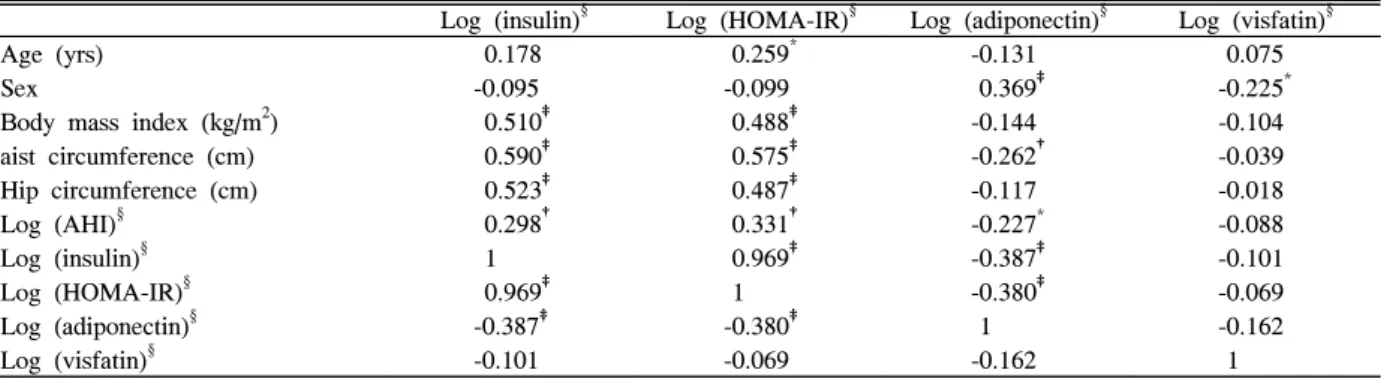
분비 단백질 간의 관련성을 알아보았다. 상관분석은 인슐린, HOMA-IR, 혈중 지방세포분비 단백질, AHI 자료들을 로그 전환 후 시행하였다. 혈중 인슐린은 BMI (r = 0.510, P <
0.001), 허리둘레(r = 0.500, P < 0.001), 엉덩이둘레 (r = 0.523, P < 0.001), AHI (r = 0.298, P < 0.05)와 유의한 관 련성이 있었다. HOMA-IR은 연령(r = 0.259, P < 0.05), BMI (r = 0.488, P < 0.001), 허리둘레(r = 0.575, P <
0.001), 엉덩이둘레(r = 0.487, P < 0.001) 및 AHI (r = 0.331, P < 0.01)와 통계학적인 상관성이 있었다. 아디포넥 틴은 여자일수록 높았고(r = 0.369, P < 0.001), 허리둘레(r
= -0.262, P < 0.01), AHI (r = -0.227, P < 0.05)와 역상관 성이 있었다. Visfatin은 남성에서 높았다(r = -0.225, P <
0.05) (Table 3).
인슐린, HOMA-IR, 지방세포분비 단백질 간의 상관분석 결과 인슐린은 HOMA-IR (r = 0.969, P < 0.001) 및 아디 포넥틴(r = -0.387, P < 0.001)과 유의한 상관성이 있었다.
또한 HOMA-IR은 아디포넥틴(r = -0.380, P < 0.001)과 유 의한 상관성이 있었다. 그러나 visfatin은 관련성을 보이는 변수가 없었다(Table 3).
3. 인슐린, HOMA-IR 및 지방세포분비 단백질의 설명 변수
인슐린, HOMA-IR 및 지방세포분비 단백질을 설명할 수 있는 변수를 찾기 위해 연령, 성별, BMI, 허리둘레 및 Log (AHI)를 독립변수로 하고 단계별 회귀분석을 시행하였다.
Table 2. Comparisons of HOMA-IR and adipokines after adjustment for age, sex, and waist circumference AHI 0~4.9/h
(N = 24)
AHI 5~14.9/h (N = 19)
AHI ≥ 15/h
(N = 38) P value
Log (insulin) 0.67 ± 0.21 0.78 ± 0.22 0.79 ± 0.24 0.915
Log (HOMA-IR) 0.03 ± 0.23 0.15 ± 0.21 0.18 ± 0.27 0.914
Log (adiponectin) 1.14 ± 0.19 1.02 ± 0.16 1.05 ± 0.13 0.582
Log (visfatin) 0.45 ± 0.53 0.49 ± 0.64 0.59 ± 0.70 0.847
Data are mean ± S.D., P value by general linear model.
AHI, apnea hyponea index; HOMA-IR, homeostasis model assessment insulin resistance.
All data were logarithmic transformed.
Table 1. Comparisons of age, sex distribution, and anthropometric data according to AHI AHI 0~4.9/h
(N = 24)
AHI 5~14.9/h (N = 19)
AHI ≥ 15/h
(N = 38) P value
Age (yrs) 40.8 ± 14.17 43.8 ± 11.75 45.0 ± 7.64 0.424
Sex (male/female) 16/8 18/1 36/2 0.003*
Body mass index (kg/m2) 25.6 ± 4.61 27.2 ± 3.96 27.3 ± 3.21 0.238 Waist circumference (cm) 87.6 ± 11.07 93.3 ± 9.76 95.3 ± 7.14 0.007
Hip circumference (cm) 99.2 ± 8.79 101.2 ± 6.81 101.5 ± 5.41 0.434
Data are mean ± SD, except sex is frequency.
P values by ANOVA test.
* P values by χ2 test.
AHI, apnea hyponea index.
그결과 허리둘레는 인슐린과 HOMA-IR을 가장 잘 설명할 수 있는 변수였고(Adj R2 = 0.340, Adj R2 = 0.322), 성별 과 허리둘레는 아디포넥틴을 잘 설명할 수 있는 변수였다 (Adj R2 = 0.161). 또한 visfatin을 설명할 수 있는 변수는 성별이었다(Adj R2 = 0.039) (Table 4).
고 찰
폐쇄성 수면무호흡증환자는 대체로 비만하고 복부비만 이 동반되므로 인슐린 저항성이 있으리라 짐작할 수 있다.
폐쇄성 수면무호흡증 환자에서 인슐린 저항성의 증가를 설 명할 수 있는 몇 가지 기전으로 신체활동도 감소와 수면박
탈22,23), 전염증성 사이토카인의 증가24,25), 간헐적인 저산소
증26,27), 과도한 복부내장지방의 축적28,29) 등이 있다. 그러나
여러 연구에서 혈중 인슐린과 혈당치는 정상군보다 심한 폐 쇄성 무호흡을 가진 환자에서 높았으나24), 연령과 BMI를 통제한 연구에서는 그렇지 않음을 보고했다.30) 최근 Trakada 등31)의 분석에서도 기존 연구에서 연구집단의 비
동질성으로 인하여 수면무호흡정도와 인슐린 저항성 간의 관련성이 낮았던 것으로 보고하였다. 이 연구결과 수면무호 흡 정도에 따른 인슐린 및 인슐린 저항성은 허리둘레만이 관련되었다. 이 결과는 기존의 Davies 등30)의 연구처럼 인 슐린저항성이 AHI 정도와 무관하였다는 결과와 일치한다.
아디포넥틴은 항동맥경화작용과 항염증작용을 하며 인슐 린의 감수성을 증가시킨다.12) 인슐린 저항성이 높거나 심한 폐쇄성 수면무호흡증환자에서는 저아디포넥틴 혈증을 보인
다.32,33) 뿐만 아니라 비만정도에 차이가 없고 당뇨병이나
심혈관 질환이 없는 사람을 대상으로 한 연구에서도 폐쇄 성 수면무호흡 정도가 심해질수록 더 낮은 아디포넥틴 혈 중치를 보였다.34) 이러한 결과는 아디포넥틴의 분비가 비 만 및 인슐린 저항성과는 독립적으로 AHI 정도와 관련 있 음을 시사한다. 폐쇄성 수면무호흡증 환자에서 낮은 아디 포넥틴 혈중치를 설명하는 기전으로 반복되는 야간 저산소 혈증 및 수면 중 각성에 의한 교감신경계의 항진으로 설명하 기도 하며28), 실제 몇몇 연구에서 베타수용체 항진제를 투여 시 아디포넥틴 유전자의 발현이 억제되어 아디포넥틴 혈중 Table 3. Pearson's correlation analysis between age, sex, anthropometric data, HOMA-IR, and adipocytokines
Log (insulin)§ Log (HOMA-IR)§ Log (adiponectin)§ Log (visfatin)§
Age (yrs) 0.178 0.259* -0.131 0.075
Sex -0.095 -0.099 0.369‡ -0.225*
Body mass index (kg/m2) 0.510‡ 0.488‡ -0.144 -0.104
aist circumference (cm) 0.590‡ 0.575‡ -0.262† -0.039
Hip circumference (cm) 0.523‡ 0.487‡ -0.117 -0.018
Log (AHI)§ 0.298† 0.331† -0.227* -0.088
Log (insulin)§ 1 0.969‡ -0.387‡ -0.101
Log (HOMA-IR)§ 0.969‡ 1 -0.380‡ -0.069
Log (adiponectin)§ -0.387‡ -0.380‡ 1 -0.162
Log (visfatin)§ -0.101 -0.069 -0.162 1
Data are correlation coefficient.
AHI, apnea hyponea index; HOMA-IR, homeostasis model assessment insulin resistance.
* P < 0.05.
†P < 0.01.
‡P < 0.001.
§ Data were logarithmic transformed.
Table 4. Stepwise multiple regression analysis of study subjects using HOMA-IR, adiponectin, visfatin as a dependent variables
Independent variables β
Log (insulin)* Log (HOMA-IR)* Log (adiponectin)* Log (visfatin)*
Age (yrs) - - - -
Sex - - 0.340 -0.225
BMI (kg/m2) - - - -
Waist circumference (cm) 0.590 0.575 -0.216 -
Hip circumference (cm) - - - -
Log (AHI)* - - - -
Adj R2 0.340 0.322 0.161 0.039
BMI, body mass index; WHR, wasit to hip ratio; AHI, apnea hyponea index; HOMA-IR, homeostasis model assessment insulin resistance.
* Data were logarithmic transformed.
치를 감소시키는 것으로 보고되었다.35,36) 또 다른 기전으로 IL-6, TNF-α가 지방세포에서 아디포넥틴의 발현과 분비를 억제한다는 것이다.37) 이 연구에서는 혈중 아디포넥틴치가 여자에서 높았고, 허리둘레 및 AHI와는 역상관성을 보였으 며 회귀분석결과 허리둘레와 성별이 아디포넥틴 혈중치를 설명하는 변수였다. 즉, 혈중 아디포넥틴치는 AHI 중증도와 무관하였다. 이러한 결과는 이 연구에서 대상군의 남녀 수 차이, 비만 정도 및 제2형 당뇨병의 유무를 고려하지 않았 던 결과로 추정해 볼 수 있다.
Visfatin은 복부내장 지방세포에서 많이 분비되는 호르몬 으로 혈중 농도는 복부내장 지방량과 비례한다.16) 또한 visfatin 혈중 농도는 인슐린 저항성의 전형적인 모습인 제2 형 당뇨병38)과 다낭성 난소증후군 환자에서 높다.39) 따라서 인슐린 저항성은 대사증후군의 핵심 요소이고 visfatin은 내 장지방세포에서 분비되므로 인슐린 저항성은 혈중 visfatin 농도와 관련될 것으로 생각된다. Hammarstedt 등40)이 보고 한 연구에서 인슐린 감수성을 증가시키는 thiazolidinediones 을 3~4주 투여한 후 측정한 혈중 visfatin 농도와 지방조직 의 visfatin 발현 정도에는 차이가 없었던 것으로 보아 visfain이 PPARγ를 통하여 인슐린 감수성에 영향을 주는 것 같지는 않음이 보고되었다. Visfatin은 복부내장지방세포 에서 주로 분비되는 호르몬이므로 복부비만 정도와 관련성 이 높으리라 생각되나 여러 연구에서 visfatin과 복부비만과 의 관련성은 일치된 결과를 보이지 않았다.16,41-43) 이 연구에 서는 AHI와 visfatin 혈중농도 간의 상관성은 없었다. 이 결 과는 visfatin이 복부비만정도와 관련 없었다는 몇몇 연
구41-43)와 일치하는 결과였다. 대신 성별만이 상관성이 있었
다. 이 결과는 최근 Seo 등44)이 보고한 결과와 일치하지 않 는 것으로 상대적으로 적은 여성군의 수로 인한 결과로 추 정된다.
이연구의 제한점으로 코골이가 없는 건강한 대조군이 없 었다는 점이다. 또한 대상군의 모집에서 BMI 분포, 제2형 당뇨병 및 고혈압 유무 등을 고려하지 않았다. 그러나 이는 단순히 연구목적으로 정상인을 대상으로 수면다원검사를 시행하기 어렵기 때문이었다. 복부비만을 반영하는 신체계 측지수로 허리둘레를 측정하였는데 복부지방량을 정확하게 측정하기 위해 복부 CT를 이용하여 복부내장지방량을 계측 하였다면 폐쇄성 수면무호흡증 환자에서 인슐린저항성과 visfatin 및 아디포넥틴의 상호 관련성을 더 정확하게 연구 할 수 있었을 것이리라 생각된다.
이상의 연구 결과 코골이 환자에서 인슐린 저항성 및 혈 중 아디포넥틴치는 허리둘레와 관련성이 있었고 수면무호 흡 정도에 따른 관련성은 없었다. 또한 혈중 visfatin치를 설 명할 수 있는 변수는 성별 이외 없었다.
ABSTRACT
Relationship between AHI and Insulin Resistance, Serum Adiponectin, and Visfatin
Background: Obstructive sleep apnea (OSA) is closely related to insulin resistance. Adipocytokines, adiponectin and visfatin, may induce the development of insulin resistance among OSA patients. Therefore, we examined the relationships between apnea-hypopnea index (AHI) and insulin resistance; between AHI and adiponectin; and between AHI and visfatin in Korean snoring subjects.
Methods: Eighty one adult habitual snorers who visited the hospital for an examination of polysomnography were divided into either simple snorers (AHI < 5), mild OSA subjects(AHI 5 ≤ to < 15), or moderate and severe OSA subjects (AHI ≥ 15). Anthropometric data were measured.
The serum adiponectin, visfatin, and insulin were measured. Insulin resistance was measured as homeostasis model assessment (HOMA-IR).
Results: After adjusting for age, sex and waist circumference (WC), insulin, HOMA-IR, and adipocytokines were not different among the subgroups. Fasting insulin level and HOMA-IR were positively correlated with body mass index (BMI), WC, hip circumference (HC) and AHI.
In addition, HOMA-IR was positively correlated with age.
The serum adiponectin level was inversely associated with WC and AHI but positively associated with sex. The serum level of visfatin was negatively correlated with sex.
Stepwise multiple regression analysis indicated that WC was an independent variable of fasting insulin (Adj R2 = 0.340) and HOMA-IR (Adj R2 = 0.322) also WC and sex were independent determinants of adiponectin level (Adj R2 = 0.161). Sex was shown to be a predictor of visfatin level (Adj R2 = 0.039).
Conclusion: Waist circumference was found to be independently associated with insulin resistance among the snoring subjects. However, AHI did not serve as a predictor of adiponectin and visfatin.
Key words: AHI, Snoring, Insulin resistance, Visfatin, Adiponectin
참 고 문 헌
1. Kim J, In K, Kim J, You S, Kang K, Shim J, et al.
Prevalence of sleep-disordered breathing in middle-aged Korean men and women. Am J Respir Crit Care Med. 2004;170(10):1108-13.
2. Strohl KP, Redline S. Recognition of obstructive sleep apnea. Am J Respir Crit Care Med 1996;154:279-89.
3. Lugaresi E, Cirignotta F, Geraldi R, Montagna P.
Snoring and sleep apnea: natural history of heavy snorers disease. In: Guilleminault C, Partinen M, editors. Obstructive sleep apnea syndrome. New York:
Raven Press; 1990. p. 25-36.
4. Smith PL, Schwartz AR. Biomechanics of the upper airway during sleep. In: Pack AI, editor. Sleep apnea:
pathogenesis, diagnosis, and treatment. New York:
Marcel Dekker, Inc.; 2002. p. 31-52.
5. Carmelli D, Swan GE, Bliwise DL. Relationship of 30-year changes in obesity to sleep-disordered breathing in the Western Collaborative Group Study.
Obes Res 2000;8(9):632-7.
6. American Diabetes Association. Consensus Development Conference on Insulin Resistance. Diabetes Care 1998;21(2):310-4.
7. Stoohs RA, Facchini F, Guilleminault C. Insulin resistance and sleep-disordered breathing in healthy humans. Am J Respir Crit Care Med 1996;154(1):
170-4.
8. Ip MS, Lam B, Ng MM, Lam WK, Tsang KW, Lam KS. Obstructive sleep apnea is independently associated with insulin resistance. Am J Respir Crit Care Med 2002;165(5):670-6.
9. Makino S, Handa H, Suzukawa K, Fujiwara M, Nakamura M, Muraoka S, et al. Obstructive sleep apnoea syndrome, plasma adiponectin levels, and insulin resistance. Clin Endocrinol (Oxf) 2006;64(1) :12-9.
10. Harsch IA, Schahin SP, Radespiel-Tröger M, Weintz O, Jahreiss H, Fuchs FS, et al. Continuous positive airway pressure treatment rapidly improves insulin sensitivity in patients with obstructive sleep apnea syndrome. Am J Respir Crit Care Med 2004;169(2):
156-62.
11. Babu AR, Herdegen J, Fogelfeld L, Shott S, Mazzone T. Type 2 diabetes, glycemic control, and continuous positive airway pressure in obstructive sleep apnea.
Arch Intern Med 2005;165(4):447-52.
12. Matsuzawa Y, Funahashi T, Kihara S, Shimomura I.
Adiponectin and metabolic syndrome. Arterioscler
Thromb Vasc Biol 2004;24(1):29-33.
13. Maeda K, Okubo K, Shimomura I, Funahashi T, Matsuzawa Y, Matsubara K. cDNA cloning and expression of a novel adipose specific collagen-like factor, apM1 (AdiPose Most abundant Gene transcript 1). Biochem Biophys Res Commun 1996;221(2):286-9.
14. Lara-Castro C, Fu Y, Chung BH, Garvey WT.
Adiponectin and the metabolic syndrome: mechanisms mediating risk for metabolic and cardiovascular disease. Curr Opin Lipidol 2007;18(3):263-70.
15. Wolk R, Svatikova A, Nelson CA, Gami AS, Govender K, Winnicki M, et al. Plasma levels of adiponectin, a novel adipocyte-derived hormone, in sleep apnea. Obes Res 2005;13(1):186-90.
16. Fukuhara A, Matsuda M, Nishizawa M, Segawa K, Tanaka M, Kishimoto K, et al. Visfatin: a protein secreted by visceral fat that mimics the effects of insulin. Science 2005;307(5708):426-30.
17. Sethi JK, Vidal-Puig A. Visfatin: the missing link between intra-abdominal obesity and diabetes? Trends Mol Med 2005;11(8):344-7.
18. Ishibashi E, Eguchi Y, Eguchi T, Matsunobu A, Oza N, Nakashita S, et al. Waist circumference correlates with hepatic fat accumulation in male Japanese patients with non-alcoholic fatty liver disease, but not in females. J Gastroenterol Hepatol 2008;23(6):
908-13.
19. Matthews DR, Hosker JP, Rudenski AS, Naylor BA, Treacher DF, Turner RC. Homeostasis model assessment: insulin resistance and beta-cell function from fasting plasma glucose and insulin concentrations in man. Diabetologia 1985;28(7):412-9.
20. Keenan BS. Respiratory monitoring during sleep:
polysomnography. In: Guilleminault C. Sleeping and Waking Disorders: Indications and Techniques. Menlo Park: Addison-Wesley; 1982. p. 183-212.
21. The Report of an American Academy of Sleep Medicine Task Force. Sleep-related breathing disorders in adults: recommendations for syndrome definition and measurement techniques in clinical research. Sleep 1999;22(5):667-89.
22. Gangwisch JE, Malaspina D, Boden-Albala B, Heymsfield SB. Inadequate sleep as a risk factor for obesity: analyses of the NHANES I. Sleep 2005;28(10):1289-96.
23. Spiegel K, Leproult R, Van Cauter E. Impact of sleep
debt on metabolic and endocrine function. Lancet 1999;354(9188):1435-9.
24. Vgontzas AN, Papanicolaou DA, Bixler EO, Hopper K, Lotsikas A, Lin HM, et al. Sleep apnea and daytime sleepiness and fatigue: relation to visceral obesity, insulin resistance, and hypercytokinemia. J Clin Endocrinol Metab 2000;85(3):1151-8.
25. Minoguchi K, Tazaki T, Yokoe T, Minoguchi H, Watanabe Y, Yamamoto M, et al. Elevated production of tumor necrosis factor-alpha by monocytes in patients with obstructive sleep apnea syndrome. Chest 2004;126(5):1473-9.
26. Matsuoka T, Kajimoto Y, Watada H, Kaneto H, Kishimoto M, Umayahara Y, et al. Glycation -dependent, reactive oxygen species-mediated suppression of the insulin gene promoter activity in HIT cells. J Clin Invest 1997;99(1):144-50.
27. Furukawa S, Fujita T, Shimabukuro M, Iwaki M, Yamada Y, Nakajima Y, et al. Increased oxidative stress in obesity and its impact on metabolic syndrome. J Clin Invest 2004;114(12):1752-61.
28. Somers VK, Dyken ME, Clary MP, Abboud FM.
Sympathetic neural mechanisms in obstructive sleep apnea. J Clin Invest 1995;96(4):1897-904.
29. Chin K, Shimizu K, Nakamura T, Narai N, Masuzaki H, Ogawa Y, et al. Changes in intra-abdominal visceral fat and serum leptin levels in patients with obstructive sleep apnea syndrome following nasal continuous positive airway pressure therapy.
Circulation 1999;100(7):706-12.
30. Davies RJ, Turner R, Crosby J, Stradling JR. Plasma insulin and lipid levels in untreated obstructive sleep apnoea and snoring; their comparison with matched controls and response to treatment. J Sleep Res 1994;3(3):180-5.
31. Trakada G, George C, Alexandros V, Slobodanka P.
Sleep Apnea and its association with the Stress System, Inflammation, Insulin Resistance and Visceral Obesity. Sleep Med Clin 2007;2(2):251-61.
32. Harsch IA, Wallaschofski H, Koebnick C, Pour Schahin S, Hahn EG, Ficker JH, et al. Adiponectin in patients with obstructive sleep apnea syndrome:
course and physiological relevance. Respiration 2004;71(6):580-6.
33. Iwashima Y, Katsuya T, Ishikawa K, Ouchi N, Ohishi M, Sugimoto K, et al. Hypoadiponectinemia is an
independent risk factor for hypertension. Hypertension 2004;43(6):1318-23.
34. Zhang XL, Yin KS, Wang H, Su S. Serum adiponectin levels in adult male patients with obstructive sleep apnea hypopnea syndrome.
Respiration 2006;73(1):73-7.
35. Fasshauer M, Klein J, Neumann S, Eszlinger M, Paschke R. Adiponectin gene expression is inhibited by beta-adrenergic stimulation via protein kinase A in 3T3-L1 adipocytes. FEBS Lett 2001;507(2):142-6.
36. Delporte ML, Funahashi T, Takahashi M, Matsuzawa Y, Brichard SM. Pre- and post-translational negative effect of beta-adrenoceptor agonists on adiponectin secretion: in vitro and in vivo studies. Biochem J 2002;367(Pt 3):677-85.
37. Fasshauer M, Kralisch S, Klier M, Lossner U, Bluher M, Klein J, et al. Adiponectin gene expression and secretion is inhibited by interleukin-6 in 3T3-L1 adipocytes. Biochem Biophys Res Commun 2003;301(4):1045-50.
38. Chen MP, Chung FM, Chang DM, Tsai JC, Huang HF, Shin SJ, et al. Elevated plasma level of visfatin/pre-B cell colony-enhancing factor in patients with type 2 diabetes mellitus. J Clin Endocrinol Metab 2006;91(1):295-9.
39. Chan TF, Chen YL, Chen HH, Lee CH, Jong SB, Tsai EM. Increased plasma visfatin concentrations in women with polycystic ovary syndrome. Fertil Steril 2007;88(2):401-5.
40. Hammarstedt A, Pihlajamäki J, Rotter Sopasakis V, Gogg S, Jansson PA, Laakso M, et al. Visfatin is an adipokine, but it is not regulated by thiazolidinediones.
J Clin Endocrinol Metab 2006;91(3):1181-4.
41. Berndt J, Klöting N, Kralisch S, Kovacs P, Fasshauer M, Schön MR, et al. Plasma visfatin concentrations and fat depot-specific mRNA expression in humans.
Diabetes 2005;54(10):2911-6.
42. Pagano C, Pilon C, Olivieri M, Mason P, Fabris R, Serra R, et al. Reduced plasma visfatin/pre.B cell colony-enhancing factor in obesity is not related to insulin resistance in humans. J Clin Endocrinol Metab 2006;91(8):3165-70.
43. Jian WX, Luo TH, Gu YY, Zhang HL, Zheng S, Dai M, et al. The visfatin gene is associated with glucose and lipid metabolism in a Chinese population. Diabet Med 2006;23(9):967-73.
44. Seo JA, Jang ES, Kim BG, Ryu OH, Kim HY, Lee KW, et al. Plasma visfatin levels are positively associated with circulating interleukin-6 in apparently
healthy Korean women. Diabetes Res Clin Pract 2008;79(1):108-11.