• 검색 결과가 없습니다.

Oral Hygiene Controllability and Personality Type Test (MBTI)

N/A
N/A
Protected

Academic year: 2021

Share "Oral Hygiene Controllability and Personality Type Test (MBTI)"

Copied!
7
0
0

로드 중.... (전체 텍스트 보기)

전체 글

(1)

ISSN 2288-9272 J Oral Med Pain 2014;39(1):15-21 http://dx.doi.org/10.14476/jomp.2014.39.1.15

Oral Hygiene Controllability and Personality Type Test (MBTI)

Hye Sook Park

Department of Dental Laboratory Technology, Shingu College, Seongnam, Korea

Received January 15, 2014 Revised January 29, 2014 Accepted February 10, 2014

Purpose: The purpose of this study was to investigate the relationship between personality type and oral hygiene controllability.

Methods: Four hundred eighty-two college students in Gyeonggi-do completed the Myers- Briggs type indicator (MBTI) and a questionnaire and collected data were analyzed by SAS 9.2 program.

Results: Compared to extroverted subjects, a significantly increased percentage of introverted subjects demonstrated oral malodor and stress (p<0.05). Tongue coating and stress seemed to occur the most frequently in intuition-feeling (NF) type, while oral malodor seemed to occur the most frequently in sensation-feeling (SF) type among four fuctional types. Tongue coating and stress seemed to occur the most frequently in NF type, while oral malodor seemed to occur the most frequently in sensation-perceiving (SP) type among four temperaments. Significantly increased mean scales of tongue scraping index and oral hygiene controllability index were found for extroverts (p<0.05). Mean scales of tooth brushing index and oral hygiene control- lability index appeared to be the highest in NF type among four fuctional types. Mean scales of tongue scraping index and oral hygiene controllability index appeared to be the highest in sensation-judging (SJ) type among four temperaments.

Conclusions: Oral hygiene controllability was associated with personality type and it is neces- sary to develop oral health education program considering personality type.

Key Words: MBTI; Oral hygiene; Personality; Questionnaires

Correspondence to:

Hye Sook Park

Department of Dental Laboratory Technology, Shingu College, 377, Gwangmyeong-ro, Jungwon-gu, Seongnam 462-743, Korea Tel: +82-31-740-1575 Fax: +82-31-740-1589 E-mail: [email protected]

individuals differ in the way that they relate to, or interpret their environments and the way is said to reflect their indi- vidual personality.

8)

The Myers-Briggs type indicator (MBTI) delineates per- sonality types based on Jungian typology and identifies preferences for four dichotomous dimensions: ‘extroversion’

versus ‘introversion’, ‘sensation’ versus ‘intuition’, ‘thinking’

versus ‘feeling’, and ‘judging’ versus ‘perceiving’.

9)

There is a previous study on the relation of personality preference and performance level.

10)

Bakdash and Proshek

11)

showed that oral hygiene status was related to personal and academic profiles. Reports on attitude and behavior of oral health care have been also suggested.

12,13)

However to date, no analysis of oral hygiene performance and personality type has been performed. The aim of this study was to as- sess the association between oral hygiene controllability

INTRODUCTION

In modern society, oral health has been considered as an important factor to maintain a well-being life. Therefore, attention to oral hygiene care has been more increasing than the past. The key point for oral hygiene care is said to be to remove the dental plaque.

1)

Oral malodor of oral etiology may result from excessive microbial metabolism on the tongue dorsum, and periodon- tium, periodontal disease, excessive caries, poor oral hy- giene, oral ulcers, food impaction, unclean denture and dry mouth.

2-4)

People under stressful conditions may show dry mouth

5)

and decreased salivary production can lead to increased risk of unfavorable oral condition.

6)

Stress is one type of the interaction between the individual and environment.

7)

All

JOMP

Journal of Oral Medicine and Pain

Copyright 2014 Korean Academy of Orofacial Pain and Oral Medicine. All rights reserved.ⓒ

(2)

prepared questionnaire (Fig. 1) containing items on self- evaluation of tongue coating, oral malodor, stress, and hab- it related to tooth brushing and tongue scraping and also returned the completed answers.

Collected MBTI replies were analysed and scored ac- cording to routine MBTI analysis.

14)

To assess quantitavely and objectively the oral hygiene habit, frequency of tooth brushing per day was rated on the following 1 to 4 rating scale, where 1 indicated once, 2 indicated twice, 3 indicated three times, and 4 indicated four times or more per day.

15)

Time needed for each brushing was rated on the following 1 to 5 rating scale, where 1 indicated less than 30 seconds, 2 indicated from 30 seconds to 1 minute, 3 indicated more than 1 minute to 2 minutes, and 4 indicated more than 2 minutes to 3 minutes, 5 indicated more than 3 minutes.

15)

Thus, tooth brushing index was defined as follows: tooth brushing index=frequency of tooth brushing per day (score 1, 2, 3, 4)×time needed for each brushing (score 1, 2, 3, 4, 5).

15)

In addition, tongue scraping index which scored the frequency of tongue scraping was estimated on a scale of 2, 4, 8 as follows: 2=not fixed; 4=once per day; 8=with tooth brushing.

16)

Furthermore, tongue scraping index added to and personality type and to use the result for oral health

education.

MATERIALS AND METHODS

1. Subjects

Data were collected from 482 college students in Gyeonggi- do, including 233 men and 249 women. Mean age of the subjects was 21.1±3.0 years (Table 1).

2. Data Collection

Data were obtained in September and October of 2013.

After explaining MBTI, the examiner distributed the MBTI GS form to students and retrieved completed replies at their classroom. Moreover, the students were asked to answer the

Fig. 1. Form and contents of questionnaire.

Table 1. Demographics of the subjects

Sex Subject Age (y)

Men Women Total

233 (48.3) 249 (51.7) 482 (100.0)

21.4±2.9

20.9±3.1

21.1±3.0

Values are presented as number (%) or mean±standard deviation.

(3)

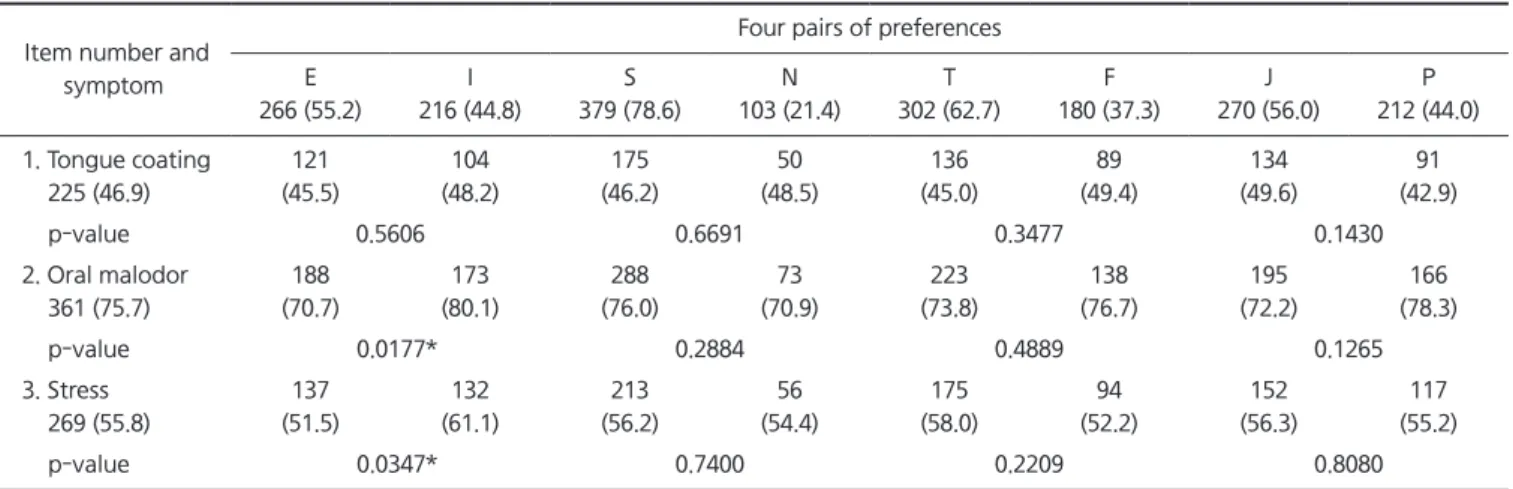
experienced and 193 (40.2%) sometimes experienced (Table 2). Three hundred sixty-one (75.7%) subjects felt oral mal- odor among whom 347 (72.8%) slightly felt and 14 (2.9%) strongly felt (Table 2). Two hundred sixty-nine (55.8%) sub- jects were under stressful condition (Table 2). With respect to four preferences of personality, extroversion (E) type was demonstrated by 266 (55.2%), introversion (I) type by 216 (44.8%), sensation (S) type by 379 (78.6%), intuition (N) type by 103 (21.4%), thinking (T) type by 302 (62.7%), feel- ing (F) type by 180 (37.3%), judging (J) type by 270 (56.0%) and perceiving (P) type by 212 (44.0%) (Table 2). Compared to extroverted subjects, a significantly increased percent- age of introverted subjects demonstrated oral malodor and stress (p<0.05) (Table 2). Tongue coating and oral malodor seemed to occur more frequently in F type than in T type (Table 2). S type and P type appeared to have higher preva- lence of oral malodor than N type and J type, respectively (Table 2).

Regarding four psychological functions (sensation-thinking tooth brushing index made oral hygiene controllability in-

dex, that is, oral hygiene controllability index=tooth brush- ing index+tongue scraping index.

15,16)

3. Statistical Analyses

All the statistical analyses were performed by SAS 9.2 program (SAS Institute Inc., Cary, NC, USA). The chi-square test was used to evaluate the relationship of personal- ity types to self-reporting prevalence rate of tongue coat- ing, oral malodor, and stress. Student’s t-test and one-way ANOVA were performed to evaluate the difference of mean scales of tooth brushing index, tongue scraping index and oral hygiene controllability index according to personality types.

RESULTS

Two hundred twenty-five (46.9%) subjects have experi- enced tongue coating among whom 32 (6.7%) frequently

Table 2. Prevalence of tongue coating, oral malodor and stress according to 4 pairs of preference tendency

Item number and symptom

Four pairs of preferences E

266 (55.2)

I 216 (44.8)

S 379 (78.6)

N 103 (21.4)

T 302 (62.7)

F 180 (37.3)

J 270 (56.0)

P 212 (44.0) 1. Tongue coating

225 (46.9)

121 (45.5)

104 (48.2)

175 (46.2)

50 (48.5)

136 (45.0)

89 (49.4)

134 (49.6)

91 (42.9)

p-value 0.5606 0.6691 0.3477 0.1430

2. Oral malodor 361 (75.7)

188 (70.7)

173 (80.1)

288 (76.0)

73 (70.9)

223 (73.8)

138 (76.7)

195 (72.2)

166 (78.3)

p-value 0.0177* 0.2884 0.4889 0.1265

3. Stress 269 (55.8)

137 (51.5)

132 (61.1)

213 (56.2)

56 (54.4)

175 (58.0)

94 (52.2)

152 (56.3)

117 (55.2)

p-value 0.0347* 0.7400 0.2209 0.8080

E, extroversion type; I, introversion type; S, sensation type; N, intuition type; T, thinking type; F, feeling type; J, judging type; P, perceiving type.

Values are presented as number (%).

*p-values were completed by chi-square test.

Table 3. Prevalence of tongue coating, oral malodor and stress according to four psychological functions

Item number and symptom

Four functions NF

51 (10.6)

NT 52 (10.8)

SF 129 (26.7)

ST

250 (51.9) p-value

1. Tongue coating 2. Oral malodor 3. Stress

27 (52.9) 39 (76.5) 31 (60.8)

23 (44.2) 34 (65.4) 25 (48.1)

62 (48.1) 99 (76.7) 63 (48.8)

113 (45.2) 189 (75.6) 150 (60.0)

0.7416 0.4122 0.1071 NF, intuition-feeling; NT, intuition-thinking; SF, sensation-feeling; ST, sensation-thinking.

Values are presented as number (%).

p-values were completed by chi-square test.

(4)

while oral malodor seemed to occur the most frequently in SP type (Table 4).

Significantly increased mean scales of tongue scraping in- dex and oral hygiene controllability index were found for extroverts (p<0.05) (Table 5). Mean scales of tooth brushing index, tongue scraping index and oral hygiene controllability index appeared to be higher in J type than in P type (Table 5).

Mean scales of tooth brushing index and oral hygiene controllability index appeared to be the highest in NF type (Table 6).

Mean scales of tongue scraping index and oral hygiene [ST], sensation-feeling [SF], intuition-thinking [NT], intu-

ition-feeling [NF]), ST type was shown by 250 (51.9%), SF type by 129 (26.7%), NT type by 52 (10.8%) and NF type by 51 (10.6%) (Table 3). Tongue coating and stress seemed to occur the most frequently in NF type, while oral malodor seemed to occur the most frequently in SF type (Table 3).

Concerning four temperaments (sensation-perceiving [SP], sensation-judging [SJ], NT, NF), SP type was exhibited by 142 (29.4%), SJ type by 237 (49.2%), NT type by 52 (10.8%) and NF type by 51 (10.6%) (Table 4). Tongue coating and stress seemed to occur the most frequently in NF type,

Table 4. Prevalence of tongue coating, oral malodor and stress according to four temperaments

Item number and symptom

Four temperaments NF

51 (10.6)

NT 52 (10.8)

SJ 237 (49.2)

SP

142 (29.4) p-value

1. Tongue coating 2. Oral malodor 3. Stress

27 (52.9) 39 (76.5) 31 (60.8)

23 (44.2) 34 (65.4) 25 (48.1)

120 (50.6) 177 (74.7) 131 (55.3)

55 (38.7) 111 (78.2)

82 (57.8)

0.1106 0.3361 0.5691 NF, intuition-feeling; NT, intuition-thinking; SJ, sensation-judging; SP, sensation-perceiving.

Values are presented as number (%).

p-values were completed by chi-square test.

Table 5. Mean scales of tooth brushing index, tongue scraping index and oral hygiene controllability index according to 4 pairs of preference tendency

Index Four pairs of preferences

E I S N T F J P

Tooth brushing index (8.4±3.5) 8.6±3.6 8.2±3.5 8.4±3.6 8.6±3.4 8.4±3.4 8.5±3.7 8.6±3.6 8.2±3.5

p-value 0.5606 0.7133 0.7731 0.1441

Tongue scraping index (6.8±2.6) 7.1±2.4 6.5±2.8 6.8±2.6 6.8±2.7 6.8±2.6 6.8±2.6 6.9±2.5 6.6±2.7

p-value 0.0248* 0.8867 0.9321 0.1859

Oral hygiene controllability index (15.2±4.8) 15.7±4.6 14.7±5.0 15.2±4.8 15.3±4.6 15.2±4.7 15.3±4.9 15.6±4.7 14.8±4.9

p-value 0.0304* 0.8461 0.7952 0.0716

E, extroversion type; I, introversion type; S, sensation type; N, intuition type; T, thinking type; F, feeling type; J, judging type; P, perceiving type.

Values are mean±standard deviation.

*p-values were completed by Student’ s t-test.

Table 6. Mean scales of tooth brushing index, tongue scraping index and oral hygiene controllability index according to four psychological functions

Index Four functions

NF NT SF ST p-value

Tooth brushing index Tongue scraping index

Oral hygiene controllability index

8.7±3.6 6.7±2.7 15.5±4.9

8.4±3.1 6.8±2.7 15.2±4.4

8.4±3.7 6.9±2.6 15.3±4.9

8.4±3.5 6.8±2.6 15.2±4.8

0.9457 0.9952 0.9872 NF, intuition-feeling; NT, intuition-thinking; SF, sensation-feeling; ST, sensation-thinking.

Values are mean±standard deviation.

p-values were completed by one-way ANOVA.

(5)

four types was ST (53.9%), SF (26.4%), NT (12.4%), and NF (7.3%).

27)

Whereas SF type and NF type handle things with personal warmth, ST type and NT type handle things with impersonal analysis.

23)

While SF type is sympathetic and NF type is enthusiastic, ST type is practical and NT type is logical.

23)

Previous study suggested that the level of mental health of NF type seemed to be low in nursing students.

28)

Mitchell et al.

29)

indicated that psychophysiologic disorder such as hypertension and heart disease occurred more fre- quently in SF type than in other types. These characteris- tics of each type may support the result that tongue coating and stress seemed to occur the most frequently in NF type and oral malodor seemed to occur the most frequently in SF type (Table 3).

Four temperaments of the MBTI (SP, SJ, NT, NF) corre- spond to Hippocrates’ temperaments (sanguine, melanchol- ic, choleric, phlegmatic) and to the Greek gods (Dionysian, Epimetheus, Prometheus, Apollinian),

30)

respectively. Four temperaments of this study exhibited the distribution of SJ (49.2%), SP (29.4%), NT (10.8%), and NF (10.6%) which is comparable to the finding of SJ (57.1%), SP (27.1%), NT (11.8%), and NF (4.1%) in medical pofessionals

31)

(Table 4). NF type is emotionally sensitive and SP type is impulsive.

30)

SP type was more frequent than other types among patients with hypertension or heart disease which is stress-related disease.

29)

These traits may be consistent with the result that tongue coating and stress seemed to occur the most fre- quently in NF type and oral malodor seemed to occur the most frequently in SP type (Table 4).

Oral hygiene controllability is closely related to level of knowledge and attitude about oral health.

32)

The higher lev- el of knowledge and attitude about oral health care is, the higher level of oral hygiene performance is.

33)

In contrast with introverts, extroverts tend to be action- oriented and have positive attitude.

22)

Vogel et al.

34)

studied controllability index appeared to be the highest in SJ type

(Table 7).

DISCUSSION

Both dental plaque and tongue are important sources of oral malodor with most of the odor emanating from the dorso-posterior surface of the tongue.

17)

Oral malodor might be caused mainly by tongue coating in the younger genera- tion.

18)

Oral hygiene procedures such as tooth brushing and tongue scraping decrease caries, gingivitis and periodontitis that may increase the incidence and intensity of oral mal- odor.

19)

75.7% of subjects in this study felt oral malodor, though Park et al.

20)

reported that prevalence rate of oral malodor of Korean was 58.2% (Table 2).

The MBTI identifies four preferences. Knowledge of psy- chological preferences enables individuals to look at them- selves in relation to others and to environment.

21)

E versus I preference concerns a person’s mechanism of interacting with the external environment and people.

8)

While extro- verts have optimistic and relaxed attitude and unload their emotions, introverts have pessimistic and anxious attitude and bottle up their emotions.

22,23)

It was found that I type had more stress than E type in kindergarten teachers.

24)

It was reported that the decrease in salivary secretion was as- sociated with emotional change.

25)

It was suggested that subjects with oral malodor showed the decreased amount of salivary secretion.

26)

These findings explain the significantly increased percentage of introverted subjects of this study in occurrence of oral malodor and stress (p<0.05) (Table 2).

Combination of perception (S, N) and judgment (T, F) pro- duces four functional types (ST, SF, NT, NF).

23)

Distribution of four types in this study was ST (51.9%), SF (26.7%), NT (10.8%), and NF (10.6%) (Table 3). This finding is similar to the finding for high school students in which distribution of

Table 7. Mean scales of tooth brushing index, tongue scraping index and oral hygiene controllability index according to four temperaments

Index Four temperaments

NF NT SJ SP p-value

Tooth brushing index Tongue scraping index

Oral hygiene controllability index

8.7±3.6 6.7±2.7 15.5±4.9

8.4±3.1 6.8±2.7 15.2±4.4

8.6±3.6 7.0±2.4 15.6±4.7

8.1±3.6 6.5±2.8 14.7±5.1

0.6108 0.4845 0.3706 NF, intuition-feeling; NT, intuition-thinking; SJ, sensation-judging; SP, sensation-perceiving.

Values are mean±standard deviation.

p-values were completed by one-way ANOVA.

(6)

extroverts (p<0.05).

5. Mean scales of tooth brushing index and oral hygiene controllability index appeared to be the highest in NF type among four fuctional types.

6. Mean scales of tongue scraping index and oral hygiene controllability index appeared to be the highest in SJ type among four temperaments.

Therefore, oral hygiene controllability was associated with personality type and it is necessary to develop oral health education program considering personality type.

CONFLICT OF INTEREST

No potential conflict of interest relevant to this article was reported.

REFERENCES

1. Kim YK, Moon HS, Jung JY, et al. A study on the oral health aware- ness and behavior in the higher grades of elementary school. J Ko- rean Soc School Health 2001;14:73-81.

2. Kostelc JG, Preti G, Zelson PR, Brauner L, Baehni P. Oral odors in early experimental gingivitis. J Periodontal Res 1984;19:303-312.

3. Yaegaki K, Sanada K. Biochemical and clinical factors influencing oral malodor in periodontal patients. J Periodontol 1992;63:783- 789.

4. Lu DP. Halitosis: an etiologic classification, a treatment approach, and prevention. Oral Surg Oral Med Oral Pathol 1982;54:521-526.

5. Chang BY, Kim SH, Chun YH, Hong JP. An effect of endocrino- logical changes related to the stress on the submandibular gland in rats. Korean J Oral Med 2000;25:279-291.

6. Kho HS, Lee SW. Influences of saliva substitutes on salivary en- zymatic activity. Korean J Oral Med 2009;34:227-235.

7. Auvenshine RC. Psychoneuroimmunology and its relationship to the differential diagnosis of temporomandibular disorders. Dent Clin North Am 1997;41:279-296.

8. Boyd R, Brown T. Pilot study of Myers Briggs type indicator per- sonality profiling in emergency department senior medical staff.

Emerg Med Australas 2005;17:200-203.

9. Havens SE. Comparisons of Myers-Briggs and enneagram types of registered nurses [master’s thesis]. Gainesville: University of Florida; 1995. pp. 16-22.

10. Lim SR. Relation of personality preference, and achievement goal orientation, academic self-efficacy, test anxiety in selecting dental hygiene students. J Korean Soc Dent Hyg 2010;10:1025-1035.

11. Bakdash MB, Proshek JM. Oral hygiene status of dental students as related to their personal and academic profiles. J Periodontal Res 1979;14:438-443.

12. Lee MJ. Knowledge, belief, attitude and behavior concerning oral hygiene in healthcare and non-healthcare students. J Korean Soc Dent Hyg 2003;3:169-182.

13. Lee ES, Ra SJ, Han MD, Kim HC, Kwon HS. A study on the awareness for oral health among health personnels in hospital. J

the relationship between the amount of plaque and person- ality traits: the more introverted the individual, the higher the individual’s plaque score. Lim

10)

indicated that perfor- mance approach level was higher in extroverts than in in- troverts. These findings explain the result that significantly increased mean scales of tongue scraping index and oral hygiene controllability index were found for extroverts (p<0.05) (Table 5).

As opposed to P type, J type is industrious and well-orga- nized.

22)

Chae

35)

demonstrated that J type showed higher academic achieve ment than P type. These findings may ex- plain the result that mean scales of tooth brushing index, tongue scraping index and oral hygiene controllability in- dex appeared to be higher in J type than in P type (Table 5).

Kim

36)

reported that NT type among four fuctional types showed the highest academic achievement in junior college students. Huh

37)

suggested that NT type and ST type showed higher academic achievement than SF type and NF type in high school students. These findings are not comparable to my result that mean scales of tooth brushing index and oral hygiene controllability index appeared to be the highest in NF type (Table 6).

SJ type tends to be orderly and dependable.

22)

Kim et al.

38)

reported that SJ type among four temperaments had the highest academic achievement in medical students. These findings support the result that mean scales of tongue scraping index and oral hygiene controllability index ap- peared to be the highest in SJ type (Table 7).

In conclusion, the purpose of this study was to investigate the relationship between personality type and oral hygiene controllability. Four hundred eighty-two college students in Gyeonggi-do completed the MBTI and a questionnaire and collected data were analyzed by SAS 9.2 program. The ob- tained results were as follows:

1. Compared to extroverted subjects, a significantly in- creased percentage of introverted subjects demonstrated oral malodor and stress (p<0.05).

2. Tongue coating and stress seemed to occur the most frequently in NF type, while oral malodor seemed to occur the most frequently in SF type among four fuctional types.

3. Tongue coating and stress seemed to occur the most frequently in NF type, while oral malodor seemed to occur the most frequently in SP type among four temperaments.

4. Significantly increased mean scales of tongue scraping

index and oral hygiene controllability index were found for

(7)

Chungbuk: Graduate School, Korea National University of Educa- tion; 1997.

28. Kim HS. The relationship among personality type, self-esteem and mental health of nursing students. J Korean Acad Psych Mental Health Nurs 2003;12:385-393.

29. Mitchell WD, Culig KM, Circerchi J, Casper M, Byyny RL, LoV- erde M. Type similarity of hypertensives and patients with heart disease. J Psychological Type 1991;21:54-58.

30. Kim JT, Shim HS, Lim SH. My appearance, my face. Seoul: Ko- rean Psychology Test Research Center; 1993.

31. Song GH. A study on socio-psychological stress and stress coping style by the personality types of medical professionals [master’s thesis]. Seoul: Graduate School of Education, Konkuk University;

2005.

32. Murray JJ. The prevention of oral disease. 3rd ed. New York: Ox- ford University Press; 1996.

33. Kim HK. A Study of related factors on self oral hygiene behaviors of the adult population in the workplace [master’s thesis]. Seoul:

Graduate School of Health, Yonsei University; 2001.

34. Vogel R, Morante EA, Ives C, Diamond R. Relationship of person- ality traits and periodontal disease. Psychosomatics 1977;18:21- 24.

35. Chae MS. Effects of personality preference, academic self-efficacy, and test anxiety on dentistry school students’ academic achieve- ment [master’s thesis]. Gwangju: Graduate School of Chonnam National University; 2008.

36. Kim HS. The relationship among personality type, academic achievement and major satisfaction of junior college students.

Keochang Jr Coll J 2001;4:141-155.

37. Huh J. An evaluation of senior high school administration in terms of Carl G. Jung’s theory of personality type [master’s the- sis]. Seoul: Graduate School of Kyunghee University; 1991.

38. Kim S, Kim JH, Hur YR. A proposal on educational method of studying by comparing medical students’ personality types and class achievement. Korean J Med Education 2005;17:107-119.

Korean Acad Dent Health 1999;23:139-149.

14. Kendall E. Myers Briggs type indicator. European English ed. Ox- ford: Oxford Psychologists Press; 1998.

15. Han KS. A study on the factors affecting feeling of oral malodor.

Korean J Oral Med 2002;27:255-269.

16. Park JH, Han KS, Kim MG. Effect of tongue scraping, ZnCl2 mouth rinse, and periodontal treament on the reduction of oral malodor. Korean J Oral Med 2000;25:41-51.

17. Tonzetich J. Production and origin of oral malodor: a review of mechanisms and methods of analysis. J Periodontol 1977;48:13- 20.

18. Miyazaki H, Sakao S, Katoh Y, Takehara T. Correlation between volatile sulphur compounds and certain oral health measure- ments in the general population. J Periodontol 1995;66:679-684.

19. Sulser GF, Brening RH, Fosdick LS. Some conditions that effect the odor concentration of breath. J Dent Res 1939;18:355-359.

20. Park MS, Kim YK, Chung SC, Lee SW. Epidemiologic study on oral malodor for Korean. Korean J Oral Med 2001;26:107-114.

21. Hirsh SK. Using the Myers-Briggs type indicator in organizations.

2nd ed. Palo Alto: Consulting Psychologists Press; 1991.

22. Myers IB, McCaulley MH. Manual: a guide to the development and use of the Myers-Briggs type indicator. Palo Alto: Consulting Psychologists Press; 1985.

23. Myers IB, Myers PB. Gifts differing. Palo Alto: Consulting Psy- chologists Press; 1980.

24. Kim SY, Lee JY. The relationship between kindergarten teachers’

personality types and job stress in teaching. J Future Early Child Educ 2004;11:305-330.

25. Rhodus NL. Xerostomia and the geriatric patient. Dentistry 1988;8:12-17.

26. Kim KE. The relation of salivary secretion, the oral care and the oral malodor [master’s thesis]. Seoul: Graduate School of Social Development, Chung-Ang University; 2001.

27. Cho WP. An analysis of the difference of high school students’

stress coping behavior by personality type [master’s thesis].

수치

Table 1. Demographics of the subjects
Table 2. Prevalence of tongue coating, oral malodor and stress according to 4 pairs of preference tendency
Table 4. Prevalence of tongue coating, oral malodor and stress according to four temperaments
Table 7. Mean scales of tooth brushing index, tongue scraping index and oral hygiene controllability index according to four temperaments

참조

관련 문서

These suggestions above are expected to help provide opportunity for elementary school students to establish a desirable oral health attitude and habit in the field

Comparison of the proportion of permanent teeth extraction according to oral disease by tooth type in the upper jaw ··· 21... Comparison of the proportion of permanent

In contrast, Chiropractic has shown better result than sports massage in the range of motion of the shoulder joint, Thoracic Scapular rhythm test, and the

Conclusion: Aromatherapy with neroli essential oil had a difference in brain wave and brain utilization ability according to the MBTI personality type

The Oral health status (such as subjective oral heal th status, toothache) and oral health behaviors (such as tooth brush, or al health examination) were

In other words, the higher level of social support and positive reward in leadership type, the higher level of social approval among the sub-variables

programming skills, outstanding research potential in machine learning (e.g, recurrent networks, reinforcement learning,.. evolution, statistical

Connections of wind power system usually occur to voltage drop due to reactive power absorption and sometime result in higher than nominal voltages which may