• 검색 결과가 없습니다.

Surgical Experience of Ascending Aorta and Aortic Valve Replacement in Patient with Calcified Aorta

N/A
N/A
Protected

Academic year: 2021

Share "Surgical Experience of Ascending Aorta and Aortic Valve Replacement in Patient with Calcified Aorta"

Copied!
6
0
0

로드 중.... (전체 텍스트 보기)

전체 글

(1)

http://dx.doi.org/10.5090/kjtcs.2012.45.1.24 ISSN: 2233-601X (Print) ISSN: 2093-6516 (Online)

1

Department of Thoracic and Cardiovascular Surgery, Samsung Medical Center, Sungkyunkwan University School of Medicine,

2

Department of Thoracic and Cardiovascular Surgery, Gospel Hospital, Kosin University College of Medicine

Received: September 5, 2010, Revised: November 23, 2011, Accepted: November 25, 2011

Corresponding author: Pyo Won Park, Department of Thoracic and Cardiovascular Surgery, Samsung Medical Center, Sungkyunkwan University School of Medicine, 50 Irwon-dong, Gangnam-gu, Seoul 135-710, Korea

(Tel) 82-2-3410-3481 (Fax) 82-2-3410-0089 (E-mail) [email protected]

C

The Korean Society for Thoracic and Cardiovascular Surgery. 2012. All right reserved.

CC
This is an open access article distributed under the terms of the Creative Commons Attribution Non-Commercial License (http://creative- commons.org/licenses/by-nc/3.0) which permits unrestricted non-commercial use, distribution, and reproduction in any medium, provided the original work is properly cited.

Surgical Experience of Ascending Aorta and Aortic Valve Replacement in Patient with Calcified Aorta

Suryeun Chung, M.D.

1

, Pyo Won Park, M.D., Ph.D.

1

, Min Suk Choi, M.D.

1

, Seong Ho Cho, M.D.

2

, Ki Ick Sung, M.D., Ph.D.

1

, Young Tak Lee, M.D., Ph.D.

1

, Jae-Han Jeong, M.D.

1

Background: The conventional method of aortic cross-clamping is very difficult and increases the risk of cerebral infarct due to embolism of the calcified aorta in these patients. Accordingly, we analyzed our experience with 11 cases of ascending aorta and aortic valve replacement with hypothermic circulatory arrest. Materials and Methods:

From January 2002 to December 2009, 11 patients had ascending aorta and aortic valve replacement with hypo- thermic arrest at our hospital. We performed a retrospective study. Results: There were 5 males and 6 females, with a mean age of 68 years (range, 44 to 82 years). Eight patients had aortic stenosis, and 3 patients had aort- ic regurgitation. An aortic cannula was inserted into the right axillary artery in 3 patients and ascending aorta in 6 patients. Two patients with aortic regurgitation had a remote access perfusion catheter inserted though the right femoral artery. The mean cardiopulmonary bypass time was 180 minutes (range, 110 to 306 minutes) and mean hypothermic circulatory arrest time was 30 minutes (range, 20 to 48 minutes). The mean rectal temperature during hypothermic circulatory arrest was 21

o

C (range, 19

o

C to 23°C). No patient had any new onset of cerebral infarct or cardiovascular accident after surgery. There was no hospital mortality. Early complications occurred in 1 patient who needed reoperation due to postoperative bleeding. Late complications occurred in 1 patient who underwent a Bentall operation due to prosthetic valve endocarditis. The mean follow-up duration was 32 months (range, 1 month to 8 years) and 1 patient died suddenly due to unknown causes after 5 years. Conclusion: Patients with a calcified aorta can be safely treated with a technique based on aorta and aortic valve replacement under hypo- thermic circulatory arrest.

Key words: 1. Aortic valve replacement 2. Calcified aorta

3. Total circulatory arrest, induced

INTRODUCTION

With the increasing elderly population, accompanied by in- creased incidence of aortic calcification, of aortic valve sur- gery patients are going. Associated with aortic calcification in patients has been an increase in stroke and systemic embo-

lism after operation with a traditional aortic cross clamp

[1-4]. As an alternative, a balloon cross clamp in the ascend-

ing aorta may be considered in ascending aorta replacement

under circulatory arrest, aortic valve replacement under circu-

latory arrest, apico-aortic valve conduit, and transapical aortic

valve implantation The aim of this study was to evaluate the

(2)

outcomes for the initial 11 patients who underwent ascending aorta and aortic valve replacement under circulatory arrest.

MATERIALS AND METHODS

A total of 11 patients with calcified ascending aorta re- ceived ascending aorta and aortic valve replacement under circulatory arrest between January 2000 and December 2009 at our center. This study investigated the characteristics of the patients, skill of the surgeon and operation time, and post- operative mortality and morbidity through a review of medi- cal records. Risk factors were preoperative cerebrovascular disease (stroke, hemorrhage, and seizure), diabetes mellitus, hypertension, heart failure, combined pulmonary disease, se- verity of aortic stenosis, or insufficiency under echocardio- gram.

All patients underwent replacement under hypothermic cir- culator arrest. Aortic cannulation was inserted into the right auxiliary artery in 3 patients, the right femoral artery in 2 pa- tients, and the ascending aorta in 6 patients during ex- tracorporeal circulation. In 2 cases with severe aortic valve regurgitation, Remote access perfusion (RAP catheter; Estech Inc., Danville, CA, USA) was inserted through the ascending aorta and femoral artery. Also in these two cases, Pruitt’s catheter (Le Maitre Vascular Inc., St. Petersburg, FL, USA) was inserted into the ascending aorta without calcification and ballooned at the left ventricle outflow to prevent distension of the left ventricle for aortic insufficiency and maintain a con- stant cardioplegic flow during operation. We searched for the ideal balloon site through transesophageal echocardiogram in the operation room. All patients used retrograde cardioplegic and retrograde cerebral protection.

Our center performed ascending aorta replacement under hypothermic arrest and aortic valve replacement under re- started extracorporeal circulation. We also performed endar- ectomy of the calcified ascending aorta and reinforcement of the proximal aorta with Teflon felt fixed inner and outer lay- ers of the aorta during ascending aorta replacement. In case of aortic cannulation at the ascending aorta, we used a branched vascular graft during ascending aorta replacement.

RESULTS

1) Patient characteristics and indication

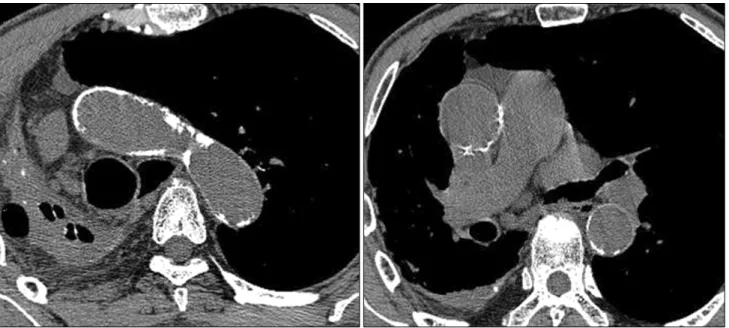
The mean age was 68 years (range, 44 to 82 years) and 5 patients were male. Two patients exhibited porcelain ascend- ing aorta in the preoperative chest contrast computer tomog- raphy (CT). Diagnostic methods were manual palpation dur- ing the operation for 1 patient who underwent surgery in 2002 and preoperative aorta non-contrast CT for all others.

Three patients had preoperative combined cerebrovascular disease. One patient had cerebral infarct without symptoms 3 years earlier. One patient was epileptic, so he had been tak- ing medication. Another patient had a carotid stent inserted in 2004 due to the diagnosis of left carotid totally occlusion.

Two patients had combined pulmonary disease (pulmonary tuberculosis and chronic obstructive pulmonary disease) (Figs.

1, 2). The 2 patients with aortic regurgitation were diagnosed with Takayasu's vasculitis. Indications for surgery included aortic valve stenosis (8 patients) and aortic valve regurgitation valves (3 patients) that included a case of reoperation for in- fective endocarditis after tissue valve replacement at another hospital. Three patients with aortic valve stenosis showed a bicuspid valve (Table 1).

2) Results

Eleven patients underwent ascending aorta and aortic valve replacement under hypothermic circulatory arrest. The mean cardiopulmonary bypass time was 189 minutes (range, 110 to 136 minutes) and mean circulatory arrest time was 30 mi- nutes (range, 20 to 48 minutes). The mean hypothermic rectal temperature was 21

o

C (range, 19

o

C to 23

o

C) (Table 2). The intensive care unit stay duration was 3.8 days (range, 1 to 8 days) and hospitalization period was 15 days (range, 5 to 20 days).

The average period of intubation was 1.3 days (range, 1 to

4 days) and there were no pulmonary complications after

operation. There were no neurologic complications (cerebral

infarct or embolism) after operation. However, a seizure oc-

curred in 1 patient who was taking antiepileptic medication

preoperatively. Two patients were reoperation cases. One pa-

tient was bleeding at the right atrium and 1 patient experi-

enced a pericardial hematoma 4 days postoperatively. Other

(3)

Fig. 1. Preoperative aorta non-contrast computer tomography: an 85-year-old male with severe aortic stenosis and a tuberculosis destroyed lung.

Fig. 2. Preoperative aorta non-contrast computer tomography: a 46-year-old female with aortic regurgitation and Takayasu’s disease.

postoperative complications, including arrhythmia, acute renal injury, acute myocardiac infarction, and paravalvular leakage, did not occur in any patients. The mean duration of fol- low-up was 3.8 years (range, 1 month to 8 years). There was 1 case of late morbidity. An 85-year-old male patient had a fever after 5 months. CT showed a paravalvular infection in the aortic tissue valve though, so he underwent a Bentall op- eration with a homograft. The other patients had no para- valvular infection or leakage, or cerebrovascular complications during follow-up. There was no late mortality. One patient

died suddenly due to unknown causes after 5 years.

DISCUSSION

Cerebrovasular disease is a severe complication after car-

diac surgery. Previous series have suggested cerebral in-

farction after cardiac surgery related to embolism of a calci-

fied ascending aorta and a higher prevalence in old age pa-

tients [1,2]. Blauth et al. [3] investigated the prevalence of

embolism after cardiac surgery. They performed autopsies on

(4)

Table 1. Preoperative patient profile

No. Age Sex Diagnosis Associated disease 1

2 3

4 5 6 7 8 9 10 11

56 44 46

72 65 85 70 69 82 79 78

F M F

M F M F M M F F

AR AS AR (redo)

AS with AR AR

AS with AR AS (bicuspid) AS

AS (bicuspid) AS with AR AS (bicuspid)

Prior CVA, A.fib

Takayasu’s disease, previous tissue AVR COPD

Takayasu's disease HTN, pulmonary TB HTN, DM, A.fib HTN, A.fib HTN, SSS HTN, DM HTN

AR=aortic regurgitation; CVA=cerebrovascular accident; A.fib=

atrial fibrillation; AS=aortic stenosis; AVR=aortic valve repla- cement; COPD=chronic obstructive pulmonary disease; HTN=

hypertension; TB=tuberculosis; DM=diabetics mellitus; SSS=sick sinus syndrome.

Table 2. Operative profile No. Cannular

method

CPB (min)

ACC (min)

HCA (min)

Rectal temperature

(

o

C)

Combined operation

1 2 3 4 5 6 7 8 9

10 11

Axillary Axillary Femoral (RAP) Aorta

Femoral (RAP) Axillary Aorta Aorta Aorta

Aorta Aorta

216 306 244 203 110 152 177 217 161

159 138

90 122 167 147 84 80 115 118 102

97 85

33 20 48 29 31 31 23 30 30

28 27

23 12 19 20 22 22 21 20 23

23 21

CABG

CABG

Pacemeker insertion

CPB=cardiopulmonary bypass; ACC=aorta cross clamp; HCA=

hypothermic circulatory arrest; CABG=coronary artery bypass graft; RAP=retrograde access perfusion.

221 patients after cardiac surgery in 1992. They found 46 deaths from embolization and 95.8% were related to severe arthrosclerosis in an ascending aorta embolism. Barbut et al.

[4] reported a 24% cerebral embolization rate when removing aortic cross clamp in coronary artery bypass surgery in 1994.

Aortic valve replacement or coronary artery bypass surgery has a higher prevalence of cerebrovascular complications for thromboembolism because these surgeries require incision at near the origin of the ascending aorta. Okita et al. [5] re- ported that the operative mortality was 20% and postoperative cerebral infarct was 11% with arthrosclerosis of the aorta. In particular, mortality was 50% in cerebral infarct patients.

Gillinov et al. [6] also reported similar mortality and morbid- ity in aortic valve replacement surgery.

Therefore, patients in old age must have calcification of as- cending aorta checked before surgery. If accompanied by aortic calcification, avoiding using an aortic cross clamp if at all possible can reduce the frequency of cerebrovascular complications.

Aorta balloon clamp can be regarded as an alternative to traditional aorta cross clamp in ascending aorta and aortic valve replacement under hypothermic circulatory arrest, api- co-aorta conduit and transapical valve replacement for instead [7]. To evaluate aortic calcification before surgery, chest

X-ray or aortic non-contrast CT can be used, while aortic non-contrast CT is more effective for checking calcification or distribution of calcification in the aorta [8].

This study also used aortic non-contrast CT for pre- operative evaluation in 10 patients. The method of examina- tion in the operating room was aortic palpation, trans- esophageal ultrasound, and epiaortic scanning (EPS). Accor- ding to many reports, EPS is more accurate than transeso- phageal ultrasound and direct palpitation and more helpful in decreasing the frequency of postoperative cerebral infarct [9-11]. In this study, 1 patient was diagnosed by palpitation during operation because aortic CT had not yet been in- troduced in the hospital. EPS is currently used.

Aortic valve replacement under hypothermic circulatory ar- rest was introduced by Coselli and Crawford [12] in 1986.

Byrne et al. [13] reported that reduced mortality and cere-

braovascular complications after introducing this surgical

technique [12]. Gillinov et al. [6] investigated the treatment

of calcification of the ascending aorta at the same time as

aortic valve replacement under hypothermic circulatory arrest

in aortic calcification patients. They compared the mortality

and morbidity of aortic endarterectomy, ascending aorta re-

placement, and balloon clamping in the ascending aorta. They

reported that ascending aorta replacement has a lower fre-

(5)

quency of cerebral infarct than the other methods [6].

Therefore, our hospital chose to perform ascending aorta and aortic valve replacement under hypothermic circulatory arrest in elderly patients with aortic calcification. Our experience confirmed that cerebrovascular complications and systemic thromboembolism events did not occur after surgery.

Intra-aortic balloon clamping was introduced by Cosgrove [14] in 1983. Ooi et al. [15] reported aortic valve replace- ment with an intra-aortic balloon clamp by Foley catheter without complications in 2006 [14].

However, some cases of complications of this method have been reported. Zingone et al. [16] reported that balloons can cause aortic endothelial injury and did not find any difference in the frequency of postoperative cerebrovascular accident and systemic thromboembolism and mortality. In our hospital, similar cases have also been reported. We undertook aortic valve replacement though balloon clamping with a RAP cath- eter in 7 patients who experienced difficulties with aortic cross clamping including pseudoaortic aneurysm. However, we failed adaptation of aortic occlusion because of balloon migration, balloon rupture, limitation in size, and dissection of the aorta. In such a case, Pruitt’s catheter can be inserted via the ascending aorta and the left ventricular outflow can be blocked while maintaining cardioplegic perfusion and aort- ic clamping [17]. Aortic endarectomy alone can result in dis- section or rupture of the aorta because aortic wall becomes thin. Therefore, when we undertook aortic endarectomy with aortic replacement under hypothermic circulatory arrest in 8 patients, we reinforced the aortic wall with Dacron felt to prevent dissection of the aorta [18]. Cribier et al. [19] re- ported the first successful aortic valve replacement via a transapical or transfemoral approach with a catheter in high-risk aortic stenosis patients without extracorporeal circu- lation in 2002. Walther et al. [20] reported early mortality and morbidity of transapical aortic valve replacement in high risk patients. In their series, transapical aortic valve replace- ment had a good survival rate similar to the classic procedure and nor were there any cerebrovascular complications [20].

However, transapical valve replacement has the risks of ven- tricular perforation, coronary artery occlusion, contrast in- duced kidney injury, and vascular injury during the procedure. Also, there has been no long term follow-up re-

ports on the procedure, so we believe that more study is needed regarding the safety and long term outcomes of this method compared to classic surgery such as the Placement of Aortic Transcatheter Valve trial.

CONCLUSION

In conclusion, ascending aorta and aortic valve replacement under hypothermic circulatory arrest without the aortic cross clamping technique showed no cerebrovascular complications after operation in calcified ascending aorta patients, specifi- cally in an elderly group. Therefore, this method may be safely used in patients who have difficulties undergoing aortic cross clamping.

REFERENCES

1. Ngaage DL, Cowen ME, Griffin S, Guvendik L, Cale AR.

Early neurological complications after coronary artery by- pass grafting and valve surgery in octogenarians. Eur J Cardiothorac Surg 2008;33:653-9.

2. Davila-Roman VG, Murphy SF, Nickerson NJ, Kouchoukos NT, Schechtman KB, Barzilai B. Atherosclerosis of the as- cending aorta is an independent predictor of long-term neu- rologic events and mortality. J Am Coll Cardiol 1999;33:

1308-16.

3. Blauth CI, Cosgrove DM, Webb BW, et al. Atheroembolism from the ascending aorta: an emerging problem in cardiac surgery. J Thorac Cardiovasc Surg 1992;103:1104-11.

4. Barbut D, Hinton RB, Szatrowski TP, et al. Cerebral emboli detected during bypass surgery are associated with clamp removal. Stroke 1994;25:2398-402.

5. Okita Y, Ando M, Minatoya K, Kitamura S, Takamoto S, Nakajima N. Predictive factors for mortality and cerebral complications in arteriosclerotic aneurysm of the aortic arch. Ann Thorac Surg 1999;67:72-8.

6. Gillinov AM, Lytle BW, Hoang V, et al. The atherosclerotic aorta at aortic valve replacement: surgical strategies and results. J Thorac Cardiovasc Surg 2000;120:957-63.

7. Girardi LN, Krieger KH, Mack CA, Isom OW. No-clamp technique for valve repair or replacement in patients with a porcelain aorta. Ann Thorac Surg 2005;80:1688-92.

8. Quint LE, Francis IR, Williams DM, et al. Evaluation of thoracic aortic disease with the use of helical CT and multi- planar reconstructions: comparison with surgical findings.

Radiology 1996;201:37-41.

9. Aranki SF, Nathan M, Shekar P, Couper G, Rizzo R, Cohn

LH. Hypothermic circulatory arrest enables aortic valve re-

(6)

placement in patients with unclampable aorta. Ann Thorac Surg 2005;80:1679-86.

10. Zingone B, Rauber E, Gatti G, et al. The impact of epi- aortic ultrasonographic scanning on the risk of perioper- ative stroke. Eur J Cardiothorac Surg 2006;29:720-8.

11. Ibrahim KS, Vitale N, Tromsdal A, Kirkeby-Garstad I, Fraser AG, Haaverstad R. Enhanced intra-operative grading of ascending aorta atheroma by epiaortic ultrasound vs echocardiography. Int J Cardiol 2008;128:218-23.

12. Coselli JS, Crawford ES. Aortic valve replacement in the pa- tient with extensive calcification of the ascending aorta (the porcelain aorta). J Thorac Cardiovasc Surg 1986;91:184-7.

13. Byrne JG, Aranki SF, Cohn LH. Aortic valve operations un- der deep hypothermic circulatory arrest for the porcelain aorta: "no-touch" technique. Ann Thorac Surg 1998;65:1313- 5.

14. Cosgrove DM. Management of the calcified aorta: an alter- native method of occlusion. Ann Thorac Surg 1983;36:718-9.

15. Ooi A, Iyenger S, Langley SM, Haw MP. Endovascular clamping of porcelain aorta in aortic valve surgery using

Foley catheter. Heart Lung Circ 2006;15:194-6.

16. Zingone B, Gatti G, Rauber E, Pappalardo A, Benussi B, Dreas L. Surgical management of the atherosclerotic ascend- ing aorta: is endoaortic balloon occlusion safe? Ann Thorac Surg 2006;82:1709-14.

17. Choi JH, Park PW. Endovascular aortic balloon clamping for various heart disease. Korean J Thorac Cardiovasc Surg 2008;41:61-7.

18. Svensson LG, Sun J, Cruz HA, Shahian DM. Endarterecto- my for calcified porcelain aorta associated with aortic valve stenosis. Ann Thorac Surg 1996;61:149-52.

19. Cribier A, Eltchaninoff H, Bash A, et al. Percutaneous transcatheter implantation of an aortic valve prosthesis for calcific aortic stenosis: first human case description. Circu- lation 2002;106:3006-8.

20. Walther T, Schuler G, Borger MA, et al. Transapical aortic valve implantation in 100 consecutive patients: comparison to propensity-matched conventional aortic valve replacement.

Eur Heart J 2010;31:1398-403.

수치

Fig. 1. Preoperative aorta non-contrast computer tomography: an 85-year-old male with severe aortic stenosis and a tuberculosis destroyed  lung
Table 2. Operative profile No. Cannular  method CPB (min) ACC (min) HCA (min) Rectal  temperature  ( o C) Combined operation 1 2 3 4 5 6 7 8 9 10 11 AxillaryAxillary Femoral  (RAP)AortaFemoral  (RAP)AxillaryAortaAortaAortaAortaAorta 21630624420311015217721

참조

관련 문서

Conclusion: The mean CGRP level in overweight and obese children with headache was not significantly higher than in overweight and obese children without headache. There

[r]

5 ) Stop Light Switch (Mechanical) 6 ) Front/Rear Balance Valve 6 ) Front/Rear Balance Valve 7 ) Pressure Differentiavl Valve 8 ) Brake Warning Lamp.. 9 ) Brake Fluid

The aim of this study was not only to compare the differences of ego-resilience between students with high experience and students with low experience in

Typical trace of pacemaker potentials in current clamping mode (A) and spontaneous inward pacemaker currents in voltage clamping mode at a holding potential of -70 mV

• Theory can extent to molten polymers and concentrated solutions.. The single-molecule bead spring models.. a)

qRT-PCR for VSMC synthetic phenotype protein, cellular retinol binding protein 1(CRBP-1) and connexin 43, from thoratic aorta showed that CRBP-1 expression was increased by 70%

The realization of the meridian and collateral system & Qi transformation by the body water ascending and fire descending is the result of the antagonism