• 검색 결과가 없습니다.

Axillofemoral Bypass to Treat Severe Heart Failure Caused by Takayasu’s Arteritis

N/A
N/A
Protected

Academic year: 2021

Share "Axillofemoral Bypass to Treat Severe Heart Failure Caused by Takayasu’s Arteritis"

Copied!
3
0
0

로드 중.... (전체 텍스트 보기)

전체 글

(1)

Korean J Thorac Cardiovasc Surg 2012;45:124-126 □ Case Report □ http://dx.doi.org/10.5090/kjtcs.2012.45.2.124 ISSN: 2233-601X (Print) ISSN: 2093-6516 (Online)

− 124 −

Department of Thoracic and Cardiovascular Surgery,

1

Asan Medical Center, University of Ulsan College of Medicine,

2

Gangneung Asan Hospital, University of Ulsan College of Medicine

Received: August 22, 2011, Revised: November 20, 2011, Accepted: November 22, 2011

Corresponding author: Sung-Ho Jung, Department of Thoracic and Cardiovascular Surgery, Asan Medical Center, University of Ulsan College of Medicine, 86 Asanbyeongwon-gil, Songpa-gu, Seoul 138-736, Korea

(Tel) 82-2-3010-3584 (Fax) 82-2-3010-6966 (E-mail) [email protected]

C

The Korean Society for Thoracic and Cardiovascular Surgery. 2012. All right reserved.

CC
This is an open access article distributed under the terms of the Creative Commons Attribution Non-Commercial License (http://creative- commons.org/licenses/by-nc/3.0) which permits unrestricted non-commercial use, distribution, and reproduction in any medium, provided the original work is properly cited.

Axillofemoral Bypass to Treat Severe Heart Failure Caused by Takayasu’s Arteritis

Ji Hyun Bang, M.D.

1

, Jong Wook Kim, M.D.

2

, Sung-Ho Jung, M.D.

1

, Ju Yong Lim, M.D.

1

Takayasu’s arteritis is an inflammatory vasculitis that primarily affects the aorta and its major branches. Involvement of the thoracic and abdominal aortas, although rare, causes marked hypertension and may lead to severe heart failure. We report the improvement of cardiac function after axillofemoral bypass grafting in a 59-year-old woman who had this condition.

Key words: 1. Takayasu’s arteritis 2. Arterial bypass

CASE REPORT

A 59-year-old woman who had pre-existing hypertension presented with chest pain and dyspnea. She reported claudica- tion and coldness of the lower extremities that had been be- coming more severe. Her medical history included a diag- nosis of hypertension.

On physical examination, she was found to be hypertensive in the right arm (170/100 mmHg), normotensive in the left arm (100/60 mmHg), and hypotensive in the thighs (76/45 mmHg). Both femoral pulses were weak and the ankle-bra- chial index (ABI) was 0.56. There were no remarkable find- ings in the laboratory tests including the C-reactive protein level and erythrocyte sedimentation rate. A 12-lead electro- cardiogram revealed a normal sinus rhythm and left ven- tricular hypertrophy. The chest X-ray revealed cardiomegaly (cardiothoracic ratio 57.4%) and left ventricular enlargement.

The computed tomography findings, such as diffuse concen- tric wall thickening, and luminal narrowing of the aorta from

the thoracoabdominal junction to the infrarenal level along with diffuse stenosis of the left renal artery, were compatible with the presumed diagnosis of Takayasu’s arteritis. The left ventricular ejection fraction assessed by echocardiography was 25%.

For treatment, bypass grafting was performed between the

right axillary artery and the right femoral artery using an 8

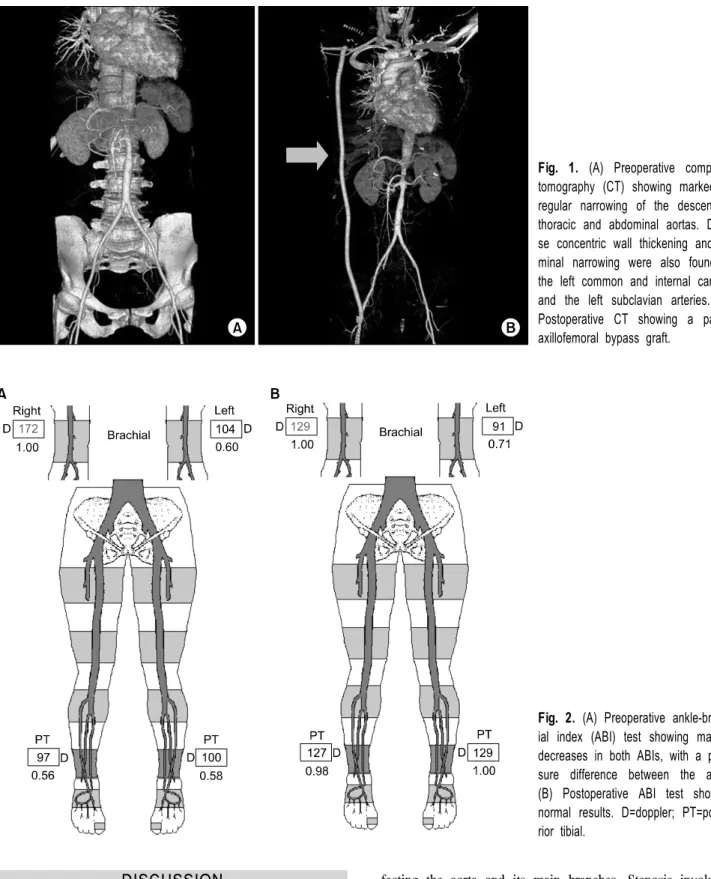
mm ringed Gore-Tex graft (Fig. 1). Warfarin (2 mg/day) was

administered postoperatively. At the time of discharge, the

patient showed marked improvement of the dyspnea and

chest pain. The ABI became normal (1.0) (Fig. 2). Echocardi-

ography showed early improvement of the left ventricular

ejection fraction (range, 23% to 41%) and dimensions (range,

61/69 mm to 52/62 mm) compared with the preoperative

values. At 11 months, these indices had improved further ac-

cording to the echocardiogram; the left ventricular ejection

fraction was 57% and the dimensions were 37/52 mm.

(2)

Treated Takayasu’s Arteritis Using Axillofemoral Bypass

− 125 −

Fig. 1. (A) Preoperative computed tomography (CT) showing marked ir- regular narrowing of the descending thoracic and abdominal aortas. Diffu- se concentric wall thickening and lu- minal narrowing were also found in the left common and internal carotid, and the left subclavian arteries. (B) Postoperative CT showing a patent axillofemoral bypass graft.

Fig. 2. (A) Preoperative ankle-brach- ial index (ABI) test showing marked decreases in both ABIs, with a pres- sure difference between the arms.

(B) Postoperative ABI test showing normal results. D=doppler; PT=poste- rior tibial.

DISCUSSION

Takayasu’s arteritis is a chronic inflammatory disease af-

fecting the aorta and its main branches. Stenosis involving both the thoracic and abdominal portions is extremely rare.

Hypertension can increase systemic resistance, causing in-

(3)

Ji Hyun Bang, et al

− 126 − creased after-load and resulting in heart failure. Surgery is generally warranted because the prognosis is poor if left untreated. The first successful resection and end-to-end anas- tomosis of stenosis of the aorta was performed by Crafoord and Nylin [1] in October 1944. There are problems associated with resection and anastomosis. First of all, aortic restenosis can occur with the reported incidence between 1.5% and 43%

[2]. In addition, the intercostal arteries can be injured due to anatomical distortion caused by the surrounding scar tissue, and spinal cord ischemia can also occur as the result of aort- ic cross-clamping. In 1973, Weldon et al. [3] reported bypass grafting as an alternative to resection and anastomosis be- cause it avoids dissection of the scar tissue and aortic cross-clamping. Since then, tube bypass grafting has been performed in various ways with the proximal anastomosis on the axillary artery or the ascending aorta, and the distal anas- tomosis on the descending aorta or the femoral artery [2,4].

Axillofemoral bypass has been a widely accepted manage- ment approach that carries a low risk of mortality and morbidity. Martin and Katz [5] reported a 30-day mortality rate of 4.9% and Schneider et al. [6] described a 30-day mor- tality rate of 9%. This procedure reduces the hemodynamic disturbances that accompany aortic resection and end-to-end anastomosis. This benefit appears to be the result of the re- duction of cardiac after-load, reduction of spinal cord ische- mia by avoiding cephalic hypertension and caudal hypo- tension, and preservation of renal and mesenteric perfusion, thus avoiding the need for heparin in many patients.

However, the procedure’s long-term patency is contro- versial. The patency of a bypass graft can be affected by multiple factors including the surgeon’s experience, surgical method, and the material and size of the prosthetic grafts.

Martin and Katz [5] reported patency rates of 88% at 1 year, 79% at 3 years, and 69% at 5 years.

It is unlikely that aortoaortic and axillofemoral bypass will be subjected to the rigors of a prospective and randomized

study to compare their relative merits, and the current studies describing the results of these bypass operations have had dissimilar patient cohorts. In the majority of series, patients undergoing axillofemoral grafting were older, had more medi- cal comorbidities, and had a higher number of operations for limb salvage than patients undergoing an aorto-aortic bypass.

As the age of the population increases and the healthcare system suffers greater economic restraints, these factors will become increasingly important when determining treatment options. We believe that axillofemoral bypass grafting is a viable alternative to direct aortic reconstruction in the treat- ment of patients with severe cardiac and pulmonary disease, with highly reproducible 3-year and 5-year patency rates [7].

Although aortofemoral bypass remains the procedure of choice in good-risk patients, axillofemoral grafting remains an excellent therapeutic option for surgeons encountering elderly or debilitated patients with diffuse aortic disease.

REFERENCES

1. Crafoord C, Nylin G. Congenital coarctation of the aorta and its surgical treatment. J Thorac Surg 1945;14:347-61.

2. Beekmann RH, Rocchini AP, Behrendt DM, Rosenthal A.

Reoperation for coarctation of the aorta. Am J Cardiol 1981;48:1108-14.

3. Weldon CS, Hartmann AF Jr, Steinhoff NG, Morrissey JD.

A simple, safe, and rapid technique for the management of recurrent coarctation of the aorta. Ann Thorac Surg 1973;

15:510-9.

4. Grinda JM, Mace L, Dervanian P, Folliguet TA, Neveux JY.

Bypass graft for complex forms of isthmic aortic coarctation in adults. Ann Thorac Surg 1995;60:1299-302.

5. Martin D, Katz SG. Axillofemoral bypass for aortoiliac oc- clusive disease. Am J Surg 2000;180:100-3.

6. Schneider JA, Rheuban KS, Crosby IK. Rupture of post- coarctation mycotic aneurysms of the aorta. Ann Thorac Surg 1979;27:185-90.

7. Passman MA, Taylor LM, Moneta GL, et al. Comparison of

axillofemoral and aortofemoral bypass for aortoiliac occlu-

sive disease. J Vasc Surg 1996;23:263-71.

수치

Fig. 1. (A) Preoperative computed  tomography (CT) showing marked  ir-regular narrowing of the descending  thoracic and abdominal aortas

참조

관련 문서

Five days later, on 15 January 1975, the Portuguese government signed an agreement with the MPLA, FNLA and UNITA providing for Angola to receive its independence on 11

Usefulness of co-treatment with immunomodulators in patients with inflammatory bowel disease treated with scheduled infliximab maintenance therapy.. Oussalah A, Chevaux JB, Fay

Inclusion and Inclusiveness: Shared Vision of Youth for Local, National, and Global Village Inclusion at large stands for embracing populations with disabilities and

- In patients presenting with end-stage organ failure, sequential solid organ (kidney heart liver) transplant followed by ASCT has been successfully. J

It is impossible to change the voltage across a capacitor by a finite amount in zero time, for this requires an infinite current through the capacitor.. (A capacitor resists

The index is calculated with the latest 5-year auction data of 400 selected Classic, Modern, and Contemporary Chinese painting artists from major auction houses..

The key issue is whether HTS can be defined as the 6th generation of violent extremism. That is, whether it will first safely settle as a locally embedded group

The “Asset Allocation” portfolio assumes the following weights: 25% in the S&P 500, 10% in the Russell 2000, 15% in the MSCI EAFE, 5% in the MSCI EME, 25% in the