Hypokalemic Hypertension Leading to a Diagnosis of Autosomal Dominant Polycystic Kidney Disease
Wasawat Vutthikraivit, M.D., Montira Assanatham, M.D., Chutintorn Sriphrapradang, M.D.
Department of Medicine, Faculty of Medicine Ramathibodi Hospital, Mahidol University, Bangkok, Thailand
Autosomal dominant polycystic kidney disease (ADPKD) is the most common in- herited renal disease. Hypertension is common and occurs before decline in renal function. However, the coexistence of hypertension and hypokalemia is rare in ADPKD patients. We report on a 32-year-old woman with secondary aldosteronism.
Magnetic resonance imaging of the renal arteries revealed multiple cysts of varying sizes in both the kidneys and the liver, compatible with ADPKD. Increased renin- angiotensin-aldosterone system activity was secondary to cyst expansion. After ini- tiation of angiotensin II receptor blocker, her blood pressure was controlled without additional requirement of potassium.
Key Words: Angiotensin receptor antagonists, Autosomal dominant polycystic kidney disease, Hyperaldosteronism, Hypertension, Hypokalemia Received: January 15, 2016
Accepted: April 8, 2016 Corresponding Author:
Chutintorn Sriphrapradang, M.D.
Department of Medicine, Faculty of Medicine Ramathibodi Hospital, Mahidol University, 270 Rama 6 Road, Rajthevi, Bangkok 10400, Thailand Tel: +66-2-2011647, Fax: +66-2-2011647 E-mail: [email protected]
This is an Open Access article distributed under the terms of the Creative Commons Attribution Non-Commercial License (http://creativecommons.org/licenses/by-nc/3.0/) which permits unrestricted non-commercial use, distribution, and reproduction in any medium, provided the original work is properly cited.
Introduction
Secondary hypertension is defined as hypertension that results from an identifiable etiology. Only 5-10% of hyper- tension cases are thought to have a secondary cause, whe- reas the majority of hypertensive patients have essential
(idiopathic or primary) hypertension1). Because hyper- tension can be controlled by specific medication or sur- gery, it is thus important to identify certain clinical suspi- cions that could suggest the secondary form of hypertension.
One of the clinical features indicative of secondary hy- pertension is hypokalemia due to mineralocorticoid excess.
Hypokalemia may be combined with metabolic alkalosis and excessive urinary sodium excretion. Disorders with mineralocorticoid excess can be divided into three catego- ries. First, in the high aldosterone-low renin category, the diagnosis is primary aldosteronism. High aldosteronehigh
renin, known as secondary aldosteronism, includes malig- nant hypertension, renovascular hypertension, and renin- producing tumor. In the low aldosterone-low renin cat- egory, the diagnoses to consider are apparent mineralo- corticoid excess, congenital adrenal hyperplasia, Cushing’s syndrome, deoxycorticosterone-producing tumor, exoge- nous mineralocorticoid intake, and Liddle’s syndrome.
Autosomal dominant polycystic kidney disease (ADPKD) is a common hereditary renal disease affecting approx- imately 12.5 million people worldwide. It is characterized by the gradual growth of multiple renal cysts, hypertension and, eventually, end-stage renal disease (ESRD), account- ing for 5-10% of ESRD cases2,3). Hypertension is the early and frequent manifestation of ADPKD. It appears in 50- 70% of cases before a noticeable reduction in glomerular filtration, with the average age of onset of 30 years4). ADPKD in patients with hypertension leads to a great and rapid loss of renal function5). Up-regulation of the reninangio-
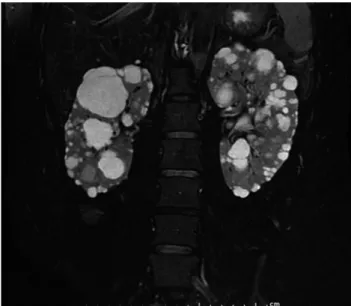
Fig. 1. Magnetic resonance imaging of the renal artery revealed innumerable cysts, causing diffuse enlargement of both kidneys.
The cysts ranged from subcentimeter size to the largest diameter of 5.3 cm. The largest cyst is seen at the upper pole of the right kidney, which had thin septation. Also, there were multiple small hepatic cysts ranging from tiny to 1.1 cm in diameter (not shown).
Renal arteries and adrenal glands were normal (not shown).
tensin-aldosterone system(RAAS) plays a major role in the pathogenesis of hypertension in ADPKD. However, the coexistence of hypertension and hypokalemia is very rare in ADPKD patients. We illustrate a case with hypertension and hypokalemia who was finally diagnosed with ADPKD and successfully corrected hypokalemia and hypertension with angiotensin II receptor blocker (ARB).
Case Report
A 32-year-old Asian female was referred to an endocri- nologist for evaluation of hypertension and hypokalemia.
Blood pressure of 170/120 mmHg was found during a rou- tine annual examination. She was asymptomatic and did not take diuretic, liquorice or herbs. She did not have diar- rhea, vomiting, history of chronic alcohol intake or toxin exposure. Her parents had hypertension starting in late adulthood. She had no family history of stroke, renal dis- ease, periodic paralysis or hypokalemia. Her electrolytes were notable for serum potassium of 3 mmol/L (mEq/L) with spot urine potassium concentration of 23 mmol/L.
Despite taking a combination of antihypertensive drugs of amlodipine 10 mg daily and atenolol 50 mg daily, her blood pressure remained 130/100-150/110 mmHg.
On examination, the patient’s blood pressure was 134/
96 mmHg and heart rate was 104 beats/min. Clinical ex- amination findings were unremarkable except for being overweight according to Asian criteria (body mass index, 23.4 kg/m2). No Cushingoid appearance was detected.
Auscultation showed no renal bruit. Laboratory evalu- ation showed hypokalemia and normal renal function [sodium 140 mmol/L (136-145), potassium 3.31 mmol/L (3.5-5.1), chloride 106 mmol/L (98-107), carbon dioxide 26.4 mmol/L (22-29), blood urea nitrogen 19 mg/dL (7- 18), creatinine 0.77 mg/dL (0.51-0.95)]. Urinalysis showed 3-5 red blood cells per high-power field, without protein and glucose. She required up to 1.5 g of oral potassium chloride daily to maintain normokalemia. Supine plasma renin activity and aldosterone concentrations were 1.41 ng/mL/h (reference range, supine position 0.23-3.33 and seated position 0.36-3.84 ng/mL/h) and 25.2 ng/dL (refe-
rence range, supine position 1-16 and seated position 2.5- 31.5 ng/dL), with an aldosterone/renin ratio of 17.87 (pri- mary hyperaldosteronism, ratio >20; secondary hyper- al- dosteronism, ratio ~10). Clinical and laboratory data favo- red a diagnosis of secondary aldosteronism. Magnetic reso- nance imaging of renal arteries was initially planned to exclude renal artery stenosis, but the examination revea- led multiple cysts of varying sizes in both the kidneys and the liver, consistent with ADPKD (Fig. 1). There was no adrenal mass or renal artery stenosis.
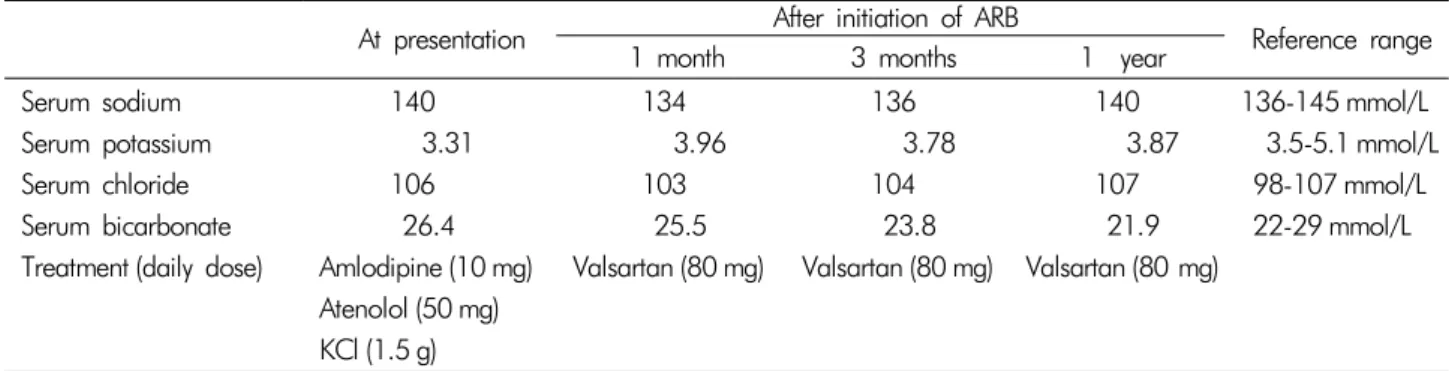
After the diagnosis of ADPKD had been established, the patient received valsartan 80 mg daily without further requi- rement of potassium(Table 1). After a 4-year follow-up, her blood pressure was controlled within the normal range, and she had no further episodes of hypokalemia.
Discussion
We demonstrate a patient with ADPKD discovered by work-up of secondary aldosteronism. In addition, we show the benefit of ARB for treatment of hypertension and hypo-
Table 1. Summary of serum electrolyte before and after initiation of angiotensin II receptor blocker (ARB) At presentation After initiation of ARB
Reference range
1 month 3 months 1 year
Serum sodium 140 134 136 140 136-145 mmol/L
Serum potassium 3.31 3.96 3.78 3.87 3.5-5.1 mmol/L
Serum chloride 106 103 104 107 98-107 mmol/L
Serum bicarbonate 26.4 25.5 23.8 21.9 22-29 mmol/L
Treatment (daily dose) Amlodipine (10 mg) Valsartan (80 mg) Valsartan (80 mg) Valsartan (80 mg) Atenolol (50 mg)
KCl (1.5 g)
ARB, angiotensin II receptor blocker; KCl, potassium chloride.
kalemia.
Increased blood pressure in patients with ADPKD have been attributed to several causes, including activation of the RAAS, increase in sympathetic nervous system activity, endothelial dysfunction, increased endothelin-1, and arte- rial stiffness. The most important factor is the activation of the RAAS, possibly caused by renal vascular compression by cyst expansion, leading to bilateral renal ischemia. Plasma renin activity and plasma aldosterone concentration in hy- pertensive patients with ADPKD were significantly higher than in matched patients with essential hyperten- sion6). In addition, immunohistochemical studies and clinical stud- ies support a major role of the intrarenal RAAS in the pathogenesis of hypertension in patients with ADPKD.
Activation of the RAAS may enhance renal cyst formation and enlargement by means of its mitogenic effects7).
However, hypokalemia is a rare manifestation in ADPKD patients. Renal impairment due to ADPKD could mask hypokalemia. Additionally, activation and dysregulation of the intrarenal RAAS is sufficient to result in increased blood pressure without affecting the circulating RAAS8). In our patient, normal plasma renin activity and a low aldosterone/renin ratio favored a diagnosis of secondary aldosteronism. The coexistence of hypertension and hypo- kalemia in secondary aldosteronism is an uncommon pre- sentation in ADPKD patients; only two cases have been reported9,10). There are other case reports of ADPKD com- plicated by the coincidence of primary aldosteronism11-15). The diagnosis included hyperaldosteronemia and hypore- ninemia. Even though the identification of adrenal ade-
noma may be obscured by adjacent renal cysts, adrenal venous sampling can confirm the site of aldosterone-pro- ducing adenoma. Excessive aldosterone aggravates cyst formation and/or progression16,17). Among patients with primary aldosteronism, either adrenalectomy or spirono- lactone resulted in the abrogation of newly developed renal cysts on follow-up ultrasonographic imaging17).
Considering that RAAS plays an important role in the pathophysiology of hypertension in ADPKD, treatment with angiotensin-converting enzyme inhibitor (ACEI) or ARB has been suggested to be the first-line of treatment.
Increased renal plasma flow and decreased renal vascular resistance were found in hypertensive patients with ADPKD after administration of enalapril6). This rationale was sup- ported by recent data from large, randomized, double- blind, placebo-controlled Halt Progression of Polycystic Kidney Disease (HALT-PKD) trials18,19). Theoretically, du- al therapy of ACEI and ARB should improve renal out- comes by circumventing the compensatory feedback re- sponse that generates more angiotensin II when a single blocker is used. Data from HALT-PKD trials showed that combination therapy was not more effective than mono- therapy with an RAAS blocker18,19). The role of the direct renin inhibitor, aliskiren, is not yet established in ADPKD patients; however, it could be relevant given that this is the only RAAS inhibitor which also reduces plasma re- nin9,10). To date, there is no head-to-head comparison study between ACEI and ARB for the renal or cardiovascular outcomes in ADPKD patients. There is no available evi- dence on the potential benefits of adding an aldosterone
antagonist to ACEIs or ARBs.
Previous reports of ADPKD cases with secondary aldo- steronism were managed with a direct renin inhibitor (alis- kiren)9,10), while our case was managed with ARB. Hyper- tension was successfully controlled without a potassium supplement in all cases. ARB blocks the binding of angio- tensin II to the angiotensin-1 receptor, which leads to in- crements in plasma renin activity and levels of angiotensin I and angiotensin II. However, this elevation of precursors does not overcome the receptor blockade, as evidenced by a persistent decrease in both blood pressure and plasma aldosterone concentrations20). Either ACEI or ARB, not only direct renin inhibitor, could be the drug of choice for man- aging ADPKD with secondary aldosteronism. However, further study is required to compare the effectiveness of hypertension treatment among RAAS- blocking agents in ADPKD with secondary aldosteronism.
In summary, hypertension with hypokalemia is an un- common presentation that clinicians should be aware of in ADPKD. RAAS activation plays an important role in the pathogenesis of hypertension in ADPKD patients.
Understanding the exact mechanism of hypertension will contribute to effective blood pressure control, as observed in this case.
Conflict of interest statement: None declared.
References
1. Rimoldi SF, Scherrer U, Messerli FH: Secondary arterial hypertension: when, who, and how to screen? Eur Heart J 35:1245-1254, 2014
2. Reule S, Sexton DJ, Solid CA, Chen SC, Collins AJ, Foley RN: ESRD from autosomal dominant polycystic kidney disease in the United States, 2001-2010. Am J Kidney Dis 64:592-599, 2014
3. Spithoven EM, Kramer A, Meijer E, et al.: Renal replace- ment therapy for autosomal dominant polycystic kidney disease (ADPKD) in Europe: prevalence and survival--an analysis of data from the ERA-EDTA Registry. Nephrol Dial Transplant 29(Suppl4):15-25, 2014
4. Ecder T, Schrier RW: Hypertension in autosomal-domi- nant polycystic kidney disease: early occurrence and uni-
que aspects. J Am Soc Nephrol 12:194-200, 2001 5. Gabow PA, Johnson AM, Kaehny WD, et al.: Factors af-
fecting the progression of renal disease in autosomal- dominant polycystic kidney disease. Kidney Int 41:1311- 1319, 1992
6. Chapman AB, Johnson A, Gabow PA, Schrier RW: The renin-angiotensin-aldosterone system and autosomal do- minant polycystic kidney disease. New Engl J Med 323:
1091-1096, 1990
7. Thomas W, Dooley R, Harvey BJ: Aldosterone as a renal growth factor. Steroids 75:550-554, 2010
8. Doulton TW, Saggar-Malik AK, et al.: The effect of sodium and angiotensin-converting enzyme inhibition on the clas- sic circulating renin-angiotensin system in autosomal- dominant polycystic kidney disease patients. J Hypertens 24:939-945, 2006
9. Amico P, Kalbermatter S, Kiss D: Aliskiren corrects re- current hyperreninemia and hyperaldosteronism in auto- somal dominant polycystic kidney disease. Clin Nephrol 72:237-239, 2009
10. Chow KM, Ma RC, Szeto CC, Li PK: Polycystic kidney disease presenting with hypertension and hypokalemia.
Am J Kidney Dis 59:270-272, 2012
11. Bobrie G, Sirieix ME, Day M, Landais P, Lacombe M, Grunfeld JP: Autosomal dominant polycystic kidney dis- ease with primary hyperaldosteronism. Nephrol Dial Trans- plant 7:647-650, 1992
12. Gejyo F, Ishida K, Arakawa M: Autosomal dominant pol- ycystic kidney disease complicated by primary aldostero- nism. Case report and review of the literature. Am J Ne- phrol 14:236-238, 1994
13. Liou HH, Tsai SC, Chen WJ, Huang TP, Huang WJ, Chen KK: The association of aldosterone-producing adre- nal adenoma in a patient with autosomal dominant poly- cystic kidney disease. Am J Kidney Dis 23:739-742, 1994 14. Kao CC, Wu VC, Kuo CC, et al.: Delayed diagnosis of
primary aldosteronism in patients with autosomal domi- nant polycystic kidney diseases. J Renin Angiotensin Al- dosterone Syst 14:167-173, 2013
15. Peixoto AJ: A young patient with a family history of hypertension. Clin J Am Soc Nephrol 9:2164-2172, 2014 16. Ogasawara M, Nomura K, Toraya S, et al.: Clinical impli-
cations of renal cyst in primary aldosteronism. Endocrine J 43:261-268, 1996
17. Novello M, Catena C, Nadalini E, et al.: Renal cysts and hypokalemia in primary aldosteronism: results of long- term follow-up after treatment. J Hypertens 25:1443-
1450, 2007
18. Schrier RW, Abebe KZ, Perrone RD, et al.: Blood pres- sure in early autosomal dominant polycystic kidney dis- ease. New Engl J Med 371:2255-2266, 2014
19. Torres VE, Abebe KZ, Chapman AB, et al.: Angiotensin blockade in late autosomal dominant polycystic kidney
disease. New Engl J Med 371:2267-2276, 2014 20. Grossman E, Peleg E, Carroll J, Shamiss A, Rosenthal
T: Hemodynamic and humoral effects of the angiotensin II antagonist losartan in essential hypertension. Am J Hy- pertens 7:1041-1044, 1994