Evaluation of shear bond strength between dual cure resin cement and zirconia ceramic after thermocycling treatment
Jung-Jin Lee1, Cheol-Kyun Kang1, Ju-Won Oh1, Jae-Min Seo1,2*, Ju-Mi Park1,2*
1Department of Dental Prosthodontics and Institute of Oral Bioscience, School of Dentistry, Chonbuk National University, Jeonju, Republic of Korea
2Research Institute of Clinical Medicine Chonbuk National University-Biomedical Research Institute of Chonbuk National University Hospital, Jeonju, Republic of Korea
PURPOSE. This study was performed to evaluate shear bond strength (SBS) between three dual-cured resin cements and silica coated zirconia, before and after thermocycling treatment. MATERIALS AND METHODS.
Sixty specimens were cut in 15 x 2.75 mm discs using zirconia. After air blasting of 50 μm alumina, samples were prepared by tribochemical silica coating with RocatecTM plus. The specimens were divided into three groups according to the dual-cure resin cement used: (1) Calibra silane+Calibra®, (2) Monobond S+Multilink® N and (3) ESPN sil+RelyXTM Unicem Clicker. After the resin cement was bonded to the zirconia using a Teflon mold, photopolymerization was carried out. Only 10 specimens in each group were thermocycled 6,000 times.
Depending on thermocycling treatment, each group was divided into two subgroups (n=10) and SBS was measured by applying force at the speed of 1 mm/min using a universal testing machine. To find out the differences in SBS according to the types of cements and thermocycling using the SPSS, two-way ANOVA was conducted and post-hoc analysis was performed by Turkey’s test. RESULTS. In non-thermal aged groups, SBS of Multilink group (M1) was higher than that of Calibra (C1) and Unicem (U1) group (P<.05). Moreover, even after thermocycling treatment, SBS of Multilink group (M2) was higher than the other groups (C2 and U2). All three cements showed lower SBS after the thermocycling than before the treatments. But Multilink and Unicem had a significant difference (P<.05). CONCLUSION. In this experiment, Multilink showed the highest SBS before and after thermocycling. Also, bond strengths of all three cements decreased after thermocycling. [J Adv Prosthodont 2015;7:1-7]
KEY WORDS: Y-TZP zirconia; Resin cement; Shear bond strength; Thermocycling treatment; Silica coating
INTRODUCTION
In a field of dentistry, ceramic has been widely used because it provided a restoration without metallic component, good esthetics, stability of shade, bio-compatibility, high resis- tance to attrition and low thermo-conductibility.1 Among ceramics, zirconia has properties such as high strength, transformation toughening, chemical and structural stabili- ty, and bio-compatibility; and these properties enabled ceramic prosthesis possible in posterior teeth area.2-4 In recent days, advancement of CAD/CAM allowed even more use of zirconia.5,6 Zirconia exists in three types of crystal states and it can be partially stabilized by adding oxi- dized metal to maintain its stable tetragonal state in room
Corresponding author:
1Ju-Mi Park, 2Jae-Min Seo
Department of Prosthodontics and Institute of Oral Bioscience, School of Dentistry, Chonbuk National University, 634-18 Geumam-dong, Jeonju 561-712, Republic of Korea
1Tel. 82 63 270 2030: e-mail, [email protected]
2Tel. 82 63 270 2696: e-mail, [email protected]
Received November 19, 2013 / Last Revision December 12, 2014 / Accepted December 23, 2014
© 2015 The Korean Academy of Prosthodontics
This is an Open Access article distributed under the terms of the Creative Commons Attribution Non-Commercial License (http://creativecommons.
org/licenses/by-nc/3.0) which permits unrestricted non-commercial use, distribution, and reproduction in any medium, provided the original work is properly cited.
temperature. And this unique state is called partially stabi- lized zirconia (PSZ). If external force is applied to the PSZ, zirconia crystal undergoes phase variation in which its size increases and crack progression is inhibited that fracture toughness increases. All ceramic restorations that need high mechanical strength can be made as a result.
In terms of resin-cement bonding, all ceramic restora- tion has been attempted by acid-etching the inner surface and application of silane to achieve chemical bonding between silica based ceramic and resin.7,8 However, there is a limitation to using resin cement because zirconia does not contain silica and has resistance to acid corrosion due to its highly-crystallized structure.9-11
A weak mechanochemical bond of resin cement and zirconia can have a significant effect on the prognosis, such as debonding in restorations and microleakage. For this rea- son, to obtain improved bonding strength, various surface treatment methods have been proposed. These include alu- mina air blasting and silica coating treatment, as in the Rocatec™ and CoJet™ systems (3M ESPE, Seefeld, Germany).
Manufacturers recommend resin cements including 10-meth- acryloyloxy-decyl dihydrogenphosphate (MDP) monomer or phosphate monomer components, because it is possible to obtain increased bonding strength when using them.
Resin cements including MDP show excellent bonding strength and remain stable even after thermocycling treat- ment and long-term storage in water.12 Furthermore, phos- phate monomers, such as phosphoric acid and methacrylat- ed phosphoric ester, directly bond to zirconia and to teeth, so that better bonding strength can be obtained.12 Many studies have reported that when resin cements including phosphate monomer after alumina air blasting were used, bonding strength increased.2,13,14
Chemical bonding through monomers can enhance bonding strength, but the bond strength decreases without effective maintenance after thermocycling treatment.9,13 But, whether MDP monomer forms a chemical bond with zirconia or operates via micromechanical retention forces remains unclear.15
This study measured and compared shear bond strength to evaluate the influences of the monomer of resin cement and thermocycling treatment on bonding strength of zirco- nia and resin cements by selecting three dual-cured resin
cements including different commercially available mono- mer components.
MATERIALS AND METHODS
Zirconia block (Fulluster, HASS Co., Gangneung, Korea) made from tetragonal zirconia polycrystal (3Y-TZP: yttria- tetragonal zirconia polycrystal) containing 3 mol% Y2O3 was used as a specimen. Zirconia block was cut into a disk- shaped form using CAD/CAM, ground with a diamond wheel, polished with 1 μm diamond paste, and completed into a shape with diameter of 15 mm and thickness of 2.75 mm. 50 μm alumina particles were blasted for 10 seconds with 2.8 bar pressure away from 10 mm vertical distance and silica coating was done for 10 seconds with 2.8 bar pres- sure away from 10 mm vertical distance using Rocatec™
plus system (3M ESPE, Seefeld, Germany).
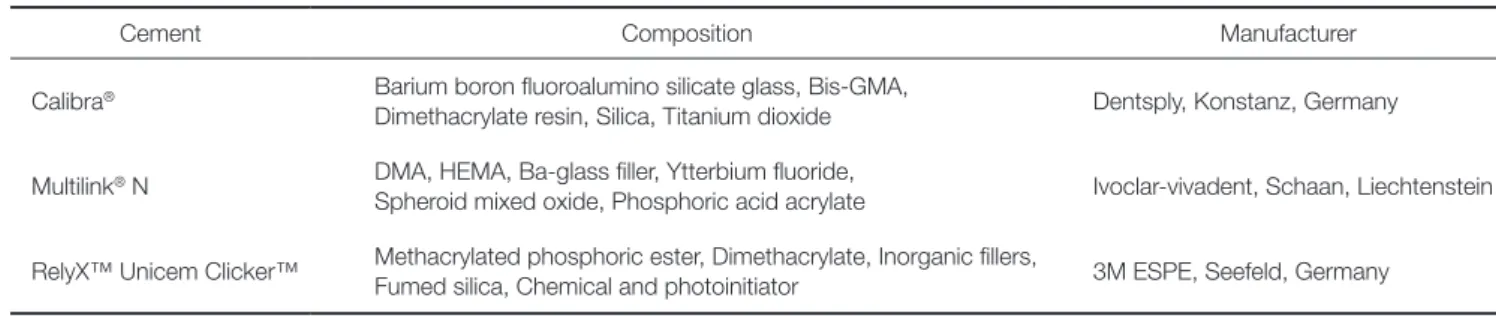
Among the widely used resin cements for cementation of zirconia restorations, three cements have different kinds of monomers. The Calibra® (Dentsply, Konstanz, Germany), Multilink® N (Ivoclar-vivadent, Schaan, Liechtenstein) and RelyX™ Unicem clicker™ (3M ESPE, Seefeld, Germany) cements were used (Table 1). Sixty specimens were divided into three groups depending on the type of resin cements.
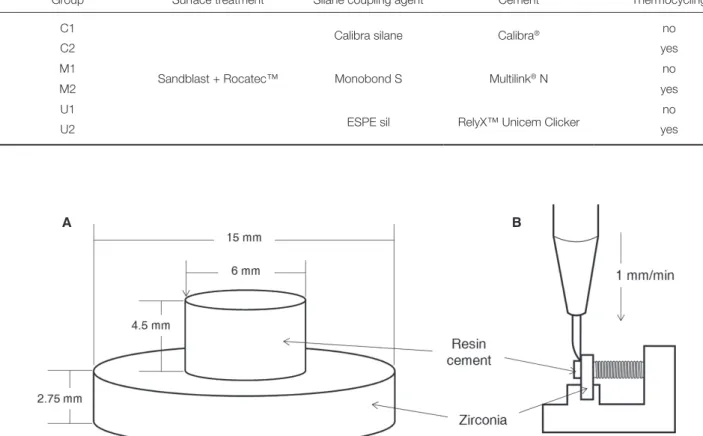
Each group was divided into two subgroups depending on thermocycling treatment. A total of six groups (C1, C2, M1, M2, U1, and U2), each with 10 specimens, were pre- pared (Table 2). After applying manufacture-recommended silane coupling agent to the surface of each specimen and drying for 1 minute, a cylindrical Teflon mold 6 mm in diameter and 4.5 mm in height was fixed using a metal jig.
At the manufacturer’s suggestion, three types of dual- cured resin cements were mixed, placed in a mold and pho- topolymerized for 1 minute with 500 lx on the upper side of 2 mm vertically using a light-curing unit (Elipar FreeLight™
2, 3M ESPE, St. Paul, MN, USA). After applying an oxy- gen-blocking agent, autopolymerization was carried out for 3 minutes. All procedures were done by the same person.
The cements were stored in sterile distilled water at room temperature for 24 hours after the completion of polymer- ization (Fig. 1A).
After specimens were dried, the shear bond strength of the C1, M1 and U1 groups that did not undergo thermocy-
Table 1. Resin cements used in this study
Cement Composition Manufacturer
Calibra® Barium boron fluoroalumino silicate glass, Bis-GMA,
Dimethacrylate resin, Silica, Titanium dioxide Dentsply, Konstanz, Germany
Multilink® N DMA, HEMA, Ba-glass filler, Ytterbium fluoride,
Spheroid mixed oxide, Phosphoric acid acrylate Ivoclar-vivadent, Schaan, Liechtenstein
RelyX™ Unicem Clicker™ Methacrylated phosphoric ester, Dimethacrylate, Inorganic fillers,
Fumed silica, Chemical and photoinitiator 3M ESPE, Seefeld, Germany
cling was measured using a universal test machine (Model 4021, Instron Co, Norwood, MA, USA). Regarding shear- ing force, a force was applied at a crosshead speed of 1 mm/min and shear bond strength was calculated by divid- ing a maximum load until the resin cement cylinder separat- ed from the zirconia surface by the cross-sectional area (Fig.
1B). The conversion formula is:
S = L/A S: shear bond strength (MPa) L: load at failure (kg∙m/s2) A: adhesive area (mm2)
To evaluate the changes of bonding strength according to aging, the shear bond strength of C2, M2 and U2 groups that underwent thermocycling treatment 6,000 times at 5ºC and 55ºC for 20 seconds was measured under the same conditions described above. It was impossible to measure the shear bond strength of C2 group because after thermo- cycling treatment, resin cements spontaneously debonded from the two specimens. These specimens were excluded.
Surfaces that had been polished, alumina air blasted and
silica coated using Rocatec™ were observed using scanning electron microscopy (SEM) (JSM-6400, JEOL Co., Tokyo, Japan). The surface of specimens was observed using the same microscope to permit comparison of the failure pattern.
To compare the bonding strength between the resin cement and zirconia according to the types of resin cements and thermocycling treatment, two-way ANOVA was performed after normality test using SPSS statistical pro- gram (SPSS 20.0 for Window, SPSS Inc., Chicago, IL, USA), and post-hoc analysis was done using Turkey’s test. All sta- tistical significance was assayed at 95%.
RESULTS
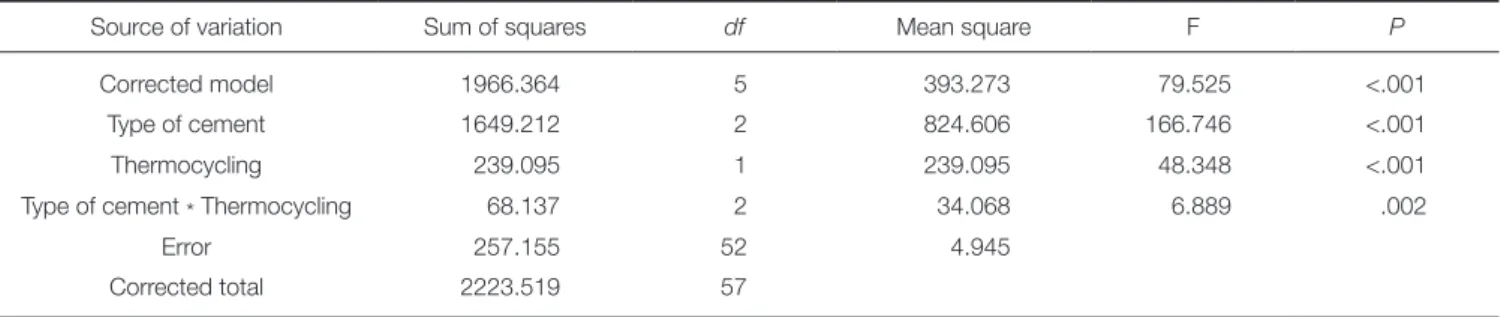
Results and analysis on shear bond strengths were shown in Table 3 and Fig. 2. Table 4 summarizes the results of the two-way ANOVA. Three cements were stored in distilled water for 24 hours after bonding, and then shear bond strengths were measured. Before thermocycling treatment, the result showed that the bond strength was 17.71 ± 1.37 MPa in Multilink (the highest), 11.78 ± 1.82 MPa in RelyX Unicem, 2.66 ± 0.25 MPa in Calibra (the lowest), and dis- crepancy between these values was statistically significant Table 2. Six groups used in this study
Group Surface treatment Silane coupling agent Cement Thermocycling
C1 Calibra silane Calibra® no
C2 yes
M1 Sandblast + Rocatec™ Monobond S Multilink® N no
M2 yes
U1 ESPE sil RelyX™ Unicem Clicker no
U2 yes
Fig. 1. The specimen (A) and the measurement of the shear bond strength (B) were illustrated by the schematic diagram.
A B
(P<.05). Also, after thermocycling treatment, shear strength of Multilink, Unicem and Calibra showed discrepancies of significance in a respective order (P<.05).
As a result of analysis on changing of shear bond strength before and after thermocycling treatment, RelyX Unicem showed the highest change, followed by Multilink and Calibra. Shear bond strength of all three cements before and after thermocycling treatment decreased but, Multilink and RelyX unicem showed significant differences (P<.05).
In C2 group, resin cements of two specimens were separat- ed automatically.
In a result of observation on the surface of specimen after fracture, Calibra showed 100% adhesive failure before and after thermocycling treatment, and Multilink and Unicem showed adhesive failure and mixed failure, combined.
Cohesive failure was not shown in any of specimens (Fig. 3).
Fig. 4A, Fig. 4B, Fig. 4C respectively shows polished surface of each zirconia, surface after alumina air blasting, and surface after silica Rocatec™ silica coating; and Fig.
4D, Fig. 4E, Fig. 4F show SEM views on surfaces of Calibra, Multilink, and Unicem after shear bond strength experiment respectively.
Table 3. Shear bond strength (SD) of experimental groups
Group n Mean maximum force (kg∙m/s2) Shear bond strength (MPa) Amount of change (MPa)
C1 10 75.18 (7.10) 2.66 (0.25) -1.09
C2 8 44.29 (10.66) 1.57 (0.38)
M1 10 500.61 (38.82) 17.71 (1.37)
-4.75
M2 10 366.25 (125.50) 12.96 (4.44)
U1 10 333.04 (51.53) 11.78 (1.82)
-6.37
U2 10 152.82 (52.59) 5.41 (1.86)
Table 4. The results of two-way ANOVA test with type of metal and galvanic corrosion
Source of variation Sum of squares df Mean square F P
Corrected model 1966.364 5 393.273 79.525 <.001
Type of cement 1649.212 2 824.606 166.746 <.001
Thermocycling 239.095 1 239.095 48.348 <.001
Type of cement * Thermocycling 68.137 2 34.068 6.889 .002
Error 257.155 52 4.945
Corrected total 2223.519 57
Fig. 2. Mean shear bond strength of resin cements before and after thermocycling was shown. Same lowercase letters were not statistically significant (P<.05).
Fig. 3. Mean percentage of failure patterns after shear bond strength test.
DISCUSSION
In order to increase bond strength of ceramic restorations, mechanical or chemical method could be used. There are mechanical methods such as acid-etching, alumina air blast- ing, etc., and chemical methods such as application of silane and various adhesive monomers. There are difficul- ties in establishing reliable protocols because there are many variables such as blasting pressure when air blasting, time, diameter, and section form of blasted particles.14 Because Y-TZP ceramic is acid-resistant and does not con- tain silica component, it is important to understand physical properties and reciprocal action of material in order to use it properly to gain a stable bonding with resin cement.
Külünk et al.16 stated that 30-50 μm or 110 μm alumina particles were effective in making appropriate roughness structure. On the other hand, Tsuo et al.15 reported that there were no difference in initial bond strengths by sizes of alumina particles and bond strengths decreased after thermocycling treatment. Phark et al.17 stated that there was no difference in bond strengths by the sizes of particles and stable adhesive force was maintained after thermocy- cling treatment as well.
Therefore, it is considered that it is not the size of the particle but the micro-roughness of the surface is impor- tant in bond strength, and in some reports, it is also said that air blasting particles could decrease the strength of zir- conia causing failures.18 Based on these, 50 μm alumina par-
ticles were used in this experiment, and micro-roughness of the surface was confirmed by SEM observation after air blasting.
Silica coating can also be attempted as chemical method to increase bond strength between resin cement and zirco- nia. Silica-coated layer which is formed in zirconia improves the bond strength by reacting with silane coupling agent and forming chemical bonding with resin cement.19-21 Silane reacts with hydroxyl radical of silica that is coated on zirco- nia surface and forms siloxane networks through a chemical bonding and also forms a bonding with metacrylate mono- mer of the resin. However, there is also a report that silica coating is not so effective because permeation of silica is not sufficient due to its high density.4
It was reported that using resin cement which contains phosphate monomer makes bond strength of zirconia higher. This is because adhesive monomer not only forms bonding with silane but also forms a chemical bonding with hydroxyl radical of zirconia surface.22 Adhesive monomers of resin cements used for this experiment were Bis-GMA of Calibra, phosphoric acid acrylate of Multilink, and methacrylate phosphoric ester of RelyX Unicem.
It is known that using Bis-GMA series cement after silane application shows high bond strength, but it was reported that bond strength decreased after thermocycling treatment.23,24 Bonding of Bis-GMA resin cement after sili- ca coating produced high bonding strength, which was not stable for a long period.22,24 The explanation is that because Fig. 4. Scanning electron microscope images of zirconia surface were shown (magnification ×1,000). A: polished with 1 μm diamond paste, B: 50 μm Al2O3 sandblasting, C: Silica coating with Rocatec™ plus, D: Adhesive failure mode of zirconia surface (Calibra), E: Mixed failure mode of zirconia surface (Multilink N), F: Mixed failure mode of zirconia surface (RelyX Unicem).
A B C
D E F
air-blasting, unlike a metal, does not form a sufficient undercut so that sufficient chemical bond cannot be obtained through silica coating.2 The rationale likely also applies to Calibra including Bis-GMA, which showed the lowest binding forces; two specimens showed spontaneous debonding.
Bond strength of Multilink was higher than that of Unicem before and after thermocycling treatment. Based on this, it is thought that phosphoric acid acrylate mono- mer shows more stable bonding with hydroxyl radical of zirconia surface than methacrylate phosphoric ester mono- mer and similar results were shown in experiments of D’Amario et al.25 in 2010.
It is important for the bonding strength of resin cements to be maintained even after a long-term aging process.
Thermocycling treatments were performed to compare bonding strength according to aging. Regardless of the types of cements, the shear bonding strength tended to decrease in all groups after thermocycling. This was because all three types of cements were enhanced in their binding forces through chemical bonds at first, with these bonds subsequently weakening due to degeneration of material through thermocycling treatments.
In this study, as a result of bonding three kinds of dual cure resin cements on zirconia surface and measuring their shear bond strengths, resin cement containing phosphate series monomer showed higher shear bond strength than resin cement containing Bis-GMA monomer. Additionally, it is thought that experiments on bond strengths using vari- ous surface treatments on zirconia and various kinds of cements will be necessary.
CONCLUSION
Shear bond strength was measured to determine the influ- ences of the type of resin cements and thermocycling treatment on the bonding strength between resin cement and zirconia.
The types of resin cements and thermocycling treat- ment had a significant effect on bonding strength between zirconia and resin cement. The bonding strength of resin cement including phosphoric acid acrylate was significantly higher than resin cements including other monomer. The bonding strength between resin cement and zirconia tended to reduce after thermocycling treatment.
REFERENCES
1. Odén A, Andersson M, Krystek-Ondracek I, Magnusson D.
Five-year clinical evaluation of Procera AllCeram crowns. J Prosthet Dent 1998;80:450-6.
2. Kern M, Wegner SM. Bonding to zirconia ceramic: adhesion methods and their durability. Dent Mater 1998;14:64-71.
3. Kosmac T, Oblak C, Jevnikar P, Funduk N, Marion L. The effect of surface grinding and sandblasting on flexural strength and reliability of Y-TZP zirconia ceramic. Dent Mater 1999;15:426-33.
4. Borges GA, Sophr AM, de Goes MF, Sobrinho LC, Chan DC. Effect of etching and airborne particle abrasion on the microstructure of different dental ceramics. J Prosthet Dent 2003;89:479-88.
5. Luthardt RG, Holzhüter M, Sandkuhl O, Herold V, Schnapp JD, Kuhlisch E, Walter M. Reliability and properties of ground Y-TZP-zirconia ceramics. J Dent Res 2002;81:487-91.
6. Luthardt R, Weber A, Rudolph H, Schöne C, Quaas S, Walter M. Design and production of dental prosthetic restorations:
basic research on dental CAD/CAM technology. Int J Comput Dent 2002;5:165-76.
7. Brentel AS, Ozcan M, Valandro LF, Alarça LG, Amaral R, Bottino MA. Microtensile bond strength of a resin cement to feldpathic ceramic after different etching and silanization reg- imens in dry and aged conditions. Dent Mater 2007;23:1323- 31.
8. Krämer N, Frankenberger R. Clinical performance of bond- ed leucite-reinforced glass ceramic inlays and onlays after eight years. Dent Mater 2005;21:262-71.
9. Ozcan M, Vallittu PK. Effect of surface conditioning meth- ods on the bond strength of luting cement to ceramics. Dent Mater 2003;19:725-31.
10. Blatz MB, Sadan A, Kern M. Resin-ceramic bonding: a re- view of the literature. J Prosthet Dent 2003;89:268-74.
11. Dérand P, Dérand T. Bond strength of luting cements to zir- conium oxide ceramics. Int J Prosthodont 2000;13:131-5.
12. Mirmohammadi H, Aboushelib MN, Salameh Z, Feilzer AJ, Kleverlaan CJ. Innovations in bonding to zirconia based ce- ramics: Part III. Phosphate monomer resin cements. Dent Mater 2010;26:786-92.
13. Parsa RZ, Goldstein GR, Barrack GM, LeGeros RZ. An in vitro comparison of tensile bond strengths of noble and base metal alloys to enamel. J Prosthet Dent 2003;90:175-83.
14. Kim CH, Jeon YC, Jeong CM, Lim JS. Effect of surface treatments of zirconia ceramic on the bond strength of resin cements. J Korean Acad Prosthodont 2004;42:386-96.
15. Tsuo Y, Yoshida K, Atsuta M. Effects of alumina-blasting and adhesive primers on bonding between resin luting agent and zirconia ceramics. Dent Mater J 2006;25:669-74.
16. Külünk S, Külünk T, Ural C, Kurt M, Baba S. Effect of air abrasion particles on the bond strength of adhesive resin ce- ment to zirconia core. Acta Odontol Scand 2011;69:88-94.
17. Phark JH, Duarte S Jr, Blatz M, Sadan A. An in vitro evalua- tion of the long-term resin bond to a new densely sintered high-purity zirconium-oxide ceramic surface. J Prosthet Dent 2009;101:29-38.
18. Karakoca S, Yilmaz H. Influence of surface treatments on surface roughness, phase transformation, and biaxial flexural strength of Y-TZP ceramics. J Biomed Mater Res B Appl Biomater 2009;91:930-7.
19. Wegner SM, Gerdes W, Kern M. Effect of different artificial aging conditions on ceramic-composite bond strength. Int J Prosthodont 2002;15:267-72.
20. Ozcan M. The use of chairside silica coating for different dental applications: a clinical report. J Prosthet Dent 2002;87:
469-72.
21. Amaral R, Ozcan M, Bottino MA, Valandro LF. Microtensile
bond strength of a resin cement to glass infiltrated zirconia- reinforced ceramic: the effect of surface conditioning. Dent Mater 2006;22:283-90.
22. Ozcan M, Nijhuis H, Valandro LF. Effect of various surface conditioning methods on the adhesion of dual-cure resin ce- ment with MDP functional monomer to zirconia after ther- mal aging. Dent Mater J 2008;27:99-104.
23. Isidor F, Stokholm R, Ravnholt G. Tensile bond strength of resin luting cement to glass infiltrated porous aluminium ox- ide cores (In-Ceram). Eur J Prosthodont Restor Dent 1995;3:
199-202.
24. Söderholm KJ, Shang SW. Molecular orientation of silane at the surface of colloidal silica. J Dent Res 1993;72:1050-4.
25. D'Amario M, Campidoglio M, Morresi AL, Luciani L, Marchetti E, Baldi M. Effect of thermocycling on the bond strength between dual-cured resin cements and zirconium- oxide ceramics. J Oral Sci 2010;52:425-30.