FDM 3D Printing of Environmental Friendly and High Strength Bio-based PC Filaments for Baby Toys
Seong Je Park *,** , Ji Eun Lee *,** , Jean Ho Park * , Min-Young Lyu ** , Keun Park ** , Myung Sool Koo *** , Sun Chul Jin *** , Ki Yong Kim *** , and Yong Son *,†
*
Micro/Nano Scale Manufacturing R&D Group, Korea Institute of Industrial Technology, 143 Hanggaulro, Sangnok-gu, Gyeonggi-do 15588, South Korea
**
Department of Mechanical System Design Engineering, Seoul National University of Science and Technology, 232 Gongneung-ro, Nowon-gu, Seoul 01811, South Korea
***
Chemincal Research Center, Samyang Co., Hwoam-dong, Yuseong-gu, Daejeon 34055, South Korea (Received April 18, 2017, Revised April 27, 2017, Accepted May 8, 2017)
Abstract: Due to the depletion of fossil oil and the increasing oil price, bio-plastic is currently topical. Bio-based plastics are synthesized from plant resources, unlike conventional petroleum-based counterparts. Therefore, the former minimizes global warming and reduces carbon dioxide emission. Fossil polycarbonate (PC)has good mechanical and optical properties, but its synthesis requires bisphenol-A and phosgene gas, which are toxic to humans. To address these problems, the fused deposition 3D printing process (hereafter, FDM) is studied using environmentally-friendly and high-strength bio-based PC.
A comparisonof the environmental impact and tensile strength of fossil PC versus bio-based PC is presented herein, demon- strating that bio-based PC is more environmentally-friendly with higher tensile strength than fossil PC. The advantages of bio-based PC are applied in the FDM process for the fabrication of environmentally-friendly baby toys.
Keywords: bio-based PC, isosorbide, fused deposition modeling (FDM), 3D printing, baby toys, Environmental friend- liness
Introduction
현재 플라스틱의 생산량은 철강의 생산량 보다 많으며 고 분자 시대라 불릴 만큼 우리 주변에서 흔히 플라스틱 제품을 볼 수 있다.
1,2그러나 석유 산업 기반의 플라스틱 사용으로 현 재 지구상의 심각한 환경 오염 및 석유자원 고갈의 문제가 야 기 되고 있다. 따라서 최근 이를 해결하기 위한 바이오 플라 스틱(bio-plastic) 개발에 관한 연구가 크게 각광 받고 있다.
3,4바이오 플라스틱을 대표하는 플라스틱으로는 자연에서 분해 될 수 있는 생 분해성 플라스틱과 식물에서 원료를 추출한 식 물 기반 플라스틱 등이 있다.
5폴리카보네이트(Polycarbonate, PC)는 석유에서 추출한 비 스페놀 A(Bisphenol-A, BPA)와 포스겐 가스(Phosgene gas)로 합성되며 fossil PC 혹은 bisphenol-A PC라 불린다. PC는 기 계적 물성 및 광학적 물성이 매우 뛰어나 자동차 부품, 렌즈 그리고 방탄 헬멧 등과 같이 산업전반에서 많이 사용되고 있 다.
6,7하지만 비스페놀 A와 포스겐 가스는 인체에 매우 유해 하기 때문에 영유아 용품 등 친환경성이 요구되는 제품에는
사용이 제한된다.
8-10이와 같은 문제로 최근 일본의 Mitsubishi chemical 사는 옥수수 전분에서 isosorbide를 추출하여 인체에 무해한 친환경 bio-based PC를 개발 하였다.
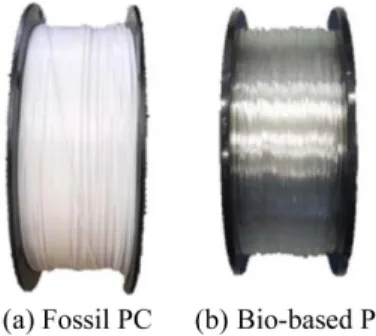
11이를 활용하여 본 연구에서는 기존 유해 성분이 검출되던 기존 PC필라멘트를 bio-based PC 필라멘트로 대체하고 그에 맞는 FDM 3D 프린팅 공정을 개발함으로써 친환경 제품 및 부품 제작으로 활용할 수 있도록 하였다.
3D 프린팅 공정은 절삭 가공에 비하여 버려지는 재료의 양 이 매우 적고 형상 제작의 한계가 없다는 큰 장점으로 현재 활발히 연구되고 있는 플라스틱 가공 방법이다.
12대표적으로 FDM 방식 3D 프린팅은 Figure 1과 같이 필라멘트 상태의 소 재를 모터로 히팅 블록에 공급하고 높은 열로 용융시켜 노즐 을 통해 압출 하여 베드 위에서 한 층씩 적층하는 방식이다.
13-15일반적으로 FDM 방식 3D 프린팅에서 사용되는 재료는 PLA (Poly Lactic Acid), ABS (Acrylonitrile Butadiene Styrene), PA (Poly Amide) 그리고 PC (Poly Carbonate) 등이 있다. PLA의 경우 식물 기반 친환경 바이오 플라스틱이며 변형이 거의 없 어 FDM 방식 3D 프린팅 재료로 가장 많이 활용 된다. ABS 의 경우 Acrylonitrile, Butadiene 그리고 Styrene의 합성 비율 에 따라 매우 다양한 물성의 구현이 가능하다.
15따라서 사용
†