Biomedical Science Letters 2016, 22(2): 37~45 http://dx.doi.org/10.15616/BSL.2016.22.2.37 eISSN : 2288-7415
Distribution of Oncogenic Human Papillomavirus Genotypes at High Grade Cervical Lesions above CIN 2 Grade with Histological Diagnosis
Geehyuk Kim 1 , Sungyoung Park 1 , Hye-young Wang 2 , Sunghyun Kim 3 , Sangjung Park 4 , Kwangmin Yu 1 , Boohyung Lee 7 , Seung-Ju Ahn 5 , Eun-Joong Kim 6 and Dongsup Lee 7,†
1
Department of Biomedical Laboratory Science, College of Health Sciences, Yonsei University, Wonju, Gangwon 26493, Korea
2
M&D, Inc., Wonju Eco Environmental Technology Center, Wonju, Gangwon 26493, Korea
3
Department of Clinical Laboratory Science, College of Health Sciences, Catholic University of Pusan, Pusan 46252, Korea
4
Department of Biomedical Science, College of Life and Health Sciences, Hoseo University, Asan, Chungcheong 31499, Korea
5
Department of Clinical Laboratory Science, Daegu Health & Science College, Daegu 41453, Korea
6
Department of Clinical Laboratory Science, Chungbuk Health & Science University, Chungju 28250, Korea
7
Department of Clinical Laboratory Science, Hyejeon College, Choongchung, Hongseoung 32244, Korea
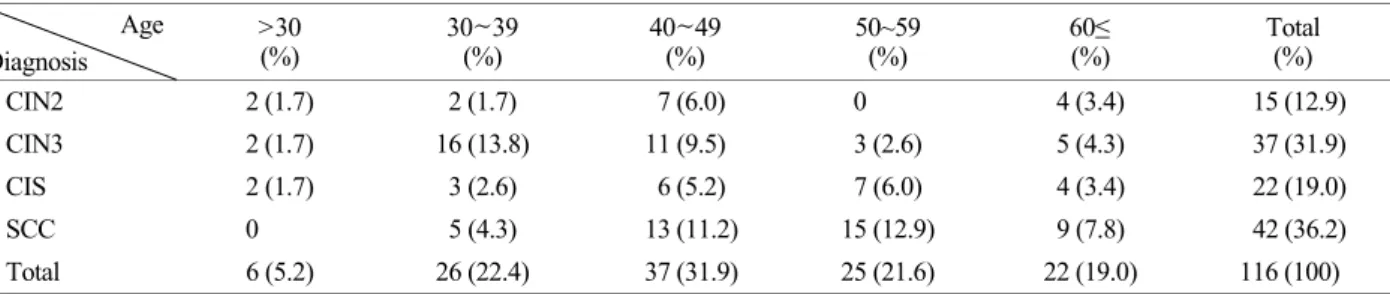
High risk human papillomavirus (HR-HPV) is major risk factor for uterine cervical cancer. There are approximately 15 types of HR-HPV. Liquid based cytology samples (116 samples) with high grade cervical lesions belonging to cervical intraepithelial neoplasia (CIN) 2, CIN 3, carcinoma in situ (CIS) and squamous cell carcinoma (SCC) were used after histologic confirmation. HR-HPV genotype assay was conducted using DNA chips. The HR-HPV infection rate was 81.9% with SCC samples showing the highest HR-HPV infection rate of 31%. CIN 3, CIS and CIN 2 showed infection rates of 25%, 16.4% and 9.5%, respectively. According to age with HR HPV infection rate, the 30~39 years-old group showed the highest infection rate by 92.3%. According to distribution with HR HPV genotyping, HPV 16 showed the highest infection rate by 42.3% whereas HPV 33 and HPV 58 showed infection rates of 11.7% and 10.8%, respectively.
HPV 18 which is the second most common infected HPV genotype in the world showed 3.6%. Of the three most common oncogenic HR-HPV genotypes in CIN 2, we detected HPV 16, 35, 58; CIN 3 was HPV 16, 33, 58; CIS was HPV 16, 58, 33 (35/52); and SCC was HPV 16, 33, and 18 (31/52/58). Among the HPV 18, CIN 2, CIN 3, CIS and SCC showed 0.9%, 0.9%, 0% and 1.8%, respectively. The most often used preventive vaccines for cervical cancers use HPV 16 and HPV 18 as targets. However, results derived from this study suggest that a preventive vaccine against HPV 16 and HPV 18 would not be optimal for populations in this study.
Key Words: Human papillomavirus, Uterine cervix cancer, Cervical intraepithelial neoplasia, Carcinoma in situ, Squamous cell carcinoma, DNA chip
Original Article
*
Received: May 18, 2016 / Revised: June 28, 2016 / Accepted: June 28, 2016
†