Biomedical Science Letters 2017, 23(3): 223~229 https://doi.org/10.15616/BSL.2017.23.3.223 eISSN : 2288-7415
Genetic Variations of Aspergillus fumigatus Clinical Isolates from Korea
Sunghyun Kim1, Pan-Gon Ma2, Young-Seok Park3, Young-Bin Yu4, Kyu Jam Hwang5,† and Young Kwon Kim4,†
1Department of Clinical Laboratory Science, College of Health Sciences, Catholic University of Pusan, Busan 46252, Korea
2Department of Clinical Laboratory Science, Daegu Health College, Daegu 41453, Korea
3Department of Emergency Medical Services, Sunmoon University, Asan 31460, Korea
4Department of Biomedical Laboratory Science, College of Medical Sciences, Konyang University, Daejeon 35365, Korea
5Pathogen Resource TF, Center for Infectious Disease, National Research Institute of Health, Korea Center for Disease Control and Prevention, Chongju 281259, Korea
Fungal infections by human pathogenic fungi are increasing globally in elderly, children and immune suppressed or deficient patients. Aspergillus fumigatus is one of the well-known pathogenic fungi and causes aspergilloses in human world widely. However, current identification and classification methods based on its phenotypic characteristics still have limitations. Therefore, currently, molecular biological tools using their DNA sequences are used for genotype identification and classification. In the present study, in order to analyze genetic variations of A. fumigatus clinical isolates, a total of six housekeeping genes were amplified by PCR using specific primer pairs and multi-locus sequence typing (MLST) assay. Results from phylogenetic tree analysis showed that most A. fumigatus strains (88.9%) from respiratory specimens were classified into cluster A and B, and approximately half of A. fumigatus strains (46%) from non-respiratory specimens were classified into cluster C and D. Although the sample size was limited, genetic characteristics of A. fumigatus clinical isolates according to their origins were very similar and well-correlated with other clinical data.
Key Words: Aspergillus fumigatus, Clinical isolates, Genetic variations, Multi-locus sequence typing, Genotypes
서 론
급속한 고령화 사회로의 진입으로 노인 인구의 증가, 후천성면역결핍증, 암, 당뇨, 화상, 백혈병, 비경구적 영양 요법, 혈액투석에 의한 점막 내 집락화 등 면역이 저하되
거나 억제된 환자의 수가 증가함에 따라 기회 감염 진균 증 환자의 발생률과 유병률 또한 동반하여 증가하고 있는 상황이다(Yoon et al., 2004). 공기를 통해 사람에게 감염되 는 곰팡이들 중 가장 큰 비중을 차지하고 있는 아스페르 길루스증(Aspergillosis)은 대부분 Aspergillus fumigatus에 의 해 발병하는 것으로 알려져 있다. A. fumigatus에 감염되면
Original Article
*Received: August 22, 2017 / Revised: September 18, 2017 / Accepted: September 18, 2017
†Corresponding author: Young Kwon Kim. Department of Biomedical Laboratory Science, College of Medical Sciences, Konyang University, Daejeon 35365, Korea.
Tel: +82-42-600-6371, Fax: +82-42-600-6375, e-mail: [email protected]
†Corresponding author: Kyu Jam Hwang. Pathogen Resource TF, Center for Infectious Disease, National Research Institute of Health, Korea Center for Disease Control and Prevention, Chongju 281259, Korea.
Tel: +82-43-719-6870, Fax: +82-43-719-6680, e-mail: [email protected]
○CThe Korean Society for Biomedical Laboratory Sciences. All rights reserved.
○CCThis is an Open Access article distributed under the terms of the Creative Commons Attribution Non-Commercial License (http://creativecommons.org/licenses/by-nc/3.0/) which permits unrestricted non-commercial use, distribution, and reproduction in any medium, provided the original work is properly cited.
심할 경우 사망에까지 이르게 되고, 항진균제를 투여함에 도 불구하고 감염자의 사망률은 매우 높게 보고되고 있 다(Reichenberger et al., 2002). 또한 Aspergillus 속은 인체 의 피부감염, 외이 아스페르길루스증(otomycosis), 폐 아스 페르길루스증, 심내막염과 같은 침습성 감염을 포함한 넓 은 범주의 감염을 일으킨다. 폐 아스페르길루스증은 심각 한 면역저하증 환자에게서 일어날 수 있는 침습성 폐 아 스페르길루스증(invasive pulmonary aspergillosis, IPA)부터 경미한 면역저하증 환자에게서 일어나는 만성 괴사성 아 스페르길루스증까지 그 감염범위가 매우 넓게 나타난다 (Neofytos D et al., 2010).
최근 IPA의 위험은 혈액 줄기세포이식 환자와 백혈병 환자 등에서 훨씬 높은 것으로 보고되고 있는데, 치사율 이 38.5%로 알려져 있다. 특히 A. fumigatus는 IPA의 가장 현저한 병인으로 작용하고 있으며, 그 뒤를 이어 발생률 이 높은 것은 병원 환경에 따라 A. terreus 또는 A. flavus 인 것으로 알려져 있다(Warnock, 2007; Jiang et al., 2015). 최 근에는 A. ustus, A. alliaceus, A. lentulus 그리고 A. udagawae 로 인해 발생하는 IPA 또한 보고된 바 있다(Balajee et al., 2005). Aspergillus 종의 분류방법은 배지, 광학현미경 또는 전자현미경을 이용한 형태학적 방법과 최근에는 분자생물 학적 방법이 많이 사용되고 있다. 집락의 특징은 집락 성 장속도(colony growth rates), 배열(texture), 포자형성(sporu- lation) 정도, 균핵(sclerotia) 또는 폐쇄포자낭과(cleistothecia) 의 생성, 균사(mycelia)의 색, 포자형성 여부, 용해성 색소 (soluble pigment), 삼출물(exudates), 집락 뒷면(colony re- verses)의 색조 생성 등이 있으며, 종 동정을 위한 배지의 종류 선택, 접종 기술, 접종 조건은 형태학적 분류에 영 향을 줄 수 있다(De Hoog et al., 2000; Balajee et al., 2006).
진균의 분류를 위해 사용되고 있는 분자생물학적 분석 기술의 하나인 Multi-locus sequence typing (MLST)은 염기 서열 분석을 통해 얻어진 정보를 이용해 동일진균 종의 유 전자형(sequence types) 및 단일한 순수 클론인지, 또는 혼 합된 클론인지를 확인할 수 있다(Yoon et al., 2004). MLST 에서 주로 사용되는 유전자는 다형성(polymorphism)과 microsatellite가 강한 유전자들로 약 10개 정도의 house- keeping 유전자를 대상으로 분석하며, 해당 유전자 부위 약 200~500 bp 정도 영역을 사용한다. 기존에 많이 사용 되었던 multi-locus enzyme electrophoresis (MLEE)는 분석에 많은 수의 균주가 필요하고, 숨겨진 variation은 분석할 수 없었으나, MLST는 이 부분까지도 찾아낼 수 있는 장점이 있기 때문에 기존의 phenotyping이나 mating test를 통해서
동정하지 못했던 부분까지도 동정이 가능하다(Yoon et al., 2004; Balajee et al., 2005). 따라서 본 연구에서는 국내에서 분리된 A. fumigatus 임상분리주의 sequence type (ST)의 다 양성 분석을 위해 MLST 분석을 수행하였다. 이를 통해 국내에서 유행하는 A. fumigatus의 ST와 질병을 유발한 환 자의 임상정보 대한 분석을 수행함으로써 각 유전자 형의 특성을 이해하기 위한 기초 자료를 제시하고자 하였다.
재료 및 방법
연구균주
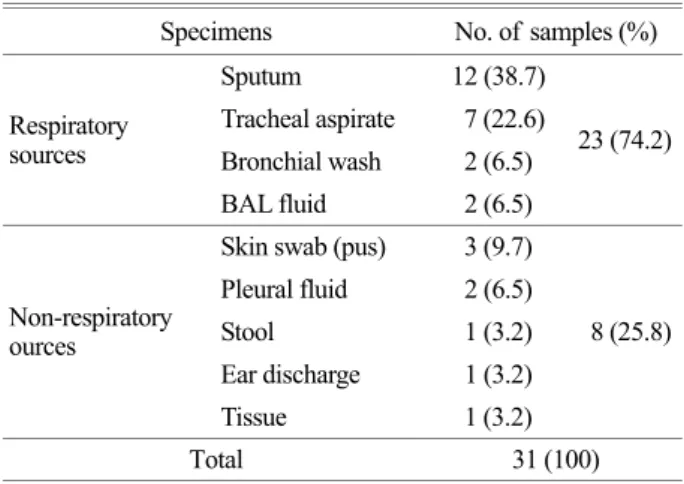
국내 3차 병원의 내원 환자로부터 potato dextrose agar (PDA), Sabouraud dextrose agar (SDA), Czapek Dox agar (CzA), malt extract agar (MEA)에 26℃에서 2~4주간 배양 후 얻은 집락의 표면, 뒷면 색, 형태, 색소 형성 유무 등을 통한 형태학적인 동정과 fungal internal transcribed spacer (ITS) 부위 염기서열 분석을 통해 동정 재확인을 완료한 후 한국의진균자원은행(Korean Collection of Medical Fungi, KCMF)에서 기탁, 보관중인 의진균자원 중 A. fumigatus 31주를 분양 받아 본 연구에 사용하였다. 분리 검체의 종 류에 따른 임상분리주 간의 차이를 비교하기 위해 관련 정보 또한 KCMF로부터 제공받았다(Table 1).
Genomic DNA (gDNA) 추출
20~30 mL의 Sabouraud dextrose 액체 배지를 이용하여 25℃에서 3~4일간 120 rpm으로 교반하면서 배양하였다.
충분히 자란 균사체를 거즈로 걸러내고, 멸균 증류수로 3회 세척하였다. 물기를 충분히 제거한 균사체를 1.5 mL
Table 1. Clinical specimen sources for this study Specimens No. of samples (%)
Respiratory sources
Sputum 12 (38.7)
23 (74.2) Tracheal aspirate 7 (22.6)
Bronchial wash 2 (6.5) BAL fluid 2 (6.5)
Non-respiratory ources
Skin swab (pus) 3 (9.7)
8 (25.8) Pleural fluid 2 (6.5)
Stool 1 (3.2)
Ear discharge 1 (3.2)
Tissue 1 (3.2)
Total 31 (100)
tube로 옮기고 deep freezer에서 급속 동결시켰다. 동결된 균사체는 동결건조기를 이용하여 5 mmTorr 이하의 압력 에서 건조시켰다. 건조된 균사체 20~300 mg을 막자사발 로 옮기고 sea sand (15~20 mesh, Sigma, USA) 소량을 같이 넣어주고 액체질소를 이용해 빠르고 강하게 분쇄하였다.
균사 분말 적당량을 취하여 새로운 tube에 담고 genomic DNA를 추출하였다. gDNA 추출 과정은 cetyltrimethyll- ammonium bromide (CTAB) 방법을 기준으로 수행하였다.
추출된 DNA에 2 μL의 RNase (10 mg/mL)를 첨가하여 RNA를 제거한 후 -20℃에서 사용 시까지 보관하였다.
Multi-locus sequence typing (MLST) 분석
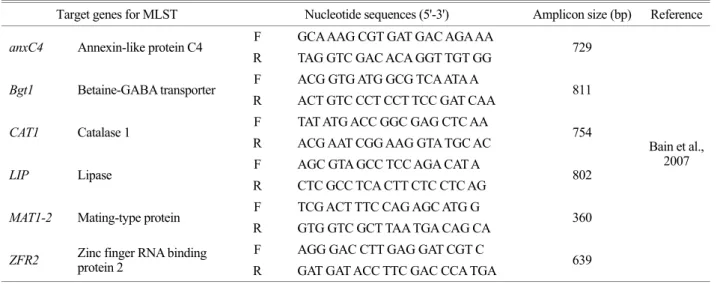
A. fumigatus의 MLST 분석을 위해 사용된 프라이머 정 보는 Table 2와 같다. 각 프라이머 쌍은 총 6개의 유전자 인 annexin-like protein C4 (anxC4), betaine-GABA transporter 1 (Bgt1), catalase 1 (CAT1), Lipase (LIP), mating-type protein (MAT1-2), zinc finger RNA binding protein 2 (ZRF2)의 염기 서열을 기초로 기존 연구에서 디자인된 프라이머를 제작 해 사용하였다(Bain et al., 2007). PCR 반응물의 조성은 Prime Taq Premix 10 μL, 멸균 증류수 5 μL, 10 pmol 프라 이머 혼합액 2 μL, template DNA 3 μL (25 ng/μL)로 총 20 μL 로 PCR 반응물의 양을 맞췄다. PCR 반응 조건은 초기 변 성(initial denaturation)은 94℃에서 5분, 변성(denaturation) 은 94℃에서 1분, 프라이머 결합(annealing)은 60℃에서 1분, 신장반응(extension)은 72℃에서 1분으로 35회 반복하 였으며, 마지막으로 72℃에서 10분 동안 증폭한 후 4℃에
서 보관하였다.
증폭된 PCR 반응 산물은 1% agarose gel상에서 전기영 동으로 확인한 후, Accuprep PCR purification kit (Bioneer, Korea)를 이용하여 PCR 반응 산물을 정제하였다. 염기서 열 분석은 마크로젠(Macrogen, Korea)에 의뢰하여 분석하 였다. 염기서열 분석 결과들을 기초로 각각의 대립유전자 에 대한 유전자형은 A. fumigatus MLST database (http://
www.pubmlst.org)를 이용하였고, 총 6개의 대립유전자 유 전자형을 조립하여 각 균주의 ST를 결정하였다. 6개의 대 립유전자 중 1개라도 하나 이상의 염기가 다른 경우에는 새로운 ST로 분류하였다.
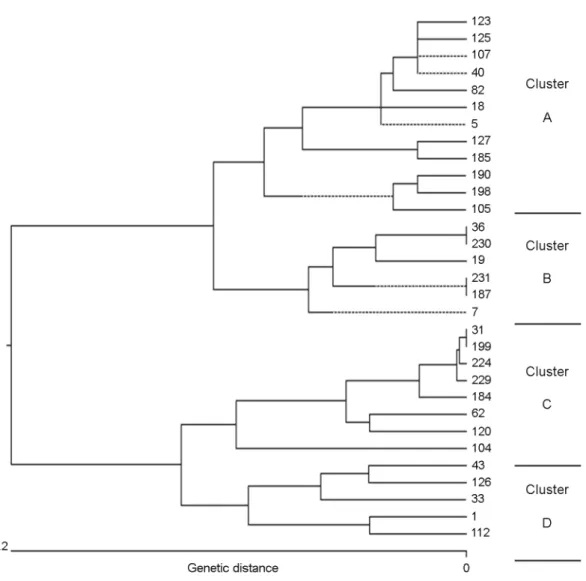
Nucleotide substitution 및 유전적 연관성 분석 분석 대상 6개 유전자의 염기서열 분석이 완료된 후, 유 전자의 염기서열 차이를 분석하기 위해 증폭 후 확인된 6개 표적유전자 각각의 염기서열을 Molecular Evolutionary Genetics Analysis (MEGA) v. 7.0 프로그램을 통해 총 4,360 bp의 사이즈가 되도록 하나의 파일로 결합하였고, 결합된 염기서열 정보를 이용해 1,000 boostrap replication 조건으 로 unweighted pair group method using arithmetic average (UPGMA) dendrogram을 생성하여 A. fumigatus 임상분리주 간 차이를 분석하였다(Bain et al., 2007). 유전적 cluster 구 분 및 연관성을 구분 짓기 위해 cut-off limit을 0.1 genetic distance로 설정하여 분석하였다.
Table 2. Specific oligonucleotide primer sets used for A. fumigatus MLST
Target genes for MLST Nucleotide sequences (5'-3') Amplicon size (bp) Reference anxC4 Annexin-like protein C4 F GCA AAG CGT GAT GAC AGA AA
729
Bain et al., 2007 R TAG GTC GAC ACA GGT TGT GG
Bgt1 Betaine-GABA transporter F ACG GTG ATG GCG TCA ATA A R ACT GTC CCT CCT TCC GAT CAA 811
CAT1 Catalase 1 F TAT ATG ACC GGC GAG CTC AA
R ACG AAT CGG AAG GTA TGC AC 754
LIP Lipase F AGC GTA GCC TCC AGA CAT A
R CTC GCC TCA CTT CTC CTC AG 802
MAT1-2 Mating-type protein F TCG ACT TTC CAG AGC ATG G R GTG GTC GCT TAA TGA CAG CA 360
ZFR2 Zinc finger RNA binding protein 2
F AGG GAC CTT GAG GAT CGT C R GAT GAT ACC TTC GAC CCA TGA 639
결 과
임상 검체의 종류에 따른 A. fumigatus의 분리 비율 본 연구에서 사용된 총 31개의 A. fumigatus 임상분리주 중 객담을 포함한 호흡기 검체의 유래가 총 23건(74.2%) 으로, 객담 12건(38.7%), 기관흡인액 7건(22.6%), 기관지세 척액 2건(6.5%), 기관지폐포세척액 2건(6.5%)을 포함하고
있다. 비호흡기 유래 검체는 총 8건(25.8%)으로 농(pus)을 포함한 피부 swab 검체 유래가 3건(9.7%), 체액이 2건 (6.5%), 분변, 귀 분비물, 조직이 각각 1건(3.2%)을 포함하 고 있다. 호흡기 검체 유래가 70% 이상으로 가장 많은 빈 도를 나타냈다(Table 1).
PCR을 통한 MLST 분석 유전자의 증폭 결과
총 31개의 A. fumigatus 임상분리주에 대한 MLST 분석
Table 3. MLST allele types and sequence types (STs) of A. fumigatus clinical isolates Strain
No.
Target genes / Allele types
STs Clusters anxC4 Bgt1 CAT1 LIP MAT1-2 ZFR2
1 2 3 2 1 1 1 UST5 D
5 1 1 3 1 1 1 ST14 A
7 1 1 3 1 2 1 UST7 B
18 1 1 1 1 1 1 ST1 A
19 1 3 3 1 6 (new) 2 UST12 B
31 1 3 2 1 2 2 ST5 C
33 1 3 2 1 1 2 UST3 D
36 1 1 3 1 2 2 UST8 B
40 1 1 3 1 5 1 ST42 A
43 1 3 2 1 1 5 UST4 D
62 1 1 2 1 6 (new) 1 UST1 C
82 1 1 3 1 1 1 ST14 A
104 2 1 7 1 6 (new) 1 UST14 C
105 1 3 3 1 1 2 UST11 A
107 1 1 3 1 5 1 ST42 A
112 2 1 2 2 1 1 UST2 D
120 1 1 2 2 2 1 ST7 C
123 1 1 3 1 5 1 ST42 A
125 1 1 3 9 (new) 5 1 UST9 A
126 6 3 2 1 1 5 UST6 D
127 2 1 3 2 1 1 UST10 A
184 1 3 2 1 2 1 ST3 C
185 2 1 3 1 1 1 ST9 A
187 1 3 3 1 2 1 ST19 B
190 1 9 (new) 3 1 1 1 UST13 A
198 1 3 3 1 1 1 ST21 A
199 1 3 2 1 2 2 ST5 C
224 1 3 2 1 2 2 ST5 C
229 1 3 2 1 2 2 ST5 C
230 1 1 3 1 2 2 UST8 B
231 1 3 3 1 2 1 ST19 B
을 위해 총 6개의 표적유전자를 대상으로 PCR을 통한 증폭 후 염기서열 분석을 수행하였다. 본 연구에서 사용 한 6개의 표적 housekeeping 유전자는 anxC4, Bgt1, CAT1, LIP, MAT1-2, ZRF2였고, 이들 6개 표적 housekeeping 대 립유전자의 DNA 염기서열은 각각 310~900 bp 범위였으 며, 각 균주에 대해서는 6개 대립유전자를 조합하여 총 4,360 bp의 염기서열을 확인하였다.
대립유전자의 다형성 부위 분석 결과와 sequence type 의 분포
MLST 분석 결과 총 20개의 다형성 부위를 확인하였으 며, 다형성 부위가 존재하는 대립유전자(allele)는 anxC4 4개, Bgt1 2개, CAT1 6개, MAT1-2 4개, LIP 2개, ZRF2 2개였
으며, 이 중 5개는 이전에 보고되지 않은 새로운 다형성 부위였고, LIP, MAT1-2, Bgt1에서 발견되었다. 또한, 각 대 립유전자의 조합에 따라서 A. fumigatus ST1, ST3, ST5, ST7, ST9, ST14, ST19, ST21, ST42, undetermined ST (UST)1, UST2, UST3, UST4, UST5, UST6, UST7, UST8, UST9, UST10, UST11, UST12, UST13, UST14를 포함해 총 23가지의 ST 가 확인되었고, 이 중 기존에 보고되지 않은 새로운 ST는 UST1부터 UST14까지 총 14가지로 확인되었다(Table 3).
본 연구에서 확인된 총 14가지의 A. fumigatus ST 중 ST5 가 총 4주(12.9%)에서 확인되어 가장 많은 분포를 보였고, 다음으로 ST42가 3주(9.7%), ST14, ST19, UST8이 각각 2주(6.5%)의 분포를 나타냈으며, 나머지 18개의 ST는 각 각 1주씩의 분포를 나타냈다(Table 3).
Fig. 1. Phylogenetic tree generated from each A. fumigatus clinical isolate.
A. fumigatus 임상분리균주 간 유전적 연관성
Cut-off 값을 0.1 genetic distance로 설정하여 A. fumigatus 임상분리주들을 분석한 결과, 크게 4개의 cluster로 분류되 었다. Cluster A에는 ST1, ST9, ST11, ST14, ST21, ST42, UST9, UST10, UST11, UST13를 포함해 총 12개(38.7%), cluster B에는 ST19, UST7, UST8, UST12를 포함해 총 6개 (19.4%), cluster C에는 ST3, ST5, ST7, UST1, UST14를 포함 해 총 8개(25.8%), cluster D에는 UST2, UST3, UST4, UST5, UST6를 포함해 총 5개(16.1%)의 임상분리주가 포함됨을 확인하였다. 유전적 연관성을 분석한 결과, 임상정보와의 연관성은 뚜렷하게 나타나지는 않았지만 cluster A와 B에 포함된 18개의 임상분리주 중 16주(88.9%)는 호흡기 검체 유래였으며, 나머지 2주(11.1%)는 비호흡기 검체 유래였 다. Cluster C과 D에 포함된 13개의 임상분리주 중 7주 (53.8%)는 호흡기 검체 유래였고, 나머지 6주(46.2%)는 비 호흡기 검체 유래임을 확인할 수 있었다(Fig. 1). 전체적으 로 동일 분리원으로부터 분리된 균주들이 대부분 동일 cluster 내에 위치함을 확인하였다.
고 찰
이전 연구들에서 Aspergillus 속의 종 구분이 매우 어려 운 경우가 많았던 것으로 알려져 있다. 특히, A. fumigatus 와 이의 유사 균종인 A. lentulus 간의 구분을 위해 Af293 의 변이가 많은 5부위를 선택해 염기서열을 비교한 경 우가 있었고(Balajee et al., 2005), RFLP 방법에 의해 A.
fumigatus의 동정 결과가 A. udagawae로 바뀐 사례도 있 었다(Balajee et al., 2006).
과거에는 A. fumigatus의 균주 간 유전적 연관성을 구 분하는 방법으로 restriction fragment length polymorphism (RFLP) typing, randomly amplified polymorphic DNA (RAPD) typing 그리고 Southern blot에 의한 DNA fingerprinting 방법 이 사용되었다. 하지만, 이러한 방법들은 MLST 방법에 비하여 다양성 면에서 상당히 떨어지는 것으로 나타났다 (Anderson et al., 1996; Gil-Lamaignere et al., 2003; Balajee et al., 2006). 또한 Candida albicans (Bougnoux et al., 2003), C.
glabrata (Dodgson et al., 2003), C. tropicalis (Tavanti et al., 2005), C. krusei (Jacobsen et al., 2007), Cryptococcus neoformans var.
gattii (Halliday and Carter, 2003), C. neoformans var. grubii (Litvintseva et al., 2006) 등과 같은 다른 진균 종에서 유전 적 연관성 분석을 위해 MLST 방법을 수행한 선행연구가
많이 있었고, 유의성 있는 결과를 얻을 수 있었다. 아직 도 MLST 한 가지 방법만으로는 완벽한 분석이 어렵기 때문에 다른 분석방법과 병용하여 그 효율성을 높이고자 하는 시도들이 이어지고 있다(Bain et al., 2007; Debourgone et al., 2010).
본 연구에서는 국내 3차 병원의 환자로부터 분리배양 되어 KCMF에 기탁되어 있는 총 31개의 A. fumigatus 임 상분리주의 유전적 계통의 연관성 분석을 위해 MLST를 수행하였다. 결과에서 언급되어 있는 바와 같이 총 31개 의 임상분리주가 총 23개의 ST로 분류됨에 따라 동일 국 가에서 분리되는 동일 종의 진균에서도 유전적 다양성이 매우 다양하게 나타날 수 있음을 확인할 수 있었다. 특히, 호흡기 검체에서부터 유래한 A. fumigatus의 ST가 대부분 A와 B cluster에 포함되는 것을 확인할 수 있었다. 이러한 결과를 보았을 때 아마도 유전적으로 연관성이 높은 A.
fumigatus ST가 호흡기를 통해 환자에서 환자로의 감염 이 쉽게 전파되는 것으로 추정된다.
인체 진균 감염증이 매년 꾸준히 증가함에도 불구하고, 국내 감염률에 대한 전국단위의 감시 및 역학적 특성이 잘 밝혀져 있지 않은 상황이다. 따라서, 주요 진균 병원체 의 주기적 조사를 통해 지역별로 분리되는 균종과 유전형 에 관한 추이 분석 및 변이 특성과 항진균제에 대한 내성 패턴 등 진균 감염 예방을 위한 기초 자료들의 마련이 절 실히 요구되고 있다.
본 연구를 통해 얻은 결과들을 종합적으로 판단하여 보 았을 때 국내의 임상에서 분리된 A. fumigatus의 유전적 다양성이 매우 다양하게 나타날 수 있음을 알 수 있었고, 이러한 기초 자료들을 기반으로 국내의 다양한 환자들로 부터 분리되는 A. fumigatus의 균주 간 연관성을 지속적으 로 모니터링 함으로써 국내에서 유행할 것으로 예상되는 A. fumigatus ST를 미리 예측하고 관리할 수 있을 것으로 판단된다. 더욱 나아가서는 인체 진균 감염증의 정확한 진 단, 치료 및 예방 등 의료 보건분야의 향후 대비책 마련 에 많은 도움이 될 수 있을 것으로 사료된다.
ACKNOWLEDGEMENTS
This research was supported by a fund (2015-ER4703-00) by Research of Korea Centers for Disease Control and Prevention.
CONFLICT OF INTEREST
The authors have no conflicts of interest to disclose.
REFERENCES
Anderson MJ, Gull K, Denning DW. Molecular typing by random amplification of polymorphic DNA and M13 Southern hybri- dization of related paired isolates of Aspergillus fumigatus.
Journal of Clinical Microbiology. 1996. 34: 87-93.
Bain JM, Tavanti A, Davidson AD, Jacobsen MD, Shaw D, Gow NA, Odds FC. Multilocus sequence typing of the pathogenic fungus Aspergillus fumigatus. Journal of Clinical Microbiology.
2007. 45: 1469-1477.
Balajee SA, Gribskov JL, Hanley E, Nickle D, Marr KA. Aspergillus lentulus sp. nov., a new sibling species of A. fumigatus.
Eukaryotic Cell. 2005. 4: 625-632.
Balajee SA, Nickle D, Varga J, Marr KA. Molecular studies reveal frequent misidentification of Aspergillus fumigatus by mor- photyping. Eukaryotic Cell. 2006. 5: 1705-1712.
Bougnoux ME, Tavanti A, Bouchier C, Gow NA, Magnier A, Davidson AD, Maiden MC, D'Enfert C, Odds FC. Collab- orative consensus for optimized multilocus sequence typing of Candida albicans. Journal of Clinical Microbiology. 2003.
41: 5265-5266.
Debourgone A, Gueidan C, Henneqyuin C, Contet-Audonneau N, de Hoog S, Machouart M. Development of a new MLST scheme for differentiation of Fusarium solani species complex (FSSC) isolates. Journal of Microbiological Methods. 2010.
82: 319-323.
De Hoog GS, Guarro J, Gene J, Figueras MJ. Atlas of clinical fungi, Centraalbureau voor Schimmelcultures 2nd ed. 2000.
Dodgson AR, Pujol C, Denning DW, Soll DR, Fox AJ. Multilocus sequence typing of Candida glabrata reveals geographically enriched clades. Journal of Clinical Microbiology. 2003. 41:
5709-5717.
Gil-Lamaignere C, Roilides E, Hacker J, Muller FM. Molecular typing for fungi a critical review of the possibilities and limi- tations of currently and future methods. Clinical Microbiology and Infection. 2003. 9: 173-185.
Halliday CL, Carter DA. Clonal reproduction and limited dispersal in an environmental population of Cryptococcus neoformans var. gattii isolates from Australia. Journal of Clinical Micro-
biology. 2003. 41: 703-711.
Jacobsen MD, Gow NA, Maiden MC, Shaw DJ, Odds FC. Strain typing and determination of population structure of Candida krusei by multilocus sequence typing. Journal of Clinical Microbiology. 2007. 45: 317-323.
Jiang S, Jiang L, Shan F, Zhang X, Song M. Two cases of endo- bronchial aspergilloma with lung cancer: a review the literature of endobronchial aspergilloma with underlying malignant lesions of the lung. International Journal of Clinical and Experimental Medicine. 2015. 8: 17015-17021.
Litvintseva AP, Thakur R, Vilgalys R, Mitchell TG. Multilocus sequence typing reveals three genetic subpopulations of Cryp- tococcus neoformans var. grubii (serotype A), including a unique population in Botswana. Genetics. 2006. 172: 2223 -2238.
Neofytos D, Fishman JA, Horn D, Anassie E, Chang CH, Olyaei A, Pfaller M, Steinbach WJ, Webster KM, Marr KA. Epidemi- ology and outcome of invasive fungal infections in solid organ transplant recipients. Transplant Infectious Disease. 2010. 12:
220-229.
Reichenberger F, Habicht JM, Gratwohl A, Tamm M. Diagnosis and treatment of invasive pulmonary aspergillosis in neutropenic patients. European Respiratory Journal. 2002. 19: 743-755.
Tavanti A, Davidson AD, Johnson EM, Maiden MC, Shaw DJ, Gow NA, Odds FC. Multilocus sequence typing for differentiation of strains of Candida tropicalis. Journal of Clinical Micro- biology. 2005. 43: 5593-5600.
Warnock DW. Trends in the epidemiology of invasive fungal in- fections. Japanese Journal of Medical Mycology. 2007. 48:
1-12.
Yoon HJ, Choi HY, Kim YK, Song YJ, Ki M. Prevalence of fungal infections using National Health Insurance data from 2009-2013, South Korea. Epidemiology and Health. 2004.
36: 1-10.
https://doi.org/10.15616/BSL.2017.23.3.223
Cite this article as: Kim SH, Ma PG, Park YS, Yu YB, Hwang KJ, Kim YK. Genetic Variations of Aspergillus fumigatus Clinical Isolates from Korea. Biomedical Science Letters. 2017. 23: 223-229.