Printed in the Republic of Korea DOI 10.5012/jkcs.2010.54.3.323
요약. 이 연구에서는 야자껍질로부터 이상적인 sieving 특성을 갖는 탄소 분자 체(CMS)의 합성을 시도하였다. 그 과정은 세 단계로 이루어지는데 탄소화 과정, 이산화 탄소 활성화 과정, 그리고 polyfurfuryl 알코올 고분자 증착 과정이다. 이산화 탄소 활성화에 의해 야자 껍질로부터 만들어진 활성탄(CA)은 CMS의 합성을 위한 원료 물질로 사용되었다. 야자껍질로부터 만들 어진 AC를 준비한 다음 AC에 대한 최적의 furfuryl 알코올 과 포름 알데히드 비를 결정하였다. AC에 polyfurfuryl 알코올의 증 착을 탄소화 과정에 앞서 수행하였다. 이렇게 고분자가 증착된 AC는 불활성 환경 조건과 700 - 900 oC온도에서 탄소화 과정을 거친다. 모든 미세세공 물질은 micrometric사의 ASAP/2020을 이용하여 분석되었다. 결과로 AC에 대한 최적의 furfuryl 알코 올 과 포름 알데히드 비는 1:2.5로 결정 되었다. 7 Å 이하의 미세세공은 700 oC, 800 oC 그리고 900 oC 에서 1.5시간 동안 고분자 가 증착된 AC에 형성 되었다. 1.5시간 동안 900 oC 에서 탄소화 온도는 CMS합성을 위한 최적의 조건으로 밝혀졌다. 이러한 조건하에서 생성된 CMS는 5. 884 Å의 구멍 크기를 갖는다.
주제어: 탄소 분자체, 활성 탄소, 고분자 증착 방법, polyfurfuryl 알코올
ABSTRACT. In this work, an intention to synthesize the carbon molecular sieve (CMS) with ideal sieving properties from palm shell has been attempted. The process includes three main stages: carbonization, carbon dioxide activation and polymer deposition using polyfurfuryl alcohols. Palm shell based activated carbon (AC) produced by carbon dioxide activation was used as raw material in synthesis of CMS. After preparing palm shell based AC, optimum concentration ratio of furfuryl alcohols and formaldehyde to AC for CMS synthesis was obtained in this study. Deposition of polyfurfuryl alcohols on the palm shell based AC was then carried out prior to carbonization. These polymer deposited AC was subjected to carbonization at 700-900oC under inert condition. All the microporous materials were analyzed using micromeritics ASAP/2020. The results show that optimum concentration ratio of furfuryl alcohol and formaldehyde to AC is 1:2.5. The micropore with pore width less than 7 Å was formed on the polymer deposited AC at 700oC, 800oC and 900oC for 1.5 hours. Carbonization temperature at 900oC for 1.5 hours was found to be optimum for CMS synthesis. The CMS produced under this condition has pore width of 5.884 Å.
Keywords: Carbon Molecular Sieve, Activated Carbon, Polymer deposition method, polyfurfuryl alcohol
Polyfurfuryl 알코올 증착에 의한 야자껍질로부터 탄소분자 체의 합성
V. M. Sivakumar, Kok-Keong Lam, and Abdul Rahman Mohamed*
School of Chemical Engineering, Engineering Campus, Universiti Sains Malaysia, Seri Ampangan, 14300 Nibong Tebal, Pulau Pinang, Malaysia
(접수 2009. 12. 2; 수정 2010. 3. 11; 게재확정 2010. 3. 30)
Synthesis of Carbon Molecular Sieve from Palm Shell Using Deposition of Polyfurfuryl Alcohol
V. M. Sivakumar, Kok-Keong Lam, and Abdul Rahman Mohamed*
School of Chemical Engineering, Engineering Campus, Universiti Sains Malaysia, Seri Ampangan, 14300 Nibong Tebal, Pulau Pinang, Malaysia
*E-mail: [email protected]
(Received December 2, 2009; Revised March 11, 2010; Accepted March 30, 2010)
INTRODUCTION
Over the last four decades, Malaysia has become the world largest palm oil producer and currently the industry is considered as backbone of agriculture in Malaysia occupy- ing about 60% of the total cultivated land in the country.1 These oil palm mills produce a lot of by-products, such as palm shell. Palm shell has high carbon content, especially
after carbonization process. It is a good precursor for pro- duction of AC with high porosity. These activated carbons can possibly be converted into CMS through deposition method.2-5
CMS can be defined as substances with discrete pore struc- tures that can differentiate between molecules on the basis of size. CMS have most of the pores in the molecular size range allowing separation and purification of gas mixture
by adsorption.6-9 CMS are a special class of AC which may exhibit advantages over zeolite molecular sieves such as higher hydrophobicity, higher resistance to both alkaline and acid media, and thermal stability at high temperatures under non-oxidizing atmosphere.10 It does not adsorb in appreci- able amounts molecules larger than a particular size. This carbon may be referred to as a form of AC, distinct from peat, coconut-based, and other conventional activated carbon.
Several methods have been proposed for producing CMS since Emmett reported the molecular sieving property of a carbonized Saran in 1948. These can be done by several methods that are pyrolyzation method,11,12 covering method13 and carbon deposition method.14 The majority of methods are intended to slightly modify the pores created by carbo- nization of carbonaceous materials. All these methods have been investigated on different activated carbons. Polymer deposition method,15 which is one of the carbon deposition methods, on palm shell based AC is still a novel research yet to be done.
To carry out polymer deposition method, which is one of the carbon deposition methods, only polymers that do not undergo transformation to the thermodynamically preferred graphite phase at high temperatures can be used for CMS synthesis. This non-graphitizing character has been attribut- ed to the presence of heteroatoms of cross-links between the polymer chains when pyrolyzed. This character is present in materials like polyfurfuryl alcohol (PFA) and polyacryl- onitrile (PAN). Polyfurfuryl alcohol (PFA)16 is chosen as the polymer to be used. This study aims to synthesize CMS from palm shell by a means of polyfurfuryl alcohol deposition method.
EXPERIMENT Material and Chemicals
The primary raw material employed in this research is palm shell, which was obtained from a local oil palm mill (United Palm Oil Mill Sdn. Bhd.). The palm shell was then cleaned, sieved and dried in the oven. It was further grinded and sieved to size of 2.0 mm. Besides that, the gases employ- ed in carbonization and activation processes were nitrogen gas and carbon dioxide. Chemicals required for polymer de- position method were supplied by Sigma-Aldrich (M) Sdn.
Bhd. They were furfuryl alcohol 99 wt %, phosphoric acid 85 wt % solution in water and formaldehyde 37 wt % solu- tion in water.
Preparation of Palm Shell Based AC
Approximately 100 g of the grinded and sieved palm shells was accurately weighed using a top-pan digital balance and
charged into reactor of the carbonization rig. The reactor was then inserted into furnace gradually using electrical con- troller. The reactor with the sample was purged with pure nitrogen gas at pressure of 2 psi and flow rate of 500 mL/min for 15 minutes to remove air. Then the furnace was switched on and the samples were heated in a stream of nitrogen gas flow at 500 mL/min. Carbonization time begins when tem- perature reached 1100 oC. Temperature was kept constant for 1 hour by the temperature controller of the furnace.
After this period, the supply of nitrogen was closed and valve of carbon dioxide was open instead. The pressure of carbon dioxide was set at 20 psi. The samples were then heated in a stream of carbon dioxide flowing constantly at 500 mL/min for 1 hour 30 minutes. After that, the furnace was switched off and the reactor was allowed to cool to room temperature under nitrogen gas flow. The product formed was then discharged from the reactor and characterization was carried out on it prior to subsequent processes.
Polymerization of furfuryl alcohols
25 wt % furfuryl alcohol and 20 wt % formaldehyde were mixed in a flask containing AC and were then heated up to 80 oC. 5 wt % H3PO4 was added to the flask and the tem- perature was increased up to 100 oC for 2 hours.
Preparation of CMS
PFA coated AC produced was charged into the reactor of carbonization rig. It was purged with pure nitrogen gas at pressure of 2psi and flow rate of 200 mL/min for 15 minutes to remove air. Then, the furnace was switched on. The sam- ples were heated constantly at 200 mL/min. The reactor bed temperature was varied at 700 - 900 oC for 1.5 hours. After deposition process, the reactor was cooled to room tem- perature under constant flow of nitrogen. The product was removed from the reactor.
Characterization
An ASAP/2020 Micromeritics was used to determine the surface area, micropore volume and the pore size distribu- tion. The instrument is fully computerized high vacuum sys- tem, which allows the adsorption isotherms for each pressure step monitored in real time using computer algorithm. The reproducibility of the results was checked by preparing se- veral samples under the same conditions and characterizing these samples by gas adsorption unit.
RESULTS AND DISCUSSION Preparation of palm shell based AC
AC synthesized by our group from palm shell in two di-
Table 1. Comparisons between samples 1 and 2 according to the summary report.
Sample 1 Sample 2 Surface Area
Langmuir surface area (m2/gm) 805 953 Pore Volume
t-Plot micropore volume (cm3/gm) 0.23 0.29 Pore Size
Adsorption average pore width (Å) 22.31 20.43
Isotherm Linear Plot
0 0.5 1
Relative Pressure (P/P0)
300 250 200 150 100 50 0
Quantity Adsorbed (cm3 /STP)
Sample 1 Sample 2
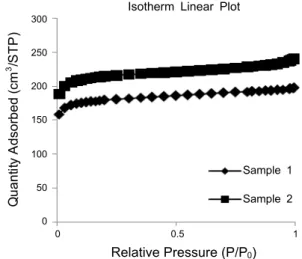
Fig. 1. Adsorption isotherm of AC (samples 1 and 2); Sample 1 (♦), sample 2(■).
t-Plot
0 2 4 6 8
Thickness (Å)
300 250 200 150 100 50 0
Quantity Adsorbed (cm3 /STP)
Sample 1 Sample 2
Fig. 2. t-Plot of samples 1 and 2 using Harkins and Jura equation;
Sample 1 (♦), sample 2(■).
fferent batches using identical preparation method was labell- ed as sample 1 and sample 2. Table 1 shows the comparisons between samples 1 and 2. It indicates that the AC synthe- sized can be employed for subsequent CMS synthesis and method used can produce an appropriate precursor for CMS synthesis.
Fig. 1 shows the adsorption isotherm of sample 1 and 2.
Both curves were plateau when relative pressures appro- ached 0.99. This implies that the adsorption has virtually achieved equilibrium and apparently stopped. It is because multilayer of adsorbates cannot be established due to close proximity of the pore wall.
These curves are categorized as type 1 adsorption iso- therm. Sample 1 and 2 have type 1 adsorption isotherm and it shows that both samples 1 and 2 have microporosity de- velopment. Both samples are ideal raw material to synthe- size CMS using PFA deposition method due to their identity as microporous materials. Besides that, it shows that the carbonization and activation process employed in producing AC is appropriate to achieve this objective. According to the Fig. 1, sample 2 has higher equilibrium quantity adsorp- tion capacity compared to sample 1. Sample 2 has higher micropore volume and exhibits the larger microporosity. It is also preferred as a base material for CMS synthesis.
T-plot. In the t-plot method, amounts adsorbed on the porous adsorbent are plotted against‘t’, the corresponding multilayer thickness of the standard non-porous solid. A straight t-plot curve starts from the origin corresponds to non-porous material whereas a linear curve intercepts at y-axis above origin corresponds to a microporous solid.
From Fig. 2, it indicates that both samples are micro- porous solids. The slope passing through the origin provides a measure of total surface area of the solid. Sample 2 appa- rently has higher surface area than sample 1, according to the intercepts of both curves. Sample 2 has more pores and is a better base material for CMS synthesis.
BJH adsorption cumulative pore volume curve. The BJH
adsorption cumulative pore volume curve can be used to characterize the AC. The pore size distributions of the AC for the sample 1 and 2 are shown in the Fig. 3. The gradual increase in pore size distribution towards the smallest pore diameters as shown in the above plot implies the formation of micropores.
The increase in the pore size distribution indicates that more micropores are exhibited by the sample. From Fig. 3, it was observed that increase in micropore volume was more significant for the sample 2. Where as Sample 1 exhibited more mesopores than sample 2. As a matter of fact, AC with higher micropores is the ideal base material for CMS synthesis. In the nutshell, from the pore size distribution curves for both samples, it clearly shows that sample 2 is more ideal to be employed for CMS synthesis. This proves that the AC produced can be used for subsequent PFA de- position processes.
Fig. 4. Final product for 1:5 ratio
Fig. 5. Final product for 1:2.5 ratio
Fig. 6. Final product for 1:1 ratio BJH Adsorption Cumulative Pore Volume
10 100 1000
Pore Width (Å)
0.1
0.08
0.06
0.04
0.02
0
Pore Volume (cm3 /g)
Sample 1 Sample 2
Fig. 3. BJH Adsorption cumulative pore volume of sample 1 and 2; Sample 1 (♦), sample 2(■).
Polymerization and polymer coating on AC
Polymerization of furfuryl alcohol was effected by the concentration ratio of polymer to AC. We have considered three different concentration ratio of polymer i.e., 1:1, 1:2.5 and 1:5 to AC. For the concentration ratio of 1:5, there was 1 mole of both furfuryl alcohol and formaldehyde mixed with 5 mole of AC.
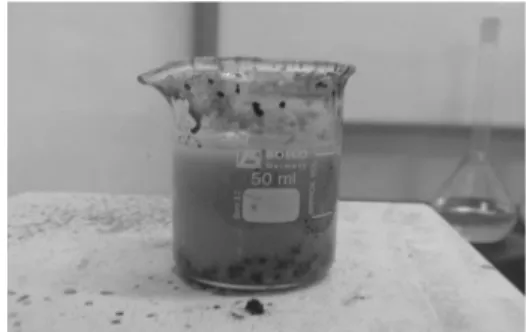
There was no apparent reaction of the mixture during heating and before and after adding phosphoric acid. During heating of the mixture, the liquid chemical evaporated and dried rapidly before it reached 80 oC (as shown in Fig. 4).
Apparently, the amount of furfuryl alcohol and formaldehyde added was not enough and the amount of polymers formed were not enough to coat the surface and pores of the AC.
For the concentration ratio of 1:2.5, it was then turned into dark orange slowly as the heating proceeded (as shown in Fig. 5). Sticky polymers were formed in the end of the process. After 2 hours of drying, the product formed was attached to each other. It had to be made discreet as AC.
There was an apparent shinny layer coating the AC. This product was referred to as polymer coated AC.
For concentration ratio of 1:1, the mixture turned colour from pale orange into milky orange as shown in Fig. 6. The colour became darker and viscous. After drying for two hours, the product obtained was seemed to be shinny on the surface and clogged to each other. It was concluded that the polymer coating on the AC was too excessive in quantity. It might lead to fully closing of the pores, leaving no pore on the product at the end of subsequent heating. From these observations on different concentration ratios, it was con- cluded that the concentration ratio 1:2.5 was more suitable and optimum to be used for subsequent heating process.
Synthesis of CMS
Table 2 showed the conditions that had been used in syn- thesis of carbon molecular sieves under three different re- action temperatures. The reaction time was maintained con- stant at 1.5 hours for all the three cases.
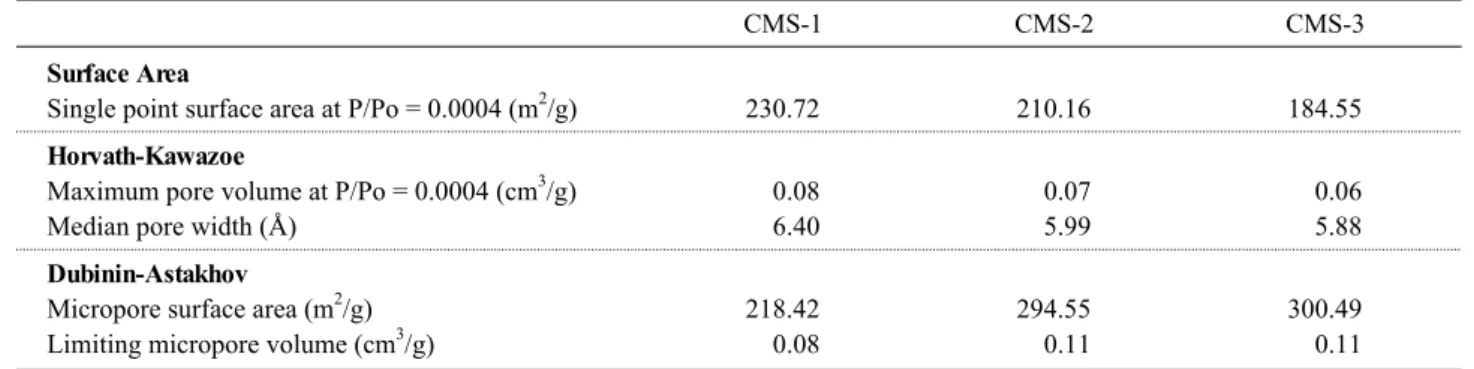
Table 3 shows the summary report of CMS-1, CMS-2 and CMS-3. According to Table 3, all the samples have smaller surface area than AC. Surface area of AC produced is app- roximately 706 m2/g whereas surface area of the CMS sam- ples produced was less than 240 m2/g. Approximately 465 m2/g surface area of AC eliminated due to the closure of pores by PFA. This is a typical phenomenon of CMS syn- thesis. The change in surface area before and after the carbo- nization indicates that the samples can be the desired product which was considered to be CMS. Besides that, by using Horvath-Kawazoe equation, the pore widths of these three
Table 2. Conditions used in producing samples 1, 2 and 3
Samples Descriptions
CMS-1 CMS sample produced under temperature of 700 oC for 1.5 hours.
CMS-2 CMS sample produced under temperature of 800oC for 1.5 hours.
CMS-3 CMS sample produced under temperature of 900oC for 1.5 hours.
Table 3. Comparisons among CMS-1, CMS-2 and CMS-3 according to the summary report.
CMS-1 CMS-2 CMS-3
Surface Area
Single point surface area at P/Po = 0.0004 (m2/g) 230.72 210.16 184.55
Horvath-Kawazoe
Maximum pore volume at P/Po = 0.0004 (cm3/g) 0.08 0.07 0.06
Median pore width (Å) 6.40 5.99 5.88
Dubinin-Astakhov
Micropore surface area (m2/g) 218.42 294.55 300.49
Limiting micropore volume (cm3/g) 0.08 0.11 0.11
Isotherm Linear Plot
0 0.000005 0.00001 0.000015 0.00002 0.000025 0.00003
Relative Pressure (P/P0)
60 50 40 30 20 10 3 Quantity Adsorbed (cm/STP) 0
Carbonization condition 700 oC, 1.5 hr Carbonization condition 800 oC, 1.5 hr Carbonization condition 900 oC, 1.5 hr
Fig. 7. Adsorption isotherm of CMS-1, CMS-2 and CMS-3.
samples were calculated to be less than 6.5 Å. It was within the range of pore width of CMS. Therefore, it implies that these three samples are certified as CMS.
Adsorption isotherm. Fig. 7 shows the adsorption isotherm of sample CMS-1, CMS-2 and CMS-3. The data of quantity adsorbed at relative pressure (after P/PO = 0.0003) could not be obtained by the equipment. Therefore, the adsorption iso- therm obtained is shown in Fig. 7 but yet it still can be used to compare the capacity and properties of respective samples.
Based on Fig. 7, CMS-3 that was produced under carbo- nization temperature of 900 oC for 1.5 hours has the highest equilibrium quantity adsorption capacity. This argument can be made based on the gradient of the curve. The steeper the curve is, the higher the equilibrium value it can achieve.
That means that CMS-3 has the highest micropore volume and exhibits the largest microporous property. CMS-3 is the best CMS among all the synthesized CMS under different conditions. It also indicates that the optimum carbonization temperature was 900 oC.
CONCLUSION
According to the experimental investigation, the following conclusions were drawn. AC was synthesized successfully from palm shell and applicable in PFA deposition method.
The optimum concentration ratio of PFA to AC was 1:2.5.
The large pores of the AC were successfully closed by PFA
through carbonization of polymer coated AC under tem- perature of 700 oC, 800 oC and 900 oC for 1.5 hours. The micropore with pore width less than 7Å was formed on the AC after the carbonization of polymer coated AC. It showed that all three samples prepared are proved to exhibit cha- racteristics of CMS. Optimum carbonization temperature for CMS synthesis was at 900 oC for 1.5 hours. The CMS pro- duced under this condition has pore width of 5.884 Å. It can be used for certain gas separation processes.
Acknowledgments. The authors gratefully acknowledge the financial support provided by the Ministry of Science, Technology and Innovations (MOSTI) under Science Fund (Project a/c No: 6013327) and Universiti Sains Malaysia for funding this project under RU Grant (Project a/c No:
814004)and Student Fellowship Scheme. Also, the author likes to extend his gratitude to Dr. D. Jagan Mohan for his scientific suggestions.
REFERENCES
1. http://www.malaysiapalmoil.org/life/implanting.asp;http:
//envdevmalaysia.wordpress.com/2009/10/14/world-growth- reportpalm-oil-is-most sustainable-vegetable-oil/
2. Moreira R. F. P. M.; José, H. J.; Rodrigues, A. E. Carbon 2001, 39, 2269.
3. Zhang, T.; Walawender, W. P.; Fan, L. T. Bioresource Tech- nology 2005, 96, 1929.
4. Vyas, S. N.; Patwardhan, S. R.; Vijayalakshmi, S. Bathula Gangadhar, Fuel 1993, 72, 551.
5. Wang, L. J.; Chau-Nan Hong F. Microporous and Mesoporous Materials, 2005, 77, 167.
6. Koresh, J. E.; Soffer, A. J. Chem. Soc., Faraday Trans. 1 1986, 82, 2057.
7. Freitas, M. M. A.; Figueiredo, J. L. Fuel 2001, 80, 1.
8. LaCava, A. I.; Koss, V. A.; Wickens, D. Gas Prep. Purif. 1989, 3, 180.
9. Jüntgen, H.; Knoblauch, K.; Harder, K. Fuel 1981, 60, 817.
10. Nandi; Satyendra, P.; Walker, Jr. P. L. Separation Science 1976, 11, 441.
11. Wan Daud, W. M. A.; Ahmad, M. A.; Aroua, M. K. Separa- tion and Purification Technology 2007, 57, 289.
12. Bello, G.; Garcia, R.; Arriagada, R.; Escribano, A. S.; Reinoso, F. R. Microporousand Mesoporous Material 2002, 56, 139.
13. Freitas, M. M. A.; Figueiredo, J. L. Fuel 2001, 80, 1.
14. Kawabuchi, Y.; Kishino, M.; Kawano, S.; Whitehurst, D. D.;
ochida, I. Langmuir 1996, 12, 4281.
15. Somanathan, T.; Pandurangan, A.; Sathiyamoorthy, D. Jour- nal of Molecular Catalysis A: Chemical 2006, 256, 193.
16. Schmitt, J. L. Jr.; Walker, P. L., Jr. Carbon 1972, 10, 87.