Printed in the Republic of Korea
http://dx.doi.org/10.5012/jkcs.2013.57.3.322
Electro-Catalytic Oxidation of Amoxicillin by Carbon Ceramic Electrode Modified with Copper Iodide
Ghasem Karim-Nezhad*, Ali Pashazadeh, and Sara Pashazadeh Department of Chemistry, Payame Noor University, PO BOX 19395-3697 Tehran, Iran.
*E-mail: [email protected]
(Received December 24, 2012; Accepted April 15, 2013)
ABSTRACT. Copper iodide was employed as a modifier for preparation of a new carbon ceramic electrode. For the first time, the catalytic oxidation of amoxicillin (AMX) was demonstrated by cyclic voltammetry, chronoamperometry and amperometry methods at the surface of this modified carbon ceramic electrode. The copper iodide modified sol-gel derived carbon ceramic (CIM- SGD-CC) electrode has very high catalytic ability for electrooxidation of amoxicillin. The catalytic oxidation peak current was lin- early dependent on the amoxicillin concentration and the linearity range obtained was 100 to 1000 µmol L−1 with a detection limit of 0.53 µmol L−1. The diffusion coefficient (D=(1.67±0.102)×10−3 cm2 s−1), and the kinetic parameter such as the electron transfer coef- ficient (α) and exchange current density (j0) for the modified electrode were calculated. The advantages of the modified CCE are its good stability and reproducibility of surface renewal by simple polishing, excellent catalytic activity and simplicity of preparation.
Key words: Electrocatalytic oxidation, Copper iodide, Sol-gel, Carbon ceramic electrode, Amoxicillin
INTRODUCTION
Antibiotics are among the most important compounds used in medicine and have been applied in large quantities for some decades.1 The penicillins are one of the most important groups of antibiotics. Since the first penicillin became available numerous other antimicrobial agents have been produced, but penicillins are still widely used, major antibiotics and they are presently the drugs used for a number of infectious diseases.2 Two commonly used types of antibiotics are sulphonamides and β-actams. Amox- icillin (AMX), (D-α-amino-p-hydroxybenzylpenicillin trihydrate), is the only phenolic penicillin and a moderate- spectrum β-lactam antibiotic used in humans and food-pro- ducing animals to treat several diseases. β-lactam antibiotics presents a structure based on a β-lactam ring responsible for the antibacterial activity and variable side chains that account for the major differences in their chemical and phar- macological properties.3 AMX is one of the more impor- tant antibiotics used in the treatment of bacterial infections and its determination.
Most of the reported methods suffer from disadvantages such as complicated procedure, time consuming, require- ment of expensive instruments and low detection sensitivity.
Some mentioned analytical problems could be solved using particular electrochemical methods with application of modified electrodes. In recent years many electrodes e.g.
(gold, platinum and copper electrode) has been reported,4 and substances e.g (poly-4-vinyl pyridine,5 poly N-vinyl imi- dazole,6 [N,N ethylene-bis(salicylideneaminato)] oxovana- dium(IV), [VO (Salen)]7 and nickel–curcumin complex8 modified carbon paste electrode, ferrocenedicarboxylic acid multi wall carbon nanotubes paste electrode have been used to make chemically modified electrodes to improve the voltammetric technique. Despite this, devel- opment of simple and low cost electrodes is very interest.
It is well known that the Cu based chemically modified electrodes (CMEs) have many advantages, such as the operability, commercial availability, not requiring the use of a pulsed potential waveform for stable long term detection and being oxidizable.9 Increasing interest has been focused on sol-gel derived carbon ceramic electrodes (CCEs).
This paper describes fabricated of simple and sensitive new sol-gel derived carbon ceramic electrode modified with copper iodide. In continuation, we employed the modified electrode for electrooxidation of the amoxicillin in NaOH solution and the results were discussed in details.
EXPERIMENTAL Reagents and Solutions
Methyltrimethoxysilane (for synthesis) was purchased from Merck and used without any further purification. Fine powdered graphite (diameter 2–3 µm) was obtained from
Merck. Amoxicillin trihydrate (C16H19N3O5·3H2O) was purchased from Sigma. Amoxicillin solutions were pre- pared every 2 weeks and stored in a refrigerator at 4oC.
All of the reagents used in this work were in analytical grade.
Apparatus
Electrochemical measurements were carried out in a conventional three-electrode cell powered by an electro- chemical system comprising an AUTOLAB system with PGSTAT12 boards (ECO Chemie, Utrecht, and The Neth- erlands). The system was run on a PC using GPES 4.9 software. CIM-SGD-CC electrode as working electrode (prepared as follows) was employed for the electrochem- ical studies. A platinum wire was employed as counter electrode and an Ag/AgCl electrode served as the refer- ence electrode. All experiments were performed at room temperature of 25±2oC.
Preparation of CIM-SGD-CC Electrode
The CIM-SGD-CC electrodes were prepared according to the procedure described by the Lev and coworkers.10 At the first stage, 0.3 mL of MTMOS, 0.45 mL of methanol, and 10 µL of hydrochloric acid (11 M) were mixed and stirred for 3 min until a homogeneous gel solution appeared, then 0.3 g of carbon powder and CuI powder at a sufficient ratio (10:90) were added and the resultant mixture shaken for an additional 1 min. The hydrochloric acid acts as cat- alyst for the hydrolysis of the MTMOS. Then the mixture was added into Teflon tubes (with 2 mm inner diameter and 5 cm length, and the length of composite material in the tube was about 0.5 cm) and dried for at least 24 h at room temperature. Then the electrode was polished with polishing paper and rinsed with distilled water. The same procedure was used for preparation of bare carbon ceramic electrode without copper iodide. The electric contact was made with a copper wire through the back of the electrode.
The electrode surface was first carefully polished with polish- ing paper, rinsed with doubly distilled water, and finally dried by air drying.
RESULTS AND DISCUSSION
Electrochemical properties of the prepared CIM-SGD- CC electrode were investigated. In this study, for the acti- vation of the electrode surface, the electrode was placed in 0.1 mol L−1 NaOH solution in the potential range of −250 to 1000 mV (vs. Ag/AgCl) at a scan rate of 50 mVs−1 (Fig. 1).
There are prominent peaks at approximately −68 and 570 mV
during the first cycle but in the second and next cycles, featureless voltammograms were recorded. This indicates that an irreversible electrochemical transformation of the CuI has been achieved during the cyclic voltammetry.
Surface elemental analysis of this modified electrode was studied by energy dispersive X-ray (EDX) technique. Fig. 2 illustrates the elemental composition of the electrode sur- face respectively. Also, EDX analysis of CCE revealed one silica peak at 1.7 keV that it severe overlaps with the gold peak. This peak can be attributed to sol-gel precursor used for electrode preparation. It seems that a film of oxy copper iodide is formed at the surface of electrode during the cyclic voltammetry step, according to the following reaction:11
2CuI + 2OH−→ (ICu)2O + H2O + 2e (1) One of the objectives of the present study was to fab- ricate a modified electrode capable of the electrocatalytic oxidation of amoxicillin. In order to test the electrocata- lytic activity of the CIM-SGD-CC electrode, the cyclic voltammograms were obtained in the presence and absence of amoxicillin at bare (Fig. 3a,b) and CIM-SGD-CC (Fig.
3c,d) electrodes. At the bare electrode, no anodic current due to the oxidation of amoxicillin is observed but for Figure 1. Repetitive cyclic voltammograms of CIM-SGD-CC electrode in 0.1 M NaOH in the potential range of −250-1000 mV.
Potential sweep rate is 50 mV s−1. (a) first cycle; (e) end cycle.
CIM-SGD-CC electrode a large anodic peak is observed.
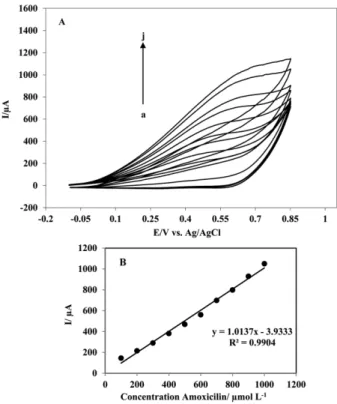
It was found that in comparison to unmodified carbon ceramic electrode, electrochemical behavior of amoxicillin was greatly improved at CIM-SGD-CC electrode, indi- cating that the anodic oxidation of amoxicillin could be catalyzed at CIM-SGD-CC electrode. This proves that the copper iodide bears the main role in electro-catalytic oxi- dation of amoxicillin. We previously proved that the presence of halides causes an increase activity in the electrocata- lytic behavior of copper. The increased activity probably related to a more favorable adsorption of reactant or of intermediates leading to a higher surface concentration of electroactive molecules ready for being oxidized or it is due to the partial delocalization of the electronic density of reactant into the solid with possible consequent bond pre-dissociations which facilitates the oxidation or both.12 Fig. 4 shows the effect of amoxicillin concentration on the cyclic voltammograms of the CIM-SGD-CC electrode.
As can be seen from Fig. 4, the height of the anodic peak
increases with increasing amoxicillin concentration. The characteristic shape of cyclic voltammogram in this poten- tial region indicates that the signal is due to the oxidation of amoxicillin. The catalytic peak current is proportional to the concentration of amoxicillin in the range of 100 to 1000 µmol L−1. The linear regression equation is I (µA)
=1.0137 CAmoxicillin (µmol L−1) − 3.9333 (R=0.9904). The detection limit calculated from the calibration graph was 71 µmol L−1 amoxicillin.
The cyclic voltammograms of CIM-SGD-CC electrode were recorded in different concentrations of NaOH solu- tion containing 400 µmol L−1 amoxicillin (not shown). It is shown that, the high catalytic peak current is achieved above a NaOH concentration of 0.1 mol L−1. So, 0.1 mol L−1 NaOH was chosen as an optimum supporting elec- trolyte.
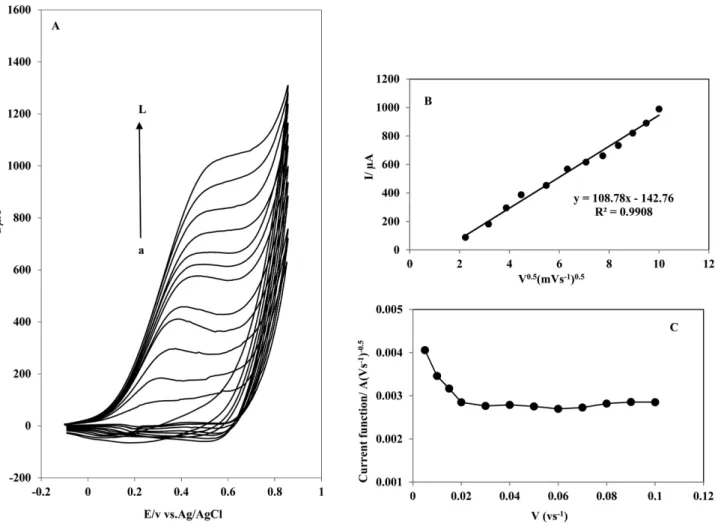
In order to test the effects of scan rate on the cyclic vol- tammograms of CIM-SGD-CC electrode in the presence of 300 µmol L−1 amoxicillin recorded in 0.1 mol L−1 NaOH solution at different scan rates (Fig. 5A). As can be seen, the anodic peaks potential shifted to more positive poten- tials with increasing of potential scan rate. However the Figure 2. Energy disperse X-ray (EDX) on the surface of CIM-
SGD-CC electrode.
Figure 3. Cyclic voltammograms of bare CCE (a,b) and CIM- SGD-CC electrode (c,d) in 0.1 mol L−1 NaOH solution in the absence (a,c) and presence of 600 µmol L−1 amoxicillin (b,d). Conditions:
potential range –100 to 850 mV scan rate of 50 mV s–1.
Figure 4. (A) Cyclic voltammograms of a copper iodide mod- ified sol-gel electrode in the presence of various amoxicillin con- centrations: (a)–(j): 100, 200, 300, 400, 500, 600, 700, 800, 900, and 1000 µmol L−1, respectively, at a scan rate of 50 mV s−1, in 0.1 mol L−1 NaOH solution. (B) Variation of anodic peak current vs. amoxicillin concentration.
electrocatalytic oxidation current of amoxicillin linearly increased with the square root of potential scan rate (Fig.
5A), which demonstrates the reaction is diffusion controlled.
Also, plotting the current function against the potential sweep rate (Fig. 5B) revealed negative slope confirming the elec- trocatalytic nature of the process.
To obtain some information on the rate-determining step, a Tafel plot (Fig. 6) was drawn using the data from the rising part of the current–voltage curves recorded at low scan rate for an amoxicillin concentration of 300 µmol L−1. The Tafel slope for the linear parts of the plot recorded at scan rate of 5 mVs−1 was estimated as being equal to 0.1756 V decade−1, indicating that one-electron process involved in the rate-limiting step, assuming a transfer coeffi- cient (α) of approximately (0.34±0.02). The exchange current density (j0) evaluated from Tafel plots is (0.84±0.22)
×10−6 Acm−2.
The Tafel slope was also obtained from the linear rela-
tionship observed for Ep versus log ν (not shown) by using the following equation:13
Ep b (1)
2---logv cons+ tant
=
Figure 5. (A) Cyclic voltammograms of CIM-SGD-CC electrode in 0.1 mol L−1 NaOH containing 300 µmol L−1 of amoxicillin at var- ious potential scan rates (from inner to outer) 5−100 mVs−1. (B) Variation of the catalytic current with the square root of sweep rate. (C) Current function vs. v for 0.1 M NaOH solution in the presence of 300 µmol L−1 amoxicillin.
Figure 6. Tafel plot derived from the rising part of voltammo- gram recorded at a scan rate 5 mV s−1.
On the basis of Eq. (1) the slope of Ep versus log ν plot is b/2, where b indicates the Tafel slope. The slope of Ep ver- sus log ν plot is ∂Ep/∂ log ν which was found to be 97.939, so b = 195.878, which is in good agreement with the cor- responding value evaluated from polarization measure- ments. This slope indicates that a one electron transfer process is the rate limiting step assuming a transfer coef- ficient of α = 0.30.
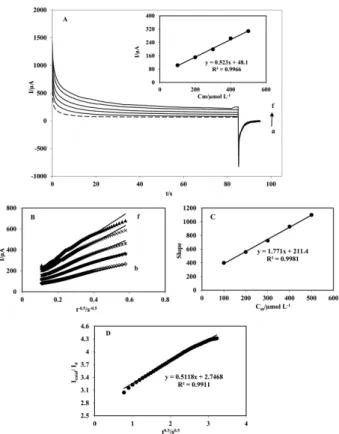
In order to evaluate the reaction kinetics, the oxidation of amoxicillin on CIM-SGD-CC electrode was investigated by chronoamperometry. Chronoamperometry, as well as cyclic voltammetry has been employed for the investiga- tion of the processes occurring via an ErCi mechanism.14 Double steps chronoamperograms were recorded by set- ting the working electrode potentials to desired values and were used to measure the catalytic rate constant on the
modified surface. Fig. 7A shows a series of well-defined chronoamperograms for the CIM-SGD-CC electrode in the absence and presence of different concentrations of amoxicillin at an applied potential of 0.42 V versus Ag/
AgCl. The plot of net current with respect to the mines square roots of time presents a linear dependency (Fig.
7B). This indicates that the transient current must be con- trolled by a diffusion process. The transient current is due to catalytic oxidation of amoxicillin, which increases as the amoxicillin concentration is raised. No significant cathodic current was observed when the electrolysis potential was stepped to 0.00 mV (vs. Ag/AgCl), indicating the irre- versible nature of the oxidation of amoxicillin. By using the slopes of these lines; we can obtain the diffusion coef- ficients of the significant according to the Cottrell equa- tion:15
(2) Where D is the diffusion coefficient, and C* is the bulk concentration. The slopes of the resulting straight lines were then plotted versus the concentration of amoxicillin (Fig. 7C), from which we calculated a diffusion coeffi- cient of (1.67±0.102)×10−3 cm2 s−1for amoxicillin.
The rate constants of the reactions of amoxicillin and the ensuing intermediates with the redox sites of the CIM- SGD-CC electrode can be derived from the chronoamper- ograms according to Eq. (3):16
(3) where Icatal is the catalytic current in the presence of amox- icillin, Id is the limiting current in the absence of amoxicillin and λ = kCt (k, C and t are the catalytic rate constant, bulk concentration of amoxicillin and the elapsed time, respec- tively) is the argument of the error function. For λ > 1.5,
I nFAD= 1/2C*( )πt –1/2
Icatal/Id=λ1/2[π1/2erf λ( 1/2)+exp( )/λ–λ 1/2] Figure 7. (A) Chronoamperograms of CIM-SGD-CC electrode
in 0.1 M NaOH contaning different concentrations of amoxicil- lin: 0.0, 100, 200, 300, 400 and 500 µmol L−1, from (a) to (g), respec- tively. Potential steps were 0.42 and 0.0 V, respectively. Insets:
Variation of chronoamperometric currents at t = 30 s vs. concen- tration of amoxicillin. (B) Plot of I vs. t1/2 obtained from chro- noamperometric measurements CIM-SGD-CC electrode in 0.1 mol L−1 NaOH contaning different concentrations of amoxicillin:
100, 200, 300, 400 and 600 µmol L−1, from (b) to (f), respec- tively. (C) The relationship between the slope of the linear seg- ments and the amoxicillin concentration. (D) Dependency of Icatal/Id on t1/2 derived from CAs of (a) and (d) in panel (A).
Figure 8. The current – time profiles recorded at the CIM-SGD- CC electrode during the successive addition of amoxicillin. Inset:
Typical calibration graph derived from the current – time profile.
erf (λ1/2) almost equals unity and Eq. (4) reduces to:17 (4) From the slope of the Icatal/Id vs. t1/2 plot (Fig. 7D), the value of k for 4×10⁻⁴ mol L–1 amoxicillin was calculated to be (20.9± 0.39)×104 cm3 mol–1 s–1.
Analytical characteristics of CIM-SGD-CC electrode for the amperometric determination of amoxicillin were estimated. Fig. 8 shows the current-time responses of the modified electrode to amoxicillin which was successively added to the electrochemical cell containing 0.1 mol L–1 NaOH under hydrodynamic conditions, while the elec- trode potential was kept at 0.42. As shown in the figure a well-defined response was observed during the stepwise increasing of amoxicillin concentration in the range 10−65 µmol L–1. It was observed that the sensor responds so rap- idly to the substrate, as about 95% of the steady-state cur- rent appears within 20 s. The linear regression equation of calibration curve is expressed as I (µA) = 1.8103 CAMX
µmol L–1+ 58.747 with a correlation coefficient of 0.9954 (n=12). The limits of detection (LOD) was evaluated by statistical treatment 3 S.D./b, where S.D. is the standard deviation of the blanks in their amperometric responses and b is the slope of the calibration curves. The sensitivity and limit of detection (LOD) were found to be 1.8103 µA/
µmol L–1 and 0.53 µmol L–1, respectively.
By repetitive CV of the CIM-SGD-CC electrode for approximately 20 times in NaOH solution at a scan rate of 50 mV s–1, the peak current value decreases less than 7%, indicating good stability.
The modified electrode retained its initiate activity for more than 50 days when kept in air at ambient conditions.
A decrease of 12% was observed in the current response of the electrode at the end of 50th day. In addition, repet- itive recording of cyclic voltamograms in amoxicillin solu- tion tested the reproducibility of the electrocatalytic effect of the modified CCE. It was found that the relative stan-
dard deviation (R.S.D.) of the peak currents of 300 µmol L–1 amoxicillin for six replicate determinations was 2.9%.
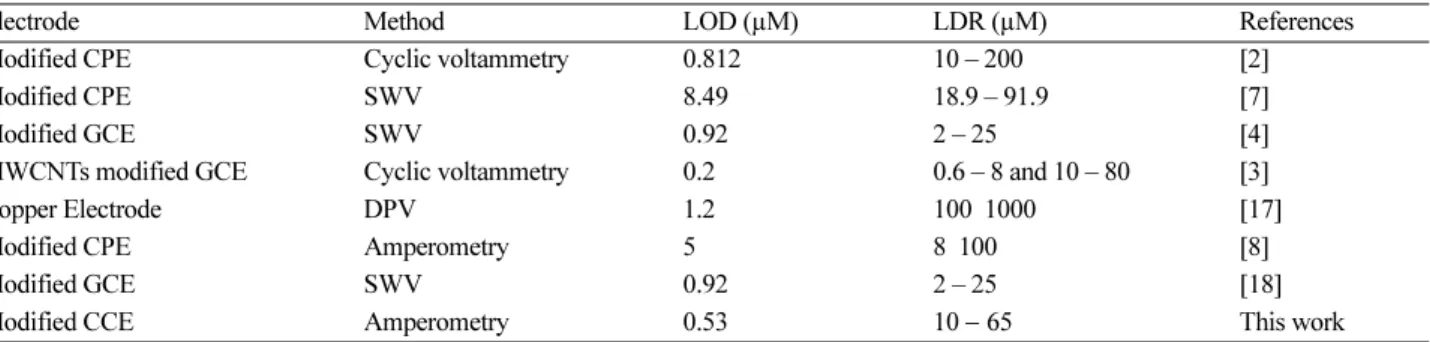
Table 1 compared the proposed electrode for amoxicillin determination with electrodes reported in literatures. As show, the proposed electrode comparable with other elec- trodes such as multiwalled carbon nanotube-modified glassy carbon electrode.
CONCLUSION
A new modified CIM-SGD-CC electrode was fabricated by sol–gel technique. The modied electrode exhibits excel- lent and persistent electrocatalytic behavior toward amoxi- cillin oxidation compared with the bare CCE. The kinetic parameters such as electron transfer coefcient and cata- lytic reaction rate constant were also determined using elec- trochemical approaches. High stability, good reproducibility, short response time, long-term stability, high sensitivity, easy surface regeneration and fabrication are the impor- tant characteristics of the proposed electrode.
Acknowledgments. The publication cost of this paper was supported by the Korean Chemical Society.
REFERENCES
1. Langin, A.; Alexy, R.; Konig, A.; Kümmerer, K. Chemo- sphere 2009, 75, 347.
2. Uslu, B.; Biryol, I. J. Pharm. Biomed. Anal. 1999, 20, 591.
3. Rezaei, B.; Damiri, S; Electroanalysis 2009, 14, 1577.
4. Santos, D. P.; Márcio, F.; Bergamini, M.; Zanoni, V. B.
Sens. Actuators, B 2008, 133, 398.
5. Biryol, I.; Uslu, B.; Kuc, Z.; ukyavuz, S. T. P. Pharma Sci.
1998, 8, 383.
6. Riviere, J. E.; Craigmill, A. L.; Sundlof, S. F. Handbook of Comparative Pharmacokinetics and Residues of Veter- inary Antimicrobials; CRC Press: Boca Raton, FL, 1991.
7. Bergamini, M. F.; Teixeira, M. F. S.; Dockal, E. R.; Bocchi, Icatal/Id=λ1/2π1/2(kCt)1/2
Table 1. Analytical parameters of several modified electrodes for AMX determination. LOD: limit of detection; LDR: linear dynamic range;
CPE: carbon paste electrode; SWV: square wave voltammetry
Electrode Method LOD (µM) LDR (µM) References
Modified CPE Cyclic voltammetry 0.812 10 – 200 [2]
Modified CPE SWV 8.49 18.9 – 91.9 [7]
Modified GCE SWV 0.92 2 – 25 [4]
MWCNTs modified GCE Cyclic voltammetry 0.2 0.6 – 8 and 10 – 80 [3]
Copper Electrode DPV 1.2 100 1000 [17]
Modified CPE Amperometry 5 8 100 [8]
Modified GCE SWV 0.92 2 – 25 [18]
Modified CCE Amperometry 0.53 10 − 65 This work
N.; Cavalheiro, E. T. G. J. Electrochem. Soc. 2006, 153, 94.
8. Ojani, R.; Raoof, J. B.; Zamani, S. Bioelectrochem. 2012, 85, 44.
9. Xu, Q.; Zhao, Y.; Xu, J. Z.; Zhu, J. J. Sens. Actuators, B 2006, 114, 379.
10. Tsionsky, M.; Gun, J.; Glezer, V.; Lev, O. Anal. Chem.
1994, 66, 1747.
11. Karim-Nezhad, G.; Seyed Dorraji, P. Electrochim. Acta 2010, 55, 3414.
12. Karim-Nezhad, G.; Zare Dizajdizi, B.; Seyed Dorraji, P.
Catal. Commun. 2011, 12, 906.
13. Harrison, J. A.; Khan, Z. A. J. Electroanal. Chem. 1970,
28, 131.
14. Bard, A. J.; Faulkner, L. R. Electrochemical Methods;
Wiley: New York, 2001; p 591.
15. Karim-Nezhad, G.; Jafarloo, R.; Seyed Dorraji, P. Elec- trochim. Acta 2009, 54, 5721.
16. Hasanzadeh, M.; Karim-Nezhad, G.; Shadjou, N.; Kha- lilzadeh, B.; Saghatforoush, L. A.; Earshad, S.; Kazeman, I. Chin. J. Chem. 2009, 27, 638.
17. Zheng, L.; Song, J. J. Appl. Electrochem. 2011, 41, 63.
18. Shafieyan, H.; Rouhollahi, A. Anal. Bioanal. Electrochem.
2010, 2, 13.
19. Santos, D. P.; Bergamini, M. F.; Zanoni, M. V. B. Sens.
Actuators, B 2008, 133, 398.