흉요추 및 요추 골절에서 단순 촬영과 3차원 컴퓨터 단층 촬영 간의 시상면 지표의 측정오차
Measurement Discrepancy of Sagittal Parameters between Plain Radiography and 3D Computed Tomography in Thoracolumbar and Lumbar Fractures
김동수 • 김용민 • 최의성 • 손현철 • 박경진 • 조병기 • 박지강 • 이현철
충북대학교 의과대학 정형외과학교실
목적: 척추 골절의 수술여부 판정에 있어 Cobb각, 압박률 등 시상면 지표가 중요한 요소이나, 그동안은 단순 촬영만으로 이를 측정하였다.
본 연구에서는 최근 도입된 3차원 computed tomography (CT)에서의 시상면 지표와 종래의 단순 촬영상에서의 지표 측정치의 차이를 알아 보고자 하였다.
대상 및 방법: 흉요추 및 요추 골절 환자 45명(남자 21명, 여자 24명)의 단순 촬영과 3차원 CT에서 시상각과 척추체 높이를 측정하였다.
시상각은 골절 추체의 상위 척추체와 하위 척추체와의 Cobb각을 측정하였다. 골절 추체의 전후방 척추체 높이를 측정하여 이를 토대로 전 후 설상비를 산정하였다.
결과: 단순 촬영의 시상각은 평균 13.1±14.3o, 3차원 CT는 평균 8.2±13.0o로 단순 촬영이 약 4.9o의 후만각이 더 있는 것으로 측정되었으 며 이는 통계적으로 유의한 차이를 보였다(p<0.001). 전후설상비는 단순 촬영이 평균 65±17%, 3차원 CT가 평균 73±17%로 유의한 차이 를 보였다(p<0.001). 최초 단순 촬영상 후만 변형이 클수록 단순 촬영과 3차원 CT 간의 시상각차 및 전후 설상비차는 더 크게 나타났다.
결론: 흉요추 및 요추 골절의 단순 촬영과 3차원 CT 간의 시상면 측정값에서 유의한 차이를 보였고, 단순 촬영의 측정치가 더 후만 변형이 큰 것으로 측정됨을 관찰하였다.
색인단어: 흉요추 및 요추 골절, 단순 촬영, 3차원 CT, 시상각, 전후 설상비
접수일 2011년 10월 1일 수정일 2011년 11월 29일 게재확정일 2012년 1월 18일
교신저자 김용민
청주시 흥덕구 성봉로 410, 충북대학교 의과대학 충북대학교병원 정형외과 학교실
TEL 043-269-6077, FAX 043-274-8719 E-mail [email protected]
*본 논문은 2011년도 충북대학교 학술연구지원사업의 연구비 지원에 의하여 연 구되었음.
Copyright © 2012 by The Korean Orthopaedic Association
“This is an Open Access article distributed under the terms of the Creative Commons Attribution Non-Commercial License (http://creativecommons.org/licenses/by-nc/3.0/) which permits unrestricted non-commercial use, distribution, and reproduction in any medium, provided the original work is properly cited.”
대한정형외과학회지:제 47권 제 3호 2012
서 론
척추 골절에서 영상검사를 통한 후만 변형 및 척추체 압박의 정 도, 불안정성의 여부에 의해 치료 방향을 결정하고 있고 또한 현 실적으로 척추 골절의 수술에 대한 국내 건강보험 인정기준은 후 만각 30o 이상 또는 압박률 40% 이상의 변형, 신경증상을 동반한
후만각의 진행이 발생한 경우 등의 기준이 사용되므로, 척추 골 절에서 시상지표의 중요성이 크다고 할 수 있다. 그 동안은 단순 촬영으로 척추 골절의 모든 것을 평가하고 치료방침을 결정해왔 다.
Computed tomography (CT)는 척추 신경근을 압박하는 병소 및 척추 골절 등의 진단에 사용하게 되었으며, 척추 골절의 분류 및 척추의 안정성에 대한 새로운 개념을 제공하였다. 최근에는 다중 검출기 CT (multidetector computed tomography)가 개발되어 높은 해상도의 다평면 영상 및 3차원 재구성이 가능해지면서 척추 골 절의 진단에 있어 CT의 유용성이 높아졌다. 임상증례 중 간혹 단 순 촬영과 3차원 CT의 후만 변형 정도의 차이가 있어 보이는 예 를 경험하였는데, 이러한 차이가 실제로 존재하는지, 그 의미는 무엇인지를 알 수 없었으며 아직은 이에 관한 연구보고를 볼 수 가 없었다.1)
이에 저자들은 흉요추 및 요추 골절에서 단순 촬영과 3차원 CT 간의 측정오차에 대하여 차이의 정도 및 경향을 비교하여 진단 및 치료방침 수립 시 기준으로 삼을 수 있는 자료를 얻고자 하였 다.
대상 및 방법
1. 연구 대상
2008년 1월부터 2011년 1월까지 내원한 흉요추 및 요추 골절 환 자 중 단순 촬영 및 3차원 CT 촬영을 모두 시행한 45명을 대상으 로 하였다. 45명 중 남자 21명, 여자 24명이었으며 평균 연령은 54 세(20-88세)로 50대와 60대가 각각 11명으로 가장 많았고 40대가 9명, 30대가 8명씩이었다. 골절부위로는 제1 요추가 16예로 가장 많았고 제2 요추가 11예로 그 뒤를 이었으며, 제12 흉추가 8예, 제 3 요추와 제11 흉추가 각 3예, 제4 요추가 2예 그리고 제10 흉추와 제5 요추가 각각 1예였다. McAfee 분류2)에 따른 골절양상은 굴곡 신연손상이 17예로 가장 많았으며 방출성 골절이 15예, 압박골절 이 13예였다.
2. 연구 방법 1) 방사선 촬영
① 단순 촬영: 단순 촬영은 표준화된 방법에 의하여 골절 추체 를 중심으로 척추의 전후면 및 측면 방사선 사진을 촬영하였다.
우측을 바라보는 측와위에서 광원 및 감광판 사이의 거리를 110
cm로 유지하였으며 이 때 고관절과 슬관절은 각각 60o와 50o 굴곡 되었다.
② 3차원 CT 촬영: 3차원 CT는 64채널 다중검출기기(Brilliance 64, Philips, Amsterdam, Netherlands)로 골절부위가 포함된 척추의 촬영을 시행하였으며 관상면과 시상면으로 3차원 재구성하였다.
이 때 환자의 자세는 앙와위로 하였다.
2) 계측 및 평가
계측은 두 명의 정형외과 전문의에 의해서 시행되었으며, 각각의 관찰자는 1주일의 간격을 두고 2회 측정하였다. 각 측정치의 범위 와 평균치를 구하였고, SPSS version 12.0 (SPSS Inc., Chicago, IL, USA)을 이용하여 비교군 간의 차이를 알아보았다.
관찰자 내 재현성 및 관찰자 간 신뢰성은 Shrout와 Fleiss3)에 의해 소개된 집단 내 상관 계수(intraclass correlation coefficients, ICCs)를 이용하여 평가하였다. 집단 내 상관 계수는 0에서 1까지 의 값을 가지며, 0.00-0.39를 불량(poor), 0.40-0.74를 보통(moder- ate) 그리고 0.75-1.00을 우수(excellent)로 정의하였다.
① 시상각: 시상각의 측정은 단순 촬영에서는 측면사진의 골절 추체 상부추체의 상종판과 하부추체의 하종판의 각도를 측정하 는 Cobb 방법4)으로 측정하였으며, 3차원 CT에서는 시상단면 중 극돌기가 가장 잘 보이는 단면에서 동일하게 Cobb 방법으로 시상 각을 측정하였다. 골절된 척추체를 기준으로 하였으며 전만각일 경우는 음수(-)로 후만각일 경우에는 양수(+)로 표현하였다(Fig.
1).
Figure 1. Measurement method of sagi ttal angle and AP wedge ratio in plain radio- graph (A), mid-sagittal plane of 3D CT (B) and schematic illustration (C). Sagittal angle is Cobb angle between upper end plate of upper body and lower end plate of lower body. AP wedge ratio is anterior body height divided by posterior body height (Ha/Hp) of fractured vertebra. AP, anterior- posterior; CT, computed tomography; Ha, anterior height; Hp, posterior height.
시상각의 평가는 단순 촬영과 3차원 CT 간의 차이를 평가하였 으며 또한 단순 촬영 상에서의 시상각이 전만각인 군, 후만각 0o- 17o군과 17o 이상인 군 사이에서의 차이를 one-way ANOVA를 통 하여 비교하였다.
② 전후 설상비: 시상각을 측정한 같은 사진에서 전방 척추체 높이(anterior height) 및 후방 척추체 높이(posterior height)를 측정 하였으며 단위는 mm로 하였다. 전방 척추체 높이를 후방 척추체 높이로 나눈 것을 전후 설상비(anterior-posterior wedge ratio)로 하였고 단위는 %로 나타내었다(Fig. 1).
단순 촬영과 3차원 CT에서의 전후 설상비 차이를 paired t-test 를 통하여 비교하였다. 또한 단순 촬영상에서의 시상각이 전만각 인 군, 후만각 0o-17o군과 17o 이상인 군에서 두 촬영법 간의 전후
설상비 차이를 paired t-test를 이용하여 비교하였다.
결 과
1. 관찰자 내 재현성과 관찰자 간 신뢰성
1주일 간격으로 측정한 시상각은 단순 촬영 ICCs가 0.948, 3차원 CT ICCs가 0.922이며, 전후 설상비는 단순 촬영은 ICCs가 0.932, 3 차원 CT ICCs가 0.919로 높은 관찰자 내 재현성을 보였다.
관찰자 간의 신뢰성은 시상각은 단순 촬영 ICCs가 0.913, 3차원 CT ICCs가 0.878로, 전후설상비는 단순 촬영 ICCs가 0.882, 3차원 CT ICCs가 0.835로 우수한 신뢰성을 보였다.
2. 단순 촬영과 3차원 CT의 시상각 비교
단순 촬영의 시상각은 평균 13.1±14.3o (-31.2o-32.2o)으로 3차원 CT는 평균 8.2±13.0o (-37.3o-26.2o)로 측정되어 두 측정법 간의 차 이는 평균 4.9±4.6o (-2.7o-19.9o)의 차이를 보여 단순 촬영에서 시 상각이 더 후만으로 측정되었다(Fig. 2, 3).
단순 촬영상 전만각으로 측정된 군(n=8)은 두 촬영법 간의 차 이가 평균 1.2±3.6o (-2.7o-6.9o), 후만각 0o-17o 군(n=16)은 평균 4.5
±5.7o (-2.5o-19.9o)의 차이를 보였으며 후만각 17o 이상군(n=21)은 평균 6.7±3.1o (0.6o-14.6o)의 차이를 보였다. 단순 촬영상 후만각 의 정도가 클수록 두 촬영법 간 시상각의 차가 더 컸으며 이는 통 계적으로 유의하였다(p=0.01).
3. 단순 촬영과 3차원 CT의 전후 설상비 비교
단순 촬영에서의 전후 설상비는 평균 65±17% (33-121%)였으며 3차원 CT에서는 73±17% (38-121%)로 나타났고 이는 통계적으 로 유의한 차이를 보여(p<0.001) 위의 시상각 측정에서와 같이 Figure 2. Comparison between plain radiography and 3D CT in sagittal
angle. The sagittal angle of plain radiography (13.1±14.3o) was significantly larger than that of 3D CT (8.2±13.0o) by 4.9o (p<0.001).
CT, computed tomography.
Figure 3. Plain radiograph (A) and sagittal CT (B) of a 28-year-old female patient. In plain radiograph, sagittal angle is 29.3o and AP wedge ratio is 57%. Sagittal angle and AP wedge ratio of 3D CT are 21.2o and 67% respectively. Sagittal parameters of plain radiograph are more kyphotic than 3D CT. CT, computed tomography; AP, anterior-posterior.
단순 촬영에서 더 후만으로 측정되었다(Fig. 3, 4).
단순 촬영상 시상각이 전만각인 군에서 전후 설상비가 단순 촬영은 평균 88±17% (63-121%), 3차원 CT는 평균 89±14% (59- 102%)로 나타났으며, 후만각 0o-17o군에서는 각각 69±8% (55- 83%)와 76±17% (49-120%)로, 후만각 17o 이상군에서는 각각 53
±12% (33-69%)와 64±12% (38-88%)로 나타났다. 후만각 0o-17o 군과 17o 이상군에서는 단순 촬영이 3차원 CT에 비해 유의하게 낮았으나, 전만각 군에서는 유의한 차이가 없는 것으로 나타났다.
4. 골절 형태 및 골절 부위(흉요추 이행부와 하요추부 간) 에 따른 시상각 및 전후 설상비 비교
굴곡신연손상, 방출성 골절, 압박골절 등 골절 형태에 따른 시상 지표의 차이(p= 0.905)는 없었다. 전후 설상비는 모든 골절 형태에 서 단순촬영보다 3차원 CT가 유의하게 더 큰 것으로 나타났다(p
<0.05).
골절 부위에 따른 차이는 제2 요추 이상의 흉요추 이행부가 하 요추부보다 시상각의 차이가 더 컸으나 이는 통계적으로 유의하 지 않았다(p=0.18).
고 찰
척추 골절 환자에서 임상증상과 함께 방사선학적 소견을 정확하 게 관찰하는 것이 매우 중요하며 그 방법으로는 단순 촬영, CT, magnetic resonance imaging (MRI)이 있다. 단순 촬영은 기술적, 진단적 제한점이 있어 척추골절에서 CT가 중요한 진단방법이 되 고 있다. 많은 외상센터에서는 흉부, 복부, 골반 외상에 대한 초기 검사로서 CT를 이용하고 있다. Lucey 등5)은 복부손상 환자에서 시행한 복부 CT 데이터를 이용하여 요추 및 골반골에 대한 3차 원 재구성을 한 결과 단순 촬영을 훨씬 능가하는 진단율 및 여러
장점들을 보고하였다. 많은 연구들에서 CT는 척추골절의 진단에 있어 단순 촬영보다 민감하다고 하며 방출성 골절과 압박 골절을 구분하기 쉽다고 주장하고 있다. 또한 단순 촬영만 시행했을 경 우 최대 25%의 오진을 보인다고 했다.6)
MRI는 추간판, 척수 등과 같은 연부조직의 손상에 평가에 있어 탁월하다.7) 최근에 다중검출 CT가 개발되어 높은 해상도의 3차원 재구성이 가능해지면서 척추 골절의 진단에 있어 CT의 유용성이 높아졌다.8-10) 또한 Street 등11)은 피질골의 골절을 발견함에 있어 CT가 MRI보다 우월하다고 하고 있다.
1976년 Di Chiro와 Schellinger12)에 의하여 처음으로 CT가 척추 병변의 진단에 사용된 이래로 high kilovolt technique 등을 사용하 여 대조력 및 공간 해상력이 상승하였고, metrizamide 등의 경막 내 조영제의 사용에 따라 척추 CT의 이용범위가 훨씬 넓어져서 척추의 외상, 선천성 기형, 신생물, 퇴행성 변화, 해부학적인 계측, 연부조직 손상 및 기타 등의 경우에까지 이용하게 되었다.10,13,14) CT에서는 단순 촬영상에서 조영하기 힘든 후관절, 척추관 같 은 수평구성 요소와 척추체의 후벽 등을 조영하는 데 많은 이점 을 가지고 있으며, 골분쇄의 정도, 골절 골편의 위치, 척수강의 협 착상태, 연부조직의 손상 등에 관한 정보를 제공함으로써 척추 골절의 분류 및 안정성에 대한 새로운 개념을 제공하였다.15) 이외 에도 CT는 여러 가지의 편리성을 제공하였는데 병변 부위의 묘 사가 뛰어나고, 해석에도 별다른 어려움이 없으며, 검사 시 환자 를 움직일 필요가 없으므로 보다 안락하고 빠르며, 연부조직의 조영 및 시상 및 관상면의 재구성 등이 가능함으로써 척추골절 환자에서 단순 촬영과 함께 응급검사 항목으로서의 위치를 확고 히 하게 되었다.8,9,16-19)
하지만 일선 의료 기관에서는 단순 촬영만으로 척추 골절을 진 단하는 경우가 많으며 CT 촬영이 가능하더라도 3차원 재구성이 없이 단순 축상면 사진만으로 진단하는 경우가 많다.
단순 촬영과 3차원 CT는 촬영 방법 및 촬영 시 환자의 자세에 따라 약간씩 다른 영상을 보여주고 있어 그 차이에 대한 이해가 필요하다.
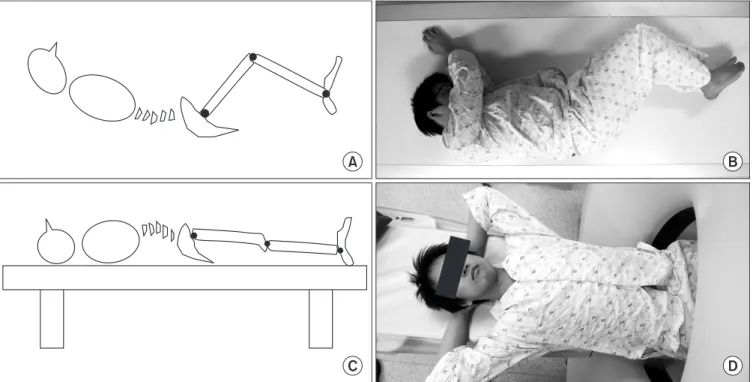
시상각은 척추 골절의 안정성을 판단하는 데 중요한 지표로 사 용되는데 본 연구에서는 단순 촬영과 3차원 CT 간에 평균 후만 4.9o의 차이를 보였다. 이를 설명할 수 있는 원인으로 각각의 촬영 법에 따른 환자의 자세를 들 수 있는데, 단순 촬영 시에는 환자는 측와위로 위치하게 되고 고관절은 약 60o, 슬관절은 약 50o 굴곡하 게 된다. 따라서 인체의 후방에 위치하는 척추에는 후만력이 작 용하게 되고 후만각이 더욱 증가될 수 있다고 생각한다(Fig. 5A, 5B). 이에 반해 3차원 CT 촬영 시 환자는 앙와위로 있게 되며 이 에 따라 척추에는 전만력이 작용하게 되고 시상각의 전만도가 증 가하게 된다(Fig. 5C, 5D). 또한 외상 환자가 응급실에 도착하게 되면 먼저 단순 촬영을 하게 되고 이후 일정 시간이 지난 뒤에 전 산화단층촬영을 시행하게 된다. 따라서 단순 촬영 이후로 환자는 Figure 4. Discrepancy between plain radiograph and 3D CT in AP wedge
ratio. AP wedge ratio of plain radiograph is lower than 3D CT (p<0.001).
CT, computed tomography; AP, anterior-posterior.
상당한 시간 동안 앙와위로 있게 되며 그에 따라 전만력이 더 오 래 작용한 후에 영상을 얻게 되므로 골절부의 자연적인 전만정복 이 일어난 뒤 촬영했기 때문이라고도 추측할 수 있다.
최초 단순 촬영에서의 시상각이 전만인 군, 후만 0o-17o인 군과 후만 17o 이상인 군으로 나누어 비교한 결과 수상 당시 최초의 후 만 변형이 클수록, 즉 압박골절이 심할수록 그 차이가 더 큼을 관 찰하였는데, 심하게 압박된 추체일수록 이후 자세변경 및 시간에 따라 골절의 정복이 더 많이 얻어지기 때문으로 추정한다.
전후 설상비로 표현되는 전방 척추체 높이와 후방 척추체 높이 의 측정차는 시상각과 마찬가지로 단순 촬영에서 더 크게 측정되 었다. 전만군은 단순 촬영과 3차원 CT 간에 차이를 보이지 않고 있으나, 후만 0o-17o인 군과 17o 이상인 군에는 단순 촬영과 3차원 CT 간에 유의한 차이를 보이고 있다. 이 또한 앞서 기술한 바와 같이 촬영 시 환자의 자세 및 그 지속시간의 영향을 받아 계측차 가 발생하리라 생각한다. 또한 단순 촬영은 추체의 모든 평면의 형태가 겹쳐져 한 면에 이차원 영상으로 얻어지므로 최소치와 최 대치가 부각되나 3차원 CT는 각 단면을 따로 봐야 한다는 차이가 있어 두 방법에 의해 얻어지는 영상의 해석에 있어 주의를 요한 다.
종합하여 보면 단순 촬영은 3차원 CT에 비해 척추 골절의 치료 방침을 정하는 데 필요한 지표가 더 과장되게 측정되나 어느 것 이 실제에 가까운 것이지 모르므로 그 차이를 미리 유념하고 지 표값을 해석해야 하며, 수술여부 등 치료계획 수립 시에는 단순 방사선 계측치만으로 결정하지 말고 단순 촬영과 전산화단층촬 영을 포함, 여러 요소를 종합한 판단이 필요할 것이다.
향후 실제 환자의 척추체 형태와 이 두 검사 중 어느 것이 더 정 확한지를 판단하기 위한 진실값은 사체연구 등을 통해 확인해봐 야 할 것이다.
결 론
척추골절 환자의 시상면 형태의 계측에 있어서 두 지표상 단순 촬영과 3차원 CT 간에 유의한 차이가 관찰되었으며, 3차원 CT에 비해 단순 촬영에서 후만 변형이 더 심한 것으로 측정되는 양상 을 관찰할 수 있었다.
참고문헌
1. Tadmor R, Davis KR, Roberson GH, New PF, Taveras JM.
Computed tomographic evaluation of traumatic spinal inju- ries. Radiology. 1978;127:825-7.
2. McAfee PC, Yuan HA, Fredrickson BE, Lubicky JP. Th e value of computed tomography in thoracolumbar fractures. An analysis of one hundred consecutive cases and a new classifi - cation. J Bone Joint Surg Am. 1983;65:461-73.
3. Shrout PE, Fleiss JL. Intraclass correlations: uses in assessing rater reliability. Psychol Bull. 1979;86:420-8.
4. Cobb JR. Th e problem of the primary curve. J Bone Joint Surg Am. 1960;42:1413-25.
5. Lucey BC, Stuhlfaut JW, Hochberg AR, Varghese JC, Soto JA.
Figure 5. Schematic illustrations and photographs of position when obtaining plain lateral radiography (A, B) and 3D computed tomography (C, D).
Evaluation of blunt abdominal trauma using PACS-based 2D and 3D MDCT reformations of the lumbar spine and pelvis.
AJR Am J Roentgenol. 2005;185:1435-40.
6. Ballock RT, Mackersie R, Abitbol JJ, Cervilla V, Resnick D, Garfi n SR. Can burst fractures be predicted from plain radio- graphs? J Bone Joint Surg Br. 1992;74:147-50.
7. Kim YM, Kim DS, Choi ES, et al. Bone & soft tissue injuries diagnosed by magnetic resonance imaging in thoracolumbar fractures. J Korean Fract Soc. 2004;17:184-90.
8. Berry GE, Adams S, Harris MB, et al. Are plain radiographs of the spine necessary during evaluation aft er blunt trauma? Ac- curacy of screening torso computed tomography in thoracic/
lumbar spine fracture diagnosis. J Trauma. 2005;59:1410-3.
9. Diaz JJ Jr, Cullinane DC, Altman DT, et al; EAST Practice Management Guideline Committee. Practice management guidelines for the screening of thoracolumbar spine fracture. J Trauma. 2007;63:709-18.
10. Epstein O, Ludwig S, Gelb D, Poelstra K, O'Brien J. Com- parison of computed tomography and plain radiography in assessing traumatic spinal deformity. J Spinal Disord Tech.
2009;22:197-201.
11. Street J, Lenehan B, Albietz J, Bishop P, Dvorak M, Fisher C;
Spine Trauma Study Group. Intraobserver and interobserver reliabilty of measures of kyphosis in thoracolumbar fractures.
Spine J. 2009;9:464-9.
12. Di Chiro G, Schellinger D. Computed tomography of spinal cord after lumbar intrathecal introduction of metrizamide (computer-assisted myelography). Radiology. 1976;120:101-4.
13. Brant-Zawadzki M, Miller EM, Federle MP. CT in the evalua- tion of spine trauma. AJR Am J Roentgenol. 1981;136:369-75.
14. Roub LW, Drayer BP. Spinal computed tomography: limita- tions and applications. AJR Am J Roentgenol. 1979;133:267- 73.
15. Willén J, Lindahl S, Irstam L, Nordwall A. Unstable thoraco- lumbar fractures. A study by CT and conventional roentgen- ology of the reduction eff ect of Harrington instrumentation.
Spine (Phila Pa 1976). 1984;9:214-9.
16. Chance GQ. Note on a type of fl exion fracture of the spine. Br J Radiol. 1948;21:452.
17. Handelberg F, Bellemans MA, Opdecam P, Casteleyn PP. Th e use of computerised tomographs in the diagnosis of thoraco- lumbar injury. J Bone Joint Surg Br. 1981;63:337-41.
18. Post MJ, Green BA, Quencer RM, Stokes NA, Callahan RA, Eismont FJ. The value of computed tomography in spinal trauma. Spine (Phila Pa 1976). 1982;7:417-31.
19. Hauser CJ, Visvikis G, Hinrichs C, et al. Prospective validation of computed tomographic screening of the thoracolumbar spine in trauma. J Trauma. 2003;55:228-34.
Measurement Discrepancy of Sagittal Parameters
between Plain Radiography and 3D Computed Tomography in Thoracolumbar and Lumbar Fractures
Dong-Soo Kim, M.D., Yong-Min Kim, M.D., Eui-Sung Choi, M.D., Hyun-Chul Shon, M.D., Kyoung-Jin Park, M.D., Byung-Ki Cho, M.D., Ji-Kang Park, M.D., and Hyun-Cheol Lee, M.D.
Department of Orthopedic Surgery, Chungbuk National University College of Medicine, Cheongju, Korea
Purpose: For decision making in the management of vertebral fractures such as operation or not, sagittal parameters like Cobb angle
and wedge compression ratio are important. Plain radiography had been the only image tool for measuring such parameters until 3D computed tomography (CT) became popular recently. In this study, we investigated the measurement discrepancy between plain radiography and 3D CT.Materials and Methods: Plain radiography and 3D CT of 45 thoracolumbar and lumbar fracture patients (male=21, female=24) were
evaluated. We measured sagittal angle and vertebral height on lateral radiography and sagittal CT. Sagittal angle was measured between the upper body and lower body of fractured vertebrae. Anterior and posterior heights were measured to assess anterior- posterior (AP) wedge ratio.Results: The sagittal angle of plain radiography (13.1±14.3
o) was signifi cantly larger than that of 3D CT (8.2±13.0o) by 4.9o (p<0.001).AP wedge ratio of plain radiography was on average 65±17%, which was signifi cantly lower than the 3D CT (73±17%) by 8% (p<0.001).
The severer the initial kyphotic deformity, the more discrepancy of results between the two methods was observed.
Conclusion: Signifi cant discrepancy was observed in sagittal features of fractured vertebra between plain radiography and 3D CT.
Measured values of plain radiography showed more kyphotic features of the fractured body.
Key words: thoracolumbar and lumbar fracture, plain radiography, 3D CT, sagittal angle, AP wedge ratio
Received October 1, 2011 Revised November 29, 2011 Accepted January 18, 2012 Correspondence to: Yong-Min Kim, M.D.
Department of Orthopedic Surgery, Chungbuk National University Hospital, 410, Seongbong-ro, Heungdeok-gu, Cheongju 361-711, Korea