- 52 -
Effect of Macrolides on the Interleukin-1β-mediated MUC2/5AC Genes Expression and Mucin Secretion
in Human Airway Epithelial Cells
Yong-Dae Kim, M.D., Jung Suck Cho, M.D., Hak Soo Kim, M.D. and Si -Youn Song, M.D.
ABSTRACT
Background and Objectives:Macrolide is a relatively effective drug in chronic bronchiolitis and chronic sinusitis with mucous hypersecretion. However, the anti-secretory effect of macrolide is not clear. The aim of this study was to evaluate the effect of macrolide on the interleukin -1β (IL-1β)-induced MUC2/5AC genes expression and mucin secretion. Matrials and Methods:We observed effects of roxithromycin and clarithromycin on the IL-1β-induced MUC2/5AC genes expression and mucin secretion in cultured human airway NCI-H292 epithelial cells. The steady state mRNA levels of MUC2/5AC and mucin secretion were determined by reverse transcriptase-polymerase chain reaction (RT-PCR) and enzyme-linked immuno- sorbent assay. Results:Roxithromycin attenuated the IL-1β-mediated MUC2/5AC genes expression and mucin secretion.
When roxithromycin treated before exposure to IL-1β and after exposure to IL-1β in cultured cells, both treatment methods inhibited the IL-1β-induced MUC2/5AC genes expression and mucin secretion. However, clarithromycin did not suppress the IL-1β-mediated MUC2/5AC genes expression and mucin secretion. Conclusion:This result suggests that roxithromycin inhibits the IL-1β-mediated mucin secretion through inhibition of MUC2/5AC genes expression.
KEY WORDS:MUC2・MUC5AC・Mucin・Roxithromycin ・Clarithromycin.
INTRODUCTION
In recent studies, it has been reported that low-dose, long-term macrolide (erythromycin, roxithromycin, and clarithromycin) therapy is effective treatment in chronic respiratory inflammatory diseases such as ch- ronic sinusitis or diffuse panbronchiolitis.1-3) Although macrolide is being used for the treatment and preven- tion of respiratory disorders, its precise mechanism of clinical effects is still uncertain. However, generally, the clinical effects of macrolide are antibiotic effect as well as anti-secretory and steroid sparing effects.4-6)
According to studies on the anti-secretory effect of macrolide, a long-term administration of macrolide inhi- bits respiratory tract secretion, increases the compliance of mucin, and change its liquidity characteristics of mucin.7)8) Also, macrolide decreases sputum and nasal secretion and in vitro erythromycin inhibits mucous secretion in the airway.9)
On the other hand, respiratory tract mucous secretion and its control is regulated by mucin genes. Among of identified mucin genes, the respiratory mucin genes are MUC2, 4, 5AC, 6, 7, 8. The most important respiratory mucin genes are MUC2 and MUC5AC.
Until now, many researchers concentrated the clinical effects and the rheologic charac teristic change of mucin after macrolide therapy. However, study of effects of macrolides on the expression of mucin genes and its mucin secretion is very rare.
In this study, we evaluated effects of roxithromycin and clarithromycin on the IL-1β-induced MUC2/5AC genes expression and mucin secretion in cultured hu- man airway NCI-H292 epithelial cells by using reverse Department of Otorhinolaryngology-Head and Neck Surgery,
College of Medicine, Yeungnam University, Daegu, Korea Address correspondences and reprint requests to Yong-Dae Kim, M.D., Department of Otorhinolaryngology, College of Medi- cine, Yeungnam University, 317-1 Daemyung-Dong, Nam-Gu, Daegu 705-717, Korea
Tel:82-53-620-3784, Fax:82-53-628-7884 E-mail: [email protected]
Accepted for publication on September 4, 2002
transcriptase-polymerase chain reaction (RT-PCR) and enzyme-linked immunosorbent assay.
MATERIAL AND METHOD Cell culture and management
Human pulmonary mucoepidermoid carcinoma cell line (NCI-H292 cells, American Type Culture Collec- tion, Rockville, MD) were cultured in RPMI 1640 medium (GibcoBRL, Grand Island, NY). NCI -H292 cells were seeded in a 6-well plate in a 1×10⁶ cell concentration and were cultured in RPMI 1640 medi- um supplemented with 2mM L-glutamine, 100 U/ml penicillin-streptomycin, and 10% fetal calf serum. Cells were grown at 37℃ in 95% O2 and 5% CO2 fully humidified. When the cultured cells were confluent, the cells incubated in RPMI 1640 medium containing 0.5% fetal calf serum for 24 hours. The cells were then rinsed with serum-free RPMI 1640 medium and ex- posed to the 2 ng/ml of IL-1β (R&D Systems, Min- neapolis, MN) for 8 hours. To observe the effects of macrolide, clarithromycin (Abbott Korea LTD., Seoul, Korea) or roxithromycin (HANDOK Pharmaceuticals Co., LTD., Seoul, Korea) was administered in a 20 μM concentration and cultured for 3 and 5 hours after added 2 ng/ml of IL-1β into cultured cells. Also, to evaluate the preventive effects of macrolide, the NCI- H292 cells were cultured in standard medium with clarithromycin (20 μM) or roxithromycin (20 μM) since cells were seeded. In the case of controls, the cells were incubated with medium alone for the same time.
IL-1β was dissolved with phosphate buffered so- lution (PBS) containing 0.1% bovine serum albumin and the concentration of ethanol and other transport solvents were maintained below 0.1%.
Analysis of MUC2/5AC genes using RT-PCR
The NCI-H292 cells were cultured, harvested, and subsequently washed three times with PBS containing 2% bovine serum albumin. Total RNA was extracted by Tri-Reagent (Molecular Research Center, Cincinnati, OH), and a modified RT-PCR technique was used to determine the mRNA level of MUC2/5AC. Briefly, total RNA was reversely transcripted into its cDNA
using random hexanucleotide primer and Moloney murine leukemia virus (MMLV) reverse transcriptase (Perkin Elmer, Morrisville, NC). The oligonucleotide primer for PCR was designed according to the publi- shed sequence for human MUC2 (Genbank accession No. L21998, 5′-TGC CTC GCC CTG TCT TTG for sense and 3′-CAG CTC CAG CAT GAG TGC for antisense) and human MUC5AC (Genbank accession No. L21998, 5′-ATC ACC GAA GGC TGC TTC TGT C for sense and 3′-GTT GAT GCT GCA CAC TGT CCA G for antisense). The PCR condition of MUC2 and MUC5AC was early heating at 95℃ for 3 minutes followed by denaturation at 95℃/1 min., 60℃
/1 min., 72℃/1 min., each carried out 30 and 28 cycles and extension at 72℃ for 20 minutes. Oligonucleotide primer for β2M were used as a positive control. The primer base order for β2M was 5′-CTC GCG CTA CTC TCT CTT TCT GG for sense and 3′-GCT TAC ATG TCT CGA TCC CAC TTA A for antisense. The products of PCR were separated by electrophoresis th- rough a 1% agarose gel in a 1% Tris-boric acid EDTA buffering solution containing 50 ng/ml ethidium bromide.
The degree of band was analyzed by a densitometry.
Analysis of MUC2/5AC mucin using immuno- assay
In order to measure the mucin content, protein from a specimen managed NCI-H292 cell was extracted and determined by a lysis buffer (50 mM Tris・Cl, pH7.5, 1 mM EGTA, 1% Triton X-100, and 1 mM phenylme- thylsulfonyl fluoride). MUC2 and MUC5AC mucin levels were determined by an enzyme-linked immuno- sorbent assay. Cell lysates were prepared in PBS at several dilutions, and each sample was incubated at 40℃ in a 96-well plate until dry. Plates were then washed three times with PBS, blocked with 2% bovine serum albumin for 1 hour at room temperature, washed again three times with PBS, and incubated with MUC2 antibody (1:100, Santa Cruz Biotechnology, Santa Cruz, CA) and MUC5AC antibody (1:1,000, Neo- Markers Inc., Fremont, CA) diluted with PBS contain- ing 0.05% Tween 20 for 1 hour. The wells were then washed three times with PBS, HRP-conjugated anti- rabbit IgG (1:10,000, Santa Cruz Biotechnology) was dispensed into each well, and after 4 hour, the plates were washed three times with PBS. Color was
developed using 3,3′,5,5′-tetramethylbenzidine peroxi- dase solution and stopped with 2N-H2SO4. Absorbance was read at 450 mm.
RESULT
Effect of macrolides on the IL-1β-mediated MUC2/5AC genes expression and mucin sec- retion
The NCI-H292 cells were cultured with 2 ng/ml of IL-1β for 8 hours at 37℃. Clarithromycin (20 μM) or roxithromycin (20 μM) was added here and the MUC2/5AC genes expression and mucin secretion after 3 and 5 hours were compared to the control cells.
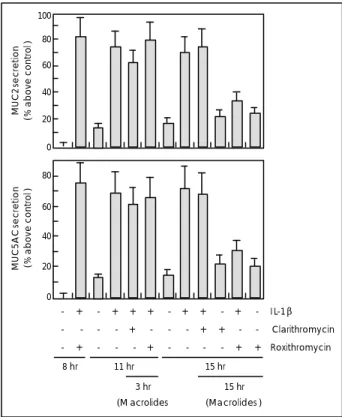
Roxithromycin and clarithromycin did not decrease on the IL-1β-mediated MUC2/5AC mRNA levels and mucin secretion compared to control cells in the case of 3 hours treatment of macrolides. However, the rema- rkable decrease of mRNA levels of MUC2/MUC5AC was observed in the cells treated with roxithromycin for 5 hours compared to the control cells. On the other hand, no noticeable change in the cells treated with clarithromycin for 5 hours. Mucin secretion showed the same characteristics as the genes expression (Fig.
1, 2).
Effects of pretreatment of macrolides
To observe the preventive effects of clarithromycin
and roxithromycin, NCI-H292 cells were cultured in standard medium with clarithromycin (20 μM) or roxithromycin (20 μM) since cells were seeded. And
MUC2 MUC5AC β2M I L-1β Clarithromycin Roxithromycin - + - + + + - + + - + -
- - - - + - - - + + - - - - - - - + - - - - + +
8 hr 11 hr 15 hr
3 hr (Macrolides)
15 hr (Macrolides)
Fig. 1. Effect of macrolides on the IL-1β-mediated MUC2/5AC genes expression. NCI-H292 cells were treated with 2 ng/ml of IL-1β for 8 hour and then treated with clarithromycin (20 μM) or roxithromycin (20 μM) for 3 and 5 hour. Control cultures were sham treated. The steady state mRNA levels of MUC2/
5AC and β2M were determined by RT -PCR. Clarithromycin and roxithromycin did not suppress the IL-1β-induced MUC2/5AC genes expression at 3 hour. Roxithromycin attenuated the IL-1 β-induced MUC2/5AC gene expression, but clarithromycin did not inhibit at 5 hour.
MUC2 MUC5AC
β2M
I L-1β Clarithromycin Roxithromycin - + + - + -
- - + + - - - - - - + +
Fig. 3. Preventive effect of macrolides on the IL-1β-mediated MUC2/5AC genes expression. NCI -H292 cells were cultured with clarithromycin (20 μM) or roxithromycin (20 μM) since see- ding state. When the cells were confluent state, cultured cells were treated with 2 ng/ml of IL-1β for 8 hour. Control cultures were sham-treated. The steady state mRNA levels of MUC2/
5AC and β2M were determined by RT -PCR. Roxithromycin attenuated the IL-1β-induced MUC2/5AC gene expression, but clarithromycin did not inhibit.
- + - + + + - + + - + - I L-1β - - - - + - - - + + - - Clarithromycin - + - - - + - - - - + + Roxithromycin
8 hr 11 hr 15 hr
3 hr (M acrolides
15 hr (Macrolides) 100
80 60 40 20 0 MUC2 secretion (% above control)
80 60 40 20 0 MUC5AC secretion (% above control)
Fig. 2. Effect of macrolides on the IL-1β-mediated MUC2/5AC mucin secretion. NCI-H292 cells were treated with 2 ng/ml of IL-1β for 8 hour and then treated with clarithromycin (20 μM) or roxithromycin (20 μM) for 3 and 5 hour. Control cultures were sham-treated. MUC2/5AC mucin secretion was measured by immunoassay analysis. Clarithromycin and roxithromycin did not suppress the IL-1β-induced MUC2/5AC mucin secretion at 3 hour. Roxithromycin attenuated the IL-1β-induced MUC2/
5AC mucin secretion, but clarithromycin did not inhibit at 5 hour. The data represent average value plus standard devia- tion of three independent experiments.
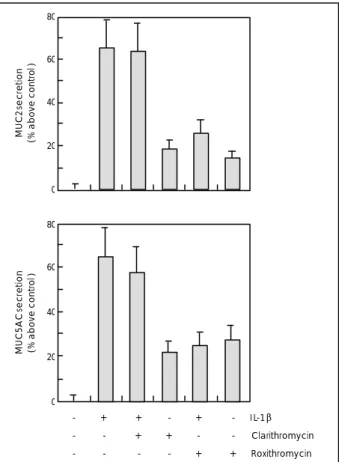
then IL-1β (2 ng/ml) was administered into the cells for 8 hours. The mRNA level of MUC2/5AC and mucin secretion were decreased in the cells treated with roxithromycin (Fig. 3). However, the cells trea- ted with clarithromycin showed no significant changes (Fig. 4).
DISCUSSION
In this study, roxithromycin, a new macrolide, inhi- bited the IL-1β-induced MUC2 and MUC5AC genes expression and mucin secretion in the cultured human airway NCI -H292 epithelial cells. The result was the same whether roxithromycin was treated before or after IL-1β. However, clarithromycin did not inhibit.
Based on several studies carried out between the la- te 1980s and early 1990s, it has been reported that symptoms of diffuse panbronchiolitis subsided after low-dose long-term erythromycin treatment and that neutrophil and leukotriene B4 decreased in bronchial secretion.10-13)
Thereafter, Lino et al.,14)15) reported that erythromy- cin inhibited the production of tumor necrosis factor- α (TNF-α) in sinobronchial syndrome. According to these results, administration of low-dose, long-term macrolide in inflammatory respiratory diseases influ- ences the regulation of inflammatory cells and cytokine or leukotriene, and therefore manifests its anti-inflam- matory effect.
Hashiba and Baba16) also reported that 71% of chronic sinusitis patients treated with clarithromycin for 12 weeks showed improvement. Suzuki et al.,17)18) reported that 20 chronic sinusitis patients treated with roxithromycin showed considerable improvement on a comparison between paranasal sinuses CT scans taken before and after treatment. On the other hand, it has been reported that IL-8, which plays an important role in eosinophil migration to the tissue, markedly decreased in chronic sinusitis patients treated with erythromycin or roxithromycin17) and that IL-8 secretion decreased by macrolide treatment in cultured nasal mucosa epit- helial cells.19) Therefore, based on these results, it can be concluded that macrolide inhibits cytokines such as IL-8 and manifests its anti-inflammatory effect.
Recently, Rubin et al.,20) reported that mucin se- cretion was inhibited in rhinitis patients and normal people with treatment of clarithromycin, however, its exact mechanism is still unknown. In addition, there are reports that clarithromycin decreases the amount of sputum7) and reduces the nasal mucosa viscosity.8) As such, there are studies based on the effect of macrolide on mucin secretion and its liquidity characteristics in chronic upper respiratory inflammatory diseases,7-9) however, the exact mechanism is still obscure and stu- dies on its effect on mucin genes and mucin secretion has still not been enforced.
In this study, we attempted to clarify the inhibitory mechanism of macrolide on mucin secretion in respi- ratory epithelial cells. We evaluated effects of roxi- thromycin and clarithromycin on the IL-1β-induced MUC2/5AC genes expression and mucin secretion in cultured human airway NCI -H292 epithelial cells.
- + + - + - I L-1β - - + + - - Clarithromycin - - - - + + Roxithromycin 80
60
40
20
0 MUC2 secretion (% above control)
80
60
40
20
0 MUC5AC secretion (% above control)
Fig. 4. Preventive effect of macrolides on the IL-1β-mediated MUC2/5AC mucin secretion. NCI-H292 cells were cultured with clarithromycin (20 μM) or roxithromycin (20 μM) since seed- ing state. When the cells were confluent state, cultured cells were treated with 2 ng/ml of IL-1β for 8 hour. Control cultures were sham-treated. MUC2/5AC mucin secretion was done by immunoassay analysis. The steady state mRNA levels of MUC2/
5AC and β2M were determined by RT -PCR. Roxithromycin attenuated the IL-1β-induced MUC2/5AC mucin secretion, but clarithromycin did not inhibit. The data represent average value plus standard deviation of three independent experi- ments.
It has been observed that roxithromycin inhibits the IL-1β-induced MUC2 and MUC5AC genes expression and mucin secretion and this effect was manifested both before and after administration of roxithromycin.
However, clarithromycin did not inhibit. It is consid- ered that macrolide decreases mucin secretion through directly inhibits the expression of mucin genes, however, the anti-secretory effect of macrolide may be slightly different according to its type.
CONCLUSION
Roxithromycin inhibits the IL-1β-induced MUC2/
5AC genes expression and mucin secretion in the human airway NCI-H292 epithelial cells. However, clarithromycin did not inhibits. This result suggests that roxithromycin inhibits IL-1β-mediated mucin secretion through directly down-regulation of MUC2/
5AC genes expression. In conclusion, the down-regu- lation of mucin genes expression by macrolide can be considered as one of inhibitory mechanisms of mucin secretions.
■Acknolwedgement
This thesis was supported by the 2001 Korean Rhi- nology Association Objective Project Research Funds.
REFERENCES
1) Keiichi I, Yuhichi S, Toshio I, Ryuzaburo H. Effect of new macrolide roxithromycin upon nasal polyps associated with chronic sinusitis.
Auris Nasus Larynx (Tokyo) 1996;23:48-56.
2) Nobuhiko K, Keiko N, Kazunori N, Teruhiro O, Yoshihiro N, Yu M. Clinical effect of low-dose, long-term roxithromycin chemothe- rapy in patients with chronic sinusitis. Acta Med Okayama 1997;
51:33-7.
3) Hideaki S, Katshuhisa I, Rikako H, Satoru G, Takeshi O, Masayuki F, et al. Progrnostic factors of chronic rhinosinusitis under long-term low-dose macrolide therapy. Otorhinolaryngol 2000;62:121-7.
4) Manabu N, Rubi P, Fusako S, Toshiaki Y. Effect of Roxithromycin on IL-8 synthesis and proliferation of nasal polyp fibroblasts. Acta Otolaryngol (Stockh) 1998;539 Suppl:71-5.
5) Hideaki S, Yukinori A, Katsuhisa I, Takeshi O, Tomonori T. Inhi- bitory effect of erythromycin on interleukin -8 secretion from exu-
dative cells in the nasal discharge of patients with chronic sinusitis.
Laryngoscope 1999;109:407-10.
6) Takechiyo Y, Shigeharu F, Shigehito M, Hideyuki Y, Hitochi S.
Macrolide treatment decreased the size of the nasal polyps and IL- 8 levels in nasal lavage. Am J Rhinol 2000;14:143-8.
7) Tamaoki J, Isono K, Sakai N, Kanemura T, Konno K. Erythro- mycin inhibits Cl secretion across canine tracheal epithelial cells.
Eur Respir J 1992;5:234-8.
8) Rhee CS, Yuichi M, Shinobu A, Jung HW, Jinn TH , Min YG, et al.
Effects of clarithromycin on rheological properties of nasal mucus in patients with chronic sinusitis. Ann Otol Rhinol Laryngol 2000;
109:484-7.
9) Satindra K, Shmuel K, Zvi M. Erythromycin inhibits respiratory glycoconjugate secretion from human airways in vitro . Am Rev Respir Dis 1990;141:72-8.
10) Kudoh S, Uetake T, Hirayama M, Kimura H. Therapy of sinobro- nchial syndrome, lo w-dose long-term chemotherapy of erythromycin in diffuse panbronchiolitis. J Jpn Bronchoesophagol Soc 1987;38:
193-6.
11) Kadota J, Sakako S, Kohno S, Sawa H, Mukae H, Oda H, et al. A mechanism of erythromycin treatment in patients with diffuse pan- bronchiolit is. Otolaryngol Jpn 1994;97:1070-8.
12) Oda H, Kadota S, Kohno S, Hara H. Erythromycin inhibits neutro- phil chemotaxis in bronchioaveoli of diffuse panbronchiolitis. Chest 1994;106:1116-23.
13) Oda H, Kadota J, Kohno S. Leukotriene B4 in bronchioalveolar la- vage fluid of patients with diffuse panbronchiolitis. Chest 1995;
108:116-22.
14) Iino Y, Toriyama M, Kudo K. Erythromycin inhibition of lipopolysa- ccharide stimulated tumor necrosis factor-α production by human monocytes in vitro. Ann Otol Rhinol Laryngol 1992;157(Suppl):
16-20.
15) Iino Y, Sugita K, Toriyama M. Erythromycin therapy for otitis media with effusion in sinobronchial syndrome. Arch Otolaryngol Head Neck Surg 1993;119:648-51.
16) Hashiba M, Baba S. Efficacy of long-term administration of clari- thromycin in the treatment of intractable chronic sinusitis. Acta Otolaryngol (Stockh) 1996;525(Suppl):73-8.
17) Suzuki H, Shimomura A, Ikeda K, Oshima T, Takasaka T. Effects of long-term low-dose macrolide administration on neutrophil re- cruitment and IL-8 in the nasal discharge of chronic sinusitis pa- tients. Tohoku J Exp Med 1997;182:115-24.
18) Suzuki H, Asada Y, Ikeda K, Oshima T, Takasaka T. Inhibitory effect of erythromycin on interleukin-8 secretion from exudative cells in the nasal discharge of patients with chronic sinusitis. La- ryngoscope 1999;109:407-9.
19) Suzuki H, Ikeda K, Honma R, Gotoh S, Oshima T, Furukawa M, et al. Prognostic factors of chronic rhinosinusitis under long-term low-dose macrolide therapy. ORL J Otorhinolaryngol Relat Spec 2000;62:121-7.
20) Rubin BK, Druce H, Oscar ER, Robert P. Effect of clarithromycin on nasal mucus properties in healthy subjects and in patients with purulent rhinitis. Am J Respir Crit Care Med 1997;155:2018-23.